

Utility System Change Control, Requalification, and Deficiencies
Changes, failures, and deficiencies can alter a GMP utility system’s quality, capacity, distribution, contamination controls, automation, monitoring, or ability to support its approved uses. Effective lifecycle control requires more than documenting the technical work. It requires evaluation of what changed, which requirements and users may be affected, whether previously generated qualification evidence remains applicable, and what verification is necessary before unrestricted operation resumes.
Requalification should be based on affected functions, risks, and evidence. It should not automatically repeat the original qualification, nor should it be omitted solely because a change was administratively classified as minor.
Purpose and Lifecycle Position
This article provides a common decision framework for:
- Planned utility-system changes
- Emergency changes
- Equipment and component failures
- Utility-quality excursions
- Temporary repairs and configurations
- Unapproved or undocumented changes
- Qualification deficiencies
- Aging and obsolescence
- Product-impact assessment
- Continued-use decisions
- Post-change verification
- Requalification-scope selection
- Closure and return to routine operation
The framework applies to pharmaceutical-water systems, clean steam, compressed air, process gases, and utility-supported CIP and SIP systems.
For the overall lifecycle framework, see Utility System Lifecycle, Monitoring, and Risk-Based Control. Utility classification and intended-use principles are addressed in Utility Systems in GMP Manufacturing.
Planned Changes, Failures, and Deficiencies
Planned changes and unplanned events enter the control process differently, but both require assessment against the utility’s approved requirements and uses.
Planned Change
A planned change is evaluated and approved before implementation whenever practical. Examples include:
- Equipment replacement
- Distribution modification
- Capacity expansion
- Instrument replacement
- Software or configuration update
- Monitoring-plan revision
- New point of use
- Sanitization-cycle modification
- Material change
- Preventive-maintenance revision
Emergency Change
An emergency change is implemented under an approved expedited process when delay could create an unacceptable risk to personnel, product, the environment, equipment, or business continuity.
Emergency status should not eliminate:
- Authorization
- Configuration control
- Documentation of work performed
- Immediate risk controls
- Product-impact assessment
- Retrospective technical and quality review
- Post-change verification
- Permanent-change or restoration decisions
Poor planning or production pressure does not convert an ordinary change into an emergency.
Failure or Excursion
A failure begins with an unplanned loss or degradation of required performance. Examples include:
- Loss of flow, pressure, temperature, or capacity
- Utility-quality failure
- Microbial or endotoxin excursion
- Compressor, pump, heater, dryer, or treatment-stage failure
- Membrane or filter-integrity failure
- Control-system malfunction
- Alarm failure
- Instrument drift
- Utility interruption
- Data loss
- Inadequate sanitization
- Cross-connection or backflow event
The failure should initially be managed through the applicable deviation, alarm, excursion, or investigation process. If correction requires modification of the approved system or control strategy, change control is also required.
Deficiency
A deficiency is a condition in which a requirement, control, record, or qualification element is absent, inadequate, obsolete, or no longer representative.
Examples include:
- Unverified system boundary
- Missing material certificate
- Incorrect as-built drawing
- Inadequately justified sampling location
- Unchallenged alarm
- Incomplete requirements traceability
- Unsupported software
- Repeated temporary repair
- Qualification that does not represent the current configuration
- Monitoring that cannot detect an important failure mode
A deficiency may be discovered during qualification, routine operation, an investigation, audit, inspection, periodic review, or change assessment.
Utility Change Categories
Change categorization supports routing and governance, but the category does not determine verification scope by itself.
| Change category | Utility examples | Principal assessment concerns |
|---|---|---|
| Source or generation | New water source, compressor, steam generator, gas supply | Utility identity, quality, capacity, variability, new contaminants |
| Treatment | Membrane, softener, dryer, filter, UV unit, resin, separator | Removal capability, microbial control, pressure drop, operating parameters |
| Storage and distribution | Tank, pump, piping, valve, branch, slope, insulation | Drainability, stagnation, flow, pressure, contamination, affected users |
| Point of use | New outlet, valve, regulator, trap, hose, final filter | Delivered quality, user interface, cleaning, sampling, replacement control |
| Material or surface | Piping alloy, gasket, seal, lubricant, coating, passivation | Compatibility, extractables, corrosion, cleanability, contamination |
| Capacity or operating range | Increased demand, new setpoint, reduced circulation, new schedule | Worst-case demand, recovery, distribution balance, system capability |
| Sanitization or sterilization | Temperature, time, chemistry, frequency, sequence | Cycle effectiveness, coverage, residues, recovery, control logic |
| Instrumentation | New sensor, range change, relocation, different technology | Accuracy, representativeness, calibration, alarm and control effects |
| Automation or data | Logic, recipe, alarm, historian, interface, access, software | Functional control, data integrity, cybersecurity, records, backup |
| Monitoring program | Location, method, frequency, limit, test method | Detection capability, trend continuity, regulatory or compendial basis |
| Maintenance | Task, interval, spare part, contractor, lubrication practice | Reliability, contamination, qualified configuration, post-work testing |
| Facility or user interface | New equipment, new process, building modification | Demand, pressure, quality, boundary, cross-connection, intended use |
| Administrative | Procedure, ownership, form, record retention | Whether the change is truly administrative or affects execution |
| Decommissioning | Removed branch, abandoned outlet, retired equipment | Isolation, dead legs, cross-connections, drawings, data retention |
Changes may affect several categories simultaneously. A new point of use, for example, may affect distribution hydraulics, sanitization, sampling, automation, drawings, maintenance, and qualification.
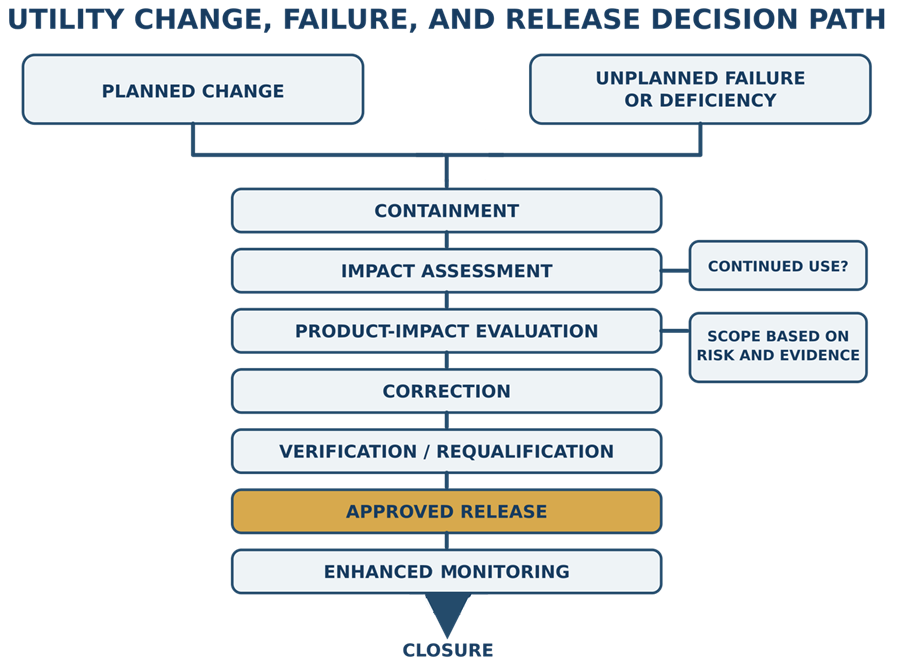
Initial Change or Event Triage
Initial triage should establish control before the complete assessment is performed.
The triage should determine:
- What changed or failed
- When the condition began
- Whether the event is continuing
- Which system section is affected
- Whether product or critical surfaces were exposed
- Whether affected utility users remain active
- Whether the approved configuration is known
- Whether reliable monitoring data are available
- Whether immediate shutdown or isolation is necessary
- Whether additional sampling or testing is required
- Whether potentially affected material must be placed on hold
- Whether continued use requires formal authorization
- Whether deviation, investigation, CAPA, or change control records are required
Immediate containment may include:
- Isolating an affected branch or point of use
- Suspending utility use
- Placing product or equipment on hold
- Switching to a qualified backup supply
- Increasing monitoring
- Installing a controlled temporary configuration
- Flushing, purging, sanitizing, or sterilizing
- Restricting use to defined applications
- Preserving electronic and physical evidence
Containment controls should not be mistaken for permanent corrective action.
Change-Impact Assessment
The assessment should compare the proposed or actual condition with the approved configuration and intended use.
Required Assessment Inputs
Relevant inputs may include:
- Approved user requirements
- System-impact classification
- Risk assessment
- Current system boundary
- Approved drawings
- Equipment and instrument lists
- Materials of construction
- Automation and configuration baseline
- Qualification records
- Monitoring and trend data
- Maintenance and calibration history
- Previous changes and investigations
- Supported equipment and processes
- Utility-use matrix
- Regulatory and compendial requirements
- Supplier information
- Current operating procedures
An assessment based only on the work-order description is normally inadequate.
Impact Questions
The assessment should determine whether the change or event affects:
- Intended utility use
- Utility identity or quality
- Product-contact or critical-surface exposure
- Generation or treatment capability
- Storage or distribution
- Capacity or peak demand
- Pressure, flow, temperature, or recovery
- Drainability or stagnation
- Sanitization or sterilization
- Filtration
- Materials of construction
- Cross-connection or backflow prevention
- Sampling locations
- Monitoring methods or limits
- Instruments and calibration
- Alarms and interlocks
- Control logic
- Electronic records
- Data integrity
- Cybersecurity
- Backup and recovery
- Maintenance or spare parts
- Approved procedures
- Training
- Drawings and documentation
- Existing qualification evidence
- Supported equipment, processes, or products
The assessment should identify both direct and indirect effects. Replacing a distribution pump may directly affect flow and pressure but may also alter return temperature, sanitization coverage, alarm behavior, and performance at remote points of use.
Risk Evaluation
Risk evaluation should connect the changed condition to credible failure modes and affected uses.
Factors include:
- Severity of the potential product-quality effect
- Probability that the failure could occur
- Ability to detect the failure before utility use
- Ability to detect it before product release
- Duration of the affected condition
- Number and criticality of affected users
- Whether the condition is localized or system-wide
- Whether contamination can spread or persist
- Whether a downstream barrier remains effective
- Whether the utility directly contacts product
- Reliability and completeness of historical data
- Reversibility of the change
- Familiarity with the replacement technology
- Similarity to the previously qualified configuration
- Uncertainty remaining after assessment
A low calculated risk score should not overrule a credible high-severity failure. Uncertainty should increase the required evidence, not be silently treated as evidence of low risk.
See Risk-Based Approach to Validation for the broader risk-control framework.
Product-Impact Assessment
Product-impact assessment determines whether product, components, equipment, or critical surfaces were exposed to a potentially unacceptable utility condition.
It should be performed when:
- Utility quality failed or may have failed
- The start time of a failure is uncertain
- An instrument was found out of tolerance
- Monitoring or alarm data are missing
- A contamination-control barrier failed
- The system operated outside its qualified range
- An unapproved change was discovered
- Maintenance may have introduced contamination
- A temporary repair affected utility delivery
- Previously accepted qualification evidence is found deficient
Assessment Inputs
The assessment should consider:
- Failure mechanism
- Earliest credible start time
- Duration
- Affected system sections and points of use
- Products, lots, processes, and equipment exposed
- Utility function in each affected use
- Direct or indirect product contact
- Exposure quantity and duration
- Process stage
- Downstream processing or removal capability
- Sterilization or filtration barriers
- Cleaning status
- Product and process specifications
- Utility sampling and online data
- Alarm and maintenance records
- Organism identification, where relevant
- Confirmatory testing
- Retain-sample or product-test results
- Scientific uncertainty
A subsequent acceptable utility sample does not by itself establish that the utility was acceptable throughout the earlier exposure period.
Likewise, a utility excursion does not automatically require product rejection. The disposition must follow the evidence, exposure pathway, process controls, and uncertainty.
Where applicable, 21 CFR 211.192 requires a thorough investigation of unexplained discrepancies and failures of a batch or its components to meet specifications, including conclusions and follow-up.
Possible Product Decisions
The documented conclusion may support:
- No product impact
- Additional product or utility testing
- Extended hold
- Restricted processing
- Reprocessing evaluation
- Batch rejection
- Field-impact assessment
- Expanded investigation
- Inability to reach a definitive conclusion
The assessment should state its limitations. “No confirmed impact” is not equivalent to “no possible impact.”
Continued-Use Decisions
Continued use may be considered when the utility cannot be immediately restored to its fully approved condition but available controls can maintain an acceptable level of risk.
The decision should define:
- Exact affected condition
- Permitted uses
- Prohibited uses
- Physical or procedural restrictions
- Additional monitoring
- Temporary alarm limits
- Sampling requirements
- Product-hold requirements
- Responsible decision-makers
- Maximum duration
- Required repair or permanent change
- Reassessment frequency
- Conditions requiring immediate shutdown
- Closure or expiration criteria
Continued use may be justified when:
- The affected function is not required for the permitted use.
- A qualified redundant system is operating.
- The condition is isolated from GMP users.
- An effective downstream control is verified.
- Increased monitoring can reliably detect deterioration.
- A technically equivalent temporary replacement is controlled and verified.
Continued use is generally not justified when:
- Utility quality cannot be established.
- The affected boundary is unknown.
- Critical data are unreliable or unavailable.
- Contamination can spread through the system.
- A required alarm or protective function is unavailable without an effective alternative.
- Product exposure cannot be bounded.
- Temporary measures cannot be consistently executed.
- The condition has persisted beyond its approved duration.
A continued-use authorization should not become an indefinite substitute for correction.
Temporary Changes and Repairs
Temporary configurations require the same technical discipline as permanent changes.
Examples include:
- Temporary piping
- Rental equipment
- Bypass arrangements
- Temporary filters or regulators
- Portable monitoring instruments
- Manual control replacing automatic control
- Disabled alarm with compensating surveillance
- Temporary sampling location
- Provisional software configuration
- Alternate utility source
Controls should address:
- Defined purpose
- Approved configuration
- Materials and compatibility
- Installation verification
- Contamination controls
- Identification and labeling
- Operating instructions
- Monitoring
- Training
- Expiration date
- Periodic reassessment
- Restoration or conversion to permanent status
- Final removal verification
Repeated extensions indicate that the temporary-change process is being used to avoid permanent resolution.
Emergency Changes
An emergency-change procedure should define:
- Who may authorize implementation
- Minimum information required before work begins
- Immediate risk controls
- Required contemporaneous records
- Identification of installed parts or configuration
- Product and operational restrictions
- Required testing before use
- Time allowed for retrospective review
- Requirements for quality-unit approval
- Conversion to permanent change or restoration
- Investigation and CAPA expectations
The retrospective assessment should confirm whether:
- The emergency designation was justified.
- The installed configuration is fully known.
- Approved materials and parts were used.
- Required testing was completed.
- Product impact was evaluated.
- Documentation and drawings were updated.
- Additional qualification is required.
- The change should remain, be modified, or be reversed.
Post-Change Verification
Post-change verification demonstrates that the work was correctly implemented and that affected requirements remain satisfied.
The selected activities may include:
- Installation inspection
- Component and material verification
- Drawing walkdown
- Weld or fabrication-record review
- Leak or pressure testing
- Flushing or purging
- Cleaning
- Passivation
- Sanitization or sterilization
- Calibration
- Loop checks
- Functional testing
- Alarm and interlock testing
- Automation or recipe verification
- Access and audit-trail testing
- Interface testing
- Backup and recovery testing
- Capacity testing
- Flow or pressure balancing
- Utility-quality testing
- Point-of-use sampling
- Performance trending
- Supported-equipment verification
- Process-specific confirmation
Post-change verification should establish:
- The approved work was implemented.
- Unintended modifications did not occur.
- Affected functions operate correctly.
- Utility quality remains acceptable.
- Monitoring and alarms remain effective.
- Documentation represents the final configuration.
- The system is suitable for release.
A successful maintenance check is not automatically sufficient qualification evidence. Conversely, not every change requires a formal IQ/OQ/PQ protocol. The evidence format should match the risk, procedural controls, and complexity of the verification.
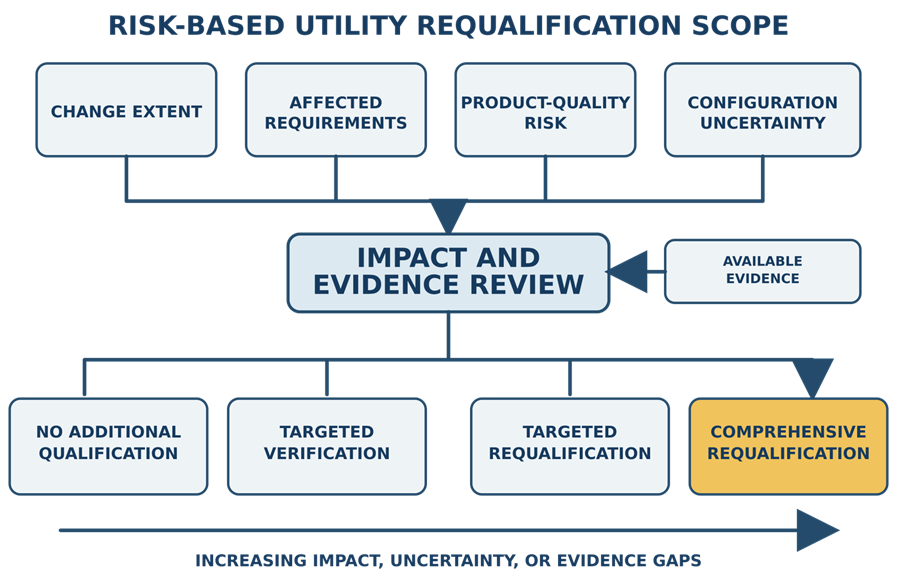
Requalification-Scope Decision
Requalification evaluates whether changed or affected elements continue to meet approved requirements. The scope should be derived from impact assessment and risk, not from labels alone.
No Additional Requalification
No formal requalification may be justified when:
- The activity restores the same approved configuration.
- Replacement is technically equivalent.
- No critical function, material, parameter, or control changes.
- Approved maintenance and post-maintenance checks fully address the intervention.
- Existing qualification evidence remains representative.
- Required verification is completed under controlled procedures.
The rationale and supporting records should still be documented.
Targeted Verification
Targeted verification may be appropriate when:
- The effect is limited and well bounded.
- Only specific installation or functional requirements are affected.
- The failure mode is detectable through focused testing.
- Other system functions remain unchanged.
- Existing qualification evidence remains applicable outside the affected boundary.
Examples include:
- Verifying a replaced instrument
- Testing a modified alarm
- Sampling an affected branch
- Challenging an updated control sequence
- Confirming operation of a replacement pump
Targeted Requalification
Targeted requalification is appropriate when formal qualification evidence is needed for affected requirements, functions, or operating conditions.
Examples include:
- A new point of use
- A changed treatment component
- A modified sanitization sequence
- New control logic
- Changed operating range
- Distribution modification
- Capacity increase
- Replacement with different technology
Comprehensive Requalification
Comprehensive requalification may be required when:
- The system has been substantially redesigned.
- Multiple critical subsystems are affected.
- System boundaries have materially changed.
- Previous qualification is obsolete or deficient.
- The system was out of control for an extended or unknown period.
- Contamination may have spread throughout the system.
- The cumulative effect of multiple changes is uncertain.
- Long shutdown or inadequate preservation challenges the entire system.
- Evidence cannot reliably distinguish affected from unaffected functions.
Comprehensive does not necessarily mean literal repetition of every historical test. The protocol should still reflect current requirements, design, risks, methods, and acceptance criteria.
Requalification-Scope Matrix
| Change or condition | Installation evidence | Functional testing | Performance verification | Typical decision |
|---|---|---|---|---|
| Equivalent component replacement | Focused | As affected | Usually limited | Maintenance verification or targeted qualification |
| Instrument replacement, same range and technology | Focused | Calibration and loop check | Normally unnecessary unless measurement is suspect | Targeted verification |
| Instrument relocation or technology change | Required | Required | May be required | Targeted requalification |
| New point of use | Required | Flow, pressure, valve, alarm as applicable | Quality and representative-use testing | Targeted requalification |
| Distribution piping modification | Required | Hydraulic and control functions | Quality, sanitization, and affected-user testing | Targeted or broader requalification |
| Treatment-stage change | Required | Required | Required under representative conditions | Targeted or comprehensive requalification |
| Capacity increase | As affected | Capacity and control challenges | Peak-demand performance | Targeted requalification |
| Sanitization-cycle change | As affected | Sequence, alarms, interlocks | Cycle effectiveness and recovery | Targeted requalification |
| Automation logic change | Configuration evidence | Functional and failure testing | Required if physical performance may change | Targeted requalification |
| Extended uncontrolled shutdown | Condition assessment | Restart functions | Quality and recovery performance | Targeted or comprehensive requalification |
| System-wide contamination event | Investigation-dependent | Recovery functions | Extensive quality verification | Usually broad requalification |
| Documentation-only correction | Document verification | None unless physical discrepancy exists | None | No requalification |
| Unknown or cumulative configuration changes | Comprehensive baseline review | Broad | Broad | Comprehensive requalification may be necessary |
This matrix provides typical directions, not automatic outcomes.
Return-to-Service and Release
Return to service should be a documented decision, not an assumed consequence of completing the physical work.
Release prerequisites may include:
- Approved change or deviation records
- Completed installation
- Verified final configuration
- Accepted materials and parts
- Completed cleaning, flushing, purging, or sanitization
- Current calibration status
- Completed post-change tests
- Approved qualification results
- Resolved critical deviations
- Product-impact assessment
- Updated drawings
- Updated equipment and instrument records
- Updated automation baseline
- Approved procedures
- Completed training
- Updated maintenance and calibration tasks
- Established monitoring requirements
- Defined enhanced-monitoring period
- Quality-unit approval where required
Conditional release should identify:
- Open items
- Risk justification
- Interim controls
- Responsible owner
- Due date
- Escalation conditions
- Final closure requirements
Release of the utility and disposition of potentially affected product are related but distinct decisions.
Enhanced Monitoring Following Change or Recovery
Some changes require an enhanced-monitoring period to demonstrate sustained performance after initial verification.
Enhanced monitoring may include:
- Increased sampling frequency
- Additional sampling locations
- Continuous parameter review
- Increased alarm review
- Shortened trend-review intervals
- Additional microbial identification
- Capacity monitoring during peak demand
- Review of sanitization recovery
- Monitoring after maintenance cycles
- Comparison with pre-change performance
The plan should define:
- Attributes and parameters
- Locations
- Frequency
- Duration
- Acceptance criteria
- Alert and escalation requirements
- Responsible reviewers
- Exit criteria
Enhanced monitoring should not be used to compensate indefinitely for incomplete qualification or an unresolved design deficiency.
Change Closure
A change should be closed only when implementation and lifecycle integration are complete.
Closure should confirm:
- Approved scope was implemented.
- Deviations were resolved.
- Final configuration was verified.
- Required qualification was approved.
- Product impact was addressed.
- Required documents were revised.
- Procedures and training are current.
- Maintenance and calibration records are updated.
- Monitoring changes are active.
- Temporary controls were removed or formally retained.
- Open commitments have owners and due dates.
- Residual risk is acceptable.
- The utility has been released for defined uses.
Administrative closure before these conditions are met weakens the configuration baseline and obscures outstanding risk.
Periodic Review of Utility Changes
Periodic review should examine changes collectively, not only as isolated records.
Review inputs should include:
- Number and type of changes
- Emergency changes
- Temporary changes and extensions
- Repeated component replacements
- Recurring failures
- Overdue change actions
- Post-change deviations
- Qualification exceptions
- Enhanced-monitoring results
- Unapproved configuration changes
- Drawing discrepancies
- Software and alarm changes
- Repeated continued-use authorizations
- Obsolescence and vendor-support status
- Cumulative effects on the original design and qualification
Several individually acceptable changes may cumulatively alter capacity, hydraulics, contamination controls, automation, maintenance burden, or system reliability. Periodic review should determine whether a consolidated risk assessment or broader requalification is required.
Common Utility-System Deficiencies
Change-Control Deficiencies
- Work begins before impact assessment and approval.
- The change description does not define the physical or functional difference.
- “Like-for-like” is asserted without comparing specifications.
- Emergency changes are not retrospectively reviewed.
- Temporary changes have no expiration or removal verification.
- Indirectly affected users are not identified.
- Cumulative change impact is not evaluated.
- Product impact is treated as part of engineering review only.
- Change records close before documents and procedures are updated.
Impact-Assessment Deficiencies
- Assessment relies only on the work order.
- System boundaries and points of use are not evaluated.
- Capacity, sanitization, automation, or data effects are overlooked.
- Risk scoring replaces technical reasoning.
- High-severity failures are dismissed because occurrence is considered low.
- Uncertainty is not documented.
- Assessments are copied from earlier changes without confirming applicability.
Product-Impact Deficiencies
- The affected time window is not established.
- Utility use by batch or equipment cannot be reconstructed.
- One acceptable resample is used to dismiss an earlier failure.
- Downstream controls are assumed without verification.
- Product exposure and equipment exposure are not distinguished.
- Data gaps are treated as evidence of acceptable operation.
- “No impact” conclusions lack scientific support.
Verification and Requalification Deficiencies
- No documented basis is provided for test selection.
- Requalification is automatically waived for a “minor” change.
- The complete original protocol is repeated without assessing affected functions.
- Testing demonstrates operation but not delivered utility quality.
- Testing occurs under favorable rather than representative conditions.
- Worst-case points or demand conditions are omitted.
- Acceptance criteria are written after execution.
- Existing qualification evidence is not checked against the final configuration.
- Enhanced monitoring has no duration or exit criteria.
Configuration and Documentation Deficiencies
- Drawings do not represent the installed system.
- Instrument, valve, filter, or point-of-use identifiers are inconsistent.
- Software versions and logic changes are not controlled.
- Alarm setpoints differ from approved records.
- Temporary piping or bypasses remain installed.
- Spare parts are not checked for equivalence.
- Supplier documentation is accepted without technical review.
- Maintenance records do not identify installed components.
Continued-Use Deficiencies
- Continued use has no expiration date.
- Restrictions are unclear to operators.
- Additional monitoring is not reviewed promptly.
- Temporary controls depend on unreliable manual action.
- Repeated extensions replace permanent correction.
- Shutdown criteria are not established.
- Approval does not include appropriate technical and quality functions
Regulatory and Technical Framework
US drug CGMP regulations do not prescribe a single change-control or requalification format for utility systems. The applicable requirements arise from control of procedures, equipment, automated systems, laboratory controls, investigations, and records under 21 CFR Part 211.
Under 21 CFR 211.100, production and process-control procedures, including changes, must be drafted, reviewed, and approved by appropriate organizational units and reviewed and approved by the quality control unit. Deviations from written procedures must be recorded and justified.
21 CFR 211.160 requires scientifically sound laboratory controls and requires deviations from laboratory specifications, standards, sampling plans, test procedures, or other laboratory-control mechanisms to be recorded and justified.
FDA’s Process Validation: General Principles and Practices places qualified facilities, utilities, and equipment within a lifecycle of continued process verification. This supports evaluation of whether utility changes or failures affect the evidence used to establish and maintain the controlled state.
Utility-specific compendial requirements, consensus standards, and industry guidance should be applied according to their actual scope and authority.
Summary
Utility change control should answer five questions:
- What changed, failed, or was found deficient?
- Which requirements, users, data, and products may be affected?
- Can the utility safely continue operating, and under what restrictions?
- What verification or requalification is necessary?
- What evidence supports release and closure?
The controlling sequence is:
Change or failure → containment → impact assessment → product-impact evaluation → correction → verification or requalification → release → monitoring → closure
Requalification should be comprehensive only when system-wide impact, uncertainty, or evidence gaps justify that scope. Limited changes require focused testing, but limited scope must be supported by a documented technical rationale.