
Clean Steam Systems for GMP Applications
Purpose and Scope
Clean steam is a controlled utility used where steam quality can affect product quality, product-contact surfaces, sterile processing, or a critical manufacturing environment. This article establishes the intended-use, quality, application, equipment-interface, and regulatory boundaries for clean steam in pharmaceutical and biopharmaceutical manufacturing.
The central question is not whether steam is present in a GMP facility. It is whether the steam, its condensate, or contaminants carried with it can reach a product, product-contact surface, sterilization pathway, or controlled air stream in a manner that could affect quality. That assessment determines whether plant steam is acceptable, clean steam is appropriate, or a compendial Pure Steam claim is required.
Clean steam should therefore be specified from the use backward. The application, contact pathway, failure modes, required steam quality, receiving-equipment needs, and lifecycle controls must be defined before selecting a generator or copying a site standard.
General utility classification principles are addressed in Utility Systems in GMP Manufacturing. Detailed engineering is addressed in Clean Steam System Design and Quality Attributes, while verification and continued control are addressed in Clean Steam System Qualification, Monitoring, and Requalification.
What Clean Steam Is
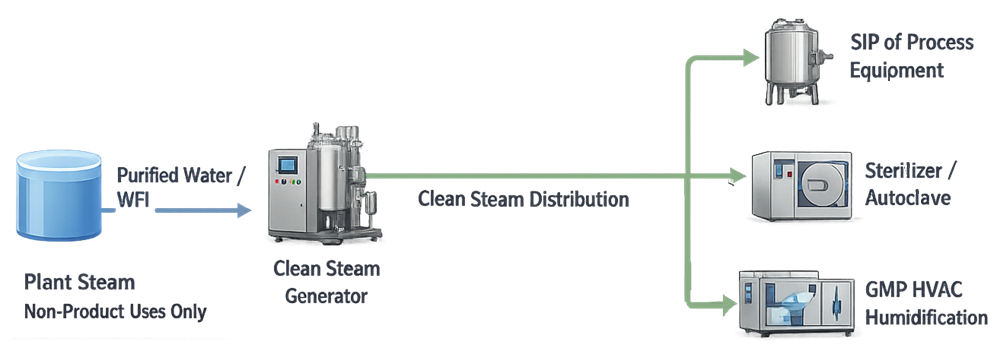
Clean steam is steam generated and distributed under controlled conditions so that the steam and resulting condensate are suitable for defined GMP uses. The term describes an engineered quality level and control strategy; it does not identify one universal pressure, temperature, feed-water grade, condensate specification, or distribution design.
The utility normally includes:
- An approved feed-water source
- A clean steam generator or other justified generation method
- Separation from heating media and plant-steam treatment chemicals
- Distribution piping, valves, traps, separators, vents, drains, and instruments
- Defined points of use
- Interfaces with sterilizers, process equipment, HVAC systems, or other GMP users
- Procedures and records that maintain the qualified state
Steam pressure and temperature confirm operating and thermodynamic conditions, but they do not by themselves demonstrate chemical purity, endotoxin control, or suitability for a sterilization application. Likewise, condensate that meets chemical specifications does not by itself demonstrate acceptable steam dryness, non-condensable-gas content, superheat, delivery capacity, or air removal.
Clean steam suitability is therefore multidimensional:
- Chemical suitability: control of dissolved, volatile, and entrained contaminants that may appear in condensate
- Endotoxin suitability: control appropriate to parenteral, sterile, or other endotoxin-sensitive applications
- Physical suitability: saturation, dryness, non-condensable gases, superheat, pressure, flow, and delivery stability as required by the use
- Microbial-control suitability: prevention of contamination during generation, shutdown, sampling, maintenance, and use, recognizing that steam itself is not evaluated as though it were a stored liquid-water system
- Interface suitability: compatibility with the receiving equipment, cycle, material, air system, or process pathway
Clean Steam, Pure Steam, and Plant Steam
These terms should not be used interchangeably.
| Term | Practical meaning | Typical control basis | Appropriate use |
|---|---|---|---|
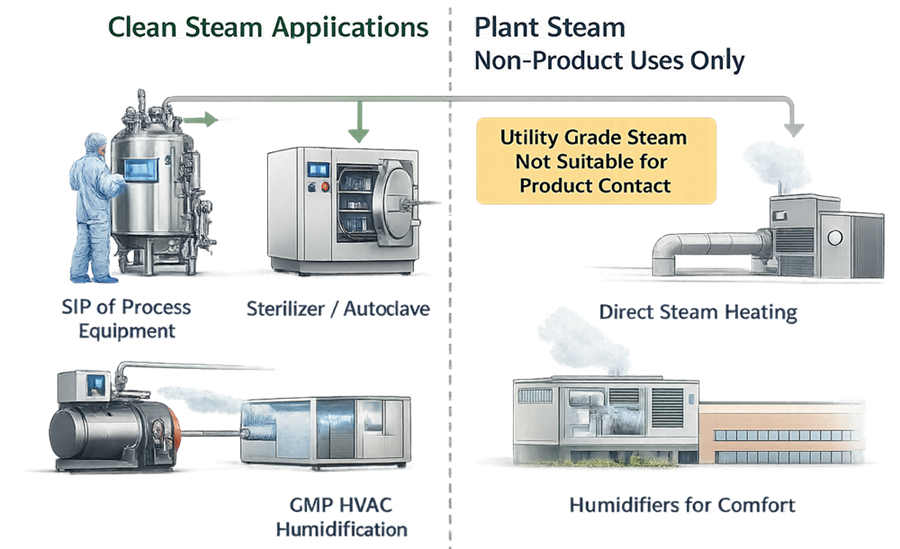
| Plant steam | General utility steam produced in a boiler system that may use feed-water treatment chemicals and conventional utility distribution | Boiler operation, energy performance, corrosion control, and safety requirements | Non-product-contact heating and mechanical services where a qualified barrier prevents quality impact |
| Clean steam | Site- or industry-defined steam generated and distributed to meet approved GMP requirements for specified applications | Intended-use specification covering condensate quality, physical steam quality, system design, interfaces, qualification, and monitoring | SIP, sterilizers, direct-contact processing, and selected critical humidification or other uses when justified |
| Pure Steam | A compendial designation governed by the applicable USP monograph when the material is represented or required as Pure Steam | Current compendial requirements plus site requirements needed for the application | Applications for which the compendial grade is specified by filing, procedure, product/process requirement, or site policy |
“Clean steam” is not automatically “Pure Steam.” A site may establish clean-steam specifications appropriate to its uses without representing the utility as compendial Pure Steam. Conversely, if a specification, filing, procedure, or label claims Pure Steam, the applicable compendial requirements become part of the acceptance basis.
Plant steam does not become clean steam merely because it passes through a final filter. Filtration does not remove dissolved boiler-treatment chemicals, volatile contaminants, entrained droplets, or all risks created by nonhygienic generation and distribution. Where plant steam is used across a heat exchanger or jacket, acceptability depends on the integrity and detectability of the barrier, pressure relationships, leak consequences, and the intended use of the receiving equipment.
Intended Use Defines the Requirement
The clean-steam requirement should begin with a documented intended-use statement for each application or user class. The statement should identify:
- Manufacturing area and equipment served
- Product, material, surface, or air pathway potentially exposed
- Direct, indirect, or no-contact relationship
- Whether steam condenses on a product-contact surface
- Whether condensate can remain, drain, or enter product
- Whether the steam supplies a validated sterilization process
- Required chemical, endotoxin, and physical attributes
- Required pressure, flow, capacity, and operating range at the point of use
- Startup, shutdown, drainage, and recovery conditions
- Boundary between the utility and receiving equipment
- Monitoring, sampling, alarm, and release expectations
- Applicable filing, compendial, regulatory, procedural, or customer commitments
The URS for GMP Facilities, Utilities, and Equipment should translate these needs into clear and testable utility and interface requirements.
An intended-use statement should be specific enough to prevent later reinterpretation. “Clean steam for manufacturing” is inadequate. A stronger statement would identify, for example, that the system supplies saturated steam to validated SIP cycles for aseptic product-contact vessels and transfer lines, with condensate requirements based on the product risk and physical steam requirements based on the validated cycle and equipment design.
Application-Selection Logic
A clean-steam decision should evaluate the actual contamination and process pathway rather than the name of the room or equipment.
Clean Steam Is Normally Appropriate When
- Steam directly contacts product or an in-process material.
- Steam condenses on a product-contact surface and the condensate may remain or reach product.
- Steam supplies an SIP process for product-contact equipment, piping, vessels, filters, or transfer pathways.
- Steam supplies a sterilizer or autoclave used for components, equipment parts, utensils, closures, porous loads, or other GMP materials whose condition can affect product quality.
- Steam is injected into a critical air stream and impurities could be deposited in a controlled area, on exposed product, or on critical surfaces.
- A product, process, regulatory submission, compendial requirement, or approved site standard specifically requires clean or Pure Steam.
Plant Steam May Be Appropriate When
- Steam is used only for comfort heating or non-GMP building services.
- Steam heats an HVAC coil without direct injection into the supply-air stream and leakage cannot introduce an unacceptable contaminant risk.
- Steam heats a vessel jacket or heat exchanger through an adequate barrier, with justified materials, pressure relationships, leak detection or inspection, maintenance, and impact assessment.
- Steam serves a non-product-contact process and neither steam nor condensate can reach product, product-contact surfaces, components, or critical air.
- The application has been assessed and documented as having no direct or credible indirect product-quality impact.
Additional Assessment Is Required When
- A barrier separates plant steam from a GMP fluid, but a tube, plate, coil, or jacket failure could create cross-contamination.
- A plant-steam branch is proposed for a washer, parts cleaner, thermal system, or other equipment with both GMP and non-GMP functions.
- Humidification is applied upstream of final filtration, downstream of final filtration, or into an area containing exposed product.
- Steam is used during cleaning but the final disposition of condensate and residues is unclear.
- A portable or temporary steam source is proposed.
- Clean steam and plant steam connections exist on the same equipment.
- The application changes from nonsterile to sterile, from closed to open processing, or from early-stage to downstream manufacturing.
The result may be plant steam, clean steam, Pure Steam, an independent barrier-control strategy, or redesign of the interface. Risk-based does not mean selecting the least controlled option; it means connecting the control level to a documented exposure pathway and consequence.
Steam-in-Place of Process Equipment
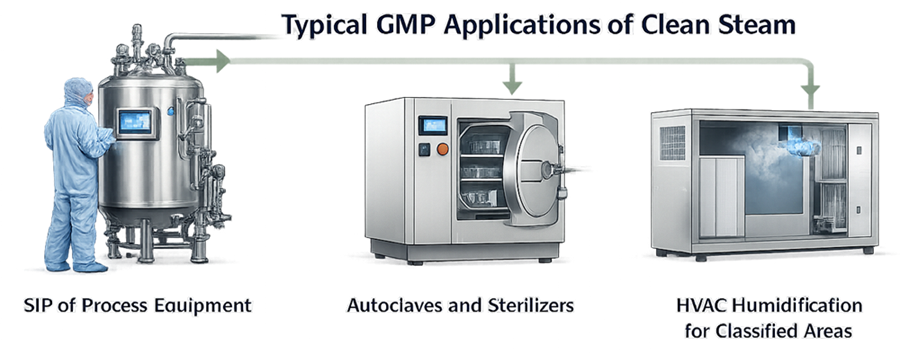
SIP uses steam to sterilize the internal product-contact path of fixed equipment without disassembly. Typical users include bioreactors, formulation vessels, hold vessels, process piping, transfer lines, filter housings, filling pathways, and lyophilizer-related systems.
For SIP, utility quality and sterilization performance must be separated conceptually:
- The clean steam system must supply suitable steam at the defined equipment boundary.
- The SIP system must distribute that steam, remove air and condensate, achieve required exposure throughout the process path, and control the validated cycle.
- The receiving equipment must be designed for drainability, venting, temperature measurement, pressure control, and sterile-boundary maintenance.
A conforming condensate sample does not validate an SIP cycle. Cycle development, air removal, heat penetration or distribution, cold-location identification, lethality, and routine controls remain part of the sterilization process. These subjects are addressed in Steam-in-Place Utility Systems and Moist Heat Sterilization Principles.
Autoclaves and Steam Sterilizers
Clean steam may supply sterilizers used for equipment parts, utensils, garments, components, containers, closures, filters, hoses, assemblies, and other loads. The required steam attributes depend on the load and cycle.
Chemical purity protects load surfaces from objectionable residues. Physical steam quality affects air removal, condensation, heat transfer, drying, and cycle reproducibility. Excessive non-condensable gases can impair steam contact; excessive superheat can delay condensation; excessively wet steam can contribute to poor drying or wet loads. The receiving sterilizer must also control chamber drainage, air removal, exposure, exhaust, and drying.
The clean-steam utility qualification and the sterilizer-cycle validation provide different evidence. Neither substitutes for the other.
Direct Product or Process Contact
Some processes use steam for direct heating, stripping, sparging, or contact with product or intermediates. These uses require explicit assessment because steam becomes a process input and condensate may become part of the material balance.
The specification should consider:
- Product route of administration and patient risk
- Process stage and downstream clearance capability
- Quantity of condensate introduced
- Chemical contaminants and volatile carryover
- Endotoxin risk
- Potential corrosion products or particulates
- Steam-treatment additives
- Effect on formulation, concentration, pH, conductivity, or other product attributes
- Required documentation and material controls
Direct injection should not be justified solely by stating that the steam is “clean.” The composition and quantity delivered to the process must be compatible with the product and registered process.
HVAC Humidification
Clean steam may be used for direct-injection humidification when steam is introduced into an air stream serving a controlled or classified environment. It is not automatically required for every GMP humidification system.
The assessment should consider:
- Injection location relative to final filters
- Possibility of droplet carryover or incomplete evaporation
- Distance and mixing time before filters or occupied space
- Potential deposition on ductwork, filters, sensors, or room surfaces
- Whether exposed product or critical surfaces are present
- Product sensitivity to chemical, microbial, or particulate contamination
- Humidifier shutdown, condensate drainage, and microbial-control provisions
- Boiler additives and plant-steam contaminants
- Consequence of a humidifier or control failure
Plant steam may be acceptable for a closed heating coil when steam does not enter the air stream and the coil-leak risk is adequately controlled. Direct injection creates a different exposure pathway and requires a separate decision. Broader environmental-control considerations are addressed in Role of HVAC in GMP Compliance and Temperature, Humidity, and Air Change Control Parameters.
Other Uses
Other applications may include sterilization of tanks and transfer systems, humidification inside specialized process equipment, sterilization of vent or gas pathways, and controlled steam use in development or pilot equipment. These uses should not be accepted or rejected by analogy alone. The same intended-use, exposure-pathway, quality, and interface assessment applies.
Clean-Steam and Plant-Steam Boundary
The boundary definition should address:
- Ownership of isolation valves and pressure-reducing stations
- Instruments included in utility versus equipment calibration programs
- Responsibility for traps, separators, strainers, filters, hoses, and removable connections
- Sampling locations and sample-cooler ownership
- Condensate discharge and drain routing
- Alarm and interlock ownership
- Maintenance and change-control responsibility
- Release authority following utility or equipment work
- Data ownership when controls are shared
Cross-Connections and Backflow
Physical or procedural arrangements must prevent plant steam, untreated condensate, cleaning agents, gases, or process fluids from entering the clean-steam system. Controls may include dedicated distribution, positive separation, suitable valves, check devices, double-block arrangements, break tanks, air gaps, removable spool controls, line clearance, and verified operating sequences.
A closed valve alone may not provide an adequate contamination barrier for every high-risk interface. The required isolation depends on pressure relationships, valve failure modes, frequency of connection, detectability, and consequence.
Heat-Transfer Barriers
A heat exchanger, jacket, or coil can justify plant-steam use upstream when it provides adequate separation from the GMP process. The assessment should consider:
- Construction and corrosion resistance
- Single-wall or double-wall design
- Relative pressures during normal, startup, shutdown, and failure states
- Direction of leakage if the barrier fails
- Leak detection, inspection, and integrity testing
- Condensate monitoring where relevant
- Maintenance history and replacement strategy
- Product-impact response after suspected leakage
The conclusion should be documented. “Indirect contact” is not enough when a credible failure can drive contaminated steam or condensate into the product side.
Quality Requirements Follow the Application
Clean steam does not have one universal specification for all pharmaceutical uses. The approved requirements should combine condensate quality and physical steam performance appropriate to each user class.
Condensate Quality
Condensate testing is used as a practical representation of contaminants carried by the steam. Depending on intended use, specifications may address:
- Conductivity
- Total organic carbon
- Bacterial endotoxins
- Selected ions, metals, or other contaminants when process knowledge identifies a risk
- Appearance or residue
- Feed-water and generator-specific carryover risks
The current FDA biological-products inspection program states that clean-steam condensate specifications should not be inferior to compendial WFI standards for physical/chemical attributes and endotoxins. This is a significant FDA inspection expectation for the biological drug-substance operations within that program. It should be applied with its scope understood, not converted into an unsupported statement that every clean-steam use in every GMP facility is legally required to meet every WFI test.
Where condensate may contact parenteral-product surfaces or downstream biological-product operations, WFI-based chemical and endotoxin expectations are a strong starting point. Less critical uses still require an approved and scientifically justified specification.
Feed-water category selection and upstream control are addressed in Pharmaceutical Water Quality Categories and Intended Use and Pharmaceutical Water System Design and Distribution.
Physical Steam Quality
For moist-heat sterilization, physical attributes can be as important as condensate chemistry. The evaluation may include:
- Saturation relationship between temperature and pressure
- Dryness or moisture content
- Non-condensable gases
- Superheat
- Pressure and flow stability
- Delivery capacity during coincident demand
- Condensate removal and drainage
Acceptance criteria should follow the intended sterilizer or SIP application, applicable standard, equipment design, load characteristics, and validated process. Limits should not be copied from an unrelated sterilizer type or treated as universal clean-steam purity specifications.
Microbial Considerations
Steam generation provides a strong thermal control, but the system remains vulnerable to poor shutdown practices, retained condensate, contaminated sample equipment, maintenance intrusion, and ingress at interfaces. Microbial control should therefore focus on hygienic design, drainage, startup and shutdown, sampling practice, maintenance recovery, and investigation of atypical results.
Routine condensate bioburden testing may be included when it adds meaningful evidence for the use, but its method, sampling conditions, and interpretation must be defined. A condensate sample collected through an uncontrolled cooler or hose can reflect the sampling arrangement rather than the steam system.
Point of Generation Versus Point of Use
Generator discharge data do not alone establish suitability at remote or high-demand users. Distribution can introduce or reveal:
- Entrainment and carryover
- Corrosion products
- Wet steam
- Non-condensable gases
- Pressure instability
- Inadequate drainage
- Trap malfunction
- Startup contamination
- Effects of simultaneous demand
Requirements should distinguish generator capability from delivered quality at the receiving-equipment boundary.
Equipment-Interface Requirements
The clean steam system and each receiving system form one functional chain. Weak interface definition is a recurring source of incomplete qualification, maintenance gaps, and disputed ownership.
Feed-Water Interface
The feed-water source should provide the quality, pressure, flow, temperature, and availability required by the generator. The interface should define sampling, backflow prevention, upstream release status, response to water excursions, and the effect of sanitization or maintenance on clean-steam availability.
Generator Interface
The generator must control separation between heating medium and clean steam, water level, blowdown, entrainment, pressure, capacity, alarms, and shutdown behavior. Where plant steam heats the generator, the design must prevent the heating medium from contaminating the clean-steam side and provide an appropriate response to suspected leakage.
Distribution Interface
The distribution system must preserve quality through appropriate materials, slope, drainage, trap performance, insulation, pressure control, and point-of-use arrangement. Detailed design considerations belong in Clean Steam System Design and Quality Attributes.
Point-of-Use Interface
Each connection should define:
- Available and required pressure and flow
- Normal and peak demand
- Isolation and pressure reduction
- Trap and separator arrangement
- Startup purge or warmup
- Condensate discharge
- Hose or hard-pipe connection controls
- Backflow or process-ingress prevention
- Sampling location
- Alarm, permissive, or interlock behavior
- Utility-release and equipment-release responsibilities
The worst-performing location may be driven by distance, elevation, branch geometry, low use, simultaneous demand, or drainage rather than simply being the farthest point from the generator.
Sterilizer and SIP Interface
The receiving system should not assume that utility pressure alone proves steam suitability. The interface must support air removal, steam penetration, condensate removal, temperature distribution, exposure, and repeatable cycle control. Utility failures, pressure excursions, or quality failures must be connected to cycle disposition and product-impact procedures.
HVAC Interface
For direct-injection humidification, responsibilities should cover steam conditioning, separators, control valves, dispersion assemblies, absorption distance, condensate drains, duct materials, final-filter protection, high-humidity limits, droplet detection or prevention, shutdown response, and inspection access.
Regulatory and Technical Boundaries
No single provision in 21 CFR Part 211 prescribes one universal clean-steam system or specification. The regulatory basis is assembled from the intended use and the general CGMP duties to provide suitable equipment, prevent contamination, maintain and clean equipment, control automated functions, follow written procedures, investigate discrepancies, and establish appropriate laboratory controls.
Relevant provisions include:
- 21 CFR 211.42: facility design and adequate separation for defined operations
- 21 CFR 211.46: ventilation and control of air-related conditions where appropriate
- 21 CFR 211.63: equipment of appropriate design, size, and location
- 21 CFR 211.65: product-contact surfaces and operating substances must not alter product quality
- 21 CFR 211.67: equipment cleaning and maintenance
- 21 CFR 211.68: automatic, mechanical, and electronic equipment
- 21 CFR 211.100: approved written procedures and documented deviations
- 21 CFR 211.113: procedures to prevent objectionable microorganisms and validate aseptic and sterilization processes where applicable
- 21 CFR 211.160: scientifically sound specifications, standards, sampling plans, and test procedures
- 21 CFR 211.192: investigation of unexplained discrepancies and failures
The FDA Compliance Program 7346.832M, issued April 14, 2026, provides particularly direct current inspection language for biological drug-substance manufacturing. It addresses WFI-based clean-steam condensate expectations, excursion investigation, CAPA, and physical steam attributes including saturation or dryness, non-condensable gases, and superheat. It is an inspection program with a defined scope, not a generally applicable clean-steam regulation.
The FDA Guidance for Industry: Sterile Drug Products Produced by Aseptic Processing supports validated sterilization of product-contact pathways and broader contamination-control expectations for aseptic manufacturing. It does not replace application-specific steam-system design and qualification.
USP requirements apply when a compendial water or steam article is claimed or required. Current official text should be consulted through the licensed USP–NF source. Site procedures should avoid quoting obsolete or secondary copies of a monograph.
Consensus standards and industry guides may establish detailed technical expectations. Depending on the application, relevant sources can include ISO 17665 for moist-heat sterilization, ASME BPE for bioprocessing equipment and hygienic utility design, and ISPE guidance for pharmaceutical water and steam systems. Their applicability should be identified in the URS, design basis, qualification plan, or sterilization validation strategy rather than listed without a defined use.
System Classification and GMP Impact
Clean steam is often classified as a direct-impact utility because it contacts product-contact surfaces or supports sterilization. That classification should not be copied automatically to every branch and user.
The impact assessment should consider:
- Direct product contact
- Contact with product-contact surfaces
- Role in a validated sterilization process
- Introduction into a critical air stream
- Barrier integrity and failure direction
- Product and process sensitivity
- Ability to detect a loss of control before use
- Downstream controls or clearance
- Regulatory and filing commitments
A site may classify the overall system as direct impact while differentiating user criticality and monitoring depth. The classification should drive requirements, qualification, maintenance, calibration, monitoring, change assessment, and requalification without implying that every component has identical criticality.
Required Boundary and Intended-Use Documentation
The controlled documentation set should include, as applicable:
- Approved intended-use statement
- System classification and risk assessment
- User inventory and criticality grouping
- Utility and receiving-equipment boundaries
- Process and instrumentation diagrams
- Feed-water requirements
- Clean-steam and condensate specifications
- Physical steam-quality requirements by application
- Capacity and demand basis
- Cross-connection and barrier assessment
- Point-of-use details
- Responsibility matrix
- Sampling and monitoring rationale
- Applicable regulatory, compendial, filing, and standard commitments
- Qualification and release strategy
- Change-control and requalification triggers
The user inventory should be maintained through change control. An added connection can alter not only applicability but also generator capacity, pressure stability, distribution performance, sampling coverage, and the qualified state of existing users.
Common Boundary and Applicability Weaknesses
Frequent weaknesses include:
- Calling all site steam “clean” without separate generation, specifications, or control
- Assuming a final filter converts plant steam into clean steam
- Requiring clean steam for every heating use without evaluating the contact pathway
- Allowing plant-steam additives to enter a direct-injection humidification system
- Describing all humidification as direct product impact regardless of injection location and air path
- Treating a heat exchanger or jacket as an absolute barrier without evaluating leakage
- Failing to define the utility-to-equipment boundary
- Omitting hoses, traps, separators, sample coolers, and pressure-reducing stations from ownership
- Using generator samples as the only evidence for a large distribution system
- Defining condensate chemistry but not physical steam quality for sterilization
- Applying sterilizer steam-quality limits universally without considering the equipment and load
- Treating clean steam qualification as validation of the SIP or sterilizer cycle
- Treating a validated sterilizer cycle as qualification of the generating and distribution system
- Claiming USP Pure Steam without controlling the current compendial requirements
- Using WFI as feed water without addressing generator carryover, distribution, or physical quality
- Connecting temporary or portable steam sources without formal impact assessment
- Adding points of use without evaluating capacity and existing-user performance
- Recovering from maintenance or shutdown without controlled purge, sampling, and release
Lifecycle Position
This article establishes the application and boundary decisions that must exist before detailed design and qualification. The lifecycle then proceeds through:
Intended use → requirements → risk assessment → design → commissioning and qualification → controlled release → monitoring and maintenance → change control and periodic review → requalification or retirement
The system design must convert the approved intended use into technical capability. Qualification must verify the actual installation, operation, quality, and interfaces. Routine monitoring and maintenance must preserve that capability. Changes, failures, adverse trends, shutdowns, and new users must be assessed against the original boundary and intended-use basis.
General lifecycle governance is addressed in Utility System Lifecycle, Monitoring, and Risk-Based Control.
Summary
Clean steam is not defined solely by its generator, pressure, feed-water name, or a passing condensate sample. It is defined by a controlled relationship among intended use, exposure pathway, quality requirements, physical steam performance, distribution, receiving-equipment interfaces, and lifecycle evidence.
An effective GMP position should ensure that:
- Clean steam is used where direct contact, sterilization, critical humidification, or another justified pathway requires it.
- Plant steam remains limited to non-contact service or the non-GMP side of an adequately controlled barrier.
- Clean steam and compendial Pure Steam are distinguished correctly.
- Chemical, endotoxin, microbial-control, and physical attributes are assigned according to use.
- Generator and point-of-use requirements are not confused.
- Utility qualification and sterilization-process validation remain connected but distinct.
- HVAC humidification is assessed by injection location, air path, and contamination consequence.
- Equipment interfaces and ownership are explicit.
- Regulatory and inspection expectations are applied within their actual scope.
- The documented boundary remains current as users, processes, and systems change.