

Role of HVAC in GMP Compliance
Purpose and Scope
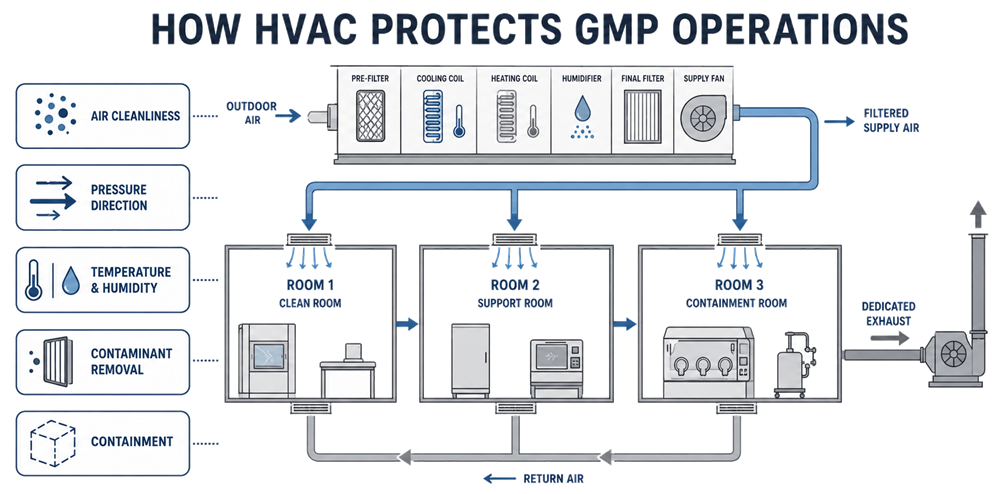
Heating, ventilation, and air-conditioning systems support GMP compliance by establishing and maintaining environmental conditions appropriate to the product, process, personnel, equipment, and manufacturing activity. Depending on their intended function, HVAC systems may:
- Protect exposed product and critical surfaces
- Reduce airborne particulate and microbial contamination
- Control movement of contaminants between rooms
- Maintain containment of hazardous or sensitizing materials
- Support cleanroom classification
- Maintain temperature and humidity within justified ranges
- Remove process-generated dust, vapor, heat, or moisture
- Support personnel comfort where comfort affects correct gowning or performance
- Provide evidence that controlled environments remain within approved conditions
HVAC significance is risk-based. Some HVAC systems have a direct GMP impact because their performance can immediately affect product quality or contamination control. Others provide indirect support to GMP areas. General office, administrative, or non-production HVAC may have no product-quality function.
The system classification and criticality should therefore be based on intended use, the areas served, product exposure, contamination and cross-contamination risk, containment requirements, and the consequences of system failure.
Regulatory Basis
21 CFR 211.42 requires pharmaceutical facilities to have suitable size, construction, location, and defined areas or other controls needed to prevent contamination and mix-ups.
21 CFR 211.46 requires adequate ventilation and, where appropriate, equipment for controlling air pressure, microorganisms, dust, humidity, and temperature. It also addresses filtration, recirculated air, exhaust, and control of contaminants generated during production.
For aseptic operations, FDA’s Sterile Drug Products Produced by Aseptic Processing—Current Good Manufacturing Practice guidance provides additional expectations for air cleanliness, HEPA filtration, pressure differentials, airflow patterns, environmental control, monitoring, and protection of critical processing zones.
These requirements do not make every HVAC system equally critical. They require the organization to identify where environmental control affects the manufacture, processing, packing, or holding of the product and apply controls appropriate to that risk.
How HVAC Supports Product Protection
HVAC protects product through a combination of filtration, air distribution, airflow direction, dilution, contaminant removal, temperature control, humidity control, and pressure management.
The importance of each function depends on the operation.
For an aseptic filling area, air cleanliness, unidirectional airflow, HEPA filtration, and first-air protection may be essential to sterility assurance.
For a nonsterile open-product operation, HVAC may be important for controlling dust, temperature, humidity, and cross-contamination.
For closed processing, HVAC may have a reduced direct effect on product but remain important for maintaining the surrounding controlled environment, managing process heat, or protecting against consequences of a leak or breach.
For warehousing, HVAC significance may be driven principally by storage-temperature or humidity requirements.
The HVAC control strategy must therefore begin with product and process needs rather than with a standard equipment configuration.
Airborne Contamination Control
Airborne contamination can originate from:
- Personnel
- Materials
- Equipment
- Process operations
- Cleaning activities
- Adjacent rooms
- Outdoor air
- Maintenance work
- Facility deterioration
- The HVAC system itself
HVAC reduces contamination risk by:
- Filtering incoming and recirculated air
- Delivering air to controlled spaces in a defined pattern
- Diluting airborne contaminants
- Removing particles, vapors, and heat from the room
- Directing air away from critical product-exposure locations
- Limiting entry of lower-quality air
- Exhausting air where recirculation would create unacceptable risk
Filtration alone does not establish adequate environmental control. Filter selection, integrity, air volume, diffuser arrangement, return locations, room geometry, equipment placement, occupancy, and operating activity all affect actual room performance.
Detailed principles are addressed in HEPA Filtration and Air Distribution.
Cross-Contamination and Containment Control
HVAC can either reduce or spread cross-contamination. The result depends on system boundaries, pressure relationships, return-air arrangements, exhaust design, leakage paths, and operating conditions. Cross-contamination controls may include:
- Dedicated air-handling systems
- Segregated supply or return-air systems
- Single-pass air
- Controlled recirculation
- Terminal or central filtration
- Local dust extraction
- Dedicated exhaust
- Pressure differentials
- Airlocks
- Closed-transfer arrangements
- Safe-change filters
- Appropriate shutdown and failure modes
Positive pressure is generally used where the objective is to protect a cleaner room from adjacent lower-quality areas.
Negative pressure is generally used where the objective is to contain hazardous, sensitizing, highly potent, biological, dusty, or otherwise objectionable materials.
Neither positive nor negative pressure is automatically correct. The direction must follow the contamination-control objective, and conflicts between product protection and containment must be resolved through suitable facility and process design.
The relationship among room pressure, airflow direction, doors, airlocks, and adjacent spaces is explained in Airflow Patterns and Pressure Cascades.
Support of Classified and Controlled Environments
HVAC establishes the environmental capability needed for a cleanroom or controlled area to achieve its required condition. This capability may include:
- Defined airborne-particle cleanliness
- HEPA-filtered supply air
- Appropriate airflow distribution
- Required pressure relationships
- Temperature and humidity control
- Removal of personnel- and process-generated contaminants
- Recovery after doors are opened or activities occur
- Stable operation under expected occupancy and equipment loads
HVAC does not independently establish GMP suitability.
Cleanroom classification measures airborne particle concentration under defined conditions. It does not demonstrate microbiological control, product protection, appropriate personnel practices, effective cleaning, or suitability for a specific process. The qualified environment results from the combined performance of:
- Facility design
- HVAC
- Process equipment
- Personnel and material flows
- Cleaning and disinfection
- Gowning
- Operating procedures
- Environmental monitoring
- Maintenance and calibration
- Process-specific controls
Temperature and Humidity Control
Temperature and humidity limits should be based on actual requirements rather than copied from another facility or established solely for personnel comfort. Requirements may be derived from:
- Product stability
- Material properties
- Process capability
- Microbial-control considerations
- Moisture sensitivity
- Electrostatic-control needs
- Equipment heat load
- Operator gowning and performance
- Condensation prevention
- Storage conditions
- Regulatory or compendial commitments
Temperature or humidity becomes GMP-critical when deviation can affect product quality, material characteristics, process performance, environmental control, or reliable operation of quality-critical equipment.
Where the conditions affect comfort only, they may remain engineering parameters rather than GMP-critical parameters.
Detailed selection and control principles are addressed in Temperature, Humidity, and Air Change Control Parameters.
HVAC System Classification and Criticality
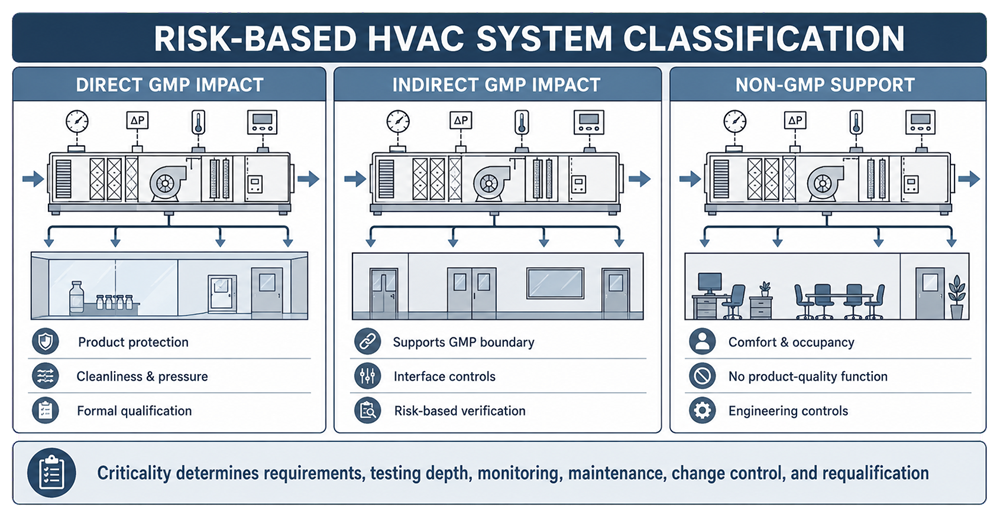
HVAC systems should be classified according to their actual GMP impact. The following categories provide a practical framework. The terminology may differ among organizations, but the decision basis should remain documented and consistent.
Direct GMP Impact
An HVAC system has direct GMP impact when its performance directly establishes or maintains a condition required for product quality, contamination control, cross-contamination control, containment, or an approved manufacturing environment. Examples may include systems serving:
- Aseptic processing areas
- Exposed sterile-product operations
- Classified cleanrooms
- Open-product manufacturing rooms
- Weighing and dispensing rooms
- Highly potent or sensitizing-product areas
- Controlled sampling areas
- Critical material-storage areas
- Laboratories where environmental conditions directly affect testing
- Rooms requiring defined pressure containment
Direct-impact systems normally require formal qualification and enhanced lifecycle control.
Indirect GMP Impact
An HVAC system has indirect GMP impact when it does not directly establish a product-quality condition but supports a GMP boundary, adjacent controlled area, flow strategy, equipment function, or operator activity. Examples may include systems serving:
- GMP corridors
- Staging areas
- Gowning support spaces
- Mechanical spaces adjacent to controlled areas
- General warehouses without product-specific environmental limits
- Support rooms that influence adjacent room pressure
- Areas providing environmental support to closed processing
Indirect-impact systems require appropriate engineering verification and controlled interfaces. Formal qualification depth should be determined through risk assessment rather than assumed.
Non-GMP Support
An HVAC system may be classified as non-GMP when its failure would not reasonably affect product quality, manufacturing control, regulated records, contamination control, or the qualified state of a GMP area. Examples may include systems serving:
- General offices
- Conference rooms
- Administrative areas
- Unrelated public spaces
- Non-GMP workshops that do not interface with controlled operations
Non-GMP classification does not eliminate engineering, safety, building-code, or maintenance obligations. It means that GMP qualification and Quality oversight are not required unless an interface creates a credible GMP effect.
Criticality Assessment
System classification identifies the general type of impact. Criticality determines the depth and rigor of lifecycle controls. The assessment should consider:
- Products and processes served
- Open or closed product exposure
- Sterile or nonsterile operation
- Required cleanroom classification
- Contamination and cross-contamination hazards
- Containment requirements
- Air recirculation and exhaust arrangements
- Areas connected to the system
- Shared-system effects
- Temperature and humidity sensitivity
- Pressure-cascade function
- Environmental-monitoring dependence
- Consequences of airflow or filtration failure
- Detectability of loss of control
- Availability of alarms and independent monitoring
- Recovery capability
- Potential effect on adjacent rooms
- Duration of product exposure
- Availability of procedural or process controls
The assessment should identify the specific HVAC functions and parameters that are critical. An entire system should not automatically be treated as equally critical in every respect.
For example, a system may have:
- Critical HEPA-filtration and pressure-control functions
- Major temperature-control functions
- Noncritical local display functions
- General comfort functions with no direct product-quality effect
This functional approach supports proportional requirements, testing, monitoring, maintenance, and change control.
Classification Outcomes and Required Controls
| Classification | Typical significance | Typical lifecycle controls |
|---|---|---|
| Direct GMP impact | Directly protects product, controls contamination or containment, or establishes a required manufacturing condition | Approved requirements, design review, risk assessment, qualification, calibrated critical instruments, alarms, monitoring, preventive maintenance, deviation management, change control, periodic review, and risk-based requalification |
| Indirect GMP impact | Supports a GMP boundary, interface, flow, adjacent area, or controlled operation | Defined requirements, engineering verification, interface testing, appropriate monitoring and maintenance, impact assessment, and controlled change |
| Non-GMP support | No credible product-quality or GMP-control function | Normal engineering, safety, maintenance, and building-management controls |
The classification should be approved and traceable to the intended use and risk assessment.
A non-GMP or indirect-impact classification should not be used merely to reduce qualification work. Conversely, applying full GMP qualification to every comfort or administrative system creates unnecessary documentation without improving product protection.
HVAC Architecture and System Boundaries
A defensible HVAC control strategy requires clear system boundaries. The assessment should identify:
- Air-handling units
- Supply-air branches
- Return-air paths
- Exhaust systems
- Outdoor-air connections
- Recirculation paths
- Terminal filters
- Room boundaries
- Pressure-control devices
- Sensors and transmitters
- Building-automation interfaces
- Environmental-monitoring interfaces
- Shared components
- Standby equipment
- Emergency modes
- Areas served
Shared systems require particular attention. A common air-handling unit or return-air path can connect rooms with different products, processes, cleanliness levels, containment needs, or operating schedules.
Architecture, components, and system-boundary principles are addressed in HVAC System Architecture and Components.
Qualification and Verification
Qualification demonstrates that a direct-impact HVAC system is properly designed, installed, and capable of operating within approved ranges. The qualification approach should be based on:
- Intended use
- System classification
- Critical functions
- Critical parameters
- Risk assessment
- System complexity
- Design novelty
- Monitoring capability
- Commissioning evidence
- Consequences of failure
The HVAC lifecycle may include:
- User requirements
- System classification and risk assessment
- Design review
- Commissioning
- Installation Qualification
- Operational Qualification
- Room and environmental performance verification
- Release for operation
- Routine monitoring and maintenance
- Change control and periodic review
- Risk-based requalification
The HVAC Qualification Strategy defines the boundaries among system qualification, room-performance verification, and routine environmental monitoring.
Qualification should demonstrate more than the ability to reach one normal operating condition. Depending on risk, it may evaluate operating ranges, alarms, interlocks, standby operation, seasonal capability, failure response, shutdown, and recovery.
Monitoring and Sustained Control
Qualification establishes an approved baseline. Routine evidence determines whether the system remains in control. Applicable monitoring may include:
- Differential pressure
- Temperature
- Relative humidity
- Supply or exhaust status
- Critical fan status
- Filter differential pressure
- Airflow or room-pressure alarms
- Environmental-monitoring data
- Nonviable-particle trends
- Viable-monitoring trends
- Equipment and room-condition observations
- System event and alarm histories
Monitoring requirements should be based on the parameter’s significance, variability, failure detectability, response time, and consequences.
Not every HVAC parameter requires continuous GMP monitoring. Continuous monitoring is appropriate where a loss of control could develop between periodic checks and materially affect product, environment, or containment.
Alert and action levels should have a documented technical basis. They should support early detection and appropriate response rather than merely repeat broad design ranges.
Deviations and Loss of Control
An HVAC excursion does not automatically mean that product is affected. It requires a documented assessment based on the event and the manufacturing conditions that existed. The assessment should consider:
- Parameter involved
- Actual value and duration
- Rooms and systems affected
- Products or materials exposed
- Process state
- Door and access activity
- Environmental-monitoring results
- Containment consequences
- Adjacent-room effects
- Alarm performance
- Data reliability
- Recovery time
- Recurrence
- Root cause
- Need for product-impact assessment
- Need for corrective action or requalification
A room pressure excursion lasting seconds during an approved door opening is not equivalent to an unexplained prolonged loss of pressure during exposed-product processing.
The response must reflect actual risk rather than treating every alarm as identical.
Maintenance, Calibration, and Change Control
HVAC systems remain qualified only when the supporting lifecycle controls remain effective. Important controls include:
- Preventive maintenance
- Corrective maintenance
- Filter replacement
- Cleaning of coils and drain systems
- Belt, bearing, fan, and damper maintenance
- Calibration of critical sensors and transmitters
- Review of out-of-tolerance conditions
- Control of software and automation changes
- Balancing after modifications
- Post-maintenance verification
- Management of temporary repairs and overrides
- Evaluation of replacement components
- Control of setpoint and alarm changes
- Updated drawings and configuration records
Maintenance completion alone does not demonstrate that affected performance was restored. Post-maintenance verification should be proportional to the work performed and its possible impact.
Changes should be assessed for direct effects and credible downstream effects on rooms, pressure relationships, airflow balance, monitoring, alarms, adjacent systems, and the qualification baseline.
Periodic Review and Requalification
Periodic review should evaluate whether accumulated evidence continues to support the approved HVAC use and qualified state. Review inputs may include:
- Change history
- Deviations and investigations
- Alarm trends
- Environmental trends
- Maintenance history
- Calibration results
- Equipment failures
- Filter-integrity results
- Airflow and balancing data
- Room-pressure performance
- Seasonal performance
- System aging
- Obsolescence
- Changes in product or process use
- Previous qualification and requalification results
Requalification should be triggered by risk, change, adverse evidence, or uncertainty. It should not automatically repeat the entire original qualification package at a fixed interval.
Possible outcomes include:
- Continued qualified use
- Enhanced monitoring
- Corrective action with verification
- Targeted requalification
- Broader system or room requalification
- Restricted operation pending resolution
Detailed lifecycle controls are addressed in HVAC Requalification Triggers and Periodic Review.
Common Weaknesses
Common HVAC control weaknesses include:
- Classifying every HVAC system as equally GMP-critical
- Treating all HVAC as non-GMP facility support
- Assigning classification without documenting the decision basis
- Failing to identify critical functions and parameters
- Copying temperature, humidity, pressure, or air-change limits without justification
- Treating HEPA filtration as sufficient without evaluating air distribution
- Assuming pressure direction without verification
- Ignoring return-air and recirculation risks
- Failing to evaluate shared-system effects
- Treating comfort requirements as product-quality requirements
- Treating product-quality requirements as comfort parameters
- Qualifying components without demonstrating room performance
- Monitoring parameters without defined response requirements
- Closing HVAC deviations without assessing manufacturing conditions
- Performing maintenance without post-maintenance verification
- Changing setpoints or control logic without change control
- Repeating complete qualification without identifying affected functions
- Assuming initial qualification remains valid indefinitely
A defensible program applies greater control where HVAC performance can materially affect product or environmental control and proportionally less control where no such relationship exists.
Summary
HVAC supports GMP compliance by maintaining environmental conditions appropriate to the product, process, facility, and manufacturing activity. Its functions may include:
- Product protection
- Airborne-contamination control
- Cross-contamination prevention
- Containment
- Cleanroom support
- Pressure control
- Temperature and humidity control
- Contaminant removal
- Environmental monitoring support
HVAC systems should be classified by actual GMP impact:
- Direct GMP impact
- Indirect GMP impact
- Non-GMP support
Criticality should then determine the required depth of design control, qualification, monitoring, maintenance, change control, periodic review, and requalification.
The correct principle is not that every HVAC system is a quality-critical system. The correct principle is that every HVAC system must be evaluated, and controls must be proportional to its credible effect on product quality, contamination control, containment, and the qualified manufacturing environment.