

Environmental Monitoring Program Design and Execution
Purpose and Scope
An environmental monitoring program defines how environmental conditions are sampled, documented, reviewed, investigated, trended, and used to maintain control during GMP operations.
Effective monitoring requires more than collecting samples at established intervals. The program must be scientifically designed, operationally representative, consistently executed, supported by suitable methods, and integrated with investigation, change control, periodic review, and the contamination-control strategy.
This article explains:
- Environmental monitoring program governance
- Risk-based selection of locations, methods, and frequencies
- Viable and nonviable monitoring methods
- Personnel and surface monitoring
- Method suitability and microbial recovery
- Sampling conditions and interference controls
- Media selection and disinfectant neutralization
- Incubation and organism-identification strategies
- Sample handling and data integrity
- Missed, compromised, and invalid samples
- Initial data review and escalation
- Environmental-excursion investigations
- Reporting, trending, and periodic program review
Environmental performance qualification, baseline establishment, and development of alert and action levels are addressed in Environmental Performance Qualification, Limits, and Trending. This article focuses on construction and controlled operation of the routine monitoring program.
Environmental Monitoring Program Lifecycle
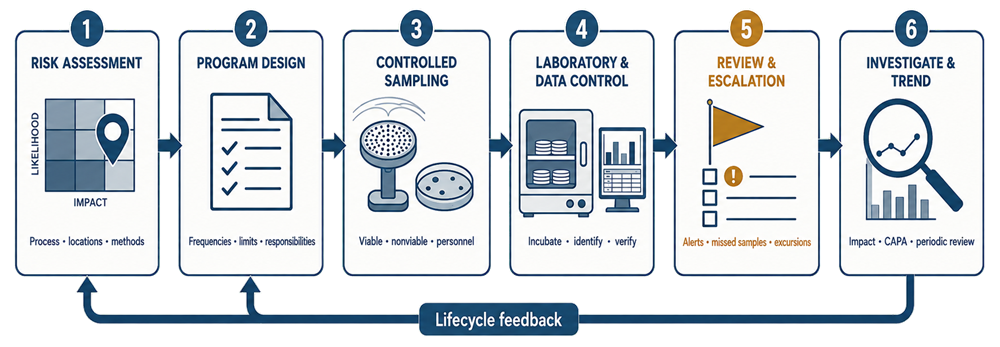
Environmental monitoring operates through six connected stages:
- Risk assessment identifies the processes, locations, activities, contamination pathways, and environmental failures that the program must be capable of detecting.
- Program design establishes locations, methods, frequencies, limits, responsibilities, procedures, records, and escalation requirements.
- Controlled sampling collects representative viable, nonviable, surface, and personnel data under documented operating conditions.
- Laboratory and data control protects sample identity, incubation, enumeration, identification, electronic records, and review.
- Review and escalation evaluates results, missed samples, anomalies, alerts, action-level excursions, and other potential indicators of loss of control.
- Investigation and trending determine significance, product impact, corrective action, and whether the monitoring program or underlying controls require revision.
The program is therefore a feedback system. Investigation findings, adverse trends, operating experience, process changes, and periodic review should return evidence to the original risk assessment and program design.
Environmental monitoring begins with risk assessment and program design, but its effectiveness depends on controlled sampling, reliable laboratory processing, timely review, and feedback from investigations and trend evaluation.
Program Governance and Responsibilities
The environmental monitoring program should be governed by approved procedures and clearly assigned responsibilities.
Depending on the organization, responsibilities may be distributed among microbiology, manufacturing, engineering, quality, validation, and environmental-control personnel. The governance model should define responsibility for:
- Program ownership
- Monitoring-location approval
- Sampling-plan preparation and scheduling
- Sampling execution
- Media and sampling-equipment control
- Sample transport and incubation
- Colony enumeration and organism identification
- Nonviable-particle data review
- Review of environmental alarms and data gaps
- Alert and action-level notification
- Missed-sample assessment
- Investigation initiation and execution
- Product-impact assessment
- Data trending and periodic reporting
- Monitoring-program changes
- Quality-unit oversight and approval
Personnel performing sampling should be trained and qualified for the specific methods they use. Qualification should address both technical execution and behavior within the monitored environment.
Routine observation or periodic reassessment should confirm that qualified samplers continue to follow approved practices. Sampling variability caused by inconsistent technique can obscure actual environmental changes and create misleading trends.
Defining Program Scope
The program should identify every room, process, equipment enclosure, barrier system, support area, and personnel group within scope.
Not every GMP space requires the same monitoring methods or intensity. Program scope should reflect:
- Intended room or area use
- Product and process contamination risk
- Open versus closed processing
- Sterile, aseptic, nonsterile, biotechnology, laboratory, or support operations
- Product and critical-surface exposure
- Cleanroom classification or functional room designation
- Barrier-system configuration
- Personnel occupancy and intervention frequency
- Material and waste movement
- Cleaning and disinfection practices
- HVAC and airflow characteristics
- Regulatory and procedural requirements
- Qualification and historical monitoring evidence
The program should also define its boundaries. Utility monitoring, compressed-gas testing, process bioburden, water-system monitoring, product testing, and cleaning validation may provide relevant evidence but should not be silently incorporated into the environmental monitoring program without defined ownership and interfaces.
Risk Assessment for Monitoring-Program Design
Monitoring locations, methods, and frequencies should be supported by a documented risk assessment.
The assessment should determine where contamination may be:
- Introduced
- Generated
- Transferred
- Retained
- Dispersed
- Detected before affecting product or process control
Risk assessment should consider at least four related factors:
Contamination Source
Potential sources include:
- Personnel
- Materials and components
- Equipment
- Product residues
- Cleaning tools
- Doors and transfers
- Maintenance activities
- HVAC or filtration failures
- Adjacent rooms
- Drains, sinks, or wet locations
- Process aerosols or powders
- Barrier-system transfers
- Sampling activities themselves
Contamination Pathway
The assessment should evaluate how contamination could travel through:
- Airflow
- Personnel movement
- Material movement
- Direct contact
- Equipment movement
- Door openings
- Pressure reversal
- Surface transfer
- Inadequate decontamination
- Maintenance access
- Improper gowning or interventions
Exposed or Vulnerable Target
Potential targets include:
- Open product
- Sterile components
- Product-contact surfaces
- Critical equipment surfaces
- Filling or assembly points
- Open containers
- Sampling ports
- Process connections
- Intermediate materials
- Clean equipment awaiting use
Detection Capability
The assessment should determine whether the proposed location and method can detect the relevant failure.
A convenient location is not necessarily an informative location. A monitoring point may be close to an operation yet provide weak evidence if airflow carries contamination away from the sampler, the surface is routinely disinfected immediately before sampling, or sampling cannot occur during the activity of interest.
The risk assessment should document why each established location is monitored and what type of environmental change it is intended to detect.
Selection of Monitoring Locations
Location selection should integrate:
- Qualification and baseline findings
- Airflow-visualization results
- Product and critical-surface exposure
- Operator positions and movement
- Interventions
- Equipment configuration
- Supply, return, and exhaust-air locations
- Doors, airlocks, and transfer openings
- Material and waste routes
- Difficult-to-clean locations
- Surface-contact patterns
- Historical recoveries
- Previous excursions or investigations
- Sampling-method limitations
Routine monitoring locations may include:
- Critical processing points
- Areas adjacent to exposed product
- Operator working positions
- Intervention locations
- Material-entry and transfer points
- Representative room-background locations
- Equipment and work surfaces
- Locations with recurring recovery history
- Surfaces frequently touched during operation
- Personnel gown or glove locations
- Areas affected by door openings or movement
Classification locations and routine monitoring locations are not automatically identical. Classification locations are selected according to the applicable cleanroom-classification methodology. Routine monitoring locations are selected according to contamination risk, process exposure, operational activity, and detection capability.
Room maps should use unique, durable location identifiers. The identifiers should remain consistent among procedures, sampling records, laboratory systems, trend reports, investigations, and room drawings.
Relocation, removal, or addition of an established point should be scientifically assessed and controlled. Apparent improvement created merely by moving a sampler away from a recurring recovery location is not evidence of improved environmental control.
Selection of Monitoring Methods
The program should select methods according to the contamination attribute and environmental failure being evaluated.
Possible methods include:
- Active viable-air sampling
- Passive viable-air monitoring using settle plates
- Contact-plate surface sampling
- Swab sampling
- Personnel or glove monitoring
- Nonviable airborne-particle monitoring
- Differential-pressure monitoring
- Temperature and relative-humidity monitoring
- Review of environmental and HVAC alarms
No individual method provides complete environmental evidence.
Active-air sampling measures recoverable microorganisms from a defined air volume. Settle plates evaluate microorganisms that settle onto an exposed surface during a defined time. Contact plates recover organisms from suitable flat surfaces. Swabs can access irregular or inaccessible surfaces but commonly produce more variable recovery. Nonviable particle counters detect particles without determining whether they contain living organisms.
Methods should be complementary and selected for their intended purpose rather than treated as interchangeable.
Method Suitability and Recovery Efficiency
A monitoring method should be shown to be suitable for its intended application.
Suitability considerations may include:
- Intended organism types
- Expected environmental counts
- Sampling volume or exposure time
- Air-sampler collection efficiency
- Air velocity and impaction characteristics
- Media formulation
- Surface material
- Surface geometry
- Swab material and extraction technique
- Incubation conditions
- Organism stress or desiccation
- Residual disinfectant
- Sample holding time
- Detection and enumeration capability
- Instrument operating range
- Environmental conditions during use
Environmental-monitoring methods are not expected to recover every microorganism present. Recovery is affected by the sampler, medium, organism, surface, environmental stress, and operator technique.
Method evaluation should therefore establish that the selected approach can recover relevant environmental organisms with adequate and reproducible performance for its intended purpose.
For active-air samplers, assessment may include:
- Airflow calibration
- Sample-volume accuracy
- Physical and biological collection efficiency
- Effect of sampling duration on media
- Potential desiccation
- Cleaning and disinfection of the sampling head
- Carryover prevention
- Suitability for use in critical airflow
For contact plates and swabs, assessment may include:
- Recovery from representative surface materials
- Neutralization of disinfectant residues
- Applied pressure or contact technique
- Swab wetting and extraction
- Sampled surface area
- Ability to access irregular locations
- Surface restoration after sampling
Method changes should be assessed for their effect on historical comparability. An increase or decrease in recovery after introducing a different sampler, medium, incubation cycle, or identification method may reflect changed method capability rather than changed environmental performance.
Viable Active-Air Monitoring
Active-air sampling draws a measured volume of air through or onto a collection medium.
The procedure should define:
- Approved sampler and sampling head
- Required calibration or verification
- Sample volume
- Sampling duration
- Location and orientation
- Sampling height
- Timing relative to the operation
- Media type
- Sampler preparation and disinfection
- Sample identification
- Post-sampling handling
- Incubation requirements
- Response to interrupted or incomplete samples
Sampling volume should be sufficient for the monitoring objective without causing excessive media desiccation, particle overlap, loss of collection efficiency, or unacceptable disruption of critical airflow.
The sampler should be positioned to collect representative air without obstructing operations, compromising first-air protection, contacting critical surfaces, or introducing contamination through its placement or removal.
Tubing should not be used merely to place the sampler outside a critical area unless the complete configuration has been assessed. Tubing length, bends, material, electrostatic effects, and particle or microbial losses can materially affect recovery.
Passive-Air Monitoring Using Settle Plates
Settle plates provide time-integrated information about microorganisms capable of depositing onto the exposed medium.
The procedure should define:
- Plate location
- Exposure start and stop time
- Maximum exposure duration
- Plate orientation
- Media type
- Controls against desiccation
- Handling of interrupted exposures
- Relationship to the monitored activity
- Incubation and enumeration requirements
Settle plates do not sample a defined air volume and should not be interpreted as equivalent to active-air samples.
They are particularly useful where potential microbial deposition onto exposed product or critical surfaces is relevant. Their interpretation should consider exposure time, airflow, activity, plate condition, and proximity to the operation.
If an extended operation requires replacement plates, the program should define how sequential plates are identified and evaluated. Results should not automatically be combined into a single equivalent count without a scientifically justified procedure.
Surface Monitoring
Surface monitoring evaluates recoverable microorganisms from defined equipment, room, or work surfaces.
Contact Plates
Contact plates are generally suitable for flat, accessible surfaces. The method should control:
- Sampled area
- Applied contact pressure
- Contact duration
- Plate orientation
- Media contact with the entire intended area
- Residual agar left on the surface
- Post-sampling cleaning or disinfection
Swab Sampling
Swabs may be used for irregular, recessed, curved, or inaccessible surfaces. The method should define:
- Swab material
- Wetting or neutralizing solution
- Sampled area
- Swabbing pattern
- Applied technique
- Extraction or transfer method
- Holding time
- Result calculation and reporting
Swab recovery can be highly technique-dependent. Sampler qualification and periodic observation are therefore important.
Surface monitoring should be timed according to its purpose. Sampling immediately after disinfection may evaluate the cleaned state but may produce low recovery because of remaining antimicrobial residue. Sampling after an operation may better reflect contamination accumulated during use but must be performed without transferring contamination to product, equipment, or adjacent surfaces.
The program should clearly distinguish these objectives.
Personnel Monitoring
Personnel monitoring provides evidence concerning gowning effectiveness, aseptic technique, interventions, and contamination transferred by operators.
The program should define:
- Personnel groups included
- Gown or glove locations sampled
- Sampling method
- Sampling frequency
- Timing during or after operations
- Response to interventions or unusual events
- Requirements before personnel leave the controlled area
- Actions following an unacceptable result
- Relationship to operator qualification
Sampling locations may include:
- Gloves or fingertips
- Forearms
- Chest
- Hood or face-covering area
- Other gown locations supported by risk assessment
For aseptic operations, monitoring should be positioned to detect contamination associated with critical activities without causing an additional contamination risk. Glove monitoring performed during operation should not return the sampled glove to critical work unless an approved control prevents transfer from the sampling activity.
Personnel results should be traceable to the operator, operation, room, date, time, shift, intervention history, and potentially affected batch or activity.
An unacceptable personnel result should not be treated solely as a training issue. Investigation should consider gown integrity, gowning materials, room conditions, intervention design, work practices, sampling execution, cleaning controls, and potential product exposure.
Nonviable Airborne-Particle Monitoring
Nonviable monitoring evaluates airborne particles at defined size thresholds.
The monitoring plan should define:
- Instrument type
- Particle-size channels
- Sample flow rate
- Sampling interval or volume
- Location and probe orientation
- Tubing configuration
- Monitoring period
- Alarm criteria
- Data averaging rules
- Response to data interruption
- Calibration and maintenance requirements
- Review of short-duration and sustained excursions
Nonviable monitoring may be continuous, frequent, periodic, or event-based depending on the process and applicable requirements.
Sampling probes should be positioned to provide meaningful information without disrupting critical airflow or interfering with operations. Long tubing, sharp bends, unsuitable tubing materials, and poor probe orientation can reduce particle transport and delay detection.
Continuous data should preserve sufficient resolution to identify meaningful events. Averaging should not conceal short-duration excursions associated with interventions or environmental disturbance.
Instrument alarms should be evaluated with:
- Magnitude
- Duration
- Location
- Operational activity
- Product exposure
- Instrument status
- Concurrent viable results
- Other environmental parameters
A particle alarm should not be dismissed merely because the cumulative monitoring period remains within a separate classification criterion.
Determination of Monitoring Frequency
Monitoring frequency should be justified by risk and applicable requirements.
The rationale should consider:
- Room classification and function
- Product and critical-surface exposure
- Aseptic versus nonaseptic operation
- Frequency and duration of room use
- Personnel occupancy
- Intervention frequency
- Process duration
- Qualification and baseline results
- Historical recovery patterns
- Seasonal variation
- Method sensitivity
- Consequence of delayed detection
- Regulatory expectations
- Recent changes, maintenance, or adverse events
Monitoring may be required:
- Continuously during operation
- During each batch or session
- At defined intervals during extended operations
- Daily, weekly, monthly, or at another justified frequency
- Before or after specified activities
- Following cleaning or disinfection
- Following maintenance, shutdown, or restart
- During investigation or enhanced monitoring
A record of acceptable results does not by itself justify reduced monitoring. Reduction should also consider process risk, regulatory expectations, the ability to detect deterioration, facility history, and the amount and representativeness of available data.
Temporary increased monitoring may be appropriate after:
- Facility or HVAC modification
- Equipment installation or relocation
- HEPA-filter work
- Significant maintenance
- Cleaning or disinfection failure
- Adverse environmental trend
- Action-level excursion
- Contamination event
- Extended shutdown
- Process or room-use change
The increased-monitoring plan should define its duration, locations, acceptance criteria, review requirements, and conditions for returning to routine frequency.
Sampling Conditions and Operational Context
Sampling should represent the conditions the program is intended to evaluate.
The sampling record should document, as applicable:
- At-rest or in-operation state
- Process or activity performed
- Batch, campaign, or work-order identity
- Start and stop times
- Personnel count
- Operator identity
- Equipment status
- Interventions
- Door openings
- Material movement
- Cleaning or disinfection status
- Maintenance activity
- Environmental alarms
- Unusual observations
- Deviations from the approved plan
Routine in-operation monitoring should reflect actual operations rather than artificially quiet conditions selected to obtain favorable results.
Where sample timing is linked to a process step, the acceptable sampling window should be defined. A sample collected substantially before or after the intended activity may not provide equivalent evidence.
Sampling Interference and Contamination Control
Environmental monitoring can itself disturb the environment being measured.
Potential interference includes:
- Sampler obstruction of unidirectional airflow
- Turbulence caused by equipment placement
- Particle or microbial release from the sampler
- Operator movement required to position or retrieve media
- Contact between sampling equipment and critical surfaces
- Introduction of disinfectant vapors
- Electrical cables or tubing crossing controlled boundaries
- Open settle plates obstructing operations
- Surface sampling that spreads contamination
- Monitoring activity performed during a critical intervention
The sampling plan should minimize these effects through:
- Appropriate sampler location
- Remote sampling where suitable and qualified
- Prepositioned equipment
- Controlled disinfection
- Defined operator movement
- Low-shedding materials
- Appropriate timing
- Assessment through airflow visualization where necessary
Monitoring should not be placed so far from the risk merely to avoid operational interference. Where direct sampling cannot be performed safely, the alternative location or method should be justified by airflow, process understanding, and method capability.
Sampling Equipment and Material Controls
Sampling equipment and materials should be controlled to prevent contamination, misidentification, and unreliable results.
Controls may include:
- Approved equipment inventory
- Unique instrument identification
- Calibration status
- Preventive maintenance
- Battery and operating checks
- Cleaning and disinfection procedures
- Sampling-head sterilization or sanitization
- Media receipt and storage
- Media lot traceability
- Growth-promotion testing
- Sterility controls
- Expiration control
- Neutralizer suitability
- Controlled transfer into classified areas
- Protection of exposed media
- Post-use segregation
Equipment should be inspected before use. Damaged sampling heads, depleted batteries, incorrect flow settings, contaminated surfaces, expired media, and incomplete disinfection should be identified before sampling begins.
Media Selection and Disinfectant Residue
Recovery media should support the organisms relevant to the monitored environment and sampling objective.
Media selection should consider:
- Expected bacterial and fungal flora
- Stressed environmental organisms
- Sampling method
- Incubation strategy
- Required neutralizers
- Agar condition during exposure
- Compatibility with the sampling equipment
- Ability to support enumeration and identification
Residual disinfectants can suppress recovery after surface sampling or when disinfectant aerosols contact exposed media. This may create an artificially low result.
The program should assess:
- Disinfectants used in the area
- Expected surface residues
- Required neutralizing agents
- Neutralizer effectiveness
- Neutralizer toxicity
- Time between disinfection and sampling
- Potential transfer of residues to the medium
- Applicability to contact plates, swabs, and rinse solutions
A medium containing neutralizers should not be assumed suitable solely because it is commercially labeled for environmental monitoring. Suitability should be demonstrated for the disinfectants, concentrations, residues, surfaces, and organisms relevant to the facility.
Sample Identification, Handling, and Transport
Each sample should remain traceable from preparation through final disposition.
Sample identification should include, as applicable:
- Unique sample number
- Room and location
- Sample type
- Date and time
- Sampler identity
- Equipment identity
- Media lot
- Sample volume or exposure duration
- Operational state
- Process or batch association
- Required incubation conditions
Handling controls should protect samples from contamination, desiccation, temperature extremes, excessive delay, and loss of identity.
The procedure should define:
- Maximum time from collection to incubation
- Permitted transport conditions
- Protection of plates and swabs
- Handling of damaged or dropped samples
- Chain-of-custody requirements
- Receipt verification
- Reconciliation of planned and received samples
- Storage after incubation
- Isolate-retention requirements
- Final sample disposal
Unexplained delay between collection and incubation should be assessed for its possible effect on recovery.
Incubation Strategy
Incubation conditions should be scientifically justified for the organisms, media, and monitoring objectives.
The strategy should define:
- Incubation temperature or temperature sequence
- Incubation duration
- Order of temperatures when dual-temperature incubation is used
- Transfer time between conditions
- Plate orientation
- Incubator qualification and mapping
- Temperature monitoring
- Excursion response
- Examination frequency
- Final read requirements
No single incubation temperature or sequence is universally optimal for every facility or organism population.
The selected strategy should consider recovery of:
- Bacteria
- Yeasts
- Molds
- Stressed environmental isolates
- Organisms historically recovered from the facility
- Organisms relevant to the process or contamination-control strategy
Method suitability or comparative studies may be required when establishing or changing the incubation strategy.
Plates should be examined at defined points where interim examination is necessary to detect overgrowth, spreading colonies, or conditions that could compromise final enumeration. Interim examination should not disturb incubation controls or compromise data integrity.
Incubator excursions should be assessed according to magnitude, duration, organisms of interest, media exposure, and supporting study data. Samples should not automatically be accepted or rejected solely because an incubator alarm occurred.
Enumeration and Organism Identification
Colony enumeration should follow an approved method and preserve the original observation.
The procedure should address:
- Counting of discrete colonies
- Spreading growth
- Merged colonies
- Overgrown or unreadable plates
- TNTC or equivalent reporting
- Calculation for swab extracts or diluted samples
- Second-person verification where required
- Image retention, if used
- Correction of transcription errors
- Entry into the environmental-monitoring system
Recovered organisms should be identified to a level appropriate for the location, count, event, and product risk.
Identification may be required for:
- Action-level excursions
- Critical-area recoveries
- Personnel recoveries associated with aseptic operations
- Repeated alert-level results
- Recurring recovery at the same location
- Unusual colony morphology
- Objectionable organisms
- Spore-forming organisms
- Molds
- Organisms associated with product or process contamination
- Investigation or trend isolates
Species-level identification may not be necessary for every routine low-risk recovery, but the program should define when genus-level, species-level, or another identification level is required.
Identification results should be evaluated against historical facility flora. A low numerical count may remain significant when the organism is unusual, objectionable, difficult to control, or recovered near exposed sterile product.
Isolate retention should support investigations, identification confirmation, comparison of recurring organisms, and advanced typing when warranted.
Data Integrity and Electronic Records
Environmental monitoring data should be attributable, legible, contemporaneous, original, accurate, complete, consistent, enduring, and available.
Controls should address:
- Unique user access
- Role-based permissions
- Audit trails
- Date and time synchronization
- Instrument-to-system data transfer
- Manual transcription
- Data review and approval
- Changes to sample identity or location
- Result corrections
- Invalidations
- Recalculations
- Electronic signatures
- Backup and recovery
- Interface failures
- Data retention
- Retrieval for investigation and trending
Raw particle-counter files, laboratory observations, organism-identification records, incubation records, sample metadata, and audit trails should be retained according to approved requirements.
Automatic transfer is preferable where it reduces transcription risk, but an interface does not eliminate the need for reconciliation and review.
The program should identify data that may exist outside the primary environmental-monitoring database, including:
- Instrument-local records
- Paper sampling worksheets
- Incubator charts
- Identification-system records
- HVAC alarm histories
- Manufacturing logbooks
- Batch records
- Investigation records
These data sources should remain traceable and available for integrated review.
Missed, Late, Compromised, and Invalid Samples
The program should define how sampling discrepancies are documented and assessed.
Examples include:
- Sample not collected
- Sample collected outside its required window
- Incorrect location
- Incorrect method or medium
- Incomplete sample volume
- Interrupted active-air sample
- Settle plate exposed for the wrong duration
- Dropped or damaged plate
- Missing label
- Duplicate or incorrect sample identity
- Delayed transport or incubation
- Incubator excursion
- Sampler malfunction
- Media desiccation
- Suspected laboratory contamination
- Lost electronic data
- Unreadable or overgrown plate
A missed sample is not equivalent to an acceptable result. It creates a gap in required evidence.
The assessment should consider:
- Reason for the discrepancy
- Location and process risk
- Product or critical-surface exposure
- Available concurrent monitoring
- Ability to recollect a representative sample
- Whether the intended operating condition still exists
- Recurrence
- Potential effect on batch or area assessment
- Need for deviation or investigation
- Corrective action
A replacement sample collected after the operation may not provide equivalent evidence for the missed in-operation condition. The original gap should remain documented even when additional sampling is performed.
A sample should be invalidated only when an assignable cause demonstrates that the result does not represent the environmental condition or cannot be reliably interpreted. An unfavorable result should not be invalidated merely because a repeat sample is acceptable.
Initial Result Review
Environmental results should receive timely initial review.
The reviewer should verify:
- Sample identity
- Location
- Method
- Volume or exposure duration
- Sampling time
- Operating condition
- Media and incubation information
- Instrument status
- Applicable alert and action levels
- Required organism identification
- Concurrent environmental results
- Missing or compromised samples
- Unusual observations
- Data-entry and calculation accuracy
Initial review should determine whether the result represents:
- Expected routine performance
- An alert-level event
- An action-level excursion
- A procedural deviation
- A data anomaly
- A potentially adverse pattern
- An instrument or laboratory issue
- A condition requiring immediate operational response
Review should not be delayed until preparation of a monthly or quarterly trend report. Critical excursions and potentially meaningful events require prompt evaluation.
Application of Alert and Action Levels
Alert and action levels should be applied according to their approved definitions.
An alert-level result normally requires documented assessment and increased attention. Response may include:
- Verification of the result and sample information
- Review of concurrent data
- Review of room activities
- Organism identification where warranted
- Increased short-term observation
- Assessment during trend review
- Escalation when the alert recurs or forms a pattern
An action-level result should initiate formal investigation and documented assessment.
The response should not be based only on the numerical count. Evaluation should consider:
- Location
- Monitoring method
- Operational state
- Product exposure
- Organism identity
- Historical performance
- Concurrent viable and nonviable results
- Personnel activity
- Interventions
- Cleaning and disinfection
- HVAC and pressure conditions
- Recent maintenance or change
- Recurrence
A result below an action level may still require investigation when its identity, recurrence, location, or relationship to other data indicates a potentially significant loss of control.
Environmental Excursion Investigation
The investigation should determine what occurred, why it occurred, whether environmental or process control was affected, and what corrective action is necessary.
Immediate Assessment
Immediate actions may include:
- Notification of responsible personnel
- Protection or suspension of affected operations
- Preservation of samples and isolates
- Verification of room and equipment status
- Review of concurrent environmental data
- Identification of potentially affected materials or batches
- Targeted additional monitoring
- Restrictions on implicated personnel or equipment
- Inspection of cleaning, gowning, or facility conditions
Immediate actions should protect the operation without destroying evidence needed for the investigation.
Sampling and Laboratory Review
The investigation should examine:
- Sampler qualification
- Sampling execution
- Sample volume or exposure duration
- Media condition
- Media lot and growth-promotion status
- Disinfection and neutralizer controls
- Transport and holding time
- Incubation records
- Incubator performance
- Enumeration
- Identification records
- Data entry
- Audit trails
- Laboratory contamination controls
Laboratory review should determine whether an assignable laboratory or sampling cause exists. It should not be used as a routine mechanism for dismissing unfavorable environmental results.
Facility and Operational Review
The investigation may evaluate:
- Activities occurring during sampling
- Personnel present
- Interventions
- Material and waste movement
- Door openings
- Equipment configuration
- Cleaning and disinfection
- Recent maintenance
- Construction or facility work
- HVAC operation
- Pressure differentials
- Temperature and humidity
- Particle alarms
- Airflow behavior
- HEPA-filter status
- Recent shutdown or restart
- Adjacent-room events
Microbiological Evaluation
Microbiological review may consider:
- Organism identity
- Typical source or ecological association
- Gram reaction
- Spore-forming capability
- Resistance characteristics
- Persistence in dry or wet environments
- Relationship to historical facility flora
- Recovery at adjacent locations
- Similar personnel or process isolates
- Recurrence over time
- Need for additional identification or typing
Organism identity can materially change the significance of a result. Investigation should not rely solely on the number of recovered colonies.
Product and Process Impact
Impact assessment should consider:
- Product or component exposure
- Critical-surface exposure
- Duration and timing
- Distance from the monitored event
- Airflow relationship
- Process step
- Barrier or closed-system protection
- Intervention history
- Organism identity
- Magnitude and recurrence
- Concurrent environmental evidence
- Sterilization or microbial-reduction steps
- Process controls
- Potentially affected batches
- Timing of detection relative to batch release
An environmental excursion does not automatically establish product contamination. Conversely, an acceptable sterility or finished-product test does not negate evidence of environmental-control failure.
Investigation Closure
Closure should document:
- Event description
- Scope
- Evidence reviewed
- Root cause or most probable cause
- Product and process impact
- Immediate corrections
- Corrective and preventive actions
- Additional monitoring
- Program changes
- Requalification decision
- Responsible owners
- Due dates
- Effectiveness verification
- Quality-unit approval
Failure to identify a definitive root cause should not automatically justify closure without action. The response should reflect recurrence risk, product exposure, strength of available evidence, and remaining uncertainty.
Additional Monitoring and Resampling
Additional monitoring may help define the extent, persistence, or source of an environmental event.
It may include:
- Repeat sampling at the original location
- Adjacent locations
- Upstream or downstream airflow locations
- Personnel monitoring
- Surface monitoring
- Increased viable-air sampling
- Particle monitoring
- Monitoring before and after cleaning
- Monitoring during representative operations
- Targeted monitoring after corrective action
Additional monitoring should have a defined objective. Repeating the same sample without a scientific rationale may add data but provide little understanding.
A favorable resample does not invalidate the original result. The two samples represent different times and potentially different conditions.
Reporting and Escalation
The program should define required reports and escalation timeframes.
Routine reporting may include:
- Samples planned and completed
- Missed or compromised samples
- Alert-level results
- Action-level excursions
- Organisms recovered
- Personnel-monitoring results
- Nonviable-particle alarms
- Data gaps
- Investigations
- Corrective actions
- Recurring locations
- Adverse trends
- Changes in facility flora
- Program changes
- Requalification input
Reports should distinguish between:
- Individual-result review
- Batch- or operation-specific assessment
- Short-term area review
- Periodic trend review
- Comprehensive program review
Data should be stratified sufficiently to prevent important location-specific or process-specific patterns from being concealed by program-wide averages.
Detailed trend methods and level-establishment principles are addressed in Environmental Performance Qualification, Limits, and Trending.
Change Control
Changes that may affect the monitoring program should be formally assessed.
Examples include:
- New product or process
- Change in room use
- Equipment installation or relocation
- Barrier-system modification
- HVAC modification
- Revised airflow pattern
- HEPA-filter work
- Change in personnel or material flow
- New disinfectant
- Changed cleaning frequency
- New sampler or particle counter
- Changed sampling volume
- New media
- New neutralizers
- Changed incubation cycle
- New organism-identification technology
- Electronic-system change
- Revised monitoring locations
- Revised frequency
- Changed alert or action levels
The impact assessment should determine whether the change requires:
- Method-suitability evaluation
- Recovery comparison
- Baseline study
- Revised risk assessment
- Additional monitoring
- Procedure or training updates
- Historical-data bridging
- Requalification
- Revised trend interpretation
Changes should not destroy the ability to interpret historical trends without documenting the discontinuity and its expected effect.
Periodic Program Review
The environmental monitoring program should be periodically reviewed for continued suitability and effectiveness.
The review should consider:
- Current room and process use
- Sampling-location rationale
- Monitoring methods
- Method suitability
- Sampling frequencies
- Missed-sample history
- Alert and action events
- Adverse trends
- Organism-recovery patterns
- Changes in facility flora
- Personnel-monitoring performance
- Investigation outcomes
- Recurring root causes
- Corrective-action effectiveness
- Data-integrity events
- Instrument and sampler performance
- Media and incubation changes
- Seasonal variation
- Facility and HVAC changes
- Cleaning and disinfection changes
- Regulatory or procedural changes
- Qualification and requalification results
Possible outcomes include:
- No change
- Revised monitoring locations
- Increased or reduced frequency
- Added or removed methods
- Revised sample timing
- Improved sampler qualification
- Revised media or neutralization
- Revised incubation strategy
- Expanded organism identification
- Strengthened data controls
- Additional personnel training
- Targeted environmental study
- Revised alert or action levels
- Targeted or comprehensive requalification
- Revision of the contamination-control strategy
The review should document decisions, rationale, responsible owners, due dates, required change controls, and closure evidence.
Maintaining an Effective Environmental Monitoring Program
An effective environmental monitoring program combines:
- Risk-based program design
- Scientifically suitable methods
- Representative locations and frequencies
- Qualified samplers
- Controlled sampling conditions
- Reliable recovery media
- Justified incubation
- Meaningful organism identification
- Complete and traceable records
- Timely review
- Formal response to excursions
- Integrated trending
- Periodic reassessment
- Lifecycle feedback into environmental controls
The objective is not merely to complete a sampling schedule. The objective is to generate reliable evidence that can detect deterioration, support timely decisions, and maintain environmental control throughout the GMP operational lifecycle.