

Facility Operational Qualification (OQ)
Purpose and Scope
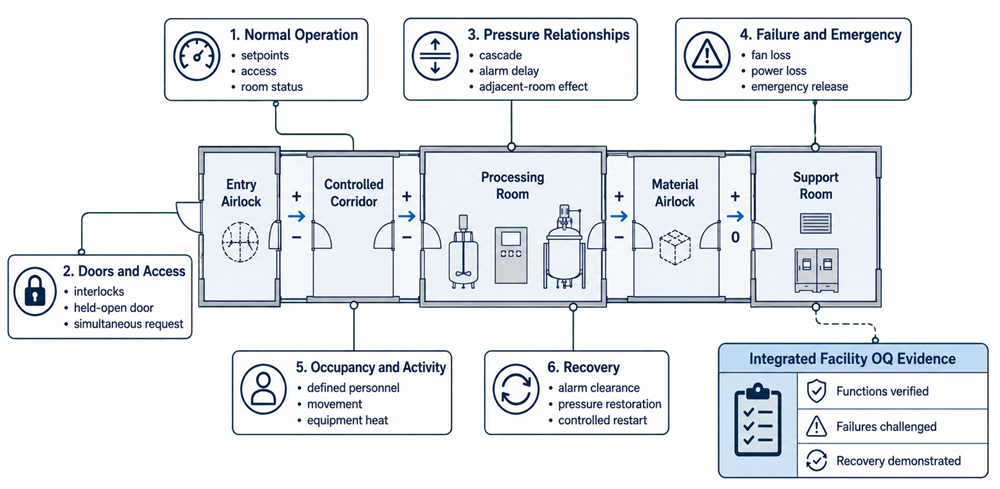
Facility Operational Qualification provides documented evidence that integrated facility functions operate as intended throughout approved operating ranges and respond correctly to defined challenge, alarm, failure, emergency, and recovery conditions.
Facility OQ evaluates the facility as a coordinated operational environment. It focuses on interactions among rooms, architectural features, doors, access controls, pressure relationships, environmental controls, monitoring systems, utilities, alarms, interlocks, emergency functions, operating procedures, and personnel activities.
Facility OQ may include verification of:
- Room operating states
- Environmental setpoints and ranges
- Room-to-room pressure relationships
- Door operation and interlocks
- Access-control functions
- Airlock and pass-through sequences
- Alarm generation, indication, notification, acknowledgement, and clearance
- Facility automation interfaces
- Utility availability and failure indications
- Emergency functions
- Power-loss responses
- Operating-mode changes
- Defined occupancy and activity conditions
- Response to abnormal conditions
- Recovery following failures or excursions
- Readiness for environmental performance verification and intended operation
Facility OQ does not simply repeat individual HVAC, automation, utility, security, or electrical tests. It determines whether these systems work together to support the intended facility-control strategy.
Detailed installation verification belongs in Facility Installation Qualification. Sustained environmental performance under representative operating conditions requires subsequent performance verification and routine monitoring.
Regulatory and Lifecycle Basis
21 CFR Part 211, Subpart C establishes requirements for pharmaceutical buildings and facilities.
21 CFR 211.42 requires suitable construction, adequate space, orderly placement, and defined areas or other controls necessary to prevent contamination and mix-ups.
21 CFR 211.46 addresses ventilation, filtration, air pressure, microorganisms, dust, humidity, temperature, exhaust, and air recirculation.
When automated equipment is used, 21 CFR 211.68 requires appropriate controls to ensure proper operation and control of changes.
These regulations establish required outcomes but do not prescribe a universal facility OQ protocol. Facility OQ provides controlled evidence that the installed facility can achieve and maintain the operational conditions on which those outcomes depend.
FDA’s Process Validation: General Principles and Practices guidance places facility and utility qualification before process performance qualification. For sterile operations, FDA’s Aseptic Processing CGMP Guidance provides additional recommendations concerning clean-area control, airflow, pressure relationships, environmental conditions, alarms, and facility operation.
The OQ scope and testing depth should be based on intended use, approved requirements, contamination risks, process risks, system complexity, design controls, and the consequences of operational failure.
Position of OQ in the Facility Lifecycle
Facility OQ follows sufficient completion of construction, commissioning, and IQ.
The typical progression is:
- Define intended use and facility requirements.
- Complete facility design and risk assessment.
- Perform Facility Design Qualification.
- Construct and commission the facility.
- Complete facility and system IQ activities.
- Establish the controlled as-built configuration.
- Confirm readiness for functional challenge testing.
- Execute facility and system OQ.
- Resolve deviations and confirm recovery capability.
- Perform environmental and performance verification.
- Complete operational-readiness activities.
- Approve the facility for its intended GMP use.
Controlled overlap between IQ and OQ may be acceptable for phased projects when system boundaries are clear, applicable prerequisites are complete, configuration is controlled, and remaining work cannot invalidate OQ results.
Facility OQ should not proceed where unresolved installation defects, uncontrolled field changes, missing instruments, incomplete automation configuration, or construction activities could invalidate functional testing.
The complete facility qualification lifecycle should define the relationships among commissioning, IQ, facility OQ, system-specific OQ, environmental performance verification, and release.
Defining the Facility OQ Boundary
The OQ boundary should be established before protocol development.
The scope may be organized by:
- Building
- Floor
- Operational area
- Room group
- Cleanroom suite
- HVAC zone
- Pressure-control zone
- Personnel or material route
- Utility boundary
- Automation package
- Qualification package
- Phased-release area
The boundary should identify:
- Rooms and spaces included
- Facility functions included
- Operating states included
- HVAC and utility interfaces
- Doors, airlocks, and pass-throughs
- Access-control functions
- Automation and monitoring functions
- Alarm and interlock dependencies
- Emergency and power interfaces
- Tests performed in separate system protocols
- Commissioning evidence intended for use
- Exclusions and their justification
- Adjacent areas that could affect the qualified boundary
A room cannot always be tested independently of its surrounding spaces. Door operation, pressure relationships, airflow direction, shared utilities, access controls, exhaust systems, and emergency modes may produce effects beyond the nominal room boundary.
The selected OQ boundary must therefore support meaningful integrated testing.
Facility OQ Versus HVAC OQ
Facility OQ and HVAC OQ are related but not interchangeable.
HVAC OQ
HVAC Operational Qualification focuses on the air-handling and environmental-control system itself.
Typical HVAC OQ scope includes:
- Air-handling-unit operating modes
- Supply, return, and exhaust fan operation
- Fan rotation and status
- Start and stop sequences
- Damper modulation
- Heating and cooling control
- Humidification or dehumidification control
- Filter differential-pressure monitoring
- Airflow control loops
- Variable-air-volume terminal operation
- Sensor and transmitter functions
- Local and remote status indication
- HVAC alarm functions
- Setpoint adjustment controls
- Loss-of-signal responses
- Equipment-failure responses
- Lead-lag or standby-unit changeover
- Building-automation interfaces
- System recovery following shutdown
- Verification of defined airflow, temperature, humidity, and pressure-control capability
HVAC OQ answers:
Does the HVAC system operate correctly throughout its defined functional and control ranges?
Facility OQ
Facility OQ focuses on integrated room and facility behavior.
Typical facility OQ scope includes:
- Room operating-state changes
- Room-to-room pressure relationships
- Effects of door operation on pressure control
- Airlock and pass-through sequences
- Access-control and door-interlock functions
- Effects of occupancy and movement
- Coordination of supply and exhaust systems
- Facility-wide alarm routing
- Emergency modes
- Power-loss response
- Utility-failure effects
- Adjacent-area interactions
- Controlled shutdown and restart
- Recovery of required room conditions
- Implementation of alarm-response and operating procedures
Facility OQ answers:
Does the integrated facility operate as intended when rooms, doors, people, automation, HVAC, utilities, alarms, and emergency functions interact?
Shared Evidence
Some evidence may support both activities.
For example, HVAC testing may demonstrate that individual pressure-control loops reach their setpoints. Facility OQ may then challenge the complete pressure cascade while doors, airlocks, access controls, exhaust systems, and adjacent rooms operate in defined combinations.
The qualification plan should identify:
- Which protocol generates the original evidence
- Which requirements the evidence satisfies
- Whether integrated confirmation is required
- How the evidence is referenced
- Which deviations could affect both protocols
Testing should not be duplicated merely because two protocols use the same measurement. However, successful component testing should not be treated as proof of integrated facility performance when critical interactions have not been challenged.
OQ Prerequisites
Before facility OQ execution, applicable prerequisites should be confirmed.
These may include:
- Approved OQ protocol
- Defined facility boundary
- Approved requirements and acceptance criteria
- Approved design and operating documents
- Accepted facility IQ status
- Accepted supporting-system IQ status
- Completed commissioning necessary for OQ
- Controlled as-built drawings
- Approved automation configuration
- Current control narratives
- Current cause-and-effect matrices
- Current alarm and interlock lists
- Current room-data sheets
- Current pressure-cascade diagrams
- Required utilities available
- Required systems placed into service
- Instruments calibrated
- Qualification test instruments calibrated
- Data-acquisition systems available
- Required operating procedures available
- Required emergency procedures available
- Personnel trained for test participation
- Test areas clean and controlled
- Construction activities adequately restricted
- Open punch-list items assessed
- Critical deviations resolved
- Safety review completed
- Test restoration plan available
A prerequisite should not be marked complete solely because a document exists. Its content and status must support the planned test.
If a required prerequisite is incomplete, the affected test should be deferred unless an approved assessment demonstrates that execution remains valid.
Facility OQ Planning
The OQ protocol or controlled test package should define:
- Purpose and scope
- System and facility boundaries
- Responsibilities
- Applicable requirements
- Reference documents and revisions
- Prerequisites
- Operating states
- Test conditions
- Challenge methods
- Expected system responses
- Acceptance criteria
- Test instruments
- Data-recording requirements
- Required hold or stabilization periods
- Alarm and event-record review
- Restoration steps
- Safety controls
- Deviation handling
- Traceability
- Approval requirements
- Criteria for progression
Testing should be based on approved functional requirements and risk assessment. It should not consist of generic challenges copied from another facility without considering the actual control strategy.
Each challenge should define:
- Initial condition
- Function or failure introduced
- Expected local response
- Expected remote response
- Alarm or interlock expected
- Permitted response time
- Effect on adjacent rooms or systems
- Operator action required
- Data to be recorded
- Recovery method
- Final acceptable condition
The protocol should identify which controls may be deliberately overridden, forced, disconnected, or simulated. Such actions require authorization, technical controls, restoration verification, and protection against unintended operation.
Functional Challenge Matrix
A functional challenge matrix connects facility requirements and risks to defined test conditions.
The matrix should identify:
| Facility function | Normal condition | Challenge condition | Failure condition | Recovery evidence |
|---|---|---|---|---|
| Room pressure | Required cascade established | Door opened or adjacent condition changed | Fan, sensor, or control loss | Cascade restored within defined time |
| Door interlock | Approved sequence permits access | Simultaneous door request | Interlock or communication failure | Secure operating state restored |
| Environmental control | Conditions within approved ranges | Setpoint or load changed | HVAC or utility loss | Conditions return to approved range |
| Alarm management | Normal status displayed | Alarm threshold challenged | Notification or communication failure | Alarm clears and records remain complete |
| Access control | Authorized entry permitted | Invalid or restricted request | Power or network interruption | Defined access state restored |
| Emergency function | Normal operating mode | Emergency function initiated | Loss of supporting power or signal | Controlled reset and restart |
| Facility automation | Correct status and control | Mode or command changed | Signal, sensor, or controller failure | Configuration and control restored |
| Utility interface | Required utility available | Demand or operating mode changed | Utility interruption | Utility and affected facility functions restored |
The matrix should include only meaningful challenges. Testing every theoretical combination is neither practical nor technically useful.
Combination testing should focus on credible interactions that could:
- Compromise product protection
- Reverse a pressure relationship
- Defeat segregation
- Permit simultaneous door opening
- Prevent alarm annunciation
- Create an uncontrolled room state
- Affect multiple rooms
- Prevent safe shutdown
- Delay recovery
- Produce misleading status information
Verification of Normal Operation
Facility OQ should first establish that the integrated facility operates correctly under defined normal conditions.
Normal-operation verification may include:
- Correct room operating mode
- Required pressure relationships
- Temperature and humidity control
- Correct door and access status
- Functional airlock sequences
- Correct automation displays
- Correct room-status indication
- Required utilities available
- Alarm-free normal state
- Correct system time
- Appropriate trend generation
- Appropriate status recording
- Correct interaction with adjacent areas
- Stable conditions during routine equipment operation
Normal conditions must be defined. Phrases such as “room operating normally” are inadequate without identifying:
- Systems operating
- Doors normally closed or in use
- Required occupancy
- Equipment operating
- Utility demand
- Environmental setpoints
- Room-use status
- Adjacent-room condition
- Required stabilization period
Normal-operation testing establishes the baseline from which challenge and failure responses are evaluated.
Room Operating States and Mode Changes
Facilities may use different operating modes, such as:
- Unoccupied
- At rest
- Operational
- Production
- Cleaning
- Sanitation
- Decontamination
- Maintenance
- Reduced setback
- Night or unoccupied setback
- Shutdown
- Emergency
- Recovery
- Restricted access
Facility OQ should verify applicable mode transitions.
Testing may address:
- Authorization to change mode
- Correct initiation of the mode
- HVAC response
- Pressure-setpoint changes
- Access restrictions
- Alarm-limit changes
- Monitoring status
- Exhaust operation
- Door or pass-through availability
- Status indication
- Event recording
- Required delay or stabilization
- Prevention of incompatible modes
- Return to the approved operating state
A mode label alone does not establish a controlled state. The functions associated with each mode should be defined in an approved control narrative, operating matrix, or equivalent document.
Doors, Airlocks, and Pass-Throughs
Doors and controlled-transfer devices are important elements of facility segregation.
Facility OQ may verify:
- Door opening and closing
- Automatic closing
- Door-position indication
- Interlock sequence
- Simultaneous opening prevention
- Access authorization
- Access denial
- Emergency release
- Local and remote alarm indication
- Held-open alarm
- Alarm delay
- Door-status display
- Pass-through interlocks
- Automatic locking
- Manual override
- Reset function
- Response following power loss
- Response following communication loss
- Restoration following an emergency release
Challenges may include:
- Requesting both interlocked doors simultaneously
- Holding one door open beyond the approved delay
- Attempting unauthorized access
- Interrupting door-position feedback
- Simulating a failed latch or lock indication
- Removing normal power
- Initiating emergency release
- Challenging the sequence from both sides
- Operating adjacent airlocks concurrently
- Evaluating pressure response during the permitted sequence
The facility-control strategy should define whether an interlock is required for product protection, containment, access security, procedural control, or a combination of purposes.
Door interlocks should not create an unacceptable life-safety hazard. Emergency-release requirements take precedence over contamination-control preferences, and the resulting facility response should be evaluated and documented.
Pressure Relationships and Airflow Direction
Facility OQ should confirm that required pressure relationships function as an integrated cascade.
Testing may address:
- Room-to-room pressure differentials
- Indication at local displays
- Indication at remote systems
- Normal pressure stability
- Alarm thresholds
- Alarm delays
- Alarm notification
- Alarm acknowledgement
- Pressure response to door opening
- Response to adjacent door opening
- Response during airlock operation
- Response to occupancy and movement
- Effect of exhaust-system operation
- Effect of equipment extraction
- Response to supply or exhaust reduction
- Pressure reversal prevention
- Recovery after disturbance
- Response after controlled shutdown and restart
The applicable pressure and airflow strategy is discussed in Airflow Patterns and Pressure Cascades.
A single point-in-time pressure reading does not demonstrate operational control. The test should evaluate the required relationship over a justified observation period and under defined challenge conditions.
Acceptance should consider:
- Required direction
- Approved differential-pressure range
- Permitted transient
- Alarm limit
- Alarm delay
- Duration of the challenge
- Recovery time
- Effects on adjacent spaces
- Intended use of the affected rooms
Brief pressure loss during an authorized door opening may be acceptable when it is expected, limited, controlled, and followed by recovery. Persistent reversal or unrecognized loss of the intended cascade requires investigation.
Detailed airflow, HEPA-filter, air-change, and differential-pressure measurements may be generated through Airflow, Filtration, and Pressure Verification. Facility OQ should reference that evidence while retaining responsibility for integrated facility challenges.
Temperature, Humidity, and Environmental Ranges
Facility OQ should verify that environmental controls operate throughout approved ranges relevant to the facility’s intended use.
Testing may include:
- Normal setpoint control
- Permitted setpoint adjustment
- Upper and lower alarm challenges
- Sensor failure response
- Loss of heating
- Loss of cooling
- Loss of humidification
- Loss of dehumidification
- Response to equipment heat load
- Response to occupancy
- Response to door activity
- Response to outdoor-condition changes
- Recovery after an excursion
- Correct display, trending, and alarm recording
OQ generally demonstrates functional control and response. Spatial environmental mapping and demonstration of conditions throughout the usable room volume may belong to environmental performance qualification.
Acceptance criteria should distinguish among:
- Control setpoint
- Normal operating range
- Alert level
- Alarm level
- Product or process limit
- Permitted transient
- Required recovery time
These values should not be treated as interchangeable.
Access Control and Facility Status
Facility access functions may affect segregation, controlled flow, data security, and prevention of unauthorized entry.
Facility OQ may verify:
- Authorized access
- Unauthorized-access denial
- Role-based access
- Time-based restrictions
- Area-status restrictions
- Anti-passback functions where used
- Door-position status
- Forced-door alarms
- Held-open alarms
- Local alarm indication
- Remote alarm notification
- Event recording
- Emergency egress
- Power-loss behavior
- Communication-loss behavior
- Restoration following interruption
Access-control testing should be coordinated with door-interlock and emergency testing. Successful security-system testing alone does not demonstrate that pressure control and contamination-control functions remain acceptable during access events.
Facility Automation and Monitoring Interfaces
Facility OQ should verify the integrated use of automation systems that monitor or control facility functions.
Testing may address:
- Room-status displays
- Graphical displays
- System navigation
- Control commands
- Mode changes
- Setpoint controls
- Alarm generation
- Alarm priorities
- Alarm delays
- Alarm routing
- Alarm acknowledgement
- Alarm clearance
- Alarm history
- Event history
- Trend generation
- Time synchronization
- Data recording
- Communication failure
- Sensor failure
- Input and output failure
- Loss of controller
- Loss of server
- Loss of network
- Backup or standby function
- System restart
- Restoration of configuration
- Interfaces among building, environmental, security, and utility systems
Detailed automation verification should be performed under the Qualification and Verification of Facility Automation Systems strategy.
Facility OQ should focus on whether automation supports the intended facility response. For example, a pressure transmitter may be calibrated and the alarm logic may function correctly, but the facility-level test must still confirm that the alarm corresponds to an actual unacceptable room condition and reaches the personnel responsible for responding.
Alarm Verification
Facility OQ should verify alarms that support product quality, contamination control, containment, safety, or reliable facility operation.
Alarm testing should address applicable:
- Initiating condition
- Threshold
- Delay
- Priority
- Local indication
- Remote indication
- Audible or visual annunciation
- Notification
- Acknowledgement
- Recorded value
- Timestamp
- Event history
- Required operator action
- Escalation
- Clearance
- Return-to-normal indication
- Latched or nonlatched behavior
- Response after power or communication loss
Alarm testing should not be limited to forcing a digital input and observing a screen message when the actual process condition can be safely challenged.
Where simulation is necessary, the protocol should explain:
- Why direct challenge is impractical or unsafe
- What portion of the alarm chain is tested
- What evidence verifies the excluded portion
- How the simulation is controlled
- How normal configuration is restored
An alarm should be challenged sufficiently to verify the complete intended path from initiating condition to documented response.
Interlocks and Protective Functions
Interlocks prevent or restrict actions that could create an unacceptable facility condition.
Examples include:
- Simultaneous opening of airlock doors
- Operation in an incompatible room mode
- Starting equipment without required exhaust
- Opening a transfer device under prohibited conditions
- Entering an area during decontamination
- Changing a controlled setpoint without authorization
- Operating with a failed safety or containment condition
- Starting a system before required utilities are available
Interlock testing should verify:
- Initiating condition
- Prevented action
- Permitted action
- Local indication
- Remote indication
- Alarm generation
- Manual override controls
- Override recording
- Restoration
- Fail-safe or defined failure position
- Interaction with emergency functions
Interlocks should be challenged in combinations where the design depends on coordinated logic. Testing each input independently may not reveal sequencing conflicts.
Utility Interfaces and Loss of Utility
Facility functions may depend on:
- Normal electrical power
- Emergency power
- Uninterruptible power
- Compressed air
- Chilled water
- Heating water
- Steam
- Process gases
- Vacuum
- Potable water
- Clean utilities
- Data networks
- Communications
- Exhaust systems
Facility OQ should assess credible utility interruptions.
Testing may verify:
- Alarm generation
- Automatic transfer
- Standby-system operation
- Controlled shutdown
- Equipment fail position
- Access status
- Door status
- Environmental effect
- Pressure effect
- Data continuity
- Notification
- Required operator action
- Restoration sequence
- Controlled restart
- Recovery of required conditions
Not every facility requires physical interruption of every utility. Simulation may be appropriate where direct interruption would create unacceptable safety, equipment, or business risk.
The selected method must still verify the intended functional response.
Power-Failure and Emergency Conditions
Facility OQ should evaluate the facility response to applicable power and emergency conditions.
These may include:
- Loss of normal power
- Transfer to emergency power
- Loss of emergency power
- Uninterruptible-power operation
- Fire-alarm initiation
- Emergency ventilation mode
- Emergency exhaust
- Emergency shutdown
- Emergency door release
- Security lockdown or release
- Utility isolation
- Hazardous-material response
- Evacuation mode
- Loss of automation communication
Testing should confirm:
- Which systems continue operating
- Which systems stop
- Equipment fail positions
- Door and access status
- Pressure relationships
- Alarm generation
- Emergency notification
- Data continuity
- Manual actions required
- Conditions for restart
- Restoration sequence
- Need for environmental recovery or additional monitoring
Facility emergency functions must be coordinated with applicable building, fire, electrical, environmental, health, and safety requirements. Qualification personnel should not defeat or disrupt life-safety functions without an approved test plan and authorized safety controls.
A facility may not maintain every GMP condition during a genuine emergency. The control strategy should instead define:
- Safe system response
- Protection or disposition of exposed materials
- Access restrictions
- Required assessment
- Recovery criteria
- Conditions for resuming GMP operations
Occupancy-Related Conditions
Occupancy affects room pressure, temperature, humidity, particulate generation, airflow disturbance, door use, and equipment heat load.
Facility OQ should evaluate occupancy-related functions where they affect facility control.
Possible conditions include:
- Defined minimum occupancy
- Defined maximum or challenge occupancy
- Personnel movement through doors
- Concurrent use of airlocks
- Material transfers
- Equipment operation
- Equipment heat load
- Cleaning activities
- Mobile equipment movement
- Use of local exhaust
- Use of pass-throughs
- Adjacent-room activity
OQ does not need to reproduce full commercial manufacturing unless that is required to evaluate a facility function. Controlled simulations may be used to challenge:
- Door frequency
- Heat load
- Airlock traffic
- Equipment operation
- Exhaust demand
- Personnel movement
- Simultaneous facility activities
The test should define the number of people, equipment state, movement pattern, duration, and adjacent-room conditions.
Environmental performance qualification should subsequently determine whether required environmental conditions are maintained during representative operations. Facility OQ verifies that the controls and responses needed to support those operations function correctly.
Seasonal Conditions
Outdoor temperature and humidity may affect HVAC capacity, room recovery, condensation risk, pressurization, humidification, dehumidification, and utility demand.
Seasonal OQ considerations may include:
- Summer cooling load
- Winter heating load
- High outdoor humidity
- Low outdoor humidity
- Seasonal pressure variation
- Seasonal utility capacity
- Freeze-protection functions
- Condensation prevention
- Economizer or outdoor-air modes
- Seasonal alarm limits
- Seasonal mode changes
- Recovery during adverse outdoor conditions
Seasonal requirements should be identified during design and qualification planning.
Evidence may be obtained through:
- Direct testing during representative seasonal conditions
- Approved design calculations
- Commissioning load tests
- Controlled load simulation
- Manipulation within approved operating ranges
- Trend review during initial operation
- Deferred seasonal verification under an approved protocol
Facility release does not always need to wait for both seasonal extremes when design evidence and available challenge testing adequately support initial operation. Any deferred seasonal verification should have:
- Defined scope
- Scientific justification
- Interim operating restrictions if required
- Responsible owner
- Target period
- Acceptance criteria
- Deviation requirements
- Final approval
Seasonal testing should verify real operational capability, not merely record outdoor weather conditions.
Failure-Condition Testing
Facility OQ should challenge credible failures identified through design review, risk assessment, commissioning, operating experience, or control-system analysis.
Potential failures include:
- Supply-fan failure
- Return-fan failure
- Exhaust-fan failure
- Standby-fan failure
- Damper failure
- Valve failure
- Sensor failure
- Transmitter signal loss
- Controller failure
- Network interruption
- Server interruption
- Power failure
- Emergency-power failure
- Door-position failure
- Interlock failure
- Access-control failure
- Utility loss
- Communication failure
- High or low environmental condition
- Simultaneous demand on shared systems
Failure testing should determine:
- Whether the failure is detected
- Whether the indicated status is accurate
- Whether the correct alarm is generated
- Whether affected systems move to defined positions or modes
- Whether the effect propagates to adjacent rooms
- Whether personnel receive adequate notification
- Whether procedures provide appropriate response
- Whether unsafe automatic restart is prevented
- Whether recovery can be completed in a controlled manner
Testing should prioritize credible failures with significant consequences. It should not create uncontrolled damage merely to demonstrate an already well-supported low-risk function.
Recovery Testing
Recovery is part of OQ. Demonstrating an alarm without demonstrating restoration leaves the operating sequence incomplete.
Recovery testing may address:
- Removal of the initiating failure
- Alarm acknowledgement
- Alarm clearance
- Restoration of utilities
- Restoration of communication
- Restart sequence
- Return of fans and controls
- Re-establishment of pressure relationships
- Return of temperature and humidity
- Restoration of access functions
- Restoration of door interlocks
- Confirmation of correct operating mode
- Verification of trend and event continuity
- Inspection for retained overrides or forced values
- Required operator actions
- Required environmental assessment
- Authorization to resume operation
Recovery acceptance criteria may include:
- Correct sequence
- No uncontrolled restart
- No inappropriate alarm clearance
- Required conditions restored
- Recovery within an approved time
- Correct status displayed
- Required events recorded
- No unresolved forced values
- No unacceptable effect on adjacent areas
- Required procedural actions completed
Recovery time should be defined where delayed restoration could affect exposed product, environmental control, containment, workflow, or facility availability.
Use of Commissioning and System-Specific Evidence
Commissioning and system-specific OQ evidence may support facility OQ when it is suitable for the intended qualification purpose.
Existing evidence should be evaluated for:
- Applicable scope
- Test method
- Acceptance criteria
- Initial conditions
- Challenge conditions
- Instrument calibration
- Raw-data availability
- Traceability
- Configuration
- Deviations
- Review and approval
- Correspondence with the final installed system
- Coverage of integrated facility requirements
Evidence may be referenced when it directly satisfies the requirement.
Additional facility-level testing is needed when:
- The original test addressed only a component.
- Interactions among systems were not evaluated.
- Room or adjacent-area effects were excluded.
- Door, access, or occupancy effects were not included.
- Alarm routing was not challenged through the complete path.
- Recovery was not demonstrated.
- The configuration changed after testing.
- Acceptance criteria were inadequate.
- Supporting records are incomplete or uncontrolled.
Leveraging appropriate engineering evidence prevents unnecessary repetition. It does not eliminate the need to demonstrate integrated operation.
Data Collection and Test Instruments
Facility OQ data may be generated using:
- Installed room instruments
- Building-automation trends
- Environmental-monitoring systems
- Portable differential-pressure meters
- Temperature and humidity data loggers
- Airflow instruments
- Electrical test instruments
- Event and alarm histories
- Video recording
- Door-event records
- Access-control logs
- Network or communication logs
The protocol should identify:
- Instrument identifier
- Calibration status
- Measurement range
- Accuracy
- Resolution
- Sampling interval
- Sensor location
- Time synchronization
- Data source
- Raw-data retention
- Calculation method
- Acceptance method
Sampling intervals should be sufficient to capture brief pressure reversals, alarm delays, system transitions, and recovery behavior.
Data from multiple systems should use synchronized time where event sequence matters. Unsynchronized clocks can make it impossible to determine whether alarms, door events, system responses, and recovery occurred in the correct order.
OQ Acceptance Criteria
Facility OQ acceptance criteria should be approved before execution.
Typical criteria include:
- Defined functions operate as approved.
- Applicable operating modes function correctly.
- Required room pressure relationships are established.
- Permitted disturbances remain within approved limits.
- Door and airlock sequences function correctly.
- Access restrictions operate as intended.
- Environmental controls operate within defined ranges.
- Alarm thresholds and delays are correct.
- Alarms are indicated, transmitted, recorded, acknowledged, and cleared correctly.
- Interlocks prevent prohibited actions.
- Facility automation displays correct status.
- Utility losses produce the defined response.
- Power failure produces the defined safe or controlled condition.
- Emergency functions operate correctly.
- Credible failures are detected and appropriately controlled.
- Adjacent-room and shared-system effects are acceptable.
- Defined occupancy and activity challenges produce acceptable responses.
- Seasonal capability is demonstrated or controlled through an approved deferred plan.
- Recovery sequences operate correctly.
- Required conditions are restored within approved times.
- Data and event records remain complete.
- Forced values, overrides, and temporary configurations are removed.
- Deviations have approved dispositions.
- Traceability is complete.
- The facility is ready for required performance verification.
Acceptance criteria should be quantitative where meaningful.
Examples include:
- Pressure differential
- Temperature or humidity range
- Alarm threshold
- Alarm delay
- Door-held-open time
- Standby-system transfer time
- Recovery time
- Required notification time
- Permitted transient duration
- Data-sampling interval
“Operates as expected” is not an adequate criterion unless the expected response is defined in the protocol or a specific approved reference.
Deviations and Unexpected Results
Unexpected conditions may include:
- Incorrect response
- Missing alarm
- Incorrect alarm delay
- Wrong alarm priority
- Incorrect interlock
- Pressure reversal
- Excessive recovery time
- Incorrect display
- Missing data
- Unrecorded override
- Incorrect fail position
- Failure to transfer to standby service
- Unacceptable adjacent-room effect
- Incomplete restoration
- Difference between the control narrative and actual logic
The deviation record should address:
- Expected condition
- Actual condition
- Test step and challenge
- Affected room or system
- Immediate correction or containment
- Product-quality and contamination-control impact
- Effect on adjacent systems
- Root cause where required
- Corrective action
- Retesting
- Effect on previously completed tests
- Document or configuration changes
- Final disposition
- Approval
A failed test should not be accepted by rewriting the expected result after execution unless the original requirement or criterion is demonstrably incorrect and the change is technically justified, assessed, and approved.
Retesting should demonstrate correction. It should not erase the original failure.
Traceability
Facility OQ should maintain traceability among:
- User requirements
- Functional requirements
- Design criteria
- Risk controls
- Control narratives
- Cause-and-effect matrices
- Alarm and interlock lists
- Commissioning tests
- System-specific OQ tests
- Facility functional challenges
- Deviations
- Recovery evidence
- Performance-verification requirements
- Final acceptance status
Each requirement should have a clear disposition, such as:
- Verified directly in facility OQ
- Verified through accepted HVAC OQ evidence
- Verified through accepted automation evidence
- Verified through accepted commissioning evidence
- Assigned to performance verification
- Deferred under an approved seasonal plan
- Not applicable with justification
- Open and preventing progression
Traceability should identify the actual test and result. A reference to an entire commissioning report or automation package does not show how a specific facility requirement was satisfied.
Readiness for Environmental and Performance Verification
Facility OQ completion should support a documented decision that the qualified area is ready for subsequent performance testing.
Readiness may require confirmation that:
- Applicable facility functions passed OQ.
- Required HVAC functions passed OQ.
- Pressure relationships are acceptable.
- Environmental-control functions are stable.
- Doors, airlocks, and access controls operate correctly.
- Critical alarms and interlocks are functional.
- Automation and monitoring systems are available.
- Required utilities are reliable.
- Critical deviations are resolved.
- Remaining open items have acceptable impact assessments.
- Required procedures are approved.
- Required personnel are trained.
- Environmental-monitoring systems are ready.
- Required cleaning and sanitation have been completed.
- The test configuration is controlled.
- Deferred seasonal work is formally managed.
- Traceability supports progression.
Environmental performance testing may then evaluate whether the facility maintains required conditions throughout the controlled space under defined at-rest and operational conditions.
Routine environmental monitoring cannot substitute for incomplete facility OQ.
OQ Report
The facility OQ report should summarize:
- Scope and boundaries
- Protocols executed
- Supporting evidence leveraged
- Operating states tested
- Normal conditions verified
- Challenges performed
- Failure conditions tested
- Emergency conditions tested
- Occupancy-related conditions tested
- Seasonal evidence or deferrals
- Recovery tests
- Deviations
- Retesting
- Acceptance-criteria status
- Traceability status
- Open actions
- Restrictions
- Readiness for performance verification
- Final conclusion
- Approval
The report should identify:
- Tested configuration
- Applicable document revisions
- Automation version or configuration where relevant
- Alarm and interlock baseline
- Outstanding limitations
- Deferred activities
- Conditions for continued progression
OQ approval demonstrates that the defined facility functions operated acceptably during approved testing. It does not demonstrate indefinite control or remove the need for monitoring, maintenance, calibration, change control, periodic review, and requalification.
Relationship Between Facility OQ and Performance Verification
| Activity | Principal question |
|---|---|
| Commissioning | Have systems been started, adjusted, balanced, and made functional according to the design? |
| Facility IQ | Does the as-built facility conform to approved requirements, drawings, specifications, and installation criteria? |
| HVAC OQ | Does the air-handling system operate correctly throughout its defined functional and control ranges? |
| Facility OQ | Do integrated rooms and facility functions respond correctly during normal, challenge, failure, emergency, and recovery conditions? |
| Environmental performance verification | Does the controlled environment achieve and maintain required conditions throughout the defined space under applicable operating conditions? |
| Routine monitoring | Does continuing evidence indicate that the qualified facility remains in control? |
Facility OQ cannot compensate for an unsuitable design, incomplete installation, or inadequately commissioned systems.
Successful HVAC OQ does not by itself demonstrate that facility flows, doors, access functions, room interactions, emergency modes, or operational procedures work together acceptably.
Common Facility OQ Weaknesses
Common weaknesses include:
- Treating facility OQ as a duplicate of HVAC OQ
- Testing individual components without integrated challenges
- Undefined facility boundaries
- Beginning OQ before critical IQ prerequisites are complete
- Using superseded control narratives
- Undefined normal operating conditions
- Testing only normal operation
- Omitting upper and lower operating ranges
- No defined room operating modes
- No testing of mode transitions
- Testing alarms only by forcing software inputs
- Verifying alarm display without notification and response
- Testing interlocks independently without sequence challenges
- Omitting simultaneous door requests
- Ignoring held-open-door conditions
- Measuring pressure only with all doors closed
- Ignoring adjacent-room effects
- Failing to evaluate exhaust and supply-system interactions
- Omitting occupancy and equipment heat-load effects
- Treating full operational simulation as unnecessary in every case
- Failing to distinguish OQ simulation from performance verification
- Ignoring seasonal operating conditions
- Deferring seasonal testing without a controlled plan
- Omitting power-loss and utility-loss testing
- Testing shutdown without testing restart
- Demonstrating alarms without demonstrating recovery
- Failing to remove forced values and temporary overrides
- Unsynchronized automation, door, access, and monitoring records
- Insufficient data-sampling frequency
- Leveraging commissioning evidence without assessing suitability
- Repeating system tests without examining facility integration
- Inadequate emergency-function coordination
- Expecting GMP conditions to remain unchanged during every emergency
- No defined material or operational response after environmental loss
- Failed tests accepted through revised expectations
- Retesting without documenting the original failure
- Incomplete traceability
- Declaring readiness without resolving critical deviations
- Treating OQ approval as final facility release
These weaknesses leave uncertainty about how the facility will behave when real systems, rooms, people, failures, and recovery actions interact.
Summary
Facility Operational Qualification verifies the integrated operation of a GMP facility.
It determines whether rooms, doors, airlocks, access controls, environmental controls, pressure relationships, utilities, automation, alarms, interlocks, emergency functions, and operating procedures work together as intended.
Facility OQ is distinct from HVAC OQ. HVAC OQ evaluates the air-handling system’s components, sequences, control loops, alarms, and operating capability. Facility OQ evaluates the resulting room and facility behavior, including interactions with doors, adjacent areas, access controls, occupancy, utilities, emergency conditions, and recovery.
Effective OQ addresses:
- Normal operating conditions
- Operating ranges and mode changes
- Functional challenges
- Alarm and interlock operation
- Door and airlock sequences
- Pressure relationships
- Environmental-control functions
- Occupancy-related conditions
- Seasonal conditions
- Utility and power failures
- Emergency functions
- Adjacent-area effects
- Controlled shutdown
- Recovery and restart
OQ establishes that the installed facility can operate correctly. Subsequent performance verification demonstrates that the integrated environment supports its intended use under representative conditions. Routine monitoring then provides continuing evidence that the qualified state is maintained.