

HVAC Requalification Triggers and Periodic Review
A risk-based approach determines the additional or affected requalification scope. It does not eliminate classification, filter-integrity, certification, or other recurring tests required by an applicable standard, approved procedure, specification, regulatory commitment, or contamination-control strategy.
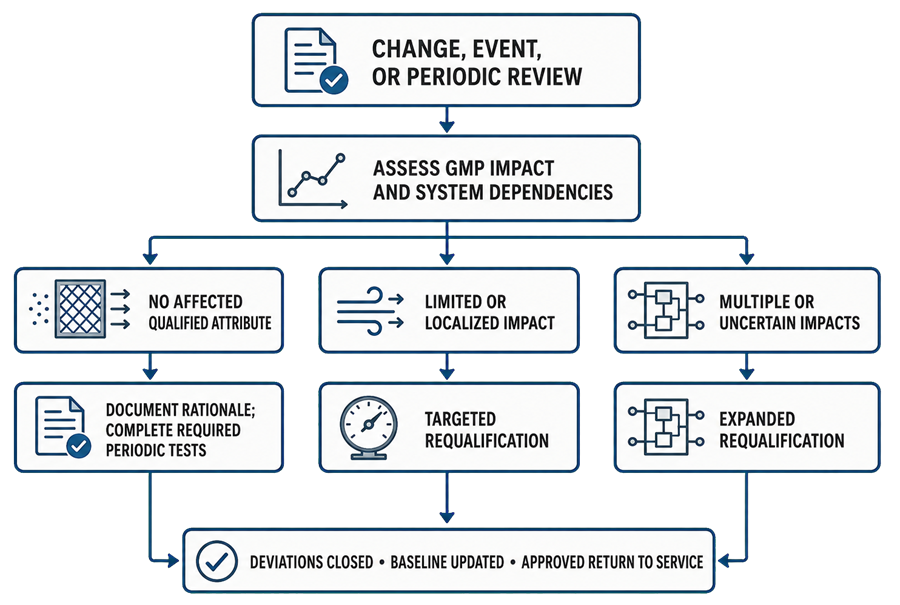
Purpose and Lifecycle Position
Initial HVAC qualification strategy establishes the approved system configuration, operating ranges, control functions, room conditions, acceptance criteria, and qualification baseline.
Following release, that state is maintained through:
- Approved operating procedures
- Preventive and corrective maintenance
- Instrument calibration
- Environmental and system monitoring
- Alarm and trend review
- Change control
- Deviation and CAPA management
- Periodic testing
- Periodic review
- Requalification when required
Requalification is not automatically a repetition of the original IQ, OQ, and room-performance package. Its scope should correspond to the affected requirements, functions, components, rooms, operating states, and dependent performance attributes.
Conversely, a narrow test is inadequate when the triggering event can affect several interconnected HVAC functions.
Regulatory and Technical Basis
21 CFR 211.46 requires adequate ventilation and, where appropriate, equipment for controlling air pressure, microorganisms, dust, humidity, and temperature. It also addresses air filtration, recirculated air, and exhaust systems.
FDA’s Sterile Drug Products Produced by Aseptic Processing—Current Good Manufacturing Practice provides recommendations concerning HEPA-filter integrity, airflow patterns, pressure relationships, cleanroom qualification, and continuing environmental control in aseptic-processing facilities.
Applicable cleanroom standards include:
- ISO 14644-1:2015 for classification of air cleanliness by airborne-particle concentration
- ISO 14644-2:2015 for a monitoring plan that provides evidence of cleanroom performance related to airborne-particle concentration
- ISO 14644-3:2019 for cleanroom and clean-zone test methods
The site should identify the specific regulations, standards, procedures, specifications, certification requirements, and contamination-control provisions adopted for each system and room.
Risk assessment can supplement those requirements and determine additional testing. It should not be used to disregard an explicitly applicable requirement.
Event-Driven Requalification
Event-driven requalification begins when a specific event could invalidate part of the existing qualification baseline. The assessment should determine:
- What changed or failed
- Why the event occurred
- When the affected condition began
- Which systems, rooms, components, and records are affected
- Which approved requirements or qualified attributes could be affected
- Whether product, process, environmental, or containment conditions were affected
- Whether previously generated qualification or monitoring evidence remains valid
- What correction, verification, and requalification are required
- What controls are needed before return to service
The assessment should occur through the applicable change control, deviation, investigation, maintenance, or CAPA process. Requalification should not be defined only after the work has been completed unless the event was an unplanned failure requiring immediate response.
Changes That May Trigger Requalification
Air-Handling and Air-Distribution Changes
Potential triggers include:
- Supply, return, or exhaust fan replacement
- Motor, drive, sheave, belt, or impeller changes affecting performance
- Damper, airflow-control valve, or terminal-unit replacement
- Ductwork modification
- Diffuser, grille, or return-location changes
- Addition or removal of supply, return, transfer, or exhaust terminals
- Airflow rebalancing
- Changes to outdoor-air or recirculated-air quantities
- Changes to pressure-control architecture
- Addition or modification of local exhaust
- Changes to shared or dedicated AHU arrangements
- Modification of occupied, unoccupied, setback, cleaning, or emergency modes
Minor replacement with a demonstrably equivalent component may require limited verification. Equivalence should be documented rather than assumed from a similar model number or physical appearance.
HEPA-Filter and Housing Work
Potential triggers include:
- HEPA-filter replacement
- Filter reseating
- Filter-media repair
- Seal or gasket replacement
- Housing or frame repair
- Modification of aerosol-injection or sampling ports
- Work that disturbs the filter, seal, frame, or housing
- Repeated installed-filter-system leakage failures
- Abnormal filter loading or pressure drop
Installed-filter-system leakage testing is normally required after filter replacement, repair, reseating, or work capable of affecting filter integrity.
Additional testing may be necessary when the work can affect:
- Airflow quantity
- Filter-face velocity
- Air distribution
- Room pressure
- Airflow visualization
- Particle classification
- Recovery performance
A passing local filter scan does not independently establish that all dependent room conditions remain acceptable.
Control-System and Instrumentation Changes
Potential triggers include:
- Control-logic modification
- Sequence-of-operation change
- Software or firmware update
- Setpoint or operating-range change
- Alarm threshold, delay, priority, or routing change
- Sensor or transmitter replacement
- Sensor relocation
- Change in engineering units, scaling, damping, or calculation
- Controller, network, or communication-interface replacement
- Building-management or environmental-monitoring interface change
- Changes to access, audit, trend, or record-retention functions
- Modification of failure responses or interlocks
Requalification scope should distinguish between the changed configuration and the functions that depend on it.
A pressure-transmitter replacement may require calibration and comparison with a reference instrument. A changed pressure-control sequence may require broader testing of control response, alarms, room pressure, door effects, recovery, and interactions with adjacent rooms or exhaust systems.
Room and Facility Changes
Potential triggers include:
- Wall, ceiling, door, window, or penetration modification
- Pass-through or airlock modification
- Changes to door closers, interlocks, or opening direction
- Equipment installation, removal, or relocation
- Changes to room volume or layout
- Changes to personnel, material, or waste flows
- Addition of barriers, curtains, partitions, or enclosures
- Changes affecting room leakage
- New heat, moisture, particle, vapor, or exhaust loads
- Construction or intrusive maintenance in a qualified area
The assessment should consider both physical changes and their effect on airflow paths, pressure relationships, cleaning, contamination transfer, and representative operation.
Room-Use and Process Changes
Potential triggers include:
- New product or process
- Increased product exposure
- Change in room classification
- Change from closed to open processing
- New contamination-control requirement
- New containment requirement
- Increased occupancy
- Increased intervention or transfer frequency
- New operating equipment
- Increased heat or moisture load
- New hazardous, sensitizing, potent, or dust-generating material
- Change in cleaning, sanitization, or decontamination practice
- Change in operating schedule or permitted HVAC setback
A system can remain mechanically unchanged while its qualified basis becomes inadequate because the intended use has changed.
Failures and Adverse Performance
Potential triggers include:
- Loss of supply, return, or exhaust airflow
- Reversal or repeated loss of a required pressure relationship
- HEPA-filter-integrity failure
- Cleanroom-classification failure
- Repeated viable or nonviable environmental excursions
- Unfavorable pressure, airflow, temperature, or humidity trends
- Repeated alarms or unexplained alarm suppression
- Failure of a critical alarm, interlock, or notification
- Failure to recover after a disturbance
- Condensation, freezing, or uncontrolled moisture
- Repeated sensor drift or calibration failure
- Extended operation outside an approved range
- Failure during seasonal load conditions
- Unplanned shutdown or prolonged loss of utilities
- Evidence that actual operation differs from the qualified condition
A single event does not always require full requalification. It always requires sufficient assessment to determine whether the qualified state or product-impact period has been affected.
Periodic Review
Periodic review is a documented evaluation of accumulated lifecycle evidence. It should not be reduced to confirmation that scheduled qualification tests were completed.
Its purpose is to determine whether:
- The approved configuration remains current
- Intended use and GMP-impact classification remain valid
- Critical requirements and operating ranges remain appropriate
- System performance remains stable
- Monitoring data support continued control
- Maintenance and calibration remain effective
- Changes were adequately assessed and closed
- Deviations and failures reveal recurring or systemic problems
- Required periodic tests remain current
- Existing qualification continues to represent actual operation
- Requalification or other corrective action is needed
Periodic review may conclude that no additional event-driven requalification is necessary. That conclusion does not cancel recurring tests already required by the approved program.
Periodic-Review Inputs
The review should evaluate a defined period and include, as applicable:
Configuration and Intended Use
- Current system boundary
- Current rooms and zones served
- Current process and room use
- Current room classification
- Product-protection and containment requirements
- Approved drawings and airflow schematics
- Equipment, instrument, filter, and terminal inventories
- Control-system hardware and software versions
- Current operating modes and setpoints
- Status of temporary modifications and overrides
Qualification and Periodic Testing
- Original qualification baseline
- Prior requalification reports
- Cleanroom-classification results
- Installed HEPA-filter-system leakage-test results
- Airflow-volume and velocity results
- Room differential-pressure results
- Airflow-visualization results
- Recovery-test results
- Temperature and humidity verification
- Alarm, interlock, failure-response, and control-sequence tests
- Deferred or seasonal-verification commitments
- Open qualification discrepancies
Monitoring and Performance Data
- Room-pressure trends
- Temperature and humidity trends
- Supply, return, and exhaust performance
- Fan speed, duct static pressure, and damper-position trends
- Filter differential-pressure trends
- Viable and nonviable environmental-monitoring trends
- Alarm frequency, duration, response, and recurrence
- Excursions and unexplained data gaps
- Seasonal performance
- Evidence of control instability or increasing variability
The review should evaluate patterns and interactions, not only whether individual results remained within limits.
Maintenance and Calibration
- Preventive and corrective maintenance history
- Fan, drive, belt, damper, coil, valve, humidifier, and filter work
- HEPA-filter repair and replacement
- Airflow balancing
- Instrument calibration history
- As-found calibration failures
- Sensor replacements and relocations
- Repeated component failures
- Deferred maintenance
- Temporary repairs
- Vendor notices and component obsolescence
- Spare-part or replacement-equivalence concerns
Quality-System Records
- Change controls
- Deviations and investigations
- CAPA
- Product-impact assessments
- Environmental excursions
- Complaints or quality events associated with environmental control
- Recurring procedural errors
- Audit or inspection findings
- Open commitments and overdue actions
Each record should be evaluated for cumulative impact. Several individually minor events may demonstrate gradual loss of control or an outdated qualification baseline.
Periodic Review Frequency
The periodic-review interval should be defined in an approved procedure or lifecycle plan.
The interval may consider:
- GMP impact
- Room classification
- Product exposure
- Sterility-assurance or containment risk
- System complexity
- Shared-system dependencies
- Performance history
- Frequency and significance of changes
- Failure and alarm history
- Monitoring capability
- Seasonal sensitivity
- Applicable standards and regulatory commitments
A risk-based interval does not mean that review occurs only after a problem is observed. The review must occur at a predetermined frequency and may be shortened when performance deteriorates or major changes accumulate.
Annual review may be used by a site for critical HVAC systems, but it is not a universal interval for every system. The selected frequency should follow the approved site program and applicable commitments.
Required Periodic Tests
Periodic review and periodic testing are related but different.
- Periodic review evaluates the complete body of lifecycle evidence.
- Periodic testing executes defined measurements or challenges at an established frequency.
Periodic tests may include:
- Cleanroom classification
- Installed HEPA-filter-system leakage testing
- Airflow-volume or velocity verification
- Room differential-pressure verification
- Airflow-direction verification
- Airflow visualization
- Recovery testing
- Temperature and humidity verification
- Alarm and interlock challenges
- Sensor comparison or calibration
- Containment or exhaust-performance testing
The required tests and frequencies should be established from:
- Applicable standards
- Approved specifications
- Qualification strategy
- Site procedures
- Regulatory commitments
- Contamination-control strategy
- Containment strategy
- Equipment certification requirements
- Risk assessment
- Performance history
Good historical performance may support continued use of an approved interval where discretion exists. It does not justify omission of a test or extension of an interval established by a controlling requirement unless that requirement is formally revised through the appropriate quality process.
Risk Decision Process
The decision process should begin with the triggering event or periodic-review finding and then evaluate affected qualified attributes and dependencies.
Step 1 — Define the Event or Finding
Document:
- Event, change, failure, or review finding
- Date and affected period
- Existing and proposed configuration
- Affected system, component, room, or function
- Immediate operating or product controls
- Related quality-system record
Step 2 — Identify Potentially Affected Attributes
Potential attributes include:
- Installation and configuration
- Airflow quantity
- Air balance
- Air-change performance
- Airflow velocity and uniformity
- HEPA-filter integrity
- Air distribution
- Room differential pressure
- Airflow direction
- Temperature and humidity
- Particle classification
- Recovery performance
- Alarm and interlock operation
- Control sequences and failure responses
- Data recording, trending, and notification
- Product protection
- Containment
- Environmental performance
Step 3 — Evaluate Dependencies
The assessment should trace the effect through connected functions.
Examples:
| Trigger | Directly affected condition | Potential dependent conditions |
|---|---|---|
| HEPA-filter replacement | Installed-filter integrity | Airflow, velocity, pressure, classification, recovery |
| Airflow rebalancing | Supply, return, or exhaust quantities | Pressure cascade, airflow direction, visualization, recovery, classification |
| Pressure-control logic change | Control sequence | Sensor response, alarms, pressure stability, door effects, adjacent-room relationships |
| New process equipment | Heat, obstruction, or exhaust load | Temperature, humidity, airflow pattern, pressure, recovery |
| Room-layout change | Air distribution | Stagnation, turbulence, sampling locations, cleaning, visualization |
| Exhaust modification | Extract airflow | Room pressure, transfer airflow, containment, supply-air demand |
| Sensor relocation | Measurement representation | Control response, alarms, trends, acceptance of historical data |
| Increased occupancy | Particle and heat load | Classification, recovery, temperature, airflow visualization |
The evaluation should extend beyond the component on which the work was performed.
Step 4 — Select the Scope Outcome
No Additional Requalification
This outcome may be justified when:
- No qualified attribute was affected
- Replacement equivalence is demonstrated
- Existing evidence remains representative
- Required post-maintenance checks are acceptable
- No adverse trend or unresolved discrepancy exists
- All required periodic tests remain current
The rationale should identify the evidence reviewed and explain why additional qualification is unnecessary.
Targeted Requalification
Targeted requalification is appropriate when the impact is limited, understood, and traceable to specific requirements or functions.
Examples include:
- Installed-filter leakage testing after HEPA-filter replacement
- Pressure-sensor verification after equivalent replacement
- Airflow measurement and pressure verification after limited terminal adjustment
- Alarm and interlock testing after a defined configuration change
- Room-level verification after localized equipment relocation
Targeted scope should include dependent tests when the direct change can affect downstream performance.
Expanded Requalification
Expanded requalification is appropriate when:
- Several critical attributes may be affected
- System boundaries or intended use changed
- The effect cannot be reliably isolated
- Changes affect several rooms or a shared AHU
- Original qualification no longer represents the configuration
- Repeated failures suggest systemic degradation
- Control logic or operating modes changed substantially
- Room classification, product exposure, or containment requirements changed
- Available evidence is incomplete or contradictory
Expanded scope may include selected IQ, OQ, room-performance, classification, environmental, and operational testing without automatically repeating every historical protocol.
Selecting Requalification Tests
For every selected test, document:
- Requirement or risk addressed
- Affected function or dependency
- Test objective
- Test method
- Locations and equipment included
- Operating state
- Challenge condition
- Acceptance criterion
- Instrument requirements
- Data-evaluation method
- Required repetition
- Relationship to other tests
The sequence should account for dependencies.
A typical sequence may be:
- Confirm final configuration and documentation.
- Complete maintenance, calibration, and balancing.
- Verify affected installation attributes.
- Test controls, alarms, interlocks, and operating modes.
- Measure affected airflow and pressure conditions.
- Perform installed-filter-system leakage testing.
- Conduct airflow visualization where required.
- Perform classification or recovery testing where required.
- Evaluate environmental or operational evidence.
- Resolve deviations and document the final as-left baseline.
The sequence should be modified for the actual change. For example, classification should not be relied upon before identified filter leaks or material airflow deficiencies have been corrected.
Justification for Tests Not Repeated
A defensible requalification plan should identify both:
- Tests that will be performed
- Relevant tests from the original qualification that will not be repeated
For each unchanged or omitted test, the justification should address:
- Whether the corresponding requirement changed
- Whether the physical configuration changed
- Whether the test result depends on an affected component or function
- Whether maintenance or calibration could influence the result
- Whether current monitoring data support continued performance
- Whether prior results remain representative
- Whether the operating state or intended use changed
- Whether the test remains independently required at a defined frequency
- Whether cumulative changes have invalidated the earlier rationale
Statements such as “not affected,” “previously tested,” or “risk-based approach” are insufficient without supporting analysis.
A test excluded from event-driven requalification may still be due as part of scheduled periodic testing.
Seasonal Implications
HVAC performance can depend on outdoor temperature, moisture load, outdoor-air fraction, filter loading, process loads, and utility capacity.
Requalification planning should evaluate whether the event or change can affect:
- Summer cooling capacity
- Dehumidification
- Winter heating capacity
- Humidification
- Minimum or maximum outdoor-air control
- Economizer operation
- Freeze protection
- Condensation control
- Seasonal room-pressure stability
- Simultaneous exhaust demand
- Performance with loaded filters
- Recovery under maximum occupancy or process load
Testing performed during mild weather may not demonstrate capacity under seasonal extremes.
Where immediate seasonal testing is impractical, the package may use:
- Approved design calculations
- Equipment-capacity information
- Historical trends
- Controlled load challenges
- Commissioning evidence
- Current qualification data
- Deferred seasonal verification
Deferred seasonal verification should have:
- Approved scope and protocol
- Defined acceptance criteria
- Interim operating controls
- Assigned responsibility
- Due date or triggering seasonal condition
- Required response to an unacceptable result
- Final review and closure
The requalification package should not be considered fully closed if a critical seasonal commitment remains unmanaged.
Requalification Prerequisites
Before execution, confirm as applicable:
- Approved change, deviation, investigation, or periodic-review record
- Completed impact and risk assessment
- Approved requalification plan or protocol
- Final installed configuration
- Current drawings and equipment records
- Completed maintenance and construction
- Completed airflow balancing where applicable
- Installed filters in final condition
- Released control configuration
- Current calibration of installed critical instruments
- Current calibration of test instruments
- Cleaned and stabilized rooms
- Defined as-built, at-rest, or operational state
- Defined occupancy and process-equipment conditions
- Available supporting utilities
- Controlled temporary changes and overrides
- Predetermined acceptance criteria
- Approved disposition of open items
Execution should be deferred when continuing work can invalidate completed testing.
Deviations, Failures, and Retesting
Unexpected or unacceptable results should be documented and investigated.
The assessment should determine:
- Whether the test method and conditions were valid
- Whether the failure confirms the anticipated impact
- Whether the original scope was too narrow
- Whether other rooms, components, or functions are affected
- Whether previously completed tests remain valid
- Whether product or operational restrictions are required
- What correction and retesting are necessary
- Whether CAPA or broader system assessment is required
Retesting should cover the failed attribute and all results potentially affected by the correction.
Repeated measurements should not be performed until a passing result appears. The original result, investigation, correction, rationale, and complete retest evidence should remain visible.
Closure Documentation
The final package should contain or reference:
- Triggering change, event, or periodic-review record
- System and room boundaries
- Description of the previous and final configuration
- GMP-impact and risk assessment
- Identified affected attributes and dependencies
- Required periodic tests
- Requalification scope
- Justification for tests not repeated
- Approved protocols
- Instrument and calibration records
- Raw data and calculations
- Deviations and investigations
- Corrections, repairs, and adjustments
- Retest results
- Seasonal assessment and open commitments
- Updated drawings and controlled documents
- Updated operating, maintenance, calibration, and monitoring requirements
- Updated qualification baseline
- Residual risks and operating restrictions
- Final technical conclusion
- Quality-unit approval
- Authorized return to service
The conclusion should state:
- What triggered the assessment
- What was evaluated
- What was tested
- What was not repeated and why
- Whether all acceptance criteria were met
- Whether dependent functions remain acceptable
- Whether required periodic tests are current
- Whether seasonal verification remains open
- Whether deviations and CAPA are closed or formally controlled
- Whether the HVAC system is approved for its intended use
“Requalification complete” is inadequate when it does not define the system, rooms, operating states, tests, limitations, and final approved configuration.
Relationship to Continued Operation
Requalification demonstrates acceptability under the tested configuration and conditions. Continued control depends on:
- Operation within approved ranges
- Effective maintenance
- Current calibration
- Monitoring and alarm response
- Environmental trending
- Controlled changes
- Timely investigation of failures
- Completion of required periodic testing
- Periodic review
- Requalification when new evidence requires it
Requalification should restore or update the qualification baseline. It should not be treated as a temporary administrative response to a failure without resolving the underlying control issue.
Summary
HVAC requalification and periodic review are connected but distinct lifecycle controls.
Event-driven requalification responds to a specific change, failure, repair, or adverse condition. Periodic review evaluates cumulative evidence and determines whether qualification remains current and whether additional action is required.
A defensible program should:
- Separate event-driven requalification from periodic review
- Define event triggers and review inputs
- Preserve periodic testing required by standards, procedures, specifications, or control strategies
- Evaluate affected qualified attributes and system dependencies
- Select no additional, targeted, or expanded requalification using documented evidence
- Explain why relevant tests are performed or not repeated
- Address seasonal performance and deferred verification
- Investigate failures and expand scope when necessary
- Update the final qualification baseline
- Close deviations, changes, and commitments before unrestricted return to service
The objective is not to repeat a standard protocol package after every HVAC activity. It is to determine, document, and execute the verification necessary to demonstrate that the actual system configuration remains suitable for its approved GMP use.