

Facility Qualification Lifecycle Overview
Purpose and Scope
The facility qualification lifecycle provides the documented framework for demonstrating that a GMP facility is suitable for its intended use and remains in a controlled condition throughout its operational life.
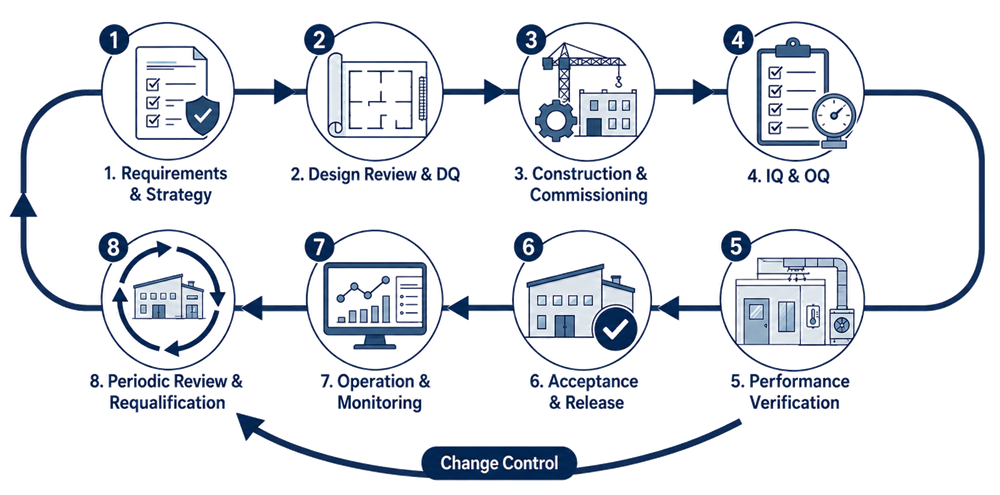
The lifecycle begins before construction. Product, process, regulatory, contamination-control, containment, environmental, utility, flow, cleaning, maintenance, and operational requirements must first be defined and translated into an integrated facility design. Construction and commissioning then establish the installed facility, while qualification and performance verification demonstrate that critical requirements have been implemented and achieved.
The lifecycle continues after initial release through:
- Approved operating procedures
- Environmental and facility monitoring
- Cleaning and sanitation
- Calibration
- Preventive and corrective maintenance
- Deviation and investigation management
- Change control
- Periodic review
- Requalification when warranted
Facility qualification is not simply the completion of Design Qualification, Installation Qualification, and Operational Qualification documents. It is the controlled progression from requirements through design, construction, verification, acceptance, release, operation, and continued lifecycle control.
Regulatory and Lifecycle Basis
21 CFR 211.42 requires buildings used in drug-product manufacture, processing, packing, or holding to be suitably designed and constructed to facilitate cleaning, maintenance, and proper operations. It also requires adequate space, orderly placement, controlled flow, and defined areas or other control systems to prevent contamination and mix-ups.
21 CFR 211.46 establishes requirements for ventilation and, where appropriate, control of air pressure, microorganisms, dust, humidity, and temperature. It also addresses filtration, dust recirculation, and exhaust.
Other provisions address lighting, plumbing, sanitation, building maintenance, equipment location, cleaning, and maintenance. Collectively, these requirements establish the facility outcomes that must be incorporated into the design and supported by objective evidence.
FDA’s Process Validation: General Principles and Practices guidance states that proper facility design and commissioning should precede process performance qualification. It also recognizes qualification as the demonstration that utilities and equipment are suitable for their intended use and perform properly.
For sterile manufacturing, FDA’s Sterile Drug Products Produced by Aseptic Processing—Current Good Manufacturing Practice provides additional recommendations for clean areas, HVAC systems, airflow, pressure differentials, cleanroom qualification, environmental monitoring, sanitation, and maintenance.
Regulations establish mandatory outcomes. FDA guidance and technical standards help define suitable approaches, but qualification must remain specific to the facility, products, processes, and identified risks.
Lifecycle Principles
An effective facility qualification lifecycle is based on several principles.
Intended Use Drives Qualification
Qualification scope must be based on how the facility will actually be used. A warehouse, nonsterile manufacturing suite, aseptic-processing area, potent-compound facility, laboratory, and controlled-temperature area require different controls and evidence.
The intended use should identify:
- Products and dosage forms
- Manufacturing and support activities
- Open and closed processing steps
- Product and personnel hazards
- Required environmental conditions
- Cleanroom classifications or controlled-area designations
- Contamination and cross-contamination risks
- Containment requirements
- Personnel, material, product, equipment, maintenance, and waste flows
- Cleaning and decontamination requirements
- Utility demands
- Occupancy and operating conditions
- Monitoring requirements
- Maintenance and shutdown needs
Qualification cannot be adequately defined until these conditions are understood.
Quality Must Be Built Into the Design
Testing cannot correct an inadequate facility design. Problems involving space, flow, segregation, pressure direction, equipment access, cleanability, maintenance access, drainage, HVAC capacity, or utility capacity may be difficult or impossible to resolve after construction.
Requirements, design reviews, risk assessments, and Design Qualification should therefore identify and control critical design decisions before they become installed conditions.
Verification Must Be Traceable
Each critical test should answer a defined requirement. Testing that cannot be traced to an approved requirement, specification, design criterion, regulatory expectation, or documented risk provides limited assurance.
Traceability should connect:
- Regulatory and business requirements
- Product and process needs
- User requirements
- Design specifications
- Identified risks and controls
- Commissioning and qualification tests
- Acceptance criteria
- Deviations and corrective actions
- Release decisions
- Continued monitoring and lifecycle controls
Lifecycle Activities May Be Integrated
Facility design, construction, commissioning, qualification, cleanroom classification, HVAC testing, automation verification, and environmental-monitoring startup are related activities. They should be planned as an integrated program rather than executed as disconnected projects.
The terminology and document structure may vary. The critical requirement is that the necessary evidence is generated, reviewed, traceable, and formally accepted.
Defining Facility and System Boundaries
Facility qualification becomes difficult when its boundaries are not clearly defined.
A facility should be divided into manageable systems based on function, design, operation, risk, ownership, and turnover strategy. Typical systems may include:
- Building shell and structure
- Interior architectural finishes
- Rooms and operational areas
- Doors, airlocks, pass-throughs, and interlocks
- Personnel and material-flow controls
- HVAC systems and environmental zones
- Building automation and monitoring systems
- Electrical distribution
- Lighting
- Plumbing and drainage
- Fire-protection and life-safety systems
- Process and clean utilities
- Waste-handling systems
- Containment and dust-control systems
- Security and access control
- Environmental-monitoring provisions
- Cleaning and sanitation infrastructure
The boundary of each system should identify:
- Included rooms, equipment, components, instruments, and controls
- Interfaces with other systems
- Utility inputs and outputs
- Control-system dependencies
- Monitoring and alarm interfaces
- Construction and commissioning responsibility
- Qualification responsibility
- Required turnover documents
- Release prerequisites
System boundaries must align with actual operation. Arbitrary boundaries can leave interfaces untested or cause the same item to be tested repeatedly without establishing overall performance.
Requirements and Qualification Planning
The lifecycle begins with approved requirements and a documented qualification strategy.
User Requirements
The facility User Requirements Specification should define what the facility must provide without prematurely restricting the engineering solution.
Requirements may address:
- Intended operations and capacity
- Room functions and adjacencies
- Space and staging
- Zoning and segregation
- Personnel, material, product, equipment, maintenance, and waste flow
- Cleanroom classification
- Temperature and humidity
- Pressure relationships
- Airflow and filtration
- Containment
- Surface finishes and cleanability
- Lighting
- Utilities
- Cleaning and disinfection
- Environmental and facility monitoring
- Alarm and data requirements
- Access control
- Maintenance and calibration
- Expansion and change
- Applicable codes, regulations, and standards
Requirements should be clear, testable where practical, and assigned an appropriate verification method.
Risk Assessment
Risk assessment should determine which facility attributes require enhanced design control, testing, monitoring, or lifecycle management.
The assessment should consider potential effects on:
- Product identity, strength, quality, and purity
- Sterility assurance
- Contamination and cross-contamination
- Material and product mix-ups
- Environmental control
- Containment
- Operator and environmental protection
- Cleaning and sanitation
- Utility availability and quality
- Data integrity
- Process performance
- Regulatory compliance
Risk assessment should support the qualification strategy. It should not be used to eliminate verification without showing how the associated risk is otherwise controlled.
Qualification Strategy
The qualification plan should define:
- Facility and system boundaries
- GMP impact and criticality
- Lifecycle deliverables
- Design-review stages
- Construction-verification controls
- Commissioning scope
- Commissioning records proposed for qualification use
- IQ, OQ, and performance-verification scope
- Cleanroom and HVAC testing
- Automation and monitoring-system verification
- Environmental-monitoring startup
- Acceptance and release criteria
- Deviation handling
- Traceability
- Responsibilities and approvals
- Turnover sequence
- Operational-readiness prerequisites
- Periodic review and requalification approach
The strategy should be approved before significant verification work begins.
Design Review and Facility Design Qualification
Design review is an engineering activity used throughout design development. Facility Design Qualification provides documented assurance that the approved design is suitable for its intended GMP use and satisfies applicable requirements.
Design review and DQ should evaluate, as applicable:
- Site and building suitability
- Room sizes and adjacencies
- Layout and equipment placement
- Personnel, material, equipment, maintenance, and waste routes
- Zoning and segregation
- Product-protection and containment boundaries
- HVAC zoning and pressure direction
- Airflow and air-return arrangements
- Temperature and humidity requirements
- Cleanroom classification
- Cleaning and disinfection provisions
- Surface materials and architectural details
- Utility capacity and distribution
- Drainage
- Equipment access and removal
- Maintenance access
- Environmental-monitoring locations
- Control, alarm, and data architecture
- Fire, safety, and code interfaces
- Future capacity and expansion
- Failure conditions and recovery
- Commissioning and qualification access
DQ should confirm that unresolved design risks, assumptions, exceptions, and open actions have been identified and assigned before construction proceeds.
Approval of DQ does not mean that every design detail is permanently frozen. Subsequent design changes must be assessed, documented, approved, and incorporated into the current design baseline.
Construction Control and Design Conformance
Construction converts the approved design into the installed facility. This phase requires controlled handling of field changes, material substitutions, construction defects, incomplete work, and evolving as-built information.
Relevant controls may include:
- Approved-for-construction drawings
- Submittal and material review
- Inspection and test plans
- Construction-quality inspections
- Weld, pressure, leakage, and integrity testing
- Surface and finish inspections
- Penetration and seal inspection
- Above-ceiling inspection
- Installation checklists
- Contractor qualification
- Clean-construction practices
- Foreign-material control
- Punch-list management
- Field-change control
- Redline drawings
- As-built-document preparation
- Construction cleaning
- System completion and turnover
A field change should not be accepted merely because it appears technically workable. Its effect on approved requirements, design intent, contamination control, qualification, operation, maintenance, and regulatory commitments must be evaluated.
Construction completion is not the same as GMP acceptance. It establishes that the system is ready for commissioning and subsequent verification.
Commissioning and Turnover
Commissioning demonstrates that facility systems have been installed, started, adjusted, and made functional in accordance with the design and manufacturer requirements.
Commissioning may include:
- Component and installation inspections
- Electrical and mechanical checks
- Pressure and leakage testing
- Flushing and cleaning
- Equipment startup
- Control-loop checks
- Point-to-point testing
- Instrument calibration
- HVAC balancing
- Alarm and interlock testing
- Functional testing
- Failure and recovery checks
- Performance adjustment
- Operator and maintenance training
- Spare-parts verification
- Initial preventive-maintenance setup
Commissioning should find and correct construction and functional deficiencies before formal qualification testing.
Use of Commissioning Evidence
Commissioning evidence may be used to support qualification when it is:
- Planned in advance
- Performed under approved procedures
- Traceable to requirements or specifications
- Executed by qualified personnel
- Supported by calibrated test instruments
- Documented contemporaneously
- Reviewed for deviations
- Complete and legible
- Subject to appropriate quality oversight
- Formally assessed and accepted for qualification use
Repeating an adequate commissioning test solely because it was labeled “commissioning” adds no assurance. Conversely, commissioning records should not be accepted merely to reduce qualification work when their quality, traceability, or control is inadequate.
The qualification plan should identify which commissioning tests will be:
- Accepted directly
- Supplemented by qualification
- Witnessed by Quality
- Repeated during qualification
- Used only as supporting engineering information
Turnover Package
System turnover should provide the controlled documentation needed for qualification, operation, maintenance, and future change assessment.
A turnover package may include:
- Approved and as-built drawings
- Specifications
- Equipment and component lists
- Material certifications
- Vendor manuals
- Factory and site acceptance records
- Construction inspections
- Commissioning reports
- Calibration certificates
- Test-instrument records
- Control narratives
- Software and configuration records
- Alarm and interlock lists
- Balancing reports
- Spare-parts lists
- Preventive-maintenance recommendations
- Training records
- Open-item and punch-list status
- Deviation and change documentation
- Warranty information
Turnover should confirm document completeness and system status. It should not become an uncontrolled transfer of miscellaneous contractor records.
Installation Qualification
Installation Qualification verifies that the facility and its systems are installed in accordance with approved requirements, drawings, specifications, and manufacturer recommendations.
Facility IQ may verify:
- Room identities, dimensions, and intended uses
- Installed layouts
- Architectural finishes
- Doors, windows, airlocks, and pass-throughs
- Penetrations and seals
- Equipment and component identification
- Materials of construction
- HVAC equipment and ductwork
- Filter installation
- Utility connections
- Plumbing and drains
- Instruments and calibration status
- Electrical supplies
- Control panels and interfaces
- Monitoring and alarm devices
- Access-control devices
- Drawing accuracy
- Manuals and supporting documentation
- Maintenance and calibration enrollment
IQ should establish the approved as-built baseline.
Unresolved construction defects, uncontrolled field changes, missing documentation, or significant punch-list items should not be hidden within IQ. Their effect on testing and release must be assessed and documented.
Operational Qualification
Operational Qualification demonstrates that facility systems operate as intended throughout defined ranges and respond appropriately to normal, boundary, alarm, failure, and recovery conditions.
Facility OQ may include:
- HVAC operating modes
- Air-supply and return performance
- Pressure relationships
- Temperature and humidity control
- Control-loop operation
- Alarm setpoints and notification
- Interlocks
- Door and airlock operation
- Access controls
- Power-loss response
- Emergency and standby modes
- System restart and recovery
- Trend generation
- Data recording and retention
- Sensor failure response
- Exhaust and containment operation
- Utility failure effects
- Building-automation-system functions
Testing should include credible operating conditions. Demonstrating only the normal condition may not establish adequate control where startup, shutdown, door opening, power interruption, occupancy change, maintenance mode, or equipment operation can materially affect facility performance.
OQ acceptance criteria should be based on approved requirements and justified operating limits. Vendor default values should not be adopted without confirming their suitability for the intended facility use.
Facility Performance Verification
The term Performance Qualification is not applied uniformly to facilities. Some organizations execute a standalone facility PQ protocol. Others distribute performance testing among HVAC qualification, cleanroom qualification, room-performance studies, environmental-monitoring startup, utility qualification, process-readiness studies, and operational verification.
The document title is less important than the evidence. Where facility performance affects product quality or contamination control, performance must be demonstrated under representative conditions before the facility is released for the intended operation.
Performance verification may evaluate:
- Integrated room and HVAC performance
- Representative occupancy
- Equipment heat and particle loads
- Normal personnel and material movement
- Door opening and transfer activity
- Process-equipment operation
- Cleaning and disinfection
- Recovery after disturbances
- Environmental conditions over time
- Containment during process operation
- Alarm response and operational intervention
- Interaction among rooms, HVAC, utilities, controls, and monitoring systems
A facility should not be released solely because its components have passed IQ and OQ when integrated operating conditions remain unverified.
When a Standalone Facility PQ May Be Appropriate
A separate facility PQ may be useful when:
- Several systems must operate together to provide a critical environment
- Representative operations materially affect room performance
- Facility performance cannot be adequately demonstrated within individual system protocols
- Containment must be demonstrated during process operation
- New or complex operating patterns require integrated challenges
- The approved validation plan specifically requires a consolidated performance study
Where no separate PQ is used, the qualification plan should identify where each required performance element is demonstrated.
Where Cleanroom, HVAC, and Environmental Activities Fit
Facility lifecycle programs often become unclear because cleanroom classification, HVAC qualification, environmental monitoring, and room performance are treated as interchangeable. They provide different evidence.
HVAC Qualification
HVAC qualification demonstrates that the installed air-handling and control systems operate as intended.
Testing may include:
- Air volume and air-change performance
- Supply, return, and exhaust operation
- HEPA-filter integrity
- Room-pressure relationships
- Temperature and humidity control
- Airflow direction
- Airflow visualization
- Recovery
- Alarm and control operation
- System operating modes
- Failure and restart response
HVAC qualification supports facility performance, but it does not by itself demonstrate that all room uses, operational flows, sanitation practices, or microbiological controls are adequate.
Cleanroom Classification
Cleanroom classification determines whether airborne nonviable-particle concentrations meet the specified classification under defined occupancy conditions.
Classification should identify whether testing was performed:
- As built
- At rest
- In operation
The occupancy state must be defined because results obtained in an empty, inactive room do not establish performance during manufacturing activity.
Classification is an important qualification activity, but it evaluates a defined aspect of air cleanliness. It does not independently demonstrate adequate microbiological control, airflow protection, pressure control, cleaning effectiveness, or operational discipline.
Room Performance Qualification
Room performance qualification or verification evaluates whether a room and its supporting systems provide the required conditions for the intended operation.
Depending on the room, this may include:
- Nonviable-particle control
- Microbiological conditions
- Temperature and humidity
- Pressure relationships
- Airflow direction and protection
- Recovery
- Representative occupancy
- Personnel and material transfers
- Equipment operation
- Cleaning and disinfection
- Containment
- Alarm response
Room performance is therefore broader than cleanroom classification.
Environmental-Monitoring Qualification and Startup
The environmental-monitoring program must be established before GMP operation begins. Its sampling locations, methods, frequencies, alert levels, action levels, incubation conditions, data handling, and response procedures should be scientifically justified.
Startup or baseline monitoring can help demonstrate environmental control and establish initial data. However, a short initial monitoring period should not be presented as proof of indefinite control.
Routine environmental monitoring then provides continuing evidence and may identify deterioration, adverse trends, or loss of control. It does not replace initial facility and HVAC qualification.
Relationship Among the Activities
| Activity | Primary question answered |
|---|---|
| HVAC qualification | Does the HVAC system operate according to its approved design and control requirements? |
| Cleanroom classification | Does airborne nonviable-particle concentration meet the specified classification under the defined occupancy state? |
| Room performance verification | Does the integrated room provide the conditions needed for its intended operation? |
| Environmental-monitoring startup | Is the monitoring program functional, and does initial evidence support environmental readiness? |
| Routine environmental monitoring | Does continuing operational evidence indicate that environmental control is being maintained? |
These activities should be coordinated, but their conclusions should not be treated as interchangeable.
Traceability and Acceptance
Facility acceptance requires more than successful protocol execution. The complete evidence package must demonstrate that applicable requirements have been satisfied and that unresolved items do not prevent the intended use.
A traceability matrix may connect:
- User requirements
- Design specifications
- Risk controls
- Design reviews and DQ
- Construction inspections
- Commissioning tests
- IQ and OQ tests
- Performance verification
- Procedures and training
- Calibration and maintenance
- Environmental-monitoring readiness
- Final acceptance status
Each requirement should have a documented disposition, such as:
- Verified and accepted
- Verified through an approved alternative method
- Not applicable with justification
- Deferred under an approved plan
- Open and preventing release
Traceability should not be closed through unexplained references to large reports. The cited evidence should clearly demonstrate how the requirement was satisfied.
Facility Release for Intended Use
Release should be a formal, documented decision confirming that the facility is ready for its approved use.
Release prerequisites may include:
- Approved requirements and design baseline
- Completed DQ, IQ, OQ, and required performance verification
- Accepted commissioning evidence
- Completed cleanroom and HVAC qualification
- Acceptable initial environmental evidence
- Approved as-built drawings
- Completed calibration
- Active preventive-maintenance program
- Approved cleaning and sanitation procedures
- Approved operating and alarm-response procedures
- Trained personnel
- Functional access and material-status controls
- Approved environmental-monitoring program
- Resolved critical deviations
- Assessed outstanding punch-list items
- Completed traceability
- Quality approval
Release may be phased by building, area, room, system, or intended use when boundaries are clear and the released portion can operate without dependence on incomplete or uncontrolled work.
Conditional release should be limited to items that do not compromise product quality, contamination control, safety, data integrity, or regulatory compliance. Each condition should have a documented justification, owner, due date, and closure requirement.
Construction completion, engineering turnover, occupancy approval, and GMP release are different decisions. One should not automatically be treated as evidence of another.
Operation and Maintenance of the Qualified State
After release, the facility must be operated within its approved conditions.
Lifecycle controls should include:
- Approved room uses
- Occupancy and activity limits
- Personnel and material-flow controls
- Cleaning and sanitation
- Environmental and facility monitoring
- Alarm response
- Calibration
- Preventive and corrective maintenance
- Building-condition inspections
- Pest control
- Access control
- Contractor and maintenance controls
- Management of shutdowns and restarts
- Deviation and investigation management
- CAPA
- Change control
- Periodic review
- Requalification
The current facility configuration should remain consistent with approved drawings, specifications, qualification records, procedures, and actual practices.
Recurring alarms, environmental excursions, damaged surfaces, failed seals, pressure instability, temporary repairs, unavailable instruments, or repeated operator workarounds may indicate that the qualified state is no longer adequately supported.
Facility Changes
Facility changes should be assessed before implementation.
Examples include:
- Changing room use
- Modifying walls, ceilings, floors, doors, or pass-throughs
- Relocating or adding equipment
- Changing HVAC zoning, airflow, filtration, exhaust, or pressure direction
- Increasing occupancy or heat load
- Changing personnel or material flows
- Altering cleaning or disinfection methods
- Modifying utilities or drains
- Changing monitoring locations or limits
- Replacing instruments or automation components
- Introducing new products or hazards
- Changing containment or segregation controls
- Installing temporary structures or services
- Changing operating schedules or campaign strategies
The change assessment should determine the effect on:
- Intended use
- Approved requirements
- Design intent
- System boundaries and interfaces
- Contamination or containment control
- Qualification status
- Monitoring
- Calibration and maintenance
- Procedures and training
- Regulatory commitments
- Requalification needs
Testing should be based on the nature and potential impact of the change. Full requalification is not automatically required, but relying on the original qualification without evaluating the changed condition is also inappropriate.
Periodic Review and Requalification
Periodic review evaluates whether accumulated lifecycle evidence continues to support the facility’s approved state.
The review may consider:
- Facility use and configuration
- Qualification status
- Environmental and facility-monitoring trends
- HVAC and utility performance
- Pressure and alarm history
- Calibration status
- Preventive and corrective maintenance
- Building-condition inspections
- Cleaning and sanitation performance
- Deviations, investigations, and CAPA
- Changes and temporary modifications
- Recurring failures
- Unresolved actions
- Product or process changes
- Regulatory changes
- Obsolescence
- Previous review commitments
Periodic review does not automatically require testing. It determines whether existing evidence remains adequate and whether additional assessment, corrective action, enhanced monitoring, targeted requalification, or comprehensive requalification is warranted.
Requalification may be triggered by:
- Significant facility or HVAC modification
- Change in intended use
- New product or hazard
- Loss of environmental control
- Repeated pressure or airflow failures
- Major shutdown
- Extended inactivity
- Critical component replacement
- Adverse monitoring trends
- Significant maintenance intervention
- Unexplained deterioration
- Inadequate original qualification
- A defined periodic requalification requirement
The scope should address the affected requirements, systems, rooms, and interfaces. It should not be expanded or reduced solely because the original qualification followed a particular document structure.
Responsibilities and Governance
Facility qualification requires coordinated responsibility among:
- Facility and project engineering
- Validation
- Quality
- Manufacturing and operations
- Environmental monitoring and microbiology
- Maintenance and calibration
- Automation and information technology
- Environmental health and safety
- Contractors and vendors
Responsibilities should be defined for:
- Requirements
- Design review
- Risk assessment
- Construction oversight
- Commissioning
- Qualification
- Document review
- Deviation resolution
- System turnover
- Procedure development
- Training
- Release
- Change control
- Periodic review
- Requalification
Quality oversight should be proportionate to GMP risk and defined before execution. Quality should not first encounter critical design or commissioning decisions when qualification protocols are submitted for approval.
Common Facility-Lifecycle Weaknesses
Common weaknesses include:
- Starting qualification without approved intended use or system boundaries
- Requirements that are vague or not testable
- Design Qualification performed after construction
- Treating design review as a drawing-signature exercise
- Uncontrolled field changes
- Incomplete or inaccurate as-built drawings
- Poorly defined interfaces between facility, HVAC, utilities, and automation
- Repeating commissioning tests without assessing whether the original evidence is usable
- Accepting inadequate commissioning records solely to save time
- IQ used to discover or resolve construction deficiencies
- OQ limited to normal operating conditions
- Cleanroom classification treated as complete facility qualification
- HVAC qualification treated as proof of microbiological control
- Routine environmental monitoring used as a substitute for initial performance verification
- No defined location for integrated facility-performance testing
- Release based only on protocol completion
- Missing traceability between requirements and evidence
- Open punch-list items without impact assessment
- Procedures, training, calibration, or maintenance incomplete at release
- Room use or equipment layout changed without qualification assessment
- Repeated alarms or environmental excursions treated as isolated events
- Periodic review performed as a document inventory rather than an assessment of continued control
- Automatic full requalification without risk evaluation
- Failure to requalify when lifecycle evidence no longer supports the original conclusions
Summary
The facility qualification lifecycle begins with intended use, requirements, system boundaries, risk assessment, and design. Design review and DQ establish whether the proposed facility can satisfy GMP and operational needs. Construction control, commissioning, and turnover establish the installed and functional baseline. IQ, OQ, and performance verification then provide objective evidence that the facility is correctly installed, operates as intended, and can support its approved use.
A document specifically named Facility PQ is not universally required. However, required performance evidence cannot be omitted. Room performance, HVAC qualification, cleanroom classification, environmental-monitoring readiness, containment verification, and representative operational challenges must be placed deliberately within the approved qualification strategy.
Formal acceptance and release should confirm that requirements are traceable, critical deviations are resolved, operational controls are active, and the facility is ready for its intended use.
The lifecycle continues through monitoring, sanitation, calibration, maintenance, change control, periodic review, and risk-based requalification. A facility remains qualified only while current evidence continues to support its approved design, operation, and state of control.