

Facility Requalification and Periodic Review
Purpose and Scope
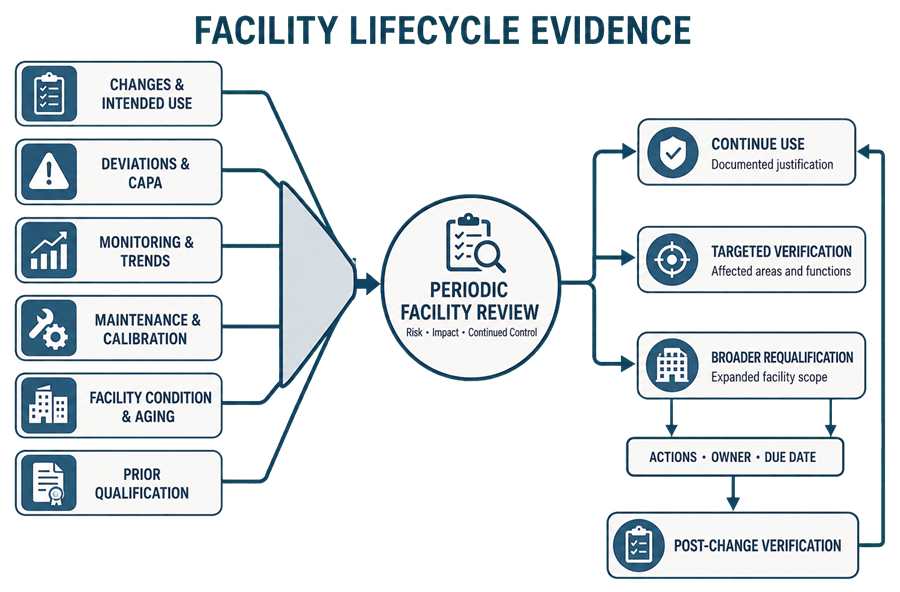
Facility periodic review is a structured, documented assessment used to determine whether a GMP facility remains suitable for its approved intended use and continues to operate in a qualified state.
The review evaluates the facility as an integrated operating environment—not merely as a collection of independently maintained systems. It considers physical condition, room use, layout, flows, segregation, environmental control, utilities, automation, alarms, maintenance, operating history, adverse trends, cumulative changes, and the continuing validity of qualification evidence.
Facility requalification is the documented verification performed when review findings, changes, failures, deterioration, or altered intended use create uncertainty about continued control.
The objective is not automatic repetition of the original qualification. The objective is to determine, using current evidence and risk, whether:
- Continued use remains justified
- Enhanced monitoring or corrective action is sufficient
- Targeted verification is required
- Targeted requalification is required
- Broader facility requalification is required
- Use must be restricted or suspended pending resolution
Facility-level review remains distinct from HVAC requalification and periodic review. HVAC review focuses on the air-handling system and environmental-control performance. Facility review evaluates the broader interaction among rooms, physical condition, flows, operations, utilities, automation, access controls, sanitation, maintenance, environmental evidence, and intended use.
Regulatory and Lifecycle Basis
21 CFR Part 211, Subpart C establishes requirements for buildings and facilities used in pharmaceutical manufacturing.
21 CFR 211.42 requires suitable construction, adequate space, orderly placement, controlled flow, and defined areas or other controls needed to prevent contamination and mix-ups.
21 CFR 211.46 addresses ventilation and, where appropriate, control of air pressure, microorganisms, dust, humidity, temperature, filtration, recirculation, and exhaust.
21 CFR 211.58 requires buildings to be maintained in a good state of repair.
These requirements apply throughout facility operation. Completion of initial qualification does not eliminate the obligation to maintain suitable facility conditions.
FDA’s Process Validation: General Principles and Practices guidance applies a lifecycle and risk-based approach and requires qualification activities to include defined studies, acceptance criteria, timing, responsibilities, documentation, approval, and evaluation of changes.
FDA’s Quality Systems Approach to Pharmaceutical CGMP Regulations describes the use of quality systems, risk management, data evaluation, CAPA, change management, and management review to maintain control and support continual improvement.
For sterile manufacturing, FDA’s Aseptic Processing CGMP Guidance provides additional expectations concerning facility design, environmental control, monitoring, sanitation, maintenance, investigations, and continuing control of aseptic-processing areas.
These sources do not prescribe one mandatory facility-requalification interval or a universal repeat-testing package. The organization must establish and document an approach appropriate to the facility’s intended use, risks, complexity, performance history, and regulatory commitments.
Position in the Facility Lifecycle
Facility periodic review and requalification are part of the continuing facility qualification lifecycle.
The lifecycle generally includes:
- Intended-use definition
- Requirements and risk assessment
- Design development and review
- Facility Design Qualification
- Construction and commissioning
- Facility Installation Qualification
- Facility Operational Qualification
- Environmental and performance verification
- Facility release
- Routine operation and monitoring
- Maintenance, calibration, sanitation, and change control
- Periodic facility review
- Risk-based requalification when warranted
- Continued-use, restriction, or retirement decisions
Periodic review closes the lifecycle loop. It compares current facility condition and performance against the approved intended use, design baseline, qualification conclusions, operating controls, and accumulated operational evidence.
Requalification updates the evidence where the review identifies uncertainty, affected requirements, unverified changes, deterioration, or loss of control.
Facility-Level Versus System-Specific Review
Facility review should not duplicate every system-specific review. It should integrate their conclusions and determine whether combined effects create a facility-level concern.
Facility-Level Review
Facility-level review evaluates:
- Continued suitability of the facility for its intended use
- Room functions and adjacencies
- Personnel, material, product, equipment, maintenance, and waste flows
- Zoning, segregation, and containment
- Physical condition of rooms and architectural finishes
- Doors, airlocks, pass-throughs, and access controls
- Facility-wide environmental conditions
- Utility availability and interfaces
- Cleaning and sanitation infrastructure
- Building automation and monitoring interfaces
- Emergency functions and recovery
- Cumulative effects of multiple changes
- Effects of equipment additions or altered operations
- Continuing validity of the facility qualification baseline
HVAC Review
HVAC-specific review evaluates:
- Air-handling equipment
- Airflow quantities and air-change performance
- HEPA-filter integrity
- Temperature and humidity control
- Pressure-control loops
- Supply, return, and exhaust performance
- HVAC alarms and controls
- Balancing status
- System failure and recovery
- HVAC maintenance and calibration history
Automation Review
Automation-specific review evaluates:
- Current configuration
- Software and hardware changes
- Alarm and event history
- Access and security controls
- Data collection and retention
- System failures
- Backup and recovery
- Interfaces and communication
- Periodic access and configuration review
Detailed automation evaluation belongs under Change Control and Periodic Review of Facility Automation.
The facility review should reference accepted system-specific evidence while evaluating whether the complete facility remains controlled.
Periodic Review Frequency
Periodic facility review should occur at an approved, risk-based interval.
The interval should consider:
- Facility criticality
- Sterile, nonsterile, containment, laboratory, warehouse, or support use
- Complexity of facility and system interactions
- Contamination and cross-contamination risk
- Age and physical condition
- Rate of operational or configuration change
- Maintenance and failure history
- Environmental and facility-monitoring history
- Prior deviations, investigations, and CAPA
- Regulatory commitments
- Previous review conclusions
- Quality of available lifecycle records
A defined periodic interval provides assurance that cumulative change and gradual deterioration are assessed even when no single event appears significant.
The interval may be shortened when:
- Facility condition is deteriorating
- Repeated failures or excursions occur
- Changes are frequent
- Open actions remain unresolved
- Monitoring indicates reduced control
- A facility is operating under restrictions
- Previous review evidence was incomplete
The interval may be extended only when supported by documented evidence of stable performance, limited change, effective maintenance, reliable monitoring, and acceptable previous reviews. A scheduled review does not replace event-driven assessment. Significant changes, failures, or adverse trends must be evaluated when they occur.
Periodic Review Inputs
The review should use current, objective, traceable evidence covering the entire review period.
Intended Use and Facility Status
Review:
- Approved intended uses
- Products and processes supported
- Room classifications or controlled-area designations
- Occupancy and activity assumptions
- Open versus closed processing assumptions
- Containment requirements
- Operating schedules
- Room or area status
- Phased-release boundaries
- Temporarily inactive or mothballed areas
- Restrictions placed on facility use
The review should determine whether actual use remains consistent with the basis of qualification.
Facility Condition
Physical inspections may evaluate:
- Floors, walls, and ceilings
- Coatings and surface finishes
- Cracks, gaps, damage, or deterioration
- Doors, frames, seals, and closures
- Windows and observation panels
- Airlocks and pass-throughs
- Penetrations and sealants
- Drains and plumbing fixtures
- Lighting
- Condensation or water intrusion
- Evidence of corrosion
- Pest-control vulnerabilities
- Cleanability
- Maintenance access
- Utility and equipment identification
- Temporary repairs
- Unresolved construction or punch-list conditions
Facility condition should not be assessed solely from work-order completion records. Direct inspection may be needed to confirm actual condition.
Change History
Review all facility-related changes since the previous accepted baseline, including:
- Room-layout changes
- Wall, ceiling, door, or pass-through modifications
- Changes in room use
- Equipment additions, removals, or relocation
- Changes affecting heat, moisture, airflow, particle, or utility loads
- Utility modifications
- HVAC changes affecting facility operation
- Automation or monitoring changes
- Alarm and interlock changes
- Access-control changes
- Cleaning or sanitation changes
- Changes to personnel or material flows
- Changes in occupancy or operating schedules
- New products or processes
- Temporary changes and emergency modifications
- Construction in or near controlled areas
- Changes implemented without complete verification
The review should assess individual and cumulative effects. Several low-impact changes may collectively alter facility behavior or invalidate original assumptions.
Deviations, Investigations, and CAPA
Evaluate:
- Facility-related deviations
- Environmental excursions
- Pressure or temperature excursions
- Contamination events
- Water intrusion
- Pest events
- Utility interruptions
- Access-control failures
- Alarm or monitoring failures
- Cleaning or sanitation failures
- Recurring operator interventions
- Investigation conclusions
- Root causes
- Corrective and preventive actions
- CAPA effectiveness
- Recurring or related events
- Events closed without adequate facility-impact assessment
A closed deviation is not automatically evidence that the underlying facility risk has been resolved.
Monitoring and Trend Evidence
Review applicable:
- Differential-pressure trends
- Temperature and humidity trends
- Environmental-monitoring data
- Nonviable-particle data
- Viable-monitoring data
- Alarm and event trends
- Facility automation trends
- Room-status histories
- Access and door-event records
- Utility performance data
- Cleaning and sanitation observations
- Pest-control trends
- Facility inspection findings
- Complaints or quality events with possible facility contribution
Routine environmental monitoring can identify deterioration or adverse trends, but it does not by itself prove that every facility attribute remains qualified.
Maintenance and Calibration
Review:
- Preventive-maintenance completion
- Corrective-maintenance history
- Emergency repairs
- Repeat work orders
- Critical-component replacements
- Temporary repairs
- Deferred maintenance
- Calibration status
- Out-of-tolerance results
- Instrument drift
- Sensor or transmitter replacements
- Maintenance-related excursions
- Post-maintenance testing
- Maintenance effects on adjacent rooms or systems
- Obsolescence and spare-part concerns
Repeated repair of the same condition may indicate aging, inadequate design, improper operation, or ineffective corrective action.
Qualification and Verification Evidence
Review:
- Original requirements and risk assessments
- Approved DQ, IQ, and OQ conclusions
- Environmental or room-performance studies
- HVAC and utility qualification status
- Automation qualification status
- Previous requalification results
- Deferred qualification activities
- Seasonal verification
- Outstanding deviations
- Approved exceptions
- Previous periodic-review actions
- Traceability status
- Post-change verification records
The review should determine whether the evidence still corresponds to the current facility configuration and use.
Review Method
The periodic review should follow a defined and approved method.
A practical sequence is:
- Confirm the review period and facility boundary.
- Confirm the current intended use.
- Identify the approved qualification baseline.
- Compile changes and temporary modifications.
- Review deviations, failures, trends, and CAPA.
- Review maintenance and calibration performance.
- Inspect current physical condition.
- Review system-specific assessments.
- Identify unresolved or conflicting evidence.
- Evaluate cumulative effects.
- Assess risks to product quality and facility control.
- Determine the required outcome.
- Assign actions, owners, priorities, and due dates.
- Document interim controls or restrictions.
- Obtain appropriate technical and Quality approval.
- Track actions through verification and closure.
The review should evaluate evidence, not merely confirm that records exist.
Evaluating Continued Control
The assessment should determine whether current evidence continues to support:
- Approved intended use
- Facility layout and room functions
- Adequate space and orderly operations
- Personnel and material flows
- Segregation and containment
- Contamination and cross-contamination controls
- Cleanability and sanitation
- Architectural integrity
- Environmental-control capability
- Pressure relationships
- Utility availability
- Alarm and monitoring functions
- Emergency and recovery functions
- Maintenance and calibration controls
- Current procedures and training
- Validity of previous qualification conclusions
A facility should not be classified through vague labels such as “acceptable” or “stable” without stating the evidence and rationale supporting that conclusion.
Requalification Triggers
Facility requalification may be triggered by planned changes, unplanned events, adverse evidence, aging, or altered intended use.
Typical triggers include:
Facility Modifications
- Room reconfiguration
- Addition or removal of walls
- Door, airlock, or pass-through changes
- Changes to personnel or material routes
- Modifications to staging or storage areas
- Changes to drains or plumbing
- Changes to architectural finishes
- Expansion or reduction of a controlled boundary
- Construction affecting adjacent GMP areas
Changes in Intended Use
- Introduction of a new product or process
- Change from closed to open processing
- Increased occupancy
- Increased equipment or thermal load
- Different contamination or containment hazard
- New cleanliness or environmental requirement
- Change in room classification
- Increased production duration or frequency
- Repurposing of a room or suite
- Restart after extended shutdown
Significant Maintenance or Aging
- Major repair
- Replacement of critical building components
- Repeated deterioration
- Persistent leakage or condensation
- Critical door or seal replacement
- Repair affecting room integrity
- Deferred maintenance affecting GMP controls
- Obsolescence that changes parts, controls, or operating strategy
Failures and Adverse Trends
- Repeated environmental excursions
- Loss of required pressure relationships
- Recurring contamination events
- Monitoring-system failures
- Utility interruptions affecting the facility
- Repeated alarms
- Inadequate recovery after disturbances
- Significant physical damage
- Failure of access or segregation controls
- Evidence that established operating assumptions are no longer valid
Quality-System Findings
- Significant deviation or investigation
- Ineffective CAPA
- Regulatory observation
- Internal-audit finding
- Uncontrolled or undocumented change
- Incomplete qualification evidence
- Discovery that previous acceptance criteria were inadequate
- Unresolved conflict between approved documents and actual configuration
A trigger requires evaluation. It does not automatically require comprehensive facility requalification.
Requalification Decision Outcomes
Periodic review should lead to an explicit, approved decision.
| Decision | Appropriate basis | Required documentation |
|---|---|---|
| Continue qualified use | Current evidence supports intended use and continued control | Documented review conclusion and next review interval |
| Continue use with enhanced monitoring | Control remains acceptable, but uncertainty or an emerging trend requires additional observation | Monitoring plan, owner, limits, duration, review date, and escalation criteria |
| Corrective action without requalification | A condition requires correction but does not invalidate applicable qualification evidence | Work order, deviation or CAPA, impact assessment, and closure verification |
| Targeted verification | A defined attribute requires confirmation, but formal re-execution of qualification is unnecessary | Test plan or controlled verification record with acceptance criteria |
| Targeted requalification | Affected rooms, functions, interfaces, or requirements require formal qualification evidence | Approved requalification protocol and report |
| Broader requalification | Change or loss of control affects multiple facility functions or makes the affected boundary uncertain | Approved facility-level requalification plan, protocols, traceability, and report |
| Restrict or suspend use | Available evidence does not justify continued unrestricted operation | Formal restriction, impact assessment, recovery plan, approval, and release criteria |
“Continue use” is a documented technical and Quality decision. It is not the absence of a decision.
Determining Requalification Scope
Requalification scope should be based on affected requirements, risks, interfaces, and uncertainty.
Targeted Verification
Targeted verification may be appropriate when:
- The affected attribute is clearly bounded.
- The change does not alter approved intended use.
- Original qualification evidence remains applicable.
- The verification method is straightforward.
- Failure would not invalidate unrelated facility functions.
Examples include:
- Inspection of a repaired surface
- Confirmation of a replaced door seal
- Verification of room identification
- Confirmation of an updated drawing
- Limited alarm or access-control testing
- Verification of a corrected utility label
- Review of a post-maintenance trend
Targeted Requalification
Targeted requalification may include:
- Selected IQ checks
- Selected OQ functional challenges
- Door and airlock testing
- Pressure-cascade verification
- Alarm and interlock testing
- Access-control testing
- Utility-interface verification
- Environmental or room-performance testing
- Recovery testing
- Updated traceability
The scope should include directly affected attributes and credible downstream effects.
Broader Facility Requalification
Broader requalification may be required when:
- Several rooms or facility systems are affected.
- Facility boundaries are no longer clear.
- Intended use changes materially.
- Segregation or flow strategy changes.
- Multiple cumulative changes have not been adequately evaluated.
- A significant contamination or loss-of-control event occurs.
- Facility configuration no longer matches qualification records.
- Original evidence is incomplete or unreliable.
- Adverse trends affect several facility functions.
- The extent of impact cannot be bounded without additional testing.
Broader requalification may require updated design review, IQ, OQ, environmental performance verification, operational-readiness assessment, and formal release.
The applicable equipment-level principles in Risk-Based Requalification may support the assessment method, but the facility scope must account for room interactions, flows, segregation, environmental control, utilities, and shared systems.
Post-Change Verification
A change is not complete merely because construction, repair, or configuration work has been performed.
Post-change verification should confirm that:
- The approved change was implemented correctly.
- The final configuration matches approved documents.
- Temporary controls and overrides were removed.
- Affected requirements were verified.
- Adjacent rooms and systems remain acceptable.
- Alarms and monitoring functions remain operational.
- Required operating conditions were restored.
- Updated drawings and records reflect the final condition.
- Maintenance and calibration records were updated.
- Personnel were trained where required.
- Deviations were resolved.
- Acceptance criteria were met.
- The facility was formally returned to its approved operating state.
The verification scope should be defined during change-impact assessment and revised when implementation reveals unexpected conditions.
Unplanned Changes and Retrospective Assessment
An undocumented modification, emergency repair, uncontrolled configuration change, or previously unidentified facility condition requires retrospective assessment. The assessment should determine:
- What changed
- When the change occurred
- Why normal controls were not followed
- Which rooms, systems, or operations were affected
- Whether affected products or activities require impact assessment
- Whether monitoring data remained reliable
- Whether previous qualification conclusions remained valid
- Whether interim controls are necessary
- What corrective action and verification are required
- Whether additional investigation or CAPA is warranted
Retrospective testing cannot always demonstrate what conditions existed before the issue was discovered. Where historical control cannot be reconstructed, the assessment must address the resulting uncertainty directly.
Action Management and Closure Controls
Every action resulting from periodic review or requalification assessment should have:
- Clear action description
- Technical basis
- Risk or priority
- Responsible owner
- Due date
- Required deliverable
- Interim control, where applicable
- Verification method
- Acceptance criteria
- Required approvers
- Closure evidence
Overdue actions should be escalated based on risk.
The review should not be closed by transferring unresolved findings to an informal list. Open conditions must remain visible within an appropriate controlled system, such as:
- Change control
- Deviation
- Investigation
- CAPA
- Maintenance management
- Calibration management
- Qualification action tracking
- Approved remediation plan
Final closure should confirm that required work was completed and that the facility’s continued-use status remains justified.
Continued-Use Decisions
A continued-use decision should state:
- Facility or area covered
- Approved intended use
- Evidence reviewed
- Significant changes and events
- Current physical and operational condition
- Remaining uncertainties
- Applicable restrictions
- Open actions
- Risk evaluation
- Requalification decision
- Next review interval
- Required approvals
Possible conclusions include:
- Qualified state remains supported.
- Continued use is acceptable with defined monitoring.
- Continued use is acceptable while targeted work is completed.
- Use is restricted pending verification.
- Use is suspended pending requalification.
- Facility or area is no longer suitable for the intended use.
Conditional continued use requires defined boundaries, controls, owner, due date, monitoring, escalation criteria, and final closure.
Periodic Review Report
The report should include:
- Purpose and review period
- Facility boundary
- Intended use
- Review team and responsibilities
- Applicable procedures
- Qualification baseline
- Documents and evidence reviewed
- Physical inspection results
- Change summary
- Deviation, investigation, and CAPA summary
- Maintenance and calibration summary
- Monitoring and trend assessment
- System-specific review conclusions
- Cumulative-change assessment
- Identified risks
- Requalification triggers
- Required scope
- Open actions
- Owners and due dates
- Interim controls
- Continued-use decision
- Next review date
- Technical and Quality approvals
The report should distinguish factual evidence from judgment. Conclusions should identify why the evidence supports continued use or why additional work is required.
Common Weaknesses
Common weaknesses include:
- Treating facility review as HVAC review
- Reviewing individual systems without assessing facility integration
- Using a checklist without evaluating trends or cumulative effects
- Failing to inspect actual facility condition
- Reviewing only completed change controls
- Excluding temporary and emergency changes
- Assuming closed deviations have no continuing impact
- Failing to compare actual use with qualified intended use
- Ignoring equipment additions and increased environmental loads
- Reviewing isolated events without evaluating recurrence
- Repeating the original qualification without defining affected requirements
- Declaring that no requalification is required without documented justification
- Requiring comprehensive requalification for every minor change
- Omitting adjacent-area and shared-system effects
- Failing to verify conditions after maintenance or construction
- Leaving actions without owners or due dates
- Closing the review while critical actions remain uncontrolled
- Allowing conditional use without restrictions or escalation criteria
- Failing to document a formal continued-use decision
- Treating elapsed time as the only basis for requalification
A strong program avoids both extremes: automatic repetitive testing and unsupported assumptions that initial qualification remains valid indefinitely.
Summary
Facility periodic review determines whether current evidence continues to support the facility’s approved intended use and qualified state. The review integrates:
- Facility condition
- Intended use
- Change history
- Deviations and CAPA
- Monitoring and trends
- Maintenance and calibration
- Qualification evidence
- System-specific assessments
- Aging and obsolescence
- Cumulative effects
The resulting decision may support continued use, enhanced monitoring, corrective action, targeted verification, targeted requalification, broader requalification, or restricted operation.
Requalification should be proportional to affected requirements and risk. Its purpose is to resolve uncertainty and restore documented assurance—not automatically recreate the original qualification package.
Actions require defined owners, priorities, due dates, verification methods, and closure evidence. Continued use must be an explicit, documented decision supported by current evidence.