

Environmental Performance Qualification, Limits, and Trending
Purpose and Scope
Environmental performance qualification establishes documented evidence that a controlled environment can maintain required conditions during defined operating states and representative activities. The resulting data helps characterize normal performance, identify sensitive locations, and establish the basis for routine environmental monitoring.
This article explains:
- Environmental performance qualification objectives and prerequisites
- Qualification study design and monitoring-location rationale
- Establishment of baseline environmental performance
- Differences among classification limits, qualification acceptance criteria, alert levels, and action levels
- Treatment of viable, nonviable, and continuous environmental data
- Data stratification and statistical review
- Seasonal and operational variation
- Identification and escalation of adverse trends
- Investigation principles
- Use of monitoring evidence in change control, periodic review, and requalification decisions
Detailed routine sampling methods, frequencies, documentation, and execution practices are addressed in Environmental Monitoring Program Execution.
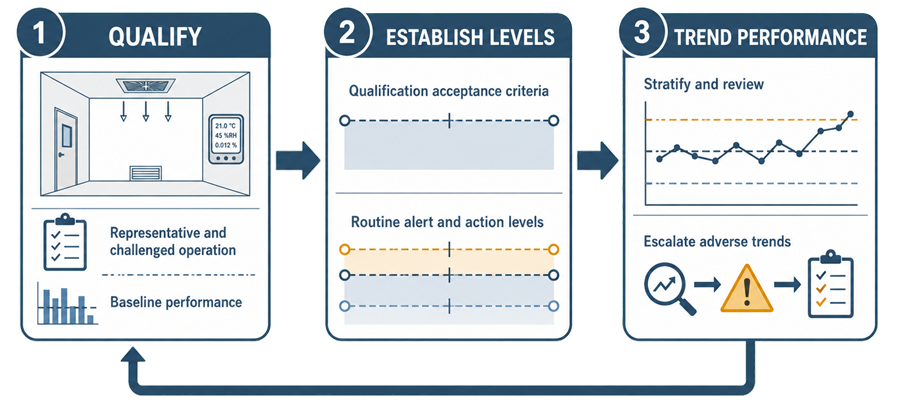
Qualification, Limits, and Trending as a Sequence
Environmental performance should be managed through three connected stages:
- Qualify the environment under defined at-rest, in-operation, representative, and justified challenged conditions.
- Establish monitoring criteria using applicable requirements, process risk, qualification evidence, baseline data, and regulatory expectations.
- Trend routine performance to detect deterioration, recurring contamination, or changes that may require investigation, corrective action, program revision, or requalification.
These stages are connected but are not interchangeable. Qualification demonstrates capability under a defined study. Alert and action levels govern routine monitoring response. Trending evaluates performance across time, locations, operating conditions, and related events.
Environmental performance management progresses from qualification and baseline characterization to establishment of distinct monitoring criteria and continued evaluation of routine data. Adverse trends return evidence to investigation, control improvement, and requalification decisions.
Environmental Performance Qualification
Environmental performance qualification evaluates whether the qualified facility, HVAC systems, operating practices, cleaning controls, personnel controls, and process configuration collectively maintain environmental conditions suitable for the intended GMP activity. The required scope depends on:
- Product and process risk
- Degree and duration of product exposure
- Sterile, aseptic, nonsterile, laboratory, or support-area use
- Cleanroom classification or functional room designation
- Facility and HVAC design
- Airflow patterns and pressure relationships
- Occupancy and personnel activity
- Equipment operation and heat or particle generation
- Material movement and interventions
- Cleaning and disinfection practices
- Applicable regulatory, procedural, and technical requirements
Environmental performance qualification is broader than cleanroom classification. Classification evaluates airborne-particle cleanliness according to a defined standard and operational state. Environmental performance qualification may integrate viable and nonviable monitoring, room-pressure data, temperature, humidity, occupancy, operating activity, and other evidence needed to demonstrate suitability for the intended operation.
Prerequisites for Performance Qualification
Environmental performance qualification should begin only after relevant systems and controls are sufficiently complete and approved for testing. Prerequisites may include:
- Approved room and HVAC requirements
- Defined room classifications or functional designations
- Completed facility and HVAC installation verification
- Completed HVAC operational qualification
- Approved airflow-balancing results
- Completed HEPA-filter installation and integrity testing, where applicable
- Verified airflow direction and pressure relationships
- Completed airflow-visualization studies where airflow behavior is critical
- Established temperature and humidity operating ranges
- Calibrated monitoring instruments
- Qualified or verified sampling and microbiological methods
- Approved cleaning and disinfection procedures
- Defined gowning and material-transfer practices
- Available equipment in its intended configuration
- Defined personnel and equipment operating conditions
- Approved sampling plan and acceptance criteria
- Resolution or documented assessment of outstanding deviations and punch-list items
The readiness assessment should identify which controls are being relied upon during the study. Qualification data generated while systems, procedures, or operating configurations remain uncontrolled may not represent the environment intended for routine use.
Qualification Study Design
The qualification protocol should define the environmental conditions, operating states, activities, locations, methods, sample quantities, durations, acceptance criteria, and evaluation approach before testing begins.
Operating States
Applicable operating states may include:
- As built, where facility and HVAC performance is evaluated before equipment and personnel are introduced
- At rest, with installed equipment complete and operating as specified but without personnel performing routine work
- In operation, with the defined number of personnel performing representative activities
- Challenged operation, where justified conditions such as maximum occupancy, intensive interventions, equipment heat load, material movement, or other credible high-demand activities are evaluated
Not every room requires testing in every state. The selected states should reflect the applicable classification standard, process requirements, intended use, and contamination risk.
A challenged condition should remain credible. Artificial activity that could not reasonably occur during approved operation may generate data that is difficult to interpret and may not demonstrate actual process suitability.
Study Duration and Repetition
A single sampling event rarely provides an adequate performance baseline. Study duration and repetition should be sufficient to evaluate:
- Day-to-day variation
- Different shifts or operating crews
- Representative activities
- Cleaning and disinfection cycles
- Equipment operating conditions
- Personnel occupancy
- Different batches or campaigns, where relevant
- Environmental recovery after activity
- Expected short-term changes in room conditions
The required number of study runs should be justified by risk, room use, sampling methods, expected variability, applicable requirements, and the strength of available commissioning and qualification evidence.
Qualification Sampling-Location Rationale
Qualification locations should be selected using documented engineering, microbiological, process, and operational rationale. The assessment should consider:
- Open product, components, and critical-surface exposure
- Airflow patterns and first-air protection
- Supply, return, and exhaust locations
- Room geometry and potential stagnant areas
- Equipment configuration
- Operator positions and interventions
- Personnel and material movement
- Doors, airlocks, and transfer openings
- Cleaning difficulty
- Locations where contamination may be generated, transported, or retained
- Findings from airflow-visualization studies
- Classification sampling requirements
- Historical data from comparable rooms or processes
- Practical limitations of the sampling method
Classification locations and environmental-monitoring locations do not have to be identical. Classification locations are selected according to the applicable classification methodology. Routine monitoring locations are selected to detect contamination risk and meaningful deterioration during operation.
Qualification sampling may therefore include both:
- Locations required to demonstrate cleanroom classification
- Additional risk-based locations needed to characterize operational environmental performance
The protocol should identify the purpose of each location rather than presenting an unexplained room map.
Establishing Baseline Environmental Performance
Baseline data describes the observed environmental behavior of an acceptable, qualified environment under documented conditions. It provides a reference for evaluating future performance but does not independently establish every monitoring limit. A useful baseline should document:
- Room and sampling-location identity
- Operational state
- Date, time, and study duration
- Personnel count and activity
- Equipment operating status
- Product or process configuration
- Cleaning and disinfection status
- Sampling method and sample volume or exposure time
- Nonviable-particle results
- Viable air, surface, and personnel results, as applicable
- Organisms recovered, where identification is required
- Differential pressure
- Temperature and relative humidity
- Relevant HVAC alarms or operating events
- Interventions, door openings, and material movement
- Deviations and unusual observations
Baseline characterization should distinguish acceptable environmental variation from variation caused by uncontrolled study execution, inconsistent sampling, laboratory error, or abnormal facility operation.
Baseline data is an evidence source. It should not be treated as permission to accept any condition previously observed during qualification.
Qualification Acceptance Criteria and Routine Monitoring Levels
Environmental programs use several types of criteria. Their purposes must remain distinct.
| Criterion | Primary purpose | Typical basis | Normal application |
|---|---|---|---|
| Classification limit | Determine compliance with a defined cleanroom class | Applicable classification standard | Formal cleanroom classification |
| Qualification acceptance criterion | Determine whether a predefined qualification requirement was successfully demonstrated | Approved requirements, classification standards, design intent, process needs, and risk assessment | Qualification or requalification study |
| Alert level | Provide early indication of possible deterioration or departure from expected performance | Baseline and historical data, regulatory expectations, process risk, and scientific judgment | Routine monitoring and trending |
| Action level | Trigger formal investigation, assessment, and documented response | Applicable requirements, contamination risk, process exposure, historical performance, and regulatory expectations | Routine monitoring |
| Operating limit or specification | Define the approved acceptable range for a controlled parameter | Product, process, facility, or engineering requirement | Routine operation and monitoring |
| Alarm threshold | Initiate notification or automated response | Control strategy, instrument capability, response time, and operating range | Automated or continuous monitoring |
A qualification result that meets its acceptance criterion does not automatically define an appropriate alert level. An alert-level result does not automatically mean that qualification has failed. An action-level result requires formal response, but its product and system significance must still be determined from the complete evidence.
Classification Limits
Classification limits apply to airborne-particle concentration under a defined classification method and operating state. They are used to determine whether the room meets the specified airborne-cleanliness class.
Classification limits should not automatically be used as:
- Routine alert levels
- Routine action levels
- Microbiological limits
- Universal limits for every sample location
- Evidence that a process is protected from microbiological contamination
- Proof that the complete environmental-control system is suitable
Routine nonviable monitoring may reference applicable classification or regulatory limits, but the monitoring strategy must also consider sampling duration, location, operating activity, instrument configuration, data frequency, process exposure, and the response expected when results deteriorate.
Qualification Acceptance Criteria
Qualification acceptance criteria should be approved before study execution and tied to defined requirements or study objectives. They may address:
- Required airborne-particle classification
- Viable environmental performance during representative operation
- Maintenance of required pressure relationships
- Temperature and relative-humidity ranges
- Recovery performance
- Absence of airflow reversal or unacceptable disturbance
- Performance during maximum justified occupancy
- Acceptable conditions during representative interventions
- Consistency among repeated study runs
- Completion of required samples without invalid execution
- Resolution of deviations affecting study validity
Qualification acceptance criteria should be scientifically justified and sufficiently specific to support an unambiguous pass, fail, or deviation decision.
They should not be revised after testing merely to accommodate an unfavorable result. If a criterion proves unsuitable, the reason should be investigated and any revision controlled before repeat testing or formal disposition.
Establishing Alert Levels
Alert levels are intended to identify results, patterns, or shifts that may represent early deterioration from expected environmental performance. Their establishment may consider:
- Qualification and baseline data
- Accumulated routine monitoring history
- Room classification and function
- Product and process exposure
- Location-specific risk
- Sampling method and sample volume
- Expected recovery frequency
- Applicable regulatory expectations
- Data from comparable rooms, where scientifically justified
- Seasonal and operational variability
- Capability of the monitoring and laboratory methods
- The need to detect change before an action level is reached
An alert-level result normally requires documented review or heightened assessment. It does not necessarily establish loss of environmental control or product impact. Alert response may include:
- Verification of sampling and laboratory information
- Review of concurrent results
- Evaluation of recent room activities
- Increased attention during trend review
- Temporary additional monitoring
- Review of cleaning, personnel, maintenance, or operational events
- Escalation when alerts recur or form an adverse pattern
Alert levels should be sensitive enough to detect meaningful deterioration without generating persistent noninformative alarms.
Establishing Action Levels
Action levels identify results that require formal investigation, documented assessment, and predefined response. Their establishment should consider:
- Applicable regulatory or procedural requirements
- Room classification and intended function
- Product and critical-surface exposure
- Process controls and sterility-assurance strategy
- Location and sampling method
- Qualification and historical performance
- Organism identity and contamination significance
- Ability of the process to tolerate environmental variation
- Consequences of delayed detection
- Relationships to alert levels and operating limits
An action-level excursion indicates a potential loss of control. It does not automatically prove product contamination, nor should it be dismissed solely because adjacent samples were acceptable.
The procedure should define:
- Required notification
- Investigation initiation
- Review of potentially affected operations or batches
- Microbial identification expectations
- Additional monitoring criteria
- Immediate containment or operational controls
- Corrective and preventive action requirements
- Quality-unit review and disposition authority
- Conditions requiring shutdown, requalification, or program revision
Where a regulation or applicable standard establishes a maximum action criterion, facility-specific historical performance should not be used to justify a less stringent level.
Viable Data and Zero-Heavy Distributions
Microbiological environmental data frequently contains many zero results and a smaller number of positive recoveries. These data are generally discrete, nonnegative, location-dependent, and often not normally distributed.
A result of zero CFU means no recoverable colony-forming organism was detected under the conditions of that sample. It does not demonstrate that the location was free of microorganisms.
Because of the zero-heavy distribution, routine calculation of a mean and standard deviation may produce misleading alert or action levels. For example, a statistical calculation may generate a fractional CFU threshold or a limit that does not reflect microbiological significance.
Viable-data evaluation should consider multiple attributes:
- Frequency of positive recovery
- Count when recovery occurs
- Repeated recovery at the same location
- Consecutive positive samples
- Organism identity
- Recovery of objectionable, unusual, spore-forming, or difficult-to-control organisms
- Changes in predominant flora
- Relationship to personnel, interventions, cleaning, or maintenance
- Recovery in adjacent or related locations
- Differences among shifts, rooms, campaigns, or operators
- Time since cleaning or disinfection
- Location-specific product or process risk
For low-count critical areas, the occurrence or identity of a recovery may be more significant than its numerical magnitude.
Nonviable and Continuous Data
Nonviable-particle, differential-pressure, temperature, and humidity systems may generate large volumes of continuous or frequently sampled data. Evaluation should distinguish among:
- Individual readings
- Averaged values
- Short-duration spikes
- Sustained excursions
- Alarm events
- Process-related disturbances
- Instrument faults
- Communication interruptions
- Data gaps
- Recurring patterns
- Changes in baseline variability
A brief particle increase associated with a documented intervention may have a different significance from a sustained increase without an identified operational cause. The evaluation should consider duration, magnitude, location, process exposure, concurrent viable data, and the activity occurring at the time.
Data averaging should not conceal meaningful short-duration excursions. Conversely, every instantaneous reading should not automatically be treated as an independent environmental event when the monitoring system produces highly frequent correlated measurements.
Data Stratification
Environmental data should be stratified before conclusions are drawn. Combining unlike locations or operating conditions can conceal significant changes or create misleading apparent trends. Useful stratification may include:
- Room or area
- Sampling location
- Sampling method
- Viable versus nonviable data
- Air, surface, and personnel results
- At-rest versus in-operation conditions
- Shift
- Operator or operating team
- Product or campaign
- Process step
- Equipment configuration
- Intervention type
- Day of week or time of day
- Time since cleaning or disinfection
- Pre-maintenance versus post-maintenance periods
- Season or external climatic condition
- Organism type
- Routine versus investigation samples
Data may also be aggregated for program-level review, but aggregation should not replace location-specific and event-specific evaluation.
Seasonal and Operational Variation
Environmental performance may vary with seasonal and operational conditions. Potential seasonal influences include:
- Outdoor temperature and humidity
- HVAC heating or cooling mode
- Outside-air moisture load
- Filter loading
- Condensation risk
- Building-pressure behavior
- Construction or maintenance activity
- Changes in environmental microbial populations
Operational influences may include:
- Occupancy
- Operator behavior
- Production intensity
- Equipment heat generation
- Material movement
- Door-opening frequency
- Interventions
- Cleaning and disinfection
- Shutdown and restart
- Campaign duration
- Maintenance activity
Observed seasonal variation should not automatically be accepted as normal. It should be evaluated against approved requirements and the capability expected from the facility and HVAC design.
Initial qualification may require seasonal evidence where environmental capability can be materially affected by seasonal conditions. Where initial studies do not cover all relevant seasons, the limitation and follow-up approach should be documented.
Trending Methods and Review Frequency
Trending should be designed to detect meaningful environmental changes before they develop into repeated excursions or loss of control. Possible methods include:
- Tabulation of alert- and action-level events
- Recovery-frequency analysis
- Location-specific time plots
- Moving averages
- Run charts
- Control charts, where the data distribution and method are appropriate
- Organism-frequency and flora analysis
- Pareto analysis by location, organism, event, or cause
- Comparison of defined periods
- Pre-change and post-change comparison
- Seasonal comparison
- Review of repeated investigation causes
- Correlation with maintenance, cleaning, pressure, particle, and operational data
No single statistical technique is suitable for every data type. The selected method should reflect the distribution, sample size, sampling frequency, detection limit, and intended decision.
Trend reviews may occur at several levels:
- Immediate result review
- Periodic short-term operational review
- Monthly or quarterly program review
- Annual or other defined comprehensive review
- Event-driven review following a change, excursion, contamination event, or maintenance activity
The review frequency should allow timely detection and response. A formal annual summary cannot replace prompt assessment of an emerging adverse trend.
Indicators of an Adverse Trend
An adverse trend may exist even when individual results remain below established action levels. Potential indicators include:
- Increasing alert-level frequency
- Repeated or consecutive alerts
- Increasing counts within the acceptable range
- Recurring isolated action-level results
- Increasing frequency of positive viable samples
- Repeated recovery at the same location
- Spread of recoveries across related locations
- Change in predominant microbial flora
- Recovery of objectionable or difficult-to-control organisms
- Increased personnel-monitoring recoveries
- Deterioration after maintenance or facility work
- Loss of a previously demonstrated seasonal pattern
- Repeated pressure, temperature, humidity, or particle alarms
- Increasing duration of excursions
- Recurring investigation causes
- Ineffective corrective actions
- Unexplained divergence between viable and nonviable data
- A new association with a specific operator, shift, intervention, or process activity
Trend criteria should not be limited to a single numerical trigger. Microbiological, engineering, operational, and quality judgment remains necessary.
Trend Escalation and Investigation
A suspected adverse trend should be evaluated through a defined escalation process. The initial assessment should confirm:
- Data identity and completeness
- Sampling location and method
- Instrument and laboratory status
- Operational conditions
- Applicable limits and procedures
- Whether similar results occurred at related locations or times
- Whether the pattern is statistically or microbiologically meaningful
- Whether an investigation threshold has been reached
Investigation may include:
- Review of sampling execution and sample handling
- Review of incubation, enumeration, and identification records
- Organism identification and comparison with prior isolates
- Review of room use, occupancy, and interventions
- Review of personnel-monitoring and training records
- Review of cleaning and disinfection
- Review of pressure, particle, temperature, and humidity data
- Review of HVAC alarms, maintenance, balancing, and filter status
- Review of recent changes, construction, or facility work
- Review of product exposure and potentially affected batches
- Targeted additional monitoring
- Airflow visualization or engineering assessment
- Corrective or preventive action
- Evaluation of qualification status
Resampling may provide additional evidence, but it does not erase or invalidate the original result. The original observation remains part of the investigation and trend history.
Failure to identify a definitive root cause should not automatically result in closure without action. The decision should address the strength of the evidence, recurrence risk, product exposure, and whether additional control or monitoring is necessary.
Product and Process Impact
Environmental excursions and adverse trends should be evaluated in relation to the activity performed and the controls protecting the product. The assessment may consider:
- Whether product, components, or critical surfaces were exposed
- Duration and location of exposure
- Distance and airflow relationship between the event and exposed product
- Process step
- Barrier or closed-system protection
- Organism identity and characteristics
- Magnitude and duration of the environmental event
- Concurrent environmental results
- Personnel and intervention history
- Cleaning and disinfection status
- Sterilization or microbial-reduction steps
- In-process and finished-product controls
- Batch timing relative to detection and reporting
- Recurrence and historical context
An action-level result does not automatically establish batch rejection. An acceptable finished-product test does not automatically negate evidence of environmental-control failure. Disposition should be based on the totality of evidence.
Periodic Review of Levels and Trending Methods
Alert levels, action levels, trend rules, locations, and review methods should be periodically evaluated for continued suitability. The review should consider:
- Accumulated environmental data
- Alert and action events
- Adverse trends
- Organism patterns
- Investigation outcomes
- Corrective-action effectiveness
- Changes in process or room use
- Facility and HVAC changes
- Revised regulatory or procedural requirements
- Monitoring-method changes
- Seasonal performance
- Requalification results
- Sampling locations and frequencies
- Excessive noninformative alerts
- Levels that no longer provide adequate early warning
Limits should not be repeatedly widened to reduce investigations. A proposed change should be scientifically justified, documented through change control, and assessed for its effect on prior trends and regulatory commitments.
A limit may also require tightening when process risk increases, performance improves enough to support earlier detection, or accumulated data shows that the existing level does not provide meaningful warning.
Requalification Input
Environmental monitoring data is an important input to requalification decisions, but an individual result does not automatically require requalification.
Targeted or comprehensive requalification should be considered when evidence indicates that the qualified basis may no longer remain valid. Potential triggers include:
- Repeated action-level excursions
- Persistent adverse trends
- Loss of required cleanroom classification
- Deterioration in pressure relationships
- Significant HVAC failure or modification
- HEPA-filter repair or replacement
- Major airflow-balancing changes
- Room-layout or equipment-configuration changes
- Changes in occupancy or operating intensity
- New product or process use
- Significant cleaning or disinfection failure
- Unexplained recurring contamination
- Evidence that qualification conditions no longer represent routine operation
- Failure of corrective actions to restore control
Requalification scope should follow the identified risk and affected control. An isolated location-specific microbiological issue may require targeted investigation and verification rather than repetition of every HVAC test. A system-wide loss of classification or airflow control may require a broader response.
The decision, selected test scope, justification for unchanged tests, acceptance criteria, responsible owner, and release requirements should be documented.
Documentation and Lifecycle Records
The environmental performance record should maintain traceability among qualification, monitoring, trending, investigations, changes, and requalification. Documentation should include, as applicable:
- Qualification protocol and report
- Prerequisite and readiness assessment
- Sampling-location rationale
- Room maps and location identifiers
- Defined operating and challenged conditions
- Raw viable and nonviable data
- Organism identification records
- Baseline-performance analysis
- Approved qualification acceptance criteria
- Alert- and action-level rationale
- Trend methodology and review frequency
- Routine trend reports
- Seasonal assessments
- Deviations and investigations
- Product-impact assessments
- Corrective and preventive actions
- Monitoring-program changes
- Requalification decisions
- Quality-unit review and approval
The objective is to maintain an understandable chain of evidence: why the environment was considered suitable, how routine criteria were established, what the monitoring data showed, and how the organization responded when performance changed.
Maintaining Environmental Control
Qualification establishes environmental capability under defined conditions. Routine levels establish when results require attention or formal action. Trending determines whether performance remains consistent or is beginning to deteriorate.
Effective environmental oversight therefore depends on more than passing individual samples. It requires:
- A qualified facility and HVAC system
- Representative baseline evidence
- Scientifically justified monitoring criteria
- Consistent sampling and data integrity
- Appropriate data stratification
- Timely review of adverse trends
- Investigation based on the complete evidence
- Documented feedback into control strategy, change control, and requalification
The purpose is not to generate a record of acceptable results. The purpose is to detect meaningful change and maintain an environment suitable for its intended GMP operation throughout the facility lifecycle.