

Periodic Review of Calibration and Maintenance Programs
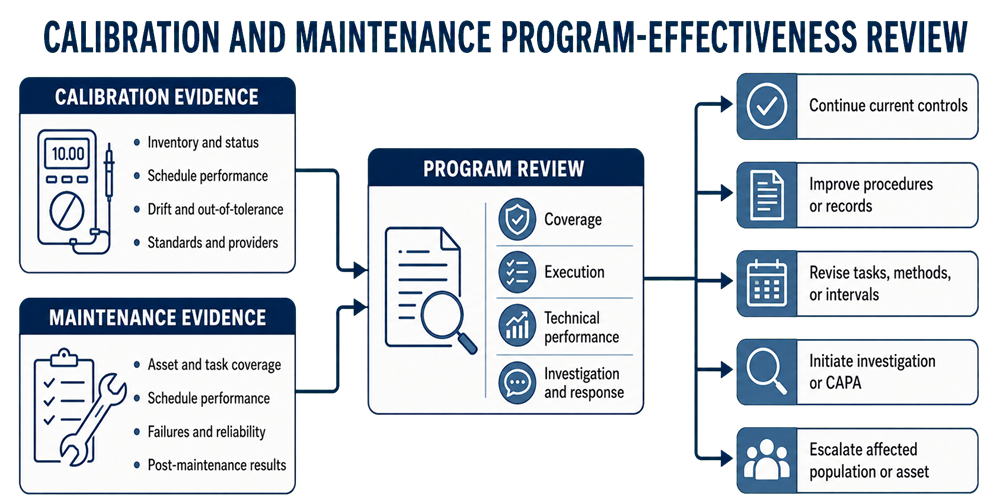
Calibration and maintenance programs must be periodically evaluated to determine whether they are functioning as intended—not merely whether scheduled work was completed.
The review should determine whether the programs:
- Include the correct instruments, assets, and functions
- Complete required activities within approved timeframes
- Detect deterioration before GMP impact occurs
- Produce reliable and complete records
- Respond appropriately to failures and adverse trends
- Use technically justified tasks, methods, limits, and intervals
- Implement effective corrective actions
- Continue to support reliable measurement and equipment performance
This review is distinct from Periodic Equipment Assessment. Periodic Equipment Assessment evaluates whether a specific equipment system or utility remains fit for use and in a qualified state. Periodic Review and Continued Verification evaluates whether the calibration and maintenance programs themselves remain effective across the controlled asset population.
Purpose and Scope
The purpose of periodic review is to evaluate accumulated program evidence and identify weaknesses that may not be apparent from individual calibration records, maintenance work orders, deviations, or investigations. The review applies to defined calibration and maintenance populations, which may include:
- GMP-critical measuring instruments
- Reference and working standards
- Production and packaging equipment
- Laboratory instruments
- Utility and HVAC assets
- Environmental-monitoring instruments
- Automation and control components
- Safety, alarm, and interlock functions
- Condition-monitoring and predictive-maintenance systems
- External calibration and maintenance providers
- Electronic calibration and maintenance-management systems
The review may cover the complete site program or a defined segment. When a segment is reviewed, its boundaries and rationale must be documented.
Program Review Versus Equipment Assessment
The activities are related but serve different purposes.
| Activity | Primary review unit | Principal question | Typical output |
|---|---|---|---|
| Periodic Review and Continued Verification | Calibration or maintenance program, or defined population | Are program controls technically adequate and consistently effective? | Program improvements, interval changes, procedure revisions, CAPA, provider controls |
| Periodic Equipment Assessment | Individual equipment system, utility, or defined asset | Does lifecycle evidence support continued fitness for use and qualified status? | Continued use, corrective action, enhanced monitoring, requalification evaluation |
| Event investigation | Specific failure, overdue activity, or adverse event | What occurred, what was affected, and what immediate action is required? | Impact assessment, correction, CAPA, disposition |
| Requalification assessment | Affected qualified functions | Is additional qualification testing required? | No testing, targeted testing, or comprehensive requalification |
Periodic program review may identify assets requiring separate assessment. It should not attempt to replace the equipment-specific assessment or requalification decision.
Regulatory and Quality-System Basis
For pharmaceutical manufacturing, 21 CFR 211.67 requires equipment to be maintained at appropriate intervals to prevent malfunctions or contamination that could affect drug-product quality.
21 CFR 211.68(a) requires automatic, mechanical, and electronic equipment to be routinely calibrated, inspected, or checked according to a written program designed to assure proper performance.
21 CFR 211.160(b)(4) requires calibration of laboratory instruments, apparatus, gauges, and recording devices at suitable intervals under an established written program containing directions, schedules, limits, and remedial-action provisions.
When program records are maintained electronically, applicable 21 CFR Part 11 requirements must also be considered.
For medical-device manufacturers, FDA’s Quality Management System Regulation became effective on February 2, 2026. QMSR incorporates ISO 13485:2016 into Part 820, including applicable controls for infrastructure and monitoring and measuring resources. Former §§820.70 and 820.72 should not be presented as current standalone regulatory requirements.
These requirements establish the need for controlled calibration and maintenance programs. Periodic review provides documented evidence that those controls remain suitable and effective.
Program Governance
The governing procedure should define:
- Program owner
- Review population and boundaries
- Review frequency
- Required data sources
- Data-quality checks
- Performance measures and calculation methods
- Segmentation requirements
- Alert and escalation criteria
- Required technical reviewers
- Quality oversight
- Action tracking
- Approval requirements
- Record-retention requirements
Calibration and maintenance may be reviewed together or separately. Combined review is useful where measurement failures, repairs, adjustments, and post-maintenance testing interact.
Responsibilities commonly include:
- Metrology or Calibration: calibration data, standards, methods, providers, intervals, and out-of-tolerance performance
- Engineering or Maintenance: maintenance execution, failure history, task effectiveness, reliability, parts, and providers
- Asset owners: operating context, recurring problems, usage changes, and equipment-access issues
- Validation: qualification implications of adverse findings
- Quality: investigations, CAPA, escalation, approval, and program oversight
- Automation or IT: electronic-system performance, configuration, interfaces, access, and data integrity
- Management: resources, priorities, unresolved systemic issues, and program improvement
Establishing Review Frequency
Review frequency should be defined from the significance and performance of the program population rather than assigning one interval to every asset. Relevant considerations include:
- GMP importance of the supported measurements and functions
- Size and complexity of the controlled population
- Volume of calibration and maintenance activity
- Historical program performance
- Frequency and significance of failures
- Ability to detect deterioration through routine controls
- Stability of calibration drift and equipment reliability
- Number of external service providers
- Changes to instruments, equipment, methods, or software
- Results of previous reviews
- Open investigations and CAPA
- Regulatory commitments or procedural requirements
A shorter review interval may be warranted following major program changes, migration to a new management system, adverse performance, significant provider changes, or ineffective CAPA. Event-driven review should not be delayed until the next scheduled review when evidence indicates a potentially systemic control failure.
Defining the Review Period and Population
Each review should identify:
- Beginning and ending dates
- Included sites, departments, systems, or asset groups
- Instrument and equipment classifications included
- Excluded populations and justification
- Data sources and extraction dates
- Systems from which data were obtained
- Known data limitations
- Responsible reviewers
- Previous review used for comparison
The opening and closing population must be reconciled. Additions, retirements, reclassifications, relocations, and inactive assets should be accounted for. A sitewide result should not be accepted without determining whether weak performance is concentrated within a particular:
- Instrument or equipment type
- Manufacturer or model
- Department or location
- Service provider
- Calibration method
- Maintenance task
- Operating environment
- Criticality classification
- Age group
- Interval
- Failure mode
Data Preparation and Integrity
Program conclusions are only as reliable as the underlying data.
Before trending, reviewers should determine whether records are:
- Complete for the defined population
- Correctly classified
- Consistently coded
- Traceable to source records
- Free from unexplained duplicates
- Linked to associated investigations and CAPA
- Supported by usable as-found and as-left results
- Sufficiently detailed to identify failure mode and affected function
- Consistent across internal and external providers
- Protected from unauthorized modification
- Retained for the required period
Data deficiencies should not automatically be treated as neutral results. Missing as-found calibration data, vague maintenance descriptions, inconsistent failure codes, or incomplete provider certificates may themselves demonstrate a program-control weakness.
Electronic records used for regulated decisions should be evaluated within the broader 21 CFR Part 11 compliance and data-integrity framework.
Calibration Program Effectiveness Review
Detailed calibration controls are established in the Calibration Program and Metrology Control article. Periodic review evaluates whether those controls are operating effectively across the defined population.
Population and Status Control
The review should determine whether:
- Required instruments are included in the controlled inventory
- Instrument classifications remain appropriate
- Retired, replaced, relocated, or inactive instruments are correctly controlled
- Calibration status is visible and current
- Instruments cannot be used unintentionally when overdue, failed, restricted, or under investigation
- Embedded instruments and reference standards are adequately identified
- Calibration requirements remain aligned with intended GMP use
Repeated inventory discrepancies may indicate weak asset control even when completed calibration records are acceptable.
Schedule Performance
The review should evaluate:
- Calibrations due during the review period
- Calibrations completed on time
- Overdue calibrations
- Duration of overdue status
- Criticality of affected instruments
- Use during the overdue period
- Recurring scheduling failures
- Approved extensions or restricted-use decisions
- Reasons for delay
- Effectiveness of escalation controls
A high completion percentage can conceal significant risk if the small overdue population contains critical instruments or extended delays.
Technical Calibration Performance
The review should evaluate:
- As-found calibration results
- Magnitude and direction of error
- Drift by instrument and population
- Out-of-tolerance frequency
- Repeat out-of-tolerance events
- Adjustments performed despite passing results
- Failures at particular calibration points
- Restricted-range releases
- Instruments repeatedly requiring repair or replacement
- Relationship between drift and use, environment, maintenance, or age
Trend analysis should use actual measurement results where available. Pass/fail counts alone cannot identify progressive drift or instruments repeatedly approaching the acceptance limit.
Out-of-Tolerance Response
The review should determine whether out-of-tolerance events were:
- Detected and documented
- Properly classified
- Investigated to an appropriate depth
- Evaluated using the as-found error
- Assessed for potentially affected GMP use
- Evaluated over a justified affected period
- Linked to applicable batches, results, studies, alarms, or controls
- Corrected before release
- Evaluated for recurrence
- Escalated to CAPA when systemic action was warranted
The review should also determine whether similar failures were evaluated collectively rather than repeatedly closed as isolated events.
Calibration Intervals
Interval effectiveness should be assessed using:
- Drift behavior
- Out-of-tolerance history
- Repeat adjustment or repair
- Instrument design and stability
- Frequency and conditions of use
- Environmental exposure
- Maintenance history
- Intermediate checks
- Failure detectability
- Consequences of undetected measurement error
Possible conclusions include maintaining, shortening, or extending the interval. Interval extension requires adequate performance evidence and formal control through Change Impact on Calibration and Maintenance.
The absence of reported failures is not sufficient evidence for extension when as-found data are missing, acceptance limits are overly broad, or failures would not be readily detected.
Reference Standards and Service Providers
The review should consider:
- Reference-standard calibration status
- Intermediate-check performance
- Storage, handling, and transportation
- Damage or suspected misuse
- Reported uncertainty
- Traceability documentation
- Provider scope and capability
- Certificate completeness
- Turnaround time
- Recurring documentation corrections
- Provider-related deviations
- Performance by provider
- Effectiveness of supplier corrective actions
A provider’s accreditation or quality certification does not eliminate the site’s responsibility to review the service and returned records.
Maintenance Program Effectiveness Review
The maintenance strategy and its technical controls are established in Preventive Maintenance and System Reliability Strategy. Periodic review determines whether those controls prevent, detect, predict, or appropriately respond to relevant failure modes.
Asset and Task Coverage
The review should determine whether:
- GMP-relevant assets are included in the maintenance program
- Critical components and functions are covered
- Each maintenance task has a defined technical purpose
- Tasks address credible failure modes
- Manufacturer recommendations have been evaluated
- Approved changes are reflected in maintenance requirements
- New and replacement equipment has been incorporated
- Obsolete tasks and parts have been removed
- Post-maintenance calibration and testing requirements are defined
A completed maintenance schedule is not effective if important assets or failure modes are absent from the program.
Schedule and Work-Order Performance
The review should evaluate:
- Maintenance activities due
- Activities completed on time
- Deferred and overdue work
- Duration and recurrence of delays
- Emergency maintenance
- Planned versus unplanned work
- Work-order cancellations
- Repeated rescheduling
- Temporary repairs
- Work performed without adequate instructions
- Work closed with incomplete documentation
- Restricted-use decisions pending maintenance
Deferred work should be distinguished from work that became overdue without an approved assessment.
Failure and Reliability Performance
Relevant evidence may include:
- Repeat equipment failures
- Corrective maintenance frequency
- Failure between scheduled maintenance activities
- Emergency interventions
- Equipment downtime
- Recurring alarms or operator interventions
- Condition-monitoring alerts
- Component life
- Spare-part consumption
- Mean time between failures where technically useful
- Failure by model, component, or operating environment
- Failure after maintenance
- Failure following component substitution
- Increasing maintenance burden
Uptime alone does not demonstrate effective maintenance. Equipment may remain operational while control stability, measurement reliability, alarm function, cleanliness, or qualified performance deteriorates.
Maintenance-Task Effectiveness
For significant or recurring tasks, the review should determine:
- Which failure mode the task is intended to control
- Whether the task detects deterioration before failure
- Whether failures continue despite task completion
- Whether the task introduces defects or unnecessary intervention
- Whether inspection criteria are objective
- Whether actual findings are recorded
- Whether the task frequency remains appropriate
- Whether required tools and calibrated test equipment are available
- Whether personnel and providers consistently follow the procedure
- Whether post-maintenance testing is adequate
A task may be ineffective because of incorrect scope, unsuitable interval, poor execution, inadequate acceptance criteria, or an incorrect assumption about the failure mechanism.
Maintenance-Induced Events
The review should specifically identify:
- Incorrect reassembly
- Wrong parts or materials
- Contamination introduced during work
- Incorrect settings or configuration
- Calibration failure following maintenance
- Failed functional or qualification testing
- Alarm or interlock failures
- Leaks or integrity failures
- Undocumented adjustments
- Incomplete restoration
- Premature failure after maintenance
Maintenance-induced events may require changes to procedures, training, supervision, parts control, testing, or service-provider qualification.
Maintenance Intervals and Strategies
The review should determine whether preventive, condition-based, predictive, corrective, or combined strategies remain appropriate.
Evidence supporting revision may include:
- Failures before scheduled maintenance
- No evidence of deterioration at repeated interventions
- Adverse condition-monitoring trends
- Unreliable predictive results
- Changes in equipment duty
- Environmental changes
- Increased or reduced production use
- Component obsolescence
- Improved failure-detection capability
- New failure modes
- Intervention-related risk
A maintenance task should not be removed solely because no failures occurred. The absence of failure may indicate that the task is effective.
Interaction Between Calibration and Maintenance
Calibration and maintenance evidence should be reviewed together when the activities affect the same function. Potential interactions include:
- Calibration failure following adjustment or repair
- Repeated repair caused by measurement instability
- Instrument drift associated with environmental or mechanical conditions
- Maintenance performed without required post-work calibration
- Calibration performed without evaluation of underlying equipment deterioration
- Repeated sensor replacement without investigation of the installation or process condition
- Post-maintenance testing that does not challenge the complete measurement loop
- Maintenance strategy changes affecting calibration stability
- Calibration interval changes masking recurring equipment problems
The review should identify cases in which one program repeatedly corrects symptoms originating in the other.
Performance Measures and Interpretation
Measures should answer a defined control question. They should not be included merely because they are easy to count.
| Review question | Useful measure | Required interpretation |
|---|---|---|
| Is scheduled work controlled? | On-time completion and overdue work | Evaluate duration, criticality, recurrence, and use during the overdue period |
| Are measurements remaining stable? | Drift magnitude and direction | Segment by type, range, environment, provider, and interval |
| Are calibration limits being exceeded? | Out-of-tolerance events per calibrations performed | Evaluate error magnitude, repeat failures, and GMP consequences |
| Is maintenance preventing relevant failures? | Failures between scheduled tasks | Link failures to the task and failure mode intended to be controlled |
| Is maintenance creating problems? | Post-maintenance failures per completed maintenance activity | Evaluate procedure, execution, parts, calibration, and testing |
| Is reactive work increasing? | Corrective or emergency work as a proportion of total work | Segment by asset class, component, and failure mode |
| Are problems recurring? | Repeat event rate | Confirm whether prior corrective actions addressed root cause |
| Are providers effective? | Failures, delays, and documentation deficiencies by provider | Consider service volume and technical significance |
| Are actions completed effectively? | Actions completed and effectiveness confirmed | Completion alone does not demonstrate effectiveness |
Percentages must use defined denominators. Counts should be normalized when workload or population changes materially between review periods. A favorable sitewide average should not override a significant adverse trend within a critical subgroup.
Trend-Evaluation Method
Trend evaluation should follow a documented sequence:
- Confirm the review population and data completeness.
- Define the measure and denominator.
- Compare with previous periods or an established baseline.
- Segment the data to identify concentrated weaknesses.
- Examine magnitude, direction, recurrence, and significance.
- Link signals to investigations, changes, operating conditions, and prior actions.
- Determine whether the issue is isolated, population-specific, or systemic.
- Define actions, responsibilities, due dates, and effectiveness criteria.
- Confirm whether immediate escalation is required.
- Reassess performance after implementation.
Statistical methods may support the review when the data quantity and structure justify their use. Statistical significance should not replace technical and GMP significance.
A single severe failure may require action even when no statistical trend exists. Conversely, numerous minor events may reveal a systemic weakness when evaluated collectively.
Review Conclusions
The review should provide a supported conclusion for each applicable area:
- Population and inventory control
- Scheduling and overdue-work control
- Calibration technical performance
- Out-of-tolerance investigations
- Maintenance reliability
- Task and interval effectiveness
- Reference-standard control
- Service-provider performance
- Electronic record and data quality
- Change implementation
- Investigation and CAPA effectiveness
- Staffing, training, and resources
- Previous review actions
Conclusions should distinguish among:
- Controls remain effective; continue without change
- Improvement is required without evidence of current GMP impact
- Enhanced monitoring or shorter review interval is required
- A procedure, method, task, limit, or interval requires change
- An investigation or CAPA is required
- A population-specific technical assessment is required
- An equipment-specific Periodic Equipment Assessment is required
- Qualification impact must be evaluated
- Immediate restriction or suspension of use is required
Terms such as “acceptable,” “stable,” or “no adverse trend” should be supported by the evidence reviewed and the criteria applied.
Escalation and Program Actions
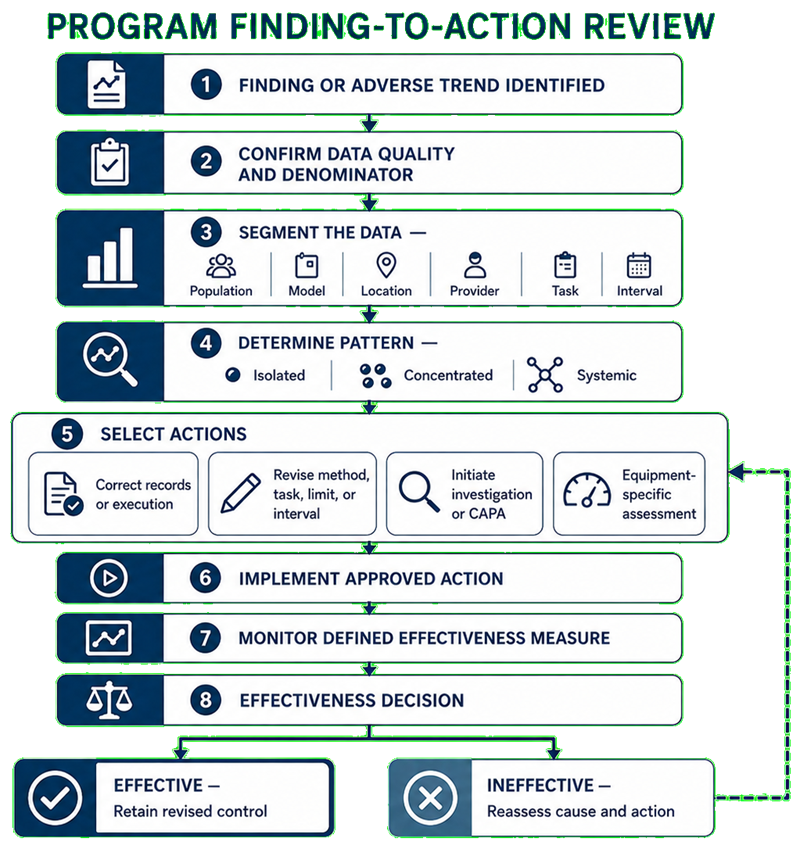
A finding or adverse trend should not lead directly to a predetermined action. Reviewers should first confirm that the underlying data are complete and reliable, then analyze the results by relevant population, instrument or equipment model, location, service provider, task, and interval.
This analysis should determine whether the finding is:
- Isolated: Limited to a specific record, activity, instrument, or equipment item
- Concentrated: Recurring within a defined population, model, location, provider, task, or interval
- Systemic: Indicating a broader weakness in program design, governance, execution, or oversight
The scope and significance of the finding determine the required response. More than one action may be necessary.
Correction of Program Records or Execution
Administrative or execution deficiencies may require:
- Correcting inventory or status records
- Improving scheduling and overdue-work escalation
- Retraining personnel
- Improving record completeness or failure-code quality
- Strengthening spare-part controls
- Revising service-provider requirements
- Correcting electronic-system controls
A correction is appropriate only when the problem is limited and there is no evidence of a broader technical or GMP impact.
Revision of Program Controls
Evidence that existing controls are unsuitable or ineffective may require:
- Revising calibration methods or calibration points
- Revising calibration acceptance limits
- Shortening or extending calibration intervals
- Revising maintenance tasks or acceptance criteria
- Changing maintenance strategies or frequencies
- Improving condition monitoring
- Increasing periodic-review frequency
- Replacing unreliable instruments or equipment
Changes to approved methods, limits, tasks, intervals, providers, or electronic systems should be evaluated through Change Impact on Calibration and Maintenance.
Investigation and CAPA
A deviation, investigation, or CAPA may be required when the finding involves:
- Actual or potential GMP impact
- Recurring failures
- Multiple affected assets
- Inadequate previous corrective action
- A significant failure of program controls
- Unreliable or incomplete regulated records
- A weakness extending across departments, providers, or asset populations
A retrospective impact assessment should be performed when instruments or equipment may have been used while calibration status, measurement reliability, maintenance condition, or qualified performance was uncertain.
Equipment-Specific Escalation
Program review may identify an affected instrument, equipment item, system, or population requiring evaluation outside the program-level review. This may include:
- Equipment-specific assessment
- Restriction or suspension of use
- Additional calibration or functional testing
- Targeted qualification testing
- Evaluation of targeted or comprehensive requalification
Program review identifies the need for escalation; it does not itself determine that affected equipment remains fit for use or qualified.
Following approval, assigned actions should be implemented and monitored against defined effectiveness measures. Action completion alone does not demonstrate effectiveness. If the expected improvement is not achieved, the cause and selected actions must be reassessed.
Action Tracking and Effectiveness Verification
Every required action should identify:
- Finding addressed
- Required deliverable
- Responsible owner
- Priority
- Due date
- Interim control, when necessary
- Approval requirement
- Effectiveness measure
- Effectiveness-review period
- Closure authority
An action is not effective merely because a procedure was revised or a work order was closed.
Effectiveness evidence may include:
- Reduced repeat failures
- Improved on-time completion
- Acceptable drift over a defined operating period
- Elimination of recurring documentation deficiencies
- Successful post-maintenance testing
- Improved provider performance
- Reliable condition-monitoring results
- Absence of recurrence over sufficient usage or time
- Confirmation that revised intervals remain suitable
When adequate operating evidence is not yet available, the review record should distinguish action completion from final effectiveness confirmation.
Interface with Equipment Assessment and Requalification
Periodic program review may reveal a subgroup or individual asset requiring deeper evaluation.
Examples include:
- Repeated out-of-tolerance results for one instrument model
- Recurring failures within one equipment family
- Increasing maintenance burden on a critical system
- Repeated post-maintenance qualification failures
- Significant degradation not detected by existing tasks
- Missing evidence supporting a qualified function
- Multiple individually acceptable changes producing cumulative impact
The affected equipment should then be evaluated through Periodic Equipment Assessment or an event-specific assessment. When available evidence does not adequately demonstrate that affected qualified functions remain acceptable, the need and scope of testing should be determined through risk-based requalification.
Periodic program review provides input to those decisions. It should not automatically conclude that equipment remains qualified or prescribe a complete requalification package.
Review Record
The approved review record should include:
- Purpose and scope
- Review period
- Population and exclusions
- Data sources
- Data-quality assessment
- Measures and calculation methods
- Comparison periods or baselines
- Segmented trends
- Significant individual events
- Evaluation of previous actions
- Calibration-program conclusions
- Maintenance-program conclusions
- Cross-program findings
- Required investigations, CAPA, or changes
- Equipment-specific escalations
- Assigned actions and due dates
- Interim controls
- Effectiveness requirements
- Reviewers and approvals
The record should permit an independent reviewer to understand how the evidence supports each conclusion.
Conclusion
Periodic Review and Continued Verification evaluates whether calibration and maintenance programs continue to provide effective lifecycle control.
A defensible review does more than report completion percentages. It evaluates population coverage, technical performance, overdue work, drift, out-of-tolerance events, failure behavior, task effectiveness, provider performance, investigation quality, and corrective-action effectiveness.
Program-level trends are used to improve calibration and maintenance controls. Equipment-specific fitness for use remains the responsibility of Periodic Equipment Assessment, event investigation, change assessment, and requalification processes.