

Change Impact on Calibration and Maintenance
Changes affecting instruments, equipment, calibration controls, or maintenance strategies can alter measurement reliability, equipment performance, and the qualified state. The impact is determined by what the change affects—not by whether it is described as a replacement, adjustment, repair, software update, procedural revision, or “like-for-like” activity.
A controlled assessment must identify the affected functions, determine which existing evidence remains valid, establish implementation controls, define post-change testing, and support a documented return-to-service decision.
This article applies the general principles of GMP change control and validation impact assessment specifically to calibration and maintenance programs.
Purpose and Scope
The purpose of change-impact assessment is to prevent a modification from unintentionally compromising:
- Measurement accuracy or uncertainty
- Metrological traceability
- Instrument range, resolution, or response
- Equipment reliability
- Maintenance effectiveness
- Alarms, interlocks, and automated controls
- Approved operating limits
- Product-contact or contamination controls
- Qualification or validation evidence
- Electronic records and data integrity
- Formal equipment status
The assessment applies to planned changes involving:
- Measuring instruments and reference standards
- Production and packaging equipment
- Laboratory instruments
- Utility and HVAC systems
- Environmental-monitoring systems
- Automation hardware and software
- Calibration methods, limits, and intervals
- Maintenance tasks, frequencies, and strategies
- Replacement parts and technical substitutions
- Service providers
- Asset-management and calibration-management systems
- Equipment relocation, change of use, replacement, or retirement
Unplanned repairs and emergency maintenance should also be evaluated when they alter approved design, configuration, performance, measurement, or maintenance requirements.
Regulatory and Quality-System Basis
For pharmaceutical manufacturing, 21 CFR 211.67 requires equipment to be maintained at appropriate intervals to prevent malfunctions or contamination that could affect drug-product quality. It also requires written procedures and maintenance records.
21 CFR 211.68(a) requires automatic, mechanical, and electronic equipment to be routinely calibrated, inspected, or checked according to a written program designed to assure proper performance.
21 CFR 211.160(b)(4) requires calibration of laboratory instruments, apparatus, gauges, and recording devices at suitable intervals under a written program containing directions, schedules, accuracy and precision limits, and remedial-action provisions.
When regulated calibration, maintenance, or change-control records are maintained electronically, applicable 21 CFR Part 11 controls must also be considered.
For medical-device manufacturers, FDA’s Quality Management System Regulation became effective on February 2, 2026. QMSR incorporates ISO 13485:2016 into Part 820, including applicable controls for infrastructure, monitoring and measuring resources, servicing, and quality-system changes. Former §820.72 should not be presented as the current standalone regulatory requirement.
These requirements establish the control framework. They do not prescribe one impact category or testing package for every change.
When a Change Assessment Is Required
A formal assessment should be initiated when a proposed activity could alter an approved characteristic or introduce uncertainty about continued suitability. Common triggers include:
- Instrument, sensor, transmitter, or reference-standard replacement
- Change to measurement range, units, scaling, or resolution
- Revision of calibration limits, methods, points, or intervals
- Adjustment of an instrument outside routine calibration
- Change of calibration service provider
- Equipment or instrument relocation
- Replacement with a different manufacturer or model
- Component substitution
- Change in materials of construction
- Modification of equipment capacity or operating range
- Change to a maintenance task, strategy, or interval
- Removal of a maintenance activity
- Software, firmware, or configuration update
- Alarm, interlock, or control-loop modification
- Change to data acquisition, calculation, storage, or reporting
- Introduction of condition-based or predictive maintenance
- Permanent implementation of a temporary repair
- Equipment repurposing, replacement, or retirement
Routine work performed according to an approved procedure may not require a separate change record when the permitted scope and required post-maintenance actions are already defined. Work that exceeds the approved scope must be escalated.
Like-for-Like Replacement
“Like-for-like” should be the conclusion of a technical comparison, not the starting assumption.
A replacement may be treated as equivalent only when the relevant characteristics remain unchanged, including:
- Intended function
- Manufacturer and model, where required
- Materials of construction
- Product-contact configuration
- Measurement principle
- Range and accuracy
- Capacity and performance
- Dimensions and connection details
- Signal type and scaling
- Power and utility requirements
- Software or firmware
- Control behavior
- Environmental rating
- Cleaning, sterilization, or sanitization compatibility
- Maintenance requirements
- Approved spare-part specification
An identical part number can still introduce impact if the component has different firmware, factory settings, revision status, calibration data, or configuration. A technically equivalent replacement may justify limited testing. It does not justify automatic return to service.
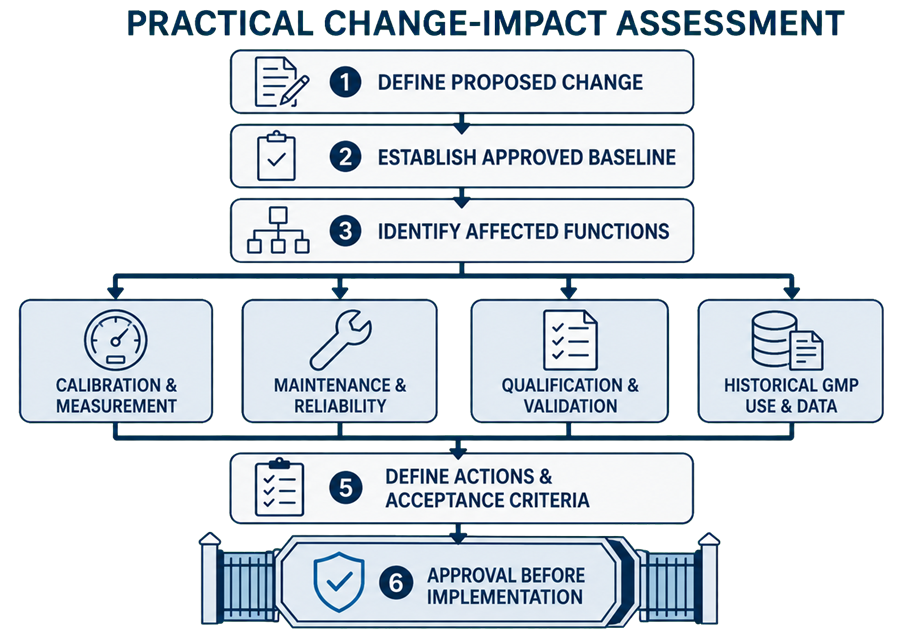
Change-Impact Assessment Method
The assessment should follow a consistent sequence.
Step 1: Define the Proposed Change
Describe:
- Current condition
- Proposed condition
- Reason for the change
- Affected asset, instrument, component, or system
- Physical and functional boundaries
- Associated equipment and systems
- Planned implementation method
- Expected downtime
- Temporary conditions or transition arrangements
- Documents, procedures, and records potentially affected
The description must be detailed enough for reviewers to understand what will be different after implementation.
Step 2: Establish the Approved Baseline
Identify the evidence defining the current approved state:
- Intended use
- User Requirements Specification
- Design and functional specifications
- Drawings and equipment data
- Instrument and asset records
- Calibration requirements
- Maintenance strategy and tasks
- Approved operating ranges
- Alarm and interlock settings
- Software and firmware versions
- Qualification protocols and reports
- Standard operating procedures
- Spare-part specifications
- Previous changes, deviations, and maintenance history
Without an established baseline, it is not possible to demonstrate whether the proposed condition remains equivalent or acceptable.
Step 3: Identify Affected Functions
Evaluate the change against actual functions rather than the equipment name or work-order category.
The assessment should determine whether the change affects:
- Product-contact surfaces
- Critical process parameters
- Process capacity or operating range
- Measurement accuracy or uncertainty
- Calibration range or acceptance limit
- Metrological traceability
- Alarm, interlock, or safeguard functions
- Control loops or automated sequences
- Data acquisition, calculation, or retention
- Utility supply or consumption
- Environmental-control performance
- Cleanability, sterility, or contamination control
- Equipment reliability or maintainability
- Failure detection
- Redundancy or backup capability
- Approved maintenance strategy
- Qualified functions or acceptance criteria
Interfaces must also be evaluated. A sensor change may affect the transmitter, control system, alarm logic, displayed value, historian, batch record, and qualification evidence.
Step 4: Evaluate Calibration Impact
The calibration assessment should answer:
- Does the measurement principle change?
- Does the approved operating range change?
- Does the calibration range still cover intended use?
- Are calibration points still appropriate?
- Does accuracy, resolution, repeatability, or uncertainty change?
- Are existing acceptance limits still technically justified?
- Does signal scaling or unit conversion change?
- Are alarm and control setpoints still aligned with calibrated values?
- Does the reference-standard hierarchy change?
- Is metrological traceability preserved?
- Is the calibration procedure still applicable?
- Is calibration required before installation, after installation, or both?
- Does the change affect other instruments calibrated from the same standard?
- Does the calibration interval remain justified?
- Must the instrument inventory or status be updated?
The broader governance requirements are addressed in the calibration program.
NIST’s policy on metrological traceability explains that traceability applies to a measurement result through a documented, unbroken calibration chain in which each calibration contributes to measurement uncertainty. A vendor statement that an instrument is “NIST traceable” does not by itself demonstrate suitability for the intended GMP measurement.
Step 5: Evaluate Maintenance and Reliability Impact
The maintenance assessment should determine whether the change affects:
- Credible failure modes
- Failure consequences
- Preventive-maintenance tasks
- Task instructions or acceptance criteria
- Maintenance frequency or trigger
- Condition-monitoring parameters
- Alert or action levels
- Predictive models or baseline data
- Lubrication, alignment, torque, or adjustment requirements
- Required tools and test equipment
- Cleaning or contamination controls
- Spare-part requirements
- Repair procedures
- Service-provider requirements
- Personnel training
- Expected component life
- Equipment redundancy
- Recovery following failure
- Required post-maintenance testing
A new component may be functionally acceptable but have different maintenance requirements. Those requirements must be established before routine operation. The technical basis for maintenance strategies and tasks is addressed in Preventive Maintenance and System Reliability Strategy.
Step 6: Evaluate Qualification and Validation Impact
The assessment should identify which approved requirements and previously qualified functions are affected.
Questions include:
- Does installation change?
- Does the change alter an approved design characteristic?
- Are operating ranges or control functions affected?
- Are alarms, interlocks, sequences, or safeguards affected?
- Is performance under routine or worst-case conditions affected?
- Does the change invalidate an original test assumption?
- Can existing qualification evidence still be relied upon?
- Which tests directly demonstrate that the affected functions remain acceptable?
- Is targeted or broader requalification required?
A risk-based validation approach should focus testing on affected functions and credible failure conditions. It should not be reduced to a numerical score that automatically assigns a testing package.
Step 7: Evaluate Historical Data and Prior GMP Use
Most planned changes affect future operation. Some changes may also reveal that the previous condition was unreliable.
A retrospective assessment may be required when:
- As-found calibration results are unacceptable
- Damage or malfunction predates detection
- The reason for replacement is an unexplained failure
- A reference standard is found unreliable
- An incorrect configuration is discovered
- Alarm or interlock functionality was absent
- Preventive maintenance was ineffective
- A component was operating outside specification
- Software or firmware produced incorrect results
- The exact time of failure cannot be established
The assessment should determine:
- Last known acceptable condition
- Earliest credible start of the affected period
- Measurements, batches, studies, or records potentially affected
- Magnitude and direction of potential error
- Availability of redundant or independent evidence
- Whether previous decisions remain supported
- Required investigation, retesting, notification, or disposition
Successful post-change testing proves the new condition. It does not automatically prove that previous operation was acceptable.
Step 8: Define Controls and Obtain Approval
Before implementation, document:
- Required change-control classification
- Implementation procedure
- Required parts and materials
- Calibration requirements
- Testing and qualification scope
- Acceptance criteria
- Required document revisions
- Required training
- Required backup or rollback arrangements
- Interim controls
- Historical-impact assessment, if applicable
- Release prerequisites
- Responsible personnel
- Required Quality approval
Approval should occur before implementation unless emergency action is necessary to protect personnel, product, facilities, or equipment. Emergency work must still be documented and assessed before unrestricted GMP use resumes.
Practical Assessment Worksheet
The following structure can be incorporated into a change-control form or attachment.
| Assessment area | Required determination | Evidence or action |
|---|---|---|
| Change definition | What will be physically, functionally, or procedurally different? | Current-versus-proposed comparison |
| Intended use | Does the approved GMP use remain unchanged? | URS and system-boundary review |
| Measurement | Are range, accuracy, uncertainty, scaling, or traceability affected? | Calibration assessment |
| Equipment function | Are capacity, operating range, controls, alarms, or interlocks affected? | Functional assessment |
| Maintenance | Do failure modes, tasks, intervals, parts, or monitoring requirements change? | Maintenance assessment |
| Qualification | Which approved requirements and tests are affected? | Qualification traceability |
| Data and records | Are data generation, calculation, storage, reporting, or audit trails affected? | Data-integrity assessment |
| Historical impact | Does the change reveal a potentially unacceptable prior condition? | Retrospective assessment |
| Implementation risk | What could go wrong during installation or transition? | Work controls and rollback plan |
| Verification | What evidence will demonstrate acceptable implementation? | Defined test plan and criteria |
| Documentation | Which controlled records require revision? | Document action list |
| Release | What must be completed before GMP use? | Return-to-service checklist |
| Follow-up | Is enhanced monitoring or effectiveness review required? | Post-implementation plan |
Every applicable row should contain a conclusion, supporting rationale, and assigned action. “No impact” without an explanation is not an assessment.
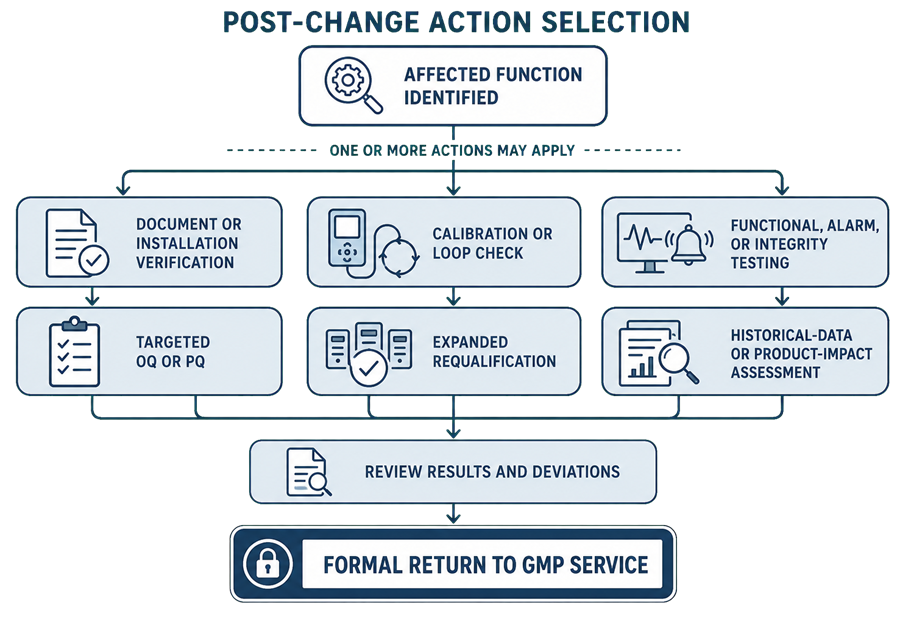
Translating Affected Functions into Post-Change Actions
Post-change actions should be selected according to the affected functions and uncertainty introduced.
| Affected characteristic | Typical evidence required |
|---|---|
| Administrative record only; no physical or functional change | Document review and controlled-record update |
| Equipment identification, location, connection, or installation | Installation and configuration verification |
| Measurement range, accuracy, sensor, transmitter, or reference standard | Calibration with review of as-found and as-left results |
| Control function, sequence, alarm, or interlock | Functional challenge testing |
| Flow, pressure, temperature, speed, capacity, leakage, or integrity | Engineering performance testing |
| Product-contact part, seal, gasket, lubricant, or surface | Material review, cleaning assessment, inspection, leak or integrity testing |
| Software, firmware, calculation, configuration, or electronic record | Configuration verification, functional testing, audit-trail or data-integrity testing |
| Previously qualified operating function | Targeted Operational Qualification |
| Routine or worst-case system performance | Targeted Performance Qualification |
| Broad design, control, or performance change | Expanded or comprehensive requalification |
| Evidence of an unacceptable prior condition | Product, batch, utility, environmental, validation, or data-impact assessment |
Several actions may be required for one change. Replacing a critical transmitter may require installation verification, calibration, loop testing, alarm challenges, targeted OQ, record updates, and formal release.
Common Change Scenarios
Instrument Replacement
The assessment should compare:
- Measurement principle
- Range
- Accuracy and uncertainty
- Response time
- Materials
- Environmental rating
- Signal and scaling
- Configuration
- Calibration requirements
- Alarm and control interfaces
- Historical trending continuity
Required actions may include incoming inspection, installation verification, calibration, loop checks, alarm challenges, configuration verification, and targeted qualification.
Calibration-Range or Tolerance Change
A range or tolerance change may affect:
- Process requirements
- Measurement suitability
- Calibration points
- Acceptance decisions
- Existing procedures
- Alarm and control setpoints
- Qualification criteria
- Historical drift trends
Widening a calibration tolerance merely to reduce failures is not technically acceptable unless the revised limit remains suitable for the supported GMP use.
Calibration-Interval Change
An interval change should consider:
- GMP impact
- Historical as-found results
- Drift magnitude and direction
- Out-of-tolerance history
- Frequency and conditions of use
- Environmental exposure
- Maintenance and repair history
- Intermediate checks
- Failure detectability
- Consequences of an undetected error
An interval extension requires adequate evidence of sustained performance. A shorter interval may be necessary following adverse drift, failure, repair, increased use, or changed operating conditions.
Reference-Standard or Calibration-Vendor Change
The assessment should evaluate:
- Approved calibration scope
- Range and capability
- Reported uncertainty
- Traceability
- Calibration method
- Reference standards
- As-found and as-left data
- Decision rules
- Certificate content
- Handling and transportation
- Electronic record controls
ISO/IEC 17025 accreditation may support evidence of competence when the specific calibration is within the accredited scope, but it does not replace technical review of the requested service and returned certificate.
Maintenance-Task or Interval Change
The assessment should identify:
- Failure mode controlled by the task
- Evidence supporting the proposed revision
- Consequence if the task is ineffective
- Whether another control detects degradation
- Effect on spare parts and staffing
- Required procedural or training changes
- Need for enhanced monitoring
- Follow-up review period
A task should not be eliminated solely because no failures have been reported. The absence of failures may indicate that the task is effective.
Component Substitution
The comparison should address:
- Function
- Materials
- Dimensions
- Capacity
- Performance
- Connection details
- Compatibility
- Firmware or configuration
- Cleaning and sterilization suitability
- Maintenance requirements
- Expected life
- Qualified operating limits
Supplier statements of equivalence should be reviewed but should not replace the site’s technical assessment.
Software, Firmware, or Configuration Change
The assessment should determine whether the change affects:
- Measurement scaling
- Calculations
- Control logic
- Alarm limits
- Interlocks
- Data acquisition
- Displayed or reported values
- User access
- Audit trails
- Interfaces
- Time synchronization
- Backup and restore
- Electronic records
Applicable controls should align with the broader 21 CFR Part 11 compliance framework.
Relocation
Relocation may affect:
- Installation and utility connections
- Environmental conditions
- Leveling, alignment, and vibration
- Measurement performance
- Network connectivity
- Configuration
- Cleanliness or area classification
- Calibration status
- Operating and maintenance access
- Qualified performance
A portable instrument may require only inspection and functional verification. Relocation of a fixed qualified system may require installation verification, calibration, OQ, or PQ.
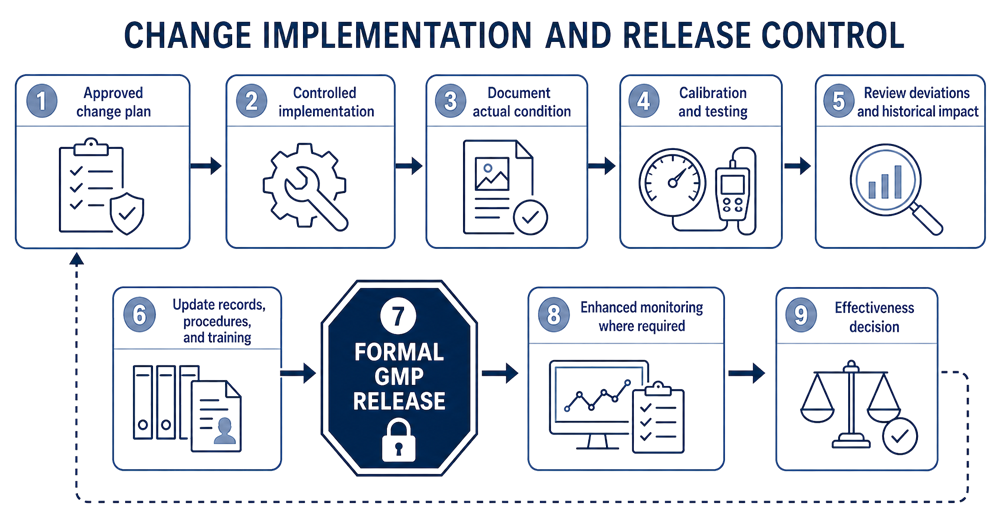
Implementation Controls
The approved change plan should define:
- Equipment shutdown and status control
- Required isolation and permits
- Protection of product and materials
- Contamination and foreign-material controls
- Approved parts and materials
- Backup of software, configuration, and data
- Baseline configuration capture
- Required tools and calibrated test equipment
- Work instructions
- Vendor supervision
- Recording of as-found conditions
- Recording of actual work performed
- Handling of deviations
- Restoration or rollback criteria
- Required inspection and testing
- Document updates
- Release authority
If actual implementation differs from the approved plan, the discrepancy must be evaluated before testing and release.
Calibration Following Change
Calibration should be performed when the change could affect measurement performance.
The calibration should confirm, as applicable:
- Correct instrument identification
- Correct range and units
- Required calibration points
- Acceptable accuracy
- Correct signal output
- Proper scaling at the receiving system
- Alarm and control alignment
- Acceptable as-left condition
- Appropriate status and next due date
As-found results should be retained when an existing instrument is adjusted, repaired, or recalibrated. They may be necessary to evaluate measurements generated before the change.
Calibration alone is insufficient when the instrument participates in an automated control loop, alarm, interlock, calculation, or qualified equipment function. The complete signal path and functional response may also require testing.
Maintenance Following Change
The change should not be closed until maintenance requirements for the new condition are established.
Required actions may include:
- Adding or revising asset records
- Creating or modifying maintenance tasks
- Establishing initial intervals
- Revising condition-monitoring limits
- Adding critical spare parts
- Updating approved part specifications
- Revising drawings and procedures
- Training maintenance personnel
- Updating vendor service agreements
- Defining post-maintenance calibration or testing
- Removing obsolete parts and instructions
- Establishing enhanced monitoring during initial operation
The maintenance program should reflect the equipment as actually installed and approved.
Requalification Decision
Requalification should be targeted to the affected functions.
Possible outcomes include:
- No qualification testing, with documented technical rationale
- Installation or configuration verification
- Calibration or loop verification
- Functional testing
- Alarm or interlock challenge
- Engineering performance testing
- Targeted OQ
- Targeted PQ
- Expanded requalification
- Comprehensive requalification
The selected scope should be based on:
- Requirements affected
- Functions affected
- Uncertainty introduced
- Complexity of the change
- Ability to inspect the completed work
- Available vendor or commissioning evidence
- Original qualification coverage
- Failure consequences
- Historical system performance
- Need to demonstrate routine or worst-case operation
The principles for selecting scope are addressed in risk-based requalification.
Post-Change Verification
Verification must demonstrate that the implemented condition matches the approved change and performs as intended.
The verification package may include:
- Inspection against drawings or specifications
- Part-number and material verification
- Installation checks
- Utility and connection checks
- Calibration
- Signal and loop checks
- Functional testing
- Alarm and interlock challenges
- Leak, pressure, flow, or integrity testing
- Software or firmware version verification
- Configuration comparison
- Data-integrity testing
- Targeted OQ or PQ
- Cleaning or environmental verification
- Review of deviations and discrepancies
Acceptance criteria should be approved before testing. A statement that the equipment “operates normally” is not adequate when specific functions, ranges, or limits were affected.
Return to GMP Service
Physical completion of the change does not authorize GMP use.
Before release, responsible personnel should confirm:
- The approved change was implemented
- Actual work is completely documented
- Required parts and materials are recorded
- As-found conditions were evaluated
- Calibration is acceptable
- Functional and qualification testing is complete
- Deviations and discrepancies are resolved or formally accepted
- Historical impact has been assessed
- Configuration is verified
- Procedures and drawings are current
- Calibration and maintenance records are updated
- Training is complete
- Temporary controls are removed or formally retained
- Equipment status is updated
- Required Quality approval is obtained
Restricted release may be appropriate when specifically justified, with defined operating limitations, monitoring, responsibilities, and expiration criteria. Production demand alone is not justification for release.
Post-Implementation Monitoring
Some changes require operating evidence beyond initial testing.
Enhanced monitoring may be appropriate following:
- Introduction of a new instrument type
- Change to a calibration or maintenance interval
- New condition-monitoring strategy
- Non-identical component replacement
- Major repair
- New service provider
- Software or firmware update
- Change involving limited historical evidence
- Change intended to correct a recurring failure
The follow-up plan should define:
- Monitoring parameter
- Baseline
- Review period
- Alert and action criteria
- Review responsibility
- Required operating exposure
- Acceptance criteria
- Escalation requirements
- Final effectiveness decision
The change should not be considered fully effective merely because initial testing passed.
Change Records and Data Integrity
The completed record should permit reconstruction of the decision and implementation.
Records should include:
- Change description and justification
- Current and proposed conditions
- Affected assets and systems
- Technical comparison
- Calibration assessment
- Maintenance assessment
- Qualification assessment
- Historical-impact assessment
- Implementation plan
- Required approvals
- Actual work performed
- Parts and materials used
- As-found and as-left conditions
- Calibration and test results
- Deviations
- Document and training updates
- Release decision
- Follow-up monitoring
- Effectiveness conclusion
Electronic change, calibration, maintenance, or asset-management systems should control access, status, record changes, attachments, approvals, and audit trails where applicable.
Interface with Periodic Review
Individual change assessments address specific events. Periodic Review and Continued Verification evaluates whether accumulated changes reveal broader program weaknesses.
Periodic review should consider:
- Repeated instrument replacements
- Frequent component substitutions
- Recurring calibration-limit revisions
- Interval extensions or reductions
- Repeated maintenance-strategy changes
- Post-change calibration failures
- Failed qualification tests
- Recurring temporary repairs
- Change-related deviations
- Unexpected performance after implementation
- Changes closed without effectiveness evidence
- Increasing reliance on restricted releases
A series of individually acceptable changes may collectively alter the system enough to require broader reassessment.
Conclusion
Change impact on calibration and maintenance must be assessed through the functions affected, the uncertainty introduced, and the evidence required to support continued GMP use.
A defensible assessment:
- Defines the proposed condition against the approved baseline
- Evaluates measurement and maintenance consequences separately
- Identifies affected requirements and qualified functions
- Determines whether previous data or operation may be affected
- Establishes technically linked calibration and testing
- Updates lifecycle controls
- Requires documented release
- Confirms effectiveness through follow-up when necessary
The objective is not to classify the change as minor, moderate, or major. The objective is to demonstrate that measurement reliability, equipment performance, data integrity, and the qualified state remain controlled.