

CAPA and Validation Impact
Corrective and Preventive Action (CAPA) is closely connected with validation because many corrective actions change the equipment, process, computerized system, material controls, procedures, parameters, or other conditions that were previously qualified or validated. Conversely, validation deviations, Continued Process Verification (CPV) signals, equipment failures, data-integrity findings, recurring alarms, and unsuccessful qualification tests can themselves identify problems requiring CAPA.
For pharmaceutical manufacturers, CAPA is explicitly identified in ICH Q10 Pharmaceutical Quality System as one of the principal Pharmaceutical Quality System (PQS) elements, together with process-performance and product-quality monitoring, change management, and management review. ICH Q10 states that corrective and preventive actions can result from complaints, product rejections, nonconformances, recalls, deviations, audits, regulatory findings, and trends from process-performance and product-quality monitoring. It also expects a structured investigation process directed toward determining root cause and requires CAPA effectiveness to be evaluated.
For validation, the important question is not simply whether a CAPA has been opened. It is whether the corrective or preventive action changes any assumption, control, configuration, operating condition, or supporting evidence on which the validated state depends.
CAPA and Validation Are Connected but Not Interchangeable
CAPA, investigation, change control, and revalidation are related activities, but each has a different purpose.
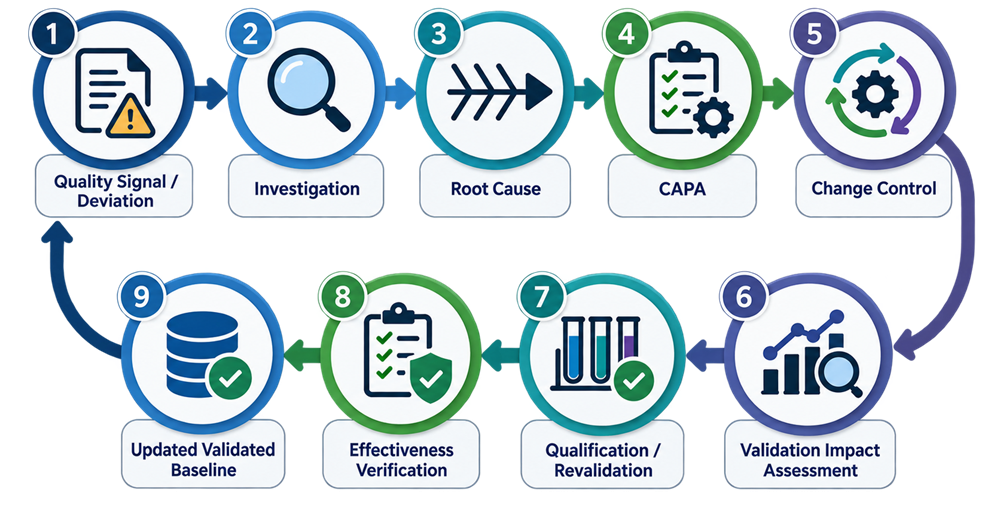
A deviation or quality event identifies that something unexpected occurred. The investigation determines what happened, assesses impact, and evaluates causes. CAPA addresses the cause or systemic weakness when action is necessary to prevent recurrence or occurrence. Change control governs controlled implementation when the CAPA requires modification of a process, system, equipment item, procedure, material, or other controlled condition. Validation then determines what evidence is required to demonstrate that the modified condition remains suitable for its intended use.
This distinction is important because treating all four activities as one process can lead to either excessive validation or inadequate control.
| Activity | Primary purpose | Validation relationship |
|---|---|---|
| Correction | Correct the immediate observed condition | May restore operation but does not necessarily address recurrence |
| Investigation | Determine what happened, impact, causes, and affected scope | Determines whether existing validation evidence remains credible |
| Corrective action | Eliminate or control the cause of an existing problem | May change a validated process, system, or control |
| Preventive action | Address a potential problem before occurrence | May introduce new controls requiring verification |
| Change control | Assess, approve, implement, and document a controlled modification | Governs implementation of CAPA-related changes |
| Validation impact assessment | Determine what existing validation evidence is affected | Defines required qualification, testing, or revalidation |
| Requalification / revalidation | Generate evidence supporting the changed condition | Establishes or reconfirms the validated state |
| Effectiveness verification | Determine whether the action actually solved the problem | May rely on qualification, validation, CPV, or trend evidence |
ICH Q10 defines corrective action as action intended to eliminate the cause of a detected nonconformity or other undesirable situation, while preventive action addresses the cause of a potential undesirable condition. It also makes clear that CAPA and change management are separate but interacting PQS elements.
CAPA Is Not Required for Every Validation Deviation
Not every validation deviation should automatically generate a CAPA.
A protocol execution error may have a clear isolated cause, limited impact, no indication of recurrence, and no broader quality-system weakness. In such a case, correction, documented investigation, and appropriate disposition of the validation evidence may be sufficient.
CAPA becomes more appropriate when the investigation identifies recurrence, systemic weakness, inadequate controls, deficient procedures, equipment or system design problems, training-system deficiencies, ineffective prior actions, or another condition requiring action beyond correction of the individual event.
The distinction prevents the CAPA system from becoming overloaded with minor isolated events while ensuring that recurring or systemic validation weaknesses receive appropriate escalation.
Regulatory and Pharmaceutical Quality-System Context
U.S. drug CGMP regulations do not contain a single Part 211 section titled “CAPA.” Instead, the regulatory foundation is distributed among investigation, Quality Unit, process-control, record-review, and other requirements.
For example, 21 CFR 211.192 requires unexplained discrepancies and specification failures to be thoroughly investigated, requires the investigation to extend to other potentially affected batches or products, and requires written conclusions and follow-up.
21 CFR 211.22 gives the Quality Unit authority and responsibility to review records, ensure errors are fully investigated, and approve or reject procedures and specifications affecting product quality.
ICH Q10 provides the more explicit lifecycle CAPA framework and connects CAPA with process monitoring, change management, risk management, and continual improvement. FDA’s Quality Systems Approach to Pharmaceutical Current Good Manufacturing Practice Regulations similarly describes a modern quality-system approach consistent with 21 CFR Parts 210 and 211.
Sources of CAPA Relevant to Validation
Validation-related CAPA can originate from many parts of the pharmaceutical quality system. Common sources include:
- IQ, OQ, PQ, or PPQ deviations;
- unsuccessful qualification tests;
- recurring equipment failures;
- calibration or maintenance trends;
- OOS or OOT investigations;
- repeated manufacturing deviations;
- CPV signals or process drift;
- recurring alarms or interventions;
- complaints or product rejections;
- audit observations;
- regulatory inspection findings;
- data-integrity investigations;
- supplier or material problems;
- cleaning or sterilization failures;
- computerized-system failures;
- cybersecurity or infrastructure events affecting validated systems; and
- ineffective previous CAPA.
ICH Q10 specifically expects CAPA to receive input from complaints, rejection, nonconformance, recall, deviation, audits, regulatory findings, and monitoring trends, illustrating why CAPA should be integrated with rather than isolated from lifecycle validation.
Validation Deviations as CAPA Inputs
A deviation observed during validation should first be evaluated for its effect on the validation study itself. The investigation should determine whether the protocol was properly executed, whether affected data remain valid, whether the test was representative, and whether acceptance conclusions remain scientifically supportable.
PPQ Deviations, Investigation, and Validation Conclusion addresses this principle specifically for PPQ, but the same logic applies more broadly to qualification and validation.
The investigation should then ask a second question: Does the event reveal a broader problem that extends beyond this validation protocol?
For example, an incorrectly entered parameter during one PPQ batch may be an isolated execution deviation. Repeated entry errors caused by confusing automation screens or inadequate recipe controls may indicate a systemic weakness requiring CAPA and potentially computerized-system or process-control changes.
Routine GMP Events Can Create Validation Impact
The opposite path is equally important. A CAPA originating outside validation can materially affect the validated state.
For example:
- Recurring equipment failure → CAPA → equipment redesign → qualification impact
- OOS investigation → process cause identified → parameter change → process-validation impact
- Data-integrity investigation → software configuration CAPA → computerized-system revalidation
- Complaint trend → packaging-process modification → packaging qualification
- Cleaning failure → CAPA → revised cleaning cycle → cleaning revalidation
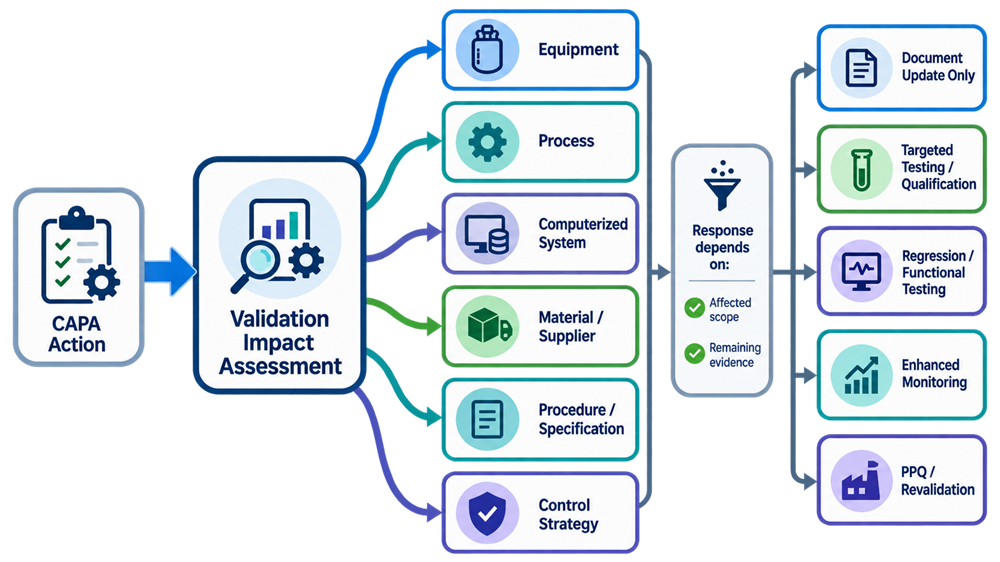
The CAPA record should therefore include or trigger a validation-impact assessment whenever the action changes something that was previously qualified or validated.
Investigation and Root-Cause Analysis
ICH Q10 expects a structured investigation approach with the objective of determining root cause, with the level of effort, formality, and documentation proportionate to risk.
Root-cause analysis should not become a paperwork exercise in which a familiar category such as “operator error” is selected without examining why the error was possible. Validation-related investigations frequently reveal interactions among equipment design, procedures, automation, training, materials, maintenance, environmental conditions, and organizational controls.
The investigation should distinguish the immediate failure mechanism from underlying and contributing causes. If an operator selected an incorrect recipe, for example, the investigation may need to examine recipe access, naming conventions, system design, procedural checks, training, and technical controls rather than ending with retraining.
A weak causal conclusion usually produces a weak CAPA.
Correction Versus Corrective Action
An immediate correction restores the affected condition. Replacing a failed sensor, correcting a spreadsheet formula, or retraining an operator can restore operation, but those actions do not automatically demonstrate that the cause of recurrence has been addressed.
Corrective action asks a broader question: What needs to change so that the problem is unlikely to recur?
That change may involve equipment redesign, additional technical controls, revised procedures, modified maintenance, improved automation, supplier controls, revised sampling, or another systemic action.
Because such actions frequently alter validated conditions, the validation function should participate before the corrective action is finalized—not after implementation when revalidation is discovered to be necessary.
CAPA Validation Impact Assessment
The validation-impact assessment should determine whether the proposed CAPA changes an element supporting the validated state.
Typical questions include:
- Does the CAPA modify equipment design or function?
- Does it change software, configuration, calculations, interfaces, or automation?
- Does it modify a CPP, operating range, recipe, alarm, or interlock?
- Does it introduce a new material or supplier?
- Does it modify a cleaning or sterilization cycle?
- Does it change sampling, analytical testing, or acceptance criteria?
- Does it change a process sequence, hold time, or operating procedure?
- Does it affect utilities or facility conditions?
- Does it change batch size, scale, or manufacturing site?
- Does it affect previously approved validation assumptions?
- Does existing qualification or validation evidence still represent the changed condition?
Quality Risk Management in Process Validation provides the broader risk framework, while Process Change Control, Revalidation, and Lifecycle Management addresses formal change and revalidation governance.
Validation Response Should Be Proportionate
A CAPA-related change does not automatically require complete revalidation.
The validation response should be proportionate to the affected functionality, existing process knowledge, uncertainty introduced by the change, and strength of existing evidence.
Possible responses include:
- documentation update only;
- targeted functional testing;
- calibration or verification;
- targeted IQ/OQ;
- partial equipment requalification;
- computerized-system regression testing;
- targeted process verification;
- additional sampling;
- enhanced monitoring;
- additional PPQ evidence;
- re-PPQ;
- partial revalidation; or
- full revalidation.
The objective is not to repeat the original validation mechanically. The objective is to generate sufficient evidence that the CAPA-related change performs as intended without invalidating existing controls or introducing new risk.
Equipment CAPA
Equipment CAPA commonly arises from recurring failures, excessive maintenance, calibration drift, wear, alarm trends, inadequate design, or repeated process deviations associated with the equipment.
If the corrective action replaces a component with an equivalent part and does not alter equipment functionality, limited verification may be sufficient. If the CAPA changes control functionality, equipment geometry, operating principle, process-contact characteristics, automation, operating range, or critical instrumentation, targeted or broader requalification may be required.
The assessment should also determine whether the change affects the manufacturing process. Equipment qualification demonstrates that the equipment functions correctly; it does not necessarily demonstrate that the changed process still produces equivalent product.
Computerized-System CAPA
Computerized-system CAPA can originate from software defects, access-control failures, audit-trail deficiencies, calculation errors, cybersecurity events, failed interfaces, data-loss incidents, or recurring operational problems.
Corrective actions may include configuration changes, software upgrades, patches, access changes, interface modification, infrastructure changes, or replacement of the application.
The validation response should address affected requirements, functionality, configuration, interfaces, data integrity, regression risk, and validated-state evidence. The detailed computerized-system change framework is addressed in Computerized System Change Control, Patching, and Revalidation.
The CAPA should remain linked to the computerized-system change record and resulting test evidence rather than closing merely because the software modification was deployed.
Process CAPA
Process CAPA frequently arises from recurring deviations, OOS/OOT investigations, CPV trends, excessive variability, low process capability, repeated operator adjustment, yield loss, or failure of the established control strategy.
Process Drift, Statistical Signals, and CPV Investigation explains how emerging statistical or operational signals can reveal deterioration before formal specification failure occurs.
A confirmed process weakness may require revision of material controls, CPP ranges, process settings, sampling, automation, alarms, equipment, procedures, or other elements of the established strategy. Process Control Strategy Lifecycle Management addresses how those controls are maintained after development.
When the CAPA modifies the commercial process sufficiently that existing PPQ evidence no longer represents the process, additional PPQ or re-PPQ may be necessary.
CAPA From CPV
CPV is particularly important because it can identify systemic problems that individual batch investigations do not reveal.
A single deviation may appear isolated. Ten similar low-level events across several months may indicate a deteriorating process, ineffective control, or recurring failure mechanism.
ICH Q10 explicitly connects process-performance and product-quality monitoring with CAPA and expects monitoring to identify sources of variation and improvement opportunities.
The lifecycle path is: CPV signal → investigation → cause assessment → CAPA → controlled change → validation impact → implementation → effectiveness monitoring
This is one reason CAPA should be closely linked with periodic review and state-of-control assessment rather than operated solely as an event-closure system.
CAPA and Change Control
CAPA and change control should remain separate but connected.
- The CAPA explains why action is necessary and what problem the action is intended to solve.
- Change control explains how the controlled modification will be assessed, approved, implemented, verified, and incorporated into the controlled system.
ICH Q10 explicitly states that innovation, continual improvement, monitoring outputs, and CAPA drive change, and that an effective change-management system is therefore needed to evaluate, approve, and implement those changes.
A CAPA should not be used as an informal substitute for change control simply because the modification is corrective.
CAPA Implementation Is Not CAPA Effectiveness
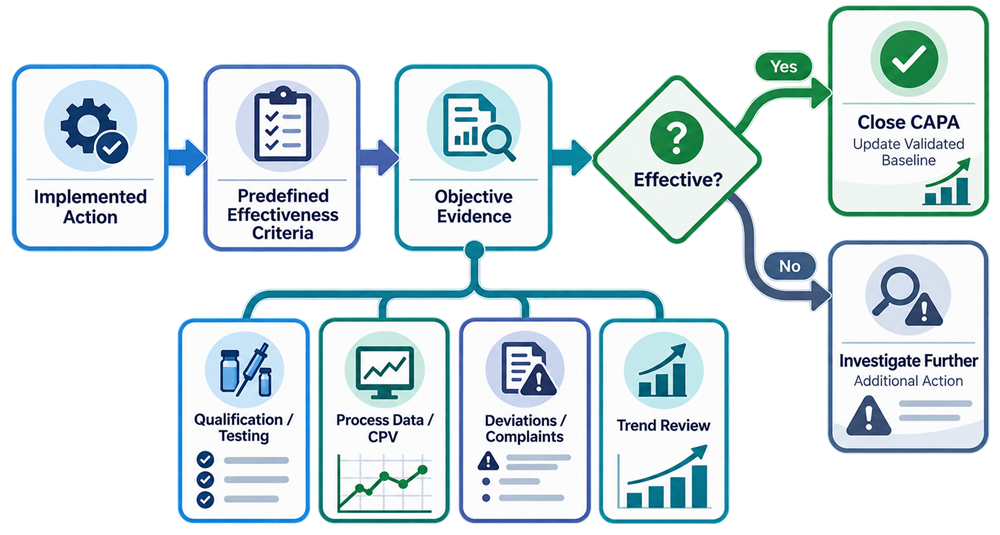
One of the most important validation connections is the distinction between implementation and effectiveness.
Installing a redesigned component demonstrates implementation. Updating an SOP demonstrates implementation. Deploying a software fix demonstrates implementation. Completing retraining demonstrates implementation.
None of those activities alone proves that the original problem has been solved. ICH Q10 specifically expects CAPA effectiveness to be evaluated.
For validation-related CAPA, effectiveness evidence may include qualification results, process verification, PPQ, CPV trends, repeat challenge testing, absence of recurrence, improved capability, alarm reduction, maintenance trends, cleaning results, sterilization performance, or other objective evidence relevant to the original failure mechanism.
Effectiveness Criteria Should Be Defined in Advance
Where practical, CAPA effectiveness criteria should be established before the effectiveness check begins.
Weak criterion: “No further issues observed.”
Stronger criterion: “No recurrence of the identified alarm condition during the next 20 commercial batches, with no increase in associated process variability.”
Another example: “Modified temperature-control loop maintains the validated range without manual intervention during three representative operating cycles and subsequent routine monitoring.”
The appropriate criterion should be tied to the cause and intended corrective action rather than selected because it is easy to measure.
Validation Can Provide CAPA Effectiveness Evidence
Qualification and validation can provide particularly strong effectiveness evidence when the CAPA changes a technical system. Examples include:
- OQ challenge testing after interlock redesign;
- process verification after parameter modification;
- regression testing after software correction;
- cleaning revalidation after cleaning-cycle CAPA;
- sterilization requalification after cycle modification;
- PPQ after significant process redesign;
- CPV trending after process CAPA;
- repeat recovery testing after backup-system CAPA.
Validation therefore should not be viewed only as an implementation requirement. It can also demonstrate whether the corrective action actually performs as intended.
Enhanced Monitoring After CAPA
Some CAPA actions can be technically verified at implementation but still require commercial evidence before effectiveness can be concluded.
Enhanced monitoring may temporarily increase sampling, review frequency, CPV attention, alarm review, deviation trending, maintenance review, or other monitoring directly connected to the original issue.
This approach is useful when the change is scientifically justified but process performance under routine commercial conditions provides the strongest evidence of sustained effectiveness.
The enhanced period should have predefined duration or exit criteria. Indefinite “monitoring” without a clear decision point is weak CAPA closure.
CAPA Effectiveness Failure
If effectiveness criteria are not met, the CAPA should not simply be extended administratively without reassessing the original assumptions. The organization should determine whether:
- the root-cause conclusion was incorrect or incomplete;
- significant contributing causes were missed;
- the corrective action was inadequately designed;
- implementation was incomplete;
- the validation scope was insufficient;
- the selected effectiveness metric was inappropriate;
- the problem has changed; or
- a new failure mechanism has emerged.
The result may require reopening the investigation, revising the CAPA, performing additional validation, expanding the affected scope, or initiating additional change control.
Repeated ineffective CAPA can itself indicate a quality-system weakness.
CAPA Closure
CAPA closure should confirm more than completion of assigned tasks. For a validation-related CAPA, closure should generally establish that:
- investigation conclusions are documented;
- applicable root or contributing causes were addressed;
- required change controls are complete;
- validation impact was assessed;
- required qualification or revalidation was completed;
- deviations arising during implementation were resolved;
- required procedures and controlled documents were updated;
- personnel were appropriately trained;
- effectiveness evidence satisfies predefined criteria; and
- the revised validated baseline has been documented where applicable.
A CAPA should not close while significant validation evidence remains pending unless the governing procedure provides a justified mechanism for staged closure and continued effectiveness monitoring.
Updating the Validated Baseline
A successful CAPA can create a new validated baseline. For example, a redesigned equipment component, revised control algorithm, modified process range, new cleaning cycle, or strengthened material control may become part of the validated state after the change has been appropriately implemented and verified.
Process Validation Documentation and Traceability explains why the relationship between the original validation evidence, CAPA, change record, new validation evidence, and revised baseline should remain reconstructable.
A future reviewer should be able to determine:
- What failed?
- Why was CAPA initiated?
- What changed?
- What validation evidence was required?
- Was the action effective?
- What now defines the validated state?
CAPA and Periodic Review
CAPA should also be evaluated collectively rather than only one record at a time.
Periodic review can identify recurring categories, repeated root causes, ineffective actions, repeated equipment problems, similar deviations across systems, or CAPA that repeatedly introduce additional validation work.
This aggregated view is especially valuable because individual CAPA records may appear successfully closed while the same underlying failure continues to emerge in different forms.
ICH Q10 includes CAPA-process performance among the quality-system performance indicators that can be reviewed through management oversight.
CAPA and Validation Documentation
Validation-related CAPA should remain traceable to the evidence that justified and verified the action.
A useful evidence path is: Quality event → Investigation → Cause → CAPA → Change control → Validation impact → Qualification / revalidation evidence → Effectiveness verification → Closure → Revised baseline
The CAPA record does not need to duplicate all validation documents. Controlled references are usually preferable, provided the relationships remain clear and the supporting records remain retrievable.
This approach aligns with the lifecycle evidence principles described in Process Validation Documentation and Traceability and the execution-record expectations in Data Integrity and Good Documentation Practices in Process Validation.
CAPA Across Validation Domains
The same governance principle applies across validation disciplines, but the specific evidence changes with the system affected.
| CAPA affects | Possible validation response |
|---|---|
| Manufacturing equipment | Targeted IQ/OQ, functional qualification, process verification |
| Process parameters or controls | Targeted process study, enhanced CPV, PPQ/re-PPQ |
| Computerized system | Requirements impact, regression testing, revalidation |
| Analytical instrument | Functional testing, calibration, qualification, return-to-service assessment |
| Cleaning process | Cleaning-cycle verification or cleaning revalidation |
| Sterilization process | Cycle qualification or requalification |
| Utility system | Targeted qualification and downstream impact assessment |
| Material or supplier | Comparability assessment, process verification, enhanced monitoring |
| Packaging system | Equipment/process qualification and packaging-performance verification |
| Facility/environment | Qualification and affected-process assessment |
This cross-domain applicability is why CAPA belongs within Validation Fundamentals rather than within one individual technical domain.
Management and Quality Oversight
CAPA involving validated systems frequently requires cross-functional participation. Quality, Validation, Engineering, Manufacturing, laboratory functions, IT, technical operations, suppliers, and subject-matter experts may each hold part of the relevant evidence.
The Quality Unit retains an important oversight role. Under 21 CFR 211.22, the Quality Unit has authority over procedures and specifications affecting product quality and responsibility for ensuring errors are appropriately investigated.
Validation personnel contribute a different question: whether the CAPA changes or challenges evidence supporting the validated state.
Neither function should operate in isolation.
Key Principles
- CAPA should be connected with validation whenever corrective or preventive action changes a previously qualified or validated condition.
- Not every validation deviation requires CAPA; isolated events without systemic or recurring significance may be adequately managed through investigation and correction.
- Investigation, CAPA, change control, validation impact assessment, and revalidation are related but distinct activities.
- CAPA should address causal mechanisms or systemic weaknesses rather than merely correct the immediate observation.
- Validation impact should be assessed before implementing CAPA-related changes to equipment, processes, software, materials, procedures, or controls.
- The amount of qualification or revalidation should be proportionate to change impact, uncertainty, and the continued applicability of existing validation evidence.
- CAPA implementation does not demonstrate CAPA effectiveness.
- Qualification, PPQ, targeted verification, regression testing, and CPV can provide objective CAPA-effectiveness evidence.
- Ineffective CAPA should trigger reassessment rather than administrative extension of the original action.
- Successful CAPA changes should be incorporated into the controlled validated baseline with traceable supporting evidence.