

Validation Master Plan
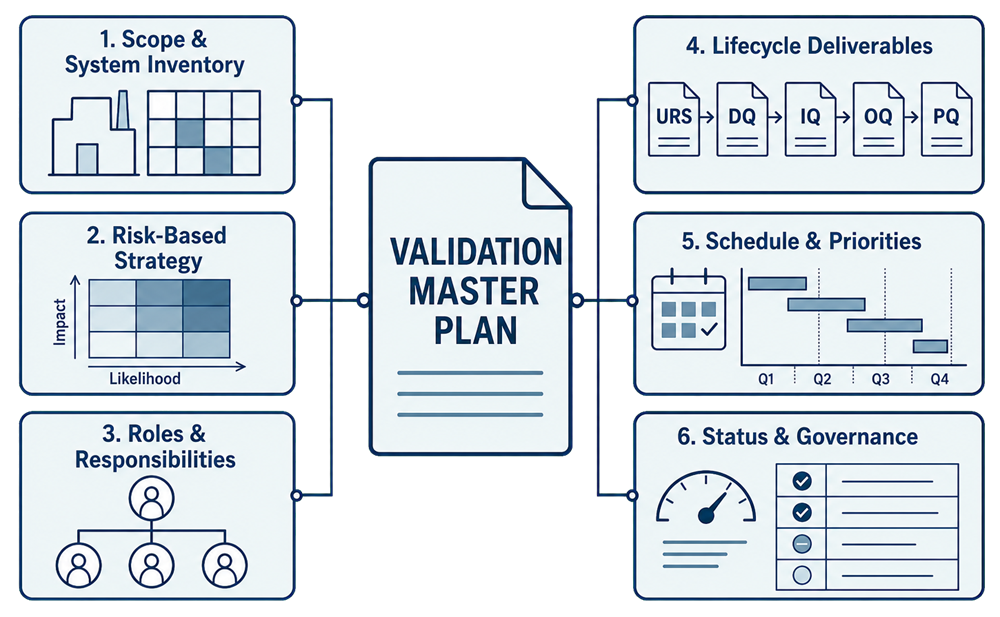
A Validation Master Plan (VMP) is a controlled, high-level GMP document that defines the overall validation strategy for a pharmaceutical, biotechnology, medical device, or regulated manufacturing facility. It establishes how validation activities are planned, executed, documented, governed, and maintained throughout the site. The VMP serves as the primary framework for ensuring that facilities, utilities, equipment, manufacturing processes, computerized systems, and supporting operations consistently operate in compliance with applicable regulatory requirements and remain fit for their intended use.
The Validation Master Plan is not an execution document and does not contain detailed testing instructions. Instead, it defines the site validation philosophy, scope, governance structure, lifecycle expectations, documentation standards, and quality system integration for validation activities across the organization.
Introduction
The VMP typically begins with a general overview of the facility, manufacturing operations, and products manufactured, packaged, tested, or stored at the site. This section establishes the regulatory and GMP context of the validation program and references applicable regulations, standards, and guidance documents issued by organizations such as the FDA, EMA, PIC/S, and other regulatory authorities.
The introduction also defines the purpose of the Validation Master Plan and explains its relationship to the site quality system, validation program, and compliance objectives.
Scope and Objectives
This section defines the scope of the validation program and identifies the systems, equipment, utilities, facilities, manufacturing processes, laboratory systems, and computerized systems covered by the VMP. Typical objectives include:
- Maintaining GMP compliance
- Establishing a consistent validation methodology
- Applying a risk-based lifecycle approach
- Defining validation governance and responsibilities
- Ensuring systems remain in a validated state throughout their operational lifecycle
The scope also identifies exclusions where appropriate and clarifies organizational or facility boundaries associated with validation activities.
Organizational Structure and Responsibilities
The VMP defines the organizational structure supporting validation activities and clearly identifies responsibilities for Validation, Quality Assurance, Engineering, Manufacturing, Information Technology, Metrology, Laboratory Operations, and other supporting departments. Clear definition of responsibilities helps ensure:
- Effective oversight
- Proper approval authority
- Data integrity protection
- Segregation of duties
- Consistent execution of validation activities
This section may also define requirements for management approval, escalation, and quality oversight responsibilities.
Validation Policies and Governing Procedures
This section identifies the policies, SOPs, corporate standards, validation procedures, and governing documents that control validation activities at the site. Referenced procedures commonly include:
- Change control
- Deviation management
- CAPA
- Document control
- Risk assessment
- Calibration
- Preventive maintenance
- Data integrity
- Computerized systems validation
- Training management
The purpose of this section is to ensure that all validation activities are performed consistently and in alignment with site quality systems and regulatory expectations.
Documentation and Record Management
The Validation Master Plan defines the framework for preparing, reviewing, approving, issuing, executing, revising, retaining, and archiving validation documents and records. Validation documentation must remain controlled, traceable, legible, attributable, and accessible throughout the applicable system and record-retention lifecycle.
The VMP may describe requirements for:
- Standard document types, templates, numbering, and identification
- Preparation, technical review, Quality Unit approval, and controlled issuance
- Protocol execution and contemporaneous recording of results
- Correction of documentation errors and management of incomplete or invalid entries
- Collection, review, and retention of raw data and supporting records
- Documentation and resolution of deviations, discrepancies, and exceptions
- Preparation and approval of validation reports
- Traceability among user requirements, specifications, risk assessments, test cases, deviations, and final conclusions
- Assessment and controlled use of vendor, commissioning, and legacy documentation
- Electronic validation records, electronic signatures, access controls, and audit trails where applicable
- Document revision, supersession, archival, retrieval, and retention
- Protection of validation records from loss, deterioration, unauthorized alteration, or premature destruction
Individual protocols and procedures should define the specific documentation practices, responsibilities, approval requirements, data-review expectations, and retention controls applicable to each validation activity. Final validation conclusions must be supported by complete and approved records demonstrating that predefined acceptance criteria were evaluated and that deviations or unresolved actions were appropriately addressed.
Validation Lifecycle
The VMP defines the lifecycle approach applied to validation activities throughout the site. This commonly includes:
- User Requirements Specification (URS)
- Design Qualification (DQ)
- Installation Qualification (IQ)
- Operational Qualification (OQ)
- Performance Qualification (PQ)
- Continued Process Verification (CPV)
- Periodic Review
- Requalification
This section describes validation lifecycle expectations at a policy level and establishes requirements for maintaining systems in a validated state throughout their operational use.
Change Control
The Validation Master Plan defines how changes affecting validated systems, equipment, utilities, facilities, processes, software, or procedures are evaluated and controlled.
This section typically includes expectations for:
- Change assessment
- Risk evaluation
- Impact determination
- Review and approval requirements
- Requalification or revalidation assessment
- Documentation updates
Effective change control is essential for maintaining compliance and preserving the validated state.
Training and Personnel Qualification
The VMP defines training and qualification requirements for personnel involved in validation activities. This includes expectations for:
- Initial training
- Technical competency
- GMP training
- Procedural training
- Ongoing qualification
- Documentation of training effectiveness
Validation activities should only be performed by appropriately trained and qualified personnel.
Validation Planning and Scheduling
This section describes how validation activities are planned, prioritized, scheduled, tracked, and resourced. The planning process commonly considers:
- Project timelines
- Manufacturing priorities
- Facility modifications
- Capital projects
- Regulatory commitments
- Risk level
- Operational impact
Effective planning supports coordination between departments and helps ensure validation activities are completed in a controlled and timely manner.
Deviations and Nonconformances
The VMP defines how deviations, discrepancies, failures, and nonconformances identified during validation activities are documented, investigated, assessed, and resolved.
This section commonly references:
- Root cause investigation
- Impact assessment
- Corrective and Preventive Action (CAPA)
- Deviation closure requirements
- Retesting requirements
- Quality approval expectations
Proper management of deviations is critical for maintaining scientific justification and regulatory defensibility.
Requalification and Revalidation
This section defines the circumstances requiring requalification or revalidation of systems, equipment, utilities, facilities, or processes. Typical triggers may include:
- Equipment modifications
- Process changes
- Software updates
- Major maintenance activities
- Adverse trends
- Repeated failures
- Extended shutdowns
- Regulatory observations
- Periodic review findings
The VMP also defines expectations for periodic review activities used to verify continued compliance and ongoing system control.
References and Appendices
The final section identifies applicable regulations, standards, guidance documents, and internal procedures supporting the validation program.
Examples may include:
- 21 CFR Parts 210 and 211
- 21 CFR Part 11
- EU GMP
- ICH Guidance Documents
- ISPE Guidance
- GAMP 5
- USP Chapters
- Internal SOPs and corporate standards
Appendices may include validation matrices, organizational charts, system inventories, validation schedules, or supporting templates.
Summary
The Validation Master Plan establishes the foundation for a structured, compliant, risk-based, and lifecycle-oriented validation program. A properly maintained VMP provides consistency, governance, traceability, and oversight across validation activities while supporting GMP compliance, inspection readiness, product quality, and patient safety throughout the operational lifecycle of regulated manufacturing systems.