

Environmental Control and Monitoring Overview
Purpose and Scope
Environmental control and environmental monitoring are complementary parts of a lifecycle contamination-control framework.
Environmental control uses facility design, HVAC performance, cleaning and disinfection, material and personnel practices, process controls, and operational discipline to prevent or reduce contamination. Environmental monitoring generates evidence used to determine whether those controls continue to perform as intended.
Neither activity is sufficient by itself. A qualified facility without an effective monitoring program may fail to detect deterioration or emerging contamination risks. Monitoring cannot compensate for inadequate design, deficient HVAC performance, uncontrolled interventions, or weak operating practices.
This overview explains:
- Environmental control versus environmental monitoring
- The role of the contamination-control strategy
- Qualification versus cleanroom classification and routine monitoring
- Viable versus nonviable environmental data
- Facility monitoring versus aseptic-process monitoring
- Limits, trending, investigation, and lifecycle feedback
- The relationship among the three articles in this subdomain
The detailed development of qualification studies, limits, and trending is addressed in Environmental Performance Qualification, Limits, and Trending. Program design and routine sampling execution are addressed in Environmental Monitoring Program Execution.
Environmental Control Versus Environmental Monitoring
Environmental control is the collection of preventive and operational measures used to establish and maintain conditions suitable for the intended GMP activity.
Depending on the facility, product, and process, environmental controls may include:
- Facility layout, zoning, segregation, and controlled transitions
- Cleanable room finishes and controlled penetrations
- Supply, return, recirculation, and exhaust-air arrangements
- HEPA filtration and appropriate air distribution
- Airflow direction and room-pressure relationships
- Temperature and relative-humidity control
- Cleaning, disinfection, and sporicidal programs
- Personnel qualification, gowning, and behavior
- Material-transfer and decontamination practices
- Equipment configuration and intervention controls
- Barrier systems or localized environmental protection
- Maintenance, calibration, alarm management, and change control
Environmental monitoring is the planned collection and evaluation of environmental data. Its purpose is to detect excursions, deterioration, recurring contamination, or adverse trends and to provide continuing evidence concerning the effectiveness of the established controls.
Monitoring may include:
- Nonviable airborne-particle monitoring
- Viable active-air sampling
- Viable passive-air monitoring using settle plates
- Surface monitoring using contact plates or swabs
- Personnel monitoring
- Differential-pressure monitoring
- Temperature and relative-humidity monitoring
- Evaluation of alarms, operational events, and environmental trends
A space should not be labeled simply as either “controlled” or “monitored.” A GMP environment may be actively controlled and monitored at the same time. The required degree of control and monitoring depends on its intended use and associated contamination risk.
Contamination-Control Strategy
The contamination-control strategy connects individual facility, HVAC, process, procedural, cleaning, personnel, and monitoring controls into an integrated risk-management framework.
The terminology and required formality may differ among regulatory frameworks. Regardless of terminology, the underlying strategy should identify:
- The product, material, process, and personnel hazards being controlled
- The locations where product, components, or critical surfaces are exposed
- The required cleanroom classifications and operating states
- The contribution of facility and HVAC design
- Applicable microbiological and particulate controls
- Personnel and material flows
- Cleaning, disinfection, and decontamination controls
- Process-specific controls and barrier technologies
- Qualification and verification activities
- Routine monitoring methods, locations, and frequencies
- Alert, action, specification, and alarm criteria
- Investigation and product-impact requirements
- Trending, periodic review, change control, and requalification
The strategy should explain how the controls operate together. A list of independent procedures or test results does not, by itself, demonstrate an integrated contamination-control strategy.
Control-and-Evidence Lifecycle
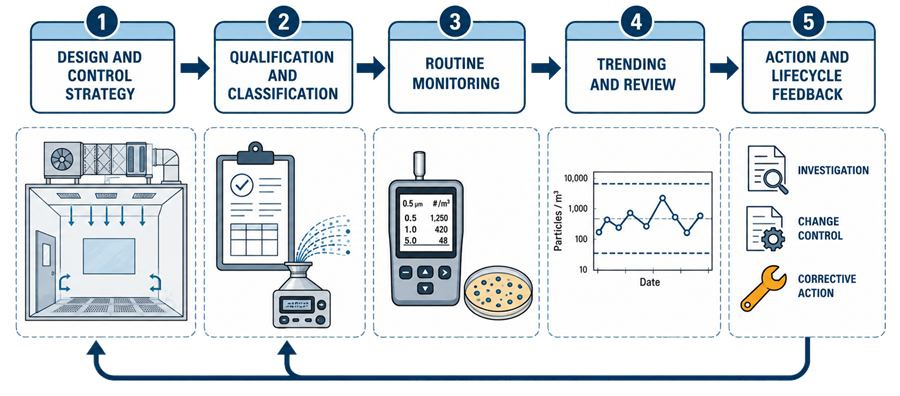
Environmental control and monitoring operate through a connected lifecycle:
- Design and control strategy establish the preventive controls appropriate for the intended process.
- Qualification and classification demonstrate that the installed facility and HVAC systems can achieve the required performance under defined conditions.
- Routine monitoring collects continuing evidence during GMP operation.
- Trending and review evaluate patterns, shifts, recurring events, and relationships among different data sources.
- Action and lifecycle feedback use monitoring results, investigations, changes, and operating experience to improve controls or reassess qualification.
Monitoring data therefore has two functions. It supports immediate evaluation of environmental conditions and provides longer-term feedback concerning the suitability of the control strategy.
Environmental control operates as a feedback system rather than a one-time qualification sequence. Design and qualification establish the control basis, while monitoring, trending, and investigation provide evidence used to maintain or revise that basis.
Qualification, Classification, and Routine Monitoring
Qualification, cleanroom classification, environmental performance studies, and routine monitoring generate different forms of evidence. They should not be treated as interchangeable activities.
Facility and HVAC Qualification
Facility and HVAC qualification demonstrate that the installed systems conform to approved requirements and can perform their intended functions.
Depending on scope, qualification may address:
- System installation and configuration
- Air volume, velocity, and air-change performance
- HEPA-filter installation and integrity
- Airflow patterns
- Room-pressure relationships
- Temperature and relative humidity
- Control sequences, alarms, and failure responses
- Recovery performance
- Room performance under representative conditions
Qualification establishes system and room capability. It does not replace continuing environmental monitoring.
Cleanroom Classification
Cleanroom classification determines airborne-particle cleanliness in accordance with an applicable classification standard and defined operational state.
Classification:
- Uses specified particle sizes and concentration limits
- Applies a prescribed sampling-location and sample-volume methodology
- Produces an ISO Class result for the tested conditions
- May be performed at rest, in operation, or in both states as required
Classification does not measure viable contamination, demonstrate sterility, establish process suitability, or define the complete routine monitoring program.
Environmental Performance Qualification
Environmental performance qualification evaluates whether the qualified room and its supporting controls maintain acceptable conditions during defined representative or challenged operation.
It may combine nonviable, viable, pressure, temperature, humidity, occupancy, operational, and process-related evidence. The resulting performance baseline supports selection of routine monitoring locations, methods, frequencies, and limits.
Routine Environmental Monitoring
Routine environmental monitoring provides continuing evidence after the area has been qualified and released for use.
Routine monitoring is normally more focused than initial qualification. Locations and frequencies are selected according to process risk, environmental performance, airflow behavior, operational activity, regulatory expectations, and historical data.
Passing routine results do not retroactively correct incomplete qualification. Conversely, one isolated result does not necessarily characterize the overall state of control. Results must be evaluated in context.
Viable and Nonviable Environmental Data
Viable and nonviable monitoring measure different attributes and should not be used as substitutes for one another.
Nonviable Monitoring
Nonviable airborne-particle monitoring counts particles at defined size thresholds without determining whether those particles contain microorganisms.
It can provide evidence concerning:
- Air cleanliness
- Particle generation during operations
- The effect of personnel movement or interventions
- Continued performance relative to established particulate criteria
- Sudden particulate events or adverse trends
Nonviable monitoring can provide rapid or continuous information, but it does not directly demonstrate microbiological control.
Viable Monitoring
Viable monitoring is intended to detect recoverable microorganisms using defined sampling and microbiological methods.
It may include:
- Active-air sampling
- Settle plates
- Contact plates
- Surface swabs
- Personnel or glove monitoring
Results are influenced by the sampling method, sampled volume or exposure time, recovery medium, incubation conditions, organism characteristics, sampling technique, and location. A result of no detected growth means that no colony-forming organisms were recovered under the conditions of that sample. It does not prove the absolute absence of microorganisms.
Integrated Evaluation
Viable and nonviable results should be evaluated together with relevant operational information, including:
- Activities performed during sampling
- Personnel presence and interventions
- Equipment status
- Cleaning or disinfection activities
- Door openings and material movement
- Pressure, temperature, and humidity conditions
- HVAC alarms or maintenance
- Recent changes, deviations, or unusual events
Agreement among different data sources strengthens the assessment. Conflicting data requires evaluation rather than automatic reliance on one measurement type.
Facility Monitoring Versus Aseptic-Process Monitoring
Facility environmental monitoring and aseptic-process monitoring are related but do not have identical objectives.
Facility Environmental Monitoring
Facility monitoring evaluates the continuing environmental condition of rooms, controlled areas, and supporting spaces.
Its objectives may include:
- Confirming continued environmental control
- Detecting deterioration in HVAC or operating performance
- Identifying recurring contamination locations
- Evaluating cleaning and disinfection effectiveness
- Supporting periodic review and requalification
- Providing context for deviation and product-impact assessments
Facility monitoring may apply to sterile, nonsterile, biotechnology, medical-device, laboratory, packaging, or controlled-support environments. The program should be proportionate to the intended use and risk of each area.
Aseptic-Process Monitoring
Aseptic-process monitoring focuses on environmental conditions surrounding exposed sterile product, sterile components, critical surfaces, and aseptic manipulations.
It places greater emphasis on:
- Critical processing locations
- First-air protection
- Continuous or frequent nonviable particle monitoring
- Viable monitoring during active operations
- Personnel and glove monitoring
- Interventions and operator activity
- Barrier-system conditions
- Correlation with batch and process events
Monitoring must be positioned and performed without creating an unacceptable contamination risk or disrupting critical airflow.
Detailed requirements for active aseptic operations are addressed in Environmental Monitoring for Aseptic Filling.
Monitoring Locations, Frequencies, and Operating Conditions
Monitoring locations and frequencies should be established through documented risk assessment rather than uniform spacing or convenience.
The rationale should consider:
- Product and critical-surface exposure
- Room classification and function
- Airflow patterns and return or exhaust locations
- Personnel activity and interventions
- Equipment arrangement
- Material-transfer routes
- Difficult-to-clean or contamination-sensitive locations
- Qualification findings
- Historical recovery patterns
- The ability of the selected method to detect a meaningful loss of control
The program should define whether sampling occurs at rest, in operation, during setup, during processing, after processing, or after cleaning. Results cannot be interpreted properly unless the operational state and relevant activities are documented.
Routine monitoring locations should remain sufficiently consistent to support trending. Additions, removals, or relocation of established points should be assessed and controlled.
Limits, Levels, Specifications, and Alarms
Environmental programs may use several types of predefined criteria. Their meaning should be clearly distinguished.
- Classification limits are maximum airborne-particle concentrations associated with a specified ISO Class and operational state.
- Qualification acceptance criteria determine whether predefined performance requirements were successfully demonstrated.
- Alert levels identify results or trends that may indicate departure from normal performance and require increased attention or evaluation.
- Action levels trigger defined investigation, assessment, and response requirements.
- Operating limits or specifications define acceptable conditions for parameters such as pressure, temperature, or relative humidity.
- Alarm thresholds initiate system notification or operator response and may be set inside or outside an operating limit according to the control strategy.
An alert-level result does not automatically establish loss of control. An action-level result requires formal response but should still be evaluated with the location, method, organism, operational conditions, historical data, and potential product impact.
Limits should not be selected solely because they are statistically convenient. They must remain scientifically meaningful, operationally appropriate, and consistent with applicable regulatory or technical requirements.
Trending and Integrated Review
Individual results are evaluated against predefined criteria, but environmental control cannot be assessed from isolated results alone.
Trending should evaluate, as applicable:
- Repeated alert-level or action-level results
- Increasing counts that remain below established levels
- Changes in recovery frequency
- Repeated recovery at the same location
- Changes in predominant microbial flora
- Recovery of objectionable or unusual organisms
- Differences among shifts, campaigns, rooms, or operators
- Seasonal patterns
- Relationships to maintenance, cleaning, or operational changes
- Correlation between viable and nonviable results
- Pressure, temperature, humidity, and HVAC alarm history
- Investigation recurrence and corrective-action effectiveness
Statistical methods can support evaluation, but numerical analysis should not replace microbiological, engineering, process, and quality judgment.
Excursions, Investigation, and Product Impact
The response to an environmental result should be proportionate to its significance and governed by approved procedures.
Evaluation may include:
- Confirmation of the sampling identity, method, and conditions
- Review of laboratory controls and sample handling
- Identification of recovered microorganisms
- Review of concurrent and adjacent monitoring results
- Assessment of personnel, interventions, and material movement
- Review of cleaning, disinfection, and room status
- Review of HVAC performance, alarms, maintenance, and pressure data
- Examination of recent changes or unusual events
- Assessment of affected operations, materials, and batches
- Additional monitoring where scientifically justified
- Corrective action, preventive action, or change control
- Evaluation of requalification or monitoring-program changes
Resampling alone should not be used to invalidate an unfavorable result. Additional samples may provide useful information, but the original result remains part of the investigation and trend history.
Product impact should be based on the totality of evidence, including the operation performed, exposure conditions, location, organism identity, process controls, environmental data, and applicable sterility-assurance measures.
Lifecycle Feedback and Continued Control
Environmental monitoring is effective only when its results influence the control system.
Monitoring results, trends, investigations, and operational experience may lead to:
- Revised sampling locations or frequencies
- Changes to alert or action levels
- Improved cleaning or disinfection practices
- Revised personnel or material controls
- HVAC maintenance, repair, or balancing
- Changes to alarms or operating ranges
- Additional airflow visualization
- Targeted environmental studies
- Updated risk assessments
- Targeted or comprehensive requalification
- Facility, equipment, or process modifications
- Revision of the contamination-control strategy
Changes to the monitoring program should be documented and justified. Reduced monitoring should be supported by risk, regulatory requirements, process understanding, and adequate historical evidence. Increased monitoring may be appropriate after changes, maintenance, adverse trends, contamination events, or loss of environmental control.
The objective is not simply to accumulate acceptable results. The objective is to maintain an understood, qualified, monitored, and responsive system of environmental control throughout the facility lifecycle.
Relationship to the Detailed Articles
This overview establishes the common framework for the following articles:
- Environmental Performance Qualification, Limits, and Trending explains performance qualification, baseline establishment, acceptance criteria, alert and action levels, data evaluation, and lifecycle trending.
- Environmental Monitoring Program Execution explains risk-based program design, viable and nonviable sampling methods, location and frequency selection, sampling conditions, documentation, governance, and routine execution.
These articles should be used together. Qualification establishes capability and the initial evidence base; routine monitoring verifies continuing performance; trending and investigation return operational evidence to the contamination-control strategy.