

Environmental Monitoring for Aseptic Process Verification
Environmental monitoring provides evidence that the manufacturing environment, personnel practices, barrier systems, and operating controls remain capable of supporting aseptic processing.
It does not directly measure the sterility of every unit produced. Environmental monitoring is a sampling-based verification system, and microbiological methods cannot recover every organism that may be present. A result showing no microbial recovery therefore means that no organisms were recovered under the specified sampling and incubation conditions—not that the monitored location was continuously free of microorganisms.
An effective environmental-monitoring program combines:
- Nonviable airborne-particle monitoring
- Active viable-air sampling
- Passive air monitoring using settle plates
- Surface monitoring
- Glove and gown monitoring
- Environmental and process alarms
- Organism identification
- Event and intervention data
- Batch-specific review
- Short- and long-term trend evaluation
These elements should be integrated with the facility contamination-control strategy, Aseptic Processing Validation Strategy and Lifecycle, Media Fill and Aseptic Process Simulation, airflow-visualization studies, cleaning and disinfection controls, and the qualification of the applicable filling and barrier systems.
Purpose and scope
The environmental-monitoring program should be capable of detecting changes that may indicate deterioration of environmental or aseptic-process control. Its objectives include:
- Verifying conditions where sterile product, sterile components, or critical surfaces are exposed
- Detecting contamination associated with personnel, interventions, equipment, or transfers
- Identifying changes in the type or frequency of microbial recoveries
- Detecting nonviable-particle events associated with operational disturbance
- Supporting evaluation of batches manufactured during abnormal conditions
- Providing evidence for investigation, corrective action, change control, and periodic review
- Confirming that previously qualified environmental controls continue to perform during routine operations
Environmental monitoring should be designed around the actual process. A program that collects large quantities of data from convenient locations may remain weak if it does not monitor the locations, activities, and contamination pathways most relevant to exposed product.
Regulatory framework
Under 21 CFR 211.113, manufacturers of sterile drug products must establish and follow appropriate written procedures designed to prevent microbiological contamination, including validation of aseptic and sterilization processes.
The FDA aseptic-processing guidance expects a documented environmental-monitoring program capable of providing meaningful information about the microbiological quality of critical and surrounding areas. It addresses risk-based location selection, active-air sampling, surface and personnel monitoring, organism identification, trending, investigation, and quality-unit oversight. FDA Guidance for Industry: Sterile Drug Products Produced by Aseptic Processing — Current Good Manufacturing Practice
EU GMP Annex 1 requires a documented environmental-monitoring program in which locations, methods, frequencies, incubation conditions, and monitoring duration are defined through risk assessment. Annex 1 also establishes specific expectations for Grade A and Grade B monitoring, including monitoring during setup and critical operations.
The FDA and Annex 1 frameworks should not be blended into a single set of unexplained limits. A site supplying different markets should identify which requirements apply and document how its program satisfies each applicable framework.
Laboratory controls, sampling plans, test procedures, and changes to them should receive appropriate quality-unit review and approval under 21 CFR 211.160.
Environmental qualification and routine monitoring
Cleanroom classification, environmental qualification, and routine environmental monitoring serve different purposes.
Cleanroom classification demonstrates that a room or clean-air device meets its specified airborne-particle classification under defined conditions.
Environmental qualification establishes baseline performance and supports the selection of monitoring locations, operating conditions, sampling methods, and initial program levels.
Routine environmental monitoring verifies environmental performance during actual manufacturing operations over time.
Classification locations should not automatically become routine monitoring locations. Routine locations should be selected according to contamination risk, product exposure, airflow, operator activity, interventions, equipment configuration, and the ability of the sampling method to detect a meaningful change.
Environmental monitoring also does not replace Media Fill and Aseptic Process Simulation. A process simulation evaluates the integrated aseptic process under defined operating conditions, while environmental monitoring provides sample-based information about specific conditions and activities during routine operation.
Program governance
The environmental-monitoring program should be governed through approved procedures and clearly assigned responsibilities.
The governance model should define responsibility for:
- Program ownership
- Monitoring-location approval
- Sampling-plan preparation
- Sampling execution
- Media and sampling-equipment control
- Sample transport and incubation
- Colony enumeration and organism identification
- Nonviable-particle data review
- Alert and action notification
- Missed or compromised sample assessment
- Investigation initiation and approval
- Batch-impact assessment
- Trend reporting
- Change control
- Periodic program review
Personnel performing monitoring should be trained and qualified for the specific methods they use. Qualification should address technical sampling practices as well as aseptic behavior, sampler positioning, movement within critical areas, and prevention of contamination introduced by the sampling activity itself.
Monitoring architecture and program elements
No individual environmental-monitoring method provides complete evidence.
Nonviable-particle monitoring detects airborne particles but does not determine whether they contain viable microorganisms. Active-air sampling evaluates recoverable microorganisms from a specified volume of air. Settle plates provide time-integrated information about microbial deposition. Surface methods assess recoverable contamination on accessible surfaces. Glove and gown monitoring provides information about personnel practices and contamination transfer.
These methods should be treated as complementary evidence.
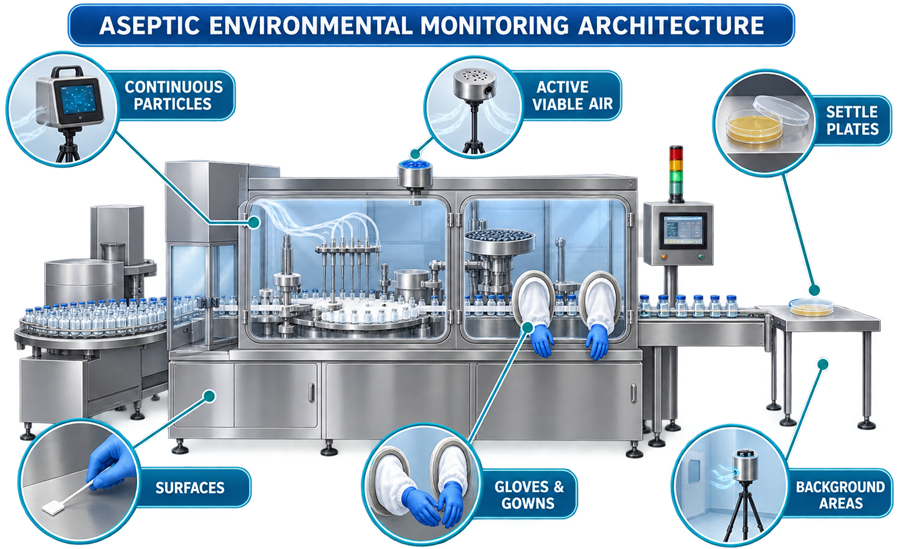
The monitoring architecture should cover:
- Critical exposure locations
- Air entering or moving through the critical zone
- Operator intervention positions
- Equipment and barrier surfaces
- Gloves or gauntlets used during critical manipulations
- Representative background areas
- Material and component transfer locations
- Areas affected by doors, transfers, or frequent movement
- Locations associated with recurring recoveries or previous investigations
The architecture should correspond to the actual Aseptic Filling Line Architecture and the qualified operating configuration of the equipment.
Risk-based monitoring location selection
Locations should be selected through a documented risk assessment rather than historical convention alone. The assessment should consider:
- Product and critical-surface exposure
- Airflow-visualization results
- First-air protection
- Operator positions and movements
- Routine and nonroutine interventions
- Equipment geometry
- Barrier openings and transfer points
- Filling duration
- Personnel occupancy
- Material and waste movement
- Difficult-to-clean surfaces
- Previous environmental recoveries
- Process-simulation observations
- Maintenance access
- Sampling-method limitations
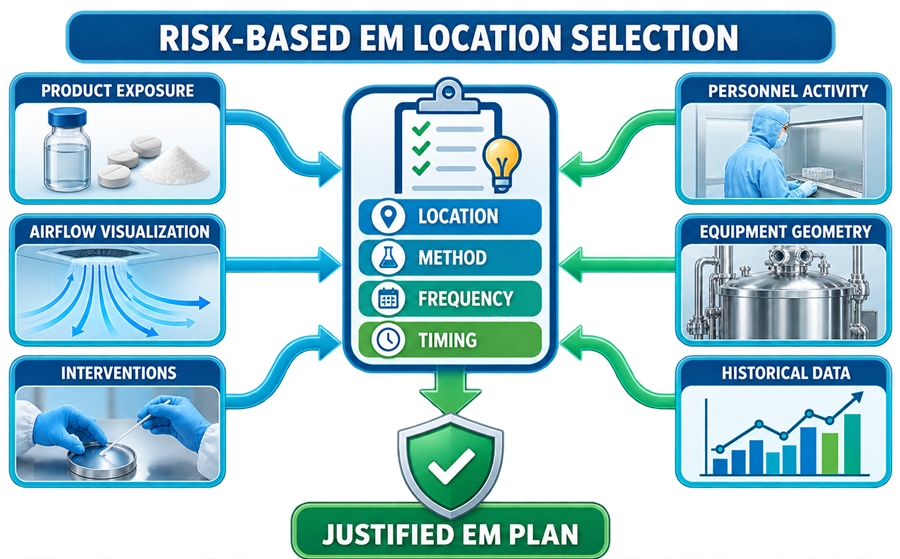
The monitoring plan should define what each location is intended to detect. For example, a point may be selected to detect:
- Contamination entering the critical zone during an intervention
- Microbial deposition near an open container
- Contamination of a frequently manipulated glove
- Organisms transferred through a material-entry path
- Particle generation caused by equipment movement
- Environmental deterioration near an access door
- Contamination accumulating on a critical surface during processing
A convenient point is not necessarily an informative point. A sampler may be physically close to the filling operation but provide weak evidence if airflow carries contamination away from it or if the sampler is positioned outside the contamination pathway being evaluated.
Each monitoring location should have a stable, unique identifier used consistently in procedures, room maps, sampling records, laboratory systems, investigations, and trend reports.
Relocation or removal of an established point should be assessed through change control. Moving a sampler away from a recurring recovery location does not demonstrate improved environmental control.
Monitoring methods
Nonviable airborne-particle monitoring
Nonviable monitoring evaluates airborne particles at specified particle-size thresholds. The monitoring plan should define:
- Instrument and probe type
- Particle-size channels
- Sample flow rate
- Monitoring interval
- Probe location and orientation
- Tubing configuration
- Alarm criteria
- Data resolution
- Response to interrupted monitoring
- Calibration and maintenance requirements
- Rules for reviewing short-duration and sustained excursions
Critical-zone probes should be positioned near the location of greatest contamination risk without obstructing operations or disturbing unidirectional airflow. Tubing length, bends, material, probe orientation, and transport losses should be evaluated. An inappropriate configuration may delay or reduce particle detection.
Continuous data should retain sufficient resolution to associate excursions with interventions, equipment movements, alarms, or other events. Results should not be averaged in a manner that conceals localized or short-duration deterioration.
For operations governed by Annex 1, Grade A particle monitoring is expected throughout critical processing, including equipment setup, subject to justified limitations such as contaminants that could damage the particle counter or create a hazard.
Active viable-air monitoring
Active-air samplers draw a measured volume of air onto or through a collection medium. Procedures should specify:
- Approved sampler and sampling head
- Calibration or flow verification
- Sample volume
- Sampling duration
- Location and orientation
- Timing relative to the operation
- Media type
- Sampler preparation and disinfection
- Sample identification
- Post-sampling handling
- Incubation conditions
- Response to interrupted or incomplete samples
The selected volume should support the monitoring objective without excessive media desiccation, colony overlap, loss of collection efficiency, or unacceptable disturbance of critical airflow.
The sampler should be assessed for:
- Physical and biological collection efficiency
- Cleanability and disinfection
- Sterilization, where applicable
- Potential carryover
- Airflow disturbance
- Suitability for use near exposed product
- Performance in the actual sampling configuration
Long tubing or remote sampler configurations should not be used without evaluating microbial and particle losses, bends, electrostatic effects, transport time, and the complete installed configuration.
Passive air monitoring
Settle plates detect microorganisms capable of depositing onto the exposed agar surface during the monitoring period.
They are useful when microbial deposition onto exposed product, components, or critical surfaces is a relevant contamination mechanism. Settle plates do not sample a defined air volume and should not be interpreted as equivalent to active-air results.
Procedures should define:
- Plate location and orientation
- Exposure start and stop times
- Maximum exposure duration
- Media type
- Plate replacement during extended operations
- Controls for agar desiccation
- Handling of interrupted exposures
- Incubation and enumeration requirements
Where Annex 1 applies, individual settle plates in Grade A and Grade B areas are generally exposed for no more than four hours unless a longer period is supported by recovery and media-suitability evidence. Sequential plates may be used for extended operations.
Results from sequential plates should not automatically be combined into an artificial single count unless the interpretation method has been scientifically justified.
Surface monitoring
Surface monitoring may use contact plates, swabs, or another qualified method. Contact plates are generally suitable for flat, accessible surfaces. The method should control the sampled area, applied pressure, contact duration, plate orientation, residual agar, and post-sampling cleaning.
Swabs may be needed for curved, irregular, recessed, or inaccessible surfaces. Swab procedures should define:
- Swab material
- Wetting or neutralizing solution
- Sampled area
- Swabbing pattern
- Extraction or transfer method
- Sample holding time
- Result calculation
- Reporting units
Critical surfaces should normally be sampled at the conclusion of processing so that the monitoring activity does not create a contamination risk during product exposure. An alternative timing should be justified by the intended monitoring objective and the controls applied.
A microbial recovery from a critical surface requires a documented assessment, but the result should not be interpreted in isolation. The investigation should consider the surface function, timing, organism, product exposure, operator activity, interventions, and possible sampling-related contamination.
Personnel monitoring
Personnel monitoring provides evidence concerning gowning effectiveness, aseptic technique, interventions, and the potential transfer of contamination by operators. The program should define:
- Personnel groups included
- Glove and gown sites
- Sampling method
- Frequency
- Timing during or after operations
- Monitoring after critical interventions
- Exit-monitoring requirements
- Response to an unacceptable result
- Relationship to operator qualification
Glove samples should be traceable to the individual operator, operation, date, time, room, intervention history, and potentially affected batch.
Sampling a glove during operation can itself contaminate the glove. A sampled glove should not be returned to critical work unless an approved and scientifically justified control prevents contamination transfer.
Manual and highly intervention-intensive processes ordinarily require more extensive personnel monitoring because operator activity represents a greater potential contamination pathway. Personnel monitoring should complement—but not replace—observation of aseptic technique and operator participation in process simulations.
Monitoring timing and frequency
Monitoring should represent the operating conditions that create the greatest contamination risk. Depending on the process and applicable requirements, monitoring may be performed:
- During equipment setup
- Throughout critical processing
- During or immediately after critical interventions
- At defined intervals during extended operations
- At the end of processing
- During each batch or production session
- Following cleaning or disinfection
- Following maintenance, shutdown, or restart
- During enhanced monitoring after an excursion
- During qualification or requalification
The frequency should consider:
- Area classification and function
- Product-exposure duration
- Process duration
- Intervention frequency
- Personnel occupancy
- Barrier-system configuration
- Qualification data
- Historical recovery patterns
- Seasonal variation
- Method sensitivity
- Consequence of delayed detection
- Recent changes or maintenance
FDA guidance recommends active-air monitoring during each production shift at carefully selected locations. Annex 1 expects routine monitoring during all critical stages, including setup, and calls for continuous viable-air monitoring in Grade A for the full duration of critical processing, using a suitable method or combination of methods.
A missed, interrupted, or compromised sample should be documented and assessed. It should not automatically be replaced by a later sample that does not represent the same operation or risk period.
Monitoring in RABS and isolators
Environmental-monitoring design should reflect the barrier technology. For Restricted Access Barrier Systems, the program should consider:
- RABS door status
- Glove-port locations
- Glove interventions
- Transfer openings
- Background-room conditions
- First-air protection
- Surface decontamination
- Barrier breaches or open-door interventions
Barrier gloves should be integrated with the Barrier Glove Integrity Qualification and Lifecycle Control program.
For Isolator Systems, monitoring should address:
- Isolator air and surface conditions
- Glove or half-suit surfaces
- Transfer systems
- Material-entry cycles
- Decontamination-cycle status
- Decontamination residues
- Monitoring equipment introduced into the enclosure
- Potential interference with recovery media
Residual decontaminating agent may inhibit microbial recovery and create a misleading negative result. Media, neutralizers, sample timing, aeration, and sampler configuration should therefore be shown to be suitable for use in the isolator environment. These controls should be coordinated with Barrier System Bio-Decontamination Validation.
Method suitability and microbiological recovery
Environmental-monitoring methods are not expected to recover every microorganism present. Recovery depends on the organism, sampler, medium, surface, environmental stress, incubation conditions, and operator technique.
Method suitability should address, as applicable:
- Relevant bacteria, yeasts, and molds
- Environmental isolates
- Media formulation
- Incubation temperature and duration
- Aerobic or other required conditions
- Sampler collection efficiency
- Sampling volume or exposure time
- Media desiccation
- Neutralization of disinfectant residues
- Surface recovery
- Sample holding time
- Organism stress
- Enumeration capability
- Sampler cleaning and carryover prevention
Prepared media should undergo appropriate growth-promotion testing. Media used on recently disinfected surfaces or inside decontaminated isolators should contain suitable neutralizers when needed, with evidence that the neutralization system is effective and not toxic to the organisms being recovered.
A change to the sampler, media, incubation scheme, neutralizer, identification technology, or laboratory may affect recovery and historical comparability. The effect should be assessed before trend data from different methods are treated as equivalent.
Alternative or rapid microbiological methods may be used when their suitability and performance have been demonstrated for the intended environmental-monitoring application.
Establishing alert and action levels
Alert and action levels should be established from:
- Applicable regulatory expectations
- Area classification and function
- Qualification data
- Routine monitoring history
- Method capability
- Process risk
- Media-fill observations
- Cleaning and disinfection studies
- Typical environmental flora
- Statistical and microbiological evaluation
Under the FDA framework, a universal numerical viable limit is not prescribed for every ISO 5 monitoring point. Site levels should be scientifically established and supported by process risk and historical data.
Under Annex 1, the viable action limit for Grade A is “no growth.” Any microbial recovery in Grade A should be investigated. Annex 1 also defines maximum viable action limits for other grades.
These requirements should be applied according to the market and regulatory framework governing the operation.
Alert level
An alert-level event is an early warning of possible environmental deterioration. It should receive documented review and follow-up appropriate to the result, location, organism, process activity, and recent history.
Repeated alerts, increasing frequency, related recoveries, or an adverse trend may require investigation even when no individual result exceeds an action level.
Action level
An action-level excursion indicates a condition requiring formal investigation under the approved program. The response should include, as appropriate:
- Confirmation of the result and sample identity
- Organism identification
- Evaluation of the monitoring method
- Review of process conditions
- Product- and batch-impact assessment
- Root-cause investigation
- Corrective and preventive action
- Effectiveness monitoring
An action level should not be defined merely as the regulatory classification limit for nonviable particles or an unsupported universal microbial value.
Organism identification and isolate control
Counts alone may not adequately describe environmental risk. Recoveries from critical and surrounding areas, personnel, and significant excursions should be identified to an appropriate taxonomic level based on risk. Identification supports evaluation of:
- Likely contamination source
- Organism migration
- Repeated recovery of a related organism
- Personnel-associated flora
- Spore-forming organisms
- Molds and yeasts
- Water-associated organisms
- Changes in the facility’s typical flora
- Potential relationship to product or process isolates
The isolate database should support searches by:
- Organism
- Location
- Room
- Operator
- Shift
- Date and season
- Batch
- Intervention
- Equipment
- Monitoring method
- Investigation
Genotypic or other higher-resolution identification methods may be useful where conventional identification cannot determine whether isolates are meaningfully related.
Data review and batch assessment
Environmental data should be reviewed with sufficient timeliness to support batch evaluation. The review should include:
- Viable results
- Nonviable-particle events
- Personnel results
- Environmental alarms
- Pressure, temperature, and humidity abnormalities
- Sampling deviations
- Monitoring interruptions
- Intervention records
- Equipment alarms
- Cleaning and disinfection records
- Organism identification
- Open investigations
- Relevant recent trends
The batch-review procedure should define which environmental results must be available before disposition and how results reported after production are assessed.
Results should remain traceable to the batch, operation, location, date, time, operator, method, and relevant process events. Audit trails and changes to electronic records should be controlled and reviewable.
Investigation of excursions and adverse trends
An investigation should begin by preserving the original result and its process context.
The initial assessment should address:
- Correct sample and location identification
- Media condition and incubation
- Sampler status and calibration
- Sample handling
- Laboratory controls
- Data transcription or electronic transfer
- Location and time of the result
- Product-exposure status
- Organism identity
- Related personnel and interventions
- Concurrent particle or environmental alarms
- Similar recent recoveries
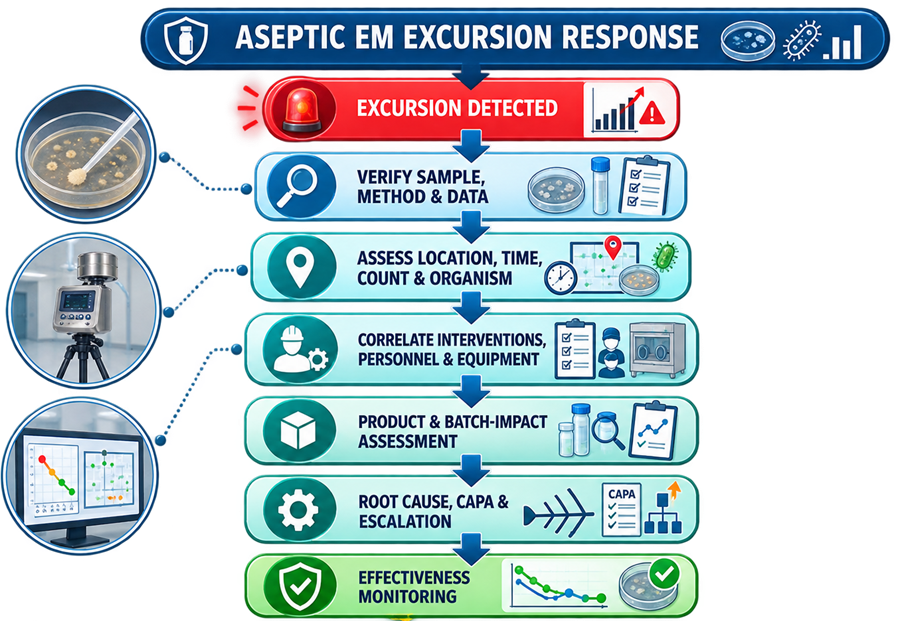
An investigation should not assume that an unusual result is a laboratory error merely because the surrounding results were acceptable. Environmental methods can produce both false-positive and false-negative results, and low-level contamination may not be detected by adjacent samples.
Process correlation
The investigation should reconstruct what occurred at the location and time of the event, including:
- Routine and nonroutine interventions
- Operator positions and movements
- Barrier-glove use
- Door or transfer activity
- Equipment stoppages
- Line clearance or adjustment
- Component replenishment
- Cleaning activity
- Maintenance
- Pressure or HVAC abnormalities
- Particle excursions
- Aseptic-practice observations
Video records, automated event histories, intervention logs, particle data, and equipment alarms may provide important evidence.
Product-impact assessment
Product impact should consider:
- Proximity of the recovery to exposed product
- Whether the location was a critical surface
- Timing relative to product exposure
- Duration of the condition
- Organism identity and characteristics
- Product and container-closure configuration
- Airflow and contamination pathway
- Associated interventions
- Barrier status
- Batch chronology
- Related personnel results
- Media-fill evidence
- Other relevant environmental data
A microbial recovery from a critical location is significant, but it does not automatically determine batch disposition under every regulatory framework. Disposition should be based on a documented, scientifically supported assessment of the result and the aseptic operation.
The investigation and batch decision should meet the production-record review and investigation expectations of 21 CFR 211.192.
Root cause and CAPA
Potential causes may include:
- Aseptic-practice failure
- Glove damage
- Inadequate disinfection
- Contaminated transfer
- Equipment or surface contamination
- Airflow disturbance
- Barrier breach
- Maintenance-related contamination
- Sampling error
- Media or incubation problem
- Laboratory handling
- Inadequate monitoring-point design
Corrective action should address the supported cause or contributing factors. Repeating cleaning, retraining an operator, or collecting additional samples may be useful, but these actions should not substitute for determining why the event occurred.
CAPA effectiveness should be confirmed through defined evidence and an appropriate monitoring period.
Trending and periodic review
Environmental trends should be evaluated by more than total monthly counts. Useful trend dimensions include:
- Monitoring location
- Room or barrier
- Shift
- Operator
- Organism
- Organism group
- Intervention
- Process stage
- Equipment
- Sampling method
- Season
- Alert frequency
- Action frequency
- Consecutive recoveries
- Recurring isolated events
An increasing incidence of recovery may be significant even when individual results remain below the action level. Repeated isolation of the same organism from related locations may also indicate a contamination pathway that is not apparent from counts alone.
Individual results should not be averaged in a manner that conceals a localized adverse condition.
Periodic review should assess:
- Continued suitability of locations
- Monitoring frequencies
- Method performance
- Alert and action levels
- Organism profiles
- Recurring investigations
- Missed or invalid samples
- Sampler reliability
- Data-review timeliness
- CAPA effectiveness
- Facility and process changes
- Alignment with the contamination-control strategy
Change control and requalification
Changes that may affect environmental-monitoring performance should undergo documented assessment. Examples include:
- Filling-line modification
- Barrier-system modification
- New interventions
- Revised production duration
- New container or component presentation
- Changed personnel or material flow
- HVAC modification
- Monitoring-point relocation
- Sampler replacement
- Media or incubation changes
- New disinfectant
- Isolator decontamination-cycle change
- Automation or data-system change
- Adverse environmental trend
The assessment should determine whether updated risk assessment, airflow visualization, environmental qualification, method studies, enhanced monitoring, or Media Fill and Aseptic Process Simulation is required.
Common program deficiencies
Common weaknesses include:
- Treating environmental monitoring as proof of batch sterility
- Using classification locations without a routine-risk assessment
- Monitoring convenient rather than consequential locations
- Disrupting first-air protection with sampling equipment
- Using long tubing without transport-loss evaluation
- Treating active-air and settle-plate results as interchangeable
- Sampling critical surfaces during processing without adequate justification
- Returning sampled gloves to critical work
- Failing to neutralize disinfectant or decontamination residues
- Delayed organism identification
- Inadequate linkage between results and batch events
- Using universal microbial limits without a site rationale
- Mixing FDA and Annex 1 limits without identifying the applicable framework
- Averaging away localized particle or microbial results
- Treating repeated alerts as isolated events
- Dismissing recoveries without investigating process context
- Moving sampling points to create apparently improved data
- Failing to assess method changes against historical trends
- Closing CAPA without effectiveness evidence
Conclusion
Environmental monitoring for aseptic processing is a lifecycle verification system. Its value depends on monitoring the locations and activities where contamination would matter, using methods that are suitable for the environment, and interpreting results in relation to process events, organism identity, product exposure, and historical trends.
The strongest programs do not rely on a single count or isolated sampling method. They integrate particle, viable-air, surface, personnel, equipment, intervention, and batch data to detect deterioration, investigate adverse conditions, and maintain the validated state of the aseptic process.