

Barrier System Bio-Decontamination Validation
Purpose and scope
Barrier-system bio-decontamination is a validated contamination-control process used to reduce or eliminate viable microorganisms from the internal surfaces of an isolator or restricted access barrier system before aseptic processing.
The validation objective is not merely to demonstrate that a sporicidal agent was introduced into the enclosure. Validation must establish that the defined process reproducibly reaches the intended surfaces, delivers the required microbiological effect, operates within justified parameter ranges, and leaves the system in a condition suitable for its intended use.
This article addresses:
- Definition of the bio-decontamination boundary
- Differences between isolator and RABS applications
- Cleaning and cycle preconditions
- Cycle development and parameter selection
- Load and configuration control
- Biological and chemical indicator strategies
- Qualification and performance verification
- Aeration and residual acceptance
- Routine cycle review
- Failure investigation
- Change control and requalification
The article applies primarily to automated gaseous or vapor-phase processes used in isolators. Relevant principles also apply to automated barrier chambers and to validated sporicidal disinfection programs used in RABS.
It does not replace validation of product-contact sterilization, component sterilization, cleaning validation, barrier integrity, or aseptic process simulation.
Bio-decontamination is not product-contact sterilization
The terms cleaning, disinfection, bio-decontamination, and sterilization should not be used interchangeably.
Cleaning removes residues, soils, and other materials that could protect microorganisms or interfere with a sporicidal agent.
Disinfection reduces viable microorganisms to a level appropriate for the intended environment.
Bio-decontamination uses a validated sporicidal process to eliminate viable bioburden from the defined enclosure surfaces.
Sterilization applies a validated process intended to render a product or item free from viable microorganisms with a defined sterility assurance objective.
A vaporized hydrogen peroxide cycle used to bio-decontaminate an isolator enclosure should not automatically be represented as sterilizing:
- Closed product pathways
- Interior surfaces of tubing
- Filling needles or product-contact components
- Covered or sealed interfaces
- Materials inside impermeable packaging
- Occluded surfaces outside the validated exposure boundary
These items require separately validated sterilization or aseptic-transfer controls.
The FDA’s aseptic processing guidance specifically distinguishes isolator surface decontamination from sterilization of the product-contact pathway. The entire sterile processing stream must be sterilized using an appropriately validated method before operation.
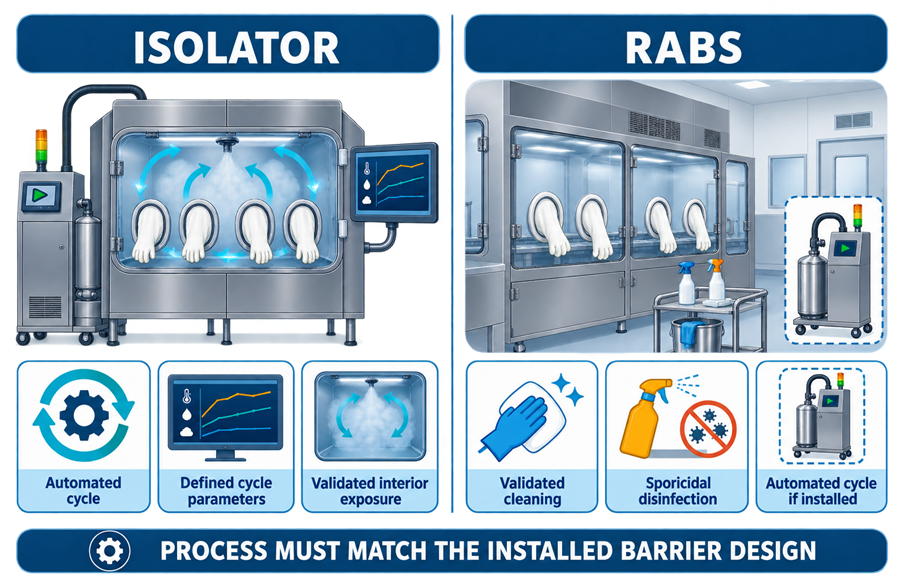
Isolator and RABS requirements are different
Isolator bio-decontamination
An isolator is designed to permit reproducible bio-decontamination of its interior. The process is commonly automated and may use vaporized hydrogen peroxide, although other scientifically justified agents and delivery technologies may be used.
The automated cycle normally includes defined conditioning, agent introduction, exposure, and aeration phases. Critical parameters are monitored and recorded by the control system.
EU GMP Annex 1 states that isolator interior bio-decontamination should be automated, validated, controlled within defined cycle parameters, and performed using a sporicidal agent in a suitable form.
RABS sporicidal disinfection
A RABS is enclosed but is not necessarily sealed or designed for the same automated gaseous bio-decontamination process as an isolator.
RABS interior surfaces are generally cleaned and disinfected using a validated program that includes application of a sporicidal agent. Some closed RABS designs incorporate automated bio-decontamination. When that technology is installed, the applicable cycle-development and qualification principles described in this article should be applied.
The validation strategy must therefore identify whether the system uses:
- Manual cleaning and sporicidal disinfection
- Semi-automated agent application
- Automated gaseous or vapor-phase bio-decontamination
- A combination of these approaches
A RABS should not be described as having an isolator-equivalent bio-decontamination capability unless the installed design and validation evidence support that conclusion.
Define the validated cycle boundary
The cycle boundary identifies every surface and connected volume that is intended to receive the bio-decontamination treatment. Depending on the system design, the boundary may include:
- Main processing enclosure
- Transfer chambers
- Rapid transfer port surfaces exposed during the cycle
- Glove and sleeve assemblies
- Doors, gaskets, and door interfaces
- Interior equipment surfaces
- Filling-line exterior surfaces
- Supply and return-air paths exposed to the agent
- Connected ducts, dampers, or recirculation paths
- Sensors and instrument surfaces
- Format parts installed during the cycle
- Material-transfer interfaces
The boundary should also identify explicit exclusions, such as:
- Closed product-contact piping
- Tubing lumens
- Sealed assemblies
- Surfaces beneath permanent impermeable seals
- Unexposed interiors of equipment
- External barrier surfaces
- Areas treated under a separate bio-decontamination cycle
The validation protocol should not imply that the agent penetrates locations outside the demonstrated exposure boundary.
Cleaning and cycle preconditions
Cleaning before bio-decontamination is a critical process prerequisite. Product residue, disinfectant residue, lubricants, dust, and other soils can interfere with surface contact or protect microorganisms from the sporicidal agent.
EU GMP Annex 1 specifically identifies cleaning before bio-decontamination as essential and requires evidence that the cleaning and bio-decontamination agents do not adversely affect the product.
Cycle preconditions should therefore define, as applicable:
- Approved cleaning procedure
- Required cleaning-agent removal
- Maximum time between cleaning and cycle initiation
- Acceptable enclosure condition
- Permitted equipment and material configuration
- Door and transfer-port positions
- Glove and sleeve positioning
- Fan, damper, and exhaust configuration
- Required temperature and humidity conditions
- Calibration and readiness of critical instruments
- Status of maintenance activities
- Absence of unresolved alarms or integrity failures
For an isolator cycle, gloves should be extended appropriately and the fingers separated so the sporicidal agent can contact the glove surfaces. Folded gloves, nested fingers, compressed sleeves, and surfaces shielded by equipment can create locations with reduced exposure.
Completion of cleaning and configuration checks should be documented before cycle initiation.
Cycle and load configuration development
The cycle must be developed for defined enclosure configurations rather than for an unspecified empty space. The development program should evaluate the effect of:
- Equipment arrangement
- Line format and installed components
- Temporary instruments
- Glove and sleeve position
- Door and port position
- Material quantity and placement
- Agent-absorbing materials
- Surface type, texture, and porosity
- Air circulation and return paths
- Equipment-generated heat
- Enclosure leakage rate
- Background temperature and humidity
A “maximum load” is not automatically the worst case. A smaller configuration may create a more difficult challenge if it blocks an injection point, disrupts circulation, creates a protected interface, or changes local humidity.
Permitted configurations should be grouped only when development evidence demonstrates that they are represented by the qualified challenge configuration. Unsupported statements such as “all routine loads are covered” should be avoided.
Bio-decontamination cycle phases
Phase names and control approaches vary with the equipment and agent technology, but an automated vapor-phase cycle commonly contains the following stages.
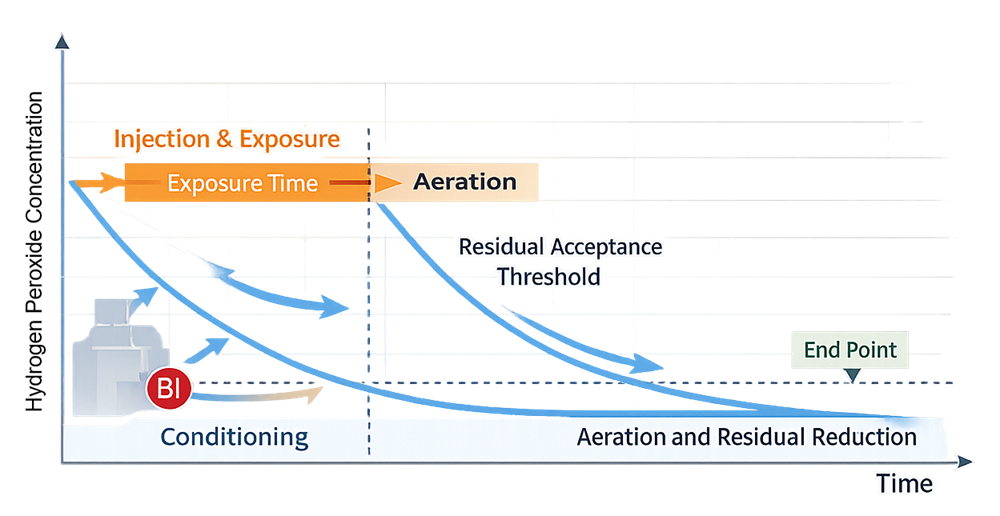
Conditioning
The enclosure is brought to defined starting conditions. Depending on the cycle design, conditioning may involve heating, dehumidification, humidification, airflow stabilization, or leak verification.
Agent introduction
The sporicidal agent is introduced at a controlled rate or dose. Injection mass, concentration, delivery rate, airflow, temperature, and humidity can affect distribution and microbiological effectiveness.
Exposure
The system maintains the defined conditions for the required contact period. The validated exposure phase should be based on demonstrated cycle performance rather than on programmed time alone.
Aeration
The agent is removed or decomposed until the enclosure meets the validated endpoint for personnel safety, process suitability, material compatibility, and potential product exposure.
The intended vapor or condensation state should be defined. Some systems are designed to prevent visible condensation, while other technologies may employ a controlled condensation mechanism. The validation strategy should confirm the intended state and demonstrate that it remains controlled.
Critical process parameters and monitored attributes
The development study should identify which parameters directly influence microbiological effectiveness and which parameters provide supporting evidence of cycle performance.
Depending on system design, evaluated parameters may include:
- Agent injection mass
- Injection rate
- Agent concentration
- Exposure time
- Temperature
- Relative humidity or absolute humidity
- Dew-point relationship
- Enclosure pressure
- Circulation airflow or fan status
- Damper position
- Catalyst or exhaust performance
- Aeration time
- Residual concentration at the cycle endpoint
Not every displayed parameter is necessarily critical. Conversely, a parameter should not be classified as noncritical solely because the control system does not actively regulate it.
For every critical parameter, the validation package should establish:
- Measurement location
- Instrument range and accuracy
- Calibration requirements
- Normal operating range
- Validated acceptance range
- Alarm or interlock limits
- Required data-recording frequency
- Response to missing or invalid data
The cycle recipe should distinguish target setpoints from validated acceptance limits.
Distribution and cycle-characterization studies
Physical and chemical characterization should be performed before final biological qualification. These studies help identify locations that receive the lowest, latest, or most variable exposure. Characterization may include:
- Agent-concentration mapping
- Temperature and humidity mapping
- Injection and distribution studies
- Aeration and residual mapping
- Chemical indicators
- Condensation observations
- Material compatibility studies
- Repeated engineering cycles
- Evaluation of alternative configurations
Development studies should include representative and worst-case operating configurations. Locations should be selected using enclosure geometry, airflow behavior, agent introduction, return paths, equipment arrangement, glove positions, and transfer interfaces.
Chemical indicators can help confirm that the agent reached a location or provide comparative distribution information. They do not independently demonstrate microbial lethality and should not replace the biological challenge when biological evidence is required.
Biological indicator strategy
Biological indicators provide a direct microbiological challenge to the bio-decontamination process.
For hydrogen peroxide processes, Geobacillus stearothermophilus spores are commonly used. The organism, carrier, population, resistance, packaging, storage conditions, and recovery method must nevertheless be appropriate for the specific process.
The biological indicator program should define:
- Challenge organism
- Nominal population
- Resistance information
- Carrier material
- Supplier and lot qualification
- Storage and expiry controls
- Positive controls
- Placement procedure
- Recovery and incubation conditions
- Acceptance criteria
- Handling of damaged, missing, or compromised indicators
The BI carrier can influence resistance. A challenge demonstrated on one carrier should not automatically be assumed to represent a different surface or application.
Selection of BI locations
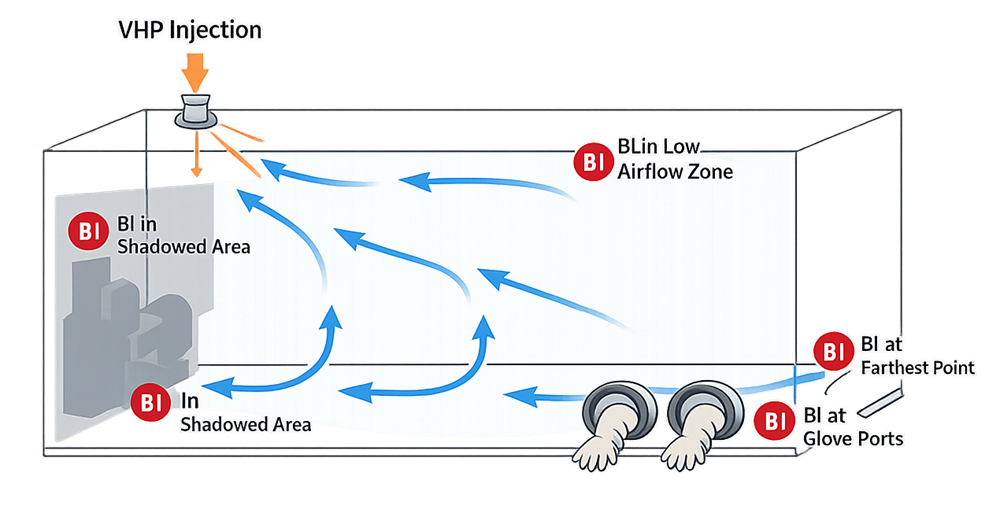
BI locations should be based on cycle-development evidence and documented risk assessment. Representative locations may include:
- Areas receiving the lowest measured agent exposure
- Locations farthest from agent introduction
- Supply or return-air interfaces
- Glove fingertips, cuffs, and sleeve interfaces
- Door and gasket interfaces exposed during the cycle
- Rapid transfer port surfaces
- Areas behind or beneath installed equipment
- Difficult-to-access corners
- Representative surfaces of different materials
- Locations affected by heat or agent absorption
A difficult location must still be part of the intended exposure boundary. Placing a BI inside a sealed, impermeable, or deliberately excluded space does not represent a meaningful challenge to a surface bio-decontamination process.
The FDA recommends justified BI placement throughout the isolator, including difficult-to-reach locations and representative materials. Its aseptic processing guidance indicates that a four- to six-log reduction may be justified depending on the application. Therefore, a six-log challenge should not be presented as a universal requirement for every barrier application.
The selected lethality target should reflect:
- Intended use of the enclosure
- Incoming bioburden controls
- Transfer process
- Material exposure
- Regulatory expectations
- Cycle capability
- Required process margin
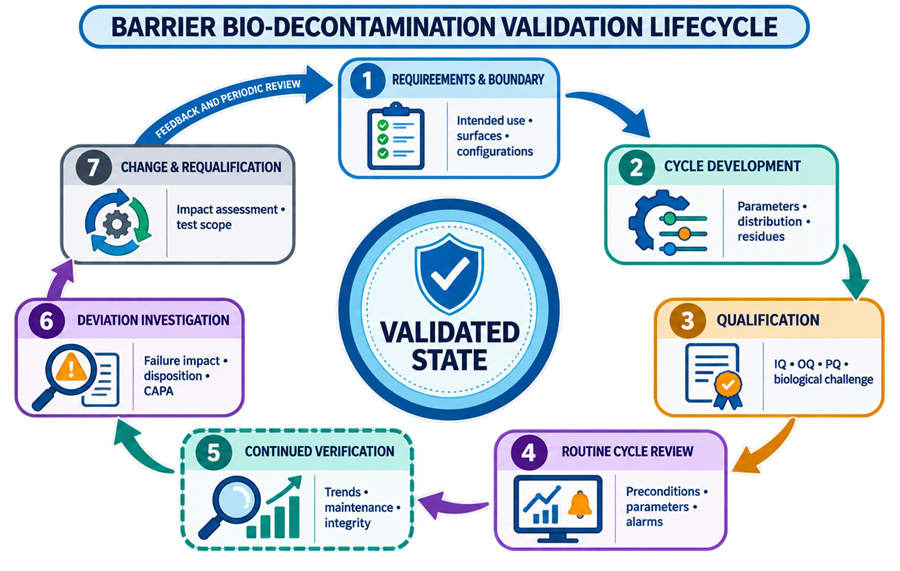
Qualification lifecycle
Organizations may assign individual studies to OQ or PQ differently. The validation package should clearly show where each requirement was tested and how the evidence collectively establishes the validated state.
User requirements and design qualification
The user requirements specification and design qualification should address:
- Intended microbiological outcome
- Barrier and cycle boundary
- Agent-delivery technology
- Cleaning requirements
- Permitted configurations
- Material compatibility
- Agent distribution
- Aeration capacity
- Residual monitoring
- Cycle-control architecture
- Alarm and interlock requirements
- Electronic records
- Calibration
- Maintenance access
- Occupational and environmental safety
Design review should confirm that internal surfaces can be cleaned and exposed to the selected agent. Permanent obstructions, inaccessible recesses, poorly positioned injection points, and surfaces that cannot tolerate repeated exposure should be resolved during design rather than accepted as routine validation exceptions.
Installation qualification
Installation qualification should verify the installed system against approved drawings and specifications.
The scope normally includes:
- Agent generator
- Injection and distribution components
- Circulation fans
- Supply and return pathways
- Dampers and valves
- Aeration and exhaust systems
- Catalysts, where installed
- Temperature, humidity, pressure, and concentration sensors
- Control panel and software version
- Recipe configuration
- Utilities
- Instrument identification and calibration
- Data storage and report generation
- Materials of construction
- Safety controls
Deviations between the installed system and approved design should be resolved or formally assessed before cycle qualification.
Operational qualification and cycle development
Operational qualification should demonstrate functional operation across the proposed operating range and challenge the controls needed to execute a valid cycle.
Testing may include:
- Cycle phase sequencing
- Parameter control
- Sensor response
- Alarm and interlock verification
- Incorrect configuration detection
- Cycle abort
- Loss of power
- Communication failure
- Sensor failure
- Generator fault
- Exhaust or aeration failure
- Unauthorized recipe modification
- Data capture and report accuracy
- Recovery after an interrupted cycle
Distribution mapping and biological development studies may be executed during OQ, PQ, or a dedicated cycle-development stage. The validation plan should define the chosen structure.
Performance qualification
Performance qualification confirms that the finalized cycle performs reproducibly in the defined routine or justified worst-case configuration.
PQ should include:
- Approved load and equipment configuration
- Verified cleaning and cycle preconditions
- Justified BI locations
- Qualified BI lots
- Chemical indicators when used
- Recorded critical process parameters
- Defined aeration endpoint
- Cycle acceptance criteria
- Investigation requirements
- A predefined number of successful cycles
Three consecutive successful cycles are common practice, but the number of cycles should be justified based on process variability, development evidence, regulatory expectations, and the intended use of the system.
Successful BI results alone do not demonstrate an acceptable cycle if critical parameters were outside their validated ranges. Likewise, parameter compliance does not automatically override an unexplained positive BI.
Aeration and residual acceptance
Aeration must reduce the agent to a predefined endpoint suitable for the next activity.
Acceptance criteria should consider:
- Potential product exposure
- Material compatibility
- Operator exposure
- Environmental discharge
- Sensor capability
- Sampling location
- Time between cycle completion and processing
A generic residual value should not be copied from another system without evaluating its intended use and measurement method.
Residual studies should identify locations with slowest removal and evaluate representative worst-case configurations. Adsorbent materials, elastomers, filters, gloves, tubing, and enclosed equipment can extend aeration time.
The routine cycle should not be released merely because the programmed aeration time elapsed. Cycle acceptance should confirm that the validated endpoint or validated endpoint logic was satisfied.
Routine cycle execution and acceptance
Each routine cycle should be executed under an approved procedure using a controlled recipe.
Before initiation, the operator should verify:
- Cleaning status
- Correct configuration
- Glove and sleeve position
- Door and transfer-port position
- Equipment readiness
- Instrument calibration status
- Availability of agent
- Absence of unresolved alarms
- Correct recipe and version
Cycle review should confirm:
- Cycle identity
- Date and time
- Operator or initiating user
- Recipe name and version
- Completion of every required phase
- Compliance with critical parameter limits
- Alarm and event history
- Cycle interruptions
- Aeration endpoint
- Electronic record completeness
- Quality-unit disposition when required
Routine cycle acceptance may be based on the recorded critical parameters when the relationship between those parameters and cycle performance has been established. This should not be confused with regulatory parametric release of finished product.
Routine BIs are not necessarily required in every cycle. Their frequency should be defined by the site’s validation and continued-verification strategy.
Maintaining the bio-decontaminated state
A successful cycle establishes the required microbiological condition only at the time and under the conditions represented by validation. Subsequent controls must maintain that state. The control strategy should address:
- Barrier pressure and airflow
- Glove and sleeve integrity
- Transfer-port operation
- Door opening
- Material transfers
- Intervention controls
- Maximum post-cycle hold time
- Maximum campaign duration
- Environmental monitoring
- Maintenance and calibration
- Response to barrier-integrity loss
The justified interval between bio-decontamination cycles should consider campaign duration, interventions, transfers, environmental data, integrity history, and the ability of the system to maintain controlled conditions.
A loss of pressure, glove breach, failed transfer, door opening, power interruption, or other integrity event does not automatically have the same consequence in every design. The event must be investigated using predefined decision criteria.
Related controls are discussed in Isolator Systems: Design, Qualification, and Lifecycle Control, Restricted Access Barrier Systems: Design and Qualification, and Barrier Glove Integrity Qualification and Lifecycle Control.
Cycle failures and investigation
A cycle should be considered potentially invalid when predefined acceptance criteria are not satisfied. Examples include:
- Critical parameter outside its validated range
- Incomplete exposure phase
- Incorrect load configuration
- Incorrect glove position
- Agent-delivery failure
- Unexplained concentration anomaly
- Temperature or humidity excursion
- Sensor malfunction
- Aeration failure
- Missing electronic data
- Unresolved critical alarm
- Positive BI
- Missing or compromised BI
- Unexpected chemical-indicator result
The affected enclosure and any potentially affected materials should be placed under controlled status while the event is evaluated.
The investigation should determine:
- Whether the cycle record is complete
- Whether the correct recipe was used
- Whether preconditions were satisfied
- Whether the BI was correctly manufactured, stored, placed, recovered, and incubated
- Whether positive controls performed as expected
- Whether physical data support adequate distribution
- Whether a hardware, software, utility, or operator failure occurred
- Whether the event affects previous cycles
- Whether product or sterile materials were exposed to risk
- Whether cleaning and repeat bio-decontamination are required
- Whether requalification is necessary
A failed cycle should not be invalidated solely because a repeat cycle passed. Repetition may restore the enclosure only after the original failure has been assessed and the repeat cycle has been scientifically and procedurally justified.
Continued process verification and trending
Routine data should be reviewed for evidence of drift even when individual cycles meet their acceptance criteria. Useful trending parameters include:
- Injection mass and duration
- Agent concentration
- Exposure time
- Temperature and humidity
- Conditioning time
- Aeration time
- Residual concentration
- Total cycle duration
- Alarm frequency
- Aborted cycles
- BI and chemical-indicator results
- Sensor calibration adjustments
- Generator maintenance
- Configuration-specific performance
A gradual increase in aeration time, conditioning time, or injection demand may indicate deterioration in catalyst performance, enclosure leakage, changing material load, sensor drift, or ventilation problems.
Cycle trends should be reviewed with environmental monitoring, barrier-integrity, maintenance, and deviation data rather than as an isolated equipment report.
Change control and requalification
Changes that can affect distribution, lethality, or residual removal require documented validation impact assessment. Examples include:
- Generator replacement or modification
- Injection nozzle changes
- Fan, damper, or airflow changes
- Exhaust or catalyst modification
- Sensor replacement or relocation
- Control-system or recipe change
- Enclosure geometry change
- Addition or removal of equipment
- New load configuration
- New surface or glove material
- Transfer-port modification
- Cleaning-agent change
- Sporicidal-agent change
- Modified exposure or aeration parameters
- Room HVAC or pressure change
- Repeated cycle deviations
- Extended campaign duration
The assessment should determine whether the change requires document revision, engineering studies, mapping, targeted biological challenge, partial requalification, or full PQ repetition.
Risk-based requalification should combine periodic review with event-driven evaluation. A calendar interval remains useful, but the requalification scope should reflect system performance, change history, deviations, maintenance, configuration use, and regulatory commitments.
Common validation deficiencies
Common deficiencies include:
- Treating bio-decontamination as equivalent to product-contact sterilization
- Applying isolator requirements to all RABS designs
- Failing to define the cycle boundary
- Qualifying only an empty enclosure
- Using unsupported “worst-case” configurations
- Selecting BI locations without development evidence
- Deliberately placing BIs outside the exposure boundary
- Assuming every application requires the same log-reduction target
- Using chemical indicators as substitutes for biological evidence
- Failing to control glove position
- Ignoring cleaning and residue removal
- Using only programmed phase times as acceptance criteria
- Applying an unjustified generic residual limit
- Reviewing only the final “cycle complete” message
- Repeating a failed cycle without investigating the original failure
- Failing to assess equipment and software changes
- Performing periodic BI studies without reviewing routine cycle trends
Conclusion
Barrier-system bio-decontamination validation must demonstrate more than sporicidal-agent delivery. It must establish a defined exposure boundary, controlled preconditions, justified configurations, reproducible distribution, appropriate microbiological effectiveness, and acceptable residual removal.
The validated state is maintained through controlled routine execution, complete cycle-record review, barrier-integrity controls, continued performance trending, deviation investigation, change control, and risk-based requalification.
A robust program distinguishes enclosure bio-decontamination from product-contact sterilization and applies requirements appropriate to the actual isolator or RABS design.