

Fill Line Qualification Lifecycle
Aseptic fill-line qualification provides documented evidence that the installed system is suitable for its intended use, operates within defined limits, protects exposed sterile product and components, and performs reproducibly under representative manufacturing conditions.
The qualification boundary extends beyond mechanical filling accuracy. It includes the integrated functions that can affect sterility assurance, product quality, container closure, data integrity, and batch disposition.
Depending on the line architecture, the qualification scope may include:
- Container introduction and transport
- Sterile product pathway
- Pumps, manifolds, tubing, and filling needles
- Filling-volume control
- Stopper and closure handling
- Capping or crimping
- In-process inspection
- Container tracking and rejection
- Barrier-system interfaces
- Critical-zone airflow interaction
- Lyophilizer loading and unloading interfaces
- Automation and electronic records
- Utilities and supporting systems
Qualification of the filling equipment does not replace qualification of the isolator, RABS, sterilizing-grade filtration process, component preparation, environmental-control systems, or aseptic process simulation. The validation plan should define these boundaries and explain how the separate evidence packages support release of the integrated aseptic filling process.
Qualification lifecycle position
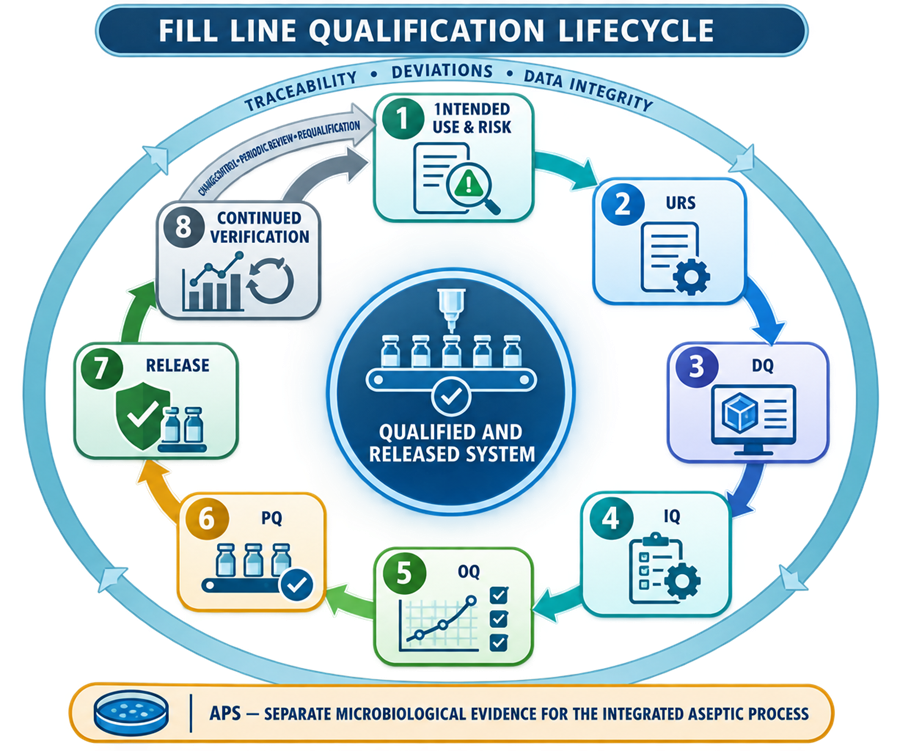
Fill-line qualification should follow a planned lifecycle rather than a collection of unrelated vendor tests.
The lifecycle normally includes:
- Intended-use and boundary definition
- User requirements
- Quality-risk assessment
- Design qualification
- Supplier and commissioning testing
- Installation qualification
- Operational qualification
- Performance qualification
- Integrated readiness and release
- Continued verification
- Change control
- Periodic review and requalification
Risk assessment, requirements traceability, deviation management, and change control apply across the lifecycle. They should not be treated as activities performed only after PQ.
Qualification boundaries and supporting systems
The fill line operates as part of an integrated aseptic manufacturing system. The validation plan should identify which elements are included in the fill-line qualification and which are covered by separate qualification or validation packages. Typical supporting systems include:
- Barrier enclosure
- HVAC and HEPA-filtered airflow
- Barrier gloves and sleeves
- Barrier bio-decontamination
- Depyrogenation tunnel
- Component washers and sterilizers
- Product-filtration system
- Clean utilities
- Lyophilizer
- Environmental-monitoring systems
- Computerized systems
- Inspection equipment
- Container closure integrity methods
A separate qualification package does not eliminate the need to test the interface. For example, a depyrogenation tunnel can be qualified independently, but transfer of depyrogenated containers into the filling line still requires verification. Similarly, an isolator may have its own qualification, but the filling machine’s effect on critical-zone airflow must be evaluated in the installed operating configuration.
Validation planning and risk assessment
The validation plan should establish:
- System boundaries
- Intended products and container formats
- Filling technologies
- Reusable and single-use product pathways
- Critical product and process attributes
- Critical zones
- Direct and indirect product-contact parts
- Barrier-system interfaces
- Qualification stages
- Supplier-document use
- Commissioning-document use
- Protocol responsibilities
- Acceptance and release requirements
- Deviation-management process
- Traceability method
- Requalification strategy
The quality-risk assessment should identify how equipment or control failures could affect:
- Sterile product exposure
- Filling accuracy
- Container quality
- Stopper placement
- Closure integrity
- Particle generation
- Product-contact-path integrity
- Container tracking
- Rejection
- Electronic records
- Batch reconciliation
Risk controls should be traced to design features, operating procedures, alarms, interlocks, qualification tests, or continued-verification activities.
A high-risk function generally requires more direct and challenging verification than a function that has limited potential to affect product quality. Risk ranking should not be used to eliminate testing required to demonstrate intended use or regulatory compliance.
User requirements specification
The user requirements specification defines what the filling line must do and the conditions under which it must perform.
Requirements should be measurable and testable.
Process and capacity requirements
The URS should define, as applicable:
- Product types and characteristics
- Container formats and sizes
- Closure configurations
- Fill-volume ranges
- Accuracy or weight-control requirements
- Minimum and maximum line speeds
- Batch-size or campaign requirements
- Product hold-time constraints
- Liquid and lyophilized-product configurations
- Changeover requirements
- Planned operating modes
Sterility-assurance requirements
Requirements should address:
- Critical exposure zones
- Barrier-system configuration
- First-air protection
- Product-contact sterilization
- Component sterilization and transfer
- Bio-decontamination or sporicidal disinfection
- Aseptic assembly
- Intervention access
- Environmental-monitoring provisions
- Glove-port locations
- Material-transfer systems
- Open-container accumulation
Mechanical and inspection requirements
Requirements may include:
- Container handling
- Needle positioning
- Filling-pump performance
- Stopper orientation and placement
- Stopper-height detection
- Cap presence and crimping
- Container inspection
- Reject confirmation
- Container reconciliation
- Line clearance
- Broken-container management
Automation and data requirements
The URS should identify:
- User roles
- Recipe management
- Parameter limits
- Alarm handling
- Interlocks
- Manual-mode controls
- Bypass controls
- Container tracking
- Audit trails
- Electronic records
- Batch reporting
- Data retention
- Backup and recovery
- External interfaces
Requirements such as “accurate filling,” “reliable rejection,” or “adequate airflow” should be replaced by defined performance criteria or linked specifications.
Design qualification
Design qualification demonstrates that the proposed design is suitable for the intended use and adequately addresses identified risks.
DQ should evaluate the complete installed concept rather than reviewing only the filling-machine vendor’s standard design.
Mechanical and process design
Review should address:
- Line configuration
- Container flow
- Filling technology
- Filling range
- Pump and needle arrangement
- Product-path design
- Component feeding
- Stopper placement
- Capping or crimping
- Inspection and rejection
- Change parts
- Maintenance access
- Equipment cleanability
Aseptic design
The design review should confirm:
- Identification of critical zones
- First-air protection
- Separation of exposed product from particle-generating mechanisms
- Barrier integration
- Glove reach and intervention access
- Material and component transfer
- Product-contact sterilization
- Barrier cleaning and bio-decontamination
- Environmental-monitoring access
- Protected open-container travel
- Lyophilizer transfer, where applicable
Airflow suitability cannot be confirmed from drawings alone. However, DQ should identify likely airflow obstructions and define the operating configurations and interventions that will require later visualization.
Failure and recovery design
The design should define the intended response to:
- Container jams
- Needle collisions
- Pump failure
- Missing stoppers
- Closure-feed failure
- Reject-system failure
- Loss of barrier pressure
- Loss of critical airflow
- Power interruption
- Communication failure
- Sensor failure
- Extended stoppage
The design should identify which failures require an immediate stop, which functions must remain operational, and what information is necessary to assess potentially affected units.
Automation design
Automation review should address:
- Hardware and software architecture
- Recipe structure
- Critical parameter control
- Alarm philosophy
- Interlocks
- Manual and maintenance modes
- User access
- Container tracking
- Reject logic
- Data flow
- Time synchronization
- Interfaces
- Electronic batch records
- Backup and recovery
DQ approval should document unresolved risks, required design changes, and conditions that must be verified during later qualification.
Supplier and commissioning documentation
Supplier testing and commissioning can provide useful evidence when it is planned, documented, reviewed, and traceable to approved requirements.
Potentially leveraged activities include:
- Factory acceptance testing
- Site acceptance testing
- Mechanical checkout
- Instrument-loop checks
- Motor and drive testing
- Software module testing
- Utility verification
- Container-transport trials
- Filling-pump setup
- Preliminary alarm testing
- Preliminary airflow evaluation
Supplier documentation should be assessed for:
- Approved procedures
- Defined acceptance criteria
- Instrument calibration
- Test configuration
- Raw-data availability
- Deviations
- Traceability
- Change control
- Reviewer independence
Factory or commissioning tests do not automatically replace qualification. Testing performed before final installation may not represent the installed equipment, final software, production barrier, utilities, change parts, or operating environment.
Installation qualification
Installation qualification confirms that the filling line and its supporting components are installed in accordance with approved design documents and specifications.
IQ should verify, as applicable:
- Equipment identification
- Manufacturer, model, and serial numbers
- Installed modules
- Container-transport equipment
- Filling pumps
- Product vessels and manifolds
- Filling needles
- Stopper and cap feeders
- Inspection and reject devices
- Barrier interfaces
- Utilities
- Instruments
- Control panels
- Network connections
- Safety devices
- Materials of construction
- Lubricants
- Product-contact components
- Change parts
- Spare parts
Documentation verification
Documentation may include:
- Approved drawings
- Piping and instrumentation diagrams
- Electrical drawings
- Instrument lists
- Software and hardware inventories
- Bills of material
- Product-contact material certificates
- Surface-finish documentation
- Filter certificates
- Welding records
- Equipment manuals
- Calibration certificates
- Preventive-maintenance recommendations
- Spare-parts lists
Product-path verification
IQ should confirm the installed product pathway against approved drawings and assembly specifications.
Verification may include:
- Component identity
- Tubing and piping routes
- Sterile-filter location and orientation
- Pump configuration
- Manifold arrangement
- Needle identification
- Connections
- Gaskets and seals
- Drain and vent points
- Sampling points
- Flow direction
- Assembly labels
For single-use systems, IQ should distinguish permanent machine installation from batch-specific disposable assembly verification.
Instrumentation and calibration
Instruments used to control, monitor, or demonstrate critical functions should be identified and calibrated before OQ.
These may include:
- Load cells
- Balances
- Flow meters
- Pressure sensors
- Temperature sensors
- Vacuum sensors
- Position sensors
- Servo encoders
- Force sensors
- Vision systems
- Stopper-height sensors
- Particle counters
- Barrier-pressure instruments
IQ completion should confirm readiness for functional challenge testing rather than attempting to demonstrate operational performance.
Operational qualification
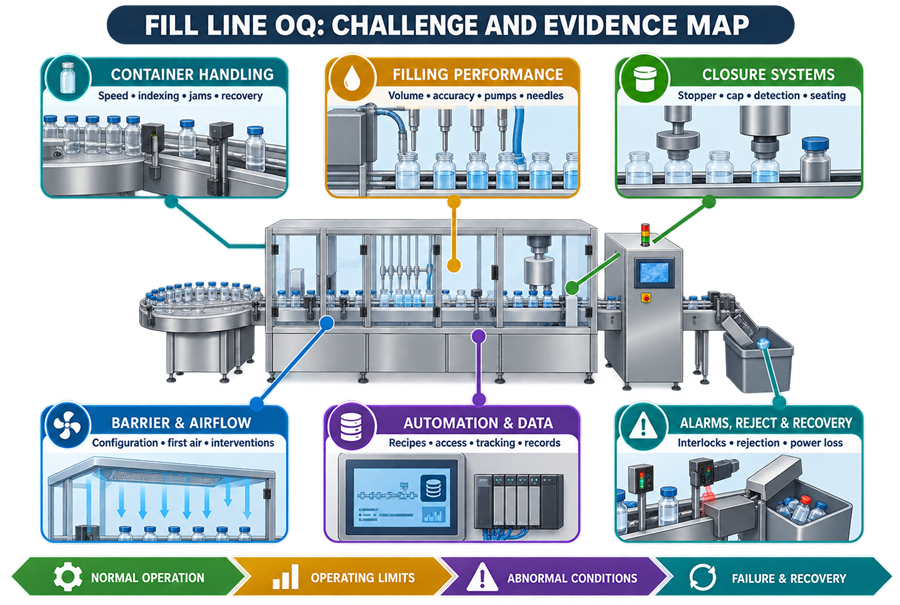
Operational qualification demonstrates that the installed line performs its intended functions throughout defined operating ranges and responds appropriately to abnormal and failure conditions.
OQ should evaluate normal, boundary, challenge, and failure conditions.
Container handling
Testing should challenge:
- Minimum and maximum line speeds
- Container spacing
- Accumulation
- Start and stop sequences
- Empty-container detection
- Container tipping
- Container jams
- Format-change setup
- Incorrect or missing change parts
- Container tracking
- Recovery following stoppage
Maximum speed is not necessarily the only worst case. Lower speed may create longer product exposure, while higher speed may challenge alignment, rejection, or filling accuracy.
Filling-system performance
Testing should cover applicable combinations of:
- Minimum and maximum fill volumes
- Container sizes
- Pump types
- Pump channels
- Needle configurations
- Product or representative fluid properties
- Product-head or bag-level conditions
- Line speeds
- Filling duration
- Start-up and end-of-run conditions
Performance characteristics may include:
- Accuracy
- Precision
- Repeatability
- Pump-to-pump variability
- Needle-to-needle variability
- Dripping
- Splashing
- Foaming
- Air bubbles
- Product recovery
- Hold-up volume
- Filling adjustment
Representative fluids should be selected based on relevant characteristics such as viscosity, surface tension, density, and foaming tendency. Water should not automatically be assumed to represent every product.
Needle positioning and collision control
OQ should verify:
- Vertical and horizontal positioning
- Insertion depth
- Movement profile
- Bottom-up filling sequence
- Synchronization with containers
- Position sensors
- Travel limits
- Collision detection
- Safe response to misalignment
- Recovery following a detected collision
Stoppering and closure handling
Testing should address:
- Stopper transfer
- Stopper orientation
- Feed-rate capability
- Low-stopper conditions
- Missing stopper
- Stopper placement
- Stopper height
- Partial stoppering where applicable
- Stopper rebound or displacement
- Cap feeding
- Cap presence
- Capping or crimping
- Closure-defect detection
Detailed qualification principles are addressed in Stoppering, Capping, and Sealing System Qualification.
Inspection and rejection
Reject-system testing should demonstrate:
- Detection of defined defects
- Association of the defect with the correct container
- Tracking through the line
- Physical rejection
- Reject confirmation
- Secure reject collection
- Prevention of rejected-unit reentry
- Alarm generation
- Reject-count accuracy
- Batch reconciliation
Challenges should be conducted across relevant line speeds and container positions. A reject command without evidence that the intended unit was physically removed does not fully demonstrate reject-system effectiveness.
Alarms and interlocks
OQ should challenge alarms and interlocks associated with:
- Incorrect recipe
- Missing change parts
- Product pressure
- Product level
- Pump fault
- Fill-volume deviation
- Needle position
- Container jam
- Missing stopper
- Stopper height
- Cap presence
- Reject failure
- Barrier pressure
- Door or glove-port status
- Airflow failure
- Utility interruption
- Communication failure
- Sensor failure
The test should confirm:
- Detection
- Alarm message
- Alarm priority
- Equipment response
- Data recording
- Operator acknowledgement
- Recovery
- Reset authorization
Power loss and recovery
Testing should determine what happens to:
- Open containers
- Partially filled containers
- Containers awaiting stoppering
- Product pumps
- Sterile product pressure
- Container tracking
- Reject records
- Barrier airflow
- Batch data
- Time-dependent sequences
Recovery should not permit unassessed containers to rejoin the acceptable batch.
Barrier and airflow interfaces
Fill-line qualification should confirm that the final mechanical configuration is compatible with the qualified barrier system.
Integrated testing should address:
- Machine position
- Installed change parts
- Filling needles
- Stopper bowls and tracks
- Glove position
- Environmental-monitoring equipment
- Interventions
- Doors and transfer ports
- Operating speeds
- Equipment motion
Airflow visualization should demonstrate protection of exposed product, containers, closures, and critical surfaces under representative operating conditions.
Qualification of the barrier itself remains within the applicable isolator or RABS package.
Computerized-system functions
Functions affecting product quality, sterility assurance, or batch disposition should be tested using a risk-based computerized-system approach. Testing may include:
- User access
- Recipe creation and approval
- Parameter limits
- Unauthorized changes
- Audit trails
- Alarm history
- Manual mode
- Maintenance mode
- Bypass control
- Container tracking
- Reject records
- Batch reports
- Data retention
- Backup and restoration
- Interfaces
- Time synchronization
Electronic records should be evaluated for applicable 21 CFR Part 11 controls.
Performance qualification
Performance qualification demonstrates that the qualified line performs reproducibly in its intended integrated operating configuration.
The distinction between equipment PQ, process performance qualification, and aseptic process simulation should be defined in the validation plan. These activities may support one another, but they do not have identical objectives.
Fill-line PQ may evaluate:
- Approved production configuration
- Representative container and closure formats
- Defined filling assemblies
- Routine operators
- Normal operating speeds
- Routine start-up and shutdown
- Filling accuracy
- Container handling
- Stopper and cap placement
- In-process inspection
- Reject performance
- Batch reporting
- Barrier-system operation
- Utility performance
- Defined interventions
The number of PQ runs should be predefined and justified. Three runs are common practice, but a fixed number should not be applied without considering equipment complexity, configuration families, prior development, variability, and the relationship to product-specific process qualification.
Configuration matrix
PQ should define which configurations are directly tested and which are represented through grouping.
Potential variables include:
- Container size
- Container material
- Closure type
- Fill volume
- Pump type
- Tubing size
- Needle size
- Number of filling heads
- Line speed
- Barrier configuration
- Lyophilized versus liquid product
- Single-use versus reusable pathway
A configuration should not be declared worst case solely because it uses the highest speed or largest fill volume. Different configurations can represent different risks.
Acceptance criteria
PQ acceptance criteria may include:
- Fill accuracy and variability
- Container throughput
- Stopper-placement performance
- Closure performance
- Reject accuracy
- Alarm frequency
- Intervention frequency
- Yield
- Reconciliation
- Electronic-record completeness
- Absence of unexplained critical deviations
PQ should not be accepted based on overall yield if individual critical functions failed.
Relationship to aseptic process simulation
Media fill and aseptic process simulation evaluates the microbiological capability of the integrated aseptic process. It is not a substitute for mechanical, functional, computerized-system, or barrier qualification.
APS should normally be executed only after the line, barrier, sterilization processes, component pathways, environmental controls, and operating procedures are sufficiently qualified for representative aseptic operation.
Fill-line qualification provides inputs to APS design, including:
- Line speeds
- Operating duration
- Container formats
- Aseptic assembly
- Inherent interventions
- Corrective interventions
- Line stoppages
- Component replenishment
- Shift changes
- Lyophilizer transfer
- Reject and reconciliation procedures
A mechanically successful line can still fail to demonstrate microbiological process control. Conversely, a successful media fill does not justify unresolved mechanical or data-integrity deficiencies.
Environmental monitoring relationship
Fill-line qualification should confirm that monitoring devices can be positioned and operated without compromising critical-zone protection or interfering with equipment operation.
The design and qualification should address:
- Nonviable particle probe location
- Viable air-sampling location
- Surface-sampling access
- Sampling-tubing routes
- Probe orientation
- Equipment and glove interference
- Monitoring during interventions
- Data interfaces
- Alarm handling
Routine program design and trending are addressed in Environmental Monitoring for Aseptic Filling.
Prerequisites for release
Completion of IQ, OQ, and PQ does not automatically authorize routine aseptic production. Release should be based on an integrated readiness assessment.
Applicable prerequisites may include:
- Approved qualification reports
- Closed or formally accepted deviations
- Requirements traceability
- Approved calibration program
- Approved preventive-maintenance program
- Approved operating procedures
- Approved cleaning procedures
- Qualified product-contact sterilization
- Qualified component preparation and transfer
- Qualified barrier system
- Validated barrier bio-decontamination
- Qualified filtration and integrity-testing strategy
- Approved environmental-monitoring program
- Trained and qualified personnel
- Qualified computerized-system functions
- Successful APS
- Approved change-control baseline
- Quality-unit authorization
Conditional release should identify the outstanding item, associated risk, temporary controls, responsible owner, and expiration or closure requirement.
Continued verification
Continued verification provides evidence that the qualified line remains in control during routine use.
Useful data include:
- Filling accuracy and variability
- Pump or channel adjustments
- Reject rates
- Reject reasons
- Stopper-placement defects
- Capping or crimping defects
- Container jams
- Needle collisions
- Line stoppages
- Intervention frequency and duration
- Alarm trends
- Barrier-pressure events
- Environmental-monitoring trends
- Glove-integrity results
- Calibration history
- Maintenance history
- Replaced parts
- Software changes
- APS results
- Deviations and investigations
Trends should be reviewed together. An increase in reject rate, interventions, mechanical adjustments, and environmental excursions may indicate a developing problem even when each individual result remains within its specified limit.
Deviations during qualification
Qualification deviations should document:
- Requirement or test affected
- Observed result
- Immediate containment
- Technical investigation
- Root cause, where determinable
- Product or validation impact
- Corrective action
- Retesting rationale
- Traceability impact
- Final disposition
Repeating a failed test without investigating the original failure is not acceptable evidence of qualification.
Retesting should demonstrate correction of the identified condition. The assessment should determine whether previously completed tests, related configurations, or other qualification stages are affected.
Change control
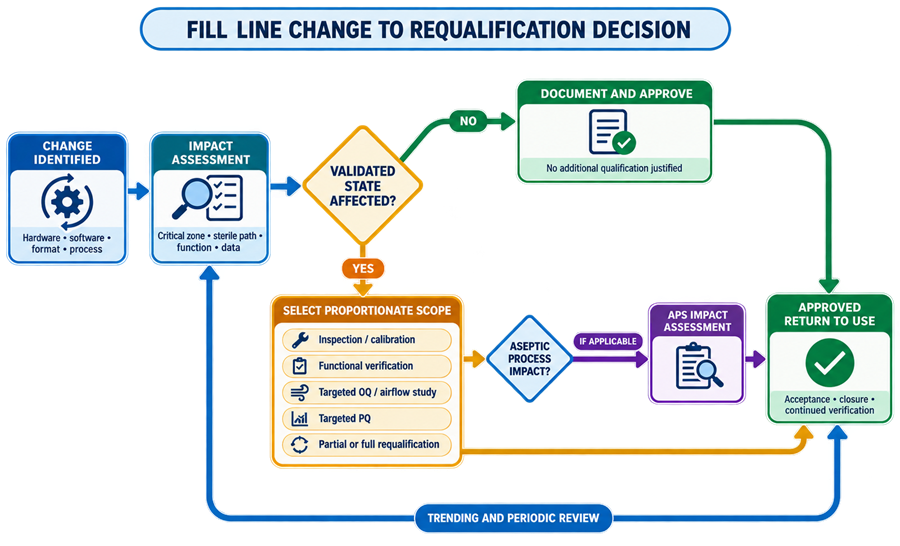
Changes should be assessed for their effect on:
- Intended use
- Qualified operating ranges
- Sterile product pathway
- Critical zones
- Airflow
- Barrier integrity
- Container handling
- Filling performance
- Stopper and closure control
- Inspection and rejection
- Automation
- Electronic records
- Environmental monitoring
- APS representation
Potentially significant changes include:
- New product or container format
- New fill-volume range
- Increased or reduced line speed
- New pump or filling technology
- New tubing or needle configuration
- Product-path modification
- Change-part redesign
- Stopper or cap change
- Reject-system modification
- Sensor replacement with a different design
- Software or recipe change
- Barrier modification
- Glove-port relocation
- HEPA or airflow modification
- Lyophilizer-interface change
- Extended campaign duration
The impact assessment should select the required response rather than assigning every change to the same qualification category.
Possible responses include:
- Documentation update
- Inspection
- Calibration
- Functional verification
- Targeted OQ
- Airflow visualization
- Targeted PQ
- APS assessment
- Partial requalification
- Comprehensive requalification
Periodic review and requalification
Periodic review should evaluate whether the qualification basis remains current and whether accumulated changes, failures, maintenance, or trends require additional testing.
Review inputs may include:
- Qualification status
- Change history
- Deviation history
- Alarm trends
- Maintenance
- Calibration
- Replaced components
- Software versions
- Access and audit-trail review
- Fill-performance trends
- Reject performance
- Environmental monitoring
- Barrier integrity
- APS results
- Product and configuration changes
- Obsolescence
- Supplier support
Risk-based requalification may be targeted or comprehensive.
Requalification scope should be based on the affected functions and supporting evidence. Calendar-based review remains necessary where required by procedures or the contamination-control strategy, but elapsed time alone should not determine the entire test scope.
Required lifecycle documentation
A complete qualification package should provide traceable evidence from intended use through continued operation.
The package may include:
- Validation plan
- System boundary
- URS
- Risk assessments
- Design review
- Supplier assessment
- FAT and SAT records
- Commissioning records
- IQ protocol and report
- OQ protocol and report
- PQ protocol and report
- Requirements traceability matrix
- Deviation records
- Calibration records
- Software configuration records
- Airflow-study references
- Barrier qualification references
- APS references
- Release authorization
- Change controls
- Periodic reviews
- Requalification records
Common qualification deficiencies
Common deficiencies include:
- Treating the filling machine as isolated equipment
- Failing to define qualification boundaries
- Using vague requirements
- Accepting vendor testing without assessment
- Repeating commissioning tests without a risk rationale
- Omitting minimum or low-speed conditions
- Treating maximum speed as the only worst case
- Testing fill accuracy at only one volume
- Failing to challenge reject confirmation
- Failing to test manual or maintenance modes
- Omitting power-loss recovery
- Testing automation without container tracking
- Qualifying the machine before final barrier installation
- Performing airflow studies without representative interventions
- Treating APS as a substitute for mechanical qualification
- Releasing the line with unresolved critical deviations
- Repeating failed tests without investigation
- Changing recipes or format parts without qualification assessment
- Performing periodic requalification without reviewing routine performance data
Conclusion
Fill-line qualification must demonstrate that the installed system functions as an integrated aseptic manufacturing platform rather than merely as an accurate liquid-dispensing machine.
The lifecycle begins with intended use, measurable requirements, risk assessment, and design evaluation. It progresses through installation verification, functional challenges, integrated performance qualification, and readiness assessment. The validated state is then maintained through routine performance review, maintenance, calibration, change control, periodic review, and risk-based requalification.
Mechanical performance, critical-zone protection, barrier interfaces, sterile pathways, closure handling, rejection, automation, electronic records, and failure recovery must collectively support reliable aseptic operation.