

Sterile Component Preparation and Transfer Qualification
Sterile component preparation and transfer qualification demonstrates that containers, closures, filling parts, single-use assemblies, tools, and other sterility-critical items are consistently prepared and introduced into the aseptic processing environment without compromising their required microbiological condition.
Sterility assurance does not begin at the filling needle. A component may be successfully sterilized or depyrogenated and subsequently compromised through damaged packaging, excessive hold time, incorrect staging, inadequate transfer disinfection, uncontrolled unwrapping, improper docking, or poor presentation within the critical zone.
The qualification strategy must therefore address the complete pathway from initial preparation through presentation at the point of use.
Purpose and scope
This article addresses qualification and lifecycle control of:
- Reusable product-contact parts
- Sterile containers
- Elastomeric closures
- Caps and seals, where applicable
- Filling needles and manifolds
- Transfer tubing and connectors
- Sterilizing-grade filters
- Single-use assemblies
- Sterile tools and utensils
- Environmental-monitoring accessories introduced into critical zones
- Component transfer containers
- Wrapped and double-wrapped assemblies
- Ready-to-use containers and closures
The scope includes:
- Component classification
- Cleaning and preparation
- Packaging and load configuration
- Sterilization and depyrogenation interfaces
- Post-process storage and hold time
- Transfer-route qualification
- Barrier-system introduction
- Presentation to the filling line
- Intervention control
- Release documentation
- Failure investigation
- Continued verification
- Change control and requalification
Detailed sterilization-cycle validation remains within the applicable sterilization article. This article focuses on how those validated processes are connected to the aseptic filling operation.
Component classification and intended use
Components should be classified according to their relationship to sterile product and the critical processing environment.
| Component category | Examples | Principal qualification concern |
|---|---|---|
| Direct product-contact components | Filling needles, pumps, manifolds, tubing, product filters | Cleaning, sterilization, assembly, integrity and sterile hold |
| Primary containers | Vials, syringes, cartridges, ampoules | Cleaning, depyrogenation or supplier preparation, protected transfer |
| Direct closure components | Stoppers, plungers, septa | Washing, rinsing, sterilization, drying, storage and feeding |
| Caps and seals | Aluminum caps, overseals and alternative seals | Clean or sterile pathway based on capping strategy |
| Indirect sterility-critical parts | Stopper bowls, tracks, guides, assembly tools | Cleaning, sterilization and protected installation |
| Single-use assemblies | Bags, tubing sets, filters, connectors and filling manifolds | Supplier qualification, sterilization, packaging, installation and integrity |
| Ancillary critical-zone items | Tools, monitoring equipment and replacement parts | Sterilization or qualified introduction process |
Not every item entering the filling-line enclosure has the same control requirements.
Direct product-contact components generally require a validated sterilization process and protection until use. Caps may be introduced through a clean or sterile pathway depending on the capping design. Tools or monitoring accessories may require sterilization when they contact critical surfaces or enter the critical zone.
The classification should define:
- Intended use
- Product-contact status
- Critical-surface status
- Required microbiological condition
- Endotoxin risk
- Preparation method
- Sterilization or depyrogenation method
- Packaging configuration
- Transfer route
- Hold-time requirements
- Release documentation
The validated component pathway
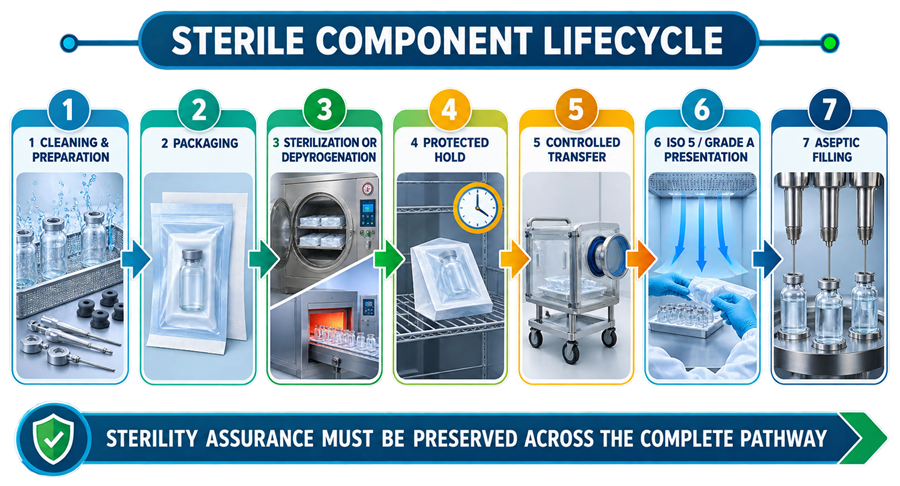
The component pathway should be treated as one controlled chain:
- Receipt and inspection
- Cleaning or supplier-prepared status
- Rinsing and drying
- Assembly or packaging
- Sterilization or depyrogenation
- Post-process cooling
- Sterile or protected hold
- Staging
- Transfer through controlled environments
- Removal of outer packaging
- Transfer through an airlock, rapid transfer port, tunnel, or chamber
- Presentation within the ISO 5 or Grade A critical zone
- Loading into the filling-line feed system
- Use during aseptic processing
Each step must preserve the status established by the preceding step.
A validated sterilization cycle does not compensate for an uncontrolled transfer route. Likewise, a well-designed transfer process cannot compensate for an inadequate preparation or sterilization process.
Requirements and qualification strategy
Qualification should begin with defined requirements rather than existing operating practices. Requirements should identify:
- Component types and materials
- Direct and indirect product-contact surfaces
- Required sterility or cleanliness condition
- Endotoxin requirements
- Cleaning and rinsing methods
- Required water quality
- Drying requirements
- Packaging configuration
- Sterilization or depyrogenation method
- Permitted load configurations
- Storage environment
- Maximum hold times
- Transfer routes
- Barrier interfaces
- Manual and automated interventions
- Traceability
- Release criteria
- Failure response
The validation plan should identify which activities are qualified under:
- Component preparation
- Cleaning validation
- Sterilization validation
- Depyrogenation validation
- Barrier qualification
- Transfer qualification
- Filling-line qualification
- Aseptic process simulation
Separate protocols may be used, but the evidence should collectively demonstrate control of the complete component pathway.
Risk assessment
The risk assessment should evaluate more than whether the component is sterile after processing. Relevant risk factors include:
- Direct product contact
- Surface complexity
- Material compatibility
- Endotoxin retention
- Cleaning difficulty
- Sterilant penetration
- Drying difficulty
- Packaging configuration
- Potential package damage
- Manual handling
- Transfer frequency
- Number of environmental transitions
- Exposure duration
- Barrier-entry method
- Intervention requirements
- Particle-generation potential
- Supplier dependence
- Maximum campaign duration
The assessment should identify both microbiological and mechanical failure modes.
Examples include:
- Inadequate washing
- Residual detergent
- Inadequate endotoxin removal
- Retained moisture
- Incorrect sterilizer load
- Wet or damaged wrapping
- Compromised ready-to-use packaging
- Exceeded sterile hold time
- Incorrect transfer disinfection
- Door-interlock failure
- Improper rapid-transfer-port docking
- Loss of first-air protection
- Dropped or contacted components
- Stopper-feed contamination
- Incorrect component lot
Risk controls should be linked to measurable qualification evidence.
Design qualification
Design qualification should confirm that the proposed preparation and transfer system can meet the defined requirements. The review should address:
- Component flow
- Segregation of dirty and clean operations
- Washer and sterilizer interfaces
- Packaging and wrapping areas
- Load preparation
- Post-sterilization unloading
- Cooling
- Storage and staging
- Airlocks
- Transfer chambers
- Rapid transfer ports
- Barrier docking
- Unwrapping locations
- Operator access
- Environmental classification
- Waste and outer-wrap removal
- Component presentation at the filling line
The design should minimize unnecessary handling and environmental transitions.
Where possible, direct engineered transfers such as a depyrogenation tunnel connected to the filler, double-door sterilizer, rapid transfer port, or qualified transfer chamber reduce dependence on manual handling. These systems still require qualification of alignment, interlocks, airflow, docking, and operating sequences.
Cleaning and preparation of reusable components
Reusable product-contact and sterility-critical components should be cleaned before sterilization.
The cleaning-validation approach should address, as applicable:
- Product residues
- Cleaning-agent residues
- Lubricants
- Particulates
- Bioburden
- Endotoxin
- Rinse-water quality
- Drying
- Visual inspection
- Maximum precleaning hold
- Maximum clean hold
- Reassembly
Cleaning acceptance criteria should reflect the component’s intended use and subsequent processing.
Sterilization should not be treated as a replacement for cleaning. Residues can protect microorganisms, interfere with sterilant contact, affect product quality, or contribute to endotoxin risk.
Washing of containers
Container-washing qualification may evaluate:
- Container orientation
- Spray coverage
- Nozzle position
- Water pressure
- Rinse volume
- Water quality
- Sequence timing
- Air-blow performance
- Residual particulates
- Container damage
- Transfer to depyrogenation
For parenteral containers, the final preparation and depyrogenation strategy should provide appropriate control of endotoxin and particulate contamination.
Preparation of elastomeric closures
Closure preparation may include:
- Washing
- Multiple rinses
- Siliconization, where applicable
- Drying
- Sterilization
- Cooling
- Protected unloading
- Sterile storage
Qualification should assess:
- Rinse effectiveness
- Water quality
- Endotoxin removal
- Residual moisture
- Component deformation
- Load configuration
- Drying performance
- Maximum hold times
Excessive moisture after washing may support microbial proliferation before sterilization and can affect sterilization and component handling.
Single-use and ready-to-use components
For single-use systems and ready-to-use components, responsibility is shared between the supplier and the pharmaceutical manufacturer. The user should establish controls for:
- Supplier qualification
- Component specifications
- Material compatibility
- Sterilization method
- Sterilization validation
- Sterilization dose or cycle documentation
- Packaging configuration
- Package-integrity controls
- Transportation
- Storage
- Shelf life
- Incoming inspection
- Lot traceability
- Change notification
- Complaints and deviations
A supplier certificate does not independently demonstrate that the component remains suitable through receipt, storage, transfer, installation, and use.
The site qualification should include the processes under site control, particularly:
- Receipt
- Package inspection
- Storage
- Material staging
- Outer-bag removal
- Transfer disinfection
- Barrier introduction
- Aseptic installation
- Connection
- Leak or integrity testing
- Use duration
Packaging and load configuration
Packaging serves two functions:
- Permitting the sterilization process to reach the component
- Protecting the component after processing
Qualification should verify that the packaging system is compatible with the selected sterilization process and expected handling.
Potential packaging configurations include:
- Single wrapping
- Double wrapping
- Sterilization bags
- Rigid transfer containers
- Tyvek or equivalent breathable systems
- Lidded trays
- Closed stainless-steel containers
- Ready-to-use tubs and nests
Load development should define:
- Component quantity
- Orientation
- Assembly status
- Wrapping
- Container closure
- Density
- Maximum and minimum load
- Representative difficult-to-sterilize locations
- Drying requirements
- Cooling requirements
Changes in wrapping, density, assembly, or orientation can affect penetration, air removal, drying, and post-cycle protection.
Sterilization and depyrogenation interfaces
The preparation process should link each component to the appropriate validated treatment.
Dry-heat depyrogenation
Glass containers may be processed through a batch oven or continuous depyrogenation tunnel. Qualification should address:
- Loading or conveyor configuration
- Temperature distribution
- Heat penetration
- Belt speed
- Endotoxin challenge
- Cooling-zone protection
- Tunnel-to-filler transfer
- Response to interruption
Detailed requirements are addressed in Depyrogenation Equipment and Process Design and Depyrogenation Validation and Qualification.
Steam sterilization
Reusable product-contact components, tools, stopper assemblies, and other heat-stable materials may be steam sterilized. The validated process should define:
- Load family
- Load configuration
- Wrapping
- Air removal
- Exposure
- Heat penetration
- Biological challenge
- Drying
- Cooling
- Unloading
- Sterile hold
Detailed qualification principles are covered in Steam Sterilizer Qualification.
Radiation sterilization
Single-use assemblies and ready-to-use components may be sterilized by gamma irradiation or electron beam.
Site controls should verify:
- Approved supplier
- Product family
- Sterilization dose
- Maximum acceptable dose
- Material compatibility
- Sterilization lot
- Packaging
- Transportation
- Shelf life
- Supplier changes
Vapor-phase treatment
Vaporized hydrogen peroxide or another sporicidal agent may be used for qualified transfer chambers or exposed external surfaces.
A barrier bio-decontamination process should not automatically be assumed to sterilize:
- Closed component packaging
- Tubing interiors
- Covered surfaces
- Sealed interfaces
- Product-contact pathways
The treatment boundary and intended microbiological outcome must be defined. See Barrier System Bio-Decontamination Validation.
Post-process cooling and unloading
Sterile or depyrogenated components remain vulnerable during cooling and unloading. Qualification should assess:
- Cooling environment
- Airflow protection
- Door-opening sequence
- Unloading technique
- Contact surfaces
- Packaging condition
- Condensation
- Operator access
- Staging duration
A hot component should not be wrapped, closed, or transferred in a manner that produces condensation or damages its sterile barrier. For a continuous depyrogenation tunnel, cooling-zone airflow and the tunnel-to-filler interface form part of the protected transfer pathway.
Hold-time qualification
The component-control strategy may require several different hold times:
- Dirty hold before washing
- Clean hold after washing
- Maximum time between washing and sterilization
- Post-sterilization hold
- Post-depyrogenation hold
- Maximum time after removal of outer wrapping
- Maximum time after opening the sterile barrier
- Maximum open-component hold in the critical zone
- Maximum component-feed or campaign duration
These times should not be combined into one generic “sterile hold time.”
The qualification rationale should consider:
- Packaging integrity
- Storage conditions
- Environmental classification
- Component material
- Moisture
- Handling
- Transfer route
- Exposure state
- Supplier shelf life
- APS coverage
Sealed-package hold-time evidence may rely heavily on packaging qualification, integrity, storage, and sterilization evidence. Open-component hold in the critical zone requires different support, including airflow protection, operating controls, environmental monitoring, and APS representation.
Transfer-route types
Direct continuous transfer
Examples include:
- Depyrogenation tunnel to filler
- Connected washer-to-sterilizer system
- Enclosed conveyor
- Automated robotic transfer
Qualification should verify:
- Mechanical alignment
- Airflow
- Pressure relationships
- Transfer speed
- Interlocks
- Protection during stoppage
- Recovery after interruption
Double-door sterilizer transfer
A double-door sterilizer can separate the preparation side from the clean or aseptic unloading side. Qualification should verify:
- Door interlocks
- Cycle-status interlock
- Prevention of simultaneous opening
- Correct unloading side
- Environmental conditions
- Package protection
- Failure response
Wrapped-component transfer
Wrapped sterilized components may pass through staged environmental zones before entering the critical area. The procedure should define:
- Number of wraps
- Wrap-removal locations
- Surface disinfection
- Handling technique
- Maximum staging time
- Prevention of inner-wrap contact with lower-grade surfaces
- Waste removal
- Final presentation
Rapid transfer port
A rapid transfer port can introduce components into an isolator or closed barrier system while maintaining separation. Qualification should assess:
- Alpha and beta interface compatibility
- Docking alignment
- Rotation or locking sequence
- Door interlocks
- Seal condition
- Transfer-container integrity
- Operator technique
- Recovery from incomplete docking
- Cleaning and bio-decontamination status
Transfer chamber
A transfer chamber may use a validated gaseous or vapor-phase bio-decontamination cycle. Qualification should address:
- Load configuration
- Surface exposure
- Biological challenge
- Cycle parameters
- Aeration
- Residuals
- Door interlocks
- Transfer sequence
- Hold time following cycle completion
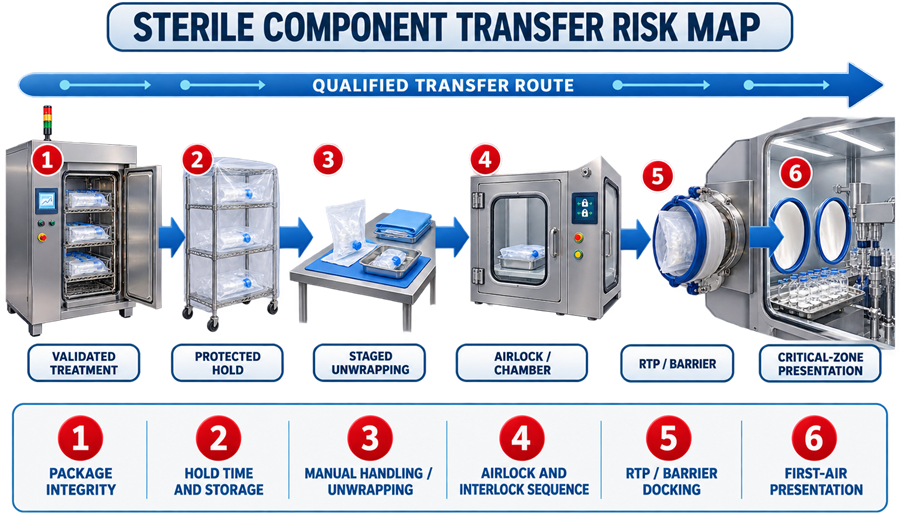
Sterile components may pass through several environmental and equipment interfaces before reaching the filling line. The following figure identifies representative points where packaging integrity, handling, airlock operation, barrier docking, or transfer sequencing can compromise the component’s qualified condition.
Qualification of the transfer process
Transfer qualification should demonstrate that the defined route and procedures reproducibly preserve the required component condition. The study should use the final or representative:
- Component
- Packaging configuration
- Transfer container
- Environmental route
- Airlock
- Barrier interface
- Operators
- Tools
- Disinfection method
- Hold time
- Operating sequence
Testing may include:
- Procedure observation
- Door and interlock challenges
- Airflow visualization
- Surface-disinfection studies
- Contact-time verification
- Transfer-container inspection
- Packaging-integrity verification
- Environmental monitoring
- Operator qualification
- APS representation
Sterility testing alone is not an adequate transfer-qualification strategy. A passing sterility test cannot demonstrate control of every handling step, surface, interface, or exposure event.
Installation qualification
Installation qualification should verify permanent equipment supporting preparation and transfer. The scope may include:
- Component washers
- Sterilizers
- Depyrogenation tunnels
- Transfer chambers
- Rapid transfer ports
- Airlocks
- Pass-throughs
- Conveyors
- Component-feed systems
- Barrier docking interfaces
- Environmental instruments
- Door interlocks
- Control systems
IQ should confirm:
- Equipment identification
- Installed configuration
- Materials
- Utilities
- Instruments
- Calibration
- Software versions
- Drawings
- Manuals
- Access and maintenance provisions
Operational qualification
OQ should challenge the functions needed to execute the component pathway. Testing may include:
- Washer cycles
- Rinse sequence
- Drying
- Load detection
- Door interlocks
- Transfer-chamber cycles
- Rapid-transfer-port operation
- Conveyor speed
- Tunnel interface
- Alarm functions
- Power interruption
- Sensor failure
- Incorrect sequence
- Recovery after aborted transfer
Operational challenges should include boundary and failure conditions, not only successful nominal operation.
Performance qualification
PQ should confirm reproducible performance using representative or justified worst-case components, loads, routes, and operators. PQ may include:
- Preparation cycles
- Packaging
- Sterilization or depyrogenation references
- Hold times
- Transfer routes
- Unwrapping
- Barrier docking
- Component loading
- Operator activities
- Required records
Terminology may vary between sites. Some transfer-performance evidence may be documented through integrated aseptic process qualification or APS. The validation plan should identify where each requirement is demonstrated.
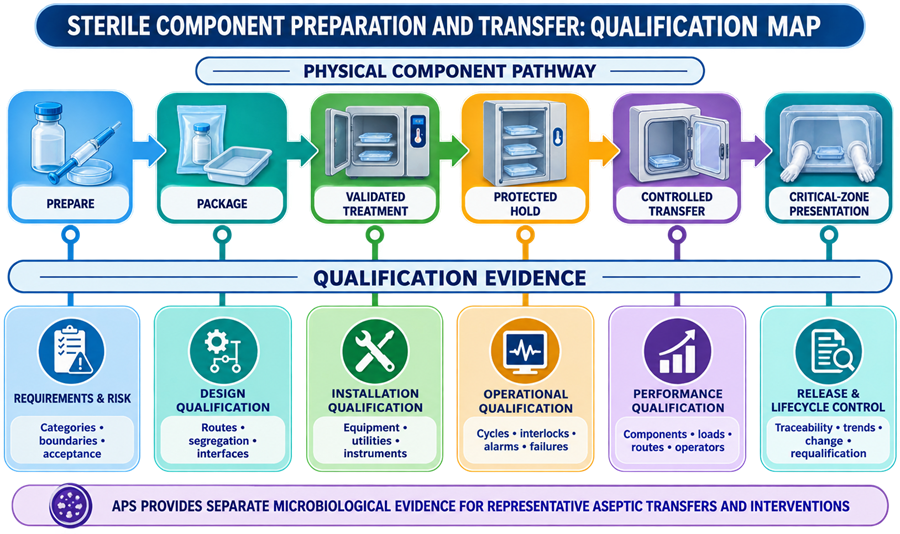
Qualification evidence must connect preparation, validated treatment, hold-time controls, transfer-system operation, critical-zone presentation, and routine lifecycle controls. The following map summarizes the evidence required across that pathway.
Presentation to the filling line
After entry into the critical zone, components must be presented without compromising first-air protection or contacting nonsterile surfaces. Examples include:
- Loading stoppers into a bowl
- Connecting sterile tubing
- Installing filling needles
- Mounting a sterile manifold
- Removing a tub lid
- Transferring a container nest
- Introducing tools
- Replenishing closures
Qualification and airflow visualization studies should evaluate:
- Operator or glove position
- Component position
- Unwrapping
- Transfer-container removal
- Equipment obstruction
- First-air protection
- Waste removal
- Recovery from dropped or misaligned components
Component feeding should not create unacceptable particle generation through abrasion, vibration, or component pile-up.
Interventions and APS
Component-related interventions may include:
- Stopper replenishment
- Cap replenishment
- Replacement of a sterile filling needle
- Adjustment of a component track
- Removal of a jam
- Introduction of a sterile tool
- Replacement of a single-use assembly
- Clearing a rapid transfer port
- Removing damaged containers
Each permitted intervention should define:
- Trigger
- Required tools
- Access point
- Aseptic technique
- Units to reject
- Cleaning or sanitization
- Recovery sequence
- Documentation
Representative interventions should be included in Media Fill and Aseptic Process Simulation. APS does not replace preparation, sterilization, transfer, or equipment qualification.
Routine release and traceability
Before a component is released for aseptic use, the record should confirm, as applicable:
- Component identity
- Component lot
- Preparation status
- Cleaning cycle
- Sterilization or depyrogenation cycle
- Load configuration
- Cycle acceptance
- Packaging condition
- Storage conditions
- Hold time
- Transfer route
- Transfer-container identity
- Operator
- Barrier or chamber cycle
- Deviations
- Final disposition
Traceability should connect the component lot and preparation cycle to the applicable filling batch. For ready-to-use components, records should connect the batch to the supplier lot and sterilization documentation.
Transfer failures and investigation
Potentially compromised components should be placed under controlled status pending assessment. Events requiring evaluation may include:
- Damaged package
- Wet wrapping
- Missing sterilization indicator
- Incomplete cycle record
- Exceeded hold time
- Unapproved load configuration
- Dropped component
- Contact with a nonsterile surface
- Incorrect unwrapping
- Airlock-door sequence failure
- Rapid-transfer-port docking failure
- Transfer-chamber cycle failure
- Barrier-pressure loss
- Airflow interruption
- Unqualified intervention
- Incorrect component lot
The investigation should determine:
- What component or lot was affected
- Whether the sterile barrier remained intact
- Whether the component entered the critical zone
- Whether production had started
- Whether other components or product were exposed
- Whether environmental or airflow data indicate additional risk
- Whether the component can be reprocessed
- Whether the component must be rejected
- Whether the event affects batch disposition
- Whether qualification or procedures require revision
A component should not be released solely because no visible damage is present.
Continued verification
Routine review should evaluate:
- Preparation-cycle performance
- Sterilization and depyrogenation results
- Package damage
- Wet loads
- Hold-time excursions
- Transfer deviations
- Rapid-transfer-port failures
- Transfer-chamber alarms
- Environmental-monitoring trends
- Component-related interventions
- Supplier deviations
- Rejected components
- Complaints
- Maintenance
- Calibration
- APS results
Data should be reviewed across the complete pathway rather than separately by equipment owner.
Change control and requalification
Changes requiring documented impact assessment include:
- New component material
- New component size
- New supplier
- Packaging change
- Wrapping change
- Load-configuration change
- Cleaning-process change
- Rinse-water change
- Sterilization-cycle change
- Depyrogenation-cycle change
- Extended hold time
- New storage location
- New transfer route
- New airlock or transfer chamber
- Rapid-transfer-port modification
- Barrier modification
- New component-feed system
- Increased campaign duration
The assessment should determine whether the change requires:
- Documentation update
- Supplier review
- Cleaning verification
- Sterilization or depyrogenation assessment
- Packaging assessment
- Hold-time study
- Transfer-route verification
- Airflow visualization
- Targeted OQ
- Targeted PQ
- APS impact assessment
- Partial or comprehensive requalification
Risk-based requalification should reflect the affected component, process step, interface, and available lifecycle evidence.
Common deficiencies
Common deficiencies include:
- Treating sterilization as the complete component-control process
- Failing to define the component pathway
- Classifying every component identically
- Assuming all caps must follow the same sterile pathway
- Using sterilization to compensate for inadequate cleaning
- Failing to control residual moisture
- Using unsupported load configurations
- Changing wrapping without sterilization assessment
- Treating supplier certificates as complete site validation
- Failing to qualify outer-bag removal
- Using unverified transfer-disinfection contact times
- Failing to challenge airlock or RTP interlocks
- Relying on sterility testing as transfer validation
- Combining different hold times into one generic limit
- Failing to represent component interventions in APS
- Releasing components without cycle and lot traceability
- Reprocessing compromised components without an approved process
- Reviewing sterilizer data without transfer and handling deviations
Conclusion
Qualification of sterile component preparation and transfer must demonstrate control from initial preparation through presentation at the point of use.
Sterilization or depyrogenation establishes the required microbiological condition. Packaging, storage, hold-time controls, transfer systems, barrier interfaces, operator practices, and filling-line presentation must then preserve that condition.
A robust lifecycle integrates requirements, risk assessment, equipment qualification, process validation, supplier controls, traceability, failure investigation, continued verification, change control, and requalification.