

Depyrogenation Validation and Qualification
Depyrogenation validation demonstrates that equipment and its defined operating process consistently provide the required thermal exposure and achieve the specified reduction of bacterial endotoxin under representative and worst-case conditions.
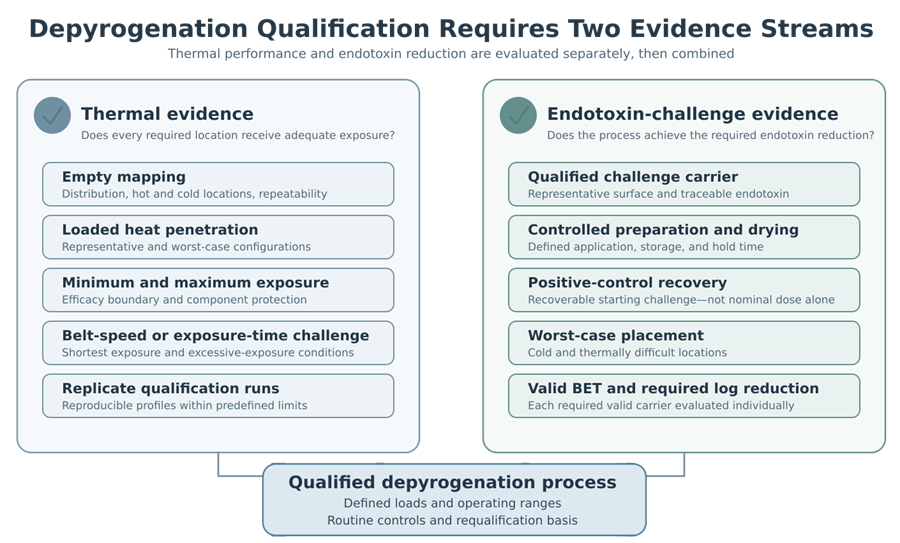
The validation requires two independent but connected evidence streams:
- Thermal evidence: The equipment provides reproducible heat distribution and every required load location receives the minimum established thermal exposure.
- Endotoxin-challenge evidence: Qualified challenge carriers processed at justified worst-case locations demonstrate the required endotoxin reduction.
Neither evidence stream replaces the other. Temperature mapping does not directly measure endotoxin destruction. A passing endotoxin challenge does not establish temperature uniformity, process control, or the suitability of untested load locations.
Depyrogenation also differs from sterilization. Sterilization addresses viable microorganisms, while depyrogenation addresses pyrogenic material that may remain after microorganisms have been killed. This distinction is explained in Pyrogens and Bacterial Endotoxins in GMP Manufacturing.
Validation Objective
A complete depyrogenation validation should demonstrate that:
- The equipment is appropriately designed and installed.
- Critical operating functions perform as intended.
- Temperature distribution is reproducible.
- Representative loads receive the required heat penetration.
- Cold or otherwise difficult-to-process locations are identified.
- The required endotoxin reduction is achieved at justified worst-case locations.
- Batch exposure time or tunnel conveyor speed remains within validated limits.
- Components are not exposed beyond justified maximum conditions.
- Cooling and post-process handling protect the processed components.
- Alarms, interlocks, records, and failure responses support routine control.
- The process remains reproducible across the required qualification runs.
The validation must define the equipment, component families, loading configurations, recipes, operating ranges, acceptance criteria, and process boundaries covered by the qualified state.
Regulatory and Compendial Basis
The validation program should consider:
- 21 CFR 211.63—Equipment design, size, and location
- 21 CFR 211.68—Automatic, mechanical, and electronic equipment
- 21 CFR 211.94—Drug-product containers and closures
- 21 CFR 211.160—General laboratory-control requirements
- FDA Guidance for Industry: Sterile Drug Products Produced by Aseptic Processing—Current Good Manufacturing Practice
- FDA Pyrogen and Endotoxins Testing: Questions and Answers
- USP
<1228>Depyrogenation - USP
<1228.1>Dry Heat Depyrogenation - USP
<1228.5>Endotoxin Indicators for Depyrogenation - USP
<85>Bacterial Endotoxins Test
FDA’s aseptic-processing guidance recommends heat-distribution and heat-penetration studies using worst-case cycles, representative container characteristics, and production loading configurations. It also describes endotoxin challenge preparation, recovery controls, and demonstration of at least a 99.9% reduction, equivalent to a 3-log reduction.
These sources do not establish one universal chamber temperature, conveyor speed, exposure duration, thermocouple quantity, or temperature-uniformity limit. Equipment-specific limits must be predefined and justified through design, cycle development, qualification data, component characteristics, and process risk.
Validation Lifecycle
Depyrogenation validation follows a lifecycle that includes:
- Design Qualification
- Installation Qualification
- Operational Qualification
- Performance Qualification
- Routine process control
- Continued verification
- Change assessment
- Requalification
The stages should be connected through approved requirements, risk assessments, design documents, qualification protocols, deviations, and final reports.
Design Qualification
Design Qualification confirms that the proposed equipment and process architecture can satisfy the intended depyrogenation requirements. DQ should evaluate:
- Intended components and component families
- Required throughput
- Batch oven versus continuous tunnel selection
- Chamber dimensions or effective tunnel-zone lengths
- Heating capacity
- Airflow and heat-transfer design
- HEPA filtration, where applicable
- Cooling capacity
- Load or conveyor configurations
- Temperature-control strategy
- Conveyor-speed range
- Pressure relationships
- Sensor locations
- Data recording
- Alarm and interlock strategy
- Cleaning and maintenance access
- Post-process contamination controls
- Qualification access and testability
- Integration with upstream and downstream equipment
For a tunnel, DQ should address the complete path from the container washer through preheating, high-temperature exposure, cooling, and transfer to the filling machine. The design must permit evaluation of temperature exposure across the usable conveyor width and under the proposed minimum and maximum throughput conditions.
For a batch oven, DQ should address shelf or cart arrangement, airflow through the load, chamber loading limits, door configuration, cooling, and protection during unloading.
The engineering basis for these systems is covered in Depyrogenation Equipment and Process Design.
Installation Qualification
Installation Qualification verifies that the equipment has been installed in accordance with approved design documents and manufacturer requirements.
IQ should include, as applicable:
- Equipment identification and location
- Chamber or tunnel dimensions
- Materials of construction
- Heating elements
- Circulation fans and motors
- Air-supply and return paths
- HEPA filters and housings
- Conveyor, belt, drive, and speed-control components
- Cooling systems
- Doors, access panels, seals, and interlocks
- Temperature sensors
- Pressure and differential-pressure sensors
- Airflow instrumentation
- Independent monitoring sensors
- Control panels and software versions
- Data-recording systems
- Alarm and event-recording functions
- Utilities and utility connections
- Safety systems
- Equipment drawings and manuals
- Recommended spare parts
- Calibration status
- Preventive-maintenance requirements
- Cleaning procedures
- Operating procedures
IQ should verify the identity, range, accuracy, location, and calibration status of instruments used for process control or acceptance decisions. Sensor locations should be reconciled with approved drawings.
Where HEPA-filtered air protects processed components, filter identity, installation, certification status, housing configuration, and access for integrity testing should be verified.
Operational Qualification
Operational Qualification demonstrates that the installed equipment operates throughout its proposed ranges and responds correctly to normal, boundary, and failure conditions. OQ typically includes:
- Empty-chamber or empty-tunnel temperature mapping
- Temperature-controller verification
- Comparison of control and independent measurement systems
- Timer verification
- Conveyor-speed verification
- Airflow or air-velocity testing
- Pressure and differential-pressure testing
- HEPA-filter integrity testing, where applicable
- Heating and cooling function
- Door and access-panel interlocks
- Recipe selection and parameter security
- Alarm verification
- Power-failure response
- Sensor-failure response
- Fan-failure response
- Conveyor-stoppage response
- Data-recording and report verification
- Start-up and shutdown sequencing
- Recovery after interruptions
OQ establishes the equipment’s functional operating range. PQ subsequently confirms that the proposed production process is effective within the approved range.
Empty Thermal Mapping
Empty mapping characterizes the inherent temperature distribution of the chamber or tunnel without a production load. Its objectives include:
- Evaluating temperature uniformity
- Identifying relatively cold and hot locations
- Comparing control-sensor readings with independent sensors
- Evaluating heating and stabilization
- Confirming repeatability
- Supporting loaded-study sensor placement
- Identifying effects associated with doors, corners, shelves, belt edges, and zone transitions
Batch-Oven Mapping
Temperature sensors should be distributed throughout the usable chamber volume. Locations should consider:
- Upper, middle, and lower elevations
- Chamber corners
- Center locations
- Areas near doors
- Supply and return-air locations
- Areas behind or between shelves
- Locations identified by airflow assessment
- Equipment control-sensor proximity
The arrangement should characterize the usable load space rather than only the geometric center of the chamber.
Tunnel Mapping
Empty-tunnel studies should evaluate the usable conveyor path and width. Test locations should represent:
- Left, center, and right belt positions
- Additional lateral positions where justified
- Preheating-zone behavior
- High-temperature-zone exposure
- Cooling-zone performance
- Zone transitions
- Leading and trailing measurement positions
- Locations near air-supply or return paths
For a continuous tunnel, moving temperature sensors or suitably instrumented test carriers may be needed to measure the thermal profile experienced by containers traveling through the process.
An empty tunnel can demonstrate equipment distribution and reproducibility, but it does not reproduce the airflow displacement, heat absorption, and packing effects produced by an actual container stream.
Loaded Thermal Mapping and Heat Penetration
Loaded studies determine how representative components respond to the process. They must evaluate the interaction among equipment conditions, component characteristics, load arrangement, and thermal exposure. Loaded studies should consider:
- Component material
- Container size
- Container mass
- Wall thickness
- Geometry
- Orientation
- Load density
- Tray or shelf position
- Conveyor packing density
- Airflow obstruction
- Minimum and maximum loads
- Routine and worst-case configurations
Batch-Oven Loads
For batch ovens, studies may include:
- Maximum load mass
- Minimum load
- Densely packed configurations
- Mixed loads, where permitted
- Thermally massive components
- Components with restricted internal airflow
- Upper, middle, and lower shelf positions
- Identified cold chamber locations
- Areas near the door or return-air path
The validated loading pattern should be documented through diagrams, photographs, component counts, orientation requirements, and spacing limitations.
Tunnel Loads
For tunnels, loaded studies should evaluate:
- Representative container sizes
- Maximum justified conveyor density
- Minimum or interrupted container flow, where relevant
- Positions across the conveyor width
- Leading, middle, and trailing portions of representative container groups
- Maximum validated conveyor speed
- Minimum speed where excessive exposure or inadequate cooling may occur
- Start-up, steady-state, and interruption conditions where applicable
The thermal measuring system should follow the same process path as the production containers. Stationary sensors located within a heated zone do not represent the complete time-temperature profile received by containers moving through a continuous tunnel.
Minimum and Maximum Exposure
Qualification must establish both process efficacy and material protection. Minimum exposure is evaluated to demonstrate:
- Adequate heating
- Required time at temperature
- Required thermal input
- Required endotoxin reduction
Maximum exposure is evaluated to prevent:
- Glass deformation
- Increased breakage
- Cosmetic damage
- Excessive cooling requirements
- Damage to coatings or surface treatments
- Particulate generation
- Degradation of heat-sensitive components
- Downstream handling problems
For tunnels, maximum conveyor speed normally produces the shortest residence time and is therefore an important challenge for minimum thermal exposure and endotoxin reduction.
Minimum conveyor speed, conveyor stoppage, or delayed discharge may produce maximum thermal exposure. These conditions should be evaluated when they can affect component quality or process disposition.
Thermal Exposure Evaluation
Thermal performance should be evaluated at each required measurement location using predefined criteria appropriate to the equipment, component, and process. Acceptance criteria may include one or more of the following:
- Minimum temperature maintained for a defined exposure time
- Minimum integrated thermal exposure
- Maximum allowable temperature or exposure
- Defined temperature-distribution limits
- An established dry-heat lethality or thermal-input value
Where Fh is used to calculate accumulated dry-heat exposure:
where:
- Fh = equivalent dry-heat exposure at the defined reference temperature
- T(τ) = measured temperature at elapsed time τ
- Tref = defined reference temperature
- z = temperature change required to produce a tenfold change in the thermal-inactivation rate
- t = total evaluated process time
If time is measured in minutes, Fh is expressed in equivalent minutes at Tref. The reference temperature, z-value, integration interval, calculation method, and minimum acceptance value must be defined in the approved protocol and scientifically justified. These values are process-specific and should not be adopted as universal depyrogenation criteria.
Each required sensor location must independently meet the applicable minimum thermal-exposure requirement. A high Fh value at one location or an acceptable average cannot compensate for inadequate exposure at another required location.
Calculated thermal exposure supports comparison of time-temperature profiles and identification of minimum-exposure locations. It does not directly demonstrate endotoxin destruction and does not replace appropriately designed endotoxin-challenge studies.
Endotoxin Challenge Carriers
An endotoxin challenge carrier is a representative surface containing a known, recoverable endotoxin challenge. For vial processes, the production container or an equivalent container is commonly used. Other carriers may be appropriate when they represent the production material and support suitable application and recovery. The challenge program should define:
- Endotoxin source
- Reference-standard traceability
- Endotoxin lot and potency
- Carrier material
- Nominal challenge level
- Application method
- Drying conditions
- Storage conditions
- Maximum hold time before processing
- Positive-control preparation
- Extraction method
- Recovery method
- BET method
- Analytical range
- Calculation and reporting rules
The carrier should represent the actual product-contact surface or a scientifically justified equivalent. A convenient carrier should not be substituted when its surface characteristics, geometry, heat transfer, or endotoxin recovery differ materially from the production component.
Challenge Preparation
A controlled volume of endotoxin solution is applied to a defined location on each carrier and allowed to dry under controlled conditions. Preparation records should identify:
- Endotoxin standard and lot
- Reconstitution procedure
- Diluent
- Prepared concentration
- Applied volume
- Nominal endotoxin challenge
- Carrier identity
- Application location
- Drying time and conditions
- Preparation date and time
- Analyst
- Storage conditions
- Time of processing
- Positive-control identification
The challenge level should be high enough to demonstrate the required log reduction after accounting for recovery and the analytical method’s quantitation capability. Excessively high challenges that do not represent a meaningful study design should not be selected only to generate a large numerical reduction.
Preparation, transport, storage, and processing should prevent cross-contamination between challenge carriers and production or qualification equipment.
Recovery and Positive Controls
The nominal quantity applied to a carrier is not automatically equal to the quantity recoverable before processing. Some endotoxin may be lost during application, drying, storage, handling, or extraction.
Unexposed positive controls are therefore necessary to establish the recoverable starting challenge. Positive controls should be:
- Prepared from the same endotoxin solution
- Applied to the same carrier type
- Dried under the same conditions
- Handled with the exposed carriers
- Stored for a comparable period
- Extracted and tested using the same method
A recovery study should demonstrate that the selected extraction method can recover and measure endotoxin from the carrier. The procedure should define:
- Extraction solution
- Extraction volume
- Mixing or agitation
- Extraction time
- Container closure
- Dilutions
- Replicate testing
- Hold time before analysis
- Acceptance criteria
The analytical procedure must demonstrate appropriate suitability for the sample matrix. Method suitability, inhibition or enhancement, standard-curve performance, blanks, and other validity controls are addressed in Bacterial Endotoxin Testing: Methods, Limits, and Suitability.
Challenge Placement
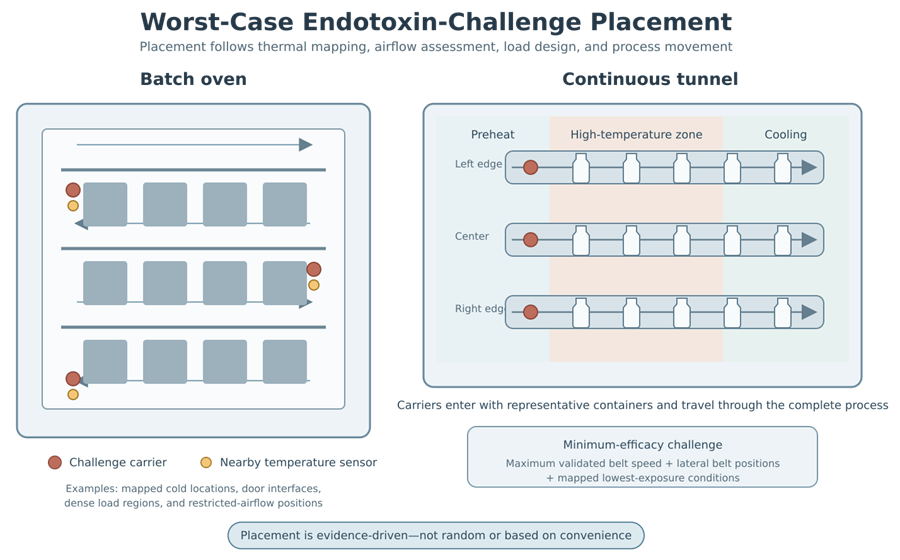
Challenge placement must be driven by thermal mapping, airflow evaluation, load design, and process mechanics.
Batch-Oven Placement
Locations may include:
- Identified cold chamber locations
- Thermally difficult load positions
- Densely loaded regions
- Upper or lower shelf extremes
- Corners
- Areas near door interfaces
- Locations with restricted airflow
- Internal surfaces or openings where justified
Challenge carriers and thermocouples should be co-located or placed in scientifically justified proximity so that thermal exposure can be correlated with endotoxin-reduction performance.
Tunnel Placement
Tunnel challenge carriers should travel through the complete process in representative containers. Placement should evaluate justified lateral positions across the belt, including:
- Left belt edge
- Center
- Right belt edge
- Additional intermediate positions where required
- Positions previously associated with minimum thermal exposure
The challenge is not placed stationary inside the high-temperature zone. It moves through the preheating, high-temperature, and cooling zones as a production container would.
Where container-group position affects exposure, challenge carriers may also represent the leading, middle, and trailing portions of the group. Studies should evaluate the maximum proposed conveyor speed when challenging minimum residence time and endotoxin destruction.
Endotoxin Log Reduction
Log reduction should be calculated from the recovered positive-control endotoxin and the recovered post-process endotoxin: Log reduction=log10(Recovered post-process endotoxinRecovered positive-control endotoxin)
A 3-log reduction means a 1,000-fold reduction in recoverable endotoxin, leaving 0.1% of the starting recoverable amount.
- Incoming endotoxin burden
- Component risk
- Process capability
- Patient risk
- Product endotoxin limit
- Overall endotoxin control strategy
The calculation procedure should define:
- How positive-control replicates are evaluated
- Whether a mean, geometric mean, or other predefined value is used
- How results below the quantitation limit are handled
- How the analytical range supports the claimed reduction
- How invalid or atypical controls are investigated
- How damaged, missing, or untestable carriers are handled
Each required valid challenge carrier should independently meet the predefined reduction criterion. Averaging results should not be used to convert a failing required location into a passing study.
Belt-Speed Challenges
Conveyor speed is a critical parameter because it determines residence time within each tunnel zone. Qualification should verify:
- Speed setpoint accuracy
- Actual belt speed
- Speed repeatability
- Approved operating range
- High- and low-speed alarms
- Speed interlocks
- Response to belt stoppage
- Data recording
- Recipe-specific speed control
The maximum validated speed normally challenges:
- Minimum residence time
- Minimum thermal exposure
- Minimum endotoxin destruction
- Cooling capacity at maximum throughput
The minimum validated speed may challenge:
- Maximum container temperature
- Excessive thermal exposure
- Glass quality
- Cooling-zone capability
- Downstream transfer conditions
Belt-speed studies should be performed with the applicable temperature setpoints, container type, container density, airflow conditions, and upstream/downstream operating state. Speed cannot be evaluated in isolation from the rest of the tunnel process.
Repeatability and Qualification Runs
Qualification must demonstrate reproducible performance, not one successful run. The validation strategy should define the number of runs based on:
- Equipment complexity
- Process variability
- Prior development data
- Component families
- Loading configurations
- Number of operating recipes
- Bracketing strategy
- Degree of process understanding
- Risk associated with failure
Three consecutive successful runs are commonly used for PQ, but the number should be established in the approved validation strategy rather than applied without justification.
Each run should demonstrate:
- Operation within approved parameter ranges
- Acceptable thermal distribution
- Acceptable minimum exposure at every required location
- Acceptable challenge-carrier recovery controls
- Required endotoxin reduction at every required challenge location
- Complete and valid data
- Acceptable alarms and interventions
- Reproducible cold and hot location behavior
If different container sizes, load patterns, or recipes are bracketed, the rationale must explain why the selected conditions represent or bound the untested configurations.
Acceptance Criteria
Acceptance criteria should be separated by evidence type.
Run and Data Validity
Acceptance should require:
- Approved protocol and authorized execution
- Correct equipment and recipe
- Calibrated measurement instruments
- Complete traceability of thermocouples and challenge carriers
- Complete process records
- Critical parameters within predefined ranges
- Required controls present and valid
- Data gaps and sensor failures evaluated
- Deviations documented and resolved
- No unexplained loss of required evidence
A run should not be accepted merely because the remaining available results pass when required data are missing or invalid.
Thermal Distribution and Penetration
Acceptance should address:
- Minimum temperature or thermal exposure at each valid sensor
- Required exposure duration
- Predefined maximum temperature
- Predefined temperature-distribution limit
- Agreement between equipment and independent sensors
- Identification of cold and hot locations
- Reproducibility of thermal profiles
- Acceptable heating and cooling
- Required tunnel-exit temperature, where applicable
Temperature spread may be calculated as: ΔTmax=Thighest valid sensor−Tlowest valid sensor
The allowable spread and the period over which it applies must be predefined. An acceptable average temperature cannot compensate for a location that fails the minimum exposure requirement.
Endotoxin-Challenge Performance
Acceptance should address:
- Traceable endotoxin preparation
- Acceptable positive-control recovery
- Suitable extraction method
- Valid BET performance
- Required log reduction for every required carrier
- Acceptable blanks and analytical controls
- Complete carrier accountability
- Acceptable treatment of results below quantitation
- Evaluation of missing, damaged, or invalid carriers
A passing thermal study cannot compensate for a failing endotoxin challenge, and a passing challenge cannot compensate for an unacceptable thermal location.
Equipment and Functional Performance
Acceptance should also address:
- Temperature-control accuracy
- Timer accuracy
- Conveyor-speed accuracy
- Airflow and pressure performance
- HEPA-filter integrity, where applicable
- Alarm and interlock performance
- Cooling-zone performance
- Data-recording accuracy
- Correct failure response
Deviations and Invalid Studies
Qualification deviations may involve:
- Thermocouple failure
- Detached or displaced sensors
- Missing thermal data
- Incorrect sensor location
- Damaged challenge carriers
- Missing challenge carriers
- Unacceptable positive-control recovery
- BET inhibition or enhancement
- Invalid standard curve
- Equipment alarm
- Conveyor-speed excursion
- Temperature excursion
- Power interruption
- Incorrect load arrangement
- Unapproved intervention
- Data-recording failure
Each deviation should be evaluated for:
- Root or contributing cause
- Affected data
- Affected locations
- Run validity
- Effect on worst-case coverage
- Effect on acceptance criteria
- Need for repeat testing
- Effect on previous or subsequent production
- Corrective and preventive action
Retesting should not be used to replace an unexplained failure. The original result and its investigation remain part of the validation record.
A failed required location cannot be excluded solely because other locations passed. Exclusion requires a documented technical basis showing that the measurement or sample was invalid and that adequate evidence remains to support the study conclusion.
Validation Report and Qualified Range
The final report should define:
- Equipment covered
- Approved recipes
- Component families
- Container sizes
- Load configurations
- Conveyor-density range
- Temperature ranges
- Exposure-time ranges
- Conveyor-speed ranges
- Airflow and pressure requirements
- Cooling requirements
- Minimum demonstrated thermal exposure
- Endotoxin-reduction capability
- Qualified cold and hot locations
- Bracketing or matrixing conclusions
- Deviations and dispositions
- Routine monitoring requirements
- Requalification requirements
- Limitations and excluded configurations
The report should distinguish between parameters tested directly, configurations scientifically bracketed, and conditions not covered by the qualification.
Routine Process Control
Routine production does not normally repeat the full thermal mapping and endotoxin challenge performed during PQ. It relies on controlled operation within the validated range. Routine records should include, as applicable:
- Equipment and recipe identification
- Component or container identity
- Load pattern or conveyor configuration
- Cycle temperature records
- Exposure time
- Conveyor speed
- Airflow or pressure status
- Cooling-zone conditions
- Alarm and event history
- Operator interventions
- Start and completion times
- Required line clearance
- Container disposition after interruptions
- Review and approval
Batch ovens should document adherence to the qualified loading pattern. Tunnels should document operation within the approved temperature, conveyor-speed, container-density, airflow, and pressure ranges.
Routine bacterial endotoxin testing provides verification of relevant materials or products but does not substitute for process control or qualification.
Continued Verification
Continued verification should evaluate whether equipment and process performance remain consistent with qualification. Review inputs may include:
- Routine temperature records
- Conveyor-speed trends
- Heating and cooling times
- Alarm history
- Process interruptions
- HEPA-filter test results
- Pressure and airflow trends
- Calibration history
- Preventive maintenance
- Sensor replacements
- Belt or drive maintenance
- Deviations
- Component breakage
- BET results
- Rejected or segregated containers
- Changes to container suppliers or specifications
- Changes to load or throughput
- Requalification results
Adverse trends should be evaluated before they become formal process failures. A gradual change in heating time, cold-location behavior, belt-speed stability, cooling performance, or positive-control recovery can indicate deterioration in the process or analytical system.
Change Control
Changes requiring documented impact assessment include:
- Heating-element replacement
- Fan, duct, damper, or airflow modification
- HEPA-filter or housing changes
- Conveyor, belt, motor, or drive changes
- Temperature-sensor replacement or relocation
- Control-system or recipe changes
- Alarm or interlock changes
- Data-recording changes
- Chamber, shelf, tray, or cart changes
- Tunnel-zone modifications
- Cooling-system changes
- Changes to container size, material, mass, or supplier
- Changes to loading pattern or conveyor density
- Changes to temperature, time, or belt speed
- Extended shutdown
- Relocation of equipment
- Major maintenance
- Changes to challenge carrier or analytical method
The assessment should determine whether documented review, calibration, functional testing, targeted requalification, or comprehensive requalification is required.
Requalification
Requalification confirms that the process remains capable after time, change, maintenance, failure, or adverse performance. Requalification may be triggered by:
- Significant equipment modification
- Heating-system repair
- Airflow or pressure-system change
- HEPA-filter replacement
- Conveyor-system modification
- Sensor relocation
- Control-system change
- New component configuration
- Expansion outside the qualified range
- Repeated deviations
- Failed routine cycle
- Adverse thermal trend
- Unexplained change in cold location
- Unacceptable endotoxin results
- Extended shutdown
- Equipment relocation
- Periodic program requirements
The scope should be based on the affected functions and risks. A conveyor-drive change may require speed verification, alarm testing, and tunnel thermal studies. A heating-system or airflow modification may require broader empty and loaded mapping together with endotoxin challenges. A new container configuration may require loaded heat penetration and challenge-carrier studies without repeating unrelated IQ tests.
Periodic requalification frequency and scope should be defined by the validation program. Calendar-based reassessment remains appropriate where required by procedure, regulatory expectation, equipment risk, or contamination-control strategy.
Documentation Requirements
The validation package should include:
- User requirements
- Risk assessment
- Design review and DQ
- IQ, OQ, and PQ protocols
- Approved acceptance criteria
- Instrument calibration records
- Sensor-location diagrams
- Load diagrams
- Conveyor-position diagrams
- Raw temperature data
- Thermal calculations
- Identification of cold and hot locations
- Equipment cycle records
- Endotoxin certificates and preparation records
- Challenge-carrier accountability
- Positive-control recovery results
- BET suitability and validity records
- Individual post-process carrier results
- Log-reduction calculations
- Deviations and investigations
- Change records
- Approved final reports
- Defined routine controls
- Requalification requirements
Records generated by automated temperature, conveyor, or BET systems must remain attributable, complete, accurate, protected, reviewable, and available throughout the required retention period. The qualification of BET instrumentation and associated software is addressed in Endotoxin Testing Systems: Qualification, Software, and Data Integrity.
Core Validation Principle
A qualified depyrogenation process rests on three connected conclusions:
- Every required location receives the minimum established thermal exposure.
- Every required valid challenge carrier demonstrates the specified endotoxin reduction.
- The equipment repeatedly operates within its defined parameter ranges under justified worst-case conditions.
A passing average temperature cannot compensate for a cold location. An average log reduction cannot compensate for a failing required challenge carrier. Neither thermal evidence nor endotoxin evidence is sufficient by itself.