

Sterilization Methods and Selection for GMP Manufacturing
Sterilization methods for GMP manufacturing must be selected from the required sterility outcome, product and material characteristics, process configuration, and ability to validate and routinely control the selected process. The decision cannot be based solely on equipment availability or a general hierarchy of technologies.
Moist heat, dry heat, ethylene oxide, vaporized hydrogen peroxide, and ionizing radiation use different mechanisms of microbial inactivation. Each method has different requirements for penetration, load configuration, material compatibility, process monitoring, residual control, and validation.
Sterilizing-grade filtration may provide a sterilization step for a compatible liquid or gas, but it does not terminally sterilize a sealed final container. When terminal sterilization is not feasible, filtration must normally be integrated with controlled downstream handling and aseptic processing.
The objective is not merely to select a process capable of killing microorganisms. The selected method must:
- Achieve the required sterility assurance
- Reach all required product or load locations
- Preserve product, component, and package quality
- Operate within measurable and controllable limits
- Support scientifically justified validation
- Remain reproducible throughout routine operation
- Be maintained through monitoring, change control, and requalification
Purpose and Scope
This article provides a framework for selecting sterilization methods for:
- Finished pharmaceutical products
- Drug-product containers and closures
- Medical devices and combination-product components
- Manufacturing equipment and product-contact parts
- Single-use assemblies and process components
- Laboratory and production utensils
- Sterile fluid and gas pathways
- Isolators, transfer chambers, and other enclosed systems
It covers the selection boundary among terminal sterilization, component sterilization, sterilizing-grade filtration, aseptic processing, and surface bio-decontamination.
Detailed cycle development and qualification requirements are addressed in the individual method articles.
What Sterilization Establishes
Sterilization is a validated process used to render a product or item free from viable microorganisms according to a defined probability of survival. It is a probabilistic process outcome rather than proof that every processed unit can be individually demonstrated to contain no microorganisms.
The required sterility assurance level depends on the product, application, regulatory framework, and applicable standard. An SAL of 10⁻⁶ is commonly applied to terminally sterilized sterile products and medical devices, but it should not be presented as an automatic universal requirement for every sterilization application.
Sterility assurance is established from an integrated body of evidence that may include:
- Presterilization bioburden
- Microbial resistance data
- Physical process parameters
- Delivered lethality or absorbed dose
- Heat, gas, vapor, or radiation penetration
- Load configuration
- Biological-indicator or process-challenge evidence where applicable
- Equipment and control-system performance
- Routine-cycle monitoring
- Deviation and change history
Finished-product sterility testing samples only a limited number of units and cannot independently establish a very low probability of microbial survival.
Sterilization Does Not Replace Other Controls
A validated sterilization process does not eliminate the need for upstream contamination control.
The control strategy may still require:
- Raw-material and component controls
- Cleaning and residue removal
- Presterilization bioburden controls
- Defined processing and hold times
- Controlled product assembly
- Suitable environmental conditions
- Package or container-closure integrity
- Protection from recontamination after processing
- Controlled storage and distribution
Sterilization and depyrogenation also have different objectives. Sterilization targets viable microorganisms. Depyrogenation targets pyrogenic material, principally bacterial endotoxin. A process that establishes sterility does not automatically establish endotoxin control.
Terminal Sterilization Preference
Terminal sterilization treats the product in its final sealed container or final packaged configuration. This generally provides stronger sterility assurance because the microbial-inactivation step occurs after the product has been filled, closed, or packaged.
FDA guidance states that aseptic processing should be used for sterile drug products only when terminal sterilization is not feasible. The feasibility assessment must consider the product and its entire container-closure or packaging system—not the active ingredient alone. FDA’s aseptic-processing guidance provides the relevant US regulatory position.
Terminal sterilization should be evaluated first when:
- The finished product can withstand the required exposure
- The container-closure system remains functional
- Critical quality attributes remain acceptable
- Sterilant or energy can reach all required locations
- A reproducible load can be defined
- Process parameters can be measured and controlled
- The process does not introduce unacceptable residues or degradation products
Terminal sterilization should not be selected merely because it is generally preferred. A process that damages the product, compromises package integrity, or cannot achieve reliable penetration is not technically suitable.
Terminal Sterilization, Filtration, and Aseptic Processing
| Control approach | Function | Principal limitation |
|---|---|---|
| Terminal sterilization | Inactivates microorganisms after the product is sealed in its final container or package | Requires product and package compatibility with the exposure |
| Component sterilization | Sterilizes equipment parts, closures, assemblies, or other inputs before use | Sterile condition must be maintained during subsequent handling |
| Sterilizing-grade filtration | Removes microorganisms from a compatible liquid or gas stream | Does not sterilize the receiving container or downstream process |
| Aseptic processing | Maintains sterility during filtration, transfer, filling, assembly, and closure | Does not apply a final microbial-inactivation step to the sealed product |
| Surface bio-decontamination | Reduces biological contamination on exposed enclosure or material surfaces | May not support a sterilization claim unless the specific process is developed and validated for that outcome |
Where terminal processing is not feasible, the alternative is normally an integrated aseptic control strategy rather than simple substitution of a filter for a sterilizer.
Sterilization-Method Selection Framework
Selection should proceed through five connected decisions:
- Define the required outcome.
- Determine whether final-container or final-package sterilization is feasible.
- evaluate product, material, and package compatibility.
- Demonstrate sterilant, heat, or energy penetration.
- Define a practical validation and routine-control strategy.
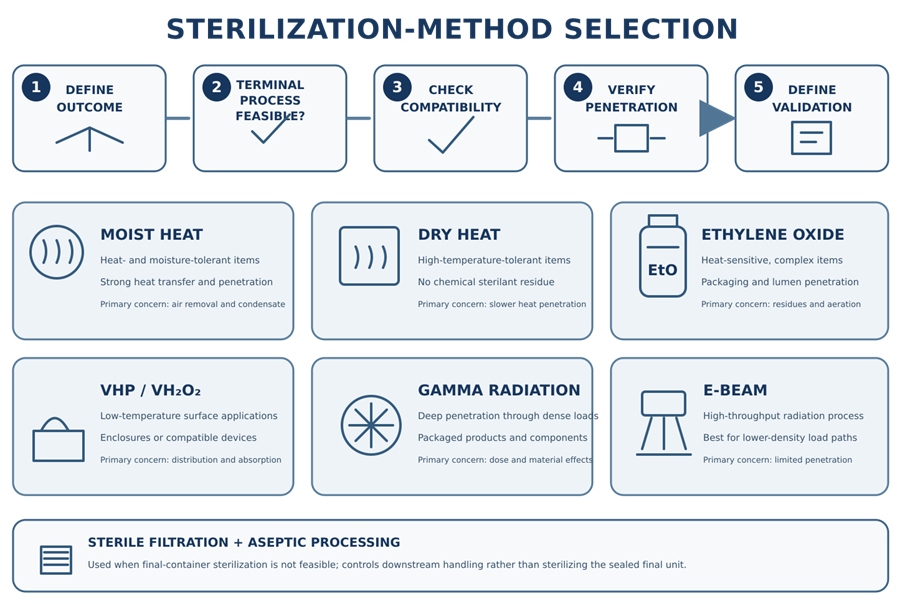
The matrix should be positioned immediately before the detailed method comparison.
Comparison of Principal Sterilization Methods
| Method | Suitable applications | Important selection constraints | Principal validation evidence |
|---|---|---|---|
| Moist heat | Aqueous products, porous loads, equipment parts, sealed containers, compatible components | Heat and moisture tolerance, steam contact, air removal, condensate, container pressure | Temperature distribution, heat penetration, lethality, air-removal performance, load studies and microbiological challenge |
| Dry heat | Glass, metal, oils, powders, and other high-temperature-compatible materials | High temperature, slower heat transfer, load density, airflow, product degradation | Empty and loaded mapping, heat penetration, exposure time, airflow, physical and microbiological evidence |
| Ethylene oxide | Heat- and moisture-sensitive medical devices, assemblies, packaged components and complex geometries | Humidity dependency, toxic residues, aeration, packaging permeability, emissions and material absorption | Gas concentration, humidity, temperature, pressure, half-cycle or other microbiological PQ, residual testing |
| VHP/VH₂O₂ | Compatible medical devices, enclosed systems, transfer chambers and exposed enclosure surfaces | Distribution, line-of-sight effects, material absorption, condensation, aeration and claim boundary | Concentration, humidity, temperature, distribution studies, BI placement, leak integrity and aeration |
| Gamma radiation | Prepackaged products and components, including dense or complex loads | Dose effects, material degradation, product density, maximum acceptable dose and contract processing | Dose establishment, dose mapping, bioburden, dosimetry and sterilization-dose audits |
| Electron beam | High-throughput processing of products with suitable density and geometry | More limited penetration, conveyor configuration, beam energy, product orientation and dose uniformity | Dose establishment, beam and conveyor controls, dose mapping, dosimetry and routine dose monitoring |
| Sterilizing-grade filtration | Heat-sensitive liquids and gases that can pass through a suitable filter | Product compatibility, microbial retention, adsorption, fouling, integrity and downstream aseptic handling | Bacterial-retention validation, process simulation, operating limits, integrity testing and aseptic-process controls |
No method is universally superior. The preferred method is the one that achieves the required microbial control with sufficient margin while preserving product quality and remaining measurable, reproducible, and controllable.
Moist Heat Sterilization
Moist heat sterilization uses moist thermal energy, commonly saturated steam, to inactivate microorganisms. Steam transfers heat efficiently when it contacts the surface or material being sterilized and when entrapped air does not interfere with exposure.
Moist heat is commonly considered first for compatible applications because it:
- Provides efficient heat transfer
- Uses readily measurable physical parameters
- Leaves no toxic chemical sterilant residue
- Supports lethality calculations
- Has an extensive pharmaceutical and health-care processing history
Potential applications include:
- Terminal sterilization of compatible aqueous products
- Equipment parts and utensils
- Porous and wrapped component loads
- Stopper and closure loads
- Single-use assemblies designed for steam exposure
- Product-contact pathways sterilized in place
Selection must evaluate:
- Product heat stability
- Moisture sensitivity
- Container pressure and deformation
- Steam access
- Air removal
- Condensate accumulation
- Load density and orientation
- Heating and cooling effects
- Required minimum and maximum lethality
A nominal chamber temperature does not demonstrate successful sterilization. The controlling question is whether the required exposure is delivered to the most difficult-to-heat location without unacceptable overprocessing elsewhere.
Dry Heat Sterilization
Dry heat sterilization uses heated air without the moisture conditions associated with steam sterilization. It is suited primarily to materials that tolerate elevated temperatures and that may be unsuitable for moist heat.
Applications may include:
- Glassware
- Metal components
- Heat-stable utensils
- Certain oils
- Certain powders
- Components for which moisture exposure is unacceptable
Dry heat generally requires higher temperatures or longer exposures than moist heat because heat transfer is less efficient. Selection therefore depends on:
- Material temperature tolerance
- Load mass and density
- Airflow distribution
- Heating and cooling rates
- Heat penetration
- Oxidation or other material effects
- Equipment capacity
- Reproducibility of load placement
Dry-heat sterilization and dry-heat depyrogenation must be distinguished. A dry-heat cycle may achieve both outcomes when specifically developed and validated to do so, but microbial lethality evidence does not by itself demonstrate endotoxin reduction.
Ethylene Oxide Sterilization
Ethylene oxide sterilization is a low-temperature gas process used primarily for heat- and moisture-sensitive medical devices, components, and assemblies. EtO can penetrate porous packaging and reach some complex internal pathways when the product, packaging, process, and load are properly designed.
Potential applications include:
- Medical devices
- Complex assemblies
- Devices containing heat-sensitive polymers
- Packaged components
- Long or narrow internal pathways
- Products requiring sterilization in a porous sterile-barrier system
Critical selection considerations include:
- Product and packaging permeability
- Load density
- Temperature and humidity equilibration
- EtO concentration
- Exposure time
- Gas removal
- Product absorption
- EtO and reaction-product residues
- Aeration time
- Worker and environmental controls
- Contract-sterilizer governance
EtO is not selected simply because the product is heat sensitive. Residual limits, aeration duration, material absorption, emissions, processing time, and supply-chain dependence can make the method impractical.
For medical-device applications, ISO 11135:2014 remains the published standard as of this review, with a replacement edition under development. The scope of that standard should not be automatically extended to unrelated pharmaceutical applications.
Vaporized Hydrogen Peroxide
Vaporized hydrogen peroxide sterilization is a low-temperature process used for certain medical devices and contained applications. Hydrogen peroxide vapor may also be used for isolator, RABS, transfer-chamber, or room bio-decontamination.
These applications must not be assigned the same claim automatically.
A process described as surface bio-decontamination may demonstrate a specified biological reduction on exposed surfaces without establishing that every item, internal pathway, or occluded location has been sterilized. The required claim must be defined before cycle development begins.
Selection considerations include:
- Required process claim
- Enclosure or load geometry
- Vapor distribution
- Temperature and humidity
- Condensation control
- Material compatibility
- Hydrogen-peroxide absorption
- Lumen or occluded-surface access
- Biological-indicator resistance and placement
- Aeration and safe re-entry
- Product or equipment residue limits
ISO 22441:2022 addresses low-temperature vaporized-hydrogen-peroxide sterilization of medical devices. Its medical-device scope should not be applied indiscriminately to pharmaceutical enclosure bio-decontamination.
Radiation Sterilization
Ionizing radiation damages microbial genetic material and can sterilize products after packaging. The principal industrial technologies include gamma radiation, electron beam, and X-ray processing.
Gamma Radiation
Gamma sterilization commonly uses Cobalt-60 sources and can provide substantial penetration through packaged products and comparatively dense loads.
Selection considerations include:
- Product density
- Load and tote configuration
- Minimum and maximum dose locations
- Material degradation
- Color, odor, or mechanical changes
- Product functionality
- Dose uniformity
- Source decay
- Processing duration
- Contract-facility controls
Electron Beam
Electron-beam sterilization uses accelerator-generated electrons. It can provide rapid processing and high throughput but generally has less penetration than gamma or X-ray processing.
Selection considerations include:
- Electron energy
- Product density
- Product thickness
- Single- or double-sided exposure
- Conveyor speed
- Beam scanning
- Dose uniformity
- Product orientation
- Maximum acceptable dose
Common Radiation Considerations
Radiation method selection must establish both:
- A minimum dose sufficient to achieve the required sterility assurance
- A maximum dose that does not cause unacceptable product, material, or package deterioration
For medical devices, ISO 11137-1:2025 provides the current requirements for development, validation, and routine control of radiation sterilization processes.
Sterilizing-Grade Filtration
Sterilizing-grade filtration removes microorganisms from a compatible fluid stream rather than inactivating them within a final sealed unit. It is used when product characteristics prevent terminal exposure to heat, gas, or radiation.
Potential applications include:
- Heat-sensitive solutions
- Biologic products
- Sterile gases
- Process intermediates
- Bulk sterile solutions before filling
Selection and validation must address:
- Microbial-retention capability
- Product viscosity
- Filterability
- Product adsorption
- Extractables and leachables
- Filter compatibility
- Maximum pressure differential
- Maximum filtration time
- Maximum processed volume
- Temperature
- Filter fouling
- Pre-use and post-use integrity testing
- Redundant filtration where justified
- Protection of the downstream sterile boundary
The sterile-filter lifecycle must be integrated with subsequent transfers, sterile holds, filling, closure, and environmental control. Once the product passes through the filter, any downstream exposure can reintroduce contamination.
Sterile filtration therefore does not eliminate the need for qualified aseptic filling operations.
Product and Material Compatibility
Compatibility studies must evaluate the entire exposed configuration, including:
- Drug substance and formulation
- Excipients
- Primary container
- Closure system
- Device materials
- Adhesives
- Lubricants
- Coatings
- Labels
- Sterile-barrier packaging
- Secondary packaging exposed during processing
- Sensors or electronic components
- Product-contact tubing and connectors
Potential effects include:
- Chemical degradation
- Loss of potency
- Aggregation
- Oxidation
- Hydrolysis
- Brittleness
- Discoloration
- Odor formation
- Dimensional change
- Seal failure
- Increased extractables or leachables
- Loss of device performance
- Loss of package integrity
- Formation or retention of process residues
Compatibility should be evaluated at the maximum expected process exposure, not only at the minimum exposure required for microbial lethality. Multiple sterilization exposures must be considered when reprocessing, repeat cycles, or cumulative exposure is possible.
Penetration and Load Configuration
A sterilization process is effective only when the sterilizing condition reaches the most difficult location in the defined load.
Potential worst-case locations include:
- Dense load regions
- Cold spots
- Long or narrow lumens
- Mated surfaces
- Wrapped components
- Occluded surfaces
- Areas containing entrapped air
- Locations shielded from radiation
- Materials that absorb chemical sterilant
- Locations furthest from the sterilant source
- Maximum-mass or minimum-load configurations
Load configuration affects:
- Heat transfer
- Air removal
- Condensate drainage
- Gas circulation
- Vapor distribution
- Radiation absorption
- Dose uniformity
- Aeration
- Cooling
- Process reproducibility
Routine loads must remain within the configurations and limits represented by validation. “Less than the maximum load” is not automatically less challenging. A minimum load, mixed load, partial load, or differently oriented load may create a separate worst case.
Residues and Post-Process Recovery
Chemical sterilization methods require evaluation of sterilant and reaction-product residues. Thermal and radiation processes may create degradation products even though no chemical sterilant is added.
The assessment should consider:
- Residual sterilant
- Reaction products
- Product degradation products
- Material off-gassing
- Aeration or desorption time
- Cooling requirements
- Safe handling
- Product-release testing
- Storage effects
- Patient exposure
- Worker exposure
- Environmental emissions
The cycle must include all required post-exposure phases. Aeration, cooling, pressure equalization, and safe unloading are controlled parts of the process, not optional activities performed after sterilization.
Validation Requirements Common to All Methods
Although validation evidence varies by technology, the lifecycle should normally include:
Requirements and Process Definition
- Intended sterilization outcome
- Product and load families
- Applicable regulatory and standards framework
- Required sterility assurance
- Critical quality attributes
- Process parameters and limits
- Equipment and utility requirements
- Routine monitoring and release strategy
Development
- Microbial-challenge rationale
- Product and material compatibility
- Process penetration
- Worst-case load definition
- Minimum and maximum exposure
- Operating ranges
- Failure conditions
- Process-margin evaluation
Equipment Qualification
- Installation verification
- Instrument calibration
- Control-system verification
- Alarm and interlock testing
- Utility verification
- Empty-equipment performance
- Data acquisition and record review
- Software and electronic-record controls where applicable
Performance Qualification
- Defined production-equivalent loads
- Physical process evidence
- Microbiological or dose evidence as applicable
- Worst-case locations
- Repeated successful studies
- Acceptance-criteria evaluation
- Deviation investigation
- Approved qualification report
Routine Control
- Approved load configuration
- Cycle-parameter review
- Process indicators or dosimeters
- Biological indicators where justified
- Product or presterilization bioburden controls
- Filter-integrity testing where applicable
- Residual or release testing
- Deviation handling
- Batch or load release
Lifecycle Control
- Periodic performance review
- Calibration and maintenance
- Alarm and failure trending
- Change control
- Supplier oversight
- Contract-processor oversight
- Targeted or comprehensive requalification
- Continued-use assessment after significant failures
Documenting the Method-Selection Decision
The selection record should explain:
- What is being sterilized.
- What sterility outcome is required.
- Whether terminal sterilization was evaluated.
- Why candidate methods were accepted or rejected.
- How product and package compatibility were assessed.
- How penetration will be demonstrated.
- What load configurations will be validated.
- What residues or degradation effects require control.
- Which standards and regulatory requirements apply.
- How the process will be qualified, monitored, released, and requalified.
The decision should remain traceable to development data, risk assessments, user requirements, validation protocols, and approved operating procedures.
Common Selection Errors
Frequent weaknesses include:
- Selecting the method before defining the required outcome
- Rejecting terminal sterilization without documented feasibility studies
- Evaluating the active ingredient but not the final container-closure system
- Assuming a sterilization cycle also establishes depyrogenation
- Describing all VHP applications as sterilization
- Treating filtration as sterilization of the complete final process
- Ignoring minimum or partial-load configurations
- Failing to evaluate product and package effects at maximum exposure
- Relying on chamber parameters without penetration evidence
- Applying medical-device standards outside their defined scope
- Assuming contract processing transfers product-quality responsibility
- Failing to connect development studies to routine operating limits
- Treating initial qualification as the end of validation
Regulatory and Standards Framework
For US drug manufacturing, 21 CFR 211.113(b) requires written procedures designed to prevent microbiological contamination of sterile drug products, including validation of all aseptic and sterilization processes.
FDA’s sterilization-process submission guidance describes information supporting sterilization-process efficacy in human and veterinary drug applications.
For medical devices, FDA inspection guidance emphasizes process validation, defined process parameters and tolerances, product and package effects, routine monitoring, and periodic assessment. Consensus standards may provide accepted technical frameworks, but their stated product and technology scopes must be respected.
Relevant standards include:
- ISO 17665:2024 — Moist-heat sterilization of health-care products
- ISO 11135:2014 and Amendment 1:2018 — EtO sterilization of medical devices
- ISO 11137-1:2025 — Radiation sterilization of medical devices
- ISO 22441:2022 — Vaporized-hydrogen-peroxide sterilization of medical devices
- ISO 11138 series — Biological indicators
- ISO 14937 — General requirements for characterization and validation of sterilizing agents and processes for medical devices
Relevant USP chapters may include General Chapters <71>, <1211>, and the <1229> sterilization series. Chapter applicability should be determined from the actual product, process, and regulatory use.
Additional requirements and standards relationships are addressed in Sterilization Regulations, Standards, and Validation Lifecycle.
Conclusion
Sterilization-method selection is a product, process, and risk decision. Terminal sterilization should be evaluated first for sterile drug products, but it is suitable only when the product, container, packaging, and required functionality remain acceptable.
Moist heat, dry heat, EtO, VHP, gamma radiation, and electron beam each impose different compatibility, penetration, monitoring, and validation requirements. Sterilizing-grade filtration is appropriate for certain heat-sensitive fluids and gases, but it transfers sterility-assurance dependence to the downstream aseptic process.
A defensible decision connects the required outcome to technical feasibility, material compatibility, worst-case penetration, process control, validation evidence, routine release, and lifecycle management.