

Endotoxin Control Strategy for Sterile Manufacturing
An endotoxin control strategy is the coordinated set of material, utility, equipment, process, environmental, analytical, and quality-system controls used to prevent unacceptable bacterial endotoxin from reaching a sterile product or product-contact surface.
The strategy should prevent three related events:
- Introduction of Gram-negative bacteria or pre-existing endotoxin
- Microbial proliferation and endotoxin accumulation during manufacturing
- Carryover or recontamination after cleaning, sterilization, or depyrogenation
Finished-product testing confirms whether sampled units meet the applicable limit. It does not establish that the manufacturing process consistently prevents endotoxin contamination.
Effective control therefore depends on layered measures applied from raw-material receipt through product release:
- Raw-material and supplier controls
- Pharmaceutical-water control
- Sanitary equipment design
- Cleaning and rinsing
- Control of aqueous processing and hold times
- Component preparation
- Sterilization and depyrogenation
- Environmental and personnel controls
- In-process monitoring
- Scientifically justified limits
- Bacterial endotoxins testing
- Trending and investigation
- Change control and periodic review
The biological distinction among pyrogens, bacterial endotoxin, lipopolysaccharide, viable microorganisms, sterilization, and depyrogenation is explained in Pyrogens and Bacterial Endotoxins in GMP Manufacturing.
Control-Strategy Objective
The objective is not an absolute claim that every material or surface is “endotoxin-free.” The objective is to maintain endotoxin at levels appropriate for the product, process stage, patient exposure, and intended use.
The strategy should establish that:
- Endotoxin hazards have been identified.
- Patient and product risks are understood.
- Sources and amplification points are defined.
- Preventive controls are implemented at appropriate process stages.
- Endotoxin-removal or inactivation steps are validated where relied upon.
- Sampling locations and frequencies are scientifically justified.
- Alert, action, in-process, and release limits have defined purposes.
- Deviations and adverse trends trigger proportionate investigation.
- Changes are assessed against the approved control strategy.
- Lifecycle data confirm that the controls remain effective.
A useful control hierarchy is:
- Prevent contamination.
- Prevent microbial growth.
- Remove microorganisms and residues early.
- Apply validated endotoxin removal or inactivation where required.
- Protect treated surfaces and materials from recontamination.
- Verify performance through monitoring, testing, and review.
Testing occupies the final layer. It should not be the primary control.
Regulatory and Compendial Basis
The strategy should be aligned with applicable requirements for:
- Suitable equipment design and construction
- Cleaning and maintenance
- Component and container preparation
- Written production and process controls
- Laboratory controls
- Sampling
- Specifications
- Investigation of discrepancies and failures
- Change control
- Product release
Relevant US requirements include applicable provisions of 21 CFR Part 211, particularly requirements addressing components, containers and closures, equipment, cleaning and maintenance, production and process controls, laboratory controls, sampling, and investigation.
FDA’s Pyrogen and Endotoxins Testing: Questions and Answers, updated in March 2026, addresses sampling, test methods, acceptance criteria, and regulatory expectations for drugs, biological products, and devices.
FDA states that endotoxin sampling should reflect:
- Potential contamination in raw materials
- In-process materials
- Finished product
- Manufacturing-process consistency
- In-process hold times
- Endotoxin-removal steps
- Finished-product specifications
FDA also describes sampling as dynamic: initial coverage may be extensive and subsequently adjusted as process knowledge and evidence of prevention accumulate. Reduced sampling requires documented justification; it should not result merely from a history of passing tests.
USP chapters relevant to the overall program include:
- USP
<85>Bacterial Endotoxins Test - USP
<1085>Guidelines on the Endotoxins Test - USP
<1228>Depyrogenation - USP
<1228.1>Dry Heat Depyrogenation - USP
<1228.3>Depyrogenation by Filtration - USP
<1228.5>Endotoxin Indicators for Depyrogenation - USP
<1231>Water for Pharmaceutical Purposes
Applicable product monographs, regulatory submissions, commitments, and approved specifications remain controlling for the individual product.
Source-to-Control Model
Endotoxin control should trace the complete path from potential source to patient exposure.
The major relationships are:
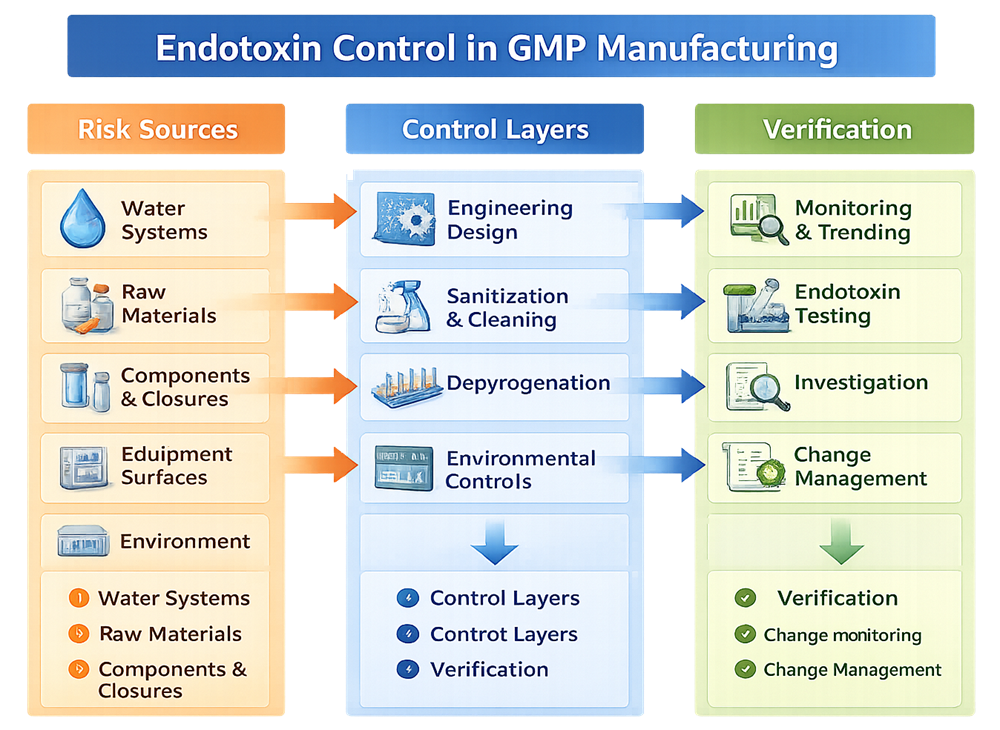
| Potential source | Amplification or transfer mechanism | Principal preventive control | Verification |
|---|---|---|---|
| Raw materials | Pre-existing endotoxin or microbial contamination | Supplier, specification and incoming controls | Supplier data, incoming or periodic testing, trends |
| Pharmaceutical water | Gram-negative growth and biofilm | Sanitary design, circulation, sanitization and use controls | Microbial and endotoxin monitoring |
| Equipment | Residue, retained moisture and biofilm | Cleanable design, cleaning, drainage and dry storage | Cleaning verification, inspection and trend review |
| Components | Contaminated surfaces or wet storage | Washing, controlled handling and depyrogenation | Process records and qualification |
| Aqueous intermediates | Growth during processing or holding | Bioburden limits, time and temperature control | Pre- and post-hold monitoring |
| Environment and personnel | Indirect transfer to exposed product or surfaces | Segregation, airflow, cleaning and aseptic controls | Environmental and operational monitoring |
| Process interruption | Unplanned extended wet hold or exposure | Defined response and product segregation | Deviation investigation and impact assessment |
| Post-treatment handling | Recontamination after depyrogenation | Protected cooling, storage and transfer | Environmental, process and status-control records |
The illustration below should present these sources, amplification mechanisms, preventive barriers, reduction steps, and verification activities as one connected system.
Product and Patient Risk Assessment
The control strategy should begin with the finished-product requirement and work upstream. The assessment should consider:
- Route of administration
- Maximum human dose
- Administration rate
- Administration period
- Patient population
- Product concentration
- Batch size
- Product presentation
- Intrathecal, intraocular, intravascular, implantable, or other sensitive use
- Applicable endotoxin specification
- Product capability to support microbial growth
- Aqueous processing duration
- Manufacturing complexity
- Sterilization method
- Availability of an effective endotoxin-removal step
- Potential for endotoxin to be distributed nonuniformly
- Ability of the test method to recover endotoxin from the product matrix
The final product limit provides the patient-protection boundary. It should not automatically become the operating limit for every upstream material or process.
Upstream limits may need to be more restrictive to account for:
- Contributions from multiple materials
- Concentration during processing
- Pooling
- Batch-to-batch variability
- Process recovery
- Analytical uncertainty
- Limited removal capability
- Growth during subsequent holds
- Desired operating margin
Process Mapping and Endotoxin Mass Balance
The manufacturing process should be mapped from raw-material receipt through finished-product release. For each step, determine:
- Whether water is introduced
- Whether the material can support microbial growth
- Whether the process is open or closed
- Whether product-contact surfaces are wet
- Maximum temperature and hold duration
- Expected bioburden
- Potential Gram-negative organisms
- Endotoxin contribution
- Downstream concentration or dilution
- Endotoxin removal or inactivation
- Sampling opportunity
- Consequence of control failure
Where practical, a conceptual endotoxin mass balance can be used: Eout=∑Einputs+Egenerated−Eremoved−Einactivated
where:
- Einputs is endotoxin introduced through materials, water, equipment, components, or environment
- Egenerated is endotoxin associated with microbial proliferation and cell breakdown
- Eremoved is endotoxin physically removed by a demonstrated process
- Einactivated is endotoxin rendered biologically inactive by a validated process
The equation is a control concept, not normally a precise release calculation. Endotoxin behavior may be affected by adsorption, aggregation, matrix interactions, incomplete recovery, nonuniform distribution, and processing conditions.
Raw-Material Control
Raw materials can introduce viable Gram-negative bacteria, endotoxin, nutrients, or moisture that later permit endotoxin amplification. Higher-risk materials may include:
- Materials of animal, plant, or microbial origin
- Fermentation-derived materials
- Biologically produced active ingredients
- Process enzymes
- Natural gums and polysaccharides
- Nutrient-rich media components
- Aqueous solutions
- Materials manufactured using water late in the supplier’s process
- Materials with limited microbial processing controls
- Materials supplied in bulk reusable containers
- Materials requiring extended aqueous preparation before use
The material risk assessment should consider:
- Origin and manufacturing process
- Water quality used by the supplier
- Microbial-control strategy
- Endotoxin-removal capability
- Packaging and transportation
- Storage conditions
- Supplier history
- Certificate-of-analysis reliability
- Incoming-test history
- Material contribution to the final dose
- Downstream removal or inactivation
- Effect of supplier or process changes
Potential controls include:
- Qualified suppliers
- Endotoxin specifications
- Bioburden specifications
- Supplier questionnaires and audits
- Review of supplier manufacturing controls
- Incoming testing
- Periodic verification testing
- Vendor-change notification
- Controlled storage
- Defined retest periods
- Segregation of high-risk materials
- Rejection criteria
- Alternative-source qualification
A supplier certificate should be treated as evidence within the supplier-control system, not as automatic proof that the material is suitable.
Raw-Material Limit Allocation
Where several materials contribute to one formulation, the control strategy may allocate an endotoxin budget among inputs. The allocation should consider:
- Quantity of each material per batch
- Endotoxin specification of each material
- Water contribution
- Equipment and component contribution
- Process concentration
- Recovery or yield
- Expected variability
- Analytical uncertainty
- Downstream removal
- Final-product limit
- Required safety margin
The sum of maximum permitted input contributions should not consume the finished-product limit without adequate allowance for process variability and other sources.
A material limit should be based on its actual use and contribution. It should not be copied from another product solely because the same raw material is involved.
Pharmaceutical-Water Systems
Pharmaceutical water is commonly the most significant system-level source of Gram-negative contamination and endotoxin risk. Water systems can introduce risk through:
- Inadequate source-water control
- Generation-system breakthrough
- Storage-tank contamination
- Vent-filter deficiencies
- Inadequate circulation
- Low-flow branches
- Dead legs
- Poor drainage
- Rough internal surfaces
- Defective welds
- Infrequently used points of use
- Unsanitary sample valves
- Failed heat exchangers
- Inadequate sanitization
- Extended shutdowns
- Improper restart
- Biofilm
Water-quality selection should be based on intended use. Pharmaceutical Water Quality Categories and Intended Use explains the selection of Purified Water, Water for Injection, and packaged pharmaceutical waters.
Water-System Design Controls
Relevant design controls include:
- Sanitary materials of construction
- Controlled surface finish
- Hygienic fittings and valves
- Continuous or justified circulation
- Suitable flow regime
- Drainability
- Minimized dead legs
- Controlled tank design
- Hydrophobic vent filtration where appropriate
- Suitable temperature control
- Effective sanitization capability
- Sample points representing the system
- Instrumentation and alarms
- Prevention of cross-connections
- Controlled point-of-use design
- Maintainability without introducing contamination
The system should be capable of maintaining the required chemical, microbial, and endotoxin quality under routine, low-demand, peak-demand, shutdown, and restart conditions.
Water-System Operational Controls
Operational controls may include:
- Continuous circulation
- Temperature maintenance
- Routine sanitization
- Point-of-use flushing
- Defined management of infrequently used outlets
- Maintenance controls
- Post-maintenance sanitization
- Controlled shutdown
- Restart verification
- Alarm review
- Microbial monitoring
- Endotoxin monitoring
- Trending by location and time
- Organism identification when warranted
- Investigation of recurring Gram-negative organisms
Endotoxin results should be reviewed together with microbial counts, recovered organisms, temperature, flow, sanitization history, maintenance, and use patterns. A passing endotoxin sample does not rule out localized biofilm elsewhere in the system.
Water Used for Cleaning and Rinsing
Water quality should be appropriate for the stage and intended result of cleaning. The assessment should distinguish among:
- Initial rinse
- Intermediate rinse
- Final rinse
- Formulation water
- Water used to prepare cleaning solutions
- Water used to prepare sanitizing solutions
- Water contacting already-cleaned or depyrogenated components
The final rinse is particularly important because its residues may remain on product-contact surfaces.
The selected water should be justified based on:
- Product route
- Subsequent processing
- Surface use
- Endotoxin risk
- Required microbial quality
- Whether the surface will be depyrogenated
- Whether the next step is sterilization only
- Maximum clean hold time
- Drying and storage conditions
Use of Water for Injection does not compensate for an ineffective cleaning process. Conversely, a cleaning process should not be rejected solely because an earlier wash uses a lower water grade when later controls and the final rinse provide adequate assurance.
Equipment Design and Control
Product-contact equipment should minimize areas where water, product, cleaning solution, or residue can remain. Risk features include:
- Dead legs
- Poorly drained low points
- Unused branches
- Threaded product-contact connections
- Crevices
- Damaged gaskets
- Rough welds
- Porous or degraded hoses
- Retained rinse water
- Inadequately drained filters
- Difficult-to-clean valves
- Spray-shadowed surfaces
- Incomplete coverage during clean-in-place cycles
- Condensation
- Long wet storage
- Repeated assembly and disassembly
Design and lifecycle controls may include:
- Hygienic equipment design
- Drainability assessment
- Spray-device coverage studies
- Defined disassembly
- Controlled gasket and hose replacement
- Cleaning validation
- Rinse controls
- Drying
- Clean-hold-time limits
- Inspection
- Preventive maintenance
- Post-maintenance cleaning
- Sanitization or sterilization
- Protection before use
Equipment should not remain wet and unprotected beyond a justified period. Residual water can support microbial growth and subsequent endotoxin accumulation.
Cleaning as an Endotoxin-Control Measure
Cleaning can reduce:
- Product residue
- Nutrients supporting microbial growth
- Viable microorganisms
- Detached biofilm
- Endotoxin present on surfaces
Cleaning should not automatically be assigned a depyrogenation claim. Its endotoxin-removal capability depends on the process and evidence.
Relevant cleaning variables include:
- Cleaning-agent chemistry
- Concentration
- Temperature
- Contact time
- Flow
- Turbulence
- Spray coverage
- Mechanical action
- Rinse volume
- Rinse quality
- Surface condition
- Soil type
- Endotoxin burden
- Drainage
- Drying
Where cleaning is relied upon as a significant endotoxin-control step, the validation strategy should address whether the process:
- Prevents microbial growth
- Removes endotoxin from defined surfaces
- Avoids redistribution to another location
- Remains effective at worst-case locations
- Produces an acceptable final rinse
- Maintains performance over the equipment lifecycle
Detailed product-residue cleaning validation remains within the Cleaning Validation domain. This article addresses cleaning only as part of the endotoxin-control strategy.
Biofilm Control
Biofilm is a persistent endotoxin hazard because it can continuously release viable organisms and bacterial material. Potential indicators include:
- Recurring Gram-negative isolates
- Location-specific microbial trends
- Intermittent endotoxin excursions
- Increasing counts after shorter operating periods
- Reduced sanitization effectiveness
- Positive results following shutdown
- Repeated contamination of low-use outlets
- Apparent improvement followed by rapid recurrence
A biofilm response may require:
- Expanded sampling
- Organism identification
- Review of flow and temperature
- Inspection of affected components
- Intensified sanitization
- Mechanical cleaning
- Component replacement
- System modification
- Retrospective product assessment
- Requalification
Repeatedly sanitizing an affected system without identifying the structural cause may temporarily suppress recoverable microorganisms without removing the biofilm reservoir.
Components and Container-Closure Systems
Components can introduce endotoxin directly to product or product-contact surfaces. Relevant items include:
- Vials
- Ampoules
- Bottles
- Stoppers
- Seals
- Caps
- Syringe barrels
- Plungers
- Needles
- Tubing
- Filters
- Filling needles
- Product-contact tools
- Single-use assemblies
- Storage bags
Controls may include:
- Supplier qualification
- Incoming specifications
- Controlled storage
- Washing
- Final rinsing
- Drying
- Sterilization
- Depyrogenation
- Protected transfer
- Defined post-treatment hold time
- Prevention of mix-ups
- Treatment-status identification
Component washing and sterilization have different functions:
- Washing removes soils, particles, microorganisms, and endotoxin to the capability of the process.
- Sterilization controls viable microorganisms.
- Depyrogenation provides a validated endotoxin-reduction claim.
A washer should not be called a depyrogenation system unless its endotoxin-reduction capability has been established for the intended component and process.
Single-Use Systems
Single-use systems may reduce cleaning and cross-contamination risks but do not eliminate endotoxin risk. The assessment should consider:
- Supplier manufacturing controls
- Raw materials
- Assembly environment
- Endotoxin specification
- Sterilization method
- Packaging integrity
- Transportation
- Storage
- Shelf life
- Supplier changes
- Connection methods
- Installation
- Pre-use flushing
- Product-contact duration
- Leachables or material interactions affecting BET recovery
Sterility certification for a single-use assembly does not establish compliance with an endotoxin requirement.
Hold-Time Control
Aqueous processing time is a major endotoxin-control variable. Relevant holds include:
- Raw-material solution hold
- Buffer hold
- Bulk-product hold
- Intermediate hold
- Post-cleaning wet hold
- Clean-equipment hold
- Component hold after washing
- Hold before sterilizing filtration
- Hold after filtration
- Filled-product hold before terminal sterilization
- Shutdown and restart periods
- Process-interruption time
The hold-time assessment should consider:
- Initial bioburden
- Product growth-supporting capability
- Temperature
- Mixing
- Vessel closure
- Vent filtration
- Agitation
- Number of accesses
- Transfer operations
- Maximum duration
- Microbial and endotoxin limits
- Downstream processing
- Potential concentration
- Cleaning status of the equipment
FDA has specifically identified bioburden and endotoxin monitoring before and after the maximum allowed hold time as relevant validation evidence for aseptically processed biological products.
Hold-Time Validation
Hold studies should represent justified worst-case conditions, including:
- Maximum proposed duration
- Maximum credible initial bioburden
- Routine vessel and transfer configuration
- Least favorable temperature within the permitted range
- Minimum mixing where relevant
- Maximum number of permitted manipulations
- Routine closure and venting
- Manufacturing-scale conditions
- Representative or growth-supporting formulation
Sampling should be sufficient to determine whether:
- Bioburden remains within the approved limit.
- Gram-negative organisms proliferate.
- Endotoxin remains within the approved limit.
- The hold adversely affects downstream processing.
- The proposed operating range remains justified.
A passing result at the end of one laboratory-scale hold does not automatically validate the commercial manufacturing hold.
Microbial Proliferation Before Sterilization
Terminal sterilization or sterilizing filtration should not be used to justify uncontrolled pre-sterilization bioburden. If Gram-negative bacteria multiply before sterilization:
- The viable population increases.
- Endotoxin burden can increase.
- Filtration or sterilization may remove or kill the organisms.
- Endotoxin can remain in the product.
Presterilization controls should therefore include:
- Bioburden limits
- Endotoxin limits where warranted
- Defined sampling points
- Controlled time and temperature
- Closed processing
- Sanitary transfers
- Filter-use controls
- Investigation of Gram-negative organisms
- Action before the sterilization step
The pre-sterilization bioburden result and the finished-product BET (Bacterial Endotoxin Test) result measure different attributes. Both may be necessary.
Sterilizing Filtration Boundary
Sterilizing-grade filtration is designed primarily to remove microorganisms. It should not automatically be credited with endotoxin removal. Endotoxin may:
- Pass through a sterilizing-grade membrane
- Adsorb to the membrane
- Desorb later
- Be present in aggregates
- Interact with product components
- Be unevenly distributed
A filter can appear to reduce endotoxin under one study condition without providing a reliable general endotoxin-removal mechanism. When filtration is intentionally used for endotoxin reduction, the claim requires product- and process-specific validation addressing:
- Membrane type
- Pore structure
- Adsorptive behavior
- Product formulation
- Flow
- Pressure
- Load volume
- Initial endotoxin burden
- Recovery
- Capacity
- Reuse, where applicable
- Worst-case conditions
Sterilization Boundary
Sterilization and endotoxin control require separate conclusions. Sterilization processes may control viable microorganisms but do not necessarily destroy or remove endotoxin. This applies to processes such as:
- Moist heat
- Sterilizing filtration
- Radiation
- Ethylene oxide
- Vaporized hydrogen peroxide
The effect of any process on endotoxin should be supported by evidence before it receives endotoxin-reduction credit.
The endotoxin control strategy should clearly identify:
- Steps credited only with microbial control
- Steps credited with physical endotoxin removal
- Steps credited with endotoxin inactivation
- Evidence supporting each claim
- Controls preventing recontamination afterward
Depyrogenation
Depyrogenation is used where prevention and cleaning alone do not provide adequate assurance. Typical applications include heat-resistant:
- Glass containers
- Ampoules
- Stainless-steel equipment
- Product-contact tools
- Metal components
High-temperature dry heat is a common depyrogenation method for suitable materials. Other removal or inactivation mechanisms may be used when scientifically justified and validated.
The control strategy should define:
- Material or component requiring treatment
- Initial endotoxin burden
- Required reduction
- Process method
- Equipment
- Load configuration
- Operating parameters
- Post-process protection
- Requalification requirements
Depyrogenation Equipment and Process Design addresses ovens, tunnels, thermal systems, airflow, process parameters, and contamination-control design.
Depyrogenation Validation and Qualification addresses thermal qualification, endotoxin challenge carriers, recovery controls, reduction calculations, worst-case conditions, and lifecycle qualification.
Post-Depyrogenation Protection
A successfully depyrogenated component can be recontaminated.
Post-process controls should address:
- Cooling environment
- HEPA-filtered airflow where applicable
- Tunnel-to-filler interface
- Container exposure
- Operator interventions
- Transfer paths
- Storage containers
- Hold times
- Equipment stoppages
- Line clearances
- Maintenance
- Environmental excursions
- Loss of airflow or pressure
- Re-entry after shutdown
For depyrogenation tunnels, the cooling zone and discharge interface are part of the contamination-control boundary. Control does not end when the high-temperature dwell is completed.
Environmental Controls
Airborne endotoxin is often less significant than waterborne or wet-equipment sources in conventional sterile manufacturing, but the manufacturing environment can transfer microorganisms or contaminated residues to exposed product, components, or surfaces.
Environmental controls may include:
- Appropriate room classification
- HEPA-filtered air
- Pressure control
- Restricted access
- Gowning
- Cleaning and disinfection
- Controlled transfer
- Material decontamination
- Environmental monitoring
- Intervention control
- Rapid response to water leaks or condensation
- Separation of wet and dry operations
- Construction and maintenance controls
Routine environmental monitoring primarily measures viable microorganisms and particles. It does not directly measure surface or airborne endotoxin unless a specific method is used.
Environmental results should therefore be interpreted as evidence of contamination control, not as a direct substitute for BET (Bacterial Endotoxin Test).
Sampling Strategy
Sampling should be based on process understanding and the expected distribution of risk. The program may include sampling of:
- Incoming raw materials
- Water-system generation outlet
- Storage tank
- Distribution-loop return
- Representative points of use
- Low-use outlets
- Post-maintenance locations
- Cleaning final rinses
- Prepared components
- In-process solutions
- Pre-hold and post-hold material
- Pre-filtration bulk
- Post-filtration bulk
- Finished product
- Device extracts
- Depyrogenation challenge carriers
Sampling plans should define:
- Objective
- Location
- Timing
- Frequency
- Sample quantity
- Container
- Collection technique
- Flushing requirement
- Transportation
- Storage
- Maximum time to test
- Test method
- Acceptance criteria
- Response to invalid or missing samples
Representative and Worst-Case Sampling
Sampling should consider:
- Highest-risk materials
- Maximum hold time
- Lowest-use water outlets
- Farthest or difficult system locations
- Start-up after shutdown
- Post-sanitization conditions
- High-dose or high-volume product presentations
- Process positions without downstream removal
- Equipment difficult to clean or drain
- Historical problem locations
- Seasonal conditions
- Manufacturing campaigns
Convenient sample points should not replace representative sample points.
Dynamic Sampling
Initial process qualification or a newly introduced product may require broader sampling. Frequency or coverage may later be adjusted when supported by:
- Consistent process performance
- Adequate historical data
- Qualified controls
- No unexplained adverse trends
- Stable materials and suppliers
- Effective deviation response
- Documented risk reassessment
- Regulatory acceptability
Sampling should be expanded again after adverse trends, significant changes, extended shutdown, major maintenance, or suspected biofilm.
Endotoxin Limits
Different limits serve different purposes and should not be conflated.
Finished-Product Limit
The finished-product limit protects the patient and is derived from:
- Applicable monograph
- Route of administration
- Maximum dose
- Product labeling
- Applicable regulatory requirements
- Approved filing
For many parenteral products, the limit is based on: L=MK , where:
- L is the endotoxin limit
- K is the applicable threshold pyrogenic dose
- M is the maximum dose per kilogram within the specified administration period
Detailed calculations and test-method requirements are addressed in Bacterial Endotoxin Testing: Methods, Limits, and Suitability.
Raw-Material Limit
A raw-material limit controls the maximum permitted contribution from that material. It should consider formulation quantity, process concentration, downstream removal, variability, and the final product limit.
In-Process Limit
An in-process limit confirms control at a defined manufacturing stage. It may protect a downstream process or detect microbial proliferation before sterilization or filtration.
Water Limit
Bulk pharmaceutical waters have applicable compendial attributes. Sites may also establish tighter internal controls or alert levels based on process needs and system performance.
Alert Level
An alert level indicates an adverse shift or early warning requiring review. It does not necessarily indicate product failure.
Action Level
An action level triggers investigation and defined response. The response may include product-impact assessment, expanded sampling, sanitization, or other corrective action.
Operating Target
An operating target or internal control level may be set below an alert or specification limit to preserve process margin.
The program should clearly distinguish:
- Compendial specification
- Registered product specification
- Site release limit
- In-process action limit
- Water action level
- Alert level
- Operating target
A value should not be called a “specification” unless it functions as an approved acceptance requirement for the applicable material or product.
Trending
Endotoxin data should be trended with related microbial and process information. Useful views include:
- Result by sampling location
- Result by product
- Result by raw-material lot
- Result by supplier
- Result by equipment train
- Result by manufacturing line
- Result by season
- Result before and after sanitization
- Result before and after maximum hold
- Result following maintenance
- Result following shutdown
- Result relative to alert and action levels
- Recurring Gram-negative isolates
- Relationship to water temperature, flow, and usage
Review should evaluate:
- Gradual upward movement
- Increased variability
- Increasing frequency of detectable results
- Recurring location-specific signals
- Results approaching action limits
- Alternation between microbial and endotoxin excursions
- Repeated post-maintenance signals
- Delayed recovery after sanitization
- Loss of operating margin
- Changes hidden by averaging
A sequence of results below the formal limit can still indicate deterioration.
“No result exceeded the specification” is not an adequate trend conclusion when the data show an adverse pattern.
Deviations and Excursions
An endotoxin deviation may involve:
- Finished-product failure
- In-process failure
- Raw-material failure
- Water-system action-level excursion
- Adverse trend
- Invalid or questionable test
- Missed sample
- Excessive hold time
- Temperature excursion
- Cleaning failure
- Sanitization failure
- Sterilization or depyrogenation deviation
- Loss of environmental control
- Unplanned maintenance
- Biofilm suspicion
- Supplier notification
- Incorrect material or water use
The immediate response should address:
- Product and material status
- Potentially affected batches
- Process containment
- Need for additional sampling
- Equipment or utility status
- Ongoing manufacturing
- Patient risk
- Required notifications
Investigation Strategy
The investigation should examine the complete process, not only the laboratory.
Laboratory Assessment
Evaluate:
- Sample identity and handling
- Reagent and standard preparation
- Instrument status
- Incubation conditions
- Standard-curve performance
- Positive-product controls
- Inhibition or enhancement
- Maximum valid dilution
- Calculation
- Software records
- Analyst actions
- Contamination of laboratory materials
- Data integrity
Manufacturing Assessment
Evaluate:
- Raw materials
- Water-system performance
- Microbial trends
- Recovered organisms
- Equipment cleaning
- Rinsing
- Sanitization
- Wet storage
- Hold times
- Process temperature
- Filtration
- Component preparation
- Depyrogenation
- Environmental events
- Interventions
- Maintenance
- Shutdown and restart
- Other products sharing the system
Distribution Assessment
Endotoxin may not be distributed uniformly. The assessment should consider:
- Mixing
- Adsorption
- Settling
- Aggregation
- Surface association
- Sampling location
- Container-to-container variation
- Pooling
- Fill sequence
- Device extraction efficiency
A passing retest does not automatically invalidate the original result. Retesting should follow an approved, scientifically justified investigation plan.
Product-Impact Assessment
The assessment should determine:
- Which materials and batches were exposed
- Duration of the potential condition
- Earliest credible onset
- Whether the source is localized or systemic
- Whether a downstream process can remove or inactivate endotoxin
- Whether that process was validated for the actual condition
- Whether released product may be affected
- Whether stability samples require evaluation
- Whether other products or sites share the source
- Whether regulatory reporting or field action is required
Microbial kill, sterilizing filtration, or a later sterile result should not be used as evidence that an endotoxin concern was eliminated.
Corrective and Preventive Actions
Potential actions include:
- Rejecting affected material or product
- Sanitizing a water system
- Removing biofilm-affected components
- Revising water-system operation
- Improving drainage
- Replacing hoses, gaskets, valves, filters, or piping
- Revising cleaning or rinsing
- Improving drying
- Shortening hold times
- Lowering process temperatures where appropriate
- Strengthening raw-material controls
- Requalifying a supplier
- Expanding sampling
- Revising limits
- Revalidating cleaning
- Requalifying depyrogenation
- Revising maintenance controls
- Retraining personnel
- Updating risk assessments
- Performing retrospective review
- Initiating regulatory assessment
CAPA effectiveness should be confirmed using data capable of detecting recurrence.
Change Control
Changes that can affect endotoxin control include:
- Raw-material source or grade
- Supplier manufacturing process
- Water-system configuration
- Water temperature or circulation
- Sanitization method or frequency
- Point-of-use modification
- Equipment material or surface finish
- Equipment scale
- Hose or gasket type
- Cleaning agent or recipe
- Rinse-water quality
- Clean-hold time
- Process-hold time
- Batch size
- Filtration
- Container or closure
- Washer or depyrogenation equipment
- Depyrogenation cycle
- Environmental classification
- Manufacturing location
- Sampling plan
- Endotoxin limit
- BET (Bacterial Endotoxin Test) method, reagent or system
- Laboratory software
- Outsourced laboratory
The assessment should determine whether the change affects:
- Endotoxin introduction
- Microbial-growth potential
- Biofilm risk
- Endotoxin removal
- Endotoxin inactivation
- Post-treatment protection
- Sampling representativeness
- Test suitability
- Historical comparability
- Registered conditions
- Required requalification
Endotoxin Analytical System Qualification addresses qualification and lifecycle control of the analytical system, including instruments, software, integrated incubation or temperature control, users, calculations, audit trails, interfaces, and data integrity.
Periodic Lifecycle Review
Periodic review should determine whether the control strategy remains effective and whether its original assumptions remain valid. Review inputs should include:
- Raw-material and supplier trends
- Water microbial and endotoxin data
- Recovered organisms
- Biofilm investigations
- Cleaning performance
- Rinse results
- Equipment condition
- Hold-time performance
- Environmental trends
- Component-preparation records
- Depyrogenation qualification
- BET suitability
- Finished-product results
- Deviations
- CAPA
- Changes
- Maintenance
- Shutdown and restart events
- Complaints
- Regulatory commitments
- New technical or regulatory information
The review should answer:
- Are endotoxin sources still correctly identified?
- Are new sources or amplification points present?
- Are current controls preventing microbial proliferation?
- Are alert and action levels still appropriate?
- Is sampling still representative?
- Are trends stable or deteriorating?
- Are removal and depyrogenation claims still supported?
- Are post-treatment controls effective?
- Are investigations identifying systemic causes?
- Is requalification required?
- Does the risk assessment require revision?
Possible outcomes include:
- Continued use without change
- Increased monitoring
- Revised limits
- Shorter hold times
- Expanded raw-material controls
- Water-system remediation
- Cleaning revalidation
- Depyrogenation requalification
- Sampling-plan revision
- Supplier corrective action
- Equipment modification
- Updated regulatory assessment
Control-Strategy Ownership
Endotoxin control crosses organizational boundaries. Responsibilities may involve:
- Manufacturing
- Quality Assurance
- Quality Control Microbiology
- Engineering
- Validation
- Utilities
- Maintenance
- Procurement
- Supplier Quality
- Process Development
- Regulatory Affairs
- Contract laboratories
- Contract manufacturers
The strategy should define ownership for:
- Risk assessment
- Material specifications
- Water-system control
- Equipment cleaning
- Hold-time approval
- Depyrogenation
- Sampling
- Testing
- Trending
- Investigations
- Product-impact assessment
- Change approval
- Periodic review
Fragmented ownership is a significant program weakness. A passing laboratory result cannot compensate for gaps between utility, manufacturing, component-preparation, and quality controls.
Common Deficiencies
Common endotoxin-control deficiencies include:
- Relying primarily on finished-product testing
- Treating endotoxin control as a laboratory responsibility
- Assuming sterilization destroys endotoxin
- Crediting sterilizing filtration with endotoxin removal without validation
- Failing to control presterilization microbial growth
- Using hold times without endotoxin-supporting data
- Ignoring wet equipment storage
- Using inappropriate final-rinse water
- Assuming Water for Injection guarantees an effective rinse
- Failing to assess raw-material contribution
- Accepting supplier certificates without verification
- Failing to distinguish microbiological and endotoxin limits
- Treating alert levels as specifications
- Sampling only convenient water points
- Ignoring infrequently used outlets
- Investigating individual results without reviewing trends
- Repeated sanitization without assessing biofilm
- Treating component washing as depyrogenation
- Failing to protect components after depyrogenation
- Reducing sampling without documented evidence
- Averaging results across unlike locations
- Treating a passing retest as automatic invalidation
- Ignoring equipment, utility, or supplier changes
- Conducting periodic review without integrated source-to-patient analysis
Conclusion
Endotoxin control in sterile manufacturing begins upstream and continues throughout the product lifecycle.
The strategy should prevent introduction of endotoxin, restrict Gram-negative microbial growth, control water and wet equipment, manage raw materials and components, limit aqueous holds, validate cleaning and rinsing, distinguish sterilization from depyrogenation, protect treated components, and verify performance through representative sampling and suitable testing.
Finished-product BET (Bacterial Endotoxin Test)method, reagent or system provides necessary release evidence where applicable, but it evaluates only the sampled product. Sustained assurance comes from a connected system of preventive design, operating controls, qualification, monitoring, trending, investigation, change management, and lifecycle review.