

Steam Sterilizer Requalification and Continued Verification
Steam sterilizer requalification provides documented evidence that a qualified sterilizer, approved cycle, and defined load remain capable of achieving their intended sterilization results.
Continued verification is the broader control process used between qualification studies. It includes review of routine cycles, alarms, deviations, repairs, calibration, utility performance, biological-indicator results, changes, and performance trends.
Scheduled requalification and event-driven assessment are separate but complementary controls:
- Scheduled requalification evaluates performance at an approved interval.
- Event-driven assessment determines whether a change, failure, repair, or adverse trend requires immediate verification or requalification.
- Routine-cycle review determines whether each cycle complied with its approved requirements.
- Periodic review evaluates accumulated lifecycle evidence and determines whether the control strategy, testing scope, or requalification interval remains adequate.
A calendar date should not be the only reason for requalification, but event-driven assessment does not eliminate scheduled requalification. Applicable procedures, standards, regulatory commitments, application commitments, and the approved validation strategy may establish required intervals.
Purpose and Scope
This article applies to steam sterilizers used for:
- Terminal sterilization of drug products
- Sterilization of equipment and components used in aseptic processing
- Porous or wrapped loads
- Parts, utensils, hoses, filters, vessels, and equipment assemblies
- Stopper and closure loads
- Laboratory or manufacturing support applications having GMP impact
- Gravity-displacement cycles
- Dynamic-air-removal cycles
- Liquid cycles
- Air-overpressure or steam-air-mixture cycles
The principles apply to the qualified combination of:
- Physical sterilizer
- Chamber and supporting subsystems
- Control and monitoring instrumentation
- Software and recipe configuration
- Supporting utilities
- Approved cycle
- Defined load or load family
- Routine operating and review procedures
Requalification should not be treated as testing the chamber independently from the process it supports. A sterilizer may remain mechanically functional while an approved recipe, load configuration, utility condition, or control function is no longer adequately supported by the original qualification evidence.
Initial qualification requirements are addressed in Steam Sterilizer Qualification: IQ, OQ, and PQ.
Lifecycle Control Model
Steam sterilizer lifecycle control consists of four distinct levels.
| Control level | Primary purpose | Typical timing |
|---|---|---|
| Routine-cycle review | Determine whether an individual cycle met approved requirements | Each GMP cycle |
| Continued verification | Detect changes, drift, recurring alarms, and deterioration | Ongoing |
| Periodic review | Evaluate accumulated lifecycle evidence and confirm the control strategy | Defined review interval |
| Requalification | Reconfirm identified equipment, cycle, and load capabilities | Scheduled or event-driven |
These controls are related but not interchangeable.
A satisfactory annual requalification study does not justify accepting an unacceptable routine cycle. Conversely, a year of acceptable production records may support continued control but may not replace scheduled requalification required by an approved procedure or regulatory commitment.
Continued Verification Program
The continued verification program should identify:
- Sterilizers and cycles covered
- Approved loads and load families
- Critical process parameters
- Critical operating functions
- Required routine records
- Review responsibilities
- Data sources
- Review frequencies
- Alert and action criteria
- Trend methods
- Escalation requirements
- Requalification triggers
- Required documentation
- Quality-unit oversight
- Interfaces with change control, deviation, CAPA, calibration, and maintenance systems
The program should be based on the limiting conditions established during development and qualification, including:
- Slowest-heating locations
- Lowest-lethality locations
- Air-removal challenges
- Maximum and minimum loads
- Most restricted steam pathways
- Maximum thermal exposure
- Most difficult drying or cooling conditions
- Critical utility requirements
- Required sensor relationships
- Approved recipe limits
- Known equipment failure modes
Continued verification should preserve the connection between routine operation and the original qualification evidence. If qualification identified a specific item orientation, hose arrangement, container fill, filter location, or loading restriction as critical, routine records must demonstrate that the condition remains controlled.
Routine-Cycle Review
Each GMP cycle should be reviewed against approved acceptance requirements before the sterilized load is released for its intended use.
The review should confirm, as applicable:
Equipment and Configuration
- Correct sterilizer
- Correct chamber and accessory configuration
- Approved software and control-program version
- Approved recipe number and revision
- Acceptable calibration status
- No unresolved maintenance condition
- No open change that restricts use
- No unauthorized configuration adjustment
Load Verification
- Correct load or load-family identifier
- Approved item types and quantities
- Compliance with minimum or maximum load requirements
- Correct packaging or wrapping
- Correct orientation
- Correct rack, cart, tray, basket, or shelf arrangement
- Correct hose, lumen, valve, and connection configuration
- Correct liquid fill volume and container arrangement
- Compliance with approved preconditioning or hold-time requirements
- Recorded load diagram or photograph where required
Cycle Execution
- Correct cycle selected
- Required phases completed in the approved sequence
- Acceptable air-removal or vacuum-pulse performance
- Required exposure temperature achieved
- Required exposure duration achieved
- Acceptable pressure behavior
- Acceptable cooling and drying
- Required F₀ or other lethality value achieved where used
- Complete cycle record
- Acceptable cycle-completion status
- No unapproved manual intervention
Alarms and Deviations
- All alarms identified
- Alarm timing and duration evaluated
- Automatic responses occurred as required
- Abort or interruption status correctly recorded
- Deviations documented
- Recovery actions appropriate
- No alarm was cleared or bypassed without assessment
- No unexplained discrepancy exists between displayed, recorded, and calculated values
Indicators and Load Condition
- Required chemical-indicator results acceptable
- Required biological indicators recovered and acceptable
- Positive controls acceptable
- No missing or damaged indicators
- Load dryness acceptable
- Packaging and components undamaged
- Containers and closures acceptable
- Product or component acceptance results satisfactory
A cycle should not be accepted based solely on a “complete” status generated by the sterilizer. Automatic completion means that programmed logic was satisfied; it does not establish that the correct load, configuration, indicators, records, or release requirements were met.
Routine Performance Trending
Trending should focus on variables capable of showing deterioration before a formal acceptance criterion is exceeded. Potential trend parameters include:
- Chamber come-up time
- Equilibration time
- Exposure temperature
- Exposure-temperature variation
- Exposure duration
- Chamber pressure
- Temperature–pressure relationship
- Vacuum depth
- Evacuation time
- Leak rate
- Number and performance of vacuum pulses
- Cycle duration
- F₀ where routinely calculated
- Cooling time
- Drying time
- Drain temperature
- Control-to-monitoring sensor difference
- Frequency of wet loads
- Frequency of aborted cycles
- Alarm type and frequency
- Manual interventions
- Door-seal failures
- Vacuum-system failures
- Steam-supply interruptions
- Sensor adjustments or replacements
- Biological-indicator failures
- Chemical-indicator anomalies
- Maintenance frequency
- Repeat repairs
- Operator or shift patterns where relevant
Trend methods should be proportionate to the quantity and type of data. Run charts, control charts, distribution comparisons, alarm Pareto analyses, and cycle-to-cycle comparisons may be useful.
A parameter can remain inside its acceptance limit while showing meaningful deterioration. Increasing equilibration time, greater control-to-monitoring sensor difference, or progressively deeper vacuum demand may indicate developing equipment or utility problems before a cycle fails.
Statistical methods should not obscure operationally significant individual events. One failed BI, unexplained loss of exposure temperature, or unauthorized recipe change requires direct assessment even when the overall statistical trend appears acceptable.
Scheduled Requalification
Scheduled requalification is performed at an approved interval to confirm that defined sterilizer, cycle, and load capabilities remain reproducible.
The interval should consider:
- Sterilizer criticality
- Product and sterility-assurance risk
- Terminal versus component sterilization
- Cycle types
- Load complexity
- Frequency of use
- Historical variability
- Maintenance history
- Alarm and deviation history
- Utility stability
- Instrument reliability
- Previous requalification results
- Regulatory or application commitments
- Applicable standards
- Approved site procedures
Annual requalification is common for GMP steam sterilizers, particularly those supporting aseptic processing or terminal sterilization. It should not be described as a universal interval that can be applied without reviewing the approved program and applicable commitments.
Longer or shorter intervals require documented scientific justification. A proposed interval extension should be supported by adequate continued-verification data, acceptable periodic reviews, stable equipment performance, and absence of adverse changes or trends.
An approaching scheduled study must not delay investigation of a significant event. Event-driven assessment should occur when the event is identified.
Event-Driven Requalification Assessment
Every potentially relevant event should receive a documented impact assessment. Not every event requires requalification, but the decision should be based on the affected function and available evidence.
Load and Packaging Changes
Assessment is required for changes involving:
- Item type
- Item quantity
- Minimum or maximum load
- Item mass
- Packaging material
- Wrapping method
- Container or closure
- Liquid fill volume
- Item orientation
- Rack, cart, tray, or basket
- Hose or lumen length
- Valve state
- Equipment assembly
- Filter type or orientation
- Load preconditioning
- Permitted pre-cycle hold time
- Starting temperature
A load change should be evaluated against the approved load-family rationale and limiting heat-penetration, air-removal, cooling, drying, and maximum-exposure conditions.
Physical similarity alone is insufficient. Two items having similar names or dimensions may differ materially in thermal mass, steam pathway, condensate retention, or microbial challenge.
Additional requirements for load-family development and worst-case selection are addressed in Steam Sterilization Load and Cycle Development.
Recipe and Cycle Changes
Potentially significant changes include:
- Exposure temperature
- Exposure duration
- Vacuum-pulse number or depth
- Air-removal sequence
- Exposure-start logic
- Exposure-end logic
- Pressure-control strategy
- F₀ calculation
- Alarm limits
- Alarm delays
- Cooling parameters
- Drying parameters
- Air-overpressure settings
- Phase-transition criteria
- Abort logic
- Cycle-completion logic
A change inside an adjustable recipe range is not automatically covered by qualification. The qualified operating envelope and approved bracketing rationale must be reviewed.
Mechanical Repairs and Modifications
Relevant events may include:
- Door-gasket replacement
- Door-lock or interlock repair
- Vacuum-pump repair or replacement
- Steam-valve replacement
- Chamber or jacket repair
- Drain modification
- Steam-trap replacement
- Piping modification
- Valve or actuator replacement
- Sterile-air-filter replacement
- Rack or cart modification
- Chamber penetration repair
- Heat-exchanger or cooling-system repair
A like-for-like replacement may require only inspection, calibration, leak testing, or functional verification when equivalence is documented. Repairs affecting steam admission, condensate removal, vacuum performance, chamber integrity, sensor response, or phase control normally require broader evaluation.
Control and Monitoring Probe Changes
Probe-related events include:
- Replacement of a chamber control sensor
- Replacement of an independent monitoring sensor
- Drain-probe replacement
- Change in probe type
- Change in insertion length
- Relocation
- Change in thermowell
- Wiring or input-card change
- Revised calibration range
- Repeated calibration adjustment
- Calibration failure
- Increased control-to-monitoring disagreement
Assessment should distinguish among:
- Sensor element
- Transmitter
- input/output channel
- scaling
- control logic
- display
- electronic record
- alarm function
Calibration of a replacement probe does not by itself verify correct installation, scaling, control response, record association, or relationship to other sensors.
Changes to independent validation thermocouples or mapping equipment should be controlled through qualification of the validation measurement system. They do not necessarily constitute a change to the production sterilizer.
Software, Firmware, and Configuration Changes
Assessment should address:
- PLC logic
- HMI software
- Firmware
- Recipe-management functions
- Data historian
- Report generation
- Calculations
- Alarm configuration
- User roles
- Audit trail
- Time synchronization
- Data interfaces
- Operating-system or database changes
- Network architecture
- Backup and restoration
- Cybersecurity patches
- Replacement controllers or input/output modules
A patch that does not affect sterilizer functions may require documented assessment and targeted regression testing. Changes to sequence logic, critical calculations, recipes, alarms, phase transitions, or electronic records normally require direct functional verification and may require cycle requalification.
Utility Changes
Potential utility triggers include:
- Clean-steam generator modification
- Feed-water change
- Steam-pressure or capacity change
- Distribution-system modification
- Steam-quality deterioration
- Non-condensable-gas result
- Wet or superheated steam
- Condensate-control problem
- Cooling-water change
- Vacuum-supply modification
- Compressed-air or sterile-air change
- Electrical-supply modification
- Facility shutdown
- Utility interruption
- Addition of competing utility users
Utility assessment should consider quality and dynamic capacity at the sterilizer interface, not only the utility source.
Clean-steam lifecycle controls are addressed in Clean Steam System Qualification, Monitoring, and Requalification.
Shutdown and Restart
Shutdown assessment should consider:
- Duration
- Controlled or uncontrolled status
- Loss of environmental control
- Loss of steam, water, air, vacuum, or power
- Drainage and residual moisture
- Corrosion risk
- Door and seal condition
- Software and recipe retention
- Backup integrity
- Instrument status
- Maintenance performed during shutdown
- Utility sanitization or restart
- Duration since the last accepted cycle
A short controlled shutdown may require documented restart checks. Extended shutdown, equipment relocation, uncontrolled utility loss, major maintenance, or loss of configuration may require targeted or comprehensive requalification.
Alarm, Abort, and Deviation Trends
Escalation may be required when review identifies:
- Increasing alarm frequency
- Repeated low steam pressure
- Repeated excessive evacuation time
- Repeated exposure-temperature deviations
- Frequent aborted cycles
- Recurring door-seal leakage
- Repeated wet loads
- Increasing equilibration time
- Repeated sensor disagreement
- Recurrent operator intervention
- Multiple deviations attributed to “execution error”
- Repeated maintenance on the same subsystem
Repeated events should be evaluated collectively. Closing individual work orders or deviations does not demonstrate that the sterilizer remains in control.
Biological-Indicator Failures
A positive BI or unexpected growth requires prompt investigation.
The assessment should address:
- BI identity
- BI lot, population, and resistance
- Storage and expiration
- Placement
- Retrieval and transport
- Incubation
- Positive-control results
- Laboratory controls
- Physical cycle data
- Temperature and F₀ data
- Load configuration
- Steam quality and air removal
- Related chemical indicators
- Other BIs from the cycle
- Other loads using the same cycle
- Recent trends
- Potential product impact
A positive BI does not automatically prove that the complete sterilization process failed, because handling or laboratory contamination may be demonstrated. It cannot be dismissed merely because physical parameters were acceptable or repeat BIs showed no growth.
Additional BI controls are addressed in Biological Indicators for Sterilization Validation.
Immediate Impact and Product Assessment
When a trigger is identified, the first decision is not the future requalification protocol. The immediate concern is the potential effect on previously processed and unreleased or distributed loads.
The assessment should determine:
- When the condition began
- When it was detected
- Whether the onset can be bounded
- Sterilizers, cycles, recipes, and loads affected
- Product or components processed during the period
- Whether affected materials remain under site control
- Whether any affected product was distributed
- Whether routine records provide adequate evidence
- Whether the condition could reduce lethality
- Whether maximum thermal exposure could affect product quality
- Whether sterile-boundary protection was affected
- Whether data integrity or record completeness was compromised
- Whether continued operation is acceptable
- Whether temporary controls are required
Potential actions include:
- Placing loads on hold
- Suspending the affected cycle
- Restricting the sterilizer to unaffected uses
- Reviewing prior cycle records
- Performing retrospective trend analysis
- Inspecting or testing the sterilizer
- Evaluating product quality
- Initiating deviation, investigation, or CAPA
- Notifying regulatory or application owners where applicable
Successful requalification after repair does not by itself establish the acceptability of loads processed before the problem was corrected.
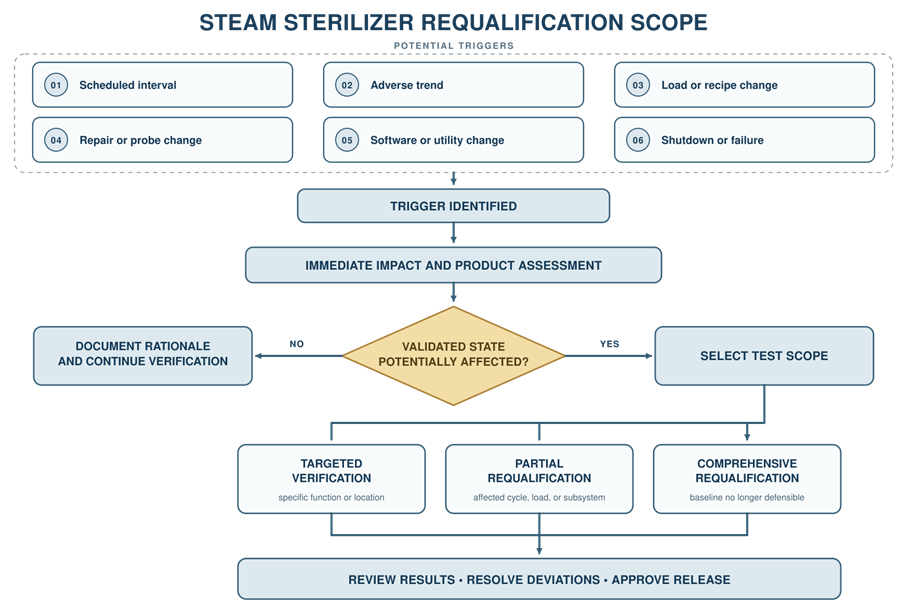
Determining Requalification Scope
Download the transparent trigger-to-scope diagram
| Outcome | Appropriate when | Examples |
|---|---|---|
| Documented assessment; no additional testing | The validated boundary and critical functions are demonstrably unaffected | Administrative document correction; nonfunctional label replacement |
| Targeted verification | One defined function or location is affected and the remaining baseline remains defensible | Door-seal replacement followed by leak testing; report-format change followed by record verification |
| Partial requalification | An affected cycle, load, subsystem, or operating function requires renewed qualification evidence | Vacuum-pump replacement; drain-probe replacement; new load within an existing family |
| Comprehensive requalification | Multiple critical functions changed, the equipment was relocated, or the original baseline is no longer defensible | Major control-system replacement; chamber modification; relocation with utility and configuration changes |
Scope selection should consider:
- Functions affected
- Critical parameters affected
- Load and cycle coverage
- Ability to bound the change
- Availability and quality of prior evidence
- Equipment and process history
- Potential product impact
- Uncertainty
- Failure detectability
- Common-cause implications
- Regulatory commitments
- Residual risk
Requalification scope should not be determined by the administrative name assigned to the change. A “minor” work order can affect a critical sensor or valve. A major corporate software project may have no effect on sterilizer control when the application and data paths remain unchanged.
Targeted Verification
Targeted verification confirms a specific affected function while retaining the remaining qualification baseline.
Examples include:
- Chamber leak test after door-seal work
- Calibration and loop check after transmitter replacement
- Alarm challenge after alarm-configuration correction
- Report verification after formatting changes
- User-access testing after role revision
- Backup restoration after infrastructure change
- Door-interlock verification after switch replacement
- Vacuum test after localized repair
- Steam-quality testing after a limited utility event
The rationale should explain why broader testing is unnecessary. It should identify the evidence showing that unrelated cycles, loads, functions, and locations remain adequately qualified.
Partial Requalification
Partial requalification may include selected OQ and PQ elements for the affected scope.
Examples include:
- Empty-chamber heat distribution after steam-control work
- Loaded heat penetration for a changed load
- Air-removal testing after vacuum-system modification
- Requalification of one recipe following phase-logic changes
- Requalification of a new minimum or maximum load
- Requalification of cycles affected by a drain-probe change
- BI challenges at identified difficult-to-sterilize locations
- Cooling and maximum-exposure studies after control changes
Partial requalification should not be described as “full requalification except for omitted tests.” The protocol should positively define the affected requirements, risks, tests, loads, and acceptance criteria.
Comprehensive Requalification
Comprehensive requalification may be appropriate after:
- Sterilizer relocation
- Major chamber or piping modification
- Replacement of the primary control system
- Loss of the controlled configuration baseline
- Multiple interacting changes
- Major utility redesign
- Repeated unexplained qualification failures
- Extensive equipment deterioration
- Long uncontrolled shutdown
- Introduction of substantially different cycles or load types
- Evidence that previous worst-case conclusions are no longer valid
Comprehensive requalification does not necessarily mean repeating every original IQ document check. The scope should re-establish the current installed baseline, critical functions, control configuration, empty-chamber capability, load performance, microbiological performance, and release conditions.
Requalification Study Design
The protocol should define:
- Trigger and background
- Sterilizer and system boundary
- Current configuration
- Changes since the previous study
- Product-impact assessment reference
- Previous qualification evidence retained
- Requirements and risks affected
- Cycles and loads included
- Bracketing rationale
- Worst-case conditions
- Sensor and BI locations
- Required number of runs
- Acceptance criteria
- Handling of failures
- Required pre- and post-use calibration
- Data-review requirements
- Release criteria
- Traceability
- Required procedure updates
Requalification should use the current approved:
- Load diagrams
- Recipe versions
- Instrument configuration
- Utility conditions
- Operating procedures
- Indicator requirements
- Routine acceptance criteria
Testing an obsolete load or recipe does not demonstrate continued suitability of the current process.
Thermal and Microbiological Testing
Depending on scope, requalification may include:
- Chamber leak testing
- Bowie-Dick-type or equivalent air-removal testing
- Empty-chamber heat distribution
- Loaded chamber distribution
- Load heat penetration
- Temperature–pressure relationship
- Equilibration evaluation
- F₀ calculation
- Biological-indicator challenges
- Cooling studies
- Drying evaluation
- Maximum-exposure assessment
- Product, container, closure, package, filter, or component evaluation
Sensor and BI locations should continue to challenge the difficult-to-heat or difficult-to-penetrate areas identified during development and prior qualification. Locations should be changed only when new evidence shows that another condition is more limiting.
Detailed thermal study requirements are addressed in Steam Sterilization Temperature Mapping, Heat Distribution, and Penetration.
Periodic Review
Periodic review should evaluate the complete evidence accumulated since the previous review or qualification.
Inputs should include:
- Routine-cycle history
- Number and type of cycles
- Cycle-parameter trends
- Alarm and abort history
- Deviations and investigations
- CAPA
- Failed or atypical cycles
- BI and chemical-indicator history
- Load and recipe changes
- Equipment and utility changes
- Maintenance and repair history
- Calibration history
- Out-of-tolerance results
- Software and configuration changes
- User and access changes
- Backup and recovery status
- Data-integrity events
- Shutdowns and utility interruptions
- Previous qualification and requalification results
- Open recommendations
- Regulatory commitments
- Procedure and training status
- Obsolescence and supplier-support status
The review should conclude:
- Whether the sterilizer remains in a qualified state
- Whether approved cycles and loads remain adequately supported
- Whether adverse trends exist
- Whether corrective action is required
- Whether requalification scope should change
- Whether the scheduled interval remains appropriate
- Whether monitoring should increase or decrease
- Whether load-family or bracketing claims remain valid
- Whether procedures require revision
- Whether continued use is acceptable
- Whether residual risks remain acceptable
Periodic review is not merely a list of completed records. It must evaluate their collective meaning.
Deviations and Failed Requalification Tests
A requalification failure should be investigated before repeat testing.
The investigation should determine:
- Whether the failure represents equipment or process performance
- Whether the test was executed correctly
- Whether the measurement system was suitable
- Whether the load was correctly prepared
- Whether utilities were acceptable
- Whether a configuration change occurred
- Whether routine cycles may be affected
- Whether previous qualification conclusions remain valid
- Whether product impact exists
- Whether repair, adjustment, or development work is required
A failed study should not be declared invalid solely because it produced an unacceptable result. Test invalidity requires evidence that the intended condition was not evaluated because of an assignable execution or measurement problem.
Additional successful runs do not cancel an unexplained failure.
Release After Requalification
Return to GMP use should require documented approval confirming:
- Required testing is complete
- Acceptance criteria are met
- Deviations are resolved
- Product-impact assessment is complete
- Current configuration is identified
- Approved recipes are identified
- Approved loads are identified
- Operating restrictions are documented
- Procedures are updated
- Training is complete
- Calibration and maintenance are current
- Routine monitoring requirements are active
- Periodic-review and requalification requirements are established
- Quality approval is complete
Release may apply to a limited scope. A sterilizer can be released for one unaffected cycle while another cycle remains unavailable, provided the separation is technically justified and effectively controlled.
Regulatory and Standards Context
For US drug manufacturing, 21 CFR 211.113(b) requires written procedures designed to prevent microbiological contamination, including validation of sterilization processes.
21 CFR 211.67 requires equipment to be maintained and, where appropriate, sterilized at suitable intervals.
21 CFR 211.68 requires routine calibration, inspection, or checking of automatic, mechanical, and electronic equipment under a written program.
21 CFR 211.100 requires approved production and process-control procedures and documentation and justification of deviations.
21 CFR 211.180(e) requires evaluation of production and control records, at least annually, to determine whether changes are needed.
FDA’s Sterile Drug Products Produced by Aseptic Processing guidance recommends periodic sterilization requalification, continued focus on difficult-to-penetrate load locations, maintenance, change control, calibration, and periodic verification including biological challenges.
FDA’s Process Validation: General Principles and Practices provides the broader continued-process-verification principle: ongoing collection and evaluation of process information to detect variability and maintain a state of control.
Relevant USP chapters include:
- USP
<1211>Sterility Assurance - USP
<1229>Sterilization of Compendial Articles - USP
<1229.1>Steam Sterilization by Direct Contact - USP
<1229.2>Moist Heat Sterilization of Aqueous Liquids - USP
<1229.5>Biological Indicators for Sterilization - USP
<1229.9>Physicochemical Integrators and Indicators for Sterilization
Cite the USP chapter numbers without adding paywalled USP links.
ISO 17665:2024 addresses development, validation, and routine control of moist-heat sterilization processes for medical devices. Its technical principles may be applied to pharmaceutical sterilization after documented applicability assessment, but its formal scope should not be misrepresented as a pharmaceutical-drug regulation.
Common Requalification Errors
Frequent errors include:
- Treating annual requalification as the complete continued-verification program
- Eliminating scheduled requalification without adequate justification
- Waiting for the scheduled date after a significant failure or change
- Reviewing only failed cycles and ignoring adverse trends
- Accepting automatic cycle completion as sufficient release evidence
- Failing to verify compliance with approved load patterns
- Treating every like-for-like replacement as having no validation impact
- Calibrating a replacement sensor without verifying its installation and control function
- Treating software patches as automatically insignificant
- Assessing utility changes only at the utility source
- Returning a sterilizer to service after repair without defining release tests
- Repeating a positive BI without investigating the original result
- Using acceptable physical data to dismiss a positive BI
- Using a negative BI to override unacceptable physical data
- Performing only empty-chamber mapping after a load change
- Requalifying only the maximum load
- Failing to evaluate maximum thermal exposure
- Selecting test scope from the administrative change category
- Omitting retrospective product-impact assessment
- Declaring failed tests invalid without evidence
- Repeating tests until acceptable results are obtained
- Failing to evaluate the effect of corrections on previous tests
- Performing periodic review as a checklist without trend evaluation
- Releasing the sterilizer without identifying approved recipes and loads
- Failing to transfer requalification conclusions into routine procedures
Conclusion
Steam sterilizer requalification is one component of a broader continued-verification program.
Routine-cycle review confirms that each load was processed according to approved requirements. Continued verification detects deterioration, variability, recurring failures, and uncontrolled change. Periodic review evaluates accumulated evidence and determines whether the existing control strategy remains adequate. Scheduled and event-driven requalification provide renewed physical and microbiological evidence where required.
The requalification scope should follow the affected function and risk. A defined local repair may require targeted verification. A load, recipe, sensor, vacuum, steam, or control change may require partial requalification. Major modifications, relocation, loss of configuration control, or multiple interacting changes may require comprehensive requalification.
The objective is not repetition of an old protocol. It is a defensible demonstration that the current sterilizer, current configuration, current utilities, current recipes, and current loads remain capable of delivering the approved sterilization process.