

Ethylene Oxide Sterilization Process and Equipment
Ethylene oxide sterilization is a low-temperature gaseous process used primarily for medical devices, combination products, components, and packaged assemblies that cannot tolerate steam, dry heat, or some radiation processes.
EtO can penetrate porous packaging and reach difficult internal locations, including narrow lumens, mated surfaces, and complex assemblies. That penetration capability does not make the process universally suitable. Effective sterilization depends on the combined control of:
- Product bioburden
- Product and packaging design
- Load configuration and density
- Preconditioning
- Temperature
- Humidity
- EtO concentration
- Exposure time
- Gas removal
- Aeration
- Material compatibility
- Residual acceptance
- Worker and environmental protection
EtO sterilization should be treated as an integrated system extending from preconditioning and gas supply through chamber processing, aeration, emission control, and product release.
Detailed cycle-development, microbiological qualification, half-cycle studies, performance qualification, routine release, and requalification requirements are addressed in Ethylene Oxide Sterilization Validation.
Application and Process Limitations
EtO is particularly useful for products containing:
- Heat-sensitive polymers
- Moisture-sensitive components
- Electronics
- Adhesives
- Long or narrow lumens
- Multiple assembled components
- Porous materials
- Complex internal pathways
- Preformed sterile-barrier systems
- Mixed materials with different thermal tolerances
FDA identifies EtO as an important method for devices that may be damaged by other sterilization technologies. It also notes its use for products made from polymers, metals, or glass and for devices having multiple packaging layers or difficult-to-reach locations.
EtO should not be selected solely because it operates at relatively low temperature. The product must also tolerate:
- Controlled temperature and humidity exposure
- Vacuum and pressure changes
- Contact with EtO
- Chemical interaction with EtO and its reaction products
- Extended aeration
- Repeated exposure where reprocessing or multiple cycles are claimed
- Potential changes in materials, adhesives, lubricants, coatings, electronics, and packaging
The broader comparison with other sterilization technologies is provided in Sterilization Methods and Selection for GMP Manufacturing.
Integrated EtO Process
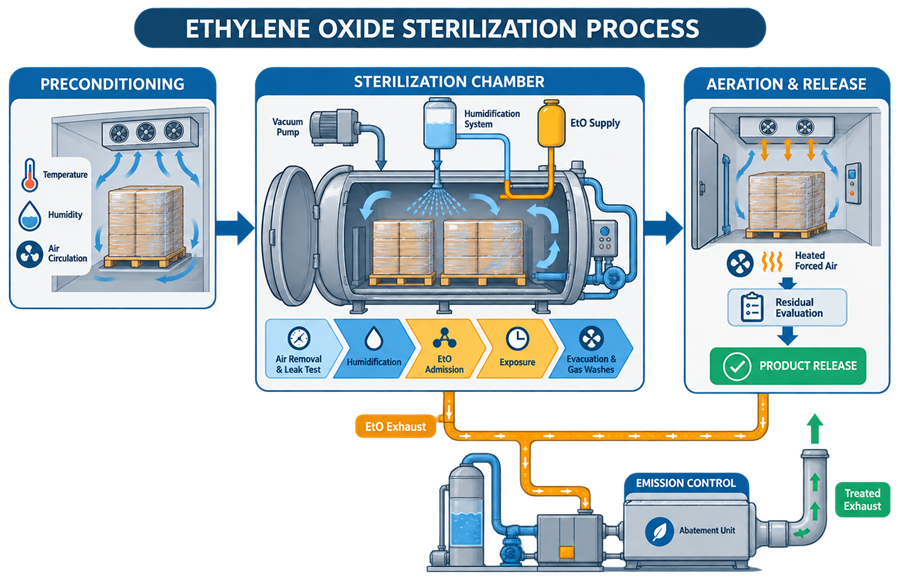
The process may include separate preconditioning, sterilization, and aeration areas, or some conditioning and aeration functions may be performed within the sterilizer chamber. The actual sequence must reflect the installed equipment, approved recipe, product characteristics, safety strategy, and emission-control design.
A representative process includes:
- Preconditioning
- Load transfer
- Air removal and leak testing
- Humidification and conditioning
- EtO admission
- Gas-distribution or conditioning dwell
- Exposure
- EtO evacuation
- Gas or air washes
- Controlled unloading
- Aeration
- Residual evaluation and release
Not every cycle uses identical pressure profiles, gas mixtures, vacuum depths, or wash sequences. The process description should reflect the actual validated cycle rather than a generic equipment sequence.
Preconditioning
Preconditioning prepares the product, packaging, and load for reproducible sterilization. It is commonly performed in a controlled room or chamber with heated, humidified, and circulated air.
Controlled variables may include:
- Room or chamber temperature
- Relative humidity
- Conditioning time
- Air circulation
- Load arrangement
- Product starting condition
- Minimum and maximum load
- Pallet and carton configuration
- Time from load preparation to preconditioning
- Time from preconditioning completion to sterilizer-cycle initiation
The objective is not merely to establish acceptable room conditions. The load must remain in the controlled environment long enough for the product and packaging to approach the required temperature and moisture condition.
Large, dense, tightly wrapped, or highly absorbent loads may require longer conditioning than small or open configurations. Product temperature and moisture equilibration may lag behind the surrounding room measurements.
Preconditioning Controls
The preconditioning system may include:
- Insulated room or enclosure
- Heating system
- Humidification system
- Supply and return air
- Circulation fans
- Temperature sensors
- Humidity sensors
- Independent monitoring
- Door controls
- Alarm functions
- Data recording
- Load-status identification
- Timers
- Backup or emergency controls
The validated range should include both minimum and maximum conditioning duration. Excessive conditioning may affect packaging, product materials, or presterilization bioburden, while insufficient conditioning may reduce process lethality.
Transfer to the Sterilizer
The interval between preconditioning and cycle initiation should be controlled when environmental exposure during transfer can alter load temperature or moisture.
Transfer controls may address:
- Maximum transfer time
- Transport route
- Ambient temperature and humidity
- Staging location
- Door-opening duration
- Load identification
- Chamber availability
- Delays and interruptions
- Disposition when the transfer limit is exceeded
A load should not be considered properly conditioned solely because the preconditioning-room record met its limits.
Air Removal and Leak Testing
Air removal creates the pressure conditions required for humidification and controlled EtO admission. It also reduces the possibility that trapped air will dilute the sterilant or create inconsistent gas distribution.
The cycle may use:
- A single vacuum
- Multiple vacuum pulses
- Vacuum combined with inert-gas additions
- Controlled pressure ramps
- Other validated conditioning sequences
Applicable parameters include:
- Starting chamber pressure
- Vacuum depth
- Evacuation rate
- Vacuum hold time
- Pressure-rise rate
- Leak-test duration
- Maximum permitted leakage
- Number of pulses
- Gas or air addition pressure
- Time between cycle steps
A successful chamber leak test establishes vessel integrity under the tested condition. It does not independently prove that sealed lumens, packages, cartons, or product cavities have been adequately evacuated.
Humidification and In-Chamber Conditioning
Moisture affects the resistance and susceptibility of microorganisms to EtO. Humidification may be performed during preconditioning, within the chamber, or through a combination of both.
Humidity may be introduced through:
- Controlled steam injection
- Metered water-vapor injection
- Humidified gas
- Validated conditioning pulses
Relevant controls may include:
- Water or steam quantity
- Injection duration
- Pressure rise
- Chamber temperature
- Conditioning dwell time
- Humidity or dew-point measurement
- Product temperature
- Load configuration
- Condensation prevention
Relative-humidity measurement under vacuum and changing gas composition can be technically difficult. Some systems therefore control and verify moisture through a combination of calibrated humidity instruments, water addition, pressure response, chamber temperature, and validated physical studies.
The control strategy should identify which measurement represents the actual process condition and should not rely on an unqualified displayed relative-humidity value.
Excessive moisture can cause:
- Condensation
- Packaging damage
- Label deterioration
- Material changes
- Increased residual formation
- Inconsistent gas distribution
Insufficient moisture can reduce microbial lethality.
EtO Admission and Gas Concentration
EtO may be supplied from:
- Cylinders
- Drums or larger pressure containers
- Bulk-storage systems
- Single-use cartridges for smaller systems
- Pure EtO or an approved diluted-gas system
The gas-supply configuration affects storage requirements, delivery equipment, flammability controls, facility classification, emergency response, and emission control.
Liquid EtO may be vaporized and admitted into the chamber through a controlled delivery system. Applicable components include:
- Storage container
- Weighing system
- Pressure regulator
- Vaporizer
- Heated delivery line
- Isolation valves
- Injection valves
- Mass-flow or metering device
- Pressure instrumentation
- Temperature instrumentation
- Gas detector
- Emergency shutoff
- Purge system
- Control-system interlocks
Dose and Concentration
EtO dose and chamber concentration are related but are not interchangeable.
Dose may be established from:
- Mass removed from the supply container
- Mass-flow measurement
- Metered liquid volume
- Cartridge quantity
- Validated pressure-volume-temperature calculation
Chamber concentration may be determined or supported by:
- EtO mass and effective chamber volume
- Chamber temperature
- Pressure change
- Direct gas measurement where installed
- Validated engineering calculation
The control strategy should account for chamber volume occupied by the load, gas absorption by the product and packaging, leakage, condensation, and measurement uncertainty.
Gas admission should be interlocked against conditions that could create an unsafe or uncontrolled mixture. The interlock sequence may evaluate:
- Door closure and lock status
- Chamber leak-test completion
- Required vacuum
- Chamber temperature
- Humidification completion
- Gas-supply availability
- Exhaust-system availability
- Abatement-system status
- Ventilation status
- Gas-detection status
- Valve alignment
- Emergency-stop status
Exposure Phase
The exposure phase provides the defined EtO contact conditions required for microbial inactivation.
The principal variables are:
- EtO concentration
- Temperature
- Moisture condition
- Exposure time
- Pressure profile
- Load configuration
- Product and packaging penetration
These variables interact. A longer exposure does not automatically compensate for inadequate moisture, insufficient EtO concentration, poor gas access, or an unrepresentative load configuration.
Exposure time should begin and end according to approved cycle logic. The boundary may depend on:
- Completion of EtO injection
- Achievement of a specified pressure
- Calculated or measured gas concentration
- Completion of a distribution dwell
- Chamber temperature
- Minimum required exposure conditions
The cycle record should clearly identify the actual exposure interval. It should not be reconstructed from the most favorable portion of the record after execution.
EtO Evacuation and Washing
After exposure, EtO must be removed from the chamber before the load can be safely transferred or unloaded.
Gas removal may include:
- Initial deep vacuum
- Controlled evacuation
- Nitrogen washes
- Filtered-air washes
- Repeated vacuum and repressurization pulses
- Heated chamber aeration
- Final ventilation or purge
The number, sequence, and endpoints of the washes should be defined by the validated recipe.
Critical controls may include:
- Vacuum depth
- Evacuation rate
- Wash-gas identity
- Wash pressure
- Number of washes
- Hold time
- Chamber temperature
- Exhaust-flow status
- Abatement-system availability
- Final chamber EtO concentration
- Door-unlock permissive
Air should not be introduced at a stage that creates an uncontrolled flammable mixture. The cycle sequence, inerting strategy, pressure profile, and gas concentration must be supported by the equipment safety design.
Exhaust streams from the chamber vacuum system and wash sequence should be routed through the approved emission-control system.
Aeration
Aeration removes EtO retained within the product, packaging, pallets, and shipping materials. It is part of the sterilization process and product-safety strategy, not merely a warehouse hold.
Aeration may occur:
- In the sterilizer chamber
- In a dedicated heated aeration cell
- In a controlled aeration room
- Through a validated combination of chamber and room aeration
Controlled parameters may include:
- Aeration temperature
- Airflow
- Air-exchange rate
- Aeration time
- Load arrangement
- Product density
- Room pressure
- Exhaust flow
- EtO concentration
- Transfer time
- Maximum room loading
- Product release time
Aeration systems commonly include:
- Heating
- Supply and exhaust fans
- Air-distribution ductwork
- Temperature monitoring
- EtO monitoring
- Door controls
- Load tracking
- Exhaust treatment
- Alarms
- Data recording
- Emergency ventilation
The most difficult product to sterilize may not be the slowest product to aerate. Materials that readily absorb EtO can receive adequate sterilant exposure yet require extended aeration before residual limits are met.
EtO Sterilizer and Supporting Equipment
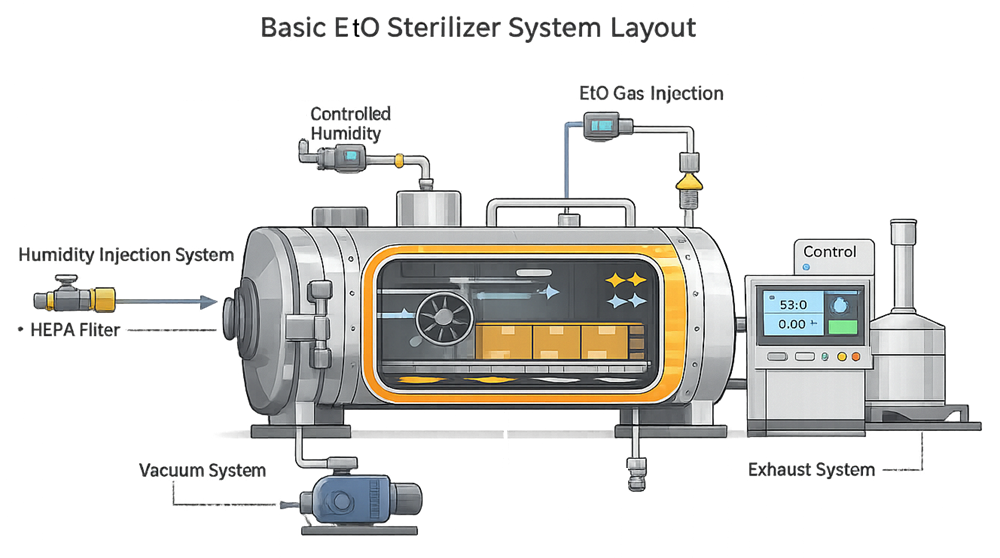
An industrial EtO sterilizer is an integrated system rather than a standalone pressure chamber.
Sterilization Chamber
The chamber may include:
- Vacuum-rated pressure vessel
- Heating jacket
- Insulation
- Single or double doors
- Door seals
- Mechanical and control-system interlocks
- Internal load rails
- Pallet or cart guides
- Gas-distribution piping
- Temperature sensors
- Pressure instruments
- Humidity instruments
- Gas-sampling points
- Internal circulation system
- Drainage or condensate handling
- Safety-relief devices
The chamber should support effective cleaning, inspection, calibration, maintenance, and leak testing.
Heating and Temperature Control
Temperature control may use:
- Steam or hot-water jacket
- Electrical heating
- Heated circulation system
- Preheated conditioning air
- Separate zone controls
Chamber-wall temperature, recirculated-gas temperature, drain temperature, and product temperature may respond differently. The approved control sensor must be shown to represent a process condition suitable for routine control.
Internal Circulation
Circulation fans or gas-distribution systems promote mixing of humidity and EtO within the chamber. Their effectiveness can be affected by:
- Load density
- Pallet spacing
- Carton arrangement
- Chamber obstructions
- Fan direction
- Fan speed
- Gas-injection location
- Return-path obstruction
- Equipment modification
Fan status alone does not establish adequate distribution. Distribution must be demonstrated during equipment qualification and process validation.
Vacuum System
The vacuum system may include:
- Vacuum pump
- Condenser or separator
- Knockout vessel
- Valves
- Pressure sensors
- Piping
- Seals
- Cooling utilities
- Exhaust connection
- Abatement interface
Performance should be evaluated for vacuum depth, evacuation rate, leakage, condensate management, and recovery after interruption.
Control and Data System
The automation system may control:
- Recipe selection
- Pressure transitions
- Temperature
- Humidification
- EtO injection
- Exposure time
- Wash sequence
- Aeration
- Valve alignment
- Door operation
- Alarms
- Aborts
- Data acquisition
- Batch reporting
Controls should prevent unauthorized recipe changes and unsafe operation. Applicable computerized-system controls include:
- User access
- Approved recipe versions
- Audit trails
- Alarm history
- Time synchronization
- Electronic records
- Backup and recovery
- Data retention
- Interface control
- Configuration change management
Critical Process and Load Variables
| Variable | Process significance | Representative routine evidence |
|---|---|---|
| Preconditioning temperature | Supports product heating and moisture equilibration | Room and load records |
| Preconditioning humidity | Supports microbial susceptibility and process consistency | Humidity record and conditioning time |
| Transfer time | Controls loss of established load conditions | Load movement timestamps |
| Chamber temperature | Affects reaction rate, gas behavior, penetration, and residual desorption | Calibrated chamber record |
| Vacuum and pressure profile | Supports air removal, gas admission, penetration, and washing | Chamber-pressure record |
| Humidification input | Establishes the required moisture condition | Water or steam addition and process response |
| EtO dose | Defines sterilant quantity admitted | Mass, flow, volume, or cartridge record |
| EtO concentration | Affects microbial lethality and residual loading | Validated measurement or calculation |
| Exposure time | Defines duration of EtO contact | Cycle timing record |
| Load configuration | Affects gas access, heat transfer, humidity, and evacuation | Approved load specification |
| Load density | Affects conditioning, penetration, gas absorption, and aeration | Pallet, carton, and product quantity |
| Wash sequence | Removes EtO and establishes safe unloading conditions | Number and endpoints of washes |
| Aeration temperature and time | Controls residual desorption | Aeration record |
| Aeration airflow | Removes desorbed EtO and supports room control | Airflow or ventilation status |
| Emission-control status | Supports environmental compliance and safe operation | Abatement and monitoring record |
Setpoints, operating ranges, alert limits, alarm limits, abort limits, and acceptance criteria should not be treated as interchangeable.
Load Configuration and Density
EtO performance is strongly influenced by how the product is arranged within:
- Primary packaging
- Secondary packaging
- Cartons
- Shippers
- Totes
- Pallets
- Chamber carts
- The sterilizer chamber
Load specifications should define:
- Product identity
- Product quantity
- Packaging configuration
- Carton dimensions
- Carton orientation
- Pallet dimensions
- Pallet pattern
- Maximum pallet height
- Wrapping method
- Chamber position
- Minimum and maximum load
- Permitted mixed loads
- Required spacing
- Load density or usable-volume relationship
- Representative photographs or diagrams
A maximum load may challenge heating, humidity penetration, EtO penetration, evacuation, and aeration. A minimum or less absorbent load may produce different gas-concentration or exposure conditions. Worst-case selection must therefore be related to the specific process attribute being evaluated.
Packaging and Sterile-Barrier Considerations
Packaging must permit EtO and moisture to reach the product while maintaining the sterile barrier after processing.
Evaluation should consider:
- Packaging permeability
- Seal design
- Seal integrity
- Package strength
- Porous and nonporous surfaces
- Vent areas
- Multiple packaging layers
- Folded or occluded regions
- Labels and inks
- Adhesives
- Protective trays
- Carton construction
- Paper content
- Pallet wrap
- Gas absorption
- Residual desorption
- Aging
- Distribution stress
Excess paper, dense cartons, restrictive pallet wrap, or excessive packaging layers may hinder gas and moisture penetration and may increase the quantity of retained EtO. FDA specifically notes that paper included in a sterilization load can hinder EtO access and increase the EtO required.
Packaging validation should represent the actual sterilized product and should evaluate the effects of preconditioning, vacuum, humidity, EtO exposure, aeration, aging, and distribution. ISO 11607-1 and ISO 11607-2 provide the principal framework for terminally sterilized medical-device packaging systems and packaging-process validation.
Material Compatibility
Material compatibility should be established before the sterilization process is finalized.
Assessment may include:
- Polymer strength
- Brittleness
- Cracking
- Discoloration
- Dimensional stability
- Adhesive performance
- Lubricant performance
- Coating integrity
- Optical properties
- Electrical function
- Battery performance
- Sensor accuracy
- Drug or biologic stability
- Chemical degradation
- EtO absorption
- Residual desorption
- Packaging integrity
- Effects of repeated exposure
Compatibility studies should use the complete process exposure, including preconditioning and aeration. A material coupon exposed to EtO without representative packaging, vacuum, humidity, and aging may not represent the finished device.
Multiple sterilization exposures should be evaluated when they can occur through:
- Manufacturing reprocessing
- Sterilization rework
- Product claims for repeated sterilization
- Component sterilization followed by final-product sterilization
- Validation or aging-study configurations
EtO Residuals
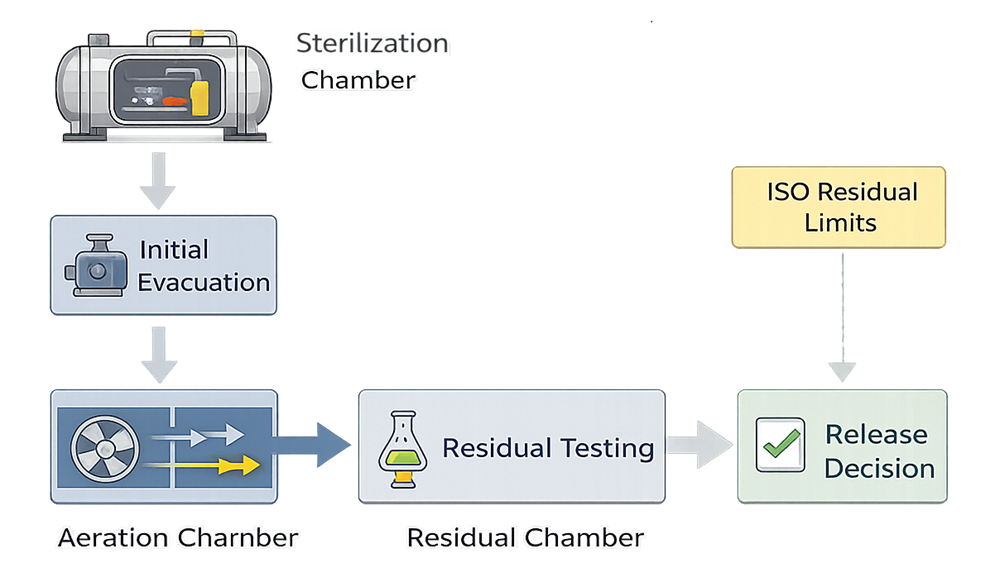
EtO and ethylene chlorohydrin can remain within the product after sterilization. Residual level depends on:
- Material composition
- Product mass
- Surface area
- Porosity
- Packaging
- EtO concentration
- Exposure time
- Temperature
- Humidity
- Aeration conditions
- Time after processing
- Storage and transportation conditions
ISO 10993-7:2026 establishes allowable limits and conformity-assessment methods for residual EtO and ethylene chlorohydrin in applicable medical devices. The 2026 edition does not establish device limits for ethylene glycol.
Residual control should define:
- Applicable allowable limits
- Device-contact category
- Patient population
- Product family
- Worst-case product
- Extraction method
- Analytical method
- Sampling time
- Sample quantity
- Aeration conditions
- Release criteria
- Handling of failures
- Periodic verification
- Change-assessment requirements
Residual testing performed immediately after extended laboratory aeration does not establish that commercial loads meet their limits under routine transfer, loading, aeration, storage, and shipping conditions.
Where parametric or time-based release is used for residual control, the relationship among product family, load configuration, sterilization exposure, aeration conditions, and residual dissipation must be established and maintained.
Worker Safety
EtO is toxic, flammable, reactive, and carcinogenic. Occupational controls should be integrated into facility design and equipment operation.
29 CFR 1910.1047 establishes:
- An action level of 0.5 ppm as an eight-hour time-weighted average
- A permissible exposure limit of 1 ppm as an eight-hour time-weighted average
- An excursion limit of 5 ppm averaged over 15 minutes
The standard also addresses exposure monitoring, regulated areas, engineering controls, work practices, respiratory protection, emergency response, medical surveillance, hazard communication, training, and records.
Facility controls may include:
- Dedicated gas-storage area
- Local exhaust ventilation
- Room ventilation
- Continuous gas detection
- Personal exposure monitoring
- Restricted access
- Emergency shutdown
- Emergency ventilation
- Leak detection
- Valve and piping inspection
- Written response procedures
- Evacuation routes
- Respiratory-protection program
- Medical surveillance
- Training
- Controlled cylinder or container handling
Fixed gas detectors support rapid warning and emergency response, but they do not automatically replace representative employee-exposure monitoring required by OSHA.
Door interlocks should prevent unloading until the approved pressure, wash sequence, gas concentration, ventilation, and safety permissives have been satisfied.
Emission Control
EtO emissions can arise from:
- Sterilizer chamber vents
- Vacuum-pump exhaust
- Chamber exhaust
- Aeration-room exhaust
- Gas-storage and delivery systems
- Product handling
- Fugitive leakage
- Abatement-system bypass or failure
Emission-control technologies may include:
- Catalytic oxidation
- Thermal oxidation
- Wet scrubbing
- Dry-bed treatment
- Multiple-stage control systems
- Permanent total enclosure
- Continuous emissions monitoring where required
Commercial sterilization facilities should assess the current requirements of 40 CFR Part 63, Subpart O, applicable state requirements, and facility permit conditions. EPA requirements have been subject to recent rulemaking and reconsideration; the current codified requirements and facility-specific compliance dates must be verified rather than inferred from an older validation record.
The emission-control system should be connected to sterilizer permissives when its unavailability would make EtO admission or evacuation unsafe or noncompliant.
Routine controls may include:
- EtO usage
- Exhaust flow
- Control-device temperature
- Pressure differential
- Destruction or removal performance
- Bypass status
- Continuous emissions data
- Alarm history
- Calibration
- Preventive maintenance
- Leak inspections
- Reporting records
Environmental compliance data and sterilization records serve different purposes, but both may be necessary to establish that the process operated as authorized.
Contract Sterilization
Use of a contract sterilizer transfers execution of specified activities. It does not transfer the medical-device manufacturer’s responsibility for product suitability, supplier control, regulatory submissions, approved specifications, change assessment, and final product release.
The relationship should be governed by an approved quality or technical agreement defining:
- Product and packaging specifications
- Product-family assignment
- Validated process specification
- Approved cycle or process definition
- Minimum and maximum load
- Pallet and carton configuration
- Preconditioning requirements
- Transfer limits
- Aeration requirements
- Biological-indicator and process-challenge-device responsibilities
- Routine monitoring
- Residual-testing responsibilities
- Batch-record content
- Deviation notification
- Investigation ownership
- Change-notification requirements
- Validation and requalification responsibilities
- Record retention
- Data access
- Audit rights
- Regulatory inspection support
- Product release authority
- Contingency and business-continuity controls
Sterilization Site and Chamber Equivalence
Transfer to another chamber or sterilization site requires documented assessment of:
- Chamber volume and geometry
- Gas-delivery system
- Humidification strategy
- Temperature-control system
- Pressure and vacuum capability
- Load arrangement
- Process-control limits
- Preconditioning
- Aeration
- Abatement-system constraints
- Validation evidence
- Product residuals
- Regulatory-submission impact
An assertion that two chambers use the same nominal recipe does not establish equivalence.
FDA states that changes to the sterilization method, process, or facility may require regulatory assessment for affected medical devices. The applicable pathway depends on device classification and submission type. Relevant FDA resources include the 510(k) sterility-information guidance and the transitional enforcement policy for certain Class III EtO facility changes.
Routine Process Control
Routine records should permit each load to be connected to:
- Product and lot
- Product family
- Load configuration
- Preconditioning record
- Transfer time
- Sterilizer and chamber
- Approved recipe
- Chamber temperature
- Pressure and vacuum profile
- Humidification input
- EtO dose
- Calculated or measured concentration
- Exposure time
- Wash sequence
- Aeration location
- Aeration temperature and time
- Alarms
- Interruptions
- Deviations
- Biological monitoring where applicable
- Residual status
- Final disposition
Automatic cycle-complete status should not replace review of the actual process record, alarms, configuration, interruptions, and data completeness.
Change Control and Continued Control
Changes requiring assessment may include:
- New product
- Product-family reassignment
- Packaging change
- Carton change
- Pallet-pattern change
- Load-density change
- Material change
- Supplier change
- EtO concentration reduction
- Exposure-time change
- Humidity change
- Preconditioning change
- Aeration change
- Chamber transfer
- Sterilization-site transfer
- Gas-supply change
- Control-system change
- Sensor replacement or relocation
- Vacuum-pump modification
- Door-seal replacement
- Circulation-system change
- Abatement-system change
- Facility ventilation change
- Extended shutdown
The assessment should address sterility assurance, process capability, residuals, product functionality, packaging, worker exposure, emissions, validation status, and regulatory-submission impact.
General change-impact principles are addressed in GMP Change Control and Validation Impact Assessment.
Boundary With EtO Validation
This article defines how the EtO process and equipment function. Formal validation must establish that the defined system consistently achieves the required sterility assurance level under approved and worst-case conditions.
Validation may include:
- Equipment IQ and OQ
- Physical performance qualification
- Microbiological performance qualification
- Product-family definition
- Process challenge device development
- Fractional-cycle studies
- Half-cycle or other cycle-definition approaches
- Full-cycle confirmation
- Temperature and humidity distribution
- Gas-concentration assessment
- Load-penetration studies
- Biological indicators
- Bioburden
- Residual studies
- Routine-control specification
- Requalification
Detailed requirements belong in Ethylene Oxide Sterilization Validation. BI selection and control are addressed in Biological Indicators for Sterilization Validation.
Regulatory and Standards Framework
For US medical devices, the Quality Management System Regulation, 21 CFR Part 820, applies together with product-specific regulatory and submission requirements. Internal application of these requirements is discussed in Medical Device Validation Requirements Under QMSR.
Principal technical standards include:
- ISO 11135:2014, with Amendment 1:2018 — development, validation, and routine control of EtO sterilization processes for medical devices
- ISO 10993-7:2026 — allowable limits and conformity assessment for EtO and ethylene-chlorohydrin residuals
- ISO 11607-1 and ISO 11607-2 — sterile-barrier systems and packaging-process validation
- ISO 11737-1 — determination and characterization of product bioburden
- ISO 11737-2 — sterility tests used in sterilization-process definition, validation, and maintenance
- ISO 11138-1 and ISO 11138-2 — general and EtO-specific biological-indicator requirements
ISO confirms that ISO 11135:2014 remains current following confirmation in 2024, although a replacement edition is under development. FDA’s recognized-standard database should be checked separately because FDA recognition may not immediately match the latest published ISO edition.
For pharmaceutical or combination-product applications, the applicable drug, biologic, device, and combination-product requirements must be assessed. EtO use for a drug product should not be justified solely through a medical-device standard.
The regulatory lifecycle is addressed in Sterilization Regulations, Standards, and Validation Lifecycle.
Common Process and Equipment Errors
Frequent deficiencies include:
- Treating EtO sterilization as only a gas-exposure phase
- Assuming room conditions establish product preconditioning
- Failing to control transfer time
- Using a nominal humidity display without qualifying the measurement
- Confusing EtO dose with chamber concentration
- Ignoring load-occupied chamber volume
- Failing to assess gas absorption by product and packaging
- Defining only a maximum load
- Allowing unapproved mixed loads
- Changing carton or pallet configuration without impact assessment
- Treating fan status as evidence of gas distribution
- Omitting wash-sequence limits
- Unlocking the chamber without complete safety permissives
- Treating aeration as an uncontrolled warehouse hold
- Using a sterility worst case as the residual worst case without justification
- Evaluating material compatibility without representative packaging and aging
- Ignoring repeated sterilization exposure
- Assuming contract sterilization transfers manufacturer responsibility
- Treating matching recipes as proof of chamber equivalence
- Changing sterilization sites without regulatory assessment
- Separating the sterilizer from its preconditioning and aeration systems
- Treating emission control as unrelated facility infrastructure
- Using fixed gas detectors as a substitute for occupational exposure monitoring
- Accepting automatic cycle-complete status without record review
- Failing to connect process changes to validation, residuals, safety, and emissions
Conclusion
Ethylene oxide sterilization is an integrated chemical, physical, microbiological, and safety-controlled process.
Preconditioning establishes the required product temperature and moisture condition. Air removal and humidification prepare the chamber and load. EtO admission and exposure provide the defined sterilant contact. Evacuation and washing remove chamber gas, while controlled aeration reduces product residuals. Gas handling, ventilation, worker protection, and emission abatement remain active throughout the process.
Process control depends on more than temperature, humidity, EtO concentration, and time. Product construction, packaging permeability, load density, chamber configuration, gas distribution, transfer time, evacuation, and aeration can materially affect the outcome.
The process is adequately defined only when the sterilization cycle, product and load specifications, equipment systems, residual controls, safety controls, emission requirements, outsourced responsibilities, and validation strategy form one controlled lifecycle.