

Pyrogens and Bacterial Endotoxins in GMP Manufacturing
Pyrogens are substances capable of producing a fever response when they enter the body through a clinically significant route. In pharmaceutical and medical-device manufacturing, pyrogen control is especially important for products administered parenterally, products contacting circulating blood, implantable products, and products introduced into cerebrospinal fluid.
Bacterial endotoxin is the pyrogen of greatest routine concern in sterile pharmaceutical manufacturing, but pyrogen and endotoxin are not interchangeable terms:
- Pyrogen is the broader category of fever-producing substances.
- Bacterial endotoxin is a specific pyrogen associated with the outer membrane of Gram-negative bacteria.
- Lipopolysaccharide, abbreviated LPS, is the principal chemical structure associated with bacterial endotoxin.
- Viable bacteria are living organisms capable of growth under suitable conditions.
- Endotoxin is nonviable bacterial material and does not reproduce.
- Sterilization controls viable microorganisms.
- Depyrogenation removes or inactivates pyrogenic material to a defined level.
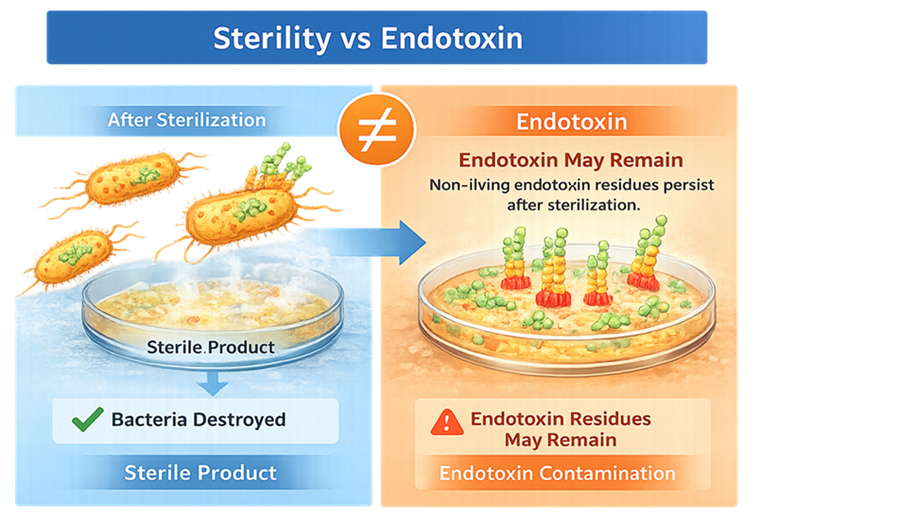
A product can meet its sterility requirement while containing an unacceptable level of endotoxin. Sterility assurance and endotoxin control must therefore be established through separate but coordinated control strategies.
Detailed program requirements are addressed in Endotoxin Control Strategy for Sterile Manufacturing. Analytical methods are addressed in Bacterial Endotoxin Testing: Methods, Limits, and Suitability.
What Is a Pyrogen?
A pyrogen is a substance that can cause fever after entering the bloodstream or another sensitive body compartment.
The clinical response depends on factors such as:
- Type of pyrogen
- Biological potency
- Amount administered
- Route of administration
- Rate of administration
- Patient body mass
- Patient condition
- Frequency of exposure
- Product volume and dosing regimen
Pyrogens may be divided broadly into:
Endotoxin Pyrogens
These are lipopolysaccharides associated with Gram-negative bacteria. They are the principal target of the compendial bacterial endotoxins test.
Non-Endotoxin Pyrogens
Non-endotoxin pyrogens can include substances associated with:
- Gram-positive bacteria
- Mycobacteria
- Fungi
- Viruses
- Other microbial components
- Certain nonmicrobial contaminants
The specific biological relevance depends on the product, manufacturing process, route of administration, and nature of the contaminant.
A bacterial endotoxins test does not establish the absence of every possible pyrogen. FDA explicitly distinguishes bacterial endotoxin from the broader pyrogen category, and USP <85> is intended to detect bacterial endotoxin rather than all pyrogenic substances. FDA’s current Pyrogen and Endotoxins Testing guidance addresses current testing expectations for drugs, biological products, and medical devices.
What Is Bacterial Endotoxin?
Bacterial endotoxin is biologically active material associated with the outer membrane of Gram-negative bacteria.
Examples of Gram-negative bacteria relevant to pharmaceutical manufacturing include species within genera such as:
- Pseudomonas
- Burkholderia
- Ralstonia
- Escherichia
- Enterobacter
- Klebsiella
- Serratia
- Proteus
Many Gram-negative organisms can survive or proliferate in water, aqueous solutions, wet equipment, hoses, tanks, piping, filters, and biofilms.
Endotoxin is not a living organism. It does not multiply independently and cannot be evaluated using only culture-based microbial methods.
FDA describes bacterial endotoxins as lipopolysaccharides associated with the outer membrane of Gram-negative bacteria. Endotoxin material can be released during bacterial growth, outer-membrane shedding, cell disruption, and lysis. FDA Bacterial Endotoxins/Pyrogens technical guidance discusses the characteristics, sources, limits, and testing of bacterial endotoxin.
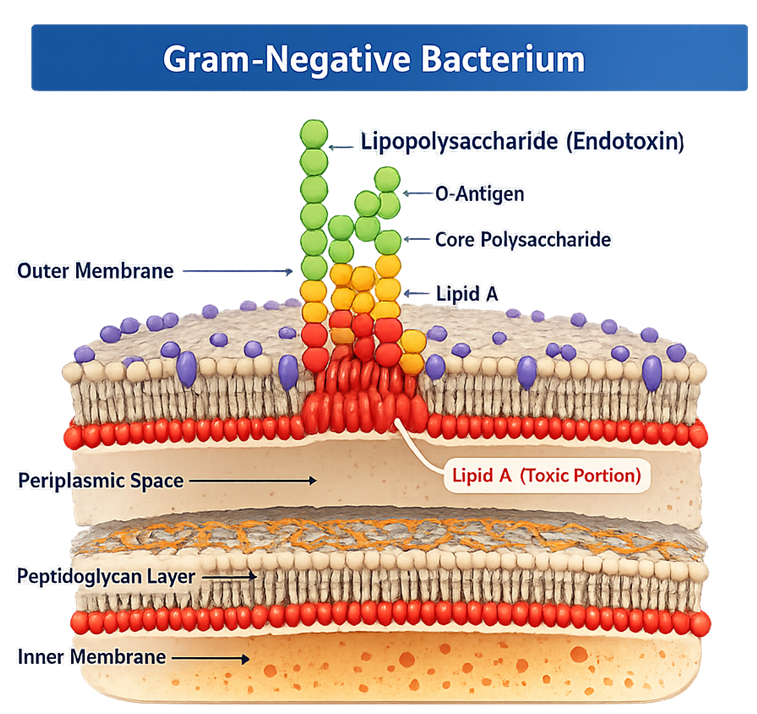
Lipopolysaccharide Structure
Lipopolysaccharide generally contains three structural regions:
- O-antigen
- Core polysaccharide
- Lipid A
O-Antigen
The O-antigen is the outer, repeating polysaccharide region. Its structure varies among bacterial strains and contributes to immunological differences among Gram-negative bacteria.
Core Polysaccharide
The core region connects the O-antigen to lipid A. It contains characteristic sugar residues and contributes to the organization of the LPS molecule.
Lipid A
Lipid A anchors LPS within the bacterial outer membrane and is primarily responsible for the characteristic biological activity associated with endotoxin exposure.
The illustration below shows where LPS is located within the Gram-negative bacterial envelope and how its three principal regions are organized.
The complete biological behavior of endotoxin depends on more than the presence of one chemical structure. Potency and test response can be affected by:
- Bacterial species and strain
- LPS structure
- Aggregation state
- Product formulation
- pH
- Ionic conditions
- Surfactants
- Proteins
- Chelating agents
- Storage
- Processing history
- Interaction with product or container surfaces
For this reason, endotoxin activity should not be inferred solely from a mass concentration.
Viable Microorganisms Versus Endotoxin
Viable microorganisms and endotoxin represent different hazards and require different measurements.
| Characteristic | Viable microorganisms | Bacterial endotoxin |
|---|---|---|
| Basic nature | Living or potentially culturable cells | Nonliving LPS-associated material |
| Principal source | Microbial contamination and growth | Gram-negative bacterial cells and cellular material |
| Ability to reproduce | Can multiply under suitable conditions | Cannot reproduce |
| Typical measurement | CFU, presence/absence, microbial identification | Endotoxin Units |
| Controlled by sterilization | Yes, through a validated microbial-lethality process | Not necessarily |
| Detected by sterility test | Viable organisms capable of recovery under test conditions | No |
| Detected by bioburden test | Viable organisms recovered by the method | No |
| Detected by BET | No direct viability measurement | Bacterial endotoxin activity |
| Principal prevention strategy | Contamination and microbial-growth control | Prevention of Gram-negative growth and endotoxin accumulation |
| Dedicated reduction process | Sterilization | Depyrogenation or validated removal |
A low bioburden result does not demonstrate a low endotoxin level. It only indicates the number of viable organisms recovered under the selected test conditions at the time of sampling.
Conversely, an endotoxin result does not establish:
- Absence of viable microorganisms
- Sterility
- Absence of non-endotoxin pyrogens
- Absence of other microbial residues
- Adequacy of environmental microbial control
How Endotoxin Accumulates
Endotoxin risk normally develops through a sequence:
- Gram-negative bacteria enter a material, solution, water system, or equipment train.
- Conditions permit survival or growth.
- Bacterial population and cellular material increase.
- Endotoxin is shed or released.
- A later process reduces or removes viable bacteria.
- Endotoxin remains unless a separate removal or inactivation mechanism is effective.
This sequence explains why microbial control must occur early. Waiting until terminal sterilization or sterilizing filtration can leave a product with acceptable viable-microbial results but unacceptable endotoxin.
The endotoxin burden can continue to matter even after the original bacteria:
- Die
- Are lysed
- Are removed by a sterilizing-grade filter
- Are rendered nonculturable
- Are killed during heat treatment
- Cannot be recovered by the bioburden method
Health Risks
Bacterial endotoxin activates the innate immune system. Exposure can initiate release of inflammatory mediators and produce a systemic response. Possible effects include:
- Fever
- Chills
- Headache
- Malaise
- Nausea
- Inflammatory response
- Changes in blood pressure
- Hypotension
- Cardiovascular effects
- Coagulation abnormalities
- Shock
- Organ injury
- Death in severe cases
The health risk is especially significant when endotoxin is introduced directly into:
- Bloodstream
- Cerebrospinal fluid
- Intraocular spaces
- Other normally sterile internal sites
Risk is related to the total endotoxin exposure delivered to the patient, not merely the concentration reported for the product.
A high-volume infusion containing a low endotoxin concentration can deliver a clinically significant total amount. A low-volume, highly concentrated product may require a limit expressed relative to product potency or maximum dose.
Intrathecal administration has a lower tolerated endotoxin exposure than ordinary parenteral administration because of the sensitivity of the route.
Sources in GMP Manufacturing
Endotoxin contamination can originate throughout the manufacturing lifecycle.
Pharmaceutical Water Systems
Water is a major endotoxin risk because Gram-negative organisms readily colonize wet environments. Potential sources include:
- Feed-water contamination
- Generation-system deficiencies
- Storage tanks
- Distribution loops
- Dead legs
- Low-flow branches
- Poorly drained piping
- Hose assemblies
- Point-of-use connections
- Heat exchangers
- Vent filters
- Sampling ports
- Biofilms
- Inadequate sanitization
- Extended shutdowns
- Improper restart
- Ambient or insufficiently controlled storage conditions
A water sample passing its microbial test does not prove that the system is free from biofilm or accumulated endotoxin. Sampling provides evidence about the sampled location and time; it does not replace sanitary design, circulation, sanitization, maintenance, and trend review.
Water categories and intended uses are addressed in Pharmaceutical Water Types and Intended Use.
Raw Materials and Active Ingredients
Raw materials can introduce endotoxin through:
- Water-based processing
- Biological origin
- Fermentation
- Inadequately controlled suppliers
- Natural-source materials
- Contaminated processing aids
- Extended wet-processing steps
- Inadequate purification
- Contaminated containers or liners
Biologically manufactured active ingredients require particular attention when Gram-negative organisms or endotoxin-containing raw materials are used or can enter the process.
Supplier test results should not be the only control when the material presents a significant endotoxin risk.
Manufacturing Equipment
Equipment can retain or generate endotoxin when it supports microbial survival or accumulation. Risk locations include:
- Tanks
- Transfer lines
- Pumps
- Valves
- Gaskets
- Seals
- Spray devices
- Filter housings
- Chromatography systems
- Ultrafiltration and diafiltration systems
- Sample ports
- Hoses
- Difficult-to-drain connections
- Product-contact surfaces
- Clean-in-place boundaries
Residues, retained moisture, surface roughness, incomplete drainage, long holds, and ineffective cleaning can support microbial growth and biofilm formation.
Product-Contact Components
Potential sources include:
- Vials
- Ampoules
- Bottles
- Stoppers
- Seals
- Syringe components
- Tubing
- Needles
- Implantable-device components
- Single-use assemblies
- Closures and caps
Washing can reduce particulate, chemical, microbial, and endotoxin contamination, but the process must be designed and controlled for the intended objective. Component sterilization alone does not establish endotoxin removal.
In-Process Solutions
Nonsterile aqueous solutions can support rapid microbial growth, especially when they are:
- Preservative-free
- Nutrient-rich
- Held at growth-supporting temperatures
- Stored for extended periods
- Repeatedly accessed
- Mixed in inadequately cleaned equipment
- Exposed through uncontrolled transfers
An acceptable initial bioburden result does not justify an unlimited hold time. Microorganisms can proliferate during the hold and increase the endotoxin burden before filtration or sterilization.
Process Gases and Environmental Sources
Compressed gases and room air are usually less direct endotoxin sources than water and wet equipment, but contamination can enter through:
- Condensate
- Contaminated gas lines
- Damaged filters
- Improperly stored components
- Personnel handling
- Wet cleaning tools
- Aerosolized water
- Maintenance activities
- Construction or facility disruptions
The significance depends on whether contamination can reach a product-contact surface or product stream.
Biofilms and Endotoxin Persistence
A biofilm is an organized microbial community associated with a surface and an extracellular matrix. Biofilms can form in:
- Water systems
- Tanks
- Piping
- Membranes
- Filters
- Hoses
- Poorly drained equipment
- Repeatedly wetted surfaces
Biofilms are important because they can:
- Continuously release microorganisms
- Release endotoxin
- Produce intermittent sampling results
- Resist routine sanitization
- Persist in protected surface locations
- Recolonize a system after temporary improvement
- Cause adverse microbial and endotoxin trends
A temporary decrease in planktonic microbial counts after sanitization does not necessarily demonstrate biofilm removal.
Persistence of Bacterial Endotoxin
Endotoxin is relatively resistant to many conditions that readily kill vegetative bacteria. Processes that may establish microbial lethality but should not automatically be credited with endotoxin destruction include:
- Moist heat sterilization
- Sterilizing filtration
- Ultraviolet treatment
- Chemical sanitization
- Radiation sterilization
- Vaporized hydrogen peroxide sterilization
- Routine surface disinfection
The actual effect depends on the process, material, endotoxin state, exposure, and validated reduction mechanism. None should receive depyrogenation credit without supporting evidence.
Endotoxin can:
- Remain after bacterial death
- Persist on equipment and component surfaces
- Adhere to glass, polymers, metals, and filters
- Form aggregates
- Interact with proteins or surfactants
- Be difficult to recover analytically
- Survive routine sterilization conditions
- Be redistributed by rinsing or processing
Apparent loss of detectable endotoxin is not always equivalent to biological destruction. Endotoxin may be removed, adsorbed, masked, diluted, or rendered poorly recoverable by the test method.
Sterility Does Not Establish Pyrogen Control
Sterility and endotoxin control have different acceptance objectives.
Sterility Objective
A sterilization process is developed and validated to achieve a defined probability of a viable microorganism surviving the process.
The process challenge and validation evidence address microbial lethality.
Endotoxin-Control Objective
An endotoxin-control program prevents unacceptable endotoxin introduction, formation, carryover, and persistence. Where required, a depyrogenation process demonstrates a defined endotoxin reduction.
The process challenge and validation evidence address endotoxin removal or inactivation.
The retained illustration below shows the essential distinction: bacterial cells may be killed during sterilization while endotoxin fragments remain.
A product can therefore be:
| Condition | Viable microorganisms | Endotoxin |
|---|---|---|
| Nonsterile with low endotoxin | Present or potentially present | Within the applicable limit |
| Sterile with unacceptable endotoxin | Not detected or controlled to the sterility requirement | Above the applicable limit |
| Sterile with controlled endotoxin | Controlled to the sterility requirement | Within the applicable limit |
| Depyrogenated component awaiting sterile handling | Endotoxin reduced to the validated level | Vulnerable to later microbial recontamination |
Terms should be used carefully:
- Sterile does not mean endotoxin-free.
- Meets the bacterial endotoxin limit does not mean free of all pyrogens.
- Depyrogenated should refer to a defined and validated reduction, not an assumed absolute absence.
- Pyrogen-free is an absolute expression and should not be used without a scientifically and regulatorily appropriate basis.
Sterilization Versus Depyrogenation
| Attribute | Sterilization | Depyrogenation |
|---|---|---|
| Primary target | Viable microorganisms | Pyrogenic material, commonly bacterial endotoxin |
| Principal objective | Defined sterility assurance | Defined endotoxin removal or inactivation |
| Typical biological challenge | Resistant microorganisms or biological indicators | Endotoxin challenge material |
| Common quantitative expression | Log microbial reduction, lethality, SAL | Log endotoxin reduction |
| Typical validated process | Moist heat, dry heat, radiation, EO, VHP, filtration where applicable | High-temperature dry heat or another demonstrated removal/inactivation method |
| Routine evidence | Cycle parameters, microbial controls, physical data | Thermal/process parameters, endotoxin challenge evidence, BET |
| Interchangeable conclusion | Does not prove depyrogenation | Does not by itself prove sterility |
Some high-temperature dry heat processes can achieve both sterilization and depyrogenation. Each claim still requires its own acceptance criteria and supporting evidence.
Depyrogenation Equipment and Process Design addresses ovens, tunnels, airflow, thermal design, operating parameters, and contamination-control interfaces.
Depyrogenation Validation and Qualification addresses thermal mapping, heat penetration, endotoxin challenge carriers, recovery controls, log-reduction calculations, worst-case loads, and requalification.
Endotoxin Units
Bacterial endotoxin activity is generally reported in Endotoxin Units, abbreviated EU.
An EU represents biological activity relative to a qualified endotoxin reference standard. It is not simply a count of molecules or a universal endotoxin mass.
Depending on the material or product, results and limits may be expressed as:
- EU/mL
- EU/mg
- EU/g
- EU/unit
- EU/device
- EU/component
- EU/microgram of active ingredient
- EU per patient dose
The correct expression depends on:
- Product dosage form
- Route of administration
- Maximum patient dose
- Administration period
- Product concentration
- Device extraction method
- Applicable monograph or specification
- Regulatory requirements
A reported result without the correct unit and sample basis is incomplete.
EU and International Units
Endotoxin activity may also be expressed in International Units. Within the applicable reference-standard framework, EU and IU are treated as equivalent units of biological activity.
EU Is Not CFU
Endotoxin Units and colony-forming units measure different properties:
- CFU estimates recoverable viable microorganisms.
- EU expresses endotoxin activity relative to a reference standard.
There is no universal conversion between CFU and EU.
One Gram-negative bacterial population can produce different endotoxin activity depending on:
- Species
- Strain
- Growth phase
- Culture conditions
- Cell density
- Cell disruption
- LPS structure
- Aggregation
- Sample matrix
- Recovery method
A microbial count cannot be converted reliably into an endotoxin result.
EU Is Not a Fixed Mass
There is no universally valid conversion of EU to nanograms for all endotoxin sources and conditions.
Mass-to-activity relationships vary with:
- Endotoxin source
- Purity
- Molecular structure
- Aggregation
- Reference preparation
- Analytical method
- Product matrix
Specifications and release decisions should therefore use the applicable activity units rather than an assumed universal mass conversion.
Endotoxin Limits and Patient Exposure
For many parenteral products, the endotoxin limit is derived from: L=MK , where:
- L is the endotoxin limit for the product
- K is the applicable threshold pyrogenic dose per kilogram of body mass
- M is the maximum product dose administered per kilogram within the defined period
The resulting unit depends on how M is expressed.
For example:
- If M is expressed in mL/kg, the limit is expressed in EU/mL.
- If M is expressed in mg/kg, the limit is expressed in EU/mg.
- If dose is defined by device or unit, an EU/device or EU/unit limit may apply.
The calculation must use:
- Correct route of administration
- Maximum labeled dose
- Correct administration period
- Correct product concentration
- Appropriate patient population
- Applicable compendial or regulatory requirements
The intrathecal route uses a more restrictive K value than ordinary parenteral administration.
Detailed limit calculations, maximum valid dilution, assay methods, and product suitability are addressed in Bacterial Endotoxin Testing: Methods, Limits, and Suitability.
Bacterial Endotoxins Test Boundary
The bacterial endotoxins test, or BET, measures bacterial endotoxin activity under defined assay conditions.
USP <85> includes bacterial-endotoxin methods based on reagent activation, including gel-clot and photometric approaches. The official chapter and applicable product monographs should be consulted when defining the test.
BET does not directly establish:
- Sterility
- Bioburden
- Absence of Gram-positive bacteria
- Absence of fungi
- Absence of viruses
- Absence of all non-endotoxin pyrogens
- Absence of residual microbial DNA
- Effectiveness of a sterilization process
- Effectiveness of a cleaning process
- Absence of biofilm
- Complete endotoxin removal from the manufacturing system
A passing finished-product BET result is one component of control. It does not replace prevention, upstream monitoring, system design, cleaning, sanitization, component preparation, validated depyrogenation, or investigation of adverse trends.
Analytical equipment, software, users, calculations, audit trails, interfaces, and data integrity are addressed in Endotoxin Testing Systems: Qualification, Software, and Data Integrity.
Masking, Inhibition, and Poor Recovery
Endotoxin present in a sample may not always produce the expected analytical response.
Potential causes include:
- pH
- Salts
- Chelating agents
- Proteins
- Surfactants
- Lipids
- High viscosity
- Product color
- Turbidity
- Adsorption
- Container surfaces
- Sample preparation
- Endotoxin aggregation
- Time and temperature
- Reagent selection
- Excessive dilution
These effects can produce inhibition, enhancement, masking, or poor recovery.
A low reported result is not meaningful unless:
- The method is suitable for the product.
- The selected dilution is valid.
- Positive-product controls meet acceptance criteria.
- The assay remains within its validated range.
- Sample handling preserves recoverable endotoxin.
- The result is supported by acceptable controls.
Analytical testing should not be used to compensate for an uncontrolled manufacturing process.
Endotoxin Reduction and Removal
Endotoxin control may involve prevention, removal, inactivation, or a combination.
Potential mechanisms include:
- Prevention of Gram-negative microbial growth
- Control of aqueous hold times
- Sanitary equipment design
- Water-system sanitization
- Cleaning and rinsing
- Component washing
- Distillation
- Ultrafiltration
- Adsorptive purification
- Chromatographic removal
- Phase separation
- High-temperature dry heat
- Disposal of contaminated material
- Replacement of biofilm-affected components
No mechanism should receive credit without evidence appropriate to its intended use.
For example:
- A sterilizing-grade filter should not automatically be credited with reliable endotoxin removal.
- A component washer should not automatically be called a depyrogenation process.
- A thermal cycle should not receive an endotoxin-reduction claim solely because it sterilizes.
- A sanitization cycle should not be assumed to remove established biofilm or accumulated endotoxin.
Prevention Is More Reliable Than End-Product Correction
Once endotoxin enters a finished product, correction may be technically difficult or impossible without damaging the product or altering its quality.
The preferred hierarchy is:
- Prevent contamination.
- Prevent Gram-negative microbial growth.
- Minimize wet holds and stagnant conditions.
- Remove microorganisms and residues early.
- Apply validated depyrogenation where appropriate.
- Protect depyrogenated surfaces and components from recontamination.
- Monitor relevant process stages.
- Test appropriate materials, components, intermediates, and finished products.
- Trend results and investigate adverse signals.
- Maintain control through change management and periodic review.
Finished-product testing samples only a limited portion of a batch. It cannot reconstruct an uncontrolled process or prove uniform distribution of endotoxin throughout the batch.
GMP Control Implications
An effective GMP endotoxin-control strategy should connect:
- Product risk
- Administration route
- Patient exposure
- Raw-material controls
- Supplier qualification
- Pharmaceutical water
- Equipment design
- Cleaning
- Sanitization
- Biofilm control
- Component preparation
- Hold times
- Bioburden monitoring
- Depyrogenation
- Aseptic processing
- BET method suitability
- Analytical-system qualification
- Specifications
- Trending
- Deviations
- CAPA
- Change control
- Periodic review
The control strategy should identify where endotoxin can:
- Enter the process
- Increase through microbial growth
- Accumulate
- Persist
- Be removed
- Be inactivated
- Be sampled
- Be measured
- Be reintroduced after treatment
Investigating Endotoxin Excursions
An endotoxin excursion should not be investigated only as a laboratory event. The investigation should evaluate:
- Test validity
- Product inhibition or enhancement
- Sample preparation
- Reagent and standard performance
- Analyst execution
- Instrument and software records
- Raw materials
- Water-system data
- Bioburden trends
- Environmental or utility events
- Cleaning and sanitization
- Equipment holds
- Wet component holds
- Manufacturing duration
- Filter history
- Maintenance
- Biofilm risk
- Other affected products or batches
- Historical endotoxin data
- Potential nonuniform contamination
A passing retest does not by itself invalidate the original result or establish that the batch is acceptable.
The investigation should determine whether the result indicates:
- An isolated analytical problem
- Product-specific interference
- Contaminated sampling materials
- A local equipment problem
- Water-system deterioration
- Biofilm
- Raw-material contamination
- Excessive microbial growth before sterilization
- Inadequate component preparation
- A broader loss of process control
Common Misunderstandings
Common errors include:
- Using pyrogen and endotoxin as exact synonyms
- Assuming all pyrogens are bacterial endotoxins
- Assuming BET detects every pyrogen
- Treating endotoxin as a living organism
- Treating CFU and EU as interchangeable
- Converting EU to mass using one universal factor
- Assuming low bioburden proves low endotoxin
- Assuming a sterile product is adequately controlled for endotoxin
- Assuming sterilizing filtration removes endotoxin
- Assuming steam sterilization depyrogenates the load
- Assuming a clean surface is endotoxin-free
- Assuming a negative sample proves absence of system biofilm
- Treating a component washer as a depyrogenation process without validation
- Using finished-product testing as the primary control strategy
- Ignoring endotoxin generated before sterilization
- Ignoring wet hold times
- Ignoring Gram-negative water organisms
- Failing to distinguish removal from destruction
- Interpreting poor recovery as absence of endotoxin
- Using absolute terms such as “endotoxin-free” without an appropriate basis
Conclusion
Pyrogens are fever-producing substances. Bacterial endotoxin is one important category of pyrogen and is the principal routine pyrogen concern in many pharmaceutical and medical-device applications.
Endotoxin is lipopolysaccharide-associated material from the outer membrane of Gram-negative bacteria. It is not alive, does not reproduce, and is not measured by sterility or bioburden tests.
Sterilization and depyrogenation address different hazards. A validated sterilization process controls viable microorganisms but does not automatically remove or inactivate endotoxin. A product can therefore be sterile and still present an unacceptable pyrogenic risk.
Effective endotoxin control begins with prevention of Gram-negative contamination and growth. It then integrates water control, sanitary design, cleaning, component preparation, hold-time control, bioburden monitoring, validated depyrogenation, suitable BET methods, trending, investigation, and lifecycle governance.