

Radiation Sterilization Validation and Dose Control
Radiation sterilization validation establishes and maintains evidence that a defined product receives an absorbed dose sufficient to achieve the specified sterility assurance level without exceeding the dose the product and packaging can tolerate.
The same overall validation framework applies to gamma and electron-beam sterilization, but the qualification evidence is not interchangeable. Gamma and e-beam differ in radiation type, penetration, dose rate, product presentation, dose distribution, equipment controls, interruption behavior, and material response.
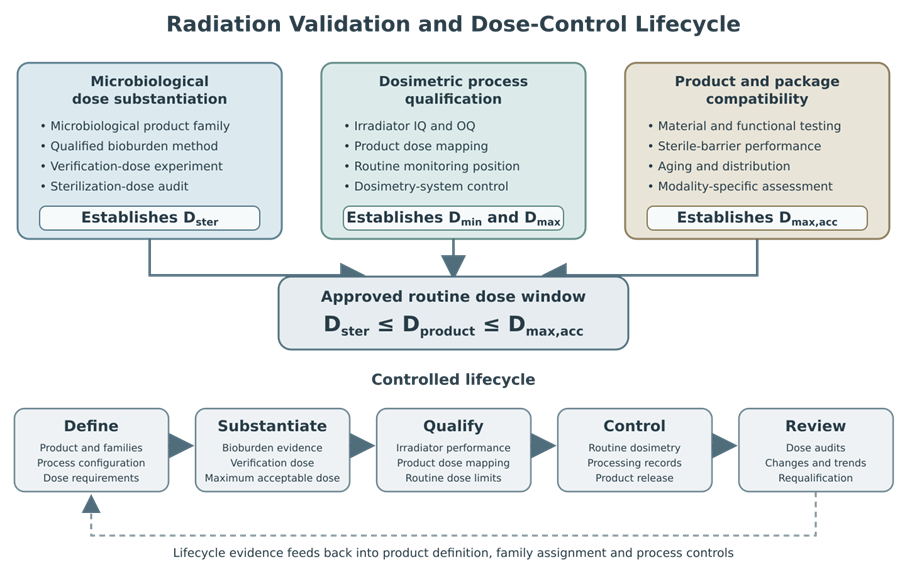
A complete radiation sterilization validation program integrates three evidence streams:
- Microbiological dose substantiation establishes the sterilization dose based on the product bioburden and the selected statistical method.
- Dosimetric process qualification demonstrates that the irradiation process delivers the required dose throughout the defined product configuration.
- Product and packaging compatibility establishes the maximum acceptable dose and confirms that safety, quality, function, and sterile-barrier performance remain acceptable.
The routine dose specification must satisfy both boundaries: Dmin≥Dster and: Dmax≤Dmax,acc
where:
- Dmin is the minimum absorbed dose within the processed product
- Dster is the substantiated sterilization dose
- Dmax is the maximum absorbed dose within the processed product
- Dmax,acc is the established maximum acceptable product dose
This article covers gamma and electron-beam validation, including product families, bioburden, dose establishment, verification-dose experiments, dose mapping, routine dosimetry, sterilization-dose audits, changes, transfers, and requalification.
The engineering principles of the two modalities are addressed separately in Gamma Radiation Sterilization Process and Electron Beam Sterilization Process.
Regulatory and Standards Framework
ISO 11137-1:2025 establishes requirements for development, validation, and routine control of radiation sterilization processes for medical devices. FDA completely recognizes this edition as consensus standard 14-611. FDA also recognizes ISO 11137-2:2013, including Amendment 1:2022, for sterilization-dose establishment and dose auditing.
The principal standards include:
- ISO 11137-1:2025 — process development, validation, and routine control
- ISO 11137-2:2013, including Amendment 1:2022 — sterilization-dose establishment, dose substantiation, product families, and dose audits
- ISO 11137-3:2017 — dosimetric aspects of development, validation, and routine control
- ISO/TS 11137-4:2020 — process-control guidance
- ISO 13004:2022 — VDmaxSD methods for selected sterilization doses
- ISO 11737-1:2018, including Amendment 1:2021 — bioburden enumeration and microbial characterization
- ISO 11737-2:2019 — tests of sterility used in sterilization-process definition, validation, and maintenance
ISO 11137 is written for medical devices. Its principles may support pharmaceutical components, combination products, biologics, tissue-based products, and other healthcare products, but application outside the standard’s stated scope requires product-specific technical and regulatory justification.
General expectations for validation governance are addressed in Sterilization Regulations, Standards, and Validation Lifecycle.
Radiation Sterilization Validation Lifecycle
Radiation sterilization validation is not one dose-mapping study or one sterility test. It is a controlled lifecycle containing the following connected activities:
- Define the product and manufacturing process.
- Establish the microbiological product family.
- Qualify the bioburden test method.
- collect representative bioburden data.
- Select the dose-establishment method.
- Perform the verification-dose experiment.
- Establish or substantiate the sterilization dose.
- Establish the maximum acceptable dose.
- Qualify the irradiation facility and equipment.
- Perform product dose mapping.
- Define routine processing parameters and dosimeter positions.
- Approve routine processing and release controls.
- Perform sterilization-dose audits.
- Monitor bioburden and process performance.
- Assess deviations and changes.
- Requalify or transfer the process when required.
The three evidence streams must remain aligned. A valid sterilization dose cannot compensate for an unqualified irradiation configuration. Acceptable dose mapping cannot compensate for an invalid bioburden assumption. Neither establishes that the product tolerates the maximum absorbed dose.
Product Definition
The validated product definition should identify the attributes that can affect microbial challenge, absorbed-dose distribution, or radiation compatibility.
The definition may include:
- Product name and identification
- Intended use
- Materials of construction
- Product dimensions and mass
- Product density and local density distribution
- Components, subassemblies, liquids, gels, or metal parts
- Manufacturing location
- Manufacturing processes
- Environmental controls
- Product-cleaning processes
- Assembly methods
- Bioburden controls
- Primary package
- Sterile-barrier system
- Secondary and tertiary packaging
- Product count per carton
- Internal carton arrangement
- Inserts and dividers
- Carton dimensions and weight range
- Irradiation orientation
- Carrier, tote, pallet, or conveyor configuration
- Permitted partial-load arrangements
- Maximum acceptable dose
- Required sterilization dose
The definition must be sufficiently specific to distinguish routine variation from a change that could affect the validated process.
Product Families and Processing Categories
Two different grouping concepts are used in radiation sterilization, and they should not be treated as interchangeable.
Microbiological Product Family
A microbiological product family supports dose establishment and sterilization-dose auditing. Products may be grouped when they have sufficiently similar factors affecting the number and resistance of microorganisms.
Relevant factors may include:
- Raw materials
- Components
- Manufacturing environment
- Personnel contact
- Water exposure
- Assembly processes
- Cleaning processes
- Manufacturing location
- Product complexity
- Bioburden level
- Bioburden variability
- Microbial types
- Seasonal effects
- Manufacturing controls
The representative product used for dose establishment or audit should provide an appropriate microbiological challenge for the family. Selection should be based on documented evidence, not merely the largest product or the product having the highest commercial volume.
Irradiation Processing Category
A processing category groups products having comparable dose-distribution behavior within a specific irradiation process. Relevant factors may include:
- Product mass
- Bulk density
- Local density concentrations
- Physical dimensions
- Materials affecting attenuation
- Carton construction
- Internal loading pattern
- Orientation
- Carrier or tote configuration
- Irradiator path
- Conveyor lane
- Single- or double-sided exposure
- Dose-uniformity relationship
- Routine monitoring position
Products in one microbiological family do not automatically share one dose map. Conversely, products having similar dose-distribution characteristics do not automatically belong to the same microbiological family.
A product can therefore be represented by:
- One family assignment for dose establishment and dose auditing
- A different processing-category assignment for dose mapping and routine irradiation
Each grouping decision should define its purpose, representative product, scientific rationale, limitations, and change triggers.
Bioburden Method Qualification
Bioburden is the population of viable microorganisms present on or in a product before sterilization. Radiation dose-establishment methods use bioburden data to support the relationship between the verification dose and the sterilization dose. The bioburden method should address:
- Product sampling
- Sample item portion, where used
- Extraction method
- Extraction fluid
- Agitation or recovery technique
- Recovery efficiency
- Correction factor
- Filtration or plating method
- Culture media
- Incubation conditions
- Counting method
- Detection limitations
- Neutralization of antimicrobial residues
- Product inhibition
- Method controls
- Data calculations
- Microbial characterization where required
Method suitability should demonstrate that microorganisms can be recovered from the product under the selected test conditions.
A low reported result does not demonstrate low bioburden when the extraction method has poor recovery or the product inhibits microbial growth.
Bioburden Sampling and Monitoring
Bioburden samples used for dose establishment should represent routine manufacturing. The sampling strategy should consider:
- Different manufacturing lots
- Manufacturing shifts
- Raw-material lots
- Equipment trains
- Manufacturing lines
- Manufacturing locations
- Seasonal conditions
- Maximum pre-sterilization hold time
- Packaging state
- Cleaning or assembly variations
- Products manufactured after shutdown or maintenance
- Products representing the defined family
The record should preserve individual unit and lot results rather than reporting only a combined average.
Bioburden review should consider:
- Average bioburden
- Unit-to-unit variation
- Lot-to-lot variation
- Recurring microbial types
- Unusual or resistant organisms
- Manufacturing trends
- Excursions
- Method changes
- Recovery-efficiency changes
- Results near the limit applicable to the selected dose-establishment method
The bioburden limit supporting a selected dose method is not automatically an appropriate routine manufacturing action limit. Routine limits should reflect process capability, product risk, method variability, and the assumptions used in dose substantiation.
Selection of the Sterilization-Dose Method
ISO 11137-2 provides more than one method for establishing or substantiating a sterilization dose. Method selection should be documented before study execution. Common approaches include:
Method 1
Method 1 uses average bioburden and a verification-dose experiment to establish a product-specific sterilization dose. It may be appropriate when:
- A product-specific dose is required
- Bioburden is adequately characterized
- The available dose range supports the resulting sterilization dose
- The manufacturer can maintain the associated bioburden controls
Method 2
Method 2 uses incremental-dose experimentation to characterize the product’s microbial response and derive the sterilization dose. It may be useful when:
- A dose is to be established from product-specific microbial-resistance information
- The bioburden population requires more direct experimental characterization
- The additional experimental complexity is justified
VDmax15 and VDmax25
VDmax methods substantiate a selected sterilization dose of 15 kGy or 25 kGy when the product bioburden and other method conditions meet the applicable requirements.
VDmax does not establish that 25 kGy is universally adequate. It substantiates the selected dose for a defined product or product family through prescribed bioburden evaluation and a verification-dose experiment.
VDmaxSD
ISO 13004:2022 provides VDmaxSD methods for selected sterilization doses of 17.5, 20, 22.5, 27.5, 30, 32.5, or 35 kGy. It also provides corresponding dose-audit methods.
Method selection should consider:
- Required sterility assurance level
- Product bioburden
- Bioburden variability
- Available sample quantity
- Product cost
- Maximum acceptable dose
- Irradiator dose capability
- Applicable regulatory pathway
- Existing product-family data
- Ongoing dose-audit burden
The approved protocol should reference the applicable standard and method revision. Statistical tables, sample quantities, permitted positives, and retest provisions should be taken directly from the controlled standard rather than reconstructed from an uncontrolled summary.
Verification-Dose Experiment
A verification-dose experiment challenges the assumptions used to establish or substantiate the sterilization dose. The verification dose is lower than the routine sterilization dose. It is selected according to the applicable method and represents a defined probability of a viable microorganism surviving the reduced exposure.
The experiment normally includes:
- Confirm the product or product-family definition.
- Collect the required bioburden data.
- Calculate or select the verification dose using the applicable method.
- Select representative test units.
- Irradiate the units at the verification dose.
- Measure the dose actually delivered.
- Perform tests of sterility on the irradiated units.
- Evaluate positive results against the method-specific acceptance criteria.
- Complete any permitted confirmatory or corrective sequence.
- Approve or reject the dose-substantiation conclusion.
The verification-dose irradiation should control and document:
- Product identity
- Lot identity
- Product-family assignment
- Sample quantity
- Packaging state
- Irradiation facility
- Radiation modality
- Product orientation
- Verification-dose target
- Measured absorbed dose
- Dosimeter system
- Dosimeter location
- Dose-measurement uncertainty
- Irradiation date
- Sterility-test initiation
- Sterility-test method
- Positive-test investigation
The delivered verification dose must remain within the limits specified by the selected method. A result cannot be interpreted solely from the nominal irradiator setting.
Tests of Sterility Used in Validation
The test used in a verification-dose experiment is a test of sterility performed during sterilization-process definition or maintenance. It is not routine finished-product sterility testing and should not be confused with compendial release testing.
ISO 11737-2:2019 applies to tests performed on products exposed to a reduced treatment during sterilization-process definition, validation, and maintenance.
The method should address:
- Product immersion or defined sample item portion
- Test-medium suitability
- Product inhibition
- Neutralization where necessary
- Aseptic manipulation
- Incubation conditions
- Observation
- Positive and negative controls
- Identification of recovered microorganisms where needed
- Laboratory deviations
- False-positive investigation
- Data integrity
A positive result should not automatically be dismissed as laboratory contamination. It should be evaluated through the decision rules of the selected dose method and a documented investigation.
Sterilization-Dose Approval
Successful completion of the prescribed method supports approval of the sterilization dose for the defined product or product family. The approval record should identify:
- Selected method
- Applicable standard revision
- Product-family rationale
- Representative product
- Manufacturing locations
- Bioburden data
- Verification-dose calculation
- Measured verification dose
- Sterility-test results
- Deviations
- Statistical conclusion
- Approved sterilization dose
- Required dose-audit method and frequency
- Associated change triggers
- Limitations of the approval
The sterilization dose represents the required minimum absorbed dose. It does not establish the routine irradiator settings, maximum dose, product configuration, or routine dosimeter position. Those controls are established through product compatibility studies and process qualification.
Maximum Acceptable Dose
The maximum acceptable dose is the highest absorbed dose at which the product and packaging remain acceptable through the intended shelf life. It should be established through product-specific studies addressing applicable attributes such as:
- Identity
- Strength
- Purity
- Potency
- Chemical degradation
- Biological activity
- Material properties
- Dimensions
- Mechanical strength
- Color
- Transparency
- Flexibility
- Brittleness
- Elastomer performance
- Adhesives
- Coatings
- Electronics
- Sensors
- Battery performance
- Package seal strength
- Package integrity
- Sterile-barrier performance
- Label adhesion and readability
- Functional performance
- Biocompatibility
- Extractables and leachables
Studies should represent the highest credible absorbed dose, including:
- Routine process variation
- Dose-measurement uncertainty
- Maximum mapped dose
- Product-position variation
- Permitted repeat exposure
- Aging
- Distribution
- Storage
- Worst-case material grade
- Relevant temperature and oxygen conditions
A product shown to tolerate a nominal dose of 25 kGy is not automatically qualified for a routine process that can deliver more than 25 kGy at the maximum-dose location.
Compatibility evidence developed with gamma radiation should not automatically be transferred to e-beam. Dose rate, temperature history, oxygen exposure, and dose distribution can affect material response.
Irradiation-Facility Qualification
The irradiation facility should be qualified before product performance qualification.
Installation Qualification
Installation qualification may address:
- Irradiator identification
- Equipment configuration
- Source or accelerator identification
- Conveyor and product-handling systems
- Shielding and safety systems
- Control and monitoring systems
- Utilities
- Instrumentation
- Calibration status
- Software and recipe configuration
- Product-status controls
- Drawings and specifications
- Maintenance provisions
- Dosimetry laboratory equipment
For outsourced sterilization, the product manufacturer may leverage the contract facility’s qualification documentation through supplier assessment and documented approval. The manufacturer does not need to reproduce the facility’s complete IQ but must establish that the approved facility is suitable for the intended product process.
Operational Qualification
Operational qualification characterizes irradiator performance across its defined operating range.
Gamma OQ may include:
- Irradiator path
- Source configuration
- Source position
- Timer or conveyor operation
- Product carriers
- Reference-material dose mapping
- Density ranges
- Process interruptions
- Source movement and safe-storage response
- Monitoring and alarm functions
E-beam OQ may include:
- Electron energy
- Beam current
- Beam power
- Scan width
- Scan uniformity
- Conveyor speed
- Product-to-window geometry
- Beam interruptions
- Conveyor stops
- Product tracking
- Single- and double-sided exposure controls
- Monitoring and alarm functions
OQ establishes the relationship between equipment parameters and dose delivery. It does not establish the product-specific minimum- and maximum-dose locations.
Product Performance Qualification and Dose Mapping
Performance qualification demonstrates dose distribution in the actual product and packaging configuration. Dose mapping should determine:
- Minimum-dose locations
- Maximum-dose locations
- Dose variation within individual product units
- Dose variation within cartons, totes, or carriers
- Dose variation among processing positions
- Dose uniformity
- Leading- and trailing-edge effects
- Lane-to-lane effects
- Effect of product orientation
- Effect of partial loads
- Effect of neighboring product
- Relationship between routine dosimeter response and product-dose extremes
- Reproducibility among qualification runs
The dose uniformity ratio is: DUR=DminDmax
DUR applies only to the mapped product, packaging, loading configuration, irradiator, process path, and operating conditions.
Dose mapping should not assume that:
- The geometric center is the minimum-dose location.
- The product surface is the maximum-dose location.
- The same locations apply to every product in a family.
- Average density adequately represents local density.
- The routine dosimeter measures either Dmin or Dmax.
Actual locations must be established experimentally.
Dose-Mapping Protocol
The protocol should define:
- Objective
- Product and packaging configuration
- Processing category
- Irradiator
- Radiation modality
- Operating parameters
- Product orientation
- Carton, tote, or carrier loading
- Number of qualification runs
- Dosimeter type
- Dosimeter locations
- Dosimeter identification
- Expected dose gradients
- Measurement uncertainty
- Acceptance criteria
- Treatment of missing or damaged dosimeters
- Deviation handling
- Data analysis
- Required report contents
Dosimeters should be sufficiently numerous and appropriately positioned to characterize credible dose extremes and gradients.
Additional dosimeters may be required around:
- Dense components
- Metal assemblies
- Liquids
- Nested products
- Product interfaces
- Carton corners
- Center regions
- Beam-entry and exit surfaces
- Leading and trailing edges
- Different conveyor lanes
- Product-turning interfaces
- Partial-load boundaries
The selected dosimetry system must provide adequate spatial resolution for the expected dose gradient. Thin-film dosimeters are often appropriate for e-beam mapping because of steep gradients and limited penetration.
Qualification Acceptance
The qualification should demonstrate that the defined routine process can maintain: Dster≤Dproduct≤Dmax,acc throughout the product configuration.
Acceptance should consider:
- Measured minimum dose
- Measured maximum dose
- Dose-measurement uncertainty
- Run-to-run variation
- Product-position variation
- Operating-parameter variation
- Routine dosimeter relationship
- Approved configuration limits
Merely obtaining one acceptable Dmin and one acceptable Dmax is insufficient when qualification results do not establish a reproducible relationship to routine processing controls.
Routine Monitoring Position
Routine dosimeters are placed at defined, reproducible locations associated with the processed product. The routine monitoring position:
- May be outside the product
- May be on a carton or carrier
- Is not necessarily the minimum-dose location
- Is not necessarily the maximum-dose location
- Must be accessible and reproducible
- Must have an established relationship to product dose
Performance qualification should establish the relationship among:
- Routine monitoring dose
- Product minimum dose
- Product maximum dose
- Product configuration
- Irradiator operating parameters
- Processing position
Routine dose limits should be derived from the qualification relationship and its uncertainty. A generic DUR should not be applied to a different product, orientation, carrier, facility, or modality without demonstrated equivalence.
Dosimetry-System Control
Dosimetry is the quantitative basis for radiation-process validation and routine control. Machine settings alone do not demonstrate absorbed dose.
The dosimetry system includes:
- Dosimeter
- Dosimeter batch
- Packaging or holder
- Identification
- Placement method
- Irradiation conditions
- Storage conditions
- Measurement instrument
- Calibration curve
- Calculation method
- Corrections
- Software
- Reference standards
- Personnel
- Procedures
- Records
ISO 11137-3:2017 provides guidance on dosimetry used in development, validation, and routine control.
Controls should address:
- Appropriate dose range
- Radiation type and energy
- Dose-rate or pulse effects
- Temperature
- Humidity
- Light exposure
- Pre-irradiation conditioning
- Post-irradiation response
- Time between irradiation and measurement
- Dosimeter thickness and orientation
- Reader wavelength or instrument settings
- Calibration traceability
- Calibration frequency
- Batch-to-batch variation
- Measurement uncertainty
- Out-of-range results
- Damaged or missing dosimeters
- Data acquisition and calculations
- Electronic-record controls
Calibration should be traceable to an appropriate national or international measurement standard. Calibration conditions should represent the intended irradiation and measurement conditions or include justified corrections.
Measurement Uncertainty
Dose results should be interpreted with their measurement uncertainty.
Uncertainty may arise from:
- Calibration-standard uncertainty
- Dosimeter variability
- Dosimeter positioning
- Instrument repeatability
- Calibration-curve fitting
- Temperature
- Humidity
- Dose rate
- Post-irradiation development
- Reader drift
- Operator technique
- Product-position variation
The validation report should state how uncertainty was estimated and how it was considered when establishing:
- Verification-dose acceptance
- Product minimum dose
- Product maximum dose
- Routine dosimeter limits
- Process margins
- Release decisions
Uncertainty should not be added or subtracted mechanically without a defined decision rule. The method should be scientifically justified and consistently applied.
Routine Processing Specification
The approved process specification should define the parameters and product attributes necessary to reproduce the qualified dose distribution.
Depending on the modality, it may include:
- Product identification
- Processing category
- Carton dimensions
- Product weight or density range
- Internal loading pattern
- Product orientation
- Carrier or tote
- Pallet configuration
- Irradiator path
- Gamma dwell time or conveyor setting
- Source configuration or applicable source range
- Electron energy
- Beam current
- Scan width
- Conveyor speed
- Conveyor lane
- Number of passes
- Single- or double-sided exposure
- Routine dosimeter type
- Routine dosimeter position
- Routine dosimeter acceptance range
- Sterilization dose
- Maximum acceptable dose
- Permitted interruption response
- Product-status controls
Changes outside the approved specification require documented assessment before use.
Routine Processing and Product Release
Before irradiation, the facility should verify:
- Product identity
- Lot or batch number
- Quantity
- Approved processing specification
- Product configuration
- Carton or carrier identification
- Irradiator
- Required orientation
- Required number of passes
- Dosimeter placement
- Product treatment status
During and after processing, the record should provide traceability to:
- Processing date and time
- Irradiator identification
- Operating parameters
- Product path
- Exposure sequence
- Interruptions and alarms
- Routine dosimeters
- Dosimeter results
- Deviations
- Operator actions
- Final treatment status
Release should be based on documented conformance to the validated process, including:
- Acceptable routine dosimetry
- Acceptable equipment records
- Correct product configuration
- Completion of all required exposures
- Acceptable deviation disposition
- Confirmation of treatment status
Routine sterility testing is not a substitute for validated processing and is not normally the basis for release of radiation-sterilized product.
Sterilization-Dose Audits
A sterilization-dose audit provides periodic microbiological evidence that the established sterilization dose remains valid for the product family.
The audit normally includes:
- Obtain representative product from routine manufacturing.
- Perform bioburden testing as required by the selected method.
- Establish the applicable verification dose.
- Irradiate the prescribed number of units at the verification dose.
- Confirm the delivered verification dose through dosimetry.
- Perform tests of sterility.
- Evaluate the results against the method-specific acceptance criteria.
- Complete any required investigation or confirmatory action.
- Document continued acceptance or escalation.
Audit frequency and sample requirements depend on the selected method, production conditions, historical control, and the applicable standard.
The audit program should define:
- Product-family rotation
- Representative-product selection
- Manufacturing-location coverage
- Seasonal coverage
- Low-volume product handling
- Missed or delayed audits
- Bioburden review
- Positive-result investigation
- Confirmatory audit provisions
- Escalation to dose re-establishment
- Regulatory assessment
Failed or Questionable Dose Audits
A failed or questionable dose audit requires controlled evaluation. It should not be addressed by automatically increasing the routine sterilization dose.
The investigation should consider:
- Product identity
- Product-family assignment
- Manufacturing lot
- Bioburden result
- Bioburden recovery method
- Microbial types
- Verification-dose calculation
- Delivered verification dose
- Dosimeter performance
- Sterility-test method
- Laboratory controls
- Product inhibition
- Manufacturing changes
- Raw-material changes
- Cleaning changes
- Facility or environmental events
- Previous audit and trend data
Potential outcomes include:
- Laboratory investigation
- Confirmatory dose audit where permitted
- Increased bioburden monitoring
- Product-family reassessment
- Manufacturing corrective action
- Temporary processing restrictions
- Dose re-establishment
- Product-impact assessment
- Regulatory assessment
- CAPA
Continued use of the existing sterilization dose should be supported by the applicable method and documented quality approval.
Deviations and Process Interruptions
Radiation-process deviations may include:
- Incorrect product configuration
- Incorrect irradiator recipe
- Missing dosimeter
- Dosimeter outside the qualified range
- Gamma conveyor interruption
- E-beam accelerator trip
- Conveyor stop
- Incorrect beam current or energy
- Scan failure
- Missed second-sided exposure
- Repeat exposure
- Product-orientation error
- Product-tracking failure
- Dosimetry-reading error
- Irradiation outside the validated window
The investigation should determine:
- Product location during the event
- Radiation state
- Exposure already received
- Potential minimum dose
- Potential maximum cumulative dose
- Ability to reconstruct the event
- Reliability of available dosimetry
- Product compatibility with additional exposure
- Status of adjacent product
- Need for supplemental mapping or testing
Reprocessing may help achieve the minimum dose while causing the maximum acceptable dose to be exceeded. It therefore requires specific technical justification.
Change Control
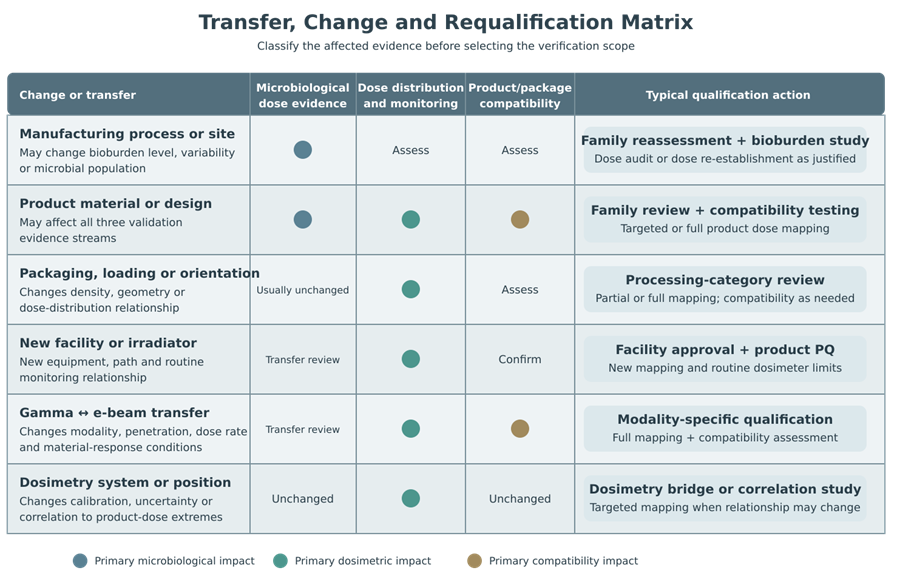
Changes should be evaluated against the three validation evidence streams.
| Change category | Principal concern | Typical evaluation |
|---|---|---|
| Product material or design | Bioburden, dose distribution, compatibility | Family assessment, compatibility testing, mapping |
| Manufacturing process or site | Bioburden level or microbial population | Bioburden study, family assessment, dose audit |
| Packaging or loading | Density, geometry, orientation, dose distribution | Processing-category review, targeted or full mapping |
| Sterilization dose | Microbiological substantiation and product tolerance | Dose-establishment assessment, compatibility review |
| Irradiator or conveyor | Dose delivery and routine monitoring relationship | Facility qualification and product mapping |
| Gamma source configuration | Dose distribution and exposure relationship | OQ assessment and mapping |
| E-beam energy or scan system | Penetration and beam distribution | OQ and product mapping |
| Dosimetry system | Calibration, response, uncertainty, comparability | Method qualification and bridging |
| Routine dosimeter position | Relationship to product dose extremes | Mapping or correlation study |
| Software or recipe | Parameter control, tracking, records | Computerized-system assessment and functional testing |
| Bioburden method | Recovery and historical comparability | Method suitability and data bridging |
| Sterility-test method or laboratory | Verification-dose interpretation | Method assessment and comparative evidence |
Change assessment should identify the affected evidence and define a corresponding action. A generic statement that the change “does not affect validation” is insufficient without supporting rationale.
Transfer Between Irradiation Facilities
Transfer to another facility or irradiator is not merely an administrative supplier change. The assessment should address:
- Radiation modality
- Irradiator design
- Product path
- Carrier or tote
- Source or accelerator characteristics
- Product orientation
- Density limitations
- Dose distribution
- Routine monitoring position
- Dosimetry system
- Measurement uncertainty
- Process interruptions
- Software and product tracking
- Quality agreement
- Regulatory submissions or commitments
Where the product, manufacturing process, microbiological family, and bioburden remain unchanged, the established sterilization dose may remain applicable when the transfer conditions of the governing standard are met.
The receiving irradiator still requires product-specific process qualification. This normally includes:
- Facility approval
- Processing-specification development
- Product dose mapping
- Establishment of minimum- and maximum-dose locations
- Establishment of the new routine monitoring position
- Confirmation of routine dosimeter limits
- Product compatibility review
- Approval of routine records and release controls
A successful dose map at the original facility does not qualify the receiving irradiator.
Transfer Between Radiation Modalities
Transfer between gamma and e-beam requires additional assessment because the radiation fields and product responses can differ. The transfer should consider:
- Electron versus photon penetration
- Product mass thickness
- Local density
- Dose rate
- Temperature history
- Oxygen exposure
- Product orientation
- Single- or double-sided exposure
- Dose distribution
- Dose uniformity
- Material response
- Packaging response
- Dosimeter response
- Processing throughput
- Interruption and repeat-exposure risks
The microbiological sterilization dose may remain scientifically relevant when the product and bioburden definition remain valid and the applicable transfer requirements are met. This does not eliminate the need for:
- New modality-specific equipment qualification
- New product dose mapping
- New routine dosimeter correlation
- Product and packaging compatibility assessment
- Updated processing specification
- Change-control and regulatory assessment
Requalification
Requalification scope should correspond to the affected validation evidence.
Documentation Update or Confirmatory Review
May be appropriate when:
- The change is administrative
- Product and process parameters remain unchanged
- No effect on bioburden, dose distribution, dosimetry, or compatibility is credible
- Existing evidence remains directly applicable
Targeted Verification
May be appropriate when:
- A limited parameter or configuration change has a defined impact
- The established dose map remains substantially applicable
- Additional dosimeters can confirm the affected region
- A dosimetry-system bridge is required
- A product-family assignment requires focused confirmation
Partial Dose Mapping
May be appropriate when:
- Specific minimum- or maximum-dose regions may shift
- One carton position, lane, orientation, or loading boundary changes
- The unchanged portions remain supported by prior qualification evidence
Full Product Dose Mapping
May be required when:
- Product density or geometry changes materially
- Packaging configuration changes
- Irradiator or facility changes
- Radiation modality changes
- Product orientation changes
- E-beam energy, conveyor path, scan geometry, or number of exposures changes
- Gamma source configuration or product path changes
- The previous routine monitoring relationship is no longer applicable
Dose Audit or Dose Re-establishment
May be required when:
- Bioburden increases or changes materially
- A new manufacturing site is added
- Manufacturing controls change
- Product-family assumptions are no longer supported
- Dose audits fail
- A new product is added to the microbiological family without sufficient evidence
Compatibility Reassessment
May be required when:
- Materials change
- Formulation changes
- Packaging changes
- Maximum process dose increases
- Repeat exposure is introduced
- Radiation modality changes
- Shelf life changes
Requalification decisions should document both the tests selected and the tests not repeated, including the justification for continued reliance on existing evidence.
Periodic Review and Continued Verification
Periodic review should integrate information from both the manufacturer and irradiation facility. Review inputs may include:
- Bioburden trends
- Sterilization-dose audits
- Routine dosimetry
- Minimum- and maximum-dose trends
- Dosimeter calibration
- Measurement uncertainty
- Processing deviations
- Irradiator interruptions
- Product nonconformances
- Complaints
- Product-family changes
- Processing-category changes
- Supplier changes
- Facility changes
- Equipment maintenance
- Software changes
- Regulatory changes
- Qualification status
- Quality-agreement performance
- CAPA effectiveness
Potential outcomes include:
- Continued use without additional testing
- Procedure or specification revision
- Increased monitoring
- Targeted dose mapping
- Full requalification
- Compatibility reassessment
- Dose audit
- Dose re-establishment
- Product-family restructuring
- Supplier or facility remediation
Periodic review does not replace required dose audits, routine dosimetry, or event-driven requalification.
Manufacturer and Contract-Irradiator Responsibilities
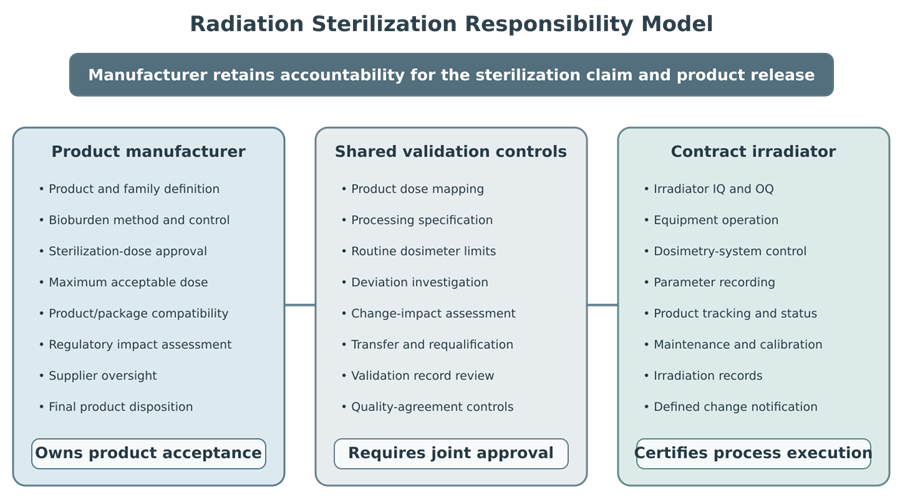
When irradiation is outsourced, responsibility is shared but not transferred completely to the contract facility.
Product Manufacturer
The manufacturer normally retains responsibility for:
- Product definition
- Microbiological product-family approval
- Bioburden control
- Dose-establishment strategy
- Sterilization-dose approval
- Maximum acceptable dose
- Product and packaging compatibility
- Processing-category approval
- Validation review
- Change-impact assessment
- Regulatory assessment
- Product release
- Contract-facility oversight
Contract Irradiator
The contract irradiator normally controls:
- Irradiator operation
- Facility IQ and OQ
- Equipment maintenance
- Equipment calibration
- Dosimetry-system operation
- Routine dosimeter placement
- Product handling and tracking
- Process-parameter recording
- Treatment-status control
- Irradiation records
- Equipment deviations
- Notification of defined changes
Shared Controls
Shared controls normally include:
- Product dose mapping
- Processing-specification approval
- Routine dosimeter limits
- Deviation investigation
- Change assessment
- Requalification
- Record review
- Quality agreements
- Regulatory inspection support
The quality agreement should define:
- Ownership of protocols and reports
- Dose-establishment records
- Dosimetry records
- Irradiation records
- Release documentation
- Change-notification requirements
- Deviation-notification timelines
- Investigation responsibilities
- Audit rights
- Record-retention periods
- Business-continuity provisions
- Transfer and requalification responsibilities
Common Validation Deficiencies
Common deficiencies include:
- Treating 25 kGy as a universal sterilization dose
- Confusing dose establishment with dose mapping
- Using one product-family rationale for both microbiology and dose distribution
- Failing to qualify bioburden recovery
- Using unrepresentative bioburden samples
- Ignoring bioburden variability
- Using uncontrolled statistical tables
- Treating the verification dose as a routine processing dose
- Failing to document the delivered verification dose
- Treating validation sterility testing as routine release testing
- Failing to establish the maximum acceptable dose
- Testing compatibility only at the nominal sterilization dose
- Ignoring dose-measurement uncertainty
- Assuming the routine dosimeter is located at Dmin or Dmax
- Assuming minimum- and maximum-dose locations from geometry
- Using a dose map from another irradiator without transfer qualification
- Transferring gamma compatibility conclusions directly to e-beam
- Changing product orientation without mapping
- Changing dosimetry systems without bridging
- Increasing throughput outside the qualified parameter relationship
- Automatically increasing dose after a failed audit
- Reprocessing interrupted product without evaluating cumulative maximum dose
- Relying on the contract irradiator without adequate manufacturer oversight
- Performing calendar-based review without evaluating actual lifecycle data
- Repeating qualification tests without linking the scope to identified risks
Conclusion
Radiation sterilization validation requires coordinated microbiological, dosimetric, and product-performance evidence.
Bioburden data and verification-dose experiments establish or substantiate the sterilization dose. Product compatibility studies establish the maximum acceptable dose. Irradiator qualification and product dose mapping demonstrate that the defined routine process can deliver an absorbed dose between those limits.
Routine dosimetry, equipment records, configuration control, sterilization-dose audits, change assessment, and periodic review maintain the validated state.
Gamma and e-beam follow the same high-level lifecycle, but their equipment qualification, dose distribution, routine controls, transfer requirements, and compatibility evidence must reflect the actual radiation modality and product configuration.