

VHP Sterilization Validation and Lifecycle Control
Validation of a vaporized hydrogen peroxide process must demonstrate that the defined system, cycle, load, and operating conditions consistently achieve the intended microbiological result.
The required evidence depends on the process claim:
- Medical-device sterilization requires validation of a defined sterilization process for specified devices, packaging, loads, equipment, and routine controls.
- Isolator, closed RABS, transfer-chamber, and room treatment normally establishes bio-decontamination of defined accessible surfaces—not terminal sterilization of a drug product or automatic sterility of everything within the enclosure.
The distinction affects the microbiological endpoint, biological-indicator strategy, acceptance criteria, release decision, and applicable regulatory framework.
Validation should connect:
- Intended use and process claim
- Equipment and enclosure characterization
- Cycle development
- Load and material definition
- Physical-distribution studies
- Chemical-indicator studies
- Biological-indicator selection and placement
- Operational and performance qualification
- Aeration and residual control
- Routine-cycle review
- Change control
- Periodic review
- Requalification
The operating principles, cycle phases, concentration, humidity, condensation, airflow, applications, and material effects are addressed in Vaporized Hydrogen Peroxide Sterilization Process.
Sterilization and Bio-Decontamination Claims
The approved validation plan should state the intended claim before cycle development begins.
| Application | Appropriate claim | Principal validation objective |
|---|---|---|
| Medical-device sterilizer | Sterilization of defined medical devices | Demonstrate a validated process capable of achieving the specified sterility-assurance objective |
| Isolator | Bio-decontamination of defined accessible internal surfaces | Demonstrate the specified microbial reduction throughout the approved configuration |
| Closed RABS | Bio-decontamination of defined enclosure surfaces | Demonstrate adequate distribution and microbial reduction under the approved closed operating state |
| Transfer chamber | Bio-decontamination of exposed external material surfaces | Demonstrate treatment of surfaces exposed under the approved loading configuration |
| Room or suite | Room bio-decontamination | Demonstrate the specified reduction at representative and difficult-to-reach exposed locations |
| Product-contact component | Sterilization only when specifically validated for that component | Demonstrate direct sterilant contact, microbial inactivation, material suitability, and maintenance of the sterile state |
ISO 22441:2022 applies to low-temperature vaporized hydrogen peroxide sterilization processes for medical devices. It excludes hydrogen peroxide decontamination systems used for rooms, enclosures, and environmental spaces. FDA completely recognizes ISO 22441 and classifies VH₂O₂ as an Established Category A medical-device sterilization method. FDA’s recognition database identifies the recognized standard and its scope.
Pharmaceutical enclosure bio-decontamination remains subject to the applicable GMP requirements, contamination-control strategy, equipment design, and aseptic-processing controls. Under 21 CFR 211.113(b), procedures intended to prevent microbiological contamination of sterile drug products must include validation of applicable aseptic and sterilization processes.
FDA inspection guidance recognizes that hydrogen peroxide can produce surface sterilization while warning that such methods have limited ability to penetrate obstructed or protected surfaces. The validation claim must therefore be restricted to the surfaces, configurations, and conditions actually represented by the studies.
Validation Lifecycle Position
VHP validation begins with a defined process claim and continues throughout routine operation. Equipment qualification alone does not establish the effectiveness of a particular load or bio-decontamination application.
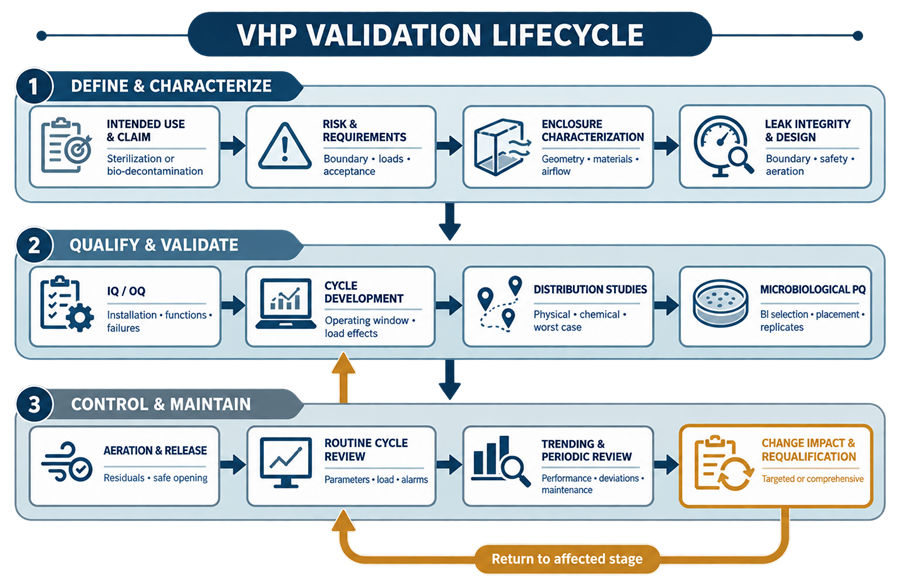
The lifecycle consists of:
- Intended-use and process-claim definition
- User requirements and risk assessment
- System and enclosure design review
- Installation and functional qualification
- Cycle and load development
- Physical and chemical distribution studies
- Microbiological performance qualification
- Aeration and release-condition verification
- Routine-cycle control and record review
- Periodic performance review
- Change-impact assessment
- Targeted or comprehensive requalification
Development data should establish the relationship among physical conditions, chemical-indicator response, biological-indicator response, load characteristics, and process variability. Routine operation then controls the parameters demonstrated to be necessary for the validated result.
Validation Planning and Responsibilities
The validation plan or protocol strategy should define:
- Process owner
- Validation owner
- Quality-unit responsibilities
- Engineering and automation responsibilities
- Microbiology laboratory responsibilities
- Equipment supplier responsibilities
- Contract laboratory responsibilities
- Medical-device manufacturer and contract sterilizer responsibilities, where applicable
- Intended use
- Process claim
- System and enclosure boundaries
- Products, loads, or configurations included
- Excluded surfaces or conditions
- Development approach
- Qualification sequence
- Required studies
- Acceptance criteria
- Deviation handling
- Routine-release approach
- Requalification strategy
- Required reports and approvals
Supplier studies may support validation when their scope, methods, data integrity, and applicability are assessed. Supplier data do not eliminate the need to demonstrate performance with the installed system, approved recipe, actual enclosure, and representative load.
User Requirements and Design Review
Requirements should be traceable to the functions necessary to deliver, distribute, monitor, remove, and document hydrogen peroxide exposure. Requirements may address:
- Enclosure volume and construction
- Surface materials
- Door, glove, port, and penetration integrity
- Hydrogen peroxide generator capacity
- Solution concentration
- Metering accuracy
- Vaporizer capability
- Injection arrangement
- Recirculation airflow
- Supply and return locations
- HVAC isolation
- Dehumidification
- Pressure control
- Catalytic decomposition
- Aeration capacity
- Temperature measurement
- Humidity measurement
- Hydrogen peroxide measurement
- Sensor locations and ranges
- Alarm and interlock functions
- Recipe control
- Data acquisition
- Audit trails
- User access
- Backup and recovery
- Occupational exposure controls
- Safe-door-release logic
- Cleaning and maintenance access
- Calibration access
- Material compatibility
- Maximum and minimum loads
- Recovery after interrupted cycles
Design review should determine whether the system can reproducibly establish the required conditions throughout the proposed process boundary. A generator may have sufficient nominal output while the complete enclosure remains unsuitable because of leakage, poor circulation, excessive absorption, inadequate aeration, or unrepresentative sensor placement.
Enclosure Characterization
Enclosure characterization establishes the physical environment in which the VHP cycle operates. The assessment should document:
- Internal dimensions and calculated volume
- Installed equipment
- Shelves, racks, carts, and supports
- Supply, injection, return, and exhaust locations
- Fan locations and operating states
- HEPA filters
- Dampers and isolation valves
- Door seals
- Glove assemblies
- Rapid-transfer ports
- Service penetrations
- Drain or utility connections
- Potential leakage paths
- Surface materials
- Cold surfaces
- Heat-generating equipment
- Obstructed areas
- Difficult-to-aerate locations
- Fixed hydrogen peroxide, humidity, pressure, and temperature sensors
- Connection to the surrounding HVAC system
The approved enclosure configuration should identify which doors, access panels, valves, ports, equipment covers, and internal pathways must be open or closed during treatment.
Temporary items should not be introduced without evaluating their effects on:
- Vapor distribution
- Hydrogen peroxide absorption
- Condensation
- Biological challenge
- Aeration
- Surface accessibility
For an isolator or RABS, the validation should also define the production configuration that follows the cycle. Bio-decontamination evidence has limited value if uncontrolled assembly or material transfer subsequently compromises the treated environment.
Leak Integrity and Boundary Control
Leak integrity influences hydrogen peroxide concentration, distribution, aeration, safety, and protection of adjacent areas.
Leak testing may include:
- Pressure-decay testing
- Pressure-hold testing
- Tracer-gas testing
- Local leak detection
- Door-seal inspection
- Glove-leak testing
- Penetration inspection
- Damper-leakage verification
- Verification of HVAC isolation
- Adjacent-area hydrogen peroxide monitoring
The acceptance criterion should reflect the enclosure design and intended process. One universal allowable leak rate is not appropriate for every isolator, chamber, RABS, or room.
Leak testing should establish that:
- The enclosure can maintain the required operating condition
- Loss of vapor does not compromise the developed cycle
- Uncontrolled ingress does not create untreated regions
- Hydrogen peroxide does not create unacceptable adjacent-area exposure
- Door-release and re-entry conditions remain controlled
A successful pressure-decay test does not establish microbiological performance. It confirms one physical prerequisite for controlling the process.
The validation strategy should define:
- Test method
- Test pressure
- Stabilization time
- Measurement duration
- Temperature compensation, where necessary
- Acceptance criterion
- Test frequency
- Response to failure
- Conditions requiring retesting
Repairs to doors, seals, gloves, penetrations, ductwork, dampers, or the enclosure structure require documented impact assessment.
Installation Qualification
Installation Qualification should verify the installed system against approved drawings, specifications, and supplier documentation.
Typical IQ elements include:
- Equipment identification
- Generator and enclosure installation
- Construction materials
- Hydrogen peroxide delivery components
- Reservoir or cartridge configuration
- Metering pump
- Vaporizer
- Injection lines and nozzles
- Recirculation fans
- Distribution ductwork
- Dampers
- Catalytic converters
- Exhaust connections
- Door seals and interlocks
- Pressure-control components
- Temperature, humidity, concentration, and pressure sensors
- Instrument ranges and accuracy
- Calibration status
- Electrical and utility connections
- Software and firmware versions
- Recipe and configuration baselines
- Data-storage locations
- Network and system interfaces
- Alarm routing
- Preventive-maintenance requirements
- Spare-part recommendations
- Operating and maintenance manuals
- As-built drawings
IQ should also confirm that critical instruments can be calibrated and maintained without creating uncontrolled changes to sensor position, airflow, enclosure integrity, or validated configuration.
Operational Qualification
Operational Qualification demonstrates that the installed system performs its specified functions throughout the intended operating ranges. OQ should address normal operation, operating limits, alarms, interlocks, failures, and recovery. Testing may include:
- Recipe selection and authorization
- Sequence initiation
- Pre-cycle checks
- Leak-test function
- HVAC isolation
- Fan operation
- Damper sequencing
- Dehumidification
- Injection control
- Vaporizer-temperature control
- Concentration response
- Temperature response
- Humidity response
- Pressure control
- Phase timing
- Aeration
- Catalyst operation
- Door interlocks
- Abort logic
- Safe-reentry logic
- Alarm generation
- Alarm acknowledgment
- Manual intervention controls
- Cycle-report generation
- Audit trails
- Power-loss response
- Communication-loss response
- Data backup and recovery
OQ should challenge the established ranges rather than merely repeat the nominal production recipe. Challenge conditions should be selected using the process-risk assessment and development data.
Cycle Development
Cycle development establishes a reproducible process capable of achieving the intended microbiological result without unacceptable material, equipment, product, or safety effects.
Development should evaluate the complete cycle:
- Conditioning
- Injection
- Distribution
- Dwell or exposure
- Aeration
Variables potentially requiring evaluation include:
- Initial temperature
- Surface temperature
- Load temperature
- Initial humidity
- Dehumidification endpoint
- Hydrogen peroxide solution strength
- Injection quantity
- Injection rate
- Number and timing of injection pulses
- Vaporizer temperature
- Hydrogen peroxide concentration
- Relative saturation
- Pressure
- Recirculation rate
- Damper configuration
- Exposure duration
- Aeration airflow
- Aeration duration
- Catalyst performance
- Load quantity
- Material type
- Surface area
- Absorption
- Packaging
- Lumen configuration
- Obstructions
- Leakage
Development should establish both insufficient-process and excessive-process conditions.
An insufficient-process challenge may use reduced injection, reduced exposure, difficult loading, or another justified condition to locate biological resistance and establish process sensitivity. An excessive-process challenge may use maximum exposure, high vapor availability, minimum load, repeated cycles, or condensation-prone conditions to evaluate material compatibility, residues, and aeration.
A shortened development exposure should not be called a “half cycle” unless that term has been specifically defined and scientifically supported for the process. Dividing total cycle time in half does not necessarily create a meaningful microbiological challenge because conditioning, distribution, and aeration are not equivalent to microbial exposure.
Physical Distribution Studies
Physical distribution studies characterize the conditions achieved throughout the enclosure and load. Measurements may include:
- Hydrogen peroxide concentration
- Delivered hydrogen peroxide mass
- Temperature
- Relative humidity
- Pressure
- Phase duration
- Airflow or circulation status
- Surface temperature
- Aeration concentration
- Time to reach the aeration endpoint
Sensor locations should include:
- Near the injection point
- Near the return or exhaust
- High and low elevations
- Remote enclosure regions
- Behind representative obstructions
- Within load centers
- Near doors and leakage-prone interfaces
- Near cold surfaces
- Adjacent to absorbent materials
- Within restricted product pathways, where measurement is technically suitable
A single chamber sensor cannot demonstrate uniform distribution. It provides information only for its location, measurement range, response time, and technology.
Physical studies should evaluate:
- Empty enclosure
- Representative routine load
- Maximum load
- Minimum load, where relevant
- Load configurations expected to challenge distribution
- Configurations expected to challenge aeration
- Normal process settings
- Defined operating-limit challenges
Hydrogen peroxide concentration, humidity, and temperature data should be interpreted together. Locally acceptable concentration does not establish microbial lethality if the surface is shielded, the carrier is inappropriate, the exposure time is insufficient, or the biological challenge has greater resistance.
Chemical Indicators
Chemical indicators can provide useful information about hydrogen peroxide exposure and distribution. They may be used during:
- Cycle development
- Location screening
- Load-pattern evaluation
- Distribution studies
- Troubleshooting
- Routine operation, when justified
The indicator should be suitable for the particular hydrogen peroxide process and should have documented:
- Intended use
- Response mechanism
- Storage conditions
- Shelf life
- Lot identity
- Exposure sensitivity
- Reading method
- Interpretation criteria
- Known interferences
- Limitations
A visible color change generally demonstrates exposure above some indicator-specific threshold. It does not automatically establish:
- Required hydrogen peroxide concentration
- Required exposure duration
- Required log reduction
- Sterility
- Successful biological-indicator inactivation
- Adequate aeration
Chemical-indicator results should be correlated with physical and microbiological evidence before they are used to make process decisions. Indicators used for location screening should not become the sole basis for eliminating biological-indicator locations.
Biological-Indicator Selection
Biological indicators provide a direct microbiological challenge to the process. Geobacillus stearothermophilus spores are commonly used for hydrogen peroxide processes, but organism identity alone does not establish suitability. BI resistance can change with:
- Strain
- Population
- Carrier material
- Inoculation method
- Recovery method
- Packaging
- Storage
- Age
- Hydrogen peroxide concentration
- Humidity
- Temperature
- Condensation
- Exposure system
- Test method
The BI specification and qualification should address:
- Organism identity
- Population
- Purity
- Carrier
- Packaging
- Resistance characteristics
- Manufacturing lot
- Certificate of analysis
- Expiration date
- Storage requirements
- Transport conditions
- Incubation conditions
- Growth-medium suitability
- Positive controls
- Recovery method
- Readout system
Resistance data generated under one supplier test condition should not be assumed to represent resistance in the user’s equipment and cycle. Development studies should confirm that the selected BI provides an appropriate and recoverable challenge in the actual process.
A BI carrier should represent or conservatively challenge the treated surface. A paper carrier may absorb hydrogen peroxide differently from stainless steel, plastic, glass, elastomer, or an inoculated product pathway.
Additional principles are addressed in Biological Indicators for Sterilization Validation.
Biological-Indicator Placement
BI locations should be determined through development, not selected solely from a drawing or visual inspection.
Candidate locations may include:
- Remote enclosure corners
- Low-circulation regions
- Behind equipment
- Under trays
- Near doors or leakage paths
- Downstream of major obstructions
- Dense load centers
- Glove folds
- Transfer-port interfaces
- Touching or closely spaced surfaces
- Overlapping bags
- Inside approved restricted pathways
- Within device lumens
- Near highly absorbent materials
- Locations slow to reach the required condition
- Locations that show inconsistent chemical-indicator response
- Locations that produce greater BI survival during reduced-exposure development studies
The location with the lowest measured chamber concentration is not automatically the microbiological worst case. Resistance may also be affected by surface moisture, condensation, carrier material, temperature, local airflow, shielding, absorption, and recovery conditions.
BI placement records should identify:
- Unique BI number
- BI lot
- Exact location
- Orientation
- Carrier or holder
- Relationship to the load
- Placement photograph or drawing reference
- Exposure cycle
- Retrieval status
- Incubation position
- Result
BIs should not be placed in an artificial sealed condition unless that condition represents the approved process claim. An excessively protected BI can challenge a condition the routine process was never intended to treat.
Worst-Case Location and Load Selection
Worst-case selection should consider different failure mechanisms rather than assume one load is worst for every attribute.
| Validation objective | Potential challenging condition |
|---|---|
| Vapor distribution | Dense load, blocked circulation, remote location, unfavorable return path |
| Microbial inactivation | Restricted surface, resistant carrier, absorbent material, low-exposure location |
| Condensation control | Cold surface, minimum load, high vapor availability, local low temperature |
| Material compatibility | Maximum exposure, repeated cycles, sensitive polymer or coating |
| Aeration | Absorbent materials, dense load, restricted pathway, limited exhaust |
| Enclosure integrity | Maximum operating pressure, door or penetration leakage |
| Sensor representation | Location differing from fixed control sensor |
| Product or device penetration | Lumen, mated surface, packaging, restricted internal pathway |
The selected worst-case configuration should be:
- Defined
- Reproducible
- Technically justified
- Traceable to development evidence
- Represented in the qualification protocol
- Controlled during routine operation
Different configurations may be required to challenge microbial lethality, condensation, aeration, compatibility, and distribution.
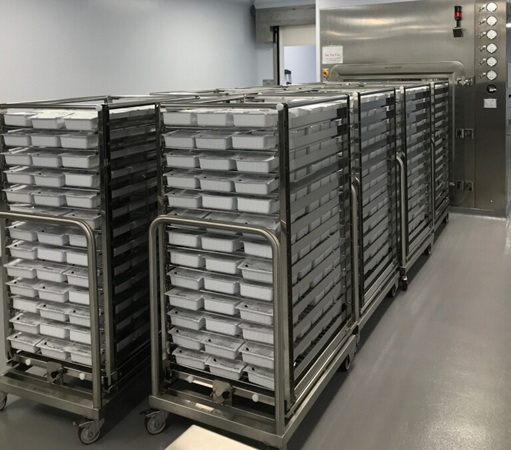
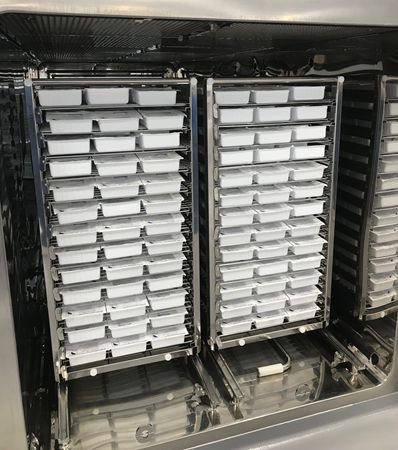
The photographs show representative high-density chamber loads. They should not be captioned as proven worst-case configurations unless development data establish that conclusion.
Microbiological Performance Qualification
Performance Qualification demonstrates that the approved process achieves the defined microbiological result with representative or challenging loads and configurations. PQ should define:
- Enclosure and equipment configuration
- Approved recipe
- Load description
- Load orientation
- Maximum and minimum load boundaries
- Material quantities
- BI type and lot
- BI population and resistance information
- BI locations
- Chemical-indicator locations, where used
- Physical sensor locations
- Positive and negative controls
- Incubation conditions
- Required number of qualification cycles
- Acceptance criteria
- Deviation handling
- Failed-run disposition
- Reporting requirements
The number of replicate qualification cycles should be established by the applicable standard, validation strategy, process variability, development evidence, and intended claim. A predefined series of successful cycles demonstrates reproducibility, but successful later cycles do not erase an unexplained earlier failure.
For enclosure bio-decontamination, the required microbiological reduction should be explicitly defined. Complete inactivation of exposed BIs may be an acceptance criterion, but the claimed log reduction must also consider the initial BI population, resistance, recovery capability, controls, and study design.
For medical-device sterilization, PQ must support the defined sterility-assurance objective for the represented device family, packaging, load, equipment, and process in accordance with ISO 22441 and applicable regulatory requirements.
Medical-Device Product Families
Medical devices may be grouped only when the family rationale considers characteristics affecting Vaporized H₂O₂ sterilization. Relevant characteristics include:
- Materials
- Surface area
- Hydrogen peroxide absorption
- Lumen length and diameter
- Internal pathways
- Mated surfaces
- Device assembly
- Packaging
- Load density
- Sterilant contact
- Aeration
- Functional compatibility
- Patient-contact classification
The microbiological worst case may differ from the material-compatibility or aeration worst case.
Adding a product to an established family requires documented adoption assessment. Commercial similarity, common branding, or use in the same procedure does not establish sterilization equivalence.
Aeration Qualification
Aeration is part of the validated process, not merely a waiting period after microbiological exposure.
Aeration studies should evaluate:
- Hydrogen peroxide concentration at the fixed sensor
- Hydrogen peroxide concentration at representative locations
- Material desorption
- Load configuration
- Catalyst performance
- Fresh-air or exhaust airflow
- Recirculation
- Temperature
- Phase duration
- Door-release logic
- Operator exposure
- Adjacent-area exposure
- Product or process sensitivity
- Device residuals, where applicable
The worst-case microbial load may not be the worst-case aeration load. Porous materials, elastomers, polymers, paper, foam, textiles, and packaging may absorb hydrogen peroxide and release it slowly.
Acceptance criteria may include:
- Maximum allowable enclosure concentration before opening
- Maximum allowable adjacent-area concentration
- Device-specific residual requirements
- Maximum aeration time
- Required airflow or catalyst condition
- Successful operation of concentration sensors and interlocks
A fixed enclosure sensor may reach its release limit before absorbent materials or restricted locations have adequately aerated. Development should confirm that the selected measurement location supports the actual release decision.
Acceptance Criteria
Acceptance criteria should be approved before protocol execution and traceable to requirements, development data, process risks, and the intended claim.
| Study area | Examples of acceptance criteria |
|---|---|
| Enclosure integrity | Leak rate or pressure-decay result within the approved limit |
| Physical cycle | Required phases completed within approved ranges |
| Hydrogen peroxide delivery | Injection quantity, rate, or concentration within established limits |
| Temperature and humidity | Specified conditions achieved and maintained at defined locations |
| Distribution | Required physical or chemical responses achieved without unexplained deficient locations |
| Biological challenge | Required BI result and positive-control growth obtained |
| Reproducibility | Required qualification runs meet all predefined criteria |
| Alarm and failure testing | Alarm, abort, interlock, and recovery functions operate as specified |
| Aeration | Hydrogen peroxide reduced to the approved unloading, transfer, or re-entry limit |
| Data integrity | Complete, attributable, reviewable cycle and laboratory records available |
| Load control | Actual load matches the approved configuration and boundaries |
| Material suitability | No unacceptable functional, physical, chemical, or packaging effect |
Acceptance criteria should distinguish:
- Setpoints
- Operating ranges
- Alert limits
- Alarm limits
- Abort limits
- Qualification challenge conditions
- Routine-release criteria
Limits should not be revised after execution merely to accept an otherwise failing study.
Failure and Recovery Testing
Failure testing should demonstrate that foreseeable faults are detected and managed without creating a false successful-cycle status. Challenges may include:
- Insufficient hydrogen peroxide supply
- Incorrect cartridge or solution
- Metering-pump failure
- Vaporizer-temperature failure
- Injection-line blockage
- Concentration below the required range
- Excessive concentration
- Temperature outside range
- Humidity outside range
- Unintended condensation
- Recirculation-fan failure
- Damper failure
- HVAC-isolation failure
- Enclosure leak
- Pressure-control failure
- Catalyst failure
- Incomplete aeration
- Hydrogen peroxide sensor failure
- Temperature or humidity sensor failure
- Door-interlock failure
- Power interruption
- Controller restart
- Network or interface failure
- Data-storage failure
- Printer or report failure
- Manual intervention
- Cycle abort
Testing should confirm:
- Alarm generation
- Alarm identification
- Cycle hold or abort response
- Prevention of inappropriate phase progression
- Prevention of premature door opening
- Preservation of data
- Identification of incomplete exposure
- Recovery or restart restrictions
- Required operator action
- Batch or load disposition
- Requirement for a complete new cycle
- Escalation to deviation or investigation
An aborted cycle should not automatically be restarted from the interruption point. The disposition must consider the completed exposure, load condition, condensation, material effects, BI status, aeration, and approved recovery procedure.
Deviation and Failed-Cycle Management
A failed BI, missing BI, failed positive control, unacceptable physical parameter, unexplained chemical-indicator result, or incomplete record requires documented assessment. The investigation should consider:
- BI identity and lot
- BI storage and handling
- BI placement
- Retrieval and incubation
- Positive and negative controls
- Physical cycle data
- Hydrogen peroxide delivery
- Temperature and humidity
- Condensation
- Load configuration
- Enclosure leakage
- Fan and damper operation
- Sensor performance
- Calibration
- Laboratory controls
- Operator actions
- Recipe version
- Maintenance history
- Similar prior events
Negative exposed BIs do not override a physical process failure. Acceptable physical parameters do not override a positive BI.
Repeating a failed cycle without investigating the original failure does not restore confidence in the process. The investigation should determine whether the event affects:
- The qualification run
- Previous routine cycles
- Products or materials
- The validated operating range
- BI-placement rationale
- Routine monitoring
- Requalification scope
Routine-Cycle Review and Release
Routine release should verify that the cycle and load remained within the validated conditions.
The review may include:
- Equipment identity
- Recipe name and version
- Operator
- Date and time
- Enclosure or chamber configuration
- Load identity
- Load pattern
- Pre-cycle leak-test result
- Initial temperature and humidity
- Injection quantity
- Injection rate
- Hydrogen peroxide concentration
- Pressure
- Exposure duration
- Fan and damper status
- Aeration parameters
- Final hydrogen peroxide concentration
- Alarms
- Aborts
- Manual interventions
- Sensor or communication faults
- Chemical-indicator results
- Routine BI results, where required
- Deviations
- Electronic audit trail
- Release authorization
A cycle-complete status confirms only that the programmed sequence reached its endpoint. It does not independently confirm compliance with every validated requirement.
Release requirements should distinguish among:
- Release of an enclosure for aseptic operation
- Release of externally bio-decontaminated materials
- Release of a sterilized medical-device load
- Release of equipment or components for use
- Safe operator entry or unloading
These decisions have different technical and quality implications.
Routine Monitoring and Trending
Routine data should be reviewed for gradual deterioration even when individual cycles meet acceptance criteria. Trends may include:
- Increasing hydrogen peroxide consumption
- Longer time to reach concentration
- Greater concentration variability
- Changing humidity response
- Increasing cycle duration
- Longer aeration time
- Increasing residual concentration
- Leak-rate deterioration
- Fan-performance changes
- Repeated minor alarms
- Frequent operator interventions
- Increased sensor adjustment
- Catalyst replacement frequency
- BI or chemical-indicator response changes
- Load-related variability
Changes in several parameters may collectively indicate declining control before a formal cycle failure occurs.
Data Integrity and Record Control
Validation and routine records should preserve:
- Original electronic process data
- Recipe versions
- Configuration records
- Sensor identities
- Calibration status
- BI certificates
- BI placement records
- Photographs or location diagrams
- Chemical-indicator records
- Incubation data
- Positive and negative controls
- Raw laboratory observations
- Alarm and event history
- Audit trails
- Manual interventions
- Deviations
- Investigations
- Calculation methods
- Protocol approvals
- Report approvals
- Load and product traceability
Electronic controls should address:
- Unique user access
- Role authorization
- Recipe approval
- Segregation of duties
- Audit trails
- Time synchronization
- Data backup
- Recovery
- Interface verification
- Record retention
- Review of changed or deleted data
A printed cycle summary should not replace reviewable raw data when the summary omits sensor detail, alarm history, interventions, or audit-trail information.
Change Control
Changes should be assessed before implementation for their potential effect on hydrogen peroxide delivery, distribution, microbial inactivation, material exposure, aeration, safety, and data integrity.
Changes requiring evaluation include:
- Generator replacement
- Metering-pump replacement
- Vaporizer changes
- Injection-nozzle or manifold changes
- Fan or motor changes
- Damper changes
- Catalyst changes
- Sensor replacement or relocation
- Instrument-range changes
- Software or firmware updates
- Recipe changes
- Alarm-limit changes
- Door, seal, glove, or penetration repairs
- Enclosure modification
- HVAC modification
- HEPA-filter replacement
- Shelf, rack, or cart changes
- Load-pattern changes
- New materials
- New packaging
- New medical devices
- Product-family additions
- Cleaning-agent changes
- BI supplier, carrier, population, or resistance changes
- Chemical-indicator changes
- Laboratory-method changes
- Extended shutdown
- Site or chamber transfer
The impact assessment should identify:
- Functions potentially affected
- Existing evidence
- New uncertainty
- Required engineering verification
- Required physical distribution testing
- Required chemical or biological testing
- Required aeration testing
- Required procedural updates
- Regulatory-submission impact, where applicable
- Conditions for post-change release
General principles are addressed in GMP Change Control and Validation Impact Assessment.
Periodic Review
Periodic review should evaluate whether the validated state remains supported by current lifecycle evidence.
Review inputs should include:
- Current intended use
- Current process claim
- Approved loads and configurations
- Qualification status
- Previous requalification
- Routine-cycle performance
- Physical-parameter trends
- BI and chemical-indicator results
- Leak-test results
- Aeration trends
- Deviations and investigations
- Aborted cycles
- Maintenance
- Calibration
- Sensor replacement
- Catalyst performance
- Software and recipe changes
- Alarm trends
- Audit-trail review
- Material-compatibility observations
- New products or loads
- BI supplier changes
- Open CAPA
- Vendor notices
- Obsolescence
- Regulatory or standards changes
Periodic review should result in a documented conclusion:
- Continue routine operation
- Continue with corrective actions or enhanced monitoring
- Perform additional investigation
- Perform targeted requalification
- Perform comprehensive requalification
- Restrict use pending resolution
The review does not automatically require repetition of the original qualification. It determines whether current evidence remains adequate.
Requalification
Requalification may be event-driven, periodic, or both, depending on applicable procedures, standards, commitments, process risk, and operating history. Potential triggers include:
- Enclosure repair
- Leak-test failure
- Generator or distribution-system modification
- Significant maintenance
- Recipe change
- Critical sensor replacement
- Software change
- New load configuration
- New absorbent material
- New medical-device family
- Change to BI or chemical indicator
- Repeated alarms
- Positive BI
- Adverse physical trend
- Extended shutdown
- Chamber transfer
- Unexplained aeration increase
- Regulatory change
- Scheduled validation commitment
Requalification scope may include:
- Documentation review only with justification
- Leak-integrity testing
- Calibration and function verification
- Targeted alarm or interlock testing
- Empty-enclosure distribution testing
- Loaded distribution testing
- Chemical-indicator study
- Targeted BI challenge
- Aeration confirmation
- Material-compatibility testing
- Partial PQ
- Comprehensive repeat PQ
The decision should evaluate the affected function rather than assign one general risk category to the entire system. Tests may be omitted only when current evidence demonstrates that the corresponding function remains unaffected and qualified.
Applicable decision principles are addressed in Risk-Based Requalification of GMP Equipment, Systems, and Utilities.
Common Validation Errors
Frequent deficiencies include:
- Failing to distinguish sterilization from enclosure bio-decontamination
- Applying ISO 22441 directly to room or isolator decontamination
- Beginning PQ before the process claim and enclosure configuration are defined
- Treating generator qualification as validation of the complete process
- Treating a successful leak test as proof of bio-decontamination
- Using one fixed concentration sensor to claim uniform distribution
- Selecting BI locations only from visual inspection
- Assuming the lowest measured concentration is always the microbiological worst case
- Using chemical indicators as substitutes for BIs
- Selecting a BI only because it contains G. stearothermophilus
- Ignoring carrier-specific resistance
- Failing to review BI certificates and lot changes
- Placing BIs in unrealistic sealed or inaccessible conditions
- Omitting positive controls
- Using inadequate BI-location records
- Calling a shortened total cycle a half cycle
- Defining only a maximum load
- Ignoring minimum-load condensation or compatibility risks
- Failing to challenge absorbent materials
- Ignoring cold surfaces
- Treating visible condensation as acceptable without an approved process strategy
- Assuming negative BIs override failed physical parameters
- Assuming acceptable physical parameters override a positive BI
- Repeating a failed run without investigation
- Assuming later successful cycles invalidate an earlier unexplained failure
- Omitting aeration from qualification
- Using the fixed enclosure sensor as the sole proof of load aeration
- Treating cycle-complete status as the release decision
- Changing a load, rack, recipe, sensor, BI, or chemical indicator without impact assessment
- Performing calendar-based requalification without reviewing lifecycle evidence
- Omitting requalification tests without documented justification
Conclusion
VHP validation must connect the intended process claim with the actual equipment, enclosure, load, biological challenge, operating conditions, and routine controls.
For medical devices, validation should establish that the defined VH₂O₂ sterilization process remains suitable for the represented devices, packaging, loads, equipment, and sterility-assurance objective. For isolators, RABS, transfer chambers, and rooms, validation should establish the specified bio-decontamination result for defined accessible surfaces and approved configurations.
Cycle development identifies the process conditions and difficult locations. Enclosure characterization and leak testing establish physical control. Distribution studies evaluate hydrogen peroxide, humidity, temperature, airflow, and load effects. Chemical indicators support exposure assessment, while appropriately selected and located biological indicators provide the microbiological challenge.
Performance qualification demonstrates reproducibility under justified conditions. Aeration qualification establishes safe and suitable release conditions. Routine record review, trending, maintenance, calibration, deviation management, change control, periodic review, and risk-based requalification maintain the validated state.