

Vaporized Hydrogen Peroxide Sterilization Process
Vaporized hydrogen peroxide is a low-temperature antimicrobial process used in two materially different applications:
- Sterilization of compatible medical devices in a defined sterilizer and cycle
- Bio-decontamination of exposed surfaces within isolators, restricted access barrier systems, transfer chambers, and controlled rooms
These applications use the same active chemical but do not support the same claim. Medical-device sterilization is developed and controlled to render a defined product sterile. Enclosure bio-decontamination reduces a defined biological challenge on accessible surfaces and supports aseptic processing, but it does not automatically sterilize the entire enclosure, its contents, or surfaces shielded from vapor contact.
Process performance depends on the interaction of hydrogen peroxide concentration, exposure time, humidity, temperature, pressure, airflow, surface condition, load configuration, material absorption, condensation behavior, and aeration. A nominal injection quantity or completed recipe does not by itself demonstrate effective treatment.
This article addresses process principles, cycle phases, equipment, distribution, applications, compatibility, and operational limitations. For VHP validation and qualification, including biological-indicator placement, cycle development, acceptance criteria, deviations, change control, and requalification, see VHP Sterilization Validation and Lifecycle Control.
Terminology
Several terms are used for hydrogen peroxide delivered through the gas phase:
- Vaporized hydrogen peroxide
- Vapor-phase hydrogen peroxide
- Hydrogen peroxide vapor
- VHP
- VH₂O₂
ISO 22441 uses the term low-temperature vaporized hydrogen peroxide, commonly abbreviated VH₂O₂. “VHP” remains widely used in pharmaceutical and medical-device practice.
The terminology should not be used to obscure the intended process claim. The approved specification should state whether the process is intended to provide:
- Medical-device sterilization
- Surface bio-decontamination
- Sporicidal surface treatment
- Material-transfer decontamination
- Room or enclosure decontamination
- Reduction of a defined biological challenge
The required validation evidence follows from the intended claim.
Sterilization and Bio-Decontamination Boundary
The distinction between sterilization and bio-decontamination is fundamental.
| Attribute | Medical-device sterilization | Enclosure bio-decontamination |
|---|---|---|
| Primary objective | Render a defined medical device sterile | Reduce microbial contamination on accessible enclosure surfaces |
| Typical application | Packaged or unpackaged compatible medical devices | Isolators, transfer chambers, closed RABS, rooms, filling-line enclosures |
| Principal standard | ISO 22441 | Applicable GMP expectations, contamination-control strategy, and site validation requirements |
| Process boundary | Defined device, packaging, load, sterilizer, and cycle | Defined enclosure, installed equipment, exposed surfaces, load, and operating state |
| Penetration requirement | Sterilant must reach all claimed product locations | Vapor must contact all surfaces included in the bio-decontamination claim |
| Microbiological claim | Defined sterility-assurance objective | Defined log reduction or bio-decontamination endpoint |
| Routine release | Based on validated cycle and required process evidence | Based on approved cycle completion, parameter compliance, and enclosure-release criteria |
| Product effect | Device functionality, packaging, residues, and biocompatibility must be addressed | Equipment surfaces, gloves, filters, sensors, product-contact parts, and environmental suitability must be addressed |
| Main limitation | Restricted pathways and incompatible materials can prevent sterilization | Shielded, closed, sealed, soiled, or occluded surfaces may remain untreated |
ISO 22441:2022 applies to low-temperature VH₂O₂ sterilization processes for medical devices. It expressly excludes hydrogen peroxide decontamination systems used for rooms, enclosures, and environmental spaces.
FDA nevertheless recognizes the importance of validated hydrogen peroxide bio-decontamination for aseptic processing. FDA inspection guidance describes vaporized hydrogen peroxide as a surface decontamination method for isolator barriers while emphasizing its limited ability to penetrate obstructed or protected surfaces.
Bio-decontamination of an isolator therefore supports contamination control but should not be described as terminal sterilization of the drug product or as proof that every object within the isolator is sterile.
Regulatory and Standards Framework
For medical devices, the principal process standard is ISO 22441:2022, Sterilization of health care products—Low temperature vaporized hydrogen peroxide—Requirements for the development, validation and routine control of a sterilization process for medical devices.
FDA completely recognizes ISO 22441 and considers VH₂O₂ an Established Category A sterilization method for medical devices. FDA’s current position is summarized on its Sterilization for Medical Devices page.
Other potentially applicable standards include:
- ISO 14937 for general characterization, development, validation, and routine control of sterilizing agents and processes
- ISO 11138-1 for general biological-indicator requirements
- ISO 11737-1 for product bioburden
- ISO 11737-2 for sterility tests used in sterilization-process development and validation
- ISO 11607-1 and ISO 11607-2 for sterile-barrier systems and packaging processes
- ISO 10993-1 and applicable supporting parts for biological evaluation of medical devices
- AAMI TIR17 for material compatibility with sterilization processes
ISO 11138-6, addressing biological indicators for vaporized hydrogen peroxide sterilization, remains under development as of August 2026 and should not be represented as a published final standard.
For pharmaceutical isolators and aseptic-processing applications, relevant US requirements and guidance include:
- 21 CFR Parts 210 and 211
- 21 CFR 211.42 for facility design and control
- 21 CFR 211.63, 211.65, 211.67, and 211.68 for equipment design, construction, cleaning, maintenance, and automated systems
- 21 CFR 211.113(b) for written procedures and validation of sterilization processes
- FDA’s Sterile Drug Products Produced by Aseptic Processing guidance
- Facility and product-specific contamination-control requirements
The broader regulatory framework is discussed in Sterilization Regulations, Standards, and Validation Lifecycle.
Hydrogen Peroxide Microbial Inactivation
Hydrogen peroxide is a strong oxidizing agent. Its antimicrobial activity results from oxidative damage to microbial structures and cellular constituents, including:
- Cell membranes
- Proteins and enzymes
- Nucleic acids
- Essential metabolic systems
- Spore structures
Bacterial spores generally present a greater challenge than vegetative bacteria and are commonly used to establish a resistant microbiological challenge.
Process lethality does not depend on exposure time alone. It is influenced by:
- Hydrogen peroxide concentration
- Vapor distribution
- Exposure duration
- Temperature
- Moisture and relative humidity
- Surface condition
- Microorganism and resistance
- Carrier material
- Initial population
- Organic or inorganic soil
- Product geometry
- Packaging
- Load density
- Surface shielding
- Hydrogen peroxide absorption
- Condensation behavior
A high chamber-average concentration does not establish adequate exposure at every required location.
Principal Applications
Medical-Device Sterilization
Dedicated low-temperature VH₂O₂ sterilizers can process compatible heat-sensitive medical devices. Potential applications include devices containing:
- Temperature-sensitive polymers
- Electronics
- Optical components
- Certain instruments
- Limited-length lumens
- Materials unsuitable for moist heat
Suitability is product-specific. Some long or narrow lumens, absorbent materials, cellulose-containing packaging, liquids, powders, and tightly occluded surfaces can present substantial limitations.
The process is not suitable for sterilizing the contents of sealed containers because the sterilant must directly contact the product locations included in the sterilization claim.
Isolators
VHP is frequently used for automated bio-decontamination of aseptic-processing and sterility-testing isolators.
The cycle may include:
- Empty isolator surfaces
- Installed equipment
- Glove interiors and exteriors, where included
- Filling-line components
- Environmental-monitoring equipment
- Material-transfer interfaces
- Defined portable items
- Exposed product-contact surfaces
Items requiring sterility should normally be sterilized by an appropriate validated method unless the VHP cycle is specifically demonstrated and approved as the sterilization process for those items.
The isolator remains dependent on:
- Leak-tight construction
- HEPA-filtered airflow
- Pressure control
- Glove integrity
- Controlled material transfer
- Surface cleaning
- Approved loading
- Validated bio-decontamination
- Controlled post-cycle operation
Additional system considerations are discussed in Isolator Systems for Aseptic Processing.
Restricted Access Barrier Systems
RABS do not all have the same capability.
An open RABS normally relies on cleaning, sporicidal disinfection, classified-room control, and operational separation rather than a sealed automated VHP cycle. A closed RABS may be designed for automated bio-decontamination if its enclosure, ventilation interfaces, seals, and controls support a reproducible process.
Use of VHP in a RABS should therefore be based on the actual design rather than on the RABS designation alone.
See Restricted Access Barrier Systems for the broader barrier-system strategy.
Transfer Chambers and Pass-Throughs
VHP transfer chambers can bio-decontaminate the exposed external surfaces of materials transferred into a cleaner or aseptic area.
Applications may include:
- Component bags
- Tooling
- Environmental-monitoring supplies
- Small equipment
- Sealed containers
- Waste-transfer containers
- Material carts or trays
The process does not sterilize the contents of a sealed package merely because its exterior was exposed.
Loading instructions should control:
- Bag layering
- Surface exposure
- Contact between items
- Shelf arrangement
- Material quantity
- Orientation
- Use of hooks or supports
- Maximum load
- Minimum load
- Packaging compatibility
- Removal of external wrapping layers
Rooms and Large Enclosures
Portable or fixed generators can be used to bio-decontaminate rooms, suites, filling-line enclosures, and other large spaces.
Large-volume applications present additional challenges:
- Complex air circulation
- HVAC isolation
- Leakage
- Multiple vapor-injection points
- Remote or obstructed locations
- Variable surface temperatures
- Large quantities of absorbent material
- Extended aeration
- Adjacent-area exposure control
- Re-entry management
Room bio-decontamination supplements cleaning and contamination control. It does not remove soil and should not be treated as a replacement for physical cleaning.
VHP Cycle Phases
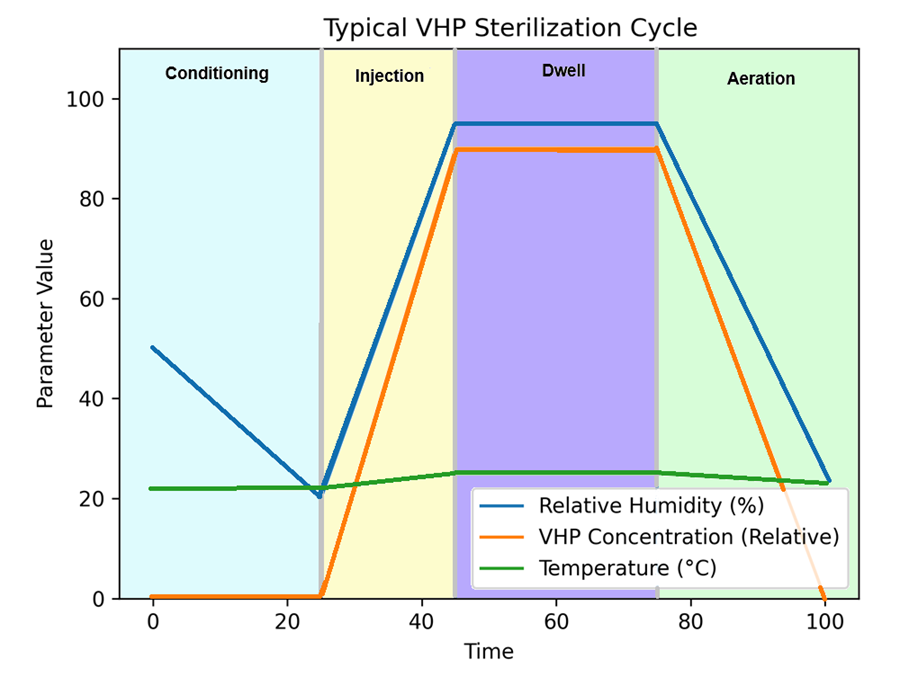
A VHP cycle commonly includes conditioning, injection, distribution, exposure or dwell, and aeration. Equipment suppliers may use different phase names or combine phases, but the underlying process functions remain comparable.
Conditioning
Conditioning establishes controlled starting conditions before hydrogen peroxide is injected.
Depending on system design, this phase may include:
- Enclosure leak testing
- HVAC isolation
- Air recirculation
- Temperature stabilization
- Dehumidification
- Pressure adjustment
- Confirmation of door and damper positions
- Verification of fan operation
- Confirmation of required sensor status
Conditioning is not necessarily synonymous with dehumidification. Some processes reduce initial humidity, while others control the chamber toward a defined moisture condition. The required starting range must reflect the specific vapor-generation and process-control strategy.
Important starting conditions include:
- Initial temperature
- Initial relative humidity
- Surface temperature
- Load temperature
- Enclosure pressure
- Load arrangement
- Residual moisture
- Airflow state
Cold surfaces can approach the local dew point and condense peroxide-containing vapor even when the chamber-average condition appears acceptable.
Injection
During injection, liquid hydrogen peroxide solution is metered to a vaporizer and introduced into the circulating air stream or enclosure.
Injection performance depends on:
- Hydrogen peroxide solution concentration
- Delivered liquid mass
- Metering accuracy
- Vaporizer temperature
- Vaporization efficiency
- Carrier airflow
- Injection location
- Enclosure volume
- Load absorption
- Surface adsorption
- Leakage
- Decomposition
- Sensor response
The programmed quantity of liquid hydrogen peroxide is not the same as the hydrogen peroxide concentration available at the target surface.
Injection may be continuous, pulsed, staged, or repeated according to the cycle design.
Distribution
Distribution allows hydrogen peroxide vapor to circulate through the chamber, load, equipment, and surface pathways.
Effective distribution requires:
- Suitable inlet and return locations
- Adequate fan performance
- Established circulation paths
- Controlled dampers
- Sufficient open area around the load
- Avoidance of blocked returns
- Exposure of required surfaces
- Control of material placement
- Reproducible enclosure configuration
Distribution can occur concurrently with injection and dwell. It should nevertheless be treated as a distinct process function because locally inadequate distribution can cause biological failure even when injection and chamber-average concentration are acceptable.
Dwell or Exposure
During dwell, the process maintains or controls the conditions needed to achieve the intended microbial reduction.
Dwell may involve:
- Continued hydrogen peroxide injection
- Controlled concentration maintenance
- Recirculation without further injection
- Pulsed replenishment
- Controlled pressure transitions
- Exposure at a defined humidity or saturation condition
The effective exposure begins only when the defined process conditions have been established. Total elapsed cycle time should not be confused with qualified microbial-exposure time.
Aeration
Aeration removes or decomposes hydrogen peroxide after exposure.
Aeration methods may include:
- Catalytic conversion
- Fresh-air purging
- HVAC exhaust
- Recirculation through a catalyst
- Repeated vacuum and air admission
- Combination approaches
Hydrogen peroxide decomposes principally to water and oxygen, but this does not eliminate the need to control remaining vapor and material-associated residues.
Aeration should continue until the applicable endpoint is achieved, such as:
- Safe operator exposure
- Permitted room re-entry
- Acceptable device residual
- Acceptable enclosure concentration
- Protection of product or process
- Approved transfer or unloading condition
Concentration, Saturation, and Condensation
Hydrogen peroxide concentration is a major process variable, but concentration must be interpreted together with water vapor, temperature, pressure, and local surface conditions.
Concentration Measurement
Concentration may be expressed as:
- Parts per million by volume
- Mass per unit volume
- Calculated concentration
- Delivered mass
- Sensor response
- Relative saturation
These values are not interchangeable without an established relationship.
A system may control the process through:
- Direct concentration measurement
- Injection mass and time
- Validated delivery algorithm
- Vaporizer output
- Pressure response
- Relative humidity
- Combined concentration and humidity measurements
Direct measurement is valuable but does not eliminate the need to demonstrate distribution. A single sensor represents its installed location and response characteristics.
Saturation
Saturation describes the relationship between the amount of hydrogen peroxide and water vapor present and the amount that can remain in the gas phase under the local conditions.
The available margin before condensation changes with:
- Temperature
- Hydrogen peroxide concentration
- Water-vapor concentration
- Pressure
- Surface temperature
- Local airflow
- Material absorption
Local surfaces may reach condensation conditions before the bulk atmosphere or control sensor indicates saturation.
Condensation Strategies
VHP processes should not all be described as strictly noncondensing.
Some systems are designed to remain below visible condensation. Other processes may operate near saturation or use controlled microcondensation as part of the microbial-inactivation mechanism. The correct strategy depends on the equipment, intended application, manufacturer’s process design, and supporting validation.
Uncontrolled condensation can cause:
- Uneven surface wetting
- Material damage
- Corrosion
- Extended aeration
- Elevated residuals
- Sensor errors
- Cycle variability
- Local dilution
- Loss of reproducibility
The process specification should distinguish intended condensation behavior from an unplanned condensation excursion.
Temperature and Humidity
Temperature affects:
- Vaporization
- Saturation behavior
- Condensation
- Hydrogen peroxide decomposition
- Material absorption
- Sensor response
- Microbial resistance
- Aeration
- Process duration
Temperature should be evaluated at surfaces and within difficult load locations, not only in the surrounding chamber air.
Relative humidity is useful but can be misunderstood. A conventional relative-humidity sensor responds to the combined atmosphere and may not separately quantify water vapor and hydrogen peroxide vapor. Sensor technology, cross-sensitivity, pressure effects, range, and recovery should be understood.
Humidity influences both the microbial challenge and vapor behavior. Excessive moisture may promote unwanted condensation, while inadequate moisture may reduce process effectiveness for some microorganisms and carriers.
No universal temperature, humidity, or hydrogen peroxide concentration is suitable for every VHP process.
VHP Equipment and System Architecture
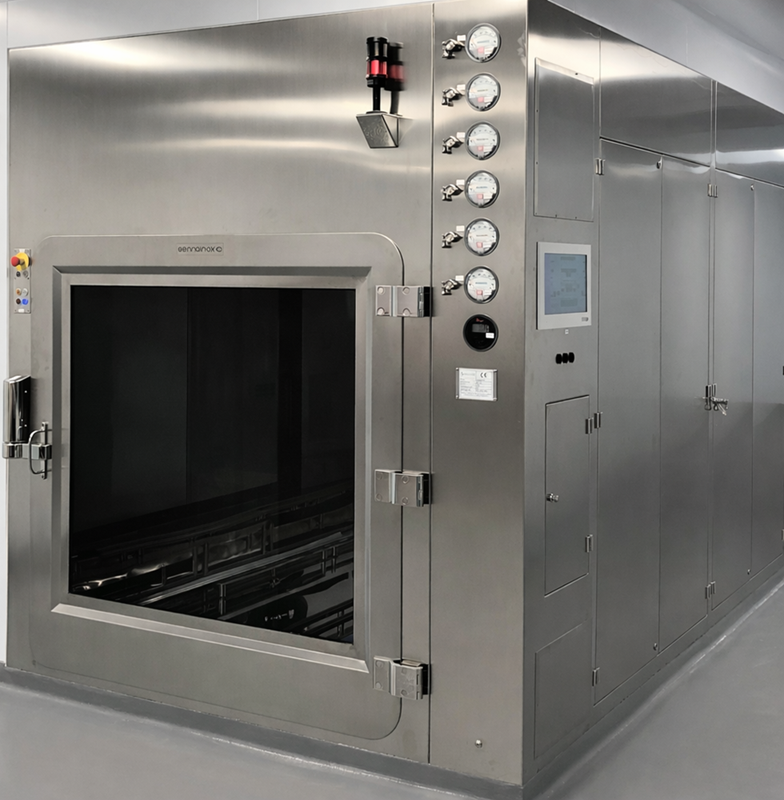
VHP systems range from small medical-device sterilizers to large chambers, integrated isolators, transfer chambers, and portable room generators.
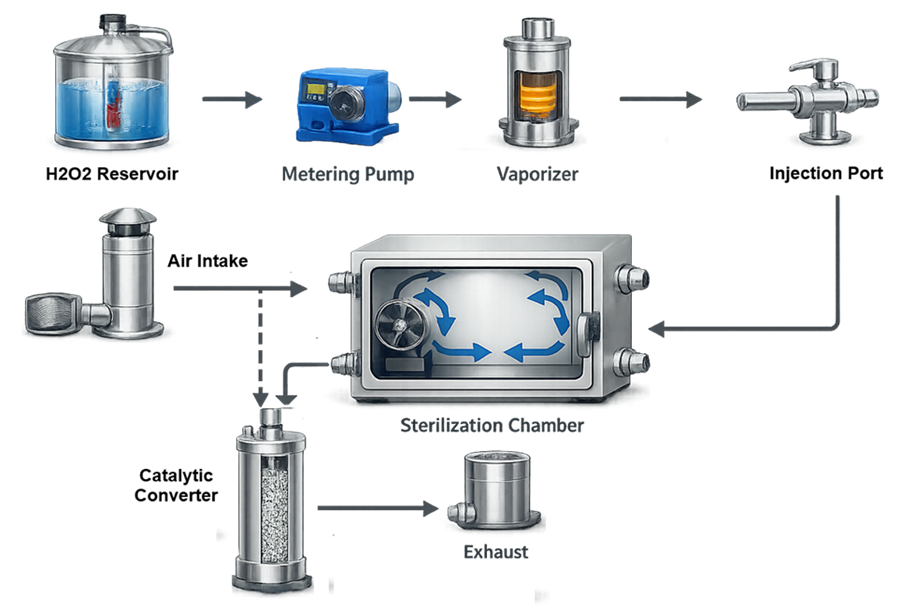
The installed system may include:
- Hydrogen peroxide reservoir or cartridge
- Concentration or solution-strength control
- Metering pump
- Vaporizer
- Heated delivery line
- Injection nozzle or manifold
- Carrier-air system
- Chamber or enclosure
- Recirculation fan
- Distribution ductwork
- Supply and return dampers
- Pressure-control system
- Dehumidification system
- Fresh-air supply
- Exhaust system
- Catalytic converter
- Temperature sensors
- Humidity sensors
- Hydrogen peroxide sensors
- Pressure transmitters
- Door seals and interlocks
- HVAC isolation dampers
- Leak-detection devices
- Control system and HMI
- Alarm and cycle-reporting functions
Airflow and Vapor Distribution
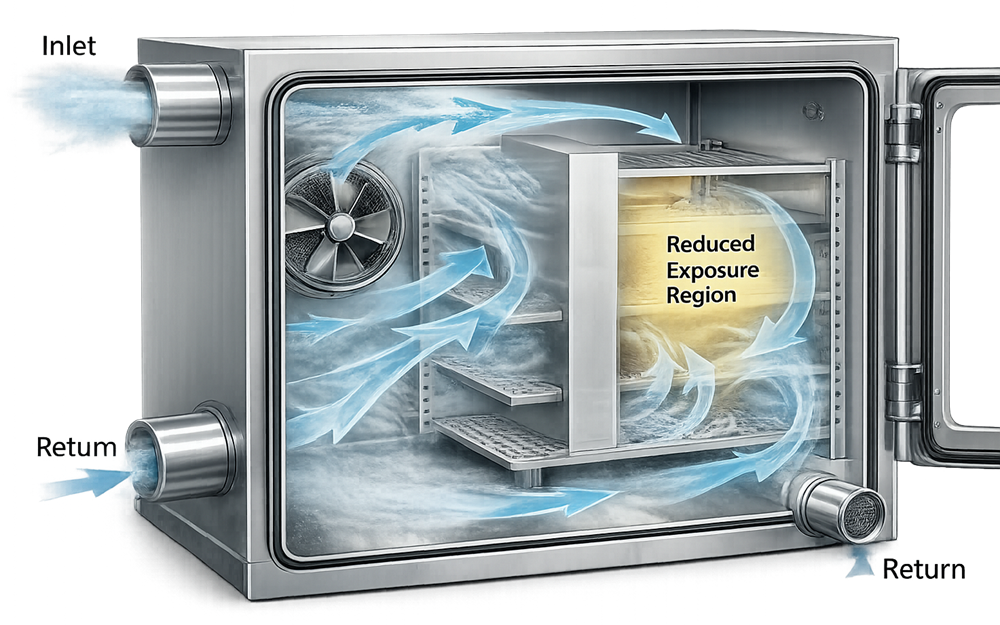
Hydrogen peroxide must be transported from the injection location to every surface or product location included in the process claim.
Distribution is affected by:
- Chamber geometry
- Supply and return arrangement
- Fan speed
- Recirculation rate
- Shelving
- Equipment
- Load density
- Packaging
- Surface orientation
- Dead spaces
- Obstructions
- Temperature gradients
- Leakage
- Absorbent materials
Potential reduced-exposure locations include:
- Behind equipment
- Under trays
- At touching surfaces
- Inside restricted pathways
- Within long or narrow lumens
- Behind closed doors or panels
- At glove folds
- Under overlapping bags
- Within dense load centers
- Near leakage paths
- In low-circulation corners
- Downstream of highly absorbent materials
The airflow illustration appropriately shows the distribution principle, but the depicted shadow region should be treated as an example. Actual worst-case locations must be established for the specific enclosure and load.
Airflow direction during VHP injection may differ from normal production airflow. Dampers, fans, returns, HEPA filters, and exhaust paths must be evaluated in each operating state.
General airflow principles are addressed in GMP Airflow Patterns and Pressure Cascades.
Load and Surface Considerations
A VHP process is inseparable from its approved load.
Load characteristics affecting performance include:
- Number of items
- Item dimensions
- Total mass
- Surface area
- Material type
- Absorption capacity
- Packaging
- Lumens
- Closed pathways
- Orientation
- Spacing
- Shelf position
- Cart or rack design
- Initial temperature
- Residual moisture
Items should be arranged to permit vapor contact with required surfaces. Uncontrolled stacking, overlapping, nesting, closed valves, assembled connections, or contact with enclosure walls can create unexposed locations.
Minimum loads may also require evaluation. A lightly loaded enclosure can produce higher vapor availability, different condensation behavior, or greater material exposure than a maximum load.
Material Compatibility
Hydrogen peroxide is a reactive oxidizing agent. Compatibility must be established for both immediate and cumulative exposure. Materials requiring evaluation may include:
- Stainless steel
- Aluminum
- Copper-containing alloys
- Coated metals
- Polycarbonate
- Polypropylene
- Polyethylene
- PVC
- Silicone
- EPDM
- Fluoroelastomers
- Adhesives
- Lubricants
- Paints and coatings
- HEPA-filter media
- Glove materials
- Sensor membranes
- Electronic components
- Optical surfaces
- Labels and inks
- Sterile-barrier materials
Potential effects include:
- Oxidation
- Corrosion
- Discoloration
- Embrittlement
- Swelling
- Cracking
- Loss of elasticity
- Adhesive degradation
- Filter damage
- Sensor drift
- Reduced optical clarity
- Functional failure
- Increased absorption and extended aeration
Compatibility should consider:
- Maximum hydrogen peroxide exposure
- Maximum cycle frequency
- Expected equipment life
- Repeated-cycle accumulation
- Temperature
- Condensation
- Cleaning-agent interaction
- Maintenance chemicals
- Product-contact implications
A material may tolerate a single development cycle but fail after repeated routine exposure.
Hydrogen Peroxide Absorption and Residues
Hydrogen peroxide can adsorb onto surfaces or be absorbed into polymeric, porous, or packaged materials. Absorption can:
- Reduce vapor available elsewhere in the load
- Delay attainment of the target concentration
- Increase cycle variability
- Extend aeration
- Produce elevated device residuals
- Affect material performance
- Introduce peroxide into a subsequent aseptic operation
Materials commonly presenting challenges include:
- Cellulose
- Paper
- Cardboard
- Foam
- Textiles
- Some elastomers
- Certain polymers
- Adhesives
- Multi-layer packaging
Hydrogen peroxide decomposition products are primarily water and oxygen. However, claims that the process is automatically “residue free” are too broad. The assessment may need to consider:
- Remaining hydrogen peroxide
- Absorbed peroxide released over time
- Stabilizers from the source solution
- Reaction products
- Effects on product-contact surfaces
- Effects on drug substances or biologics
- Patient-contact implications for medical devices
- Occupational exposure during unloading
Medical-device residual acceptance should be based on device materials, patient contact, biological evaluation, analytical capability, and applicable regulatory requirements. EtO-specific residual limits from ISO 10993-7 do not apply to hydrogen peroxide.
Isolator and Aseptic-Processing Considerations
A VHP isolator cycle does not replace:
- Cleaning
- Removal of product residues
- Sterilization of product-contact equipment where required
- Glove-integrity control
- HEPA-filter integrity testing
- Pressure control
- Material-transfer procedures
- Environmental monitoring
- Aseptic-process simulation
- Personnel qualification
- Maintenance and change control
Cleaning should precede bio-decontamination because soil can shield microorganisms, react with hydrogen peroxide, or produce an uncontrolled surface condition.
The approved cycle should define the enclosure state, including:
- Installed equipment
- Removable parts
- Door positions
- Glove position
- Filling-line configuration
- Transfer-port configuration
- Fan and damper states
- HVAC isolation
- Load arrangement
- Sensor locations
- Permitted temporary items
Post-cycle activities must preserve the established state. Opening an uncontrolled interface, introducing inadequately prepared material, or damaging a glove can invalidate the contamination-control benefit even though the VHP cycle was acceptable.
Transfer-Chamber Considerations
A transfer chamber should be treated as a controlled interface between environments.
The process should define:
- Dirty-side preparation
- Removal of shipping materials
- Permitted packaging
- Load pattern
- Surface separation
- Door interlocking
- Leak test
- Cycle selection
- Aeration endpoint
- Clean-side unloading
- Maximum hold time
- Response to an interrupted cycle
- Response to premature door opening
The transfer process should distinguish between:
- Decontaminated exterior
- Sterile item within a sealed package
- Sterilized item directly exposed to a validated sterilization process
These are different material states.
Monitoring and Control
Depending on the system and application, routine cycle monitoring may include:
- Hydrogen peroxide injection quantity
- Injection rate
- Vaporizer temperature
- Hydrogen peroxide concentration
- Relative humidity
- Temperature
- Pressure
- Phase duration
- Recirculation-fan status
- Damper position
- Catalyst status
- Aeration airflow
- Residual hydrogen peroxide
- Door and enclosure status
- Alarms
- Manual interventions
Control-system functions may include:
- Recipe selection
- User access
- Sequence control
- Phase-transition logic
- Alarm and abort logic
- Sensor plausibility checks
- Door interlocking
- Data acquisition
- Cycle reporting
- Audit trails
- Backup and recovery
- Interface control
Setpoints, acceptable processing ranges, alarm limits, abort limits, and release criteria should be separately defined.
A “cycle complete” message means that the programmed sequence ended. It does not independently establish that all validated process requirements were met.
Safety and Environmental Controls
Hydrogen peroxide vapor can create occupational exposure and material hazards. System design should address:
- Enclosure leakage
- Adjacent-area monitoring
- Hydrogen peroxide detection
- Door interlocks
- Safe unloading concentration
- Emergency stop
- Failed-aeration response
- Spill control
- Chemical handling
- Cartridge or reservoir replacement
- Ventilation
- Catalyst performance
- Exhaust routing
- Entry restrictions
- Alarm response
Portable room generators require particular attention to temporary sealing, HVAC isolation, warning signs, access control, adjacent spaces, and re-entry verification.
Process validation does not replace an occupational-safety assessment.
Common Process Failure Modes
Frequent failure mechanisms include:
- Incorrect initial humidity
- Cold surfaces
- Uncontrolled condensation
- Insufficient vaporization
- Incorrect hydrogen peroxide solution
- Metering-pump drift
- Blocked injection line
- Inadequate circulation
- Fan failure
- Blocked return
- Enclosure leakage
- Incorrect damper position
- Unapproved load
- Excessive absorbent material
- Overlapping or nested items
- Protected biological-indicator location
- Sensor cross-sensitivity
- Sensor saturation
- Concentration measurement at an unrepresentative location
- Catalyst degradation
- Insufficient aeration
- Premature door release
- Material incompatibility
- Inadequate cleaning
- Uncontrolled maintenance configuration
- Recipe or software change
A microbiological failure may result from distribution, loading, measurement, material, or equipment problems even when the hydrogen peroxide generator operated as programmed.
Boundary With Validation and Lifecycle Control
This process article defines how VHP and VH₂O₂ systems work and why their performance changes with equipment, load, materials, and environmental conditions.
The companion article, VHP Sterilization Validation and Lifecycle Control, should cover:
- User requirements
- Intended-use definition
- Sterilization versus bio-decontamination claim
- Supplier assessment
- Design qualification
- Installation qualification
- Operational qualification
- Cycle development
- Worst-case selection
- Biological-indicator selection
- BI placement
- Chemical indicators
- Physical mapping
- Microbiological PQ
- Medical-device product families
- Routine cycle release
- Deviations
- Change control
- Periodic review
- Requalification
The existing validation article requires a separate major rewrite because it currently repeats the same sterilization/bio-decontamination terminology problem and does not adequately distinguish ISO 22441 medical-device sterilization from pharmaceutical enclosure treatment.
Common Misconceptions
“VHP sterilizes everything inside the chamber.”
Only locations reached by the validated process are included. Closed, sealed, shielded, contacting, absorbent, or restricted locations may not receive an adequate exposure.
“Hydrogen peroxide leaves no residues.”
Hydrogen peroxide decomposes primarily into water and oxygen, but absorbed peroxide, source-solution stabilizers, surface interactions, and product effects may still require evaluation.
“A higher chamber concentration is always better.”
Higher concentration can increase material exposure, condensation, absorption, and aeration time. The process requires an established operating window, not simply the maximum attainable concentration.
“Relative humidity alone defines process moisture.”
Relative-humidity measurements can be affected by sensor technology, temperature, pressure, and hydrogen peroxide vapor. The process may require multiple measurements or a validated control model.
“A completed isolator cycle makes the isolator sterile.”
A validated cycle demonstrates the defined bio-decontamination result for included surfaces and configurations. It does not establish that every inaccessible surface or introduced item is sterile.
“RABS and isolators use the same decontamination strategy.”
Isolators commonly use closed automated bio-decontamination. Many RABS depend on manual cleaning and sporicidal disinfection, although some closed RABS can support automated VHP cycles.
“The largest load is always worst case.”
Maximum loads can challenge distribution and absorption. Minimum loads can produce greater vapor availability or condensation. Different configurations can be worst case for different process attributes.
Conclusion
Vaporized hydrogen peroxide is both an established low-temperature medical-device sterilization technology and an important pharmaceutical bio-decontamination technology. The intended claim determines the required process boundary and validation approach.
Medical-device sterilization under ISO 22441 applies to defined devices, packaging, loads, sterilizers, and cycles. Bio-decontamination of isolators, RABS, transfer chambers, and rooms applies to defined accessible surfaces and supports contamination control without automatically establishing sterility of the enclosure or its contents.
Effective performance depends on controlled conditioning, injection, distribution, exposure, and aeration. Hydrogen peroxide concentration must be evaluated with humidity, temperature, saturation, condensation, airflow, loading, surface geometry, material absorption, and sensor capability.
Reliable operation requires compatible materials, controlled load configurations, effective vapor distribution, adequate aeration, defined safety controls, complete cycle records, preventive maintenance, and disciplined lifecycle management.