

Gamma Sterilization Process and Dose Control
Gamma radiation sterilization uses ionizing photons emitted by sealed Cobalt-60 sources to deliver a controlled absorbed dose to a defined product and packaging configuration. When the sterilization dose has been substantiated and the process has been validated, gamma irradiation can provide terminal sterilization without elevated pressure, added moisture, or a chemical sterilant.
Gamma radiation is commonly used for:
- Single-use medical devices
- Surgical products
- Laboratory supplies
- Pharmaceutical manufacturing components
- Single-use bioprocess assemblies
- Packaging materials
- Certain combination products
- Other products shown to remain suitable throughout the validated dose range
Gamma radiation has substantially greater penetration than electron-beam radiation, making it suitable for many palletized, boxed, or relatively dense product configurations. Greater penetration does not mean uniform dose delivery. Product density, packaging, tote loading, source geometry, conveyor path, and surrounding product all influence the absorbed-dose distribution.
The process must control both ends of the dose specification:
- The minimum absorbed dose must be sufficient to achieve the validated sterilization claim.
- The maximum absorbed dose must remain within the established product and packaging tolerance.
The current medical-device framework is ISO 11137-1:2025, which specifies requirements for development, validation, and routine control of radiation sterilization processes. FDA completely recognizes this edition as consensus standard 14-611. FDA’s recognition database identifies its recognized scope.
ISO 11137 is written for medical devices. Its radiation-processing and dosimetry principles may also support other healthcare or pharmaceutical applications, but use for a drug, biologic, excipient, or pharmaceutical-process material requires an application-specific regulatory, quality, and product-impact assessment.
Detailed dose establishment, bioburden control, performance qualification, dose audits, change control, and requalification are addressed in Radiation Sterilization Validation and Lifecycle Control.
Gamma Radiation and Cobalt-60
Cobalt-60 is a radioactive isotope produced for industrial and medical applications. It decays to stable Nickel-60 while emitting two high-energy gamma photons.
Gamma photons are electromagnetic radiation. They have no electrical charge and can penetrate packaged products more deeply than accelerated electrons. As the photons pass through matter, they transfer energy through interactions with the product and packaging.
This deposited energy produces:
- Molecular ionization
- Excited molecular states
- Free-radical formation
- Direct and indirect DNA damage
- Loss of microbial reproductive capability
The sterilizing effect depends principally on absorbed dose, not merely on the time the product spends inside the irradiator.
Absorbed dose is expressed in gray: 1 Gy=1 J/kg
Industrial sterilization doses are normally expressed in kilogray: 1 kGy=1,000 J/kg
The historical unit megarad may still appear in older records: 1 Mrad=10 kGy
The use of 25 kGy has historical and standards-based significance, but 25 kGy is not a universal requirement for every product. The sterilization dose must be established or substantiated using an appropriate method, while the maximum acceptable dose must be supported by product and packaging studies.
Cobalt-60 Source Systems
Industrial gamma irradiators contain sealed Cobalt-60 sources, commonly arranged as source pencils within one or more source racks. A typical wet-storage panoramic irradiator includes:
- Sealed Cobalt-60 source pencils
- Source modules or racks
- A deep water-storage pool
- Source-lift mechanism
- Irradiation chamber
- Thick concrete biological shielding
- Product-entry and exit mazes
- Irradiation containers, carriers, or totes
- Conveyor or product-transport system
- Product-positioning or rotation mechanisms
- Process controller
- Safety interlocks
- Radiation-monitoring systems
- Dosimetry laboratory and equipment
- Segregated untreated and treated-product areas
When the irradiator is not processing product, the source rack is normally stored under water. The water provides radiation shielding. During operation, the source rack is raised into the irradiation position after the chamber has been secured and the safety sequence completed.
Other designs may use dry source storage, fixed sources, batch operation, underwater exposure, or self-shielded configurations. The process specification and qualification must correspond to the actual irradiator design.
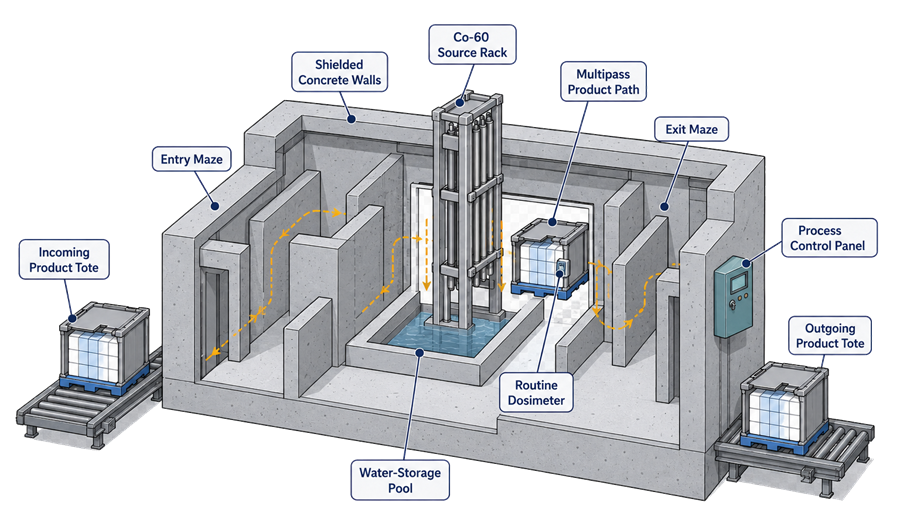
Product does not contact the source. The source remains sealed and physically separated from the product. Products exposed to industrial Cobalt-60 gamma radiation do not become radioactive under normal sterilization conditions.
Product Path Through the Irradiator
Packaged product is loaded into an irradiation container, which may be described as a:
- Tote
- Carrier
- Product carrier
- Irradiation container
- Pallet
- Product box
- Processing container
The conveyor transports the container along a defined path around the source. Depending on the irradiator, the product may:
- Pass the source once or multiple times
- Travel on both sides of the source rack
- Move through positions at different distances from the source
- Be rotated during processing
- Be turned or reoriented between passes
- Be processed through selected inner or outer conveyor paths
- Remain stationary for a defined batch exposure
- Be processed with other products assigned to a compatible processing category
Multiple passes and product repositioning improve dose distribution, but they do not eliminate attenuation or configuration effects.
The specified product path may include:
- Conveyor-path identification
- Source-pass sequence
- Container orientation
- Rotation or turn position
- Number of passes
- Dwell or cycle time
- Conveyor speed
- Required separation from adjacent containers
- Requirements for neighboring-product density
- Partial-container restrictions
- Use of dummy or compensating material
- Approved processing category
A product qualified on one path should not be transferred to another path without assessing the effect on dose distribution and the relationship between routine monitoring dose and product dose.
Dose Delivery
The dose absorbed by product depends on the combined effect of:
- Source activity
- Source geometry
- Source-to-product distance
- Exposure time
- Conveyor speed
- Number of passes
- Product orientation
- Product density
- Product dimensions
- Packaging configuration
- Container loading pattern
- Adjacent-container loading
- Photon attenuation
- Scatter and build-up
- Irradiator operating configuration
Increasing exposure time or reducing conveyor speed generally increases dose. The relationship is not a complete release model by itself because the absorbed dose at each product location also depends on geometry, density, and surrounding material.
The irradiator operator typically establishes a processing timer setting or conveyor speed from:
- Current source activity
- Validated dose-map relationships
- Routine monitoring-dose target
- Product processing category
- Approved loading configuration
- Established dose specification
The controlling objective is not simply completion of the programmed path. It is delivery of a dose within the validated range throughout the defined product load.
Penetration and Attenuation
Gamma photons can penetrate sealed cartons, packaged devices, and many palletized loads. This allows products to be sterilized in their final packaging and reduces the need for post-sterilization handling.
However, photons are progressively attenuated as they travel through material. Attenuation is influenced by:
- Material composition
- Bulk density
- Local density
- Product thickness
- Total product mass
- Package dimensions
- Metal components
- Liquids
- Product orientation
- Air spaces and voids
- Relationship to the source
- Surrounding product
Low-density materials may permit relatively deep penetration but can still produce nonuniform dose because of packaging geometry and air spaces. Dense materials may create a larger difference between exterior and interior absorbed dose.
Metal does not automatically make a product unsuitable for gamma sterilization, but significant metal masses can influence attenuation and scatter. Liquids, gels, and frozen materials may also present specific dose-distribution and product-stability concerns.
The irradiator and product must be evaluated as one processing configuration. A statement that gamma radiation has “high penetration” cannot replace product-specific dose mapping.
Product Density
Product density is commonly calculated from the packaged-product mass and external package volume: ρ=Vm
where:
- ρ is packaged-product bulk density
- m is packaged-product mass
- V is the external package volume
This calculated density is useful for processing control, but it may not describe local density variation inside the package.
Two cartons with the same average density can produce different dose distributions when one contains:
- A uniform arrangement of components
and the other contains:
- A dense component concentrated in one corner
- Large internal voids
- Metal assemblies
- Liquid-filled components
- Nested products
- Bundled tubing
- Multiple packaging layers
Density control should therefore consider:
- Nominal carton density
- Permitted density range
- Local density distribution
- Product orientation
- Internal component arrangement
- Number of units per carton
- Packaging materials
- Carton dimensions
- Manufacturing variability
- Permitted substitutions
Weight checks can help confirm the loading configuration, but weight alone does not establish dose equivalence.
Irradiation-Container and Tote Configuration
The validated tote or irradiation-container configuration defines how product is presented to the radiation field. The configuration may specify:
- Irradiation-container type and dimensions
- Product code
- Carton dimensions
- Number of cartons
- Carton location
- Product orientation
- Filling sequence
- Maximum and minimum weight
- Density range
- Use of dividers or spacers
- Use of dummy material
- Permitted voids
- Partial-load arrangement
- Orientation markers
- Container closure
- Conveyor path
- Routine dosimeter location
Uncontrolled changes to the load can alter both minimum and maximum absorbed dose. Examples include:
- Removing cartons from the center
- Adding product only near the source-facing surface
- Substituting a higher-density product
- Changing carton dimensions
- Changing the number of products per carton
- Rotating the cartons
- Replacing product with an unqualified dummy material
- Processing a partially filled tote
- Mixing incompatible product densities
- Changing neighboring-container conditions
Partial loads can be more challenging than full loads. Less material may reduce attenuation and increase maximum dose, while an asymmetric load may change the location or magnitude of both dose extremes. Partially filled containers require defined loading and supporting qualification evidence.
Dose Distribution
Dose is not distributed uniformly through an irradiation container. The location and magnitude of the absorbed dose depend on the complete product, container, conveyor, and source configuration.
Dose mapping is used to determine:
- Zones of minimum absorbed dose
- Zones of maximum absorbed dose
- Magnitude of dose gradients
- Dose variation among irradiation containers
- Relationship between product dose and routine monitoring dose
- Effects of different paths or loading configurations
- Effects of partial loads
- Effects of mixed-density processing
The minimum-dose location is often associated with an attenuated internal region, but it cannot be assigned solely from geometric appearance. The maximum-dose location is often closer to a source-facing surface, but scatter, multiple passes, source geometry, and product rotation can shift its actual location.
The minimum and maximum locations may:
- Occur in different cartons
- Occur during different passes
- Move after a packaging change
- Move after a loading-pattern change
- Differ between full and partial loads
- Differ between processing categories
- Differ among irradiator designs
- Differ when surrounding product density changes
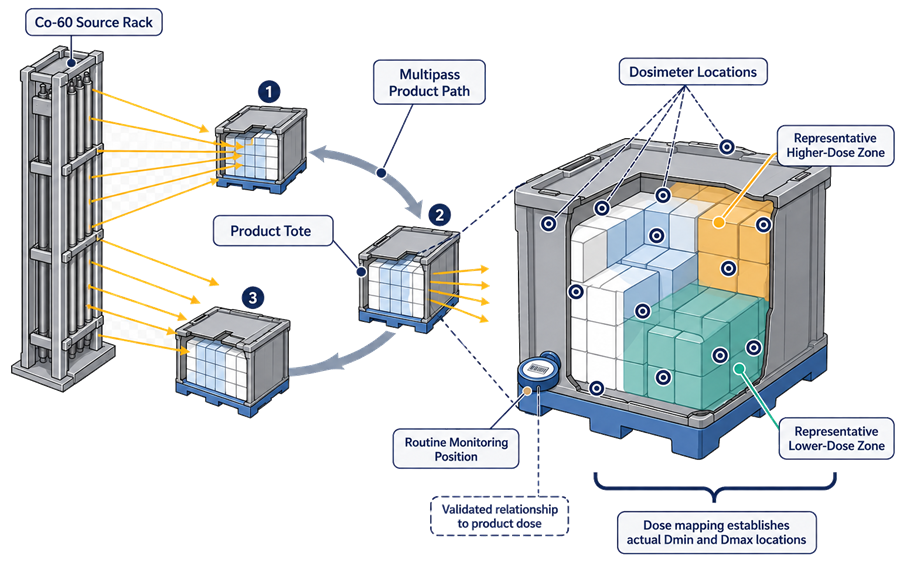
The new illustration should show representative high-dose and low-dose zones rather than declare one universal physical location. The caption must state that dosimetry establishes the actual locations.
Minimum and Maximum Absorbed Dose
A gamma sterilization process operates within an approved dose range. The lower boundary is the sterilization dose: Dster. This is the minimum dose required to support the defined sterility-assurance claim using the approved dose-establishment or substantiation method.
The upper boundary is the maximum acceptable dose: Dmax,acc. This is the maximum dose at which the product, sterile barrier, packaging, labeling, and applicable performance characteristics remain acceptable.
The fundamental processing requirement is: Dmin≥Dster, and: Dmax≤Dmax,acc
The validated dose range is therefore not created by the irradiator alone. It depends on two different bodies of evidence:
| Boundary | Evidence basis |
|---|---|
| Minimum sterilization dose | Bioburden, dose-establishment or substantiation method, verification-dose experiment, required SAL |
| Maximum acceptable dose | Material, functional, chemical, biological, packaging, aging, and performance studies |
A narrow difference between Dster and Dmax,acc can make the product difficult to process reliably. Reducing dose nonuniformity or modifying the loading configuration may be necessary.
Dose Uniformity Ratio
Dose uniformity ratio describes the dose spread within the mapped configuration: DUR=DminDmax
A DUR of 1.0 would represent perfectly uniform dose delivery, which is not expected in an industrial gamma process.
A lower DUR generally provides more processing flexibility because the minimum sterilization dose can be achieved with less risk of exceeding the maximum acceptable dose.
DUR is influenced by:
- Product density
- Density uniformity
- Container dimensions
- Source geometry
- Distance from the source
- Number of exposure sides
- Conveyor path
- Product rotation
- Loading pattern
- Partial loading
- Mixed-product processing
- Use of attenuating or compensating material
DUR should not be treated as a universal equipment constant. It applies to the defined irradiator, path, container, product, and loading configuration represented by the mapping study.
Dosimetry
Dosimetry is the quantitative basis for controlling gamma irradiation. Time inside the chamber, conveyor speed, and source activity support process control, but absorbed-dose measurement provides the direct evidence of radiation delivered. Dosimetry systems may be used for:
- Irradiator qualification
- Dose mapping
- Process definition
- Routine dose monitoring
- Verification-dose experiments
- Dose audits
- Investigations
- Requalification
- Source-replenishment assessment
- Process transfer
A dosimetry system includes more than the physical dosimeter. It includes:
- Dosimeter material
- Dosimeter batch
- Conditioning
- Packaging or holder
- Placement
- Irradiation
- Measurement instrument
- Calibration
- Environmental corrections
- Response calculation
- Measurement uncertainty
- Traceability
- Data review
- Record retention
Dosimetry should be calibrated for the applicable:
- Radiation source
- Dose range
- Dose rate
- Temperature
- Humidity, where relevant
- Time between irradiation and reading
- Measurement instrument
- Operating procedure
The measurement uncertainty must be understood and considered when evaluating compliance with the dose specification. A reported result immediately above the minimum dose or immediately below the maximum dose cannot be interpreted correctly without considering uncertainty and the validated relationship between the monitoring position and product-dose extremes.
ISO 11137-3:2017 provides guidance on dosimetric aspects of development, validation, and routine control.
Routine Monitoring Position
Routine dosimeters are normally placed at one or more defined monitoring positions that are practical and reproducible during commercial processing.
The routine monitoring position is not necessarily the minimum- or maximum-dose location. Dose mapping establishes the relationship among:
- Routine monitoring dose
- Minimum product dose
- Maximum product dose
- Irradiator operating parameters
- Loading configuration
This relationship allows the routine monitoring result to support a conclusion that the product remained within the validated dose range.
The relationship must remain valid for the approved:
- Product
- Processing category
- Container type
- Loading pattern
- Conveyor path
- Source configuration
- Dosimeter placement method
A dosimeter placed on the exterior of a tote does not directly measure the dose at an internal minimum-dose location. Its use depends on the established mapping relationship.
Cobalt-60 Source Decay
Cobalt-60 undergoes continuous radioactive decay. Its half-life is approximately 5.27 years, corresponding to an activity reduction of approximately 12% per year when no new source is added.
As source activity declines, the irradiator must compensate to maintain the required dose. Compensation may involve:
- Increasing dwell time
- Reducing conveyor speed
- Changing timer settings
- Adjusting product scheduling
- Using different conveyor paths
- Adding new Cobalt-60 source pencils
- Rearranging source modules
Routine decay compensation should follow an approved calculation and control method. It should not be treated as an uncontrolled process change.
Although a longer exposure can compensate for reduced source activity, source replenishment or rearrangement may change:
- Source geometry
- Dose rate
- Dose distribution
- Timer relationships
- Conveyor throughput
- Temperature during exposure
- Relationship between monitoring dose and product dose
Source loading changes therefore require documented assessment and appropriate operational verification or dose mapping.
Processing Categories
A processing category is a group of different products that can be processed together under defined conditions. Grouping may be based on characteristics affecting dose delivery, such as:
- Product composition
- Packaged-product density
- Density range
- Package dimensions
- Loading pattern
- Irradiation-container type
- Dose specification
- Conveyor path
- Dose-distribution behavior
- Relationship to surrounding product
A processing category is not the same as a product family used for sterilization-dose establishment.
| Grouping concept | Primary purpose | Typical basis |
|---|---|---|
| Product family | Dose establishment and dose audits | Bioburden magnitude, type, resistance, manufacturing controls, product similarity |
| Processing category | Physical irradiation and process control | Density, dimensions, loading, dose range, container, path, dose distribution |
| Material family | Product compatibility assessment | Polymer, formulation, additives, colorants, construction, intended function |
| Packaging family | Sterile-barrier and distribution assessment | Packaging material, design, seal, configuration, labeled shelf life |
Products may belong to the same processing category while belonging to different dose-establishment families. Conversely, products sharing one dose-establishment family may require different processing categories because their densities, package dimensions, or dose tolerances differ.
Processing categories should not be created solely for scheduling convenience. The inclusion rationale must demonstrate that products can be processed together without causing unacceptable dose distribution in their own or neighboring irradiation containers.
Mixed-Product Processing
Commercial gamma irradiators frequently process more than one product type within the irradiation chamber. The presence of surrounding containers can influence dose through:
- Attenuation
- Scatter
- Changes in the radiation field
- Density interfaces
- Empty conveyor positions
- Different product heights
- Different path occupancy
The process specification should define:
- Which products may be processed together
- Permitted density differences
- Required sequencing
- Empty-position controls
- Use of dummy loads
- Restrictions for partially filled containers
- Product-change transitions
- Conditions requiring dedicated processing
A product should not be combined with a substantially different density merely because both products have the same nominal sterilization dose.
Material Compatibility
Gamma radiation can affect polymers, adhesives, elastomers, electronics, pharmaceuticals, colorants, coatings, labeling, and packaging. Potential radiation-induced effects include:
- Polymer-chain scission
- Polymer cross-linking
- Oxidation
- Discoloration
- Yellowing
- Embrittlement
- Loss of tensile strength
- Increased stiffness
- Reduced elasticity
- Changes in transparency
- Adhesive degradation
- Seal-strength changes
- Odor formation
- Extractable or leachable changes
- Changes in drug potency
- Changes in dissolution or release characteristics
- Electronic-component failure
- Reduced battery performance
- Label fading or loss of legibility
Material name alone does not establish compatibility. Radiation response may vary with:
- Resin grade
- Molecular weight
- Additives
- Stabilizers
- Antioxidants
- Pigments
- Fillers
- Manufacturing history
- Oxygen availability
- Temperature
- Dose rate
- Total accumulated dose
- Post-irradiation aging
- Storage conditions
Commonly used polymers may be suitable at one dose but unacceptable after exposure to the maximum routine dose, an additional processing pass, accelerated aging, and the claimed shelf life.
Establishing the Maximum Acceptable Dose
Maximum-dose studies should represent conditions that could cause the greatest product effect. The test program may include:
- Maximum anticipated routine dose
- Dosimetry uncertainty
- Processing variability
- Potential repeat exposure
- Source or facility variation
- Accelerated aging
- Real-time aging
- Shipping simulation
- Storage conditions
- Worst-case material grades
- Worst-case product configuration
Evaluation may address:
- Device function
- Mechanical strength
- Dimensional stability
- Electrical performance
- Optical properties
- Package integrity
- Seal strength
- Label integrity
- Biocompatibility
- Chemical stability
- Extractables and leachables
- Particulates
- Drug potency
- Degradation products
- Product-specific critical quality attributes
Testing only at the nominal processing target is insufficient when routine product may receive a higher dose.
Gamma irradiation leaves no sterilant residue, but absence of a chemical sterilant does not mean absence of product effects.
Packaging Compatibility
Gamma radiation can penetrate many packaging systems, allowing sterilization after the sterile barrier has been sealed. Packaging assessment should consider:
- Sterile-barrier material
- Sealant
- Adhesive
- Ink
- Label
- Tyvek or porous material
- Film
- Tray
- Blister
- Carton
- Protective insert
- Tamper-evident feature
The packaging system should remain suitable through:
- Maximum radiation exposure
- Aging
- Distribution
- Storage
- Expected handling
- Intended shelf life
Changes in packaging may also change packaged-product density and dose distribution. A packaging change can therefore require both compatibility testing and dose-map impact assessment.
Additional principles are addressed in Packaging Design Considerations.
Product Temperature and Process Environment
Gamma sterilization is commonly described as a low-temperature process because it does not require the elevated process temperatures associated with moist or dry heat sterilization. Product temperature can nevertheless change because of:
- Duration of exposure
- Facility temperature
- Product thermal mass
- Source activity
- Processing path
- Conveyor delays
- Seasonal conditions
- Frozen or refrigerated presentation
- Post-irradiation storage
Temperature can affect both product stability and dosimeter response. Temperature limits and monitoring requirements should be established where the product, packaging, frozen state, or dosimetry system is temperature sensitive.
Environmental humidity is generally not a primary gamma lethality parameter in the same manner as it is for some gaseous or vapor processes. It may still influence product materials, packaging, and dosimeter performance.
Routine Gamma Processing
Before processing, the irradiator should verify the product against the approved process specification. Controls may include:
- Customer and product identity
- Product code
- Lot or batch number
- Quantity
- Package dimensions
- Container type
- Weight
- Density category
- Loading pattern
- Product orientation
- Conveyor path
- Dose specification
- Timer setting or conveyor speed
- Routine dosimeter location
- Processing status
- Special temperature requirements
Barcode controls, electronic recipes, and weight checks may help prevent an incorrect product or configuration from entering the irradiator. These controls must be qualified where they are relied upon for process control or segregation.
During processing, the irradiator should maintain traceability to:
- Source configuration
- Product path
- Container sequence
- Operating settings
- Irradiation start and completion
- Interruptions
- Alarms
- Routine dosimeters
- Dosimeter readings
- Operator actions
- Processing status
The completed irradiation record should demonstrate that the product was processed through the approved configuration and that dose-monitoring results support compliance with the specification.
Interruptions and Repeat Processing
A conveyor stop, power interruption, source movement fault, timer failure, or tracking-system error may leave product:
- Unprocessed
- Partially processed
- Fully processed
- Exposed more than once
- In an uncertain status
The facility must maintain physical and electronic controls preventing uncertain product from being released as successfully processed. Disposition should consider:
- Product location at the time of interruption
- Source position
- Exposure already received
- Routine dosimeter status
- Potential minimum dose
- Potential cumulative maximum dose
- Product compatibility with reprocessing
- Ability to reconstruct the product path
- Approved recovery procedure
Restarting the conveyor does not by itself establish acceptable processing. A second full pass may assure the minimum dose but cause the maximum acceptable dose to be exceeded.
Product Segregation and Status Control
Gamma facilities should maintain clear separation and status identification for:
- Product received but not released for processing
- Untreated product
- Product queued for irradiation
- Product undergoing irradiation
- Processed product awaiting dosimetry results
- Accepted processed product
- Product under investigation
- Rejected or returned product
The entry and exit conveyors may be physically separated, but physical arrangement alone is insufficient. Controls should prevent:
- Untreated product entering the treated-product area
- Processed product returning to the untreated area
- Duplicate processing without authorization
- Release before dosimetry review
- Mixing of different customer lots
- Loss of container sequence
- Misidentification during interruption recovery
Outsourced Gamma Irradiation
Gamma sterilization is frequently performed by specialized contract irradiators because source licensing, radiation security, shielding, source handling, and facility infrastructure are substantial.
Outsourcing transfers operational execution; it does not transfer the manufacturer’s responsibility for the suitability and control of the sterilization process.
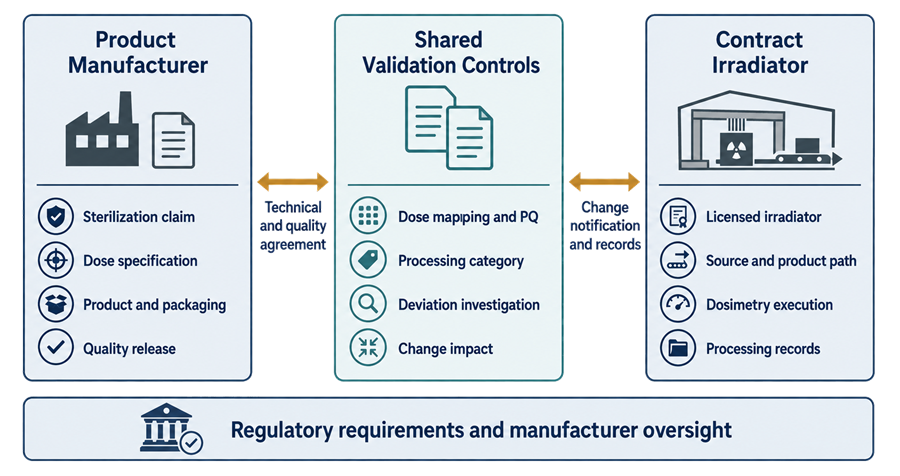
Responsibilities should be defined in technical and quality agreements.
| Product manufacturer | Contract irradiator | Shared responsibilities |
|---|---|---|
| Define intended sterilization claim | Maintain licensed irradiator | Validation planning |
| Establish product family | Control source and irradiator | PQ dose mapping |
| Establish or substantiate sterilization dose | Maintain source and conveyor configuration | Processing-category approval |
| Establish maximum acceptable dose | Operate approved processing path | Routine-monitoring strategy |
| Control bioburden | Maintain calibrated dosimetry system | Change-impact assessment |
| Define product and packaging configuration | Control loading and processing records | Deviation investigation |
| Approve dose specification | Maintain product segregation | Process transfer |
| Assess material and packaging compatibility | Report interruptions and anomalies | Requalification decisions |
| Approve processing category | Issue irradiation documentation | Regulatory-impact assessment |
| Review routine records | Notify defined changes | Periodic performance review |
| Release product under its quality system | Control irradiator maintenance | CAPA where applicable |
The agreement should address:
- Approved irradiator and site
- Approved conveyor paths
- Dose specification
- Product and loading specification
- Processing categories
- Dosimetry responsibilities
- Data review
- Record retention
- Deviation reporting
- Change notification
- Source-replenishment notification
- Facility-transfer controls
- Subcontracting
- Audit rights
- Regulatory inspection support
- Business continuity
- Product recall support
A certificate of irradiation is supporting evidence. It does not replace manufacturer review of validation status, dose compliance, deviations, changes, and product traceability.
Supplier Qualification and Ongoing Oversight
Initial assessment of a contract irradiator should evaluate:
- Applicable licenses
- Regulatory history
- Quality-system certification
- ISO 11137 capability
- Dosimetry laboratory controls
- Calibration traceability
- Measurement uncertainty
- Irradiator qualification
- Product-status control
- Electronic tracking
- Data integrity
- Deviation management
- Change control
- Source security
- Maintenance
- Disaster recovery
- Capacity
- Source-supply continuity
- Record retention
- Technical competence
- Subcontractor control
Ongoing oversight may include:
- Quality-agreement review
- Periodic audits
- Performance metrics
- Deviation trends
- Dosimetry trends
- Late or incomplete records
- Source-loading changes
- Conveyor or software changes
- Regulatory observations
- Capacity or continuity risks
- Periodic validation review
The manufacturer should understand enough of the irradiator process to evaluate changes and failures. Reliance on the contractor’s certification alone is insufficient.
Facility and Process Transfers
Moving a product to another irradiator, another site, another conveyor path, or another radiation modality requires documented assessment. The assessment should consider:
- Source type
- Source geometry
- Dose rate
- Irradiator design
- Container dimensions
- Conveyor path
- Product orientation
- Dose distribution
- Routine dosimetry system
- Monitoring location
- Processing category
- Product temperature
- Maximum acceptable dose
- Regulatory submission impact
Equivalence cannot be concluded from the fact that both facilities use Cobalt-60. Dose mapping or other justified transfer evidence is required to establish the relationship between the new process and the approved dose specification.
For medical devices, sterilization-method or site changes may also require regulatory evaluation under FDA’s 510(k) sterility guidance and the applicable device submission pathway.
Gamma, E-Beam, and X-Ray Boundaries
Gamma, electron beam, and X-ray processes all deliver ionizing radiation, and all are covered by the ISO 11137 framework. Their process characteristics are different.
| Characteristic | Gamma | Electron beam | X-ray |
|---|---|---|---|
| Radiation source | Cobalt-60 decay | Electrical accelerator | Accelerator-generated photons |
| Source state | Continuously radioactive | On only when energized | On only when energized |
| Penetration | High | Lower | High |
| Dose rate | Relatively low | Very high | Intermediate to high |
| Typical product form | Boxes, totes, pallets | Lower-density cartons or thin configurations | Boxes, totes, pallets |
| Source decay | Yes | No | No |
| Main process controls | Source activity, time, path, loading | Beam energy, current, scan, speed, orientation | Beam energy, current, conversion target, speed, loading |
| Facility concern | Radioactive-source licensing and security | Accelerator and penetration control | Accelerator efficiency and photon conversion |
A transition from gamma to another radiation source is not merely an equipment substitution. Material effects, dose rate, temperature, distribution, dosimetry, product performance, and regulatory impact must be evaluated.
Electron Beam Sterilization Process addresses the distinct penetration and operating characteristics of e-beam systems.
Common Process Errors
Frequent technical and quality errors include:
- Treating 25 kGy as a universal sterilization dose
- Using exposure time as a substitute for dosimetry
- Assuming gamma penetration produces uniform dose
- Assigning minimum- and maximum-dose locations without mapping
- Ignoring local density variation
- Defining only a maximum tote load
- Failing to evaluate partial loads
- Changing carton quantity or orientation without assessment
- Using product weight as the sole proof of configuration
- Mixing incompatible product densities
- Confusing a product family with a processing category
- Assuming one DUR applies to every product
- Treating the routine dosimeter as a direct measurement of product minimum dose
- Ignoring dosimetry uncertainty
- Testing material compatibility only at the nominal dose
- Failing to include aging after maximum-dose exposure
- Ignoring cumulative dose after interrupted or repeated processing
- Assuming no sterilant residue means no product impact
- Treating source-decay compensation as an informal timer adjustment
- Failing to assess source replenishment or rearrangement
- Transferring product between irradiators without dose-distribution evidence
- Releasing product solely from a certificate of irradiation
- Failing to define outsourced responsibilities
- Accepting an irradiator’s general ISO certification as product-specific validation
- Failing to control untreated, treated, and uncertain-status product
Conclusion
Gamma radiation sterilization is a controlled absorbed-dose process, not simply exposure of product to a Cobalt-60 source.
The source system, conveyor path, irradiation container, product density, packaging, loading pattern, and surrounding product determine how radiation is delivered. Dose mapping identifies the actual minimum- and maximum-dose zones and establishes their relationship to routine dosimetry.
The minimum dose must satisfy the substantiated sterilization requirement. The maximum dose must remain within the demonstrated tolerance of the product, packaging, labeling, and applicable quality attributes. Product compatibility, dose distribution, and sterilization-dose establishment are therefore interdependent.
Cobalt-60 decay requires controlled compensation, while source additions and configuration changes require impact assessment. Processing categories can support efficient commercial operation, but they must be based on demonstrated physical processing compatibility rather than administrative convenience.
When gamma irradiation is outsourced, the contract facility controls irradiator operation, source management, transport, and dosimetry execution. The manufacturer retains responsibility for the sterilization claim, product family, dose specification, material suitability, validated configuration, change assessment, regulatory impact, and product release.