

Sterilization Regulations, Standards, and Validation Lifecycle
Sterilization compliance is not governed by one universal document. The applicable framework is assembled from enforceable regulations, approved regulatory commitments, FDA guidance, compendial requirements, consensus standards, and the manufacturer’s validated control strategy.
These sources do not have equal legal status.
For US pharmaceutical manufacturing, 21 CFR Parts 210 and 211 establish enforceable current good manufacturing practice requirements. For US medical devices, 21 CFR Part 820—the Quality Management System Regulation, or QMSR—incorporates ISO 13485:2016 by reference. FDA guidance describes the Agency’s current thinking but does not independently create legally enforceable requirements. USP–NF text has different applicability depending on the chapter, monograph, General Notices, and product. Most consensus standards remain voluntary unless incorporated by reference, used in a regulatory submission, declared as a basis for conformity, or adopted as an approved company requirement.
A defensible sterilization program must therefore identify which sources apply, explain how they were interpreted, and connect them to process development, qualification, routine control, change control, and requalification.
Purpose and Scope
This article addresses:
- The legal distinction among regulations, guidance, compendial text, and consensus standards
- Enforceable US pharmaceutical requirements
- FDA guidance for sterile drug and biological products
- USP chapters relevant to sterilization and sterility assurance
- The US medical-device QMSR framework
- FDA-recognized consensus standards for medical-device sterilization
- Differences between pharmaceutical and medical-device frameworks
- Regulatory commitments established through submissions and approvals
- Sterilization-process development and qualification
- Routine monitoring and batch or load release
- Deviation and failure investigation
- Change control and regulatory reporting
- Periodic review and requalification
- Contract-sterilizer governance
- Standards-version and lifecycle control
Selection of the sterilization technology itself is addressed in Sterilization Methods and Selection for GMP Manufacturing.
Regulatory Source Categories and Legal Force
Sterilization requirements should be classified before they are applied.
| Source category | General US status | Practical application |
|---|---|---|
| Federal statute and applicable CFR requirements | Legally enforceable | Establish mandatory manufacturing, validation, record, investigation, and quality-system obligations |
| Requirements incorporated by reference | Legally enforceable within the scope of incorporation | ISO 13485:2016 is incorporated into the medical-device QMSR |
| Approved applications and regulatory commitments | Binding within the applicable approval or regulatory framework | Define approved sterilization methods, sites, cycles, release strategies, specifications, and reporting obligations |
| FDA guidance and compliance policy | FDA’s current thinking; generally nonbinding | Describes approaches FDA considers acceptable and the evidence normally expected |
| USP–NF monographs and General Chapters | Applicability depends on compendial status, references, General Notices, and product | Establishes applicable tests, specifications, methods, and technical practices |
| Consensus standards | Normally voluntary unless incorporated, committed to, or otherwise made applicable | Provides detailed technical requirements for development, validation, and routine control |
| Internal procedures and specifications | Mandatory within the manufacturer’s quality system once approved | Translate external requirements and development evidence into operating controls |
Calling all these documents “regulations” obscures their actual authority. It can result in both overstatement and undercompliance.
Determining the Applicable Framework
The applicable framework should be documented for each sterilization process or validated process family.
The assessment should identify:
- Product regulatory category
- Drug, biologic, medical device, or combination-product status
- Intended markets
- Required sterile claim
- Sterilization method
- Terminal, component, equipment, or in-process application
- Applicable product monograph
- Approved or cleared regulatory commitments
- Sterilization site
- Internal or contract processing
- Applicable consensus standards
- FDA recognition status where relevant
- Standard edition and amendments
- Regulatory filing or notification requirements
- Routine release strategy
- Requalification requirements
The assessment should distinguish the scope of a source from its technical usefulness. A standard written for medical-device sterilization may provide valuable technical practices for a pharmaceutical application, but its medical-device scope does not automatically make every provision a pharmaceutical requirement.
Regulation-to-Validation Lifecycle Matrix
The regulatory framework must be translated into activities across the entire sterilization lifecycle.
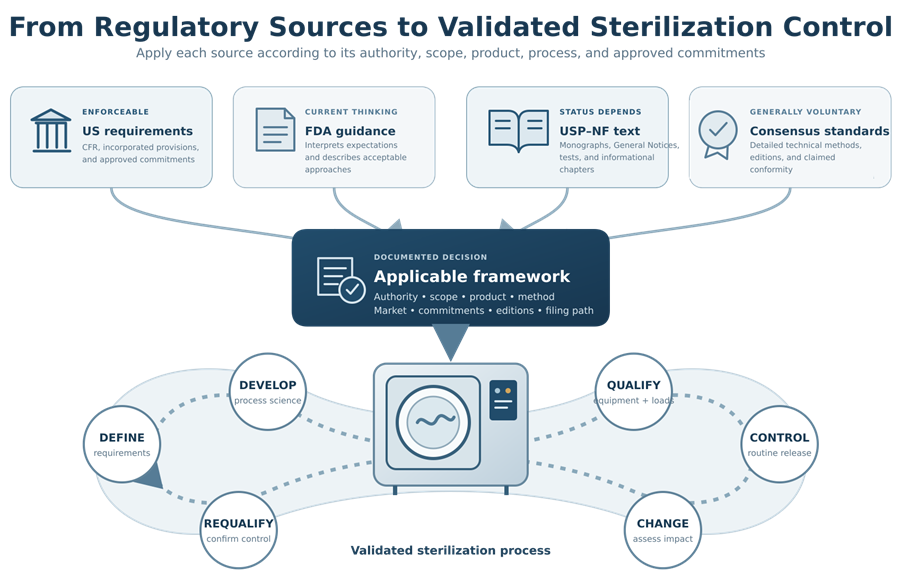
Insert illustration here: Regulation-to-Validation Lifecycle Matrix
The governing control strategy is the integrated result of the applicable sources. No single regulation, guidance, compendial chapter, or consensus standard is sufficient by itself.
Enforceable US Pharmaceutical Requirements
21 CFR Parts 210 and 211
For finished pharmaceutical products, 21 CFR 211.113(b) requires written procedures designed to prevent microbiological contamination of sterile drug products. These procedures must include validation of all aseptic and sterilization processes.
Sterilization control also depends on other Part 211 requirements.
| CFR provision | Relevance to sterilization |
| 21 CFR 211.42 | Facility design and defined areas for operations, including aseptic processing and sterilization activities |
| 21 CFR 211.63 | Equipment must be appropriate for its intended use and capable of facilitating required operations |
| 21 CFR 211.67 | Equipment cleaning and maintenance procedures and records |
| 21 CFR 211.68 | Controls for automatic, mechanical, and electronic equipment |
| 21 CFR 211.100 | Written production and process-control procedures, including recorded and justified deviations |
| 21 CFR 211.113(b) | Validation of all aseptic and sterilization processes |
| 21 CFR 211.160 | Scientifically sound laboratory controls, specifications, and test procedures |
| 21 CFR 211.165 | Testing and release requirements for finished drug products |
| 21 CFR 211.167 | Special testing requirements for sterile and pyrogen-free products |
| 21 CFR 211.180 | Record retention and review requirements |
| 21 CFR 211.192 | Investigation of unexplained discrepancies and failures |
| 21 CFR 211.198 | Complaint review and investigation |
Part 211 does not provide a complete technical sterilization protocol. It establishes the obligation to develop, validate, document, follow, monitor, investigate, and maintain an effective process.
Technical details must be established from process science, development studies, applicable guidance, compendial expectations, relevant standards, and approved commitments.
Biological Products
Biological products may also be subject to applicable requirements in 21 CFR Parts 600 through 680, including requirements related to manufacturing controls, records, testing, sterility, and licensed manufacturing conditions.
The biologics license application and approved supplements may define:
- Sterilization or aseptic-processing method
- Manufacturing and sterilization sites
- Critical process parameters
- Product and container-closure configuration
- Release strategy
- Validation commitments
- Post-approval change reporting
A licensed condition should not be changed solely through an internal change-control decision when regulatory reporting or prior approval is required.
Approved Drug Applications
For an NDA, ANDA, NADA, ANADA, or BLA, the approved application may establish process-specific commitments beyond the general wording of the CGMP regulations.
These may include:
- Sterilization method
- Cycle design
- Minimum or maximum lethality
- Load configuration
- Biological-indicator strategy
- Presterilization bioburden controls
- Filter controls
- Sterilization site
- Contract sterilizer
- Parametric-release strategy
- Container-closure system
- Routine monitoring
- Revalidation commitments
Changes must be evaluated against the applicable regulatory reporting framework, including 21 CFR 314.70 for approved human drug applications and 21 CFR 601.12 for licensed biological products.
FDA Guidance for Pharmaceutical Sterilization
FDA guidance does not carry the same legal force as a regulation. It describes the Agency’s current thinking and normally permits alternative approaches when they satisfy applicable statutory and regulatory requirements.
Important guidance includes:
Sterile Drug Products Produced by Aseptic Processing
FDA’s Aseptic Processing—Current Good Manufacturing Practice guidance addresses sterile drug and biological products manufactured using aseptic processing.
It is relevant to:
- Terminal-sterilization feasibility
- Component and equipment sterilization
- Sterilizing filtration
- Aseptic connections and transfers
- Sterile holding periods
- Environmental controls
- Process simulations
- Container-closure integrity
- Sterility-assurance systems
The guidance supports the principle that terminal sterilization should be evaluated when feasible. It does not mean that an unsuitable terminal cycle should be imposed on a product that cannot withstand the process.
Submission Documentation for Sterilization Process Validation
FDA’s Submission Documentation for Sterilization Process Validation describes information supporting sterilization-process efficacy in human and veterinary drug applications.
Relevant information may include:
- Sterilization method
- Equipment and cycle description
- Critical process parameters
- Biological and physical qualification
- Load patterns
- Container-closure considerations
- Microbiological challenge
- Sterilant residues
- Routine process control
- Reprocessing or resterilization
- Validation summaries
The guidance is an older document, but it remains listed by FDA as final guidance and continues to provide a useful submission framework.
Process Validation Guidance
FDA’s Process Validation: General Principles and Practices establishes a lifecycle model based on:
- Process design
- Process qualification
- Continued process verification
Sterilization validation should be consistent with this lifecycle concept even when modality-specific terminology divides qualification differently.
Parametric Release
FDA’s Parametric Release guidance addresses applications for parametric release of products terminally sterilized by moist heat.
Parametric release requires more than removal of the finished-product sterility test. It depends on:
- Approved regulatory strategy
- Robust cycle development
- Qualified equipment
- Defined critical process parameters
- Reliable physical monitoring
- Controlled bioburden
- Validated load configurations
- Acceptable cycle records
- Maintenance of the validated state
Parametric release should not be implemented through an internal procedure change without determining the required regulatory pathway.
USP–NF Compendial Expectations
USP–NF text should not be treated as one uniform category.
General Chapters numbered below 1000 commonly contain compendial tests or requirements when made applicable by a monograph, General Notice, or other official text. Chapters numbered 1000 through 1999 generally provide informational guidance unless made applicable through another requirement or commitment.
Relevant chapters include:
| USP chapter | Principal relevance |
<55> Biological Indicators—Resistance Performance Tests | BI population and resistance testing |
<56> Methods for Determination of Resistance of Microorganisms to Sterilization Processes | Resistance-characterization methods |
<71> Sterility Tests | Compendial sterility-test method where applicable |
<85> Bacterial Endotoxins Test | Endotoxin testing where applicable |
<1211> Sterility Assurance | General sterility-assurance principles |
<1229> Sterilization of Compendial Articles | General sterilization lifecycle and process principles |
<1229.1> Steam Sterilization by Direct Contact | Direct-contact steam sterilization |
<1229.2> Moist Heat Sterilization of Aqueous Liquids | Terminal moist-heat processing of liquids |
<1229.3> Monitoring of Bioburden | Presterilization bioburden control |
<1229.4> Sterilizing Filtration of Liquids | Sterilizing-grade liquid filtration |
<1229.5> Biological Indicators for Sterilization | BI selection and use |
<1229.6> Liquid-Phase Sterilization | Liquid chemical sterilization concepts |
<1229.7> Gaseous Sterilization | Gas sterilization processes |
<1229.8> Dry Heat Sterilization | Dry-heat sterilization |
<1229.9> Physicochemical Integrators and Indicators | Chemical and physical indicators |
<1229.10> Radiation Sterilization | Radiation-processing principles |
<1229.11> Vapor-Phase Sterilization | Vapor sterilization processes |
<1229.12> New Sterilization Methods | Development of emerging methods |
<1229.13> Sterilization-in-Place | SIP of equipment and process systems |
The official current USP–NF should be checked before relying on a chapter number, title, text, or status.
A reference to USP <71> does not make sterility testing a substitute for process validation. Likewise, informational chapters in the <1229> family provide technical direction but do not independently create the same legal obligation as 21 CFR 211.113(b).
Consensus Standards for Pharmaceutical Applications
Pharmaceutical manufacturers frequently use ISO, ANSI/AAMI, ASTM, and PDA documents as technical references.
These may provide detailed methods for:
- Biological indicators
- Temperature distribution
- Heat penetration
- Sterilization dose establishment
- Dosimetry
- Ethylene oxide cycle development
- Sterilant residues
- Filter validation
- Packaging integrity
- Process challenge devices
- Routine monitoring
- Requalification
However, many ISO sterilization standards are explicitly written for medical devices. Their technical principles may be useful for pharmaceutical systems, but their entire scope should not automatically be declared mandatory for a pharmaceutical application.
The manufacturer should document:
- Why the standard is relevant
- Which clauses or methods are being applied
- Any clauses considered outside the application
- Differences between the standard and pharmaceutical requirements
- Alternative approaches
- Standard edition and amendments
- Relationship to approved regulatory commitments
US Medical-Device Regulatory Framework
Quality Management System Regulation
The revised 21 CFR Part 820 Quality Management System Regulation became effective on February 2, 2026.
The QMSR incorporates ISO 13485:2016 by reference. This changes the legal position of ISO 13485 in the US medical-device framework: the applicable incorporated requirements are not merely voluntary consensus practices.
Manufacturers must document a quality management system that complies with applicable ISO 13485 requirements and the additional requirements of Part 820.
Sterilization is addressed through the integrated QMS, including:
- Risk management
- Design and development
- Supplier control
- Production and process control
- Validation of processes whose output cannot be fully verified later
- Specific validation of sterilization and sterile-barrier-system processes
- Identification and traceability
- Monitoring and measurement equipment
- Record control
- Nonconforming product
- Corrective action
- Change control
- Complaint and postmarket information
ISO 13485 clauses 7.5.6 and 7.5.7 are particularly relevant to validation of production processes and sterilization or sterile-barrier-system processes.
The FDA QMSR resource page confirms that the revised regulation became effective on February 2, 2026 and replaced the former Quality System Regulation framework.
FDA-Recognized Consensus Standards
Medical-device manufacturers commonly use FDA-recognized consensus standards to support premarket submissions and quality-system activities.
Recognition does not automatically make every recognized standard mandatory. It means FDA has determined that the standard is acceptable for specified purposes and within the stated extent of recognition.
When a manufacturer submits a declaration of conformity or represents that a process conforms to a recognized standard, the manufacturer must possess objective evidence supporting that claim.
Recognition should be verified in FDA’s current Recognized Consensus Standards Database, including:
- Exact standard
- Edition
- Amendments
- Recognition number
- Extent of recognition
- Transition period
- Supplemental information
- Relevant FDA guidance
Important Medical-Device Sterilization Standards
| Standard | Principal scope |
| ISO 17665:2024 | Development, validation, and routine control of moist-heat sterilization |
| ISO 11135:2014 with Amendment 1:2018 | Ethylene oxide sterilization |
| ISO 11137-1:2025 | Development, validation, and routine control of radiation sterilization |
| ISO 11137-2:2013 with applicable amendment | Establishing the radiation sterilization dose |
| ISO 11137-3:2017 | Dosimetric aspects of radiation sterilization |
| ISO 22441:2022 | Low-temperature vaporized-hydrogen-peroxide sterilization |
| ISO 20857:2010 | Dry-heat sterilization |
| ISO 14937:2009 | General framework for characterization and validation of sterilizing agents and processes |
| ISO 11138 series | Biological indicators |
| ISO 11737-1 | Product bioburden determination |
| ISO 11737-2 | Tests of sterility used in sterilization-process definition, validation, and maintenance |
| ISO 11607-1 and ISO 11607-2 | Sterile-barrier systems and packaging-process validation |
| ISO 10993-7 | Ethylene oxide sterilization residuals |
The applicable edition must be verified. A newly published ISO edition and the edition currently recognized by FDA may not always change on the same date.
Device Premarket Submissions
FDA’s January 2024 510(k) Sterility Information guidance describes sterilization information recommended for devices labeled sterile.
Depending on the submission and method, information may include:
- Sterilization method
- Sterilization site
- Validation standard
- Sterility assurance level
- Validation method
- Pyrogenicity
- Sterilant residues
- Packaging
- Maximum sterilization exposure
- Description of novel sterilization methods
- Established-category or novel-method classification
A device manufacturer must also determine whether a postmarket sterilization change requires:
- A new 510(k)
- A PMA supplement
- Another FDA notification
- Documentation within the QMS without a new submission
The decision depends on device classification, submission type, nature of the change, and potential effect on safety or effectiveness.
Pharmaceutical and Medical-Device Frameworks Compared
| Topic | Pharmaceutical products | Medical devices |
| Primary US CGMP framework | 21 CFR Parts 210 and 211; applicable biologics requirements | 21 CFR Part 820 QMSR incorporating ISO 13485:2016 |
| Direct sterilization requirement | 21 CFR 211.113(b) requires validation of aseptic and sterilization processes | QMSR and incorporated ISO 13485 process-validation requirements |
| Regulatory submissions | NDA, ANDA, BLA, supplements, and other applicable filings | 510(k), De Novo, PMA, HDE, supplements, and other device submissions |
| Role of USP–NF | Frequently relevant to product specifications, testing, and technical expectations | Generally not the primary device sterilization framework |
| Role of ISO sterilization standards | Often used as technical support; scope must be assessed | Frequently central to validation and premarket documentation |
| FDA recognition of standards | Recognition system is not normally the basis for pharmaceutical application | FDA-recognized standards can support declarations of conformity and submissions |
| Routine release | Batch release under approved specifications and process controls; parametric release requires an appropriate approved strategy | Device acceptance and release under the validated process and QMS |
| Product compatibility | Drug quality, potency, degradation, container closure, and impurities | Device function, materials, packaging, biocompatibility, residues, and sterile barrier |
| Contract sterilization | Drug manufacturer or application holder retains product responsibility | Finished-device manufacturer retains responsibility; contract sterilizers are also within QMSR scope |
| Change assessment | CGMP and application-reporting category must be determined | QMS documentation plus determination of whether a new submission or supplement is required |
Neither framework should be copied into the other without assessing scope.
Combination Products
Combination products may be subject to both drug and device requirements under 21 CFR Part 4 and the applicable lead-center regulatory framework.
The sterilization strategy should address:
- Regulatory classification
- Constituent parts
- Lead FDA center
- Applicable CGMP operating system
- Product and device compatibility
- Container-closure and sterile-barrier requirements
- Submission commitments
- Change-reporting pathways
- Responsibility among constituent-part manufacturers
A combination-product manufacturer cannot select the less demanding framework while ignoring requirements applicable to another constituent part.
Sterilization Validation Lifecycle
1. Regulatory and Standards Assessment
Before development begins, the project should establish:
- Product category and markets
- Sterile claim
- Applicable regulations
- Applicable FDA guidance
- Compendial requirements
- Consensus standards
- Approved or planned regulatory commitments
- Required SAL
- Submission pathway
- Change-reporting expectations
- Routine release strategy
The assessment should be approved and maintained as development progresses.
2. Process and Product Definition
Development should define:
- Product, component, equipment, or load to be sterilized
- Sterilization method
- Product and package compatibility
- Sterilization-process boundaries
- Sterile boundary after processing
- Load and product families
- Worst-case configurations
- Presterilization bioburden
- Microbial resistance
- Critical process parameters
- Critical quality attributes
- Minimum effective exposure
- Maximum acceptable exposure
- Routine monitoring strategy
The relationship among microbial population, resistance, lethality, and sterility assurance level must be scientifically justified.
3. Process Development
Development establishes how the sterilization process works and where it can fail.
Studies may address:
- Heat, gas, vapor, or radiation distribution
- Product or load penetration
- Air removal
- Humidity equilibration
- Sterilant concentration
- Dose distribution
- Load density and orientation
- Minimum and maximum loads
- Product and packaging effects
- Residues or degradation products
- Biological challenge
- Operating ranges
- Alarm limits
- Process margin
- Failure conditions
For microbiological challenges, Biological Indicators for Sterilization Validation provides the detailed selection and use framework.
4. Equipment Qualification
Equipment qualification should demonstrate that the sterilization system is installed correctly and operates as intended.
The scope may include:
- Design review
- Materials of construction
- Chamber or process geometry
- Utilities
- Piping and drainage
- Instrument identification
- Calibration
- Control-system configuration
- Software functions
- Recipe security
- Alarm and interlock testing
- Data recording
- Access control
- Backup and recovery
- Empty-equipment distribution
- Failure and recovery testing
- Maintenance access
- Approved operating procedures
For steam systems, these activities are addressed further in the steam-sterilization qualification lifecycle.
5. Performance Qualification
Performance qualification demonstrates reproducible process effectiveness with defined production-representative loads.
PQ should address, as applicable:
- Approved load configurations
- Minimum, maximum, and partial loads
- Worst-case product or material locations
- Physical measurements
- Biological challenges
- Heat or sterilant penetration
- Dose mapping
- Minimum and maximum exposure
- Product and package acceptance
- Sterilant residues
- Required replicate runs
- Deviations
- Acceptance criteria
- Final report and release recommendation
PQ should be traceable to development data and should not be used to discover fundamental cycle-design requirements that should already have been established.
Detailed steam-load considerations are addressed in Load Development Strategy and Temperature Mapping and Heat Distribution.
6. Routine Monitoring and Release
Each production cycle or processed load must be evaluated against the validated control strategy.
Routine controls may include:
- Recipe verification
- Load identification
- Load configuration
- Cycle-parameter review
- Temperature, pressure, humidity, concentration, or dose records
- Biological indicators where applicable
- Chemical indicators where applicable
- Dosimeters
- Bioburden
- Filter-integrity testing
- Sterilant residues
- Alarm review
- Operator review
- Electronic-record review
- Deviation assessment
- Batch or load release approval
A negative biological indicator does not override unacceptable physical data. A passing sterility test does not establish that the validated cycle was correctly executed.
7. Deviations and Failures
Sterilization deviations require documented assessment of:
- Process parameters
- Duration and magnitude of the excursion
- Load and product affected
- Equipment status
- Instrument calibration
- Alarms
- Biological or chemical indicators
- Product and package effects
- Sterile-boundary integrity
- Adjacent loads
- Repeat processing
- Regulatory commitments
- Need for product rejection, recall, or reporting
Retesting or repeat sterilization does not erase the original failure. Any reprocessing strategy must be scientifically justified and must address cumulative effects on product and packaging.
8. Change Control
Changes that can affect sterilization include:
- Sterilizer or irradiator
- Sterilization site
- Contract processor
- Cycle recipe
- Process parameters
- Load pattern
- Product family
- Product formulation
- Container or closure
- Device materials
- Packaging
- Biological indicator
- Dosimeter
- Sterilant supplier
- Software
- Instrumentation
- Utilities
- Maintenance strategy
- Preconditioning or aeration
- Test method
- Release strategy
- Applicable standard or edition
The GMP change-control impact assessment should determine:
- Whether the change remains within the validated design space.
- Which development or qualification evidence is affected.
- Whether targeted testing is sufficient.
- Whether comprehensive requalification is required.
- Whether affected product can remain in use.
- Whether regulatory notification, supplement, approval, or new submission is required.
- Whether associated procedures, specifications, and training must change.
Implementation should not occur before the required technical, quality, and regulatory approvals are obtained.
9. Periodic Review and Requalification
Periodic review should evaluate whether the sterilization process remains qualified and controlled.
Inputs should include:
- Cycle history
- Parameter trends
- Deviations
- Positive biological indicators
- Sterility or bioburden results
- Alarm history
- Maintenance
- Calibration
- Repairs
- Software changes
- Load changes
- Supplier changes
- Contract-processor performance
- Product complaints
- Standards revisions
- Regulatory changes
- Previous requalification results
Requalification may be:
- Periodic
- Event-driven
- Targeted
- Comprehensive
The scope should be justified from process risk, applicable standards, regulatory commitments, change history, and performance evidence. Detailed principles are addressed in Sterilization Requalification and Continued Verification.
Contract Sterilization
Outsourcing sterilization does not outsource product responsibility.
The manufacturer should control:
- Contract-sterilizer qualification
- Technical and quality agreements
- Responsibility for cycle development
- Validation ownership
- Load configuration
- Product-family definition
- Routine record review
- Deviation notification
- Change notification
- Maintenance and calibration oversight
- Regulatory inspections
- Data access and retention
- Business continuity
- Site transfers
- Requalification
- Product disposition authority
For medical devices, the QMSR expressly includes contract sterilization within the types of manufacturing functions subject to Part 820.
The division of work may be contractual, but responsibility for demonstrating that the finished drug or device meets applicable requirements remains with the regulated manufacturer or application holder.
Standards-Version Control
Standards must be treated as controlled lifecycle inputs.
The standards register should record:
- Full title
- Standard number
- Edition
- Amendment or corrigendum
- Publication status
- FDA recognition status where relevant
- Extent of recognition
- Internal applicability
- Regulatory commitments
- Effective or transition date
- Gap-assessment status
- Implementation decision
Publication of a new edition does not automatically invalidate an existing validation. It triggers an assessment of:
- Technical changes
- Regulatory recognition
- Existing commitments
- Process risk
- Validation gaps
- Required procedural changes
- Need for additional testing
- Submission or notification implications
Draft standards should not be represented as current published requirements.
Documentation and Inspection Readiness
A complete sterilization evidence package should allow an independent reviewer to determine:
- What requirements apply
- Why the sterilization method was selected
- How the process was developed
- How worst cases were defined
- What equipment was qualified
- What product and load configurations were validated
- How routine cycles are controlled and released
- How deviations are investigated
- How changes are assessed
- How the validated state is periodically confirmed
Typical evidence includes:
- Regulatory and standards assessment
- User requirements
- Risk assessments
- Development reports
- Equipment qualification
- Performance qualification
- Load diagrams
- Biological-indicator rationale
- Mapping or dosimetry records
- Product and package compatibility
- Residual testing
- Approved procedures
- Training records
- Routine cycle records
- Deviation investigations
- Change controls
- Periodic reviews
- Requalification reports
- Regulatory submissions and correspondence
- Supplier and contract-sterilizer records
Validation protocols and reports should follow the principles described in GMP Validation Protocol and Final Report Requirements.
Common Regulatory and Standards Errors
Frequent weaknesses include:
- Calling guidance or voluntary standards “regulations”
- Treating every USP chapter as legally equivalent
- Using an informational USP chapter as the sole basis for compliance
- Applying a medical-device standard to a drug process without assessing scope
- Continuing to cite the superseded pre-2026 device Quality System Regulation
- Treating ISO 13485 as voluntary under the current QMSR
- Assuming FDA recognition makes every sterilization standard mandatory
- Claiming conformity without meeting the applicable clauses
- Using an obsolete or withdrawn standard without assessment
- Ignoring amendments and transition periods
- Omitting approved application commitments from the requirements assessment
- Treating a cleared 510(k) as equivalent to an approved drug application
- Assuming contract sterilization transfers regulatory responsibility
- Qualifying equipment without developing the process
- Using PQ to compensate for inadequate development
- Releasing a cycle based only on negative biological indicators
- Treating finished-product sterility testing as proof of SAL
- Changing a sterilization site or method without regulatory assessment
- Performing calendar-based requalification without reviewing process history
- Relying on periodic review without performing required technical requalification
- Failing to connect standards changes to change control
- Treating validation as complete after initial qualification
Conclusion
Sterilization compliance requires a controlled interpretation of multiple sources with different legal status.
For US pharmaceutical products, enforceable requirements arise primarily from applicable statutes, 21 CFR Parts 210 and 211, biologics regulations where applicable, and approved application commitments. FDA guidance and USP–NF provide important interpretation, methods, and technical expectations.
For US medical devices, the QMSR incorporates ISO 13485:2016 into the enforceable framework. Modality-specific consensus standards then provide detailed approaches for sterilization-process development, validation, and routine control, but their edition, recognition status, and claimed use must be controlled.
The resulting strategy must remain connected across requirements, development, qualification, routine release, deviations, change control, periodic review, and requalification. The validated state is maintained by this integrated lifecycle—not by possession of a protocol, a passing sterility test, or citation of a single standard.