

Clean Steam System Qualification, Monitoring, and Requalification
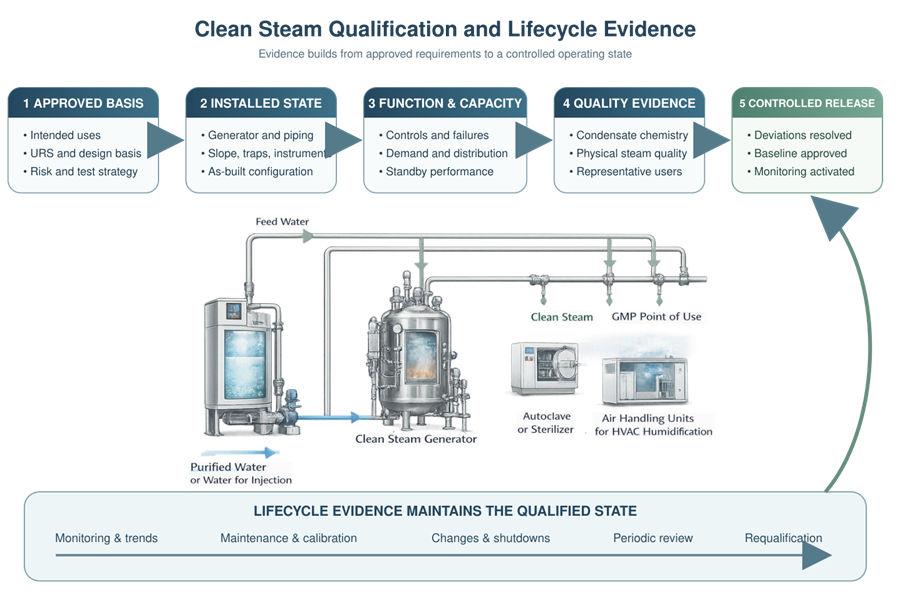
Clean steam qualification must demonstrate more than acceptable condensate from one convenient sample point. The evidence must show that the installed generator, distribution system, controls, drainage provisions, instruments, sampling arrangements, and equipment interfaces collectively deliver steam suitable for every approved GMP use under defined operating conditions.
That initial evidence is only the baseline. Continued assurance depends on operating data, steam-quality results, maintenance and calibration history, trap performance, alarms, deviations, changes, shutdown and restart controls, periodic review, and documented requalification decisions. The lifecycle program must therefore connect qualification directly to routine control.
Purpose and Scope
This article addresses qualification, monitoring, periodic review, and requalification of clean steam systems used in pharmaceutical and biopharmaceutical GMP applications. It covers:
- Qualification planning, boundaries, prerequisites, and traceability
- Use of commissioning and supplier evidence
- Installation Qualification
- Functional and operational challenges
- Capacity, distribution, turndown, and redundancy verification
- Condensate chemistry and physical steam-quality testing
- Point-of-use selection and sampling execution
- Performance verification and controlled release
- Routine monitoring, trending, maintenance, and calibration evidence
- Excursion, adverse-trend, shutdown, and restart assessment
- Periodic review and continued-use decisions
- Change-driven, targeted, and comprehensive requalification
Application selection and the boundary among clean steam, plant steam, and compendial Pure Steam are addressed in Clean Steam Systems for GMP Applications. Generation, feed-water, distribution, drainage, sampling, instrumentation, capacity, and redundancy design are addressed in Clean Steam System Design and Quality Attributes.
This article does not replace qualification or validation of the receiving process equipment. A clean steam utility may be qualified while a sterilizer cycle or SIP circuit remains unvalidated. Conversely, successful sterilization cycles do not by themselves establish that the clean steam generator and every approved distribution condition remain controlled.
Lifecycle Position and System Boundary
Qualification converts approved requirements and design decisions into documented evidence that the installed utility is suitable for its intended uses. Routine monitoring then tests whether the conditions supporting that conclusion remain present. Requalification is performed when lifecycle evidence shows that additional verification is needed; it is not merely automatic repetition of the original protocol.
The qualification boundary should be defined before protocol development. A typical boundary begins at the approved feed-water interface and includes:
- Clean steam generator and separator
- Clean-side controls and protective functions
- Blowdown and drainage provisions that affect performance
- Distribution headers, subheaders, branches, pressure-reduction stations, vents, drip legs, and traps
- GMP-relevant instruments, alarms, automation, and electronic records
- Condensate and physical steam-quality test connections
- Defined points of use or points of delivery
- Interfaces with sterilizers, SIP systems, process equipment, and HVAC humidification
- Standby generators, common headers, and changeover controls where redundancy is claimed
Physical, operating, maintenance, automation, and qualification boundaries may end at different locations. The protocol must identify who owns the final branch, valve, regulator, trap, hose, sample device, and equipment inlet, and which evidence demonstrates that each interface is suitable.
Qualification Strategy and Evidence Model
The qualification plan should begin with approved intended uses and testable requirements. The URS for GMP Facilities, Utilities, and Equipment should define required steam attributes, delivery conditions, user demand, operating modes, alarms, sampling provisions, data needs, maintenance controls, and lifecycle expectations.
The strategy should establish:
- Qualification boundary and user-point inventory
- Intended-use and application-criticality matrix
- Requirements traceability
- Risk assessment and control strategy
- Commissioning evidence proposed for qualification use
- IQ, OQ, and performance-verification scope
- Worst-case and representative conditions
- Sampling locations, methods, tests, frequencies, and acceptance criteria
- Required operating state for each test
- Handling of deviations, open items, and retesting
- Release prerequisites and authority
- Routine monitoring baseline
- Requalification triggers and decision process
The general method for focusing verification on failure modes and controls is described in Risk-Based Validation Approach for GMP Systems. Risk assessment should not be reduced to assigning the entire system a low, medium, or high label. It should identify specific failures—such as entrainment, wet steam, air ingress, poor drainage, pressure instability, sample contamination, instrument drift, or standby failure—and connect each failure to preventive controls, detection methods, and qualification evidence.
Qualification Evidence Gates
Qualification may be organized as separate IQ, OQ, and PQ protocols or as an integrated protocol. The document structure is secondary to the evidence sequence:
- Requirements and design basis are approved.
- Construction, turnover, and commissioning evidence is accepted.
- Installed configuration is verified.
- Functions, controls, failures, and operating ranges are challenged.
- Capacity and distribution performance are demonstrated.
- Steam and condensate quality are verified at justified locations and conditions.
- Deviations are resolved and residual risks are accepted.
- The system is released with an approved monitoring and lifecycle-control program.
Readiness Before Qualification
Formal qualification should not begin while the system is still being constructed, tuned, or fundamentally debugged. Readiness review should confirm, as applicable:
- Approved requirements, design basis, P&IDs, and boundary drawings
- Approved intended-use and user-point list
- Completed fabrication and construction turnover
- Accepted material, weld, surface-treatment, pressure-test, and passivation records
- Current as-built drawings and component identification
- Completed flushing, cleaning, start-up, and engineering checks
- Initial instrument calibration
- Control configuration and software baseline
- Alarm and interlock list
- Operating, sampling, maintenance, and safety procedures
- Qualified feed-water availability
- Available plant steam, power, cooling, drains, and other supporting utilities
- Sampling apparatus, trained samplers, laboratory methods, and containers
- Resolved critical punch-list items
- Defined handling of remaining noncritical items
- Trained operations, maintenance, laboratory, metrology, and validation personnel
Readiness does not require every administrative activity to be closed when a justified staged approach is used. It does require that open items cannot invalidate the planned test, conceal an uncontrolled configuration, or create unacceptable product, personnel, or equipment risk.
Commissioning Evidence and Qualification Use
Commissioning may produce valuable evidence for slope, pressure integrity, loop checks, valve action, control tuning, alarm operation, capacity, and distribution behavior. Repeating technically adequate tests solely because they were labeled “commissioning” adds little value.
Commissioning evidence may support qualification when it is:
- Planned against approved requirements or specifications
- Executed using suitable procedures and calibrated instruments
- Traceable to the installed components and configuration
- Recorded contemporaneously with complete results
- Reviewed for deviations and unresolved issues
- Approved or formally accepted for its intended GMP use
- Protected from undocumented changes after execution
Supplier records should be assessed for applicability and completeness. Factory or commissioning tests performed on a different configuration, control version, instrument range, or operating medium may provide supporting evidence but not necessarily replace site verification.
Installation Qualification
Installation Qualification (IQ) should establish the controlled installed baseline and confirm that attributes relied upon by later testing are present.
Equipment, Materials, and Fabrication
IQ should verify, as applicable:
- Generator manufacturer, model, capacity, serial number, and asset identification
- Clean-side materials and component specifications
- Separator, demister, level-control, blowdown, and heat-transfer arrangements
- Hygienic piping, fittings, valves, gaskets, diaphragms, regulators, traps, and sample devices
- Material certificates and component traceability
- Weld maps, welder qualifications, inspection records, and acceptance status
- Surface-finish, cleaning, passivation, and preservation records
- Pressure or leak-test records
- Safety devices and applicable code documentation
Document review must be supported by field verification. A material certificate does not demonstrate that the certified component was installed in the correct location, and an approved P&ID does not prove the field routing is drainable.
Distribution Walkdown and Drainability
The walkdown should verify:
- Header and branch routing against current drawings
- Continuous slope and intended flow direction
- Deliberate low points and condensate-removal provisions
- Drip-leg, separator, and trap location and orientation
- Reducer, valve, and branch orientation
- Isolation and drainage of sections taken out of service
- Absence or documented disposition of unintended pockets and dead-ended branches
- Pressure-reduction stations and downstream protection
- Thermal expansion, support, and insulation provisions
- Safe drain discharge and backflow protection
- Access for sampling, calibration, inspection, and maintenance
Slope should be verified using an appropriate field method where it is a critical design attribute. A visual statement that piping “appears sloped” is weak evidence when small construction deviations can create condensate pockets.
Instruments, Controls, and Data
IQ should confirm instrument tags, locations, ranges, accuracy requirements, calibration status, installation orientation, and association with control loops or records. Control-system hardware, software or configuration version, user access, backup, time synchronization, data retention, historian interfaces, and alarm routing should be verified to the extent they support GMP decisions.
Point-of-Use and Interface Verification
Every approved user should be accounted for in the point-of-use inventory. Verification should identify the final utility boundary, delivery connection, regulator, isolation valve, trap, sample point, receiving equipment, owner, intended use, pressure requirement, and applicable quality attributes. Unused or future branches should have a defined isolation, drainage, preservation, and change-control status.
Operational and Functional Qualification
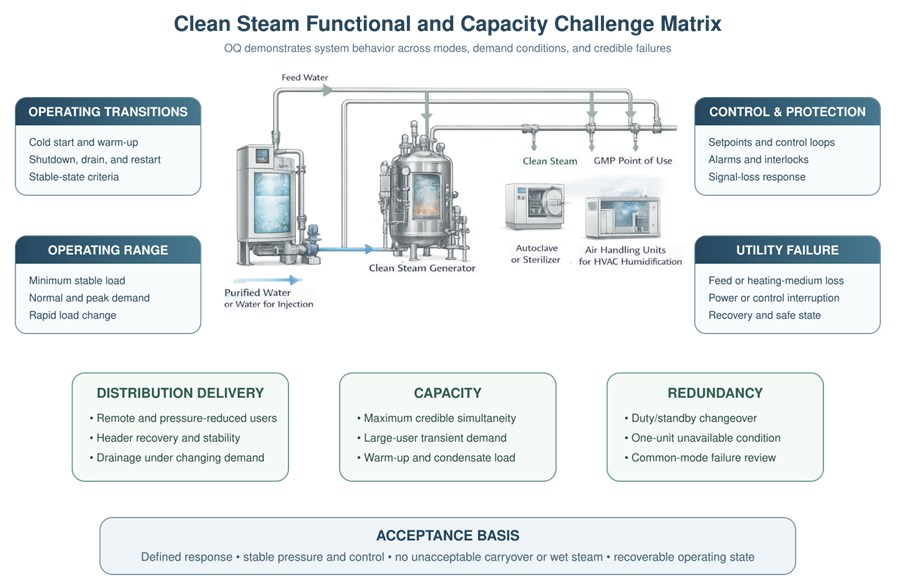
Operational Qualification (OQ) should demonstrate that the system operates as intended through defined ranges, modes, transitions, and credible failure conditions. Testing only nominal steady-state pressure is insufficient.
Start-Up, Normal Operation, Shutdown, and Restart
Functional testing should evaluate:
- Cold start and warm-up sequence
- Air and start-up condensate removal
- Generator level and feed control
- Transition to stable header conditions
- Normal shutdown and depressurization
- Short interruption and controlled restart
- Recovery after loss of feed water, heating medium, power, instrument air, or controls where applicable
- Manual and automatic operating modes
- Drainage and preservation of isolated sections
- Alarm acknowledgement, reset, and return to service
Acceptance criteria should address the behavior and resulting system state, not only whether a command was initiated.
Operating Range and Control Stability
The approved operating envelope may include minimum load, normal load, maximum credible demand, rapid load changes, low and high header pressure, generator level boundaries, feed-water variation, and pressure-reduction behavior. Challenges should show that controls remain stable and do not create unacceptable carryover, pressure cycling, wet steam, nuisance trips, or unrecognized loss of capacity.
Alarms, Interlocks, and Protective Functions
Testing should verify the initiating condition, setpoint, delay, indication, notification, automated response, reset, data record, and procedural response for GMP-relevant alarms and interlocks. Representative functions may include:
- High or low generator level
- Loss of feed water or heating medium
- High or low clean steam pressure
- Abnormal feed or blowdown condition
- Instrument failure or signal loss
- Generator trip
- Standby-unit unavailability or failure to start
- Control or communication failure
- Header or remote-user pressure outside its approved range
Forced signals may be acceptable when physical challenge is unsafe or impractical, but the protocol should distinguish simulation of logic from end-to-end verification of the actual sensor, transmission path, alarm, response, and record.
Capacity, Distribution, and Redundancy Verification
Capacity testing should verify the approved demand model at the system level. A generator nameplate or supplier factory test does not demonstrate that the installed utility can deliver the required pressure, flow, and quality through the actual distribution network.
Testing should consider:
- Maximum credible simultaneous demand
- Large-user start-up and transient demand
- Remote and hydraulically disadvantaged users
- Pressure-reduced zones
- Minimum stable demand and generator turndown
- Rapid user opening or closing
- Header pressure recovery
- Start-up condensate load and trap capacity
- Required warm-up or availability time
- Normal and abnormal user sequencing
- Approved future loads when included in the design basis
The test arrangement should represent real demand profiles. Opening several valves to atmosphere may establish raw output but may not reproduce the pressure control, cycling, condensate formation, and timing of sterilizers or SIP users.
Where redundancy is claimed, qualification should demonstrate the defined operating philosophy. This may include duty/standby changeover, operation with one generator unavailable, isolation for maintenance, load transfer, alarm response, standby readiness, and capacity for essential users. Common feed water, plant steam, power, controls, pressure reduction, and header components must be considered; two generators do not provide complete redundancy when one common failure disables both.
Performance Verification of Steam Quality
Performance verification should demonstrate that clean steam delivered under approved operating conditions meets the chemical and physical requirements assigned to each application. Performance Qualification (PQ) provides the broader basis for demonstrating consistent utility performance under routine or simulated routine conditions.
Condensate Chemistry
Testing may include, as required by the approved specification:
- Conductivity
- Total organic carbon
- Bacterial endotoxins
- Appearance or visible residues
- Other chemical, elemental, particulate, or application-specific attributes
Where the system is represented as USP Pure Steam, the current official monograph and applicable compendial procedures form part of the acceptance basis. Site or product requirements may be more restrictive. Condensate chemistry does not demonstrate steam dryness, noncondensable-gas content, superheat, pressure stability, or sterilization performance.
Physical Steam Quality
Application-specific testing may include:
- Saturation relationship between pressure and temperature
- Dryness
- Noncondensable gases
- Superheat
- Pressure, flow, and stability at the equipment boundary
These tests should be selected from the intended use, equipment needs, applicable standards, cycle-development knowledge, and risk assessment. Criteria suitable for a porous-load sterilizer should not be copied automatically to a direct-contact process, an SIP header, or a humidifier.
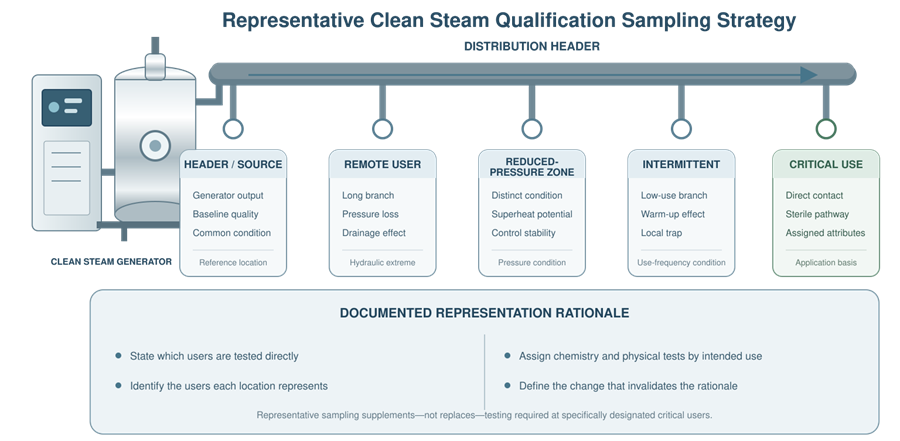
Point-of-Use Selection
The sampling plan should use the system design and intended-use matrix to select locations that collectively represent:
- Generator outlet or common header
- Remote or long branches
- Pressure-reduced zones
- High-demand users
- Low-use or intermittently used branches
- Direct-contact or critical-path applications
- Locations with distinct drainage or trap arrangements
- Locations most susceptible to pressure loss, condensate accumulation, or air ingress
- Each materially different distribution condition
Every point need not receive every test during every qualification phase. The rationale should identify which locations are tested, which are represented, why representation is valid, and what change would invalidate that rationale. A convenient sample point near the generator cannot represent a distant, pressure-reduced, infrequently used branch without supporting engineering evidence.
Sampling Execution and Method Suitability
The protocol should define:
- Required system operating state and stabilization time
- User demand during sampling
- Valve flushing or conditioning
- Sample condenser or cooler configuration
- Cooling-water controls and leak checks
- Collection sequence and sample volume
- Container, handling, hold time, and transport
- Personnel protection
- Field observations and operating parameters
- Laboratory methods and method suitability
- Treatment of atypical, invalid, or out-of-specification results
Sampling equipment can create false failures or mask system conditions. Retained condensate, contaminated tubing, inadequate flushing, cooling-water leakage, or inconsistent flow must be controlled and documented.
Duration, Repetition, and Operating Conditions
No universal number of qualification days or samples applies to every clean steam system. The duration and repetition should be sufficient to demonstrate consistency across relevant operating conditions and to establish a defensible baseline for routine monitoring.
The strategy should consider:
- System complexity and number of distribution zones
- Application criticality
- Variability in demand and operating schedules
- Generator and control stability
- Range of feed-water and seasonal conditions
- Number of representative locations
- Analytical and physical tests required
- Need to observe different production patterns or shifts
- Existing commissioning and supplier evidence
- Previous performance when qualifying a modified system
Replicates should demonstrate reproducibility, not merely repeat the same favorable condition. Where seasonal conditions could materially affect feed water, dissolved gases, heat loss, or utility demand, the strategy should identify whether initial qualification covers the effect, enhanced monitoring will bridge the period, or later verification is required.
Deviations, Traceability, and Controlled Release
Qualification deviations should document the requirement or acceptance criterion involved, observed condition, immediate control, investigation, impact on completed and planned testing, corrective action, retest decision, residual risk, and final disposition. Repeating a failed test without determining why it failed does not resolve the deviation.
The final report should trace approved requirements to design and test evidence, summarize results, identify deviations and open items, evaluate residual risks, define the qualified configuration and operating envelope, and conclude whether the system is suitable for each intended use. General documentation principles are addressed in Validation Protocol and Report.
Release should confirm:
- Approved qualification report and deviations
- Defined qualified configuration and boundary
- Approved operating ranges and alarm settings
- Approved steam-quality specifications
- Current point-of-use and intended-use inventory
- Approved operating, sampling, maintenance, calibration, and excursion procedures
- Established monitoring locations and frequencies
- Trained responsible personnel
- Acceptable status of open items
- Available backup and recovery arrangements
- Approved baseline for future change and periodic review
Conditional or staged release may be acceptable when restrictions, enhanced monitoring, owners, due dates, and exit criteria are explicit. Qualification approval should not be used to conceal an unresolved condition that could invalidate intended use.
Routine Monitoring and Continued Verification
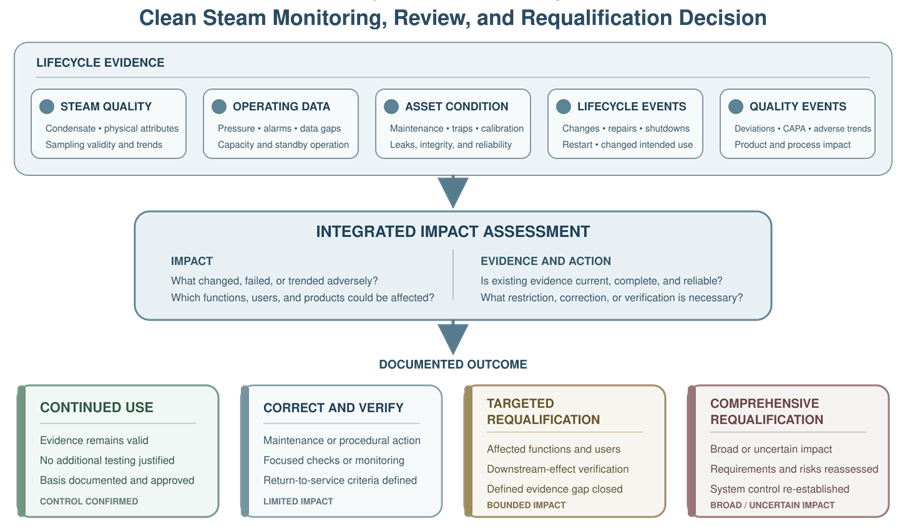
Routine monitoring should test the assumptions that support the qualification conclusion. It may combine continuous operating data, periodic condensate testing, application-specific physical testing, trap and drainage surveillance, maintenance records, calibration results, alarms, and user feedback.
Operating and Automation Data
Potential review parameters include:
- Generator and header pressure
- Steam temperature where informative
- Feed-water availability and quality status
- Generator level and control stability
- Output or demand indication
- Blowdown status or related measurement
- Remote-user pressure where monitored
- Standby availability and changeover status
- Alarm frequency, duration, recurrence, and response
- Control overrides, manual operation, and configuration changes
- Data gaps, sensor failures, and historian availability
Not every parameter requires continuous GMP trending. The monitoring plan should identify which data support quality decisions, how they are reviewed, what constitutes an alert or action condition, and how missing or unreliable data are handled.
Periodic Steam and Condensate Testing
Routine sampling frequency and location should be based on intended use, qualification results, system design, performance history, application criticality, change history, and detectability of deterioration. A rotation plan may be justified when it preserves coverage of representative and higher-risk conditions. High-consequence or poorly represented users may require more frequent direct verification.
Physical steam-quality testing may be periodic, event-driven, linked to sterilizer or SIP requirements, or otherwise defined by approved procedures and applicable standards. It should not be omitted solely because condensate chemistry remains acceptable.
Maintenance, Trap Surveillance, and Calibration
Monitoring evidence includes condition of the equipment that preserves steam quality. The program should evaluate:
- Generator inspection and service
- Separator, level control, and blowdown performance
- Steam-trap inspection, test, failure, and replacement history
- Valve, regulator, diaphragm, and gasket condition
- Heat-exchanger or barrier integrity
- Leak, corrosion, insulation, support, and slope concerns
- Sample cooler and sampling-assembly maintenance
- Safety-valve and protective-device testing
- Instrument calibration and out-of-tolerance assessment
- Standby-unit exercising
- Spare-part equivalence and obsolete components
General program controls are addressed in Calibration Program and Metrology Control and Preventive Maintenance and System Reliability Strategy.
Alert Signals, Excursions, and Adverse Trends
An alert signal is not automatically a specification failure, and a result within specification is not automatically evidence of a healthy trend. The response should reflect the type, magnitude, duration, recurrence, location, and potential exposure.
Evaluation should consider:
- Confirmed analytical or physical steam-quality result
- Sampling and laboratory method performance
- Concurrent generator and header conditions
- Feed-water quality and availability
- Demand, start-up, shutdown, or maintenance state
- Nearby or similarly configured user points
- Trap, drain, valve, regulator, and instrument condition
- Recent changes or interventions
- Potentially affected equipment, processes, batches, and time period
- Whether the qualified operating envelope was exceeded
- Whether continued use can be justified with added controls
A continuing-use decision should be explicit. Potential outcomes include unrestricted continued use, continued use with defined restrictions and enhanced monitoring, temporary isolation of affected users, system shutdown, corrective maintenance, investigation or CAPA, product-impact assessment, targeted verification, or requalification.
The current FDA biological drug-substance inspection program directs investigators to evaluate clean steam monitoring excursions, investigations, and timely CAPA, and to determine whether saturation or dryness, noncondensable gases, and superheat are suitable for the intended application. This is a particularly direct regulatory signal for biological drug-substance operations; its detailed expectations should not be presented as a universal numerical specification for every clean steam use.
Shutdown, Idle Conditions, and Restart
Shutdowns should be classified because a brief controlled interruption is not equivalent to an extended outage with open maintenance. The assessment should address duration, system temperature and pressure, drainage, exposure to atmosphere or drains, work performed, feed-water status, environmental conditions, and ability to maintain a protected configuration.
Restart controls may include:
- Verification that the approved configuration is restored
- Inspection or replacement of opened components
- Drain and trap checks
- Instrument and alarm readiness
- Controlled warm-up, venting, and condensate removal
- Defined flush or steam purge
- Leak and pressure-stability checks
- Condensate or physical-quality sampling
- Enhanced monitoring for a defined period
- Review and approval before GMP use
An approved procedure may establish predefined actions for routine short shutdowns. Extended shutdown, uncontrolled cooling, construction, contamination exposure, major maintenance, loss of feed-water control, or repeated failed restart testing requires a documented impact assessment and potentially targeted requalification.
Periodic Review
Periodic review determines whether the original qualification conclusion remains supported by accumulated lifecycle evidence. The review interval should reflect GMP impact, application criticality, system complexity, performance history, changes, procedural commitments, and the ability of routine monitoring to detect deterioration.
Review inputs should include:
- Current intended uses, user points, and system boundary
- Qualification and requalification status
- Condensate and physical steam-quality results and trends
- Generator, header, capacity, and remote-user performance
- Alerts, alarms, deviations, investigations, CAPA, and recurrence
- Maintenance, repairs, trap failures, and barrier-integrity records
- Calibration status and out-of-tolerance assessments
- Shutdown, restart, and preservation events
- Changes to feed water, generator, piping, controls, sampling, users, or demand
- Standby and redundancy performance
- Data gaps and monitoring-system reliability
- Procedure, training, drawing, and inventory currency
- Supplier notices, component obsolescence, and spare-part status
- Previous review actions and closure effectiveness
Possible outcomes include continued operation without additional action, procedural or monitoring improvements, maintenance or calibration changes, corrective action, updated risk assessment, targeted verification, targeted requalification, comprehensive requalification, restricted use, or retirement.
Broader governance of utility monitoring, maintenance, periodic review, and continued-use decisions is addressed in Utility System Lifecycle, Monitoring, and Risk-Based Control.
Change Control and Requalification Triggers
Changes should be assessed before implementation when planned and promptly after stabilization when emergency action is necessary. The assessment should identify affected requirements, failure modes, qualified conditions, documents, tests, monitoring, user processes, and product-impact pathways.
Potential triggers include:
- Generator replacement, major repair, or change in capacity
- Separator, demister, heat exchanger, level-control, or blowdown changes
- Feed-water source, grade, treatment, temperature, or supply changes
- Header, branch, trap, drain, pressure-reduction, or point-of-use modification
- New user or changed intended application
- Increased simultaneous demand or changed production schedule
- Automation, alarm, setpoint, software, historian, or instrument changes
- Material, surface-finish, valve, diaphragm, gasket, trap, or sample-device substitution
- Major maintenance, open-system intervention, contamination, or cross-connection concern
- Extended shutdown or abnormal restart
- Repeated excursions, adverse trends, capacity loss, wet steam, or drainage problems
- Significant instrument out-of-tolerance condition
- Failure of standby or common infrastructure
- Periodic-review finding or regulatory commitment
Utility System Change Control, Requalification, and Deficiencies provides the broader utility change-assessment framework.
Selecting Requalification Scope
Requalification is a documented response to changed risk or weakened assurance. It may be initiated by a change, failure, adverse trend, shutdown, periodic-review conclusion, new use, procedural frequency, or regulatory commitment.
The decision should evaluate:
- Nature and extent of the event
- System elements and users potentially affected
- Whether the installed baseline changed
- Whether functional controls or operating ranges changed
- Whether distribution, capacity, drainage, or steam quality could be affected
- Detectability of impact through existing monitoring
- Reliability and completeness of historical evidence
- Duration and extent of potentially affected operation
- Product and process consequences
- Effectiveness of corrective actions
The general decision principles are described in Risk-Based Requalification of GMP Equipment, Systems, and Utilities.
Documented Assessment Without Additional Testing
Additional execution may be unnecessary when the assessment demonstrates that the qualified configuration, operating envelope, quality attributes, and user conditions are unaffected and existing evidence remains applicable. The conclusion and supporting basis still require approval.
Targeted Verification or Requalification
Targeted work should test the specific functions and downstream effects that could have changed. Examples include:
| Trigger | Representative targeted evidence |
|---|---|
| Replacement with an equivalent calibrated pressure transmitter | Installation, calibration, loop, alarm, record, and affected-control verification |
| Steam-trap replacement | Correct type and orientation, leak check, drainage, warm-up behavior, and local steam-quality or temperature evidence where warranted |
| New distribution branch | IQ of materials, welds, slope, drainability, trap and sample point; pressure/capacity test; condensate and applicable physical-quality testing at the new and affected representative users |
| Pressure-reducing station modification | Installation, setpoint, control stability, alarms, capacity, downstream saturation or superheat assessment, and affected user testing |
| Generator control change | Configuration verification, affected sequences, alarms, level and pressure control, operating-range challenge, and representative performance testing |
| Extended shutdown without open maintenance | Restart sequence, drainage, pressure stability, condensate sampling, and enhanced monitoring based on shutdown conditions |
| Adverse result at one user | Sampling-method review, local branch and trap assessment, confirmatory and comparative sampling, operating-data review, and expansion based on findings |
Comprehensive Requalification
Comprehensive requalification may be warranted when:
- The generator or major distribution architecture is replaced or substantially modified.
- The previous qualified configuration cannot be reconstructed reliably.
- Multiple system functions or user classes may be affected.
- A major contamination, cross-connection, or barrier failure occurred.
- Repeated failures indicate loss of control without a confined cause.
- The intended use or required steam-quality basis changes materially.
- Existing qualification and monitoring evidence is incomplete or no longer credible.
- Long-term uncontrolled shutdown, major reconstruction, or extensive open-system work occurred.
Comprehensive does not necessarily mean repeating every historical test. The protocol should use current requirements, current risks, and current configuration; obsolete or non-value-adding tests should not be copied merely because they appeared in the original package.
Requalification Release and Monitoring Reset
After requalification, the report should identify:
- Trigger and assessed impact
- Configuration and uses covered
- Tests performed and rationale for omitted tests
- Results, deviations, CAPA, and residual risks
- Updated drawings, specifications, procedures, and traceability
- New or revised operating limits and alarm settings
- Effect on routine sampling locations and frequencies
- Enhanced monitoring and exit criteria, where required
- Product or batch impact conclusions
- Approval for unrestricted, restricted, or staged return to service
The monitoring baseline should be reset when the change materially alters normal behavior. Pre-change data may remain useful for historical comparison, but trend limits or expected performance should not be treated as unchanged when capacity, instruments, controls, feed water, distribution, or user demand has changed.
Common Qualification and Lifecycle Weaknesses
Recurring weaknesses include:
- Qualifying the generator but not the distribution and user interfaces
- Treating one near-generator condensate sample as representative of the entire system
- Using generic low/medium/high risk labels as a substitute for failure-mode analysis
- Omitting minimum-load, peak-demand, transient, or remote-user challenges
- Claiming redundancy without testing common-mode failures and changeover
- Verifying drawing slope without a credible field assessment
- Confusing condensate chemistry with physical steam quality
- Applying sterilizer steam criteria universally without an application basis
- Using unqualified or poorly controlled sample condensers
- Repeating samples after failure without investigation
- Monitoring results without reviewing operating, maintenance, calibration, and trap evidence
- Treating every within-specification result as proof that adverse trends do not exist
- Returning a system to service after maintenance or shutdown without defined restart evidence
- Performing calendar-based retesting without reviewing lifecycle signals
- Assuming event-driven requalification eliminates scheduled commitments
- Repeating the original protocol without assessing the current configuration and risk
- Failing to update the monitoring plan after change or requalification
Summary
Clean steam system qualification and continued control require an integrated evidence chain from installed configuration to routine lifecycle decisions.
The principal conclusions are:
- Qualification must cover the generator, distribution, drainage, controls, instruments, sampling provisions, and defined equipment interfaces.
- Commissioning evidence can support qualification when it is planned, traceable, technically adequate, and formally accepted.
- OQ must challenge operating ranges, transitions, alarms, failures, capacity, distribution behavior, turndown, and redundancy where applicable.
- Condensate chemistry and physical steam quality provide different evidence and must be assigned by intended use.
- Point-of-use selection must represent material differences in distance, pressure, demand, drainage, use frequency, and application risk.
- Controlled release must establish the qualified configuration, operating envelope, monitoring plan, and lifecycle responsibilities.
- Routine assurance depends on integrated review of quality results, operating data, maintenance, trap condition, calibration, alarms, changes, and user experience.
- Periodic review supports a documented continued-use decision; it is not merely a document inventory.
- Requalification may consist of documented assessment, targeted verification, targeted requalification, or comprehensive requalification according to impact and evidence.
- Scheduled testing may remain necessary when required by an approved procedure, standard, risk strategy, or regulatory commitment.