

USP Water Specifications, Testing, and Monitoring
Pharmaceutical-water control requires more than periodically testing samples against USP requirements. The system must consistently produce water suitable for its intended use while controlling chemical, microbial, and, where applicable, endotoxin risks throughout generation, storage, distribution, and delivery.
An effective program distinguishes among:
- Compendial monograph requirements
- Site-established quality specifications
- Microbial alert and action levels
- Engineering operating ranges
- Process alarms and interlocks
- Routine monitoring results
- Adverse trends
- Investigation and product-impact decisions
These controls serve different purposes. A microbial action-level excursion is not automatically a USP monograph failure, and a water sample that passes compendial chemical testing does not by itself demonstrate that the water system remains microbiologically controlled.
Purpose and Scope
This article addresses the testing and continued monitoring of bulk pharmaceutical-water systems, primarily:
- Purified Water
- Water for Injection
- Associated source, pretreatment, generation, storage, and distribution stages
It covers:
- USP monograph requirements
- Conductivity
- Total organic carbon
- Bacterial endotoxins
- Microbial monitoring
- Objectionable microorganisms
- Sampling locations and techniques
- Testing frequency
- Alert and action levels
- Online process monitoring
- Trend analysis
- Excursion investigations
- Product-impact assessment
- Electronic records and data integrity
Selection of the appropriate water type is addressed in Pharmaceutical Water Quality Categories and Intended Use. System design is addressed in Pharmaceutical Water System Design and Engineering Controls.
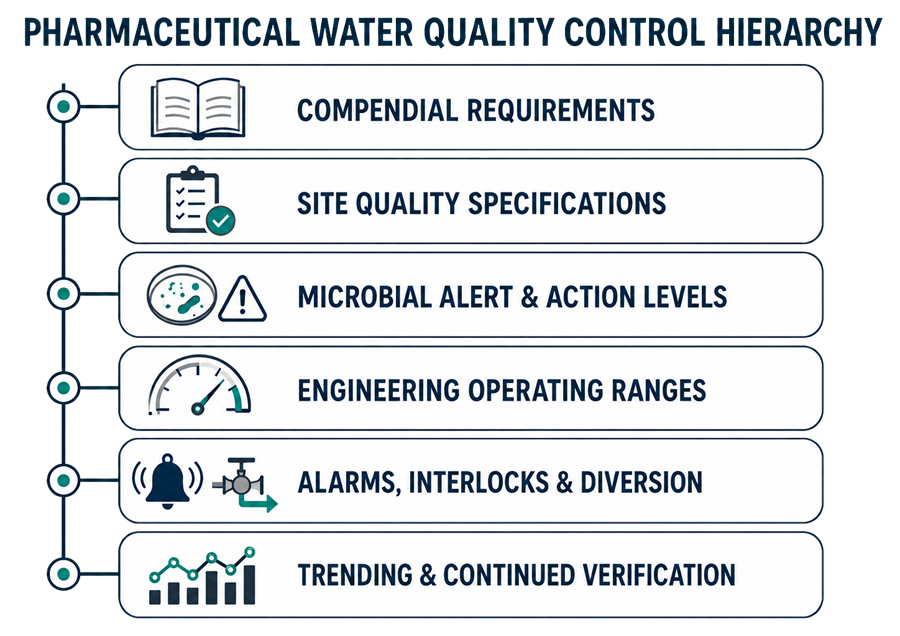
The Pharmaceutical-Water Control Hierarchy
Water requirements should be organized into a defined hierarchy.
| Control category | Primary purpose | Examples | Typical response to failure or excursion |
|---|---|---|---|
| Compendial monograph requirement | Establish official quality requirements for a compendial water type | Conductivity, total organic carbon, WFI bacterial endotoxins | OOS investigation, water-disposition assessment, product-impact evaluation |
| Site quality specification | Establish additional requirements based on intended use | Microbial limit, objectionable-organism requirement, tighter endotoxin limit | Investigation and water/product impact assessment |
| Microbial alert level | Provide early warning of departure from normal performance | Location-specific count or trend threshold | Review, confirmation, trend assessment, possible increased monitoring |
| Microbial action level | Identify a condition requiring formal action | Established count threshold, repeated recovery, objectionable organism | Investigation, impact assessment, corrective action |
| Operating range | Define normal controlled system operation | Loop temperature, return flow, pressure, ozone concentration | Operational review and restoration of normal control |
| Alert or alarm setpoint | Detect developing or unacceptable process conditions | Low return temperature, high conductivity, loss of flow | Operator response, documented assessment, escalation as required |
| Interlock or diversion limit | Prevent unsuitable water from entering storage or use | High conductivity diversion, low UV intensity, sanitization lockout | Automatic protective action and investigation |
A single value should not be assigned several different meanings. For example, a microbial action level should not also be described as a USP specification unless the requirement is actually part of the applicable monograph or another binding specification.
USP Monographs and Informational Guidance
The official USP monographs establish requirements for articles labeled as Purified Water USP or Water for Injection USP. Referenced general chapters below 〈1000〉 provide the applicable test procedures.
USP General Chapter 〈1231〉 Water for Pharmaceutical Purposes provides important technical guidance on water-system design, operation, monitoring, and microbial control. Because it is numbered above 〈1000〉, it is generally informational rather than independently mandatory. It may nevertheless become an enforceable site requirement when incorporated into:
- An approved regulatory application
- A company specification
- An approved procedure
- A validation protocol
- A quality agreement
- Another controlling document
This distinction does not make microbial control optional. CGMP requirements and intended-use risks still require appropriate microbial specifications, monitoring, investigations, and system controls. USP explains that the microbial values associated with 〈1231〉 are guidance-level action values rather than monograph microbial specifications. USP water FAQ
Compendial Requirements by Water Type
| Water category | Chemical requirements | Endotoxin requirement | Monograph microbial-count requirement |
|---|---|---|---|
| Potable or drinking water | Applicable federal, state, local, or comparable drinking-water requirements | Not normally applicable unless separately specified | Drinking-water requirements apply |
| Purified Water USP | Meets 〈645〉 Water Conductivity and 〈643〉 Total Organic Carbon | Not included in the Purified Water monograph | No numerical microbial-count limit in the monograph |
| Water for Injection USP | Meets 〈645〉 Water Conductivity and 〈643〉 Total Organic Carbon | Not more than 0.25 USP Endotoxin Unit/mL under 〈85〉 Bacterial Endotoxins Test | No numerical microbial-count limit in the monograph |
Additional requirements may be necessary based on:
- Product formulation
- Route of administration
- Patient population
- Manufacturing stage
- Cleaning application
- Downstream microbial-control capability
- Maximum allowable process bioburden
- Endotoxin sensitivity
- Approved regulatory commitments
Bulk Purified Water and bulk WFI should not be confused with packaged sterile-water products. Bulk WFI meets stringent chemical and endotoxin requirements but is not represented as a sterile packaged article.
Water Conductivity
Conductivity is an indicator of ionic contamination. It does not identify individual ions and does not directly measure microorganisms, endotoxins, or nonionic organic contaminants.
USP 〈645〉 Water Conductivity uses a staged test approach. Depending on the measurement conditions and result, evaluation may involve:
- Temperature-compensated or uncompensated measurement as permitted by the procedure
- Comparison with the applicable temperature-dependent Stage 1 limit
- Laboratory evaluation at controlled temperature
- pH determination and the applicable Stage 3 conductivity limit
At 25°C, the Stage 1 table value commonly associated with uncompensated online measurement is 1.3 µS/cm. This value should not be copied into every specification without considering:
- The actual test stage
- Sample temperature
- Instrument configuration
- Temperature compensation
- Measurement location
- The current official USP procedure
- The approved laboratory or online method
Online Conductivity Monitoring
Online conductivity is useful for:
- Detecting membrane breakthrough
- Controlling product-water diversion
- Monitoring generation performance
- Detecting chemical carryover after sanitization
- Confirming return-water quality
- Providing continuous or frequent system-performance data
Where online data support a compendial decision, the measurement system should have:
- A suitable measurement range and resolution
- Qualified installation
- Calibrated or verified sensors
- Defined temperature measurement
- Controlled signal processing
- Appropriate data-recording frequency
- Alarm and diversion logic
- Secure configuration
- Reviewable raw data and metadata
- Defined response to sensor malfunction or missing data
A passing grab sample should not automatically invalidate an earlier online excursion. Differences between the online and laboratory results require evaluation of location, time, temperature, sample handling, instrument status, and system conditions.
Total Organic Carbon
Total organic carbon is a nonspecific measure of organic contamination. It can detect changes associated with:
- Source-water variation
- Membrane or resin deterioration
- Cleaning-agent residue
- Sanitant residue
- Process contamination
- Biofilm-related organic material
- Sampling contamination
USP 〈643〉 Total Organic Carbon evaluates the sample response against a limit response based on a 0.50 mg/L carbon standard. The instrument and method must also satisfy the applicable reagent-water, standard-solution, and system-suitability requirements.
TOC results should not be interpreted as proof of microbial acceptability. A water system may have acceptable TOC while containing elevated microbial counts or objectionable microorganisms.
Online TOC systems used for compendial or release decisions require appropriate control over:
- System suitability
- Calibration or verification
- Sample flow
- Oxidation performance
- Reagent condition, where applicable
- Baseline stability
- Maintenance
- Data acquisition
- Result calculation
- Alarm handling
- Electronic records
A sudden increase that remains below the compendial limit may still represent a significant adverse process trend.
Bacterial Endotoxins
The Water for Injection monograph includes a bacterial-endotoxin limit of not more than 0.25 USP Endotoxin Unit/mL when tested according to 〈85〉 Bacterial Endotoxins Test.
A site may require a tighter limit where justified by:
- Product endotoxin limits
- Water contribution to the formulation
- Manufacturing concentration factors
- Process-stage requirements
- Equipment-rinse acceptance criteria
- Limited downstream endotoxin removal
- Regulatory commitments
An endotoxin result at or above the applicable specification requires formal investigation. Repeated increases below the specification can also indicate deteriorating microbial control or accumulation of gram-negative bacterial residues.
The investigation should consider:
- Recent microbial recoveries
- Organism identification
- Sanitization history
- Storage and return temperatures
- Flow interruptions
- Stagnant branches
- Tank venting
- Maintenance activities
- Membrane condition
- Sampling technique
- Test interference
- Product and cleaning uses during the affected period
Passing microbial counts do not eliminate endotoxin concern. Viable organisms can be reduced or destroyed while endotoxin remains present.
Microbial Quality Is an Established Control Requirement
Neither the Purified Water nor WFI bulk-water monograph provides a numerical microbial-count specification. The manufacturer must establish suitable microbial controls based on intended use and demonstrated system capability.
USP 〈1231〉 historically identifies guidance-level action values of:
- 100 CFU/mL for Purified Water
- 10 CFU/100 mL for Water for Injection
These values should not be presented as universal USP monograph specifications. They are general guidance values and may be insufficiently stringent for a particular product, process, water system, or sampling location.
A facility should establish its own scientifically justified levels using:
- Qualification data
- Routine historical performance
- Water type
- System design
- Sanitization strategy
- Sampling method and volume
- Typical microbial recovery
- Product and process risk
- Route of administration
- Patient population
- Downstream processing
- Regulatory commitments
For WFI systems, routine recovery of viable organisms can be meaningful even when the result is below an established numerical alert level. FDA inspection instructions state that WFI samples are generally expected to yield zero viable-cell counts and that recurring low-level recovery may warrant investigation. FDA Compliance Program 7356.002M
Objectionable Microorganisms
Microbial control cannot rely only on total counts. A low count may still be unacceptable when the recovered organism presents a specific product or patient risk.
The assessment of whether an organism is objectionable should consider:
- Organism identity and characteristics
- Route of administration
- Patient population
- Product water activity
- Preservative system
- Ability to grow in the product
- Ability to degrade product or preservatives
- Potential for biofilm formation
- Resistance to sanitization
- Manufacturing stage
- Downstream removal or inactivation
- Recurrence in the water system
- Recovery from related products or manufacturing areas
Waterborne organisms of concern may include, depending on the application:
- Burkholderia cepacia complex
- Pseudomonas species
- Ralstonia species
- Sphingomonas species
- Stenotrophomonas maltophilia
- Other gram-negative water-system organisms
- Molds, yeasts, or spore-forming organisms where relevant
This is not a universal prohibited-organism list. Objectionability must be evaluated in relation to the water use and affected product.
Water-Sampling Program
A water sample represents one location at one time under defined collection conditions. It does not by itself prove that the complete system is controlled. The approved sampling plan should define:
- Sampling locations
- Sample type
- Required tests
- Frequency
- Sample volume
- Container
- Flushing or nonflushing condition
- Valve sanitization
- Collection sequence
- Sample temperature
- Holding time
- Transport conditions
- Test method
- Incubation conditions
- Required records
- Alert and action levels
- Response to invalid or missed samples
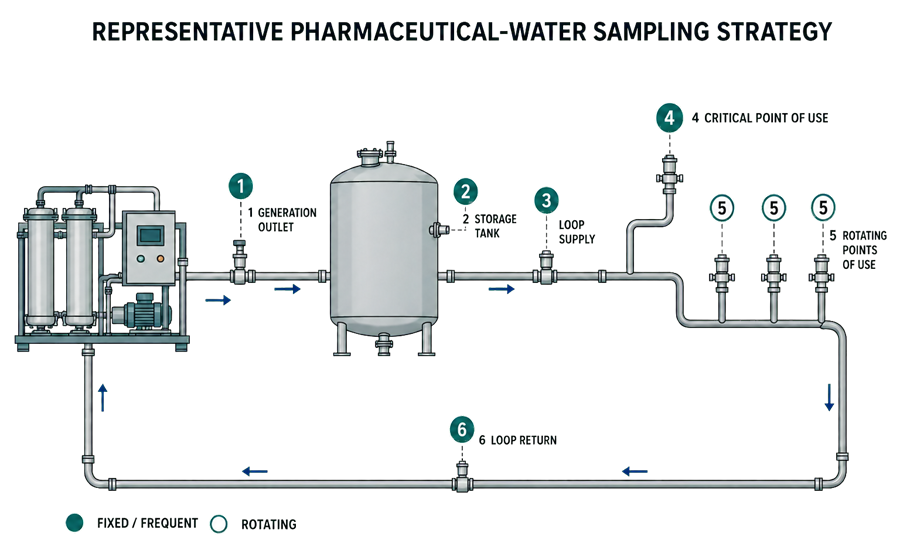
Representative Sampling Locations
The program should include locations appropriate to system design and intended use.
| System area | Monitoring purpose |
|---|---|
| Incoming potable water | Confirm feed-water suitability and source variability |
| Pretreatment stages | Detect exhaustion, breakthrough, fouling, or microbial amplification |
| Final generation outlet | Confirm performance of the generation process |
| Storage tank | Evaluate stored-water quality and tank control |
| Distribution supply | Establish quality entering the loop |
| Distribution return | Evaluate overall loop performance and worst-return conditions |
| Representative points of use | Confirm delivered-water quality |
| High-risk or remote points | Detect local stagnation, low use, or hydraulic weakness |
| Post-treatment points | Evaluate UV, ultrafiltration, ozone destruction, or other barriers |
| Temporary or flexible delivery assemblies | Confirm the quality actually delivered during use |
Sampling directly from a valve while excluding a routinely used hose or transfer assembly may fail to represent the water entering the manufacturing process.
Flushed and Unflushed Samples
The sample procedure should match the monitoring objective. An unflushed or minimally flushed sample may evaluate:
- The point-of-use valve
- Local stagnation
- The quality first delivered to the process
- A hose or attached delivery assembly
A defined flushed sample may evaluate:
- The circulating loop
- Water upstream of the outlet assembly
- Chemical quality after clearing the local branch
- A standardized system-performance condition
Neither approach is universally correct. The program may require both when system and delivered-water conditions must be evaluated separately.
Microbiological Test Methods
The microbiological method should be capable of recovering organisms adapted to nutrient-poor pharmaceutical-water environments.
Method variables include:
- Sample volume
- Direct plating or membrane filtration
- Membrane material
- Recovery medium
- Incubation temperature
- Incubation duration
- Aerobic or other growth conditions
- Sanitant neutralization
- Sample holding time
- Colony-counting rules
- Organism-identification criteria
Membrane filtration and larger sample volumes generally provide greater sensitivity for low-bioburden water, particularly WFI. However, the selected method must be defined and shown suitable for its intended application.
Changes in medium, sample volume, incubation conditions, filtration equipment, laboratory, or counting rules can alter recovery. These changes require assessment before new results are directly compared with historical trends.
The laboratory should not select incubation conditions solely to minimize recovery. The method should provide meaningful detection of organisms reasonably expected in the system.
Sampling Frequency and Rotation
Sampling frequency should reflect:
- Water type
- System qualification status
- Use frequency
- Product risk
- System design
- Historical performance
- Seasonal effects
- Sanitization frequency
- Point-of-use criticality
- Maintenance history
- Recent excursions or changes
A sound program commonly combines:
- Frequent monitoring of generation, storage, and return locations
- Risk-based rotation of points of use
- More frequent sampling of critical or historically adverse locations
- Additional monitoring after maintenance, sanitization, shutdown, or change
- Periodic coverage of every active point of use
- Defined monitoring of seldom-used outlets
- Seasonal review where source-water conditions vary
A rotation plan should not leave a critical point untested for an unjustifiably long period. Missed samples should be documented and assessed rather than silently removed from the schedule.
Alert and Action Levels
Alert and action levels should be based on actual system performance and intended-use risk.
Alert Level
An alert level indicates possible departure from normal operating conditions. It should trigger defined review such as:
- Verification of sampling and testing
- Review of recent results
- Review of system operating data
- Increased monitoring
- Organism identification
- Assessment of recurrence
- Notification of designated personnel
A single alert-level result may not require a full deviation when the approved procedure allows a documented alert review. Repeated alerts, related locations, adverse organisms, or an upward trend require escalation.
Action Level
An action-level excursion requires formal response, normally including:
- Deviation or laboratory investigation
- Immediate system assessment
- Organism identification as appropriate
- Assessment of affected water uses
- Product-impact evaluation
- Corrective action
- Effectiveness verification
- Quality-unit review
An action level should not be raised merely because the system frequently exceeds it. Repeated excursions indicate that the system, monitoring strategy, operating controls, or established limit requires investigation.
Establishing Levels
Limits may be developed using:
- Qualification data
- A defined baseline period
- Location-specific distributions
- Percentiles or other statistical tools
- System capability
- Product-risk assessment
- Organism history
- Regulatory or compendial guidance values
Statistical analysis supports limit development but does not replace scientific judgment. A statistically unusual result may be operationally harmless, while a low count of an objectionable organism may be significant.
Online Monitoring and Laboratory Testing
Online monitoring and laboratory testing provide different forms of evidence.
Online Measurements
Typical online measurements include:
- Conductivity
- TOC
- Temperature
- Flow
- Pressure
- Tank level
- Ozone concentration
- UV intensity
- Oxidation-reduction potential
- Differential pressure
- Sanitization time and temperature
Online monitoring can detect short-duration events that periodic grab sampling may miss.
Laboratory Testing
Typical laboratory tests include:
- Compendial conductivity
- Compendial TOC
- Microbial enumeration
- Organism identification
- Bacterial endotoxins
- Additional chemical or source-water tests
- Sanitant residual testing
The monitoring strategy should define which data:
- Control the process
- Trigger alarms or diversion
- Demonstrate compendial conformance
- Support water release or continued use
- Support periodic review
- Initiate investigation
A system should not generate large volumes of online data that are stored but never reviewed.
Trending and Continued Verification
Pass/fail review alone is inadequate for water systems. Trend analysis should determine whether the system remains in a continuing state of control.
Trend reports should evaluate data by:
- Sampling location
- System segment
- Water type
- Test attribute
- Organism
- Time since sanitization
- Time since maintenance
- Season
- Production status
- Temperature or operating mode
- Point-of-use frequency
- Laboratory method
- Analyst or sampling team, where relevant
Adverse signals may include:
- Gradual increase in microbial recovery
- Increasing number of positive WFI samples
- Recurrence of the same organism
- Similar organisms at hydraulically related points
- Repeated alert-level events
- Increased conductivity or TOC variability
- Results approaching specifications
- Longer recovery after sanitization
- Deteriorating return temperature
- Repeated loss of circulation
- Increasing instrument failures
- Missing or invalid data
- Changes concentrated at low-use outlets
A result does not need to exceed an established limit before an adverse trend is investigated.
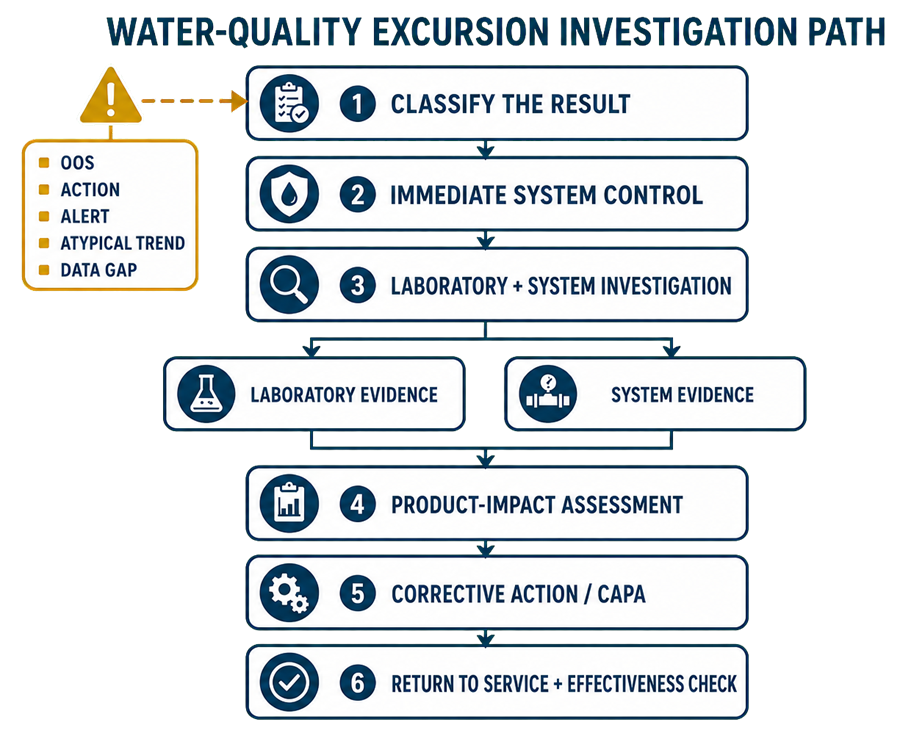
Handling Excursions and Atypical Results
Water investigations should distinguish among:
- Compendial OOS results
- Site-specification failures
- Microbial action-level excursions
- Alert-level events
- Operating-limit excursions
- Alarm or interlock events
- Atypical or adverse trends
- Objectionable-organism recoveries
- Missing, corrupted, or unreliable data
Immediate Assessment
Initial actions may include:
- Protecting the system from further use
- Identifying water uses since the last reliable acceptable condition
- Reviewing online data and alarms
- Confirming the affected location
- Checking instrument and sampling status
- Collecting justified additional samples
- Reviewing recent maintenance and sanitization
- Notifying Quality, Engineering, Manufacturing, and Microbiology
Laboratory assessment should not delay necessary system containment.
Investigation Scope
The investigation should evaluate:
- Sampling error
- Container or transport problems
- Method suitability
- Media and incubation controls
- Analyst performance
- Instrument calibration
- Online-versus-laboratory differences
- Generation-process performance
- Storage and distribution conditions
- Temperature and flow history
- Sanitization effectiveness
- Tank vent-filter status
- Maintenance and calibration work
- Power or supporting-utility interruptions
- Low-use or stagnant branches
- Temporary hoses or connections
- Recent changes
- Similar historical events
Resampling may help characterize current system condition, but a passing resample does not invalidate the original result without a scientifically demonstrated assignable laboratory or sampling cause.
Results should not be averaged across separate samples or locations to convert an unacceptable individual result into an acceptable reported value.
Product-Impact Assessment
The potentially affected interval should not be determined only from the previous and next grab samples. The assessment should integrate:
- Online process data
- Alarm history
- Sanitization status
- Hydraulic relationships
- Maintenance timing
- Organism identity
- Evidence of recurrence
- Water-use records
- Product manufacturing times
- Cleaning activities
- Downstream processing
- Product hold times
- Product microbial controls
- Route of administration
- Patient population
Possible conclusions include:
- No product exposure occurred.
- Exposure occurred, but the downstream process provided a validated control.
- Additional product testing or record review is required.
- Product remains on hold pending investigation.
- Product rejection or recall assessment is required.
- Retrospective assessment of additional batches is required.
A water-system sanitization restores operating condition but does not resolve the impact on water or product already used.
Data Integrity and Electronic Records
Water-system decisions may depend on data from laboratory systems, online analyzers, automation platforms, historians, building systems, spreadsheets, and manual records. The complete data path should be controlled.
Controls should address:
- Unique sample identification
- Date and time synchronization
- Sampling-location identification
- Raw data retention
- Instrument metadata
- Calculation methods
- User access
- Audit trails
- Configuration changes
- Alarm acknowledgment
- Result modification
- Invalidated and excluded results
- Electronic signatures
- Backup and recovery
- Interface failures
- Missing-data detection
- Record retention
The review should include original observations and relevant metadata, not only a summarized certificate or trend report.
Uncontrolled transcription of online results into spreadsheets weakens traceability. When spreadsheets are used, formulas, access, changes, review, and version control should be managed according to risk.
Electronic records and signatures within the scope of 21 CFR Part 11 should be assessed and controlled accordingly. Relevant automation principles are addressed in Qualification and Verification of Facility Automation Systems.
Review, Approval, and Program Governance
The water-quality program should define responsibility for:
- Specification approval
- Sampling
- Laboratory testing
- Online-data review
- Alert response
- Deviation initiation
- Organism identification
- Product-impact assessment
- System release after intervention
- Trend-report preparation
- Periodic review
- Limit revision
- Change control
- Record retention
Limits, methods, locations, and frequencies should be periodically reviewed against:
- Current system performance
- Product portfolio
- New points of use
- Decommissioned outlets
- System modifications
- Laboratory-method changes
- Regulatory commitments
- Recurring organisms
- Adverse trends
- Investigation history
- Sanitization effectiveness
Changes to specifications or limits should be controlled. Historical limits should not be revised retroactively to make prior excursions appear acceptable.
Continued control, change assessment, and requalification are addressed in Pharmaceutical Water System Lifecycle Control and Requalification.
Regulatory and Technical Framework
Principal U.S. references include:
- 21 CFR Part 211
- 21 CFR 211.84
- 21 CFR 211.100
- 21 CFR 211.110
- 21 CFR 211.160
- 21 CFR 211.194
- 21 CFR Part 11
- USP official monograph Purified Water
- USP official monograph Water for Injection
- USP General Chapter 〈1231〉 Water for Pharmaceutical Purposes
- USP General Chapter 〈643〉 Total Organic Carbon
- USP General Chapter 〈645〉 Water Conductivity
- USP General Chapter 〈85〉 Bacterial Endotoxins Test
- FDA’s Water for Pharmaceutical Use
- FDA’s Guide to Inspections of High Purity Water Systems
- FDA’s Microbiological Quality Considerations in Non-Sterile Drug Manufacturing, currently identified by FDA as draft guidance
The older FDA water inspection publications contain useful technical observations but should not be presented as current compendial standards or binding regulations.
Summary
A defensible pharmaceutical-water program separates compendial conformance from continued system control.
The essential framework is:
Intended use → applicable monograph → site specifications → operating controls → representative sampling → laboratory testing → online monitoring → trend review → investigation → product-impact assessment → corrective action → continued verification
The program should ensure that:
- Purified Water and WFI meet applicable USP monograph requirements.
- WFI meets the bacterial-endotoxin specification.
- Microbial levels are established from risk and system performance.
- USP 〈1231〉 guidance values are not misrepresented as monograph specifications.
- Objectionable organisms are evaluated independently of total count.
- Samples represent the water actually delivered and used.
- Online excursions are not dismissed solely because a grab sample passes.
- Alert levels detect deterioration before action levels are reached.
- Adverse trends are investigated before specification failure occurs.
- Original, atypical, and invalidated results remain traceable.
- Excursions include timely system and product-impact assessments.
- Monitoring data demonstrate continuing system control.