

Sterilizing Filtration Validation and Sterile Hold-Time Control
Sterilizing filtration is used when a product or process stream cannot be sterilized in its final container or cannot tolerate an alternative terminal sterilization process. The filter physically removes microorganisms from the fluid; it does not kill them. Consequently, a nominal pore-size rating alone does not demonstrate that the installed filtration process will consistently produce sterile filtrate.
A defensible control strategy integrates:
- Upstream bioburden and processing-time control
- Product and filter compatibility
- Product-specific bacterial-retention validation
- Defined operating limits
- Filter sterilization and installation
- Pre-use and post-use integrity testing
- Protection of the downstream sterile boundary
- Sterile hold-time validation
- Controlled transfer to aseptic filling
- Routine monitoring, investigation, and lifecycle review
The validated process extends beyond the filter cartridge. It begins with control of the unfiltered product and continues through the sterile receiving vessel, vent filters, tubing, connectors, sampling points, transfer equipment, and filling interface.
Purpose and scope
This article describes the lifecycle strategy for validating liquid sterilizing filtration and the subsequent sterile hold period used in aseptic pharmaceutical manufacturing.
It applies to:
- Final sterilizing-grade filtration before aseptic filling
- Sterile bulk filtration into a receiving or surge vessel
- Product filtration through reusable or single-use assemblies
- Sterile filtration performed immediately before filling
- Filtration followed by a validated sterile hold
- Critical liquid filters used within multistage filtration systems
- Sterile vent and process-gas filters that protect the downstream product boundary
The article focuses on the product-specific filtration process. Detailed equipment design and qualification are addressed in GMP filtration skid design and qualification.
Regulatory framework
The principal U.S. requirements arise from:
- 21 CFR 211.113, which requires appropriate written procedures designed to prevent microbiological contamination of drug products purporting to be sterile
- 21 CFR 211.111, which requires time limits where appropriate to assure product quality
- FDA’s Sterile Drug Products Produced by Aseptic Processing—Current Good Manufacturing Practice
- FDA’s Process Validation: General Principles and Practices
FDA describes a sterilizing-grade filter as one validated to reproducibly remove viable microorganisms from the process stream and produce a sterile effluent. For a nominal 0.2 or 0.22 µm liquid filter, validation generally includes a product-specific bacterial challenge under worst-case processing conditions and integrity-test limits correlated with microbial-retention performance.
For facilities supplying the European market, EU GMP Annex 1 provides additional expectations concerning sterilizing filtration, pre-use post-sterilization integrity testing, post-use testing, process times, bioburden, and sterile-product holds.
ASTM F838 provides a recognized laboratory method for evaluating bacterial retention by membrane filters. The standard itself states that process- and product-specific validation remains necessary. See ASTM F838-20.
Sterilizing filtration terminology
Sterilizing-grade filter
A sterilizing-grade filter is a filter demonstrated through bacterial-retention testing to remove a defined microbial challenge under specified conditions.
A nominal rating such as 0.2 or 0.22 µm is a starting specification—not proof that the selected filter, product, process, and operating range constitute a validated sterilizing process.
Prefilter
A prefilter removes particles, aggregates, or a portion of the microbial load before the final sterilizing-grade filter. A prefilter may protect final-filter capacity, but it does not replace control of upstream bioburden or validation of the final sterilizing step.
Final sterilizing-grade filter
The final sterilizing-grade filter is the filter that establishes the defined sterile-fluid boundary. Product-contact equipment downstream of this filter must be sterile and remain protected until filling or another validated closed operation is completed.
Sterile hold
A sterile hold is the controlled period between completion of sterilizing filtration and the next defined processing step, commonly aseptic filling. The approved hold applies to a specific product, vessel, vent, product-contact pathway, operating condition, and transfer configuration.
Process architecture and validation boundary
The filtration boundary should be shown on an approved process diagram. Depending on the operation, it may include:
- Compounding or bulk-hold vessel
- Bioburden sampling point
- Product transfer pump
- Prefilter or clarification filter
- Final sterilizing-grade filter
- Filter housing or single-use capsule
- Pressure and flow instrumentation
- Sterile receiving or surge vessel
- Sterilizing-grade vent filter
- Sterile sampling arrangement
- Downstream tubing and connectors
- Transfer pump or pressure source
- Filling manifold and needles
The validation boundary should also identify where sterility is first established and every point at which that condition could subsequently be compromised.
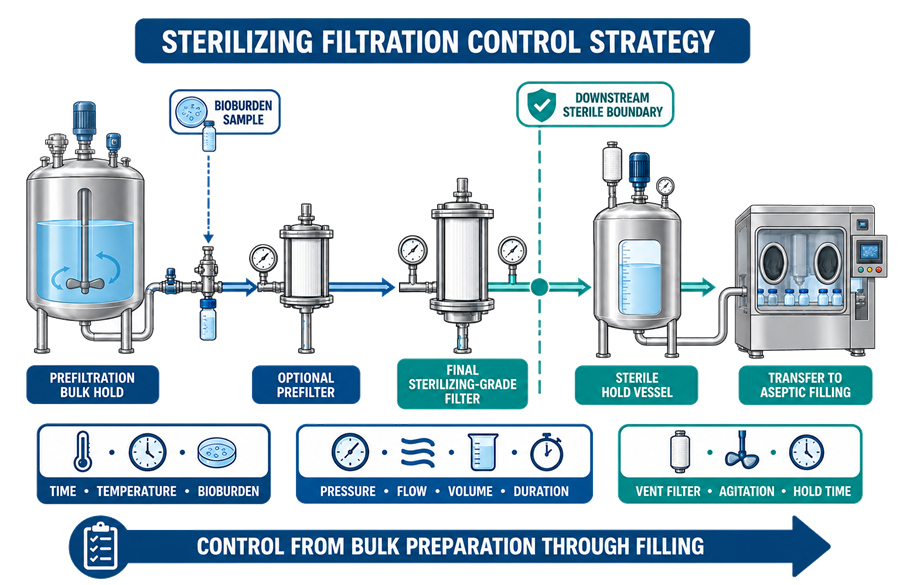
For equipment and filling-line interfaces, see aseptic filling-line architecture and the fill-line qualification lifecycle.
Validation strategy and evidence model
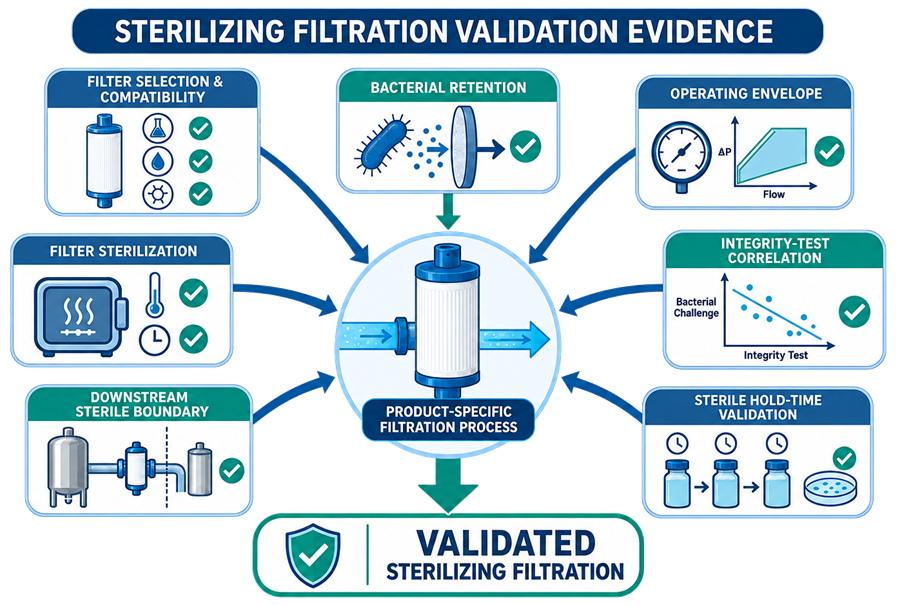
Sterilizing-filtration validation should connect several independent but complementary forms of evidence:
- Filter material and product compatibility
- Bacterial-retention performance
- Defined processing envelope
- Filter sterilization or supplier sterilization
- Integrity-test correlation
- Downstream sterile-boundary qualification
- Sterile hold-time validation
- Routine manufacturing controls
No single study replaces the integrated evidence package.
Filter selection and product compatibility
Filter selection should consider the complete process rather than pore rating alone.
Membrane and construction
The selected filter should be defined by:
- Manufacturer and part number
- Membrane polymer
- Support and drainage materials
- Housing or capsule construction
- Nominal pore rating
- Effective filtration area
- Sterilization method
- Maximum allowable differential pressure
- Maximum operating temperature
- Intended number and duration of uses
Production filters should use the same qualified construction and pore rating represented in the validation studies.
Chemical and physical compatibility
Compatibility studies should evaluate whether contact with the product or process fluids affects:
- Membrane strength
- Filter integrity
- Bacterial-retention capability
- Product potency or purity
- Product pH or osmolality
- Product appearance
- Protein or active-ingredient recovery
- Particle release
- Extractables or leachables
- Binding or adsorption
- Product aggregation
- Flow and pressure behavior
Study duration and temperature should represent or exceed the maximum validated contact conditions, including setup, filtration, pauses, sterile hold where applicable, and post-use testing.
Product recovery and adsorption
A membrane may be microbiologically suitable but unacceptable because of product loss. Recovery studies should evaluate the initial flush volume, adsorption to the membrane or assembly, hold-up volume, and the effect of concentration or batch size.
This is especially important for low-dose products, proteins, vaccines, and other products where relatively small losses could affect delivered potency.
Filter configuration
Single final filter
A process may use one validated final sterilizing-grade filter when the configuration and control strategy provide suitable assurance.
Prefilter followed by final filter
A prefilter may reduce particles or protect the final filter from premature blockage. The system should define:
- Function of each filter
- Which filter establishes the sterile boundary
- Required integrity tests
- Maximum use time
- Replacement criteria
- Sampling location for prefiltration bioburden
Serial sterilizing-grade filters
Two filters in series may both be required to achieve the validated process. If both are part of the required microbial-retention strategy, the integrity and disposition requirements should address both filters.
Redundant backup filter
A backup filter is not necessarily equivalent to a required two-filter process. Its purpose is to provide redundancy if the primary filter is damaged or fails its post-use integrity test.
The validation protocol and batch procedure should clearly distinguish:
- Two filters that are both required for validated retention
- A primary filter with an independently capable backup filter
- A prefilter followed by one final sterilizing-grade filter
Ambiguous use of “dual filter” can lead to incorrect integrity-testing and batch-disposition decisions.
Upstream bioburden and prefiltration controls
Final filtration should not be treated as compensation for an uncontrolled upstream process. Excessive prefiltration bioburden can:
- Challenge filter capacity
- Increase the possibility of microbial passage
- Allow endotoxin accumulation
- Produce microbial enzymes or degradation products
- Obstruct the membrane
- Change filtration pressure or duration
The control strategy should establish:
- A justified prefiltration bioburden limit
- Sampling location and sample timing
- Sample handling and test method
- Maximum time from compounding to filtration
- Maximum time from sampling to filtration
- Temperature limits
- Mixing or agitation requirements
- Response to an excursion
- Controls for intermediate or clarification filters
The preferred bioburden sampling point is normally as close as practicable to the final sterilizing filter. Sampling from the bulk vessel alone may not detect contamination introduced by intervening piping, pumps, hoses, or prefilters.
A final sterilizing-grade filter removes microorganisms but should not be expected to remove endotoxin already present in the process stream.
Product-specific bacterial-retention validation
Bacterial-retention validation should demonstrate that the selected filter retains the challenge organism when exposed to the actual product and the justified worst-case operating conditions.
Challenge organism
Brevundimonas diminuta ATCC 19146 is commonly used to evaluate nominal 0.2 or 0.22 µm liquid sterilizing-grade filters because of its small size under controlled growth conditions.
Another organism may be appropriate when product bioburden data identify a smaller, more resistant, or otherwise more relevant process isolate. The selection should be scientifically justified.
Challenge level
FDA guidance and ASTM F838 describe a bacterial challenge of at least 107 colony-forming units per square centimeter of effective filtration area for a standard sterilizing-grade filter evaluation.
The study should verify:
- Challenge concentration
- Effective filtration area
- Total challenge delivered
- Organism identity
- Organism viability
- Organism suitability or cell-size distribution
- Recovery method
- Absence of organisms in the filtrate
Actual product and justified surrogates
Direct inoculation into the actual formulation is preferred when the organism remains viable and the study can be conducted safely and meaningfully.
A surrogate or modified product may be needed when the formulation:
- Is antimicrobial
- Is highly viscous
- Is oily or nonaqueous
- Prevents challenge-organism recovery
- Presents unacceptable laboratory hazards
- Cannot support a reliable microbial challenge
The surrogate should reproduce the product characteristics that could adversely affect filtration, such as viscosity, surface tension, ionic strength, pH, membrane interaction, and process pressure. The rationale should explain why the study remains representative.
Worst-case operating envelope
Validation variables should be based on the actual process and may include:
- Maximum filtration time
- Maximum product-filter contact time
- Maximum and minimum temperature
- Maximum differential pressure
- Minimum and maximum flow
- Maximum batch volume
- Maximum viscosity or product concentration
- Maximum number of pauses or restarts
- Hydraulic shock or pressure pulsation
- Maximum sterilization exposure
- Maximum permitted reuse or campaign duration
- Worst-case prewetting and conditioning
- Maximum upstream bioburden
Not every numerical maximum is automatically the microbiological worst case. For example, low pressure may extend exposure time, while high pressure may increase mechanical stress. The study rationale should identify the condition most likely to challenge retention or integrity.
Laboratory work may be performed by a qualified filter manufacturer or contract laboratory, but the product manufacturer remains responsible for confirming that the study design represents the actual process.
Integrity-test correlation
A nondestructive integrity test does not directly measure microbial retention. Its value depends on a demonstrated relationship between the physical integrity-test result and the bacterial-retention performance of the filter.
Common tests include:
- Bubble-point testing
- Diffusion or forward-flow testing
- Pressure-hold testing
- Water-intrusion testing for hydrophobic filters
The acceptance limit should be based on the filter manufacturer’s bacterial-retention correlation and confirmed as applicable to:
- The exact filter construction
- Filter area and configuration
- Wetting fluid
- Product or product residue
- Test temperature
- Test pressure
- Installed test system
- Test sequence
A passing integrity test supports the conclusion that the filter remained within the correlated physical acceptance range. It does not replace the original bacterial-retention validation.
Integrity-Test Methods and Tester Control
Integrity-test methods should be selected according to the filter type, membrane properties, wetting condition, installed configuration, and manufacturer-established bacterial-retention correlation.
| Method | Typical application |
|---|---|
| Bubble point | Determines the pressure required to displace wetting liquid from the largest membrane pores. |
| Diffusion or forward flow | Measures gas flow through a wetted membrane below the bubble point. |
| Pressure hold or pressure decay | Evaluates pressure loss in a closed test system over a defined period. |
| Water intrusion | Commonly used for hydrophobic filters without wetting the membrane with an alcohol-based solution. |
The approved procedure should control the wetting fluid, wetting method, test pressure, stabilization time, temperature, tubing configuration, test-gas quality, product residue, calculation method, and acceptance limit.
Automated integrity testers should be qualified for their intended use. Qualification and lifecycle controls should address pressure, flow, and temperature measurement; automated calculations; software configuration; user access; audit trails; reports; electronic records; backup and recovery.
Critical measurement devices should remain within their approved calibration limits. An out-of-tolerance condition should trigger assessment of previously generated integrity-test results and affected batch decisions.
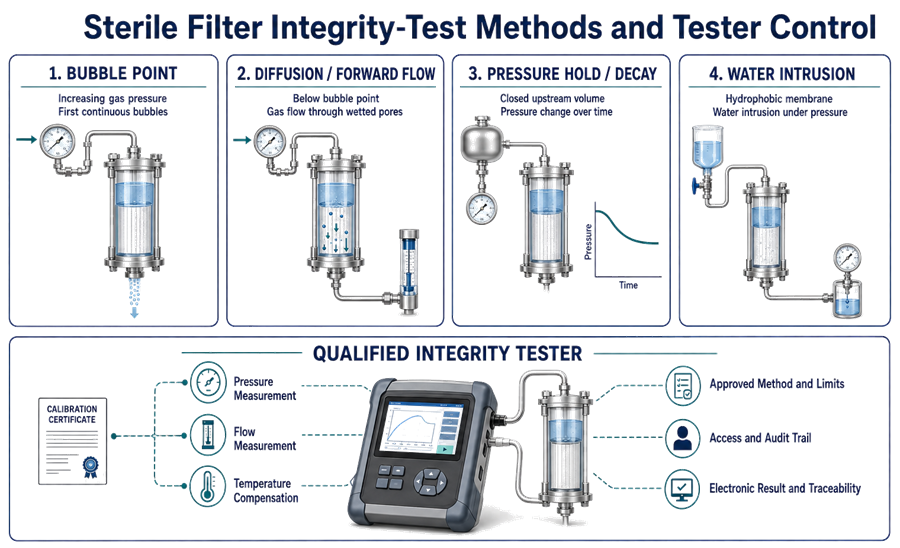
Passing, invalid, repeated, and failed results should be retained and periodically reviewed. Traceability should connect the filter lot, installation, sterilization, pre-use test, product filtration, post-use test, batch record, investigation, and release decision.
Filter sterilization and installation
The validated process should define how the filter and downstream pathway become sterile.
Possible approaches include:
- Steam sterilization in place
- Autoclaving of a reusable assembly
- Autoclaving of a filter capsule
- Supplier-sterilized single-use assembly
- Gamma- or X-ray-sterilized disposable assembly
Validation should address:
- Sterilization-cycle lethality or supplier sterilization evidence
- Maximum number of sterilization cycles
- Membrane compatibility with sterilization
- Assembly orientation
- Air removal and condensate drainage
- Cooling and storage after sterilization
- Maximum post-sterilization hold time
- Aseptic connection or installation
- Filter wetting and conditioning
- Prevention of incorrect assembly
Steam exposure can alter membrane properties or integrity-test results. The bacterial-retention and integrity-test evidence should therefore represent the filter in its post-sterilization condition.
Reusable systems may interface with steam-in-place utility systems. Disposable configurations should be integrated with the controls described for single-use systems in fill-finish.
Pre-use integrity testing and PUPSIT
A pre-use integrity test can identify filter damage, incorrect assembly, inadequate wetting, or test-system problems before product filtration.
FDA guidance states that integrity testing can be performed before processing and that post-use testing should routinely be performed. Annex 1 is more explicit: it expects pre-use post-sterilization integrity testing—commonly called PUPSIT—before the filter is used to process product.
The procedure should define:
- Whether the test occurs before or after sterilization
- Wetting fluid and wetting procedure
- Test-system configuration
- Acceptance limit
- Product-displacement or flushing requirements
- Protection of the downstream sterile boundary
- Response to failure or an invalid test
- Conditions under which testing may be repeated
Where PUPSIT cannot be performed without introducing a greater contamination or process risk, an Annex 1 strategy requires a documented risk assessment and suitable alternative controls. Technical inconvenience alone is not an adequate rationale.
Post-use filter-integrity testing
The final sterilizing-grade filter should normally be integrity tested after use and before removal from its housing or disassembly of the system.
The procedure should control:
- Time from filtration completion to testing
- Product displacement or flushing
- Wetting-fluid selection
- Temperature equilibration
- Test pressure and stabilization
- Automated or manual test sequence
- Acceptance criteria
- Electronic data and audit trail
- Handling of incomplete, interrupted, invalid, or failed tests
The approved sequence should prevent flushing, handling, or disassembly from concealing damage that occurred during processing.
Sterile vent and process-gas filters
Sterile receiving and hold vessels commonly use hydrophobic vent filters to permit pressure equalization while protecting the sterile boundary.
The strategy should address:
- Gas source and quality
- Filter hydrophobicity
- Microbial-retention capability
- Condensation risk
- Maximum gas flow
- Forward and reverse pressure
- Sterilization
- Integrity testing
- Maximum use duration
- Protection during vessel cleaning
- Response to filter wetting
- Vessel pressure or vacuum excursions
Water-intrusion testing may be suitable for some hydrophobic filters. The selected method and limit should be correlated with the specified filter.
Connected compressed-gas and vent systems should be evaluated as described in process gas systems for GMP manufacturing.
Downstream sterile boundary
Once product passes through the final sterilizing-grade filter, every downstream product-contact surface becomes part of the sterile boundary. This may include:
- Filter outlet
- Receiving vessel
- Vessel vent filter
- Tubing or piping
- Valves
- Pumps
- Aseptic connectors
- Sampling ports
- Pressure instruments
- Filling manifold
- Filling needles
Validation should demonstrate that the boundary is initially sterile and remains protected throughout the maximum processing and hold period.
Potential loss-of-integrity mechanisms include:
- Incorrectly assembled connections
- Damaged single-use components
- Valve leakage
- Nonsterile gas ingress
- Wet or failed vent filters
- Unqualified sampling
- Excessive pressure or vacuum
- Opening of the system
- Extended post-sterilization storage
- Maintenance or intervention
- Improvised reconnection after a process interruption
Sterile hold-time validation
Sterile hold-time validation should support two different conclusions:
- The product remains within its approved quality attributes for the duration of the hold.
- The validated equipment and operating configuration maintain the sterile boundary for the duration of the hold.
Time alone is not the validated parameter.
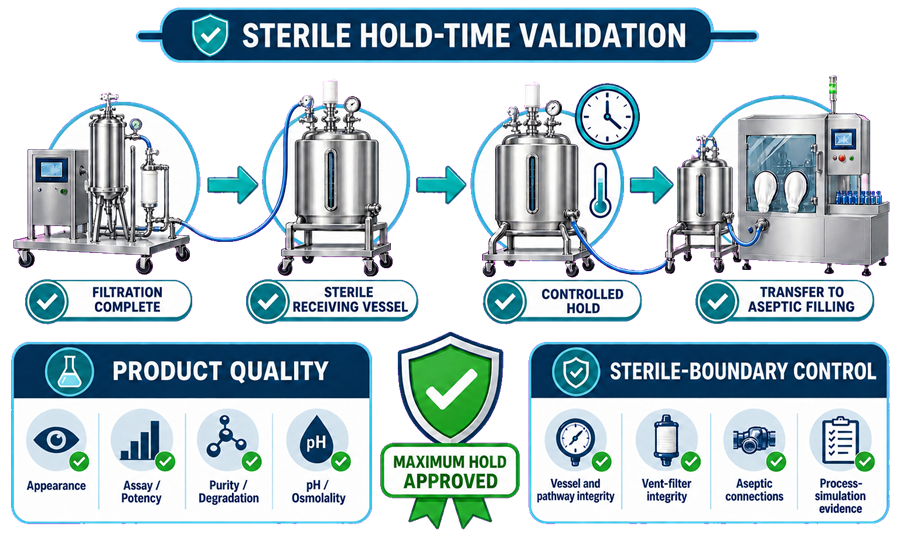
Defining the hold period
The protocol should define:
- Start of the hold
- End of the hold
- Whether filtration duration is included
- Maximum permissible duration
- Allowed temperature range
- Vessel pressure or gas-overlay conditions
- Agitation conditions
- Sampling frequency
- Permitted transfers or recirculation
- Permitted process interruptions
- Conditions for connection to the filling line
The start may be defined as completion of final filtration, completion of transfer into the receiving vessel, or another justified event. The chosen definition should be unambiguous in the batch record.
Product-quality evidence
Testing should be selected according to product risk and may include:
- Appearance
- Assay or potency
- Purity and degradation products
- pH
- Osmolality
- Particles
- Aggregation
- Preservative content
- Biological activity
- Container or bag interaction
- Extractables or leachables
- Bioburden before final filtration
Samples should represent the start and end of the proposed hold and, where useful, intermediate intervals. The validation duration commonly includes a justified margin beyond the routine operating limit.
Sterile-boundary evidence
Sterility assurance should be based primarily on qualified equipment, validated sterilization, closed-system integrity, controlled connections, filter integrity, and representative aseptic process simulation—not solely on a sterility-test result.
Supporting evidence may include:
- Sterilization records
- Vessel and transfer-path integrity
- Vent-filter integrity
- Pre-use and post-use filter tests
- Connection-integrity evidence
- Pressure and temperature records
- Environmental monitoring during aseptic manipulations
- Representative aseptic process simulation
- Sterility testing where scientifically appropriate
Sterility testing samples only a small portion of the batch and cannot prove that every location in a held bulk volume remained sterile.
Worst-case hold configuration
The study should represent the proposed maximum hold under justified worst-case conditions, potentially including:
- Longest duration
- Highest or lowest permitted temperature
- Minimum volume and maximum headspace
- Maximum number of samples
- Maximum number of aseptic connections
- Agitation or no agitation
- Maximum pressure cycling
- Vent-filter exposure
- Longest transfer duration
- Planned line stoppages
- Representative single-use assembly age
A hold study performed in a different vessel, with a different vent, without routine sampling, or without the proposed transfer pathway may not support the production configuration.
Aseptic process simulation
Aseptic process simulation should represent the sterile hold and transfer operations when they form part of the aseptic manufacturing process.
The simulation should consider:
- Maximum representative hold duration
- Vessel venting
- Agitation
- Sampling
- Sterile connections
- Transfers
- Filter-related manipulations
- Routine interventions
- Process stoppages
- Connection to the filling system
The simulation demonstrates the capability of the aseptic operation and its controls. It does not replace product-specific chemical or physical hold-time studies.
See media fill and aseptic process simulation for the broader simulation strategy.
Qualification prerequisites
Before executing product-specific validation, the supporting systems should be qualified and released for use.
Prerequisites may include:
- Approved user requirements and process description
- Equipment and utility qualification
- Calibrated pressure, temperature, flow, and timing instruments
- Qualified integrity-test equipment
- Validated sterilization cycles
- Approved single-use supplier and configuration
- Qualified aseptic connectors
- Approved filter specifications
- Vendor bacterial-retention correlation
- Approved analytical and microbiological methods
- Operator training
- Approved batch and integrity-testing procedures
- Data-integrity controls
The filtration process validation article provides additional discussion of filtration studies outside this article’s aseptic and sterile-hold focus.
Validation protocol and acceptance criteria
The protocol should identify:
- Objective and scope
- Product and batch characteristics
- Filter manufacturer and part number
- Membrane and effective area
- Complete process configuration
- Upstream and downstream boundaries
- Study variables and worst-case rationale
- Sampling plan
- Test methods
- Integrity-test limits
- Bacterial-challenge acceptance criteria
- Product-quality acceptance criteria
- Sterile-hold acceptance criteria
- Deviation handling
- Data-review responsibilities
- Requirements for the final report
Acceptance criteria should be approved before execution. They should not be retrospectively adjusted to accommodate an unexpected result.
Routine batch execution and review
Routine records should permit reconstruction of the filtration and sterile-hold process.
Records normally include:
- Filter identity and lot number
- Assembly or equipment identification
- Sterilization cycle
- Pre-use integrity-test result, where applicable
- Prefiltration bioburden result
- Filtration start and completion times
- Pressure and differential-pressure profile
- Flow or filtration rate
- Product temperature
- Volume processed
- Pauses, alarms, and interventions
- Sterile-hold start and end times
- Vessel temperature and pressure
- Vent-filter status
- Post-use integrity-test result
- Deviations and investigation references
- Operator and reviewer approval
Critical parameters should be evaluated against validated limits rather than recorded without assessment.
Integrity-test failure investigation
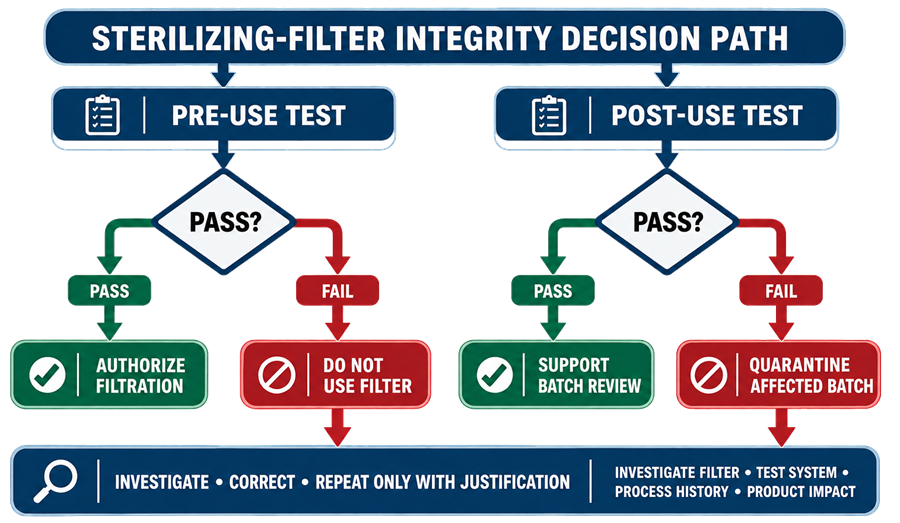
A failed integrity test should trigger a controlled response. Repeated testing until a passing result is obtained is not an acceptable disposition strategy.
Pre-use failure
A pre-use failure normally prevents use of the filter until the cause is understood and corrected.
The investigation should consider:
- Inadequate wetting
- Incorrect test recipe
- Temperature effect
- Test-equipment malfunction
- Incorrect connections
- Housing or assembly leakage
- Filter damage
- Sterilization damage
- Wrong filter installation
A repeat test should occur only when the initial test is scientifically demonstrated to be invalid or after a documented corrective action.
Post-use failure
A post-use failure should place the affected batch under quarantine pending investigation and quality-unit disposition.
The investigation should evaluate:
- Raw test data and audit trail
- Test-system function
- Wetting and flushing
- Product interference
- Temperature
- Filter and housing condition
- Pressure and flow history
- Alarms or hydraulic shocks
- Installation and sterilization records
- Prefiltration bioburden
- Downstream configuration
- Backup-filter results, where applicable
- Potential product impact
A post-use failure does not automatically establish that microorganisms passed through the filter, but it removes an important element of the validated assurance package. Batch disposition requires a documented scientific assessment of all available evidence.
Continued process verification
Lifecycle monitoring should confirm that the filtration process remains within its validated state. Useful trends include:
- Prefiltration bioburden
- Filtration duration
- Flow rate
- Initial and final differential pressure
- Product temperature
- Integrity-test values—not only pass/fail status
- Invalid and aborted integrity tests
- Filter blockage or premature replacement
- Sterile-hold duration
- Hold-temperature excursions
- Vent-filter failures
- Connection or assembly deviations
- Product recovery
- Microbial isolates
- Supplier complaints and filter changes
A gradual movement of integrity-test values toward the acceptance limit may identify a developing process, wetting, equipment, or material problem even while all individual tests continue to pass.
Change control and revalidation
Changes should be assessed for their potential effect on microbial retention, filter integrity, product quality, and the sterile boundary. Examples include:
- Filter manufacturer or membrane change
- Filter area or cartridge-size change
- Housing or capsule change
- New product or formulation
- Concentration or viscosity change
- Batch-volume increase
- Increased filtration time
- Pressure or flow-range change
- Sterilization-cycle change
- New wetting or flushing fluid
- Prefilter change
- Revised single-use assembly
- New connector or tubing material
- Receiving-vessel change
- Vent-filter change
- Longer sterile hold
- New sampling or transfer operation
- Integrity-test software or equipment change
- Supplier bacterial-retention correlation change
The assessment should determine whether documentary review, limited confirmatory testing, protocol amendment, or full revalidation is required.
Periodic review
Periodic review should evaluate whether the original validation remains representative of current operation. The review should consider:
- Current products and formulations
- Current filter specifications
- Supplier notifications
- Integrity-test trends
- Bioburden trends
- Process deviations
- Sterile-hold performance
- Changes since the prior review
- Complaints or sterility-related investigations
- Maintenance and calibration history
- Continued suitability of procedures
- Current regulatory expectations
The review should result in a documented conclusion concerning continued validity and any required corrective, preventive, or revalidation actions.
Common validation deficiencies
Recurring deficiencies include:
- Treating the nominal pore rating as complete validation
- Using generic vendor data without confirming process applicability
- Failing to define the final sterile boundary
- Omitting upstream bioburden limits
- Sampling bioburden too far upstream
- Not representing the actual product or a justified surrogate
- Ignoring pauses, restarts, or hydraulic shock
- Using integrity limits without bacterial-retention correlation
- Testing only before use or only after use without an approved rationale
- Repeating failed tests until a pass is obtained
- Confusing redundant and serial-required filters
- Omitting vent filters from the sterile-boundary assessment
- Validating hold time without the actual vessel and connections
- Relying on sterility testing as the principal hold-time evidence
- Extending filter use or sterile hold without change control
- Reviewing integrity tests only as pass/fail results
- Failing to represent sterile holds and transfers in process simulation
Conclusion
Sterilizing filtration is a product-specific aseptic process, not simply the installation of a nominal 0.2 or 0.22 µm filter. The validation strategy should demonstrate that:
- Upstream bioburden is controlled
- The product and filter are compatible
- The filter retains a suitable microbial challenge
- The operating envelope is defined
- Integrity-test limits correlate with bacterial retention
- The filter is correctly sterilized and installed
- Pre-use and post-use testing are appropriately controlled
- The downstream pathway maintains its sterile boundary
- The approved sterile hold preserves both product quality and sterility assurance
- Changes, deviations, and performance trends are controlled throughout the lifecycle
Together, these controls establish a scientifically defensible connection between the laboratory retention study, the installed filtration process, the sterile hold, and the aseptic filling operation.