

Aseptic Process Change Control, Periodic Review, and Requalification
An aseptic process remains validated only while its approved design, operating conditions, supporting systems, personnel practices, and contamination controls remain adequately represented by the established validation evidence.
Routine operation continually introduces new information. Equipment is maintained, components are replaced, software is updated, interventions change, new container formats are introduced, environmental trends develop, and deviations expose limitations that may not have been evident during initial qualification.
A lifecycle-control program uses this information to determine whether:
- The original validation basis remains current
- A proposed change can affect sterility assurance
- Additional verification is required before implementation
- Accumulated changes have altered the aseptic-process risk profile
- Periodic qualification or process-simulation requirements remain current
- Targeted or comprehensive requalification is required
- The process may continue operating within its approved validated state
This article addresses change control, periodic evidence review, requalification decisions, and restoration of the validated state. Initial aseptic-process validation is addressed in Aseptic Processing Validation Strategy and Lifecycle.
Purpose and lifecycle position
Change control, periodic review, and requalification perform related but different functions.
Change control evaluates a proposed or required change before implementation and determines its effect on approved requirements, qualified attributes, process controls, regulatory commitments, and existing validation evidence.
Periodic review evaluates accumulated lifecycle evidence to determine whether the process remains in control and whether the validation basis remains representative.
Requalification generates new evidence when previous qualification is no longer sufficient, when periodic testing is required, or when a change, failure, adverse trend, shutdown, or investigation indicates that specific qualified attributes must be demonstrated again.
These activities should not be treated as interchangeable.
A periodic review does not replace required cleanroom requalification, APS execution, sterilizer revalidation, filter-integrity testing, calibration, or other scheduled activities. Similarly, repeating an APS does not by itself qualify an equipment modification, restore deficient airflow, validate a software change, or resolve an unexplained environmental trend.
Regulatory and technical basis
21 CFR 211.100 requires production and process-control procedures, including changes to those procedures, to be drafted, reviewed, and approved by appropriate organizational units and reviewed and approved by the quality control unit.
21 CFR 211.113 requires written procedures designed to prevent microbiological contamination of sterile drug products, including validation of aseptic and sterilization processes.
21 CFR 211.160 applies quality-unit oversight to laboratory specifications, standards, sampling plans, test procedures, and changes to laboratory control mechanisms.
21 CFR 211.180(e) requires records to support at least annual evaluation of each drug product’s quality standards and the need for changes to product specifications or manufacturing and control procedures. This annual product review is an important input, but it is not identical to a system-level aseptic-process periodic review.
FDA’s Process Validation: General Principles and Practices describes validation as a lifecycle activity and identifies continued process verification as the stage providing ongoing assurance that a commercial process remains in a state of control.
The FDA aseptic-processing guidance provides expectations for ongoing environmental control, periodic APS, personnel qualification, equipment maintenance, investigations, and evaluation of changes affecting the aseptic process.
ICH Q10 Pharmaceutical Quality System, as adopted by FDA, describes formal lifecycle change management supported by quality-risk management, process knowledge, quality-unit oversight, and postimplementation evaluation.
ICH Q9(R1) Quality Risk Management establishes that quality-risk evaluations should be based on scientific knowledge, linked to patient protection, and performed with effort and formality proportionate to risk.
For facilities applying European requirements, EU GMP Annex 1 provides specific expectations for cleanroom requalification, contamination-control strategy review, APS periodicity, significant modifications, extended nonoperation, and repeat initial validation.
Validated baseline
Lifecycle control requires a defined baseline against which future changes and performance can be evaluated.
The baseline may include:
- Approved process and system boundaries
- Product and container-closure families
- Filling technologies and operating ranges
- Qualified equipment configurations
- Approved recipes and software versions
- Critical-zone and barrier configurations
- Sterile product and component pathways
- Qualified sterilization and bio-decontamination cycles
- Validated sterilizing-filtration conditions
- Approved sterile and prefiltration hold times
- Approved intervention procedures
- Maximum exposure and processing times
- Environmental-monitoring locations and methods
- Cleanroom and clean-air-equipment qualification
- Qualified operators and production shifts
- Validated APS design
- Supporting utilities
- Calibration and maintenance requirements
- Regulatory commitments
- Approved validation and requalification strategy
If this baseline is incomplete, later change-impact decisions become subjective. The assessment cannot reliably determine whether a qualified attribute has changed when the approved configuration and supporting evidence are not clearly defined.
Aseptic-process lifecycle-control model
The validated state is maintained through a closed lifecycle. The lifecycle is not complete until the final configuration, qualification evidence, procedures, and operating controls have been approved and incorporated into the controlled baseline. The validated state is maintained through a closed evidence loop rather than through a single qualification event.
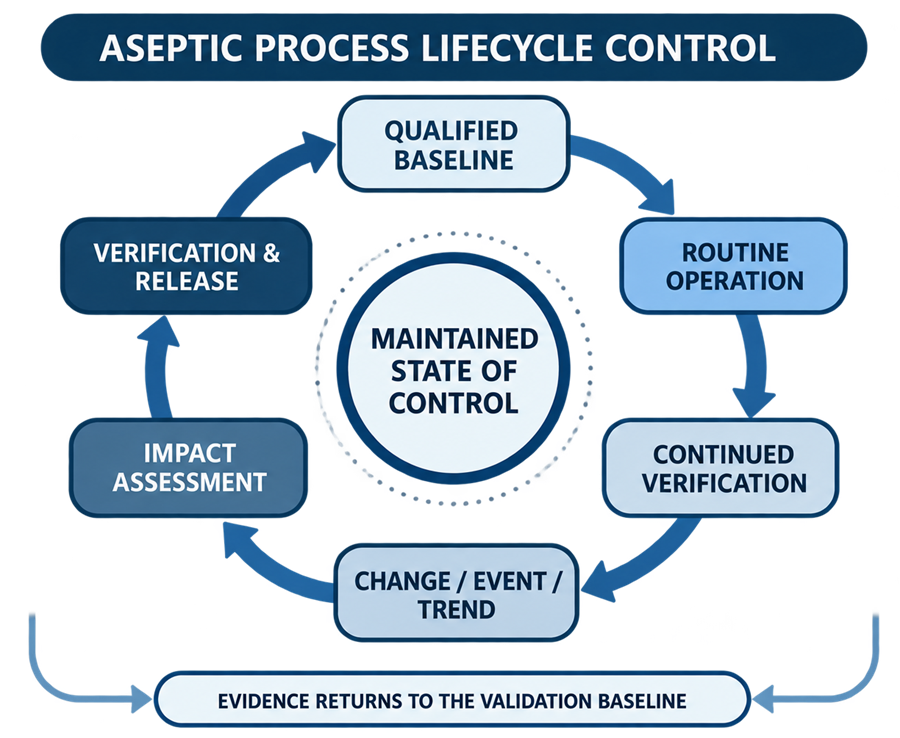
Lifecycle evidence returns to the validation baseline through:
- Updated requirements
- Revised risk assessments
- Approved drawings and specifications
- Updated configuration records
- Revised procedures
- New qualification evidence
- Updated APS design
- Revised monitoring plans
- Approved reports
- Quality-unit release
A change control should not be closed merely because the physical change has been completed. Closure should confirm that required verification was successful and that the controlled baseline reflects the final installed and approved condition.
Governance and responsibilities
Aseptic-process changes commonly cross organizational boundaries. The change-management procedure should define responsibilities for:
- Change initiation
- Technical description
- Quality-risk assessment
- Validation-impact assessment
- Sterility-assurance assessment
- Regulatory-impact assessment
- Computerized-system assessment
- Engineering design review
- Testing and requalification
- Procedure revision
- Training
- Implementation authorization
- Postimplementation verification
- Final quality-unit approval
An interdisciplinary assessment may require participation from:
- Quality assurance
- Sterility assurance
- Microbiology
- Manufacturing
- Validation
- Engineering
- Regulatory affairs
- Automation or information technology
- Maintenance
- Calibration
- Supply chain
- Product or process development
No single department should independently conclude that an aseptic-process change has no validation impact when the change affects systems outside that department’s technical ownership.
Change-control initiation
The change record should describe the proposed change with enough technical detail to support an objective impact assessment. The description should identify:
- Current configuration
- Proposed configuration
- Reason for the change
- Exact systems and components affected
- Product and process boundaries
- Associated drawings and specifications
- Software, firmware, or recipe versions
- Operating ranges
- Implementation method
- Planned downtime
- Temporary conditions
- Affected procedures
- Affected batches or campaigns
- Supporting vendor information
- Expected benefits
- Known risks and uncertainties
Descriptions such as “upgrade equipment,” “replace part,” “improve airflow,” or “update software” are not sufficient. The assessor needs to understand what physical, functional, procedural, or electronic attribute will be different after implementation.
Aseptic change-impact assessment
The assessment should identify the contamination-control and qualified attributes that could be affected directly or indirectly. An aseptic-process change may affect more than the component being modified. The assessment should examine the facility, airflow, barrier system, filling equipment, sterilization processes, filtration and hold conditions, sterile transfers, automation, data, procedures, and personnel practices as an integrated system.
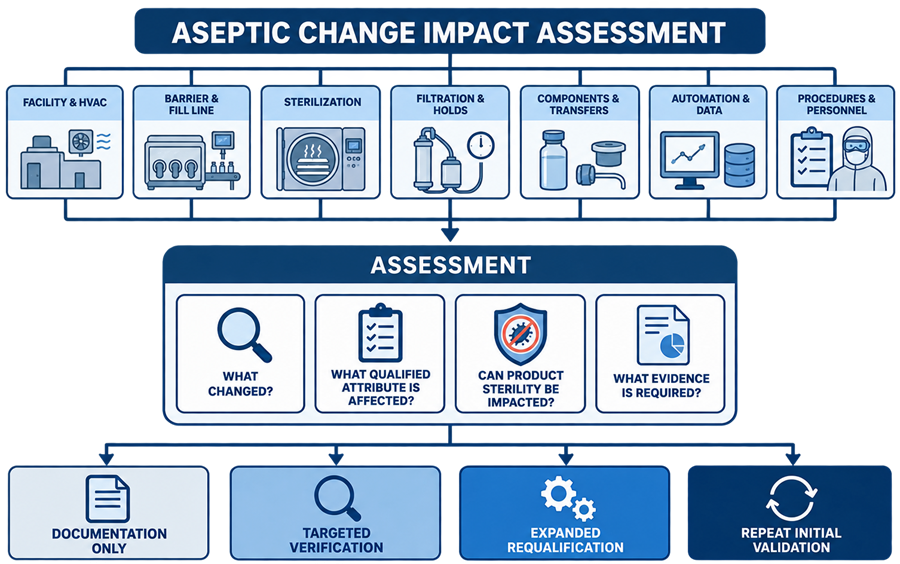
The assessment should answer four central questions:
- What is changing?
- Which qualified attributes and dependencies are affected?
- Can the change affect product sterility, endotoxin control, particulate control, container closure, or data used for batch disposition?
- What evidence is necessary to demonstrate continued suitability?
Facility and HVAC impact
Evaluate whether the change can affect:
- Room classification
- HEPA-filter integrity
- Airflow volume or velocity
- Unidirectional airflow
- First-air protection
- Pressure relationships
- Recovery
- Temperature or humidity
- Door behavior
- Personnel or material flow
- Environmental-monitoring locations
- Cleanroom operational state
Examples include:
- HEPA-filter replacement
- Air-handler modification
- Terminal-filter housing repair
- Damper adjustment
- Air-balance change
- Pressure-setpoint change
- Wall, ceiling, door, or pass-through modification
- New equipment introduced into the critical zone
- Revised room use
- Changed occupancy or shift pattern
Changes affecting critical-zone airflow may require updated Airflow Visualization and Smoke Studies, airflow measurement, filter-integrity testing, classification, pressure verification, recovery testing, or microbiological qualification.
Barrier and filling-line impact
Evaluate changes affecting:
- Barrier enclosure
- Glove ports
- Barrier doors
- Transfer systems
- Filling needles
- Pumps and manifolds
- Container transport
- Stopper or cap handling
- Filling speed
- Reject systems
- Interventions
- Critical-zone equipment motion
- Lyophilizer interfaces
The assessment should reference the established Aseptic Filling Line Architecture and Fill Line Qualification Lifecycle.
A new machine part may have limited direct product contact but still affect airflow, intervention frequency, particle generation, cleaning access, or equipment recovery following a stoppage.
Sterilization and bio-decontamination impact
Evaluate changes to:
- Sterilizers
- Load configurations
- Cycle recipes
- Sterilization parameters
- Biological indicators
- Packaging
- Load carts or accessories
- Component orientation
- Load size
- Hold times after sterilization
- Isolator bio-decontamination
- RABS disinfection
- Transfer-chamber cycles
- Aeration conditions
- Chemical concentration or distribution
A maintenance repair that changes chamber heat transfer, air removal, vapor distribution, drainage, or load configuration may require more than a maintenance functional check.
Changes to isolator or transfer-system decontamination should be assessed against Barrier System Bio-Decontamination Validation.
Filtration and sterile-hold impact
Evaluate changes to:
- Filter manufacturer or model
- Membrane material
- Effective filtration area
- Pore-size designation
- Filter housing
- Flow rate
- Differential pressure
- Product temperature
- Product formulation
- Filtration time
- Prefiltration bioburden
- Filter-integrity method
- Sterile connections
- Postfiltration pathway
- Sterile hold duration
The assessment should determine whether the existing Sterilizing Filtration Validation and Sterile Hold-Time Control remains applicable.
A nominally equivalent filter should not be accepted solely because it has the same stated pore size. Bacterial retention, product compatibility, adsorption, extractables, integrity-test correlation, operating pressure, and process time may differ.
Components and transfer impact
Evaluate changes to:
- Containers
- Stoppers
- Caps and seals
- Ready-to-use components
- Component packaging
- Washing or depyrogenation
- Sterilization
- Transfer containers
- Wrapping configuration
- Material-entry route
- Transfer disinfection
- Aseptic connectors
- Single-use assemblies
- Supplier or manufacturing site
These changes should be assessed against Qualification of Sterile Component Preparation and Transfer and, where applicable, Single-Use Systems in Fill-Finish.
Automation and data impact
Evaluate changes to:
- PLC or HMI software
- Recipes
- Parameter limits
- Alarm settings
- Interlocks
- Container tracking
- Reject logic
- User access
- Audit trails
- Electronic records
- Batch reporting
- Interfaces
- Data storage
- Backup and recovery
- Time synchronization
- Network infrastructure
- Cybersecurity controls
A software change may have no physical effect on the filling machine but can alter parameter control, alarm behavior, batch records, reject decisions, or evidence used to demonstrate process control.
Procedures and personnel impact
Evaluate changes to:
- Aseptic assembly
- Line setup
- Interventions
- Component replenishment
- Environmental monitoring
- Glove disinfection
- Cleaning and disinfection
- Material transfer
- Shift handover
- Line stoppage and restart
- Operator staffing
- Gowning
- Training
- Personnel qualification
- Maintenance access
A procedural simplification can increase contamination risk even when no equipment has changed. Revised interventions should be assessed for airflow impact, exposure time, operator proximity, monitoring coverage, and APS representation.
Product and container-closure impact
Evaluate changes to:
- Product formulation
- Viscosity
- Foaming tendency
- Fill volume
- Container size
- Container geometry
- Closure design
- Line speed
- Product temperature
- Inert-gas use
- Filling duration
- Lyophilization
- Maximum hold time
- Campaign duration
A container or product change may remain within the mechanical capability of the line while creating a new microbiological or exposure-time worst case.
Change categories and verification consequences
Administrative labels such as minor, moderate, or major should not determine the verification scope without technical assessment.
| Change category | Typical condition | Possible response |
|---|---|---|
| Administrative | No physical, functional, procedural, parameter, or regulatory effect | Document review and controlled record update |
| Like-for-like replacement | Replacement is demonstrably equivalent and does not alter qualified performance | Installation verification, calibration, loop check, or focused functional test |
| Functional change | A qualified equipment, automation, procedural, or operating attribute is altered | Targeted qualification and affected-interface testing |
| Aseptic-process-significant change | Critical zone, sterile pathway, contamination control, intervention, processing duration, or product-exposure condition may be affected | Expanded requalification, airflow study, APS, process validation, or repeat initial validation |
| Cumulative change | Several individually limited changes collectively alter configuration or risk | Integrated reassessment and potentially expanded requalification |
| Emergency or temporary change | Immediate action required or configuration used for a limited period | Authorized temporary controls, documented risk assessment, verification, expiration, and restoration assessment |
A “like-for-like” designation should be supported by comparison of design, materials, dimensions, function, performance range, software behavior, accuracy, interfaces, and effect on qualified attributes.
Selecting verification and requalification scope
The assessment should select the testing needed to address the affected attributes and uncertainty. Possible responses include:
- Documentation update
- Drawing verification
- Material or component verification
- Calibration
- Instrument-loop check
- Installation verification
- Functional testing
- Alarm or interlock challenge
- Software regression testing
- Filter-integrity verification
- Sterilization-cycle verification
- Airflow measurement
- HEPA-filter integrity testing
- Airflow visualization
- Cleanroom classification
- Environmental qualification
- Barrier leak or glove-integrity testing
- Bio-decontamination cycle requalification
- Targeted OQ
- Targeted PQ
- Hold-time study
- Sterilizing-filtration validation
- Container-closure testing
- APS
- Expanded or comprehensive requalification
- Repeat initial validation
The rationale should explain both the tests selected and relevant tests not repeated.
Prior evidence may be leveraged when it remains applicable to the final configuration. It should not be leveraged merely to reduce execution effort.
APS impact assessment
APS is a principal microbiological verification of the integrated aseptic process, but it is not automatically required for every equipment or documentation change.
An APS should be considered when a change can affect:
- Aseptic-process sequence
- Product or critical-surface exposure
- Intervention type or frequency
- Number or role of operators
- Production shifts
- Filling duration
- Line speed
- Container or closure configuration
- Aseptic connections
- Sterile hold time
- Barrier access
- Critical-zone airflow
- Lyophilizer loading or unloading
- Sterile powder addition
- Manual manipulation
- Shutdown and restart
- Campaign duration
The APS design should be updated when the approved intervention matrix, operating conditions, configuration families, worst cases, or production practices change.
Detailed APS design and execution are addressed in Media Fill and Aseptic Process Simulation.
FDA periodic APS expectations
FDA guidance recommends:
- At least three consecutive successful APS runs during initial qualification
- Routine APS generally at least semiannually for each processing line
- Representation of each production shift
- Participation of personnel authorized to enter the aseptic-processing room during manufacturing in a successful APS at least annually
The exact site program should reflect process design, operating history, regulatory commitments, and applicable product requirements.
Annex 1 periodic APS expectations
Annex 1 normally expects APS:
- During initial validation, with at least three consecutive satisfactory simulations covering all working shifts
- Approximately every six months for each aseptic process, filling line, and shift
- Approximately every six months for each operator
- After significant modification to practices, facilities, services, or equipment affecting sterility assurance
- As repeat initial validation following extended nonoperation or changes potentially affecting the aseptic process
These Annex 1 expectations should be applied where the facility or product is subject to the European framework.
Implementation controls
Change approval should define prerequisites that must be completed before implementation. These may include:
- Approved design documents
- Regulatory authorization or notification
- Supplier documentation
- Required materials
- Approved installation procedure
- Backup of software and data
- Defined rollback or recovery plan
- Updated qualification protocols
- Updated SOPs
- Training
- Environmental controls during construction or maintenance
- Cleaning and disinfection
- Postmaintenance sterilization or bio-decontamination
- Required production shutdown
- Batch or campaign restrictions
For intrusive work in or near an aseptic area, implementation controls should address:
- Personnel and material entry
- Tool control
- Construction contamination
- Open equipment protection
- Cleaning
- Disinfection
- HEPA-filter protection
- Particle generation
- Restoration of room pressure
- Environmental recovery
- Postwork monitoring
- Requalification before release
Postimplementation verification and change closure
Postimplementation verification confirms that:
- The change was installed as approved
- No unauthorized differences were introduced
- Required tests were completed
- Acceptance criteria were met
- Deviations were resolved
- Procedures reflect the final configuration
- Personnel were trained
- Electronic records and interfaces operate correctly
- Temporary controls were removed or formally retained
- Regulatory requirements were satisfied
- The change objective was achieved
- No unexpected adverse effect was identified
- The validation baseline was updated
Some changes require a defined monitoring period before final closure. Examples include new environmental-monitoring locations, revised cleaning procedures, changes intended to reduce interventions, new equipment parts, and software modifications affecting alarms or rejects.
Early closure before sufficient postimplementation evidence is available can conceal unintended effects.
Emergency and temporary changes
Emergency changes may be necessary to protect personnel, prevent equipment damage, restore critical environmental control, or maintain essential product supply. The emergency process should still require:
- Defined authorization
- Description of the condition
- Immediate risk assessment
- Product and batch-impact assessment
- Temporary operating controls
- Required testing
- Defined duration
- Expiration or review date
- Retrospective quality-unit review
- Restoration or permanent-change decision
A temporary change should not remain in use indefinitely through repeated extensions. Continued use requires reassessment and conversion to a permanent approved configuration when appropriate.
Deviations, failures, and adverse trends as triggers
Not every requalification trigger begins as a planned change. Potential event-driven triggers include:
- APS contamination
- Sterility-test failure
- Environmental-monitoring action excursion
- Repeated environmental alerts
- Change in environmental flora
- HEPA-filter integrity failure
- Loss of pressure or airflow
- Critical-zone particle excursion
- Barrier breach
- Glove-integrity failure
- Bio-decontamination failure
- Sterilization-cycle failure
- Filter-integrity failure
- Excessive sterile hold time
- Unplanned critical intervention
- Extended line stoppage
- Major maintenance
- Software malfunction
- Data loss
- Incorrect recipe
- Reject-system failure
- Product-contact-path breach
- Repeated closure defects
- Adverse intervention trend
- Extended shutdown or nonuse
The investigation should determine:
- Which qualified attributes may have failed
- Whether the event was isolated or systemic
- Whether previous batches are affected
- Whether continued use is acceptable
- What corrective action is required
- What evidence is necessary before return to service
- Whether the initial validation basis remains valid
Repeating a test without investigating the original failure does not restore the validated state.
Periodic review
Periodic review integrates lifecycle evidence that is normally distributed among separate qualification, monitoring, maintenance, calibration, deviation, CAPA, training, and change-control systems. The review should determine whether the original validation basis remains current, adverse trends are developing, cumulative changes have altered risk, and existing qualification and APS evidence still represents the process being operated.
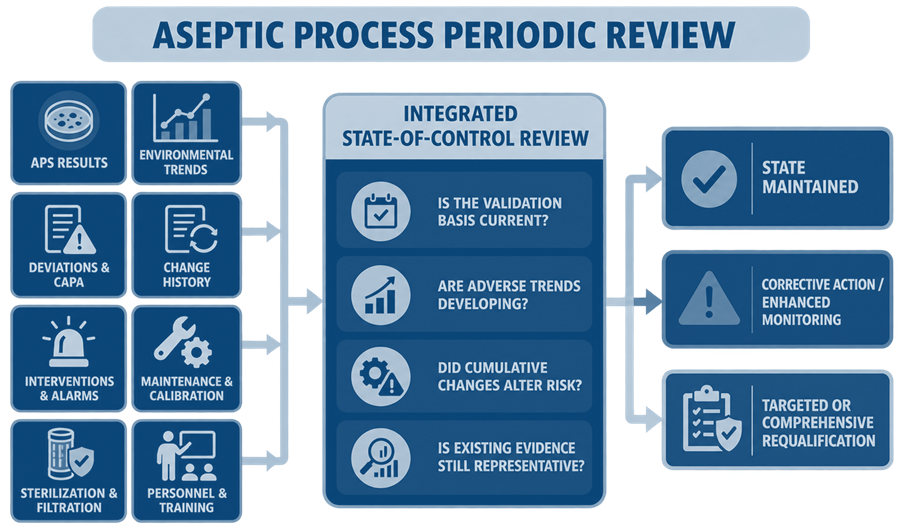
The purpose is to determine whether:
- The validation basis remains current
- The process remains in control
- Adverse trends are developing
- Cumulative changes have altered risk
- Existing qualification and APS evidence remains representative
- Required periodic activities were completed
- Requalification or corrective action is required
The review frequency should be defined by procedure and should reflect process risk, production frequency, regulatory commitments, and the timing of required supporting-system reviews.
Periodic-review inputs
APS and personnel qualification
Review:
- APS schedule completion
- Process, line, shift, and operator coverage
- Contaminated units
- Aborted or invalidated runs
- Intervention execution
- Unit reconciliation
- Incubation deviations
- Investigation outcomes
- Operator participation
- Repeat APS
- Emerging worst cases
- Changes not represented in APS
Environmental monitoring
Review:
- Viable-air results
- Surface results
- Glove and gown results
- Nonviable-particle events
- Action excursions
- Repeated alerts
- Location-specific trends
- Operator-specific trends
- Organism profiles
- Spore-former and mold recoveries
- Environmental-monitoring method changes
- Sample interruptions
- Delayed results
- CAPA effectiveness
Detailed program expectations are addressed in Environmental Monitoring for Aseptic Process Verification.
Facility and clean-air systems
Review:
- Cleanroom requalification
- Classification
- HEPA-filter integrity
- Airflow volume and velocity
- Pressure relationships
- Recovery
- Airflow visualization
- HVAC alarms
- Shutdowns
- Filter replacements
- Room modifications
- Seasonal performance
- Unresolved or repeated deficiencies
Under Annex 1, the maximum interval for requalification of Grade A and Grade B cleanrooms and clean-air equipment is six months. Grade C and Grade D areas have a maximum interval of 12 months. Applicable tests and frequencies should be incorporated into the approved site program where Annex 1 applies.
Barrier systems
Review:
- RABS or isolator qualification
- Glove and sleeve integrity
- Glove replacements
- Barrier-door events
- Transfer-system performance
- Pressure control
- Leak testing
- Bio-decontamination cycles
- Cycle alarms and aborts
- Chemical concentration
- Aeration
- Residue-control issues
- Barrier interventions
Relevant supporting articles include Restricted Access Barrier Systems: Design and Qualification, Isolator Systems: Design, Qualification, and Lifecycle Control, and Barrier Glove Integrity Qualification and Lifecycle Control.
Equipment and automation
Review:
- Filling performance
- Reject rates and reasons
- Line stoppages
- Container jams
- Needle adjustments
- Stopper-placement problems
- Closure defects
- Alarm trends
- Bypasses and overrides
- Software versions
- Recipe changes
- Access control
- Audit trails
- Backup and restoration
- Interface failures
- Obsolescence
- Supplier support
Sterilization, filtration, and sterile pathways
Review:
- Sterilization revalidation
- Cycle deviations
- Biological-indicator results
- Load changes
- Filter-integrity results
- Filtration deviations
- Prefiltration bioburden
- Sterile hold times
- Product-contact-path breaches
- Aseptic connection failures
- Single-use assembly defects
- Component sterilization
- Transfer deviations
- Supplier changes
Maintenance and calibration
Review:
- Preventive-maintenance completion
- Corrective maintenance
- Repeated equipment failures
- Critical-component replacement
- Out-of-tolerance instruments
- Calibration adjustments
- Deferred maintenance
- Temporary repairs
- Spare-part equivalence
- Maintenance-related contamination events
An acceptable calibration result does not independently confirm that the associated control loop, alarm, software calculation, or equipment function remains qualified.
Changes, deviations, and CAPA
Review:
- Open and closed change controls
- Emergency changes
- Temporary changes
- Overdue actions
- Cumulative changes
- Deviations
- Investigations
- Root-cause patterns
- CAPA effectiveness
- Repeated retraining
- Repeated extensions
- Recurring deviations classified as unrelated
Cumulative evaluation is necessary because several individually limited changes may collectively alter the process configuration or contamination-control strategy.
Periodic-review conclusions
The report should reach a clear conclusion for the defined review period.
Possible conclusions include:
State maintained
The validation basis remains current, required activities were completed, routine evidence remains acceptable, and no additional requalification is required beyond scheduled activities.
State maintained with actions
No immediate loss of control is identified, but procedure updates, enhanced monitoring, maintenance, training, risk-assessment revision, or other defined actions are required.
Targeted requalification required
One or more affected attributes require additional evidence, but the remaining validation basis remains applicable.
Comprehensive requalification required
Multiple interdependent controls have changed or deteriorated, making prior qualification insufficient to support the current process.
Validated state not adequately supported
Available evidence is incomplete, conflicting, or adverse. Continued use, batch disposition, and restoration requirements require formal quality-unit determination.
Requalification strategy
Requalification scope should follow the affected qualified attributes and their dependencies.
No additional event-driven requalification
This conclusion may be appropriate when:
- The change is administrative
- Equivalence is objectively demonstrated
- No qualified attribute is affected
- Routine controls provide sufficient evidence
- Required scheduled activities remain current
- The rationale is documented and approved
“No requalification” does not mean “no action.” Documentation, inspection, calibration, training, or verification may still be required.
Targeted requalification
Targeted requalification may address:
- Replaced sensor
- Modified alarm
- New format part
- Revised equipment function
- Local barrier repair
- Changed monitoring location
- Adjusted pressure setpoint
- Modified transfer procedure
- New sterile connection
- Updated software module
- Specific airflow obstruction
The protocol should include related dependencies rather than testing only the modified component.
Expanded requalification
Expanded requalification may be necessary when:
- Multiple qualified functions are affected
- Critical-zone airflow changes
- Barrier configuration changes
- Equipment movement changes intervention access
- New product or container conditions are introduced
- Sterile pathways are redesigned
- Several software and mechanical functions change together
- A significant shutdown or refurbishment occurs
- Adverse trends indicate broader deterioration
The scope may include IQ, OQ, PQ, airflow studies, cleanroom testing, environmental qualification, sterilization, filtration, APS, and integrated readiness assessment.
Repeat initial validation
Repeat initial validation may be appropriate when:
- A new aseptic process is introduced
- The process has not operated for an extended period
- Major equipment, facility, or barrier redesign occurs
- The sterile product pathway is fundamentally changed
- The previous validation basis is no longer representative
- A systemic failure undermines confidence in the integrated process
- Applicable regulatory requirements specifically require initial-validation repetition
Under Annex 1, an aseptic process should be subject to repeat initial validation following extended nonoperation or a change to the process, equipment, procedures, environment, or container-closure combination that has the potential to affect the aseptic process.
Requalification protocol
The protocol should define:
- Trigger and associated record
- System and process boundaries
- Previous and final configuration
- Risk and impact assessment
- Affected qualified attributes
- Supporting evidence
- Tests to be performed
- Tests not repeated and justification
- Operating states
- Product or surrogate
- Configuration matrix
- Worst-case selection
- Required instruments
- Sampling plan
- Acceptance criteria
- Deviation handling
- APS requirements
- Reporting and approval
- Return-to-service conditions
Acceptance criteria should be approved before execution and connected to approved requirements, specifications, validation studies, or applicable regulatory expectations.
Requalification report and release
The report should document:
- Activities performed
- Final installed configuration
- Raw-data location
- Results
- Deviations
- Investigation conclusions
- Retesting
- Unresolved conditions
- Requirements traceability
- Residual risk
- Updated procedures
- Training completion
- APS results, when applicable
- Postimplementation monitoring
- Final conclusion
- Quality-unit release
Return to routine production should be based on an integrated readiness decision. Completion of one successful test does not justify release when other affected qualification activities remain incomplete.
Common deficiencies
Common lifecycle-control deficiencies include:
- Incomplete definition of the validated baseline
- Vague change descriptions
- Using “like-for-like” without an equivalence assessment
- Evaluating only the modified component and ignoring system dependencies
- Treating every change as documentation-only
- Requiring APS for every change without technical rationale
- Using APS as a substitute for equipment or airflow qualification
- Omitting regulatory-impact assessment
- Implementing before required verification is approved
- Closing changes before postimplementation evidence is available
- Repeatedly extending temporary changes
- Failing to evaluate cumulative changes
- Performing periodic review as a checklist of completed documents
- Omitting adverse trends that remain below individual action limits
- Reviewing systems separately without evaluating their interfaces
- Treating annual product review as the complete aseptic-process review
- Ignoring required calendar-based testing
- Selecting requalification scope solely from elapsed time
- Repeating failed tests without investigating the original result
- Releasing the process with unresolved critical deviations
- Failing to update APS design after process changes
- Failing to update the validation baseline after implementation
Conclusion
Aseptic-process lifecycle control depends on maintaining a clear connection between the validated baseline, routine evidence, proposed changes, observed failures, periodic review, and requalification.
Change control determines what may be affected before implementation. Periodic review evaluates whether accumulated evidence continues to support the process. Requalification generates new evidence when previous qualification is no longer sufficient or when scheduled requirements apply.
A defensible program does not automatically repeat every test after every change, and it does not use risk assessment to avoid necessary verification. It identifies the affected qualified attributes and their dependencies, selects proportionate evidence, updates the validation baseline, and requires quality-unit release before the revised process is accepted for routine operation.