

Media Fill and Aseptic Process Simulation
A media fill, formally described as an aseptic process simulation or APS, uses sterile microbiological growth medium or another suitable surrogate in place of the product to evaluate the microbiological capability of an integrated aseptic manufacturing process.
The simulation exposes the medium to the equipment surfaces, container-closure system, processing environment, personnel activities, aseptic connections, holds, interventions, filling, and closing operations that could affect the sterility of the actual product. The filled units are subsequently incubated and examined for microbial growth.
APS is a central element of aseptic-process validation and periodic verification, but it does not replace:
- Appropriate process and facility design
- Equipment and barrier-system qualification
- Validated sterilization and bio-decontamination processes
- Personnel training and qualification
- Environmental monitoring
- Sterilizing-filtration validation
- Sterile-component preparation and transfer controls
- Approved operating and intervention procedures
- Routine process monitoring and deviation management
A successful APS supports the conclusion that the integrated aseptic process remains capable of excluding microbial contamination under the conditions represented by the simulation. It does not establish a numerical contamination rate for commercial production or compensate for unresolved deficiencies in the aseptic control strategy.
Purpose and scope
This article addresses the development, execution, evaluation, and lifecycle control of aseptic process simulations for:
- Conventional aseptic filling lines
- Restricted access barrier systems
- Isolator filling systems
- Manually intensive aseptic operations
- Liquid filling
- Lyophilized products
- Prefilled syringes and cartridges
- Ampoules
- Blow-fill-seal operations
- Sterile bulk manufacturing
- Single-use and reusable product pathways
- Aseptic compounding, transfer, filling, and closing operations
The simulation should be designed around the actual aseptic process rather than a generic broth-filling procedure.
Regulatory position
The principal U.S. requirement is 21 CFR 211.113, which requires appropriate written procedures designed to prevent microbiological contamination of drug products purporting to be sterile and validation of applicable sterilization processes.
FDA’s Sterile Drug Products Produced by Aseptic Processing—Current Good Manufacturing Practice describes process simulation as a means of validating aseptic operations by replacing the product with microbiological growth medium. FDA recommends that the study closely simulate the exposures, manipulations, conditions, and contamination risks encountered during production.
For facilities supplying European markets, EU GMP Annex 1 provides detailed APS expectations. Annex 1 states that APS is periodic verification of the controls used for aseptic processing and should not be considered the primary or sole means of validating the process. Process design, the pharmaceutical quality system, personnel training, process controls, and monitoring data remain essential.
The PIC/S Recommendation on Validation of Aseptic Processes, PI 007-6 provides additional technical guidance concerning process representation, media selection, run conditions, interventions, incubation, and interpretation.
Lifecycle position of APS
APS should normally occur after the contributing systems and processes are sufficiently qualified and released for representative operation.
Prerequisites commonly include:
- Qualified facility and cleanrooms
- Qualified filling equipment
- Qualified RABS or isolator
- Qualified HEPA-filtered airflow
- Completed airflow-visualization studies
- Validated barrier bio-decontamination, where applicable
- Qualified glove and sleeve systems
- Validated sterilization of product-contact equipment
- Validated component sterilization or depyrogenation
- Qualified sterile-component transfers
- Validated sterilizing filtration and filter-integrity strategy
- Qualified sterile-product hold and transfer configuration
- Approved environmental-monitoring program
- Approved cleaning and disinfection procedures
- Approved aseptic setup and intervention procedures
- Trained and qualified personnel
- Qualified incubation and inspection systems
- Approved APS protocol and batch record
The fill-line qualification lifecycle provides the mechanical, functional, automation, and barrier-interface evidence required before microbiological simulation. A mechanically successful filling line can still demonstrate inadequate microbiological control. Conversely, a successful APS cannot resolve mechanical, data-integrity, airflow, or barrier-system deficiencies.
APS boundary and process coverage
The APS boundary should begin at the earliest aseptic operation capable of affecting product sterility and continue until the container is sealed or another justified sterile boundary is established.
Depending on the process, the simulation may include:
- Growth-medium preparation
- Medium sterilization or sterilizing filtration
- Sterile equipment assembly
- Product-path connection
- Sterile receiving-vessel hold
- Aseptic additions
- Product transfer
- Surge-vessel or filling-vessel replenishment
- Sampling
- Filling
- Stoppering or initial closure
- Container accumulation
- In-process weight checks
- Routine interventions
- Corrective interventions
- Planned process interruptions
- Shift changes
- Lyophilizer loading and unloading
- Final stoppering
- Transfer to capping or sealing
- Unit inspection and reconciliation
- Incubation and microbiological inspection
Separate simulations of individual operations should be avoided when one integrated simulation is practicable. If segmenting the process is necessary, the rationale should demonstrate that the combined simulations cover every microbial-ingress pathway and all interfaces between segments.
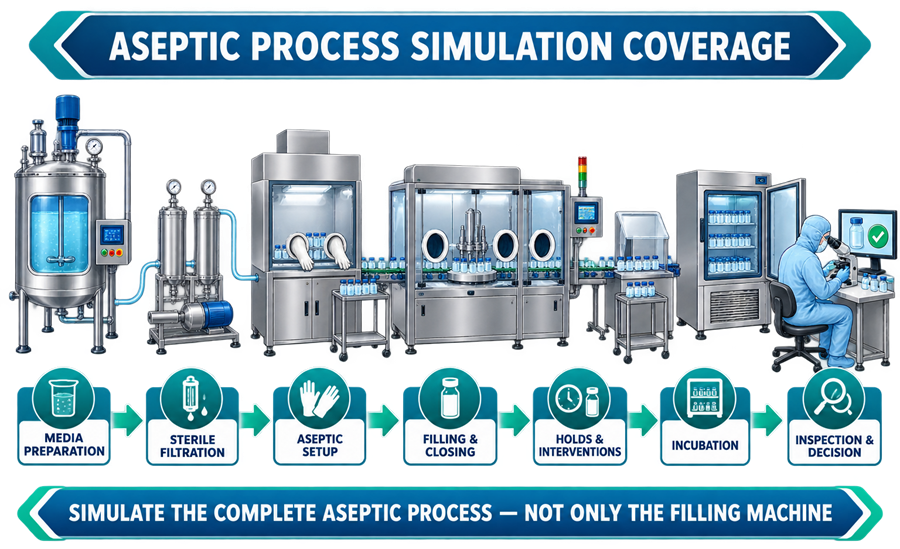
The installed process architecture and sterile-product pathway are addressed in aseptic filling-line architecture.
APS validation plan
The APS validation plan should define the overall program rather than only the details of one execution.
It should identify:
- Aseptic processes and filling lines covered
- Container and closure families
- Product-path configurations
- Reusable and single-use assemblies
- Barrier-system configurations
- Filling technologies
- Filling and closing operations
- Sterile holds and transfers
- Lyophilized and liquid configurations
- Working shifts
- Authorized personnel
- Initial qualification requirements
- Periodic simulation frequency
- Bracketing and matrixing strategy
- Intervention coverage
- Run-size rationale
- Incubation and inspection strategy
- Acceptance criteria
- Investigation requirements
- Change-triggered revalidation
- Periodic program review
The plan should explain which variables are directly challenged in each simulation and how coverage is maintained across multiple runs.
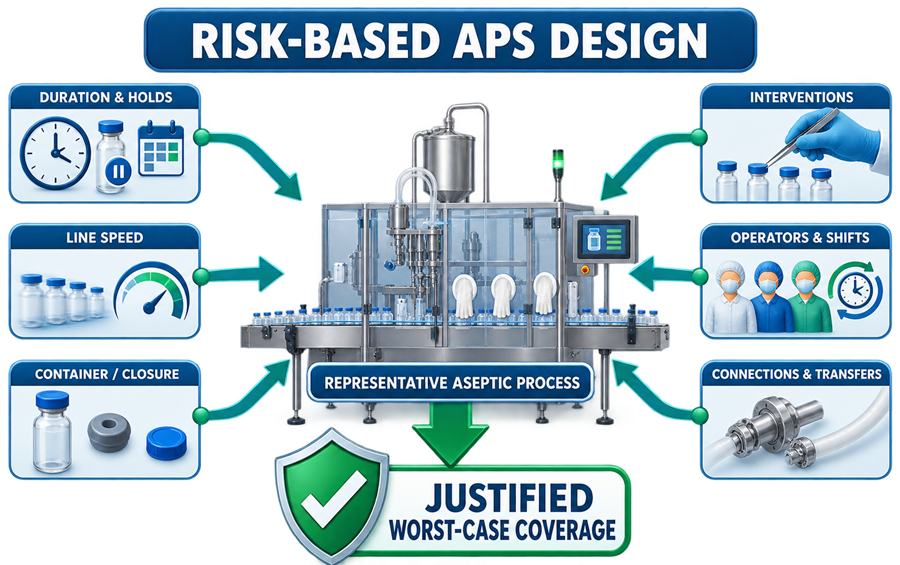
Risk-based simulation design
Worst-case APS design should be based on contamination risk. It should not be reduced to selecting the largest container, highest line speed, or longest duration without considering how each variable affects microbial exposure.
Relevant variables include:
- Process duration
- Sterile and aseptic hold times
- Container opening
- Container stability
- Line speed
- Intervention frequency
- Number of operators
- Shift transitions
- Aseptic connections
- Equipment assembly
- Component replenishment
- Product-path complexity
- Open-container accumulation
- Environmental exposure
- Barrier configuration
- Manual manipulation
- Process interruptions
- Lyophilizer transfer
- Campaign position
Different variables may represent different worst cases. A single configuration may not adequately challenge every risk.
Container and closure selection
Container and closure configurations should be assessed for their effect on contamination risk and process operation. Potential factors include:
- Container opening diameter
- Container height and stability
- Container material
- Nest or bulk presentation
- Stopper or closure type
- Fill volume
- Container exposure time
- Filling-needle position
- Line speed
- Jam frequency
- Closing method
- Equipment change parts
- Compatibility with visual growth detection
The largest opening may represent increased environmental exposure, but it is not automatically the only worst case. Smaller or less stable containers operated at high speed may produce more jams and corrective interventions.
Bracketing or matrixing may be acceptable when container and closure configurations are demonstrably equivalent or when selected configurations represent the relevant risks. The rationale should identify which variables are bracketed and why.
Clear containers should normally be used to permit visual detection of microbial growth. Where commercial containers are amber or opaque, a clear container with equivalent physical and dimensional properties may be used. If no suitable clear substitute exists, the microbial-detection method should be developed and validated.
Line speed
The APS program should cover the justified operating-speed range.
High speed may challenge:
- Container stability
- Component feeding
- Stopper placement
- Jam frequency
- Line-clearance activity
- Operator response
- Rejection and reconciliation
Low speed may challenge:
- Open-container exposure
- Product or medium hold duration
- Personnel exposure duration
- Environmental exposure
- Extended accumulation
- Long filling duration
FDA recommends evaluating one justified line speed during each simulation run. Different runs within the initial or periodic program can be used to cover different speeds and their associated risks.
A simulation should not switch repeatedly between speeds merely to claim coverage unless the speed transitions are representative of actual production and are included in the approved protocol.
Duration and process holds
The simulation duration should challenge the contamination risks associated with the approved manufacturing process. The protocol should consider:
- Longest permitted filling duration
- Maximum sterile-product hold
- Maximum equipment post-sterilization hold
- Maximum setup duration
- Maximum connection time
- Shift changes and breaks
- Vessel replenishment
- Planned pauses
- Line stoppages
- Operator fatigue
- Maximum environmental exposure
- End-of-run interventions
- Campaign beginning and end conditions
For manually intensive operations, FDA recommends that the simulation generally be no shorter than the actual manufacturing process because operator participation is a principal contamination risk.
APS duration should not be extended by operating an empty or inactive line without meaningful process activity. The study should challenge time-dependent risk while maintaining representative interventions, personnel activity, component handling, and environmental conditions.
APS run size
Run size should be sufficient to represent the operation and permit execution of all defined interventions and process conditions. FDA identifies 5,000 to 10,000 units as a generally acceptable starting range. For production batches below 5,000 units, the APS run should generally equal at least the maximum production batch size.
A larger run may be appropriate for:
- Manually intensive processes
- Multiple-shift operations
- High intervention frequency
- Large commercial batches
- Extended filling duration
- Complex container handling
- Processes with repeated component replenishment
A lower proportion of commercial batch size may be scientifically justified for a highly automated isolator process with limited direct operator involvement, but the simulation must still cover the required duration, interventions, personnel, equipment configurations, and process risks.
Run size should not be selected solely to fit an acceptance-criteria category.
Interventions
Interventions are among the most important APS design inputs because they can disturb first air, expose critical surfaces, increase operator proximity, or require entry into the barrier system.
Inherent interventions
Inherent interventions are required by the normal process.
Examples include:
- Initial aseptic setup
- Filling-needle installation
- Sterile connection
- Environmental-monitoring setup
- Component replenishment
- Stopper replenishment
- Cap replenishment
- Weight checks
- Sampling
- Filling-vessel replenishment
- Removal of routine rejects
- Adjustment permitted by the operating procedure
- Shift handover
Inherent interventions should be represented at a frequency comparable to routine production.
Corrective interventions
Corrective interventions occur in response to faults, stoppages, or abnormal conditions. Examples include:
- Clearing a container jam
- Removing a fallen or broken container
- Correcting stopper-feed problems
- Adjusting filling needles
- Clearing a sensor obstruction
- Correcting a misfeed
- Replacing or reconnecting equipment
- Responding to an extended stoppage
- Barrier access under an approved procedure
Corrective interventions should be selected from risk assessment, process knowledge, historical production records, qualification studies, alarms, and deviation history.
Not every conceivable equipment failure should be artificially created during APS. The selected interventions should represent credible production events and should not introduce unnecessary contamination risks that would not be permitted during commercial operation.
Intervention matrix
The approved intervention matrix should identify:
| Element | Required definition |
|---|---|
| Intervention name | Exact activity and purpose |
| Classification | Inherent or corrective |
| Trigger | Routine frequency, alarm, jam, replenishment, or simulated event |
| Location | Barrier position or critical-zone location |
| Operator | Authorized role or specific qualified operator |
| Equipment state | Running, stopped, idle, or restarting |
| Exposure | Critical surfaces or open containers potentially affected |
| Duration | Target or maximum representative duration |
| Frequency | Number per run or production-equivalent frequency |
| Units affected | Units to reject, segregate, or incubate separately |
| Documentation | Time, operator, sequence position, and outcome |
| APS coverage | Initial, periodic, rotational, or change-triggered |
Interventions should be performed as written. A nominal intervention that omits the difficult or exposure-generating portion of the production activity does not provide representative coverage.
Operators and working shifts
APS should evaluate the personnel who perform or support aseptic operations. The program should cover:
- Production operators
- Setup personnel
- Component handlers
- Supervisors entering the processing area
- Environmental-monitoring personnel
- Maintenance or technical personnel who may enter during production
- Personnel performing aseptic connections
- Personnel performing lyophilizer loading or unloading
- Personnel performing manual filling or closing
FDA recommends that personnel authorized to enter the aseptic processing room during manufacturing participate in a successful media fill at least annually, consistent with their actual duties.
The periodic APS program should represent each production shift and shift-specific conditions. Coverage should include:
- Shift startup
- Shift handover
- Breaks
- Gown changes
- Staffing differences
- Different operating times
- Duration of operator occupancy
- Activities specific to night or weekend operation
For manual aseptic operations, Annex 1 establishes more extensive operator-specific expectations: each operator initially participates in at least three consecutive successful simulations and is revalidated approximately every six months.
Aseptic connections, transfers, and sampling
The simulation should include representative aseptic manipulations performed after sterilization or bio-decontamination. These may include:
- Connecting sterile vessels
- Connecting single-use assemblies
- Filter installation or connection
- Product-path assembly
- Sterile ingredient addition
- Vessel replenishment
- Aseptic sampling
- Transfer between vessels
- Filling-manifold connection
- Vent-filter manipulation
- Disconnection and reconnection where permitted
- Transfer into the filling system
The number and type of connections should represent the approved production process. Simplifying the media-fill assembly by eliminating difficult connections produces an unrepresentative simulation.
The design and lifecycle controls for disposable pathways are addressed in single-use systems in fill-finish.
Growth-medium selection
Soybean-casein digest medium, commonly called tryptic soy broth, is frequently used because it supports growth of a broad range of bacteria, yeasts, and molds.
The selected medium should have:
- Low selectivity
- Suitable clarity
- Suitable concentration
- Appropriate filterability
- Compatibility with equipment and containers
- Ability to wet product-contact surfaces
- Ability to support relevant microorganisms
- Sufficient visual contrast for detection
- Stability throughout preparation, processing, and incubation
The medium should represent the process without inhibiting recovery of potential contamination.
Surrogates and non-liquid processes
Nutrient medium may not adequately represent every product or process. Additional surrogates or modified simulation approaches may be needed for:
- Sterile powders
- Semisolids
- Suspensions
- Microspheres
- Liposomes
- Highly viscous materials
- Heated or cooled products
- Inert-atmosphere processing
- Processes in which actual operating conditions would inhibit microbial recovery
The surrogate should reproduce the physical characteristics that affect contamination risk without suppressing microbial growth.
Where an inert gas is used in production, air is generally substituted during APS unless anaerobic simulation is specifically justified. Occasional anaerobic simulations may be considered where the actual process presents a credible anaerobic contamination risk.
Media preparation and sterilization
The APS protocol should define:
- Medium identity and lot
- Preparation method
- Concentration
- Mixing
- Water quality
- Prepared-medium hold time
- Sterilization or filtration method
- Filter specification
- Filter-integrity testing
- Sterile receiving vessel
- Sampling
- Transfer into the filling system
- Cleaning after the APS
Where the medium is sterilizing filtered, the filtration process should represent the relevant product-path surfaces and aseptic connections. The approved filter-integrity strategy should be followed.
Nutrient medium can support microbial proliferation if spilled or retained in equipment. APS should therefore be followed by approved cleaning, sanitization, and sterilization activities before the equipment is returned to product manufacture.
Growth-promotion testing
Growth-promotion testing demonstrates that the medium and incubation conditions can recover low numbers of relevant microorganisms. The challenge panel should include:
- Suitable pharmacopeial reference organisms
- Gram-positive bacteria
- Gram-negative bacteria
- Yeast
- Mold
- Representative local environmental or process isolates where appropriate
FDA recommends a challenge below 100 CFU per unit. PIC/S describes recovery using approximately 10–100 CFU or less.
Growth-promotion testing should address:
- Medium before use, as required by procedure
- Samples or units exposed to the APS process
- Medium following the incubation period
- Incubation temperatures and duration
- Representative local isolates
- Acceptance criteria for visible growth
- Positive and negative controls
Failure of growth-promotion testing compromises the detection capability of the simulation and requires investigation. Any contamination observed in the APS must still be investigated; a growth-promotion failure does not erase a contaminated-unit result.
Protocol and batch record
Each APS should be governed by an approved protocol and executed with a controlled batch record. The protocol should define:
- Objective and scope
- Process and line identification
- Container and closure configuration
- Product-path configuration
- Medium and preparation method
- Run size
- Line speed
- Duration
- Hold times
- Operators and shifts
- Intervention matrix
- Environmental-monitoring plan
- Sampling
- Units to be rejected or segregated
- Incubation conditions
- Inspection method
- Growth-promotion testing
- Acceptance criteria
- Deviation handling
- Contaminated-unit investigation
- Batch-impact assessment
- Approval responsibilities
The batch record should document actual execution, including:
- Media lot and preparation
- Filter and assembly identification
- Sterilization records
- Integrity-test results
- Setup start and completion
- Filling start and completion
- Line speed
- Holds and stoppages
- Intervention time and operator
- Units removed or segregated
- Environmental conditions
- Alarms and deviations
- Total units filled
- Total units incubated
- Incubation start and completion
- Inspection results
- Reconciliation
The same vigilance used during commercial production should be applied to APS. Additional precautions that make the simulation cleaner or easier than production undermine its validity.
Environmental-monitoring integration
Environmental monitoring should be performed throughout the APS under conditions representative of routine production. The program may include:
- Continuous nonviable particle monitoring
- Active viable-air sampling
- Passive air monitoring
- Critical-surface sampling
- Barrier-glove monitoring
- Operator-glove or fingertip monitoring
- Personnel monitoring
- Barrier-pressure monitoring
- Temperature and humidity monitoring
Monitoring should cover routine operation and defined interventions without introducing unnecessary risk to the simulation.
Environmental-monitoring results provide context for evaluating the state of control and investigating contamination. They should not be treated as direct predictors of which filled unit is contaminated.
The absence of an environmental-monitoring recovery does not invalidate a contaminated APS unit. Conversely, an environmental excursion without a contaminated unit still requires evaluation for its effect on APS validity and the broader aseptic process.
See environmental monitoring for aseptic filling for program design and investigation principles.
Handling filled, rejected, and intervention-associated units
All integral APS units should normally be incubated and inspected, including units with cosmetic defects and units subjected to nondestructive in-process controls.
Units may be excluded only when:
- The production procedure requires removal under the same circumstances
- The intervention type is clearly defined
- The line location is defined
- The number of units removed is specified
- The APS removes no more units than commercial production
- The exclusion is documented and reconciled
Large-scale clearance of units after an intervention can eliminate the units most likely to reveal contamination and should not be used to improve the apparent APS outcome.
Units produced during setup or an intervention that are routinely rejected during production may be incubated separately to provide information about contamination risk without necessarily including them in the formal acceptance tally. The protocol should define this treatment in advance.
Material used to simulate product flushes should also be evaluated unless it is demonstrated that the discarded material cannot affect the sterility of the product pathway.
Incubation
Filled APS units should be transferred to incubation without unnecessary delay. FDA recommends:
- Incubation for not less than 14 days
- Temperatures within the range of 20–35°C
- Control within ±2.5°C of the established target
- If two temperatures are used, at least seven days at each temperature
- The lower-temperature stage first when using the FDA dual-temperature approach
A commonly used program is seven days at 20–25°C followed by seven days at 30–35°C. The actual program should be scientifically justified and validated for recovery of the organisms relevant to the facility and process.
The incubation program should define:
- Incubator identification
- Qualified temperature range
- Loading pattern
- Maximum load
- Temperature monitoring
- Alarm handling
- Transfer time
- Incubation start and end
- Treatment of temperature excursions
- Unit orientation
- Intermediate inspections, if performed
Before incubation, units should be inverted, swirled, or otherwise manipulated as appropriate to allow the medium to contact internal container and closure surfaces while retaining sufficient headspace for microbial growth.
Inspection of APS units
Every incubated unit should be inspected for evidence of microbial growth. Inspection conditions should address:
- Suitable illumination
- Contrasting backgrounds
- Unit handling and rotation
- Turbidity
- Visible colonies
- Pellicle formation
- Sediment
- Gas formation
- Differentiation of growth from fibers, precipitate, or cosmetic particles
- Control units
- Suspect-unit segregation
- Second-person or microbiological review
Inspectors should be trained and qualified using positive and negative units representative of the containers and media being examined. Where inspection is performed outside the microbiology laboratory, QC oversight should be defined.
Inspection records should maintain unit identity or chronological position sufficiently to correlate contamination with:
- Process stage
- Intervention
- Operator
- line stoppage
- Shift
- Environmental result
- Equipment event
Acceptance criteria
Acceptance criteria should be approved before execution and should reflect the markets supplied by the manufacturing process.
FDA interpretation
FDA’s recommended interpretation is:
| Incubated run size | FDA-recommended interpretation |
|---|---|
| Fewer than 5,000 units | No contaminated units should be detected. One contaminated unit is cause for revalidation following investigation. |
| 5,000–10,000 units | One contaminated unit requires investigation, including consideration of repeat APS. Two contaminated units are cause for revalidation following investigation. |
| More than 10,000 units | One contaminated unit requires investigation. Two contaminated units are cause for revalidation following investigation. |
These thresholds are not acceptable contamination rates. FDA also states that intermittent contamination across successive simulations can indicate persistent low-level loss of control and should be investigated.
Annex 1 interpretation
Annex 1 establishes a target of zero growth and states that any contaminated unit results in a failed APS. It normally expects at least three consecutive successful repeat simulations after investigation and corrective action to demonstrate restoration of control.
Facilities supplying both U.S. and European markets generally need acceptance criteria that satisfy the stricter applicable requirement.
Other acceptance elements
The APS should also meet predefined requirements for:
- Required run size
- Required duration
- Required intervention coverage
- Required operator and shift coverage
- Approved container configuration
- Environmental monitoring
- Medium preparation
- Filter-integrity testing
- Incubation conditions
- Unit reconciliation
- Growth-promotion testing
- Inspection completion
- Absence of unresolved critical deviations
A run that contains no contaminated units but omits required interventions or fails to achieve its approved duration does not provide the intended validation evidence.
Distinguishing failed and invalid APS runs
A failed APS is one that does not meet approved microbiological or execution acceptance criteria. An invalid APS is one for which a documented event prevents a scientifically meaningful interpretation, such as:
- Demonstrated failure of the detection system
- Major incubation failure
- Loss of unit identity or reconciliation
- Confirmed use of unsuitable medium
- Demonstrated laboratory error affecting the result
- Major protocol execution failure that eliminates essential process coverage
Invalidation should be based on objective evidence. It should not be used to remove an inconvenient contamination result or avoid evaluating a deficient aseptic process.
Contamination detected during an otherwise compromised run still requires investigation.
Investigation of contaminated APS units
Any contaminated unit requires prompt containment and investigation, even where FDA’s run-size guidance does not automatically classify one unit as a revalidation trigger.
Initial actions should include:
- Secure the contaminated and suspect units
- Preserve incubation and inspection records
- Record the unit’s position in the run sequence
- Verify container integrity
- Confirm growth
- Preserve the isolate
- Place the validation conclusion on hold
- Initiate a formal investigation
- Identify potentially affected commercial batches
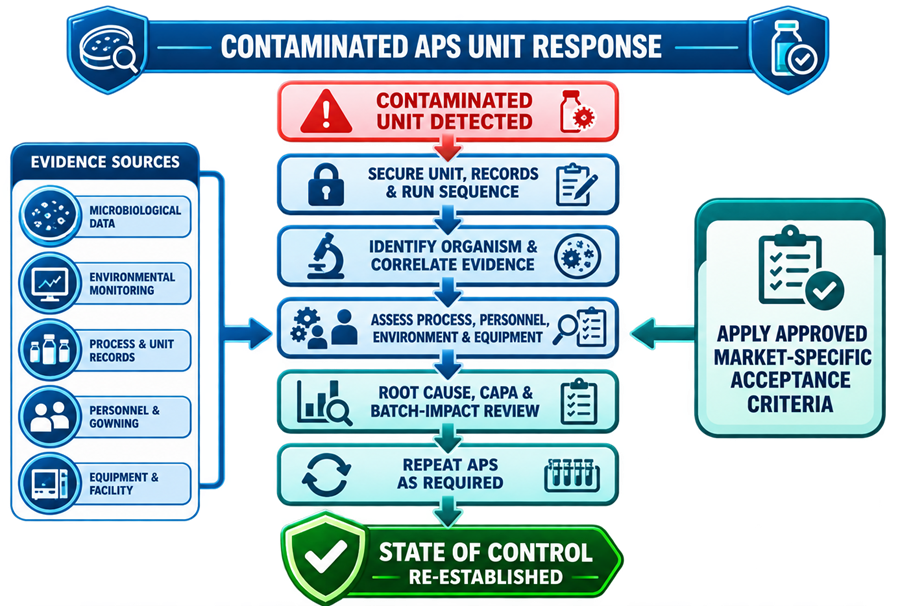
Microbiological investigation
The investigation should evaluate:
- Confirmation of microbial growth
- Organism identification
- Species-level identification where practicable
- Colony morphology
- Comparison with environmental isolates
- Comparison with personnel-monitoring isolates
- Comparison with product or facility isolates
- Possible incubation or laboratory contamination
- Container integrity
Process-sequence correlation
The contaminated unit should be correlated with:
- Filling time
- Container sequence
- Intervention
- Operator
- Line speed
- Stoppage or restart
- Shift
- Component replenishment
- Equipment alarm
- Open-container accumulation
- Aseptic connection
- Lyophilizer position
- Environmental-monitoring results
Chronological unit segregation, container coding, electronic tracking, and video records can materially improve the investigation.
Personnel and intervention review
The investigation should assess:
- Aseptic technique
- Gowning status
- Glove and sleeve condition
- Glove disinfection
- Operator positioning
- Intervention method
- Intervention duration
- First-air disturbance
- Contact with critical surfaces
- Deviations from the approved procedure
- Qualification and APS participation history
Equipment and environmental review
The review should address:
- Barrier pressure
- Door and transfer-port status
- Glove-integrity results
- Airflow interruptions
- HEPA or HVAC alarms
- Nonviable particle events
- Viable-monitoring results
- Equipment faults
- Container jams
- Needle or stopper adjustments
- Power or control-system interruptions
- Sterilization and bio-decontamination records
- Product-path and connection integrity
Root cause and batch impact
The investigation should determine whether the result is:
- Attributable to a documented process event
- Associated with a specific intervention
- Associated with an operator practice
- Associated with equipment or barrier failure
- Associated with environmental loss of control
- Associated with the incubation or laboratory process
- Evidence of a broader systemic condition
- Unexplained
An assumed or plausible source is not equivalent to a demonstrated root cause.
The impact assessment should consider commercial batches produced since the last successful APS, particularly where the result suggests that the process may not have remained in control.
Corrective action and repeat APS
Corrective actions may include:
- Procedure revision
- Operator retraining
- Operator requalification
- Intervention redesign
- Equipment modification
- Barrier repair
- Glove-system correction
- Airflow reassessment
- Environmental-control correction
- Sterilization or bio-decontamination correction
- Increased monitoring
- Targeted qualification
- Comprehensive requalification
Repeat APS should be performed only after relevant corrective actions are implemented and readiness is documented.
FDA indicates that when an investigation does not produce a well-supported conclusion, three consecutive successful runs with increased scrutiny may be warranted. Annex 1 normally expects at least three consecutive successful repeat simulations following an APS failure.
A successful repeat without correction of the original deficiency does not establish that the process returned to control.
Initial qualification
Initial qualification should normally include at least three consecutive, separate successful APS runs.
The run matrix should collectively cover:
- Applicable filling lines
- Working shifts
- Container and closure families
- Relevant line speeds
- Process duration
- Inherent interventions
- Credible corrective interventions
- Operators
- Sterile holds
- Aseptic connections
- Filling and closing configurations
- Lyophilization, where applicable
“Consecutive” means that an intervening failed or unacceptable run interrupts the successful sequence.
Initial qualification should demonstrate repeatability. Three different results obtained under poorly controlled or materially different conditions do not provide the same evidence as three properly planned runs within an approved matrix.
Periodic APS
FDA recommends routine semiannual APS for each processing line. The program should represent each production shift and applicable shift-change activities. Authorized personnel entering or participating in aseptic manufacturing should participate at least annually in a manner consistent with their duties.
Annex 1 normally expects APS approximately every six months for:
- Each aseptic process
- Each filling line
- Each working shift
It also expects each operator to participate in at least one successful APS annually, with more frequent operator-specific simulation for manual operations.
Periodic APS should not repeat the easiest configuration indefinitely. The program should rotate justified variables while maintaining coverage of:
- Container families
- Line speeds
- Interventions
- Operators
- Shifts
- Process durations
- Sterile holds
- Connections
- Campaign conditions
- Liquid and lyophilized configurations
Change-triggered APS and revalidation
Additional APS should be considered following changes or events capable of affecting microbial contamination control. Examples include:
- New filling line
- Line relocation
- Major facility shutdown
- Extended inactivity
- HVAC modification
- HEPA-filter replacement affecting critical zones
- Barrier modification
- New or modified isolator cycle
- Glove-port change
- Filling-equipment modification
- Line-configuration change
- New container or closure
- New filling technology
- New product-path configuration
- New single-use assembly
- Revised sterilizing-filtration arrangement
- New aseptic connection
- Increased process duration
- Increased sterile hold
- New working shift
- Significant personnel change
- Major intervention change
- Adverse environmental trend
- Sterility-test failure
- APS failure
- Significant aseptic-processing deviation
The change assessment should determine whether the appropriate response is:
- Documentary review
- Targeted qualification
- Limited APS coverage
- One confirmatory APS
- Three-run revalidation
- Comprehensive process requalification
Lyophilized products
APS for lyophilized products should represent the complete aseptic chain, including:
- Filling
- Partial stoppering
- Accumulation
- Transfer to the lyophilizer
- Loading
- Representative chamber dwell
- Partial evacuation
- Vacuum break
- Unloading
- Final stoppering
- Transfer to capping
The medium should not be frozen or boiled because these conditions can impair microbial recovery. FDA recommends exposing unsealed containers to partial evacuation while maintaining conditions that support aerobic recovery.
Annex 1 expects simulation of the maximum interval between lyophilizer sterilization and use, the maximum period between filtration and lyophilization, representative loading duration, and other justified worst-case conditions.
See qualification of the lyophilization–aseptic filling interface for equipment and transfer qualification.
Barrier-system APS
APS design should reflect the contamination risks of the installed barrier technology.
RABS
For a restricted access barrier system, the simulation should address:
- Glove interventions
- Component transfers
- Door-opening restrictions
- Barrier pressure
- Operator interaction
- Disinfection practices
- Inherent and corrective interventions
- Recovery following permitted access events
Isolators
For an isolator system, the simulation should address:
- Bio-decontamination status
- Glove and sleeve operations
- Rapid transfer ports
- Mouseholes or continuous transfers
- Aseptic connections
- Material introduction
- Pressure control
- Interventions and equipment adjustments
- Campaign duration, where applicable
A lower APS unit count may be justified for some highly automated isolator processes, but this does not reduce the need to represent duration, interventions, connections, personnel activity, and all relevant aseptic operations.
Manual aseptic operations
Manual compounding, filling, closing, and transfer processes place greater reliance on operator technique.
The APS should represent:
- Each operator
- Each container type
- Each closure type
- Each equipment train
- Manual additions
- Manual transfers
- Manual filling
- Manual stoppering or sealing
- Maximum batch duration
- Maximum number of manipulations
- Aseptic sampling
- Operator fatigue
- Actual production batch size
Operator-specific initial and periodic qualification should be more extensive than for a highly automated barrier filling line.
Blow-fill-seal processes
APS for blow-fill-seal equipment should represent the actual equipment sequence and critical interventions while accounting for the technology’s continuous container formation, filling, and sealing operation.
The program should consider:
- Polymer extrusion
- Container formation
- Filling
- Sealing
- Product-path sterilization
- Sterile-air systems
- Machine stoppages
- Mold-area interventions
- Product-vessel replenishment
- Environmental classification
- Container inspection
Equipment-specific controls are addressed in blow-fill-seal systems: qualification and lifecycle control.
Continued verification and trending
APS should be managed as a lifecycle program rather than as isolated semiannual events.
Useful trends include:
- Contaminated units
- Organism identities
- Suspect units
- Growth-promotion failures
- Invalid or aborted runs
- Intervention frequency
- Intervention duration
- Operators represented
- Shift coverage
- Run duration
- Line speed
- Units filled and incubated
- Units excluded
- Environmental-monitoring results
- Glove-monitoring results
- Equipment alarms
- APS deviations
- Repeat simulations
- Corrective actions
- Changes affecting APS coverage
Repeated single contaminated units, even where individual runs do not meet an FDA revalidation threshold, can indicate a persistent low-level control problem.
Periodic APS program review
Periodic review should determine whether the APS program continues to represent current manufacturing.
The review should assess:
- Current process configurations
- Current container and closure families
- Current line speeds
- Current maximum durations
- Current sterile holds
- New or revised interventions
- Operator and shift coverage
- New single-use assemblies
- Barrier-system changes
- Environmental trends
- APS results and investigations
- Sterility-test results
- Aseptic-processing deviations
- Corrective-action effectiveness
- Regulatory changes
- Overdue or missed simulations
The review should identify gaps in coverage and define required simulation, requalification, procedure revision, or risk assessment.
Common APS deficiencies
Common deficiencies include:
- Treating APS as only a filling-machine test
- Beginning the simulation after critical aseptic setup
- Omitting sterile holds or transfers
- Using the easiest container configuration
- Selecting only one line speed without justification
- Reducing the duration below actual production
- Omitting shift changes
- Underrepresenting personnel
- Excluding difficult interventions
- Performing interventions differently from production
- Removing excessive units after interventions
- Failing to incubate integral cosmetic-defect units
- Using unclear unit-exclusion rules
- Using medium that does not represent the process
- Inadequate growth-promotion testing
- Unqualified incubation or inspection
- Poor unit reconciliation
- Inadequate contaminated-unit identification
- Assigning a root cause without objective evidence
- Repeating APS before implementing corrective action
- Treating a successful repeat as proof that the original failure was irrelevant
- Failing to evaluate commercial batches after a significant APS failure
- Repeating the same easy configuration during every periodic APS
- Failing to update the program after process changes
Conclusion
Aseptic process simulation should reproduce the contamination risks of the complete aseptic manufacturing process, not merely demonstrate that a filling machine can dispense sterile growth medium. A defensible APS program establishes:
- A clearly defined process boundary
- Qualified prerequisites
- Risk-based worst-case selection
- Representative container and closure coverage
- Justified duration, speed, and run size
- Realistic inherent and corrective interventions
- Appropriate operator and shift participation
- Controlled medium preparation and growth promotion
- Representative environmental monitoring
- Complete unit reconciliation
- Qualified incubation and inspection
- Predefined market-appropriate acceptance criteria
- Rigorous investigation of every contaminated unit
- Corrective action and repeat simulation where required
- Change-triggered revalidation
- Continued verification and periodic review
APS provides meaningful microbiological evidence only when it remains faithful to actual production and is interpreted together with process design, qualification, monitoring, personnel performance, and manufacturing history.