

BSC and LFH Certification, Qualification, and Lifecycle Control
Biosafety cabinets and laminar flow hoods used for aseptic processing require more than a passing field-certification report. Certification verifies defined technical performance at a particular time. Qualification establishes that the selected unit, as installed and configured, is suitable for its intended GMP use. Lifecycle controls maintain that qualified state after release.
These activities overlap, but they are not interchangeable. Certification data can support qualification when the methods, instruments, conditions, acceptance criteria, and results are adequately documented. Qualification must also address requirements that standardized certification does not normally evaluate, including intended use, installation context, facility interfaces, representative equipment loading, operator activity, failure response, procedural controls, and change impact.
Equipment selection and airflow architecture are addressed in Biosafety Cabinets vs Laminar Flow Hoods. This article addresses certification, qualification, release, routine control, periodic review, and requalification.
Certification, Qualification, and Lifecycle Control
Certification, qualification, and lifecycle control provide different types of evidence.
Certification
Certification is a defined set of field-performance tests performed against an applicable standard, manufacturer specification, approved procedure, or combination of these sources.
Depending on the equipment type, certification may evaluate:
- HEPA-filter integrity
- Airflow velocity or volume
- Airflow uniformity
- Biosafety-cabinet inflow and downflow
- Airflow patterns
- Exhaust performance
- Alarm and indicator functions
- Sash configuration
- Particle cleanliness where specified
- General mechanical condition
Certification demonstrates that the equipment met the specified test criteria under the recorded test conditions. It does not, by itself, establish that the unit is suitable for a particular pharmaceutical process.
Qualification
Qualification establishes documented evidence that the equipment is:
- Properly specified
- Appropriately designed
- Correctly installed
- Functioning as intended
- Integrated with the facility
- Suitable for the approved operating configuration
- Capable of supporting its intended GMP use
Qualification incorporates certification evidence but also evaluates system requirements, design decisions, installation details, operational functions, failure conditions, representative workflows, and lifecycle controls.
Lifecycle control
Lifecycle control maintains the qualified state through:
- Routine equipment checks
- Periodic certification
- Preventive maintenance
- Instrument calibration
- Cleaning and disinfection
- Alarm and failure review
- Deviation management
- Change control
- Periodic review
- Requalification when warranted
The relationship among these activities is shown below.
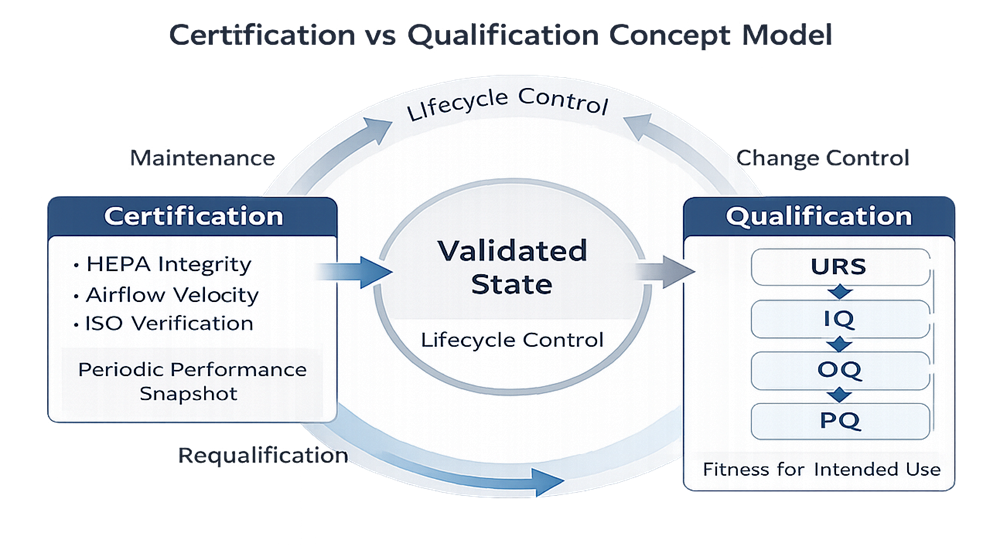
Certification provides a periodic technical-performance assessment. Qualification connects that performance to the intended use. Lifecycle control preserves both after the system is released.
Applicable Standards and Requirements
The applicable technical basis depends on the equipment type and intended use.
For Class II biosafety cabinets, NSF/ANSI 49 addresses design, construction, performance, and field-certification testing. The standard supports biosafety-cabinet certification but does not replace pharmaceutical qualification.
The CDC and NIH publication Biosafety in Microbiological and Biomedical Laboratories provides risk-based biosafety guidance. It is an advisory best-practice document rather than a regulation.
For laminar flow hoods and other clean zones:
- ISO 14644-1 establishes classification of air cleanliness by airborne-particle concentration.
- ISO 14644-3 provides test methods for cleanrooms and clean zones, including environments using unidirectional airflow.
ISO particle classification does not demonstrate microbiological control, process suitability, or containment performance. FDA states that ISO 14644 standards should not be used alone to qualify pharmaceutical aseptic-processing environments.
Applicable U.S. GMP requirements include:
- 21 CFR 211.42, addressing facility design and aseptic-processing controls.
- 21 CFR 211.63, requiring equipment to be appropriately designed, adequately sized, and suitably located for intended use, cleaning, and maintenance.
- 21 CFR 211.113, requiring procedures to prevent microbiological contamination and validation of aseptic and sterilization processes.
- FDA’s Sterile Drug Products Produced by Aseptic Processing—Current Good Manufacturing Practice, addressing HEPA integrity, airflow, environmental control, dynamic airflow visualization, and aseptic-process qualification.
USP <797> and <800> may impose additional requirements when the equipment is used for sterile compounding or hazardous-drug compounding. Those requirements should not automatically be applied to unrelated manufacturing applications.
Qualification Planning and System Boundaries
Qualification planning should define the system before protocols are prepared. The boundary may include:
- Cabinet or hood enclosure
- Supply blower
- Supply HEPA filter
- Exhaust HEPA filter
- Internal recirculation pathway
- Front opening and sash
- Airflow grilles
- Work surface
- Controls and displays
- Airflow sensors
- Alarms and interlocks
- Canopy or hard-ducted exhaust connection
- Building exhaust interface
- Utility connections
- Permanently installed equipment
- Environmental-monitoring interfaces
- Supporting room HVAC conditions
The plan should identify which functions are covered by field certification, which require site qualification, and which are evaluated through process-specific studies.
Qualification planning should define:
- Intended use
- Equipment type and configuration
- Required protection functions
- Applicable standards
- Required qualification phases
- Certification tests to be leveraged
- Additional site testing
- Test conditions
- Representative operating configurations
- Required challenges and failures
- Acceptance-criteria sources
- Responsibilities
- Documentation requirements
- Deviation handling
- Release requirements
- Periodic testing and requalification strategy
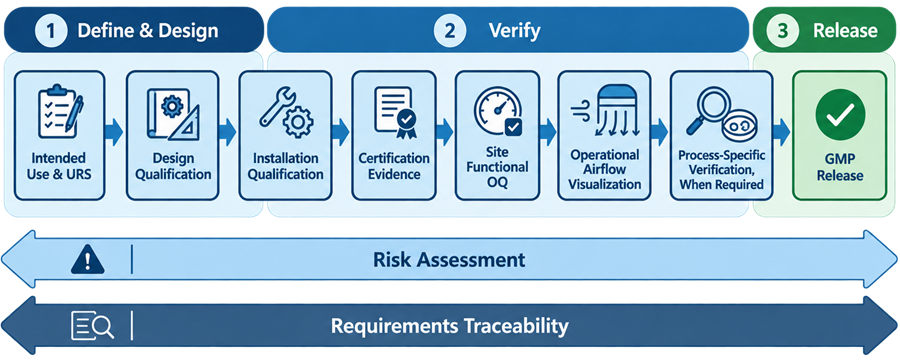
Qualification combines equipment-specific certification evidence with site verification and process-specific studies. The sequence below shows how requirements, design review, installation verification, certification, functional testing, and operational airflow evidence collectively support release for the approved GMP use.
Certification Test Scope
Certification scope differs between laminar flow hoods and Class II biosafety cabinets.
| Test or inspection | Laminar flow hood | Class II biosafety cabinet |
|---|---|---|
| Supply HEPA-filter integrity | Normally applicable | Applicable |
| Exhaust HEPA-filter integrity | Normally not applicable | Applicable where installed and accessible |
| Work-zone airflow velocity | Applicable | Downflow evaluated |
| Inflow velocity | Not applicable | Applicable |
| Airflow uniformity | Applicable | Applicable to defined downflow profile |
| Airflow visualization | Direction and uniformity of work-zone airflow | Front-opening containment and internal airflow patterns |
| Particle classification | Applicable when required for the intended use | May be added for pharmaceutical use; not a substitute for containment testing |
| Sash-position verification | Usually not applicable | Applicable |
| Airflow alarms | Where installed | Applicable |
| Exhaust performance | Normally not applicable | Applicable to exhausted configurations |
| Facility-exhaust interface | Not normally applicable | Critical for ducted or canopy-connected cabinets |
| Personnel containment | Not provided | Evaluated through applicable cabinet tests |
| General condition | Applicable | Applicable |
The approved certification protocol or service specification should define the exact tests applicable to the installed model.
Laminar Flow Hood Certification
LFH certification should verify that the installed unit produces the defined airflow and particle-control conditions over the intended work zone. Typical certification activities include:
- General inspection
- Verification of equipment identification
- Confirmation of approved operating configuration
- Supply HEPA-filter integrity testing
- Airflow velocity measurement
- Airflow uniformity assessment
- Airflow-direction visualization
- Particle classification where required
- Alarm and indicator testing where provided
- Review of blower condition
- Review of prefilter condition
- Review of work-surface condition
- Evaluation of obvious room-airflow interference
HEPA-filter integrity
The HEPA-filter system should be challenged using an approved aerosol and scanned using a qualified detection method. The test should evaluate:
- Filter media
- Filter frame
- Gaskets and seals
- Housing interfaces
- Accessible penetrations
- Potential bypass paths
A passing filter certificate does not demonstrate correct airflow distribution across the work zone. Filter integrity and airflow performance are separate attributes.
Airflow velocity and uniformity
Measurements should be collected using a predefined grid or traverse appropriate to the equipment design. The report should document:
- Measurement locations
- Instrument identification
- Individual readings
- Calculated averages
- Uniformity evaluation
- Acceptance limits
- Equipment operating condition
- Room condition
- Deviations from the approved method
Acceptance criteria should be based on the approved equipment specification, intended use, manufacturer requirements, and applicable technical standards. One generic airflow velocity should not be applied automatically to every hood design.
Particle classification
Particle classification may be required when the LFH provides an ISO-classified critical work zone. Testing should define:
- Particle sizes evaluated
- Sampling locations
- Sample volume
- Occupancy state
- Equipment configuration
- Acceptance criteria
- Particle-counter identification and calibration status
A passing ISO 5 particle-classification result does not prove that first air reaches exposed critical sites during actual work. That question requires operational airflow visualization.
Biosafety Cabinet Certification
Class II BSC certification evaluates the balance among inflow, downflow, capture, filtration, and exhaust. Typical certification activities include:
- Equipment and installation inspection
- Supply and exhaust HEPA-filter integrity
- Downflow velocity measurement
- Inflow velocity or volume measurement
- Airflow smoke-pattern testing
- Sash-position verification
- Airflow-alarm testing
- Exhaust-system assessment
- Canopy or duct-connection assessment
- Site-installation assessment
- Other tests required by NSF/ANSI 49, the manufacturer, or the approved procedure
Inflow and downflow
Inflow supports personnel containment at the front opening. Downflow supports product protection within the work zone. The two airflow functions must remain balanced. Certification should document:
- Certified sash height
- Test method
- Measurement locations
- Individual readings
- Calculations
- Applicable correction factors
- Acceptance criteria
- Cabinet operating conditions
- Building-exhaust conditions
- Room condition
Passing downflow results do not compensate for inadequate inflow, and passing inflow results do not demonstrate that critical sites receive unobstructed first air.
Airflow smoke-pattern testing
Smoke-pattern testing used for BSC field certification evaluates specified airflow characteristics at the front opening and within the cabinet. It may assess:
- Direction of airflow at the front opening
- Absence of outward escape
- Behavior around the sash
- Internal airflow movement
- Influence of work-zone obstructions
Standardized certification smoke testing is not equivalent to a pharmaceutical dynamic airflow-visualization study. The latter evaluates the actual process configuration, operator activities, and critical sites.
Exhausted BSC configurations
For canopy-connected or hard-ducted cabinets, certification should evaluate the installed exhaust interface. The assessment should address:
- Exhaust airflow
- Duct static pressure
- Canopy capture
- Cabinet-exhaust balance
- Exhaust alarms
- Supply and exhaust interlocks
- Building-exhaust stability
- Response to exhaust loss
- Effect on room pressure
- Correct recovery after restoration
For a Type B2 cabinet, building-exhaust performance is integral to cabinet function. Certification cannot be separated from the facility exhaust system.
Test Conditions and Instrument Control
Certification and qualification results are meaningful only when test conditions are defined and controlled. Records should identify:
- Equipment operating mode
- Sash position
- Blower setting
- Exhaust condition
- Room HVAC condition
- Doors open or closed
- Nearby equipment status
- Work-zone loading
- Occupancy condition
- Temperature and humidity where relevant
- Test-instrument identification
- Instrument calibration status
- Measurement range and resolution
- Test personnel
- Approved procedure and revision
- Raw data and calculations
- Deviations and retests
Test instruments should be suitable for the expected range and capable of supporting the required decision. Calibration status alone does not establish method suitability.
Where certification is performed by a service provider, the site should assess:
- Personnel competence
- Applicable accreditation
- Approved procedures
- Instrument calibration
- Report format
- Raw-data availability
- Electronic-record controls
- Deviation notification
- Review and approval responsibilities
The site remains responsible for determining whether the certification evidence is acceptable for GMP use.
User Requirements Specification
The User Requirements Specification defines what the unit must accomplish. Requirements should address:
- Intended process
- Required protection functions
- Required work-zone classification
- Horizontal or vertical airflow
- BSC class and type
- Work-zone dimensions
- Equipment loading
- Required utilities
- Exhaust configuration
- Facility HVAC interface
- HEPA-filter configuration
- Airflow monitoring
- Alarm functions
- Sash requirements
- Failure response
- Materials of construction
- Cleaning and disinfection
- Decontamination provisions
- Maintenance access
- Certification requirements
- Qualification requirements
- Data and report requirements
- Requalification triggers
Requirements should be measurable or otherwise verifiable. Statements such as “provide adequate airflow” are insufficient without a defined technical or functional basis.
Design Qualification
Design Qualification confirms that the proposed equipment and installation design satisfy the approved requirements before purchase or implementation. DQ should evaluate:
- Equipment type and protection mechanism
- Suitability for the intended material hazards
- Airflow architecture
- Work-zone capacity
- Cleanability
- Material compatibility
- Sash design
- Alarm and monitoring functions
- HEPA-filter arrangement
- Exhaust configuration
- Facility-exhaust capacity
- Room HVAC interaction
- Installation location
- Utility connections
- Maintenance and filter access
- Decontamination and filter-change strategy
- Applicable standards
- Proposed certification and qualification methods
DQ should document unresolved limitations and residual risks. Qualification testing should not be used as a substitute for correcting an unsuitable design.
Installation Qualification
Installation Qualification verifies that the delivered unit and its facility interfaces match the approved design. IQ should verify:
- Manufacturer, model, and serial number
- Equipment type and configuration
- Work-zone dimensions
- Materials of construction
- Supply and exhaust HEPA filters
- Filter identification and certificates
- Blower and motor information
- Sash configuration
- Controls, displays, and alarms
- Airflow sensors
- Electrical supply
- Grounding
- Utility connections
- Exhaust connection
- Ductwork and canopy configuration
- Installation location
- Required clearances
- Service access
- Drawings and manuals
- Spare-parts information
- Recommended maintenance
- Instrument calibration status
- Software or configurable parameters where applicable
IQ should also confirm that the unit is positioned relative to doors, supply diffusers, return grilles, personnel traffic, and adjacent equipment as approved during design review.
Operational Qualification
Operational Qualification verifies that the installed system performs its defined functions throughout the approved operating range. OQ may include:
- Start-up and shutdown
- Blower operation
- Airflow stabilization
- HEPA-filter integrity
- Airflow velocity and uniformity
- BSC inflow and downflow
- Sash-position functions
- Airflow alarms
- High- and low-airflow challenges
- Exhaust alarms
- Exhaust-failure response
- Supply and exhaust interlocks
- Control and display verification
- Power-loss response
- Recovery after power restoration
- Particle classification where required
- Empty and representative loaded configurations
- Airflow visualization
- Verification of approved setpoints
- Verification of configurable parameters
Certification results may satisfy portions of OQ when they were generated under an approved or accepted method and contain sufficient evidence. The qualification record should identify which requirements were satisfied by certification and which required additional testing.
Repeating every certification measurement solely to create a separate OQ result adds little value. The objective is complete requirements coverage, not duplicate data.
Performance Qualification and Process-Specific Verification
A separate equipment PQ is not automatically required for every LFH or BSC. For a relatively simple unit, qualification may conclude after:
- Approved requirements and design review
- Acceptable IQ
- Acceptable certification evidence
- Functional OQ
- Operational airflow visualization
- Controlled release for intended use
Where the equipment supports critical aseptic processing, hazardous manipulation, or a complex process configuration, additional process-specific verification may be appropriate.
This may include:
- Representative equipment and material loading
- Actual or simulated operator activities
- Routine manipulations
- Non-routine interventions
- Material entry and removal
- Waste handling
- Maximum approved equipment loading
- Difficult work-zone locations
- Airflow visualization at critical sites
- Dynamic particle monitoring where justified
- Environmental-monitoring integration
- Aseptic process simulation where applicable
These studies may be documented as PQ, performance verification, process qualification, or part of the broader aseptic-process validation strategy. The terminology should follow the site validation framework, but the required evidence must remain clear.
Operational Airflow Visualization
Operational airflow visualization is a critical interface between equipment qualification and process use. The study should evaluate the unit under representative operating conditions, including:
- Approved equipment arrangement
- Material staging
- Operator position
- Hand and arm movements
- Transfers
- Critical manipulations
- Routine interventions
- Non-routine interventions
- Waste removal
- Maximum or otherwise challenging loading
- Relevant room activities
The study should demonstrate that:
- First air reaches exposed critical sites
- Contamination is swept away from critical locations
- Materials do not create unacceptable airflow shadows
- Operator movements do not compromise protection
- BSC front-opening containment remains effective
- Airflow does not carry contamination from less clean to critical locations
- Turbulence and recirculation are identified and assessed
The complete approach is addressed in Airflow Visualization and Smoke Studies.
Recorded studies should preserve:
- Approved protocol
- Equipment configuration
- Camera positions
- Smoke-release locations
- Operator activities
- Raw video
- Narration or annotation
- Observations
- Deviations
- Conclusions
- Approved operating restrictions
Short edited video clips should not replace the complete study record.
Recovery and Disturbance Testing
Recovery testing is not a universal qualification requirement for every LFH or BSC. It should be included only when:
- Required by an applicable standard or procedure
- Defined in the URS
- Relevant to the intended operation
- Supported by a reproducible challenge
- Associated with justified acceptance criteria
A recovery study should define:
- Initial condition
- Challenge method
- Challenge magnitude
- Particle sizes measured
- Sampling location
- Sampling interval
- Required final condition
- Recovery-time calculation
- Acceptance criterion
No universal recovery time should be assigned without a technical basis.
Recovery testing also does not replace operational airflow visualization, viable environmental monitoring, or aseptic process simulation. Each evaluates a different aspect of control.
Acceptance, Traceability, and Release
Qualification should provide traceability from requirements to evidence. The final record should identify:
- Applicable requirement
- Risk or criticality
- Verification method
- Certification or qualification document
- Acceptance criterion
- Result
- Deviation reference
- Final status
Release for GMP use should occur only after:
- Required certification is acceptable
- Qualification activities are complete
- Deviations are resolved or formally accepted
- Required procedures are approved
- Cleaning and disinfection methods are established
- Maintenance and calibration requirements are active
- Operating configurations are defined
- Personnel training is complete
- Baseline records are approved
- Quality-unit authorization is documented
Certification completion alone should not trigger GMP release unless the approved qualification strategy explicitly demonstrates that certification and supporting records provide all required evidence.
Routine Operation and Continued Control
After release, routine controls should preserve the conditions demonstrated during qualification. These may include:
- Pre-use inspection
- Verification of correct sash position
- Confirmation of acceptable airflow indication
- Alarm-status review
- Defined airflow-stabilization time
- Cleaning and disinfection
- Work-zone configuration control
- Grille-clearance checks
- Exhaust-system status
- Prefilter inspection
- Preventive maintenance
- Sensor calibration
- Periodic certification
- Review of environmental and operational data
- Controlled shutdown and restart
Procedures should define actions for:
- Airflow alarm
- Exhaust failure
- Power loss
- Damaged work surfaces
- Liquid spills
- Suspected containment failure
- Failed certification
- HEPA-filter damage
- Abnormal noise or vibration
- Unapproved equipment loading
Certification Failure and Out-of-Tolerance Results
A failed or out-of-tolerance certification result requires more than adjustment and retesting. The assessment should determine:
- Which attribute failed
- Magnitude and location of failure
- Probable duration of the condition
- Previous acceptable result
- Maintenance and alarm history
- Processes performed since the last acceptable result
- Product and personnel impact
- Environmental-monitoring results
- Relevant airflow-study assumptions
- Need for equipment shutdown
- Corrective action
- Required retesting
- Need for expanded qualification
Examples include:
- HEPA leak
- Low or nonuniform airflow
- Inadequate BSC inflow
- Exhaust imbalance
- Failed airflow alarm
- Incorrect sash position
- Unacceptable smoke pattern
- Particle-classification failure
- Uncontrolled configuration change
A passing result after repair establishes current performance. It does not, by itself, resolve the potential impact of the preceding failed condition.
Change Control and Requalification
Changes that may affect airflow, filtration, containment, work-zone protection, or intended use require documented validation-impact assessment.
Apply the Change Control Impact on Validation framework to changes such as:
- Equipment relocation
- HEPA-filter replacement
- Filter repair
- Blower or motor replacement
- Airflow-sensor replacement
- Alarm-setpoint change
- Sash modification
- Control-system modification
- Exhaust connection change
- Ductwork modification
- Exhaust-fan modification
- Room HVAC modification
- Addition of nearby equipment
- Change in work-zone loading
- Introduction of new hazardous materials
- Change in cleaning or disinfecting agents
- Major maintenance
- Extended shutdown
- Adverse performance trend
Changes and failures do not lead automatically to the same requalification scope. The affected protection function, system dependency, operating configuration, and potential historical impact determine whether documented review, targeted testing, expanded verification, or comprehensive requalification is required.
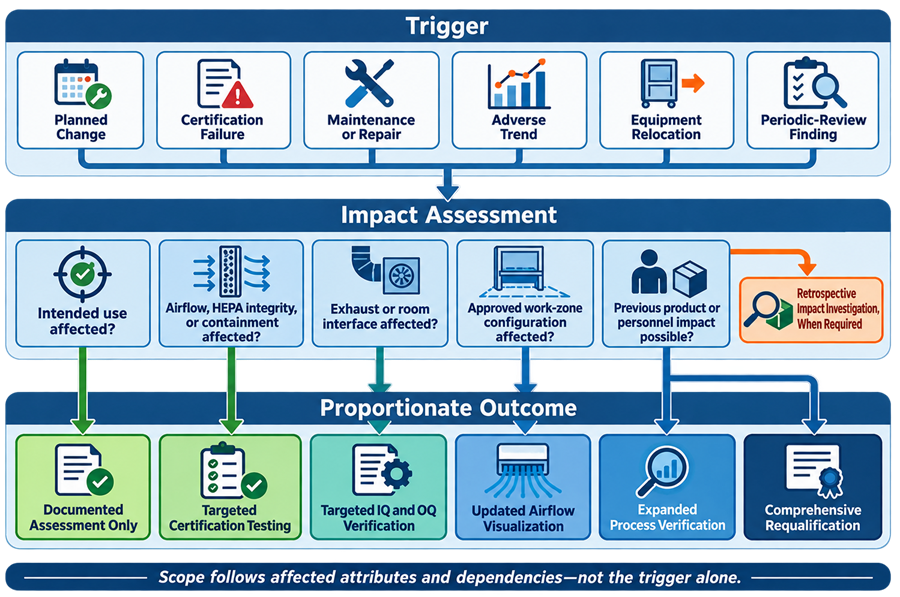
Requalification scope should follow the affected attributes and dependencies. It may include:
- Document review
- Targeted inspection
- Targeted certification tests
- Partial IQ verification
- Functional OQ testing
- Exhaust challenge
- Particle classification
- Operational airflow visualization
- Expanded process-specific verification
- Comprehensive requalification
The risk-based requalification decision should document both the tests selected and the rationale for relevant tests not repeated.
Periodic Review
Periodic review should determine whether the unit remains suitable for its approved use and whether lifecycle controls continue to support the qualified state.
Review inputs may include:
- Certification history
- Airflow and HEPA trends
- Alarm history
- Maintenance
- Repairs
- Calibration status
- Deviations
- Out-of-tolerance results
- Environmental-monitoring data
- Airflow-study observations
- Process changes
- Work-zone configuration changes
- Exhaust-system changes
- Cleaning-agent changes
- Requalification records
- Open CAPAs
- Vendor support
- Equipment condition
- Obsolescence
Possible outcomes include:
- Continued use without additional action
- Procedural improvement
- Maintenance or calibration action
- Revised certification scope or frequency
- Targeted verification
- Updated airflow visualization
- Partial requalification
- Comprehensive requalification
- Replacement or retirement
Periodic review does not replace required periodic certification. It evaluates the combined evidence and determines whether the qualified state remains supported.
Common Qualification Weaknesses
Common deficiencies include:
- Treating certification as complete qualification
- Qualifying a unit without an approved intended use
- Omitting design qualification
- Applying generic airflow limits without a documented basis
- Repeating certification data without adding qualification value
- Performing only empty-cabinet tests
- Omitting representative equipment loading
- Using standardized smoke-pattern testing as the only dynamic study
- Treating ISO 5 particle classification as proof of aseptic-process suitability
- Failing to evaluate room airflow and equipment location
- Ignoring building-exhaust dependencies
- Applying an arbitrary recovery-time requirement
- Failing to preserve raw airflow-study video
- Retesting after failure without assessing historical impact
- Relocating equipment without change control
- Failing to define requalification triggers
- Accepting service-provider reports without technical review
- Failing to connect maintenance and changes to qualification status
Conclusion
Certification, qualification, and lifecycle control are complementary but distinct activities.
Certification verifies defined technical performance at a point in time. Qualification establishes that the equipment is properly specified, designed, installed, operated, and suitable for its intended GMP use. Lifecycle controls preserve that condition through maintenance, calibration, periodic certification, monitoring, change control, periodic review, and risk-based requalification.
A defensible program uses certification evidence efficiently but does not confuse standardized field testing with process-specific qualification. The final evidence must demonstrate that the installed BSC or LFH performs its required protection functions under the conditions in which it will actually be used.