

Aseptic Processing Validation Strategy and Lifecycle
Aseptic processing validation is the structured collection and evaluation of evidence demonstrating that a manufacturing process can prevent microbial contamination while consistently producing sterile drug products meeting established quality requirements.
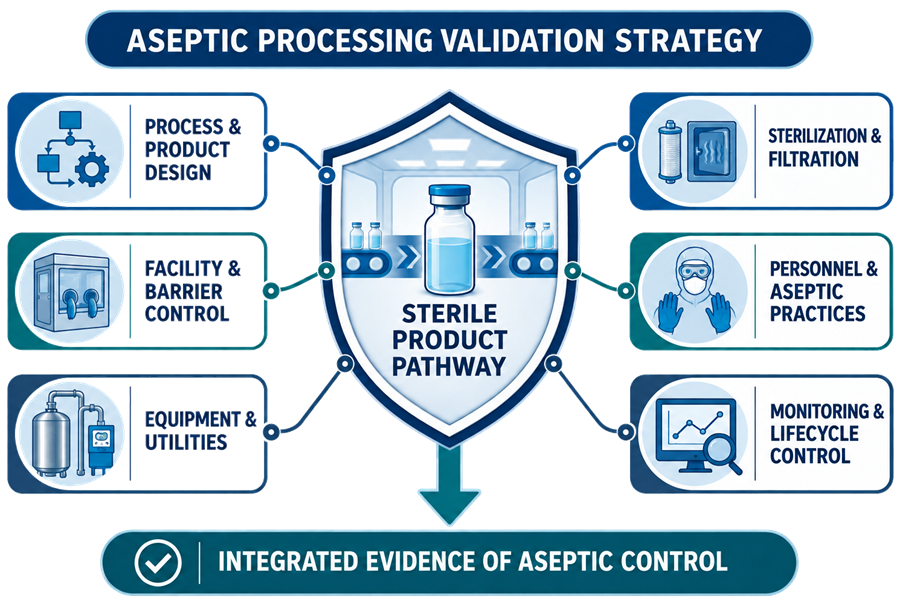
It is not represented by one protocol, three successful media fills, acceptable environmental-monitoring results, or qualification of the filling machine. It depends on coordinated evidence from:
- Product and process design
- Facility and barrier-system control
- Equipment and utility qualification
- Component sterilization and depyrogenation
- Sterilizing filtration and sterile hold
- Personnel qualification and aseptic practices
- Environmental and process monitoring
- Aseptic process simulation
- Filling and closure performance
- Container-closure integrity
- Batch review and deviation management
- Continued verification, change control, periodic review, and requalification
The validation strategy should establish how these controls interact, where separate validation studies are required, and how the accumulated evidence supports initial release and continued operation.
Purpose and scope
This article establishes the governing validation strategy for aseptically manufactured sterile drug products. It applies where the product, container, or complete container-closure system cannot undergo an effective terminal sterilization process after filling and closure.
The strategy covers the aseptic manufacturing process from the point where incoming materials, components, equipment, and product bioburden can affect the sterile process through final filling, closure, inspection, and batch disposition.
Depending on the process, the validation boundary may include:
- Preparation of product-contact equipment
- Preparation and sterilization of components
- Product formulation and prefiltration controls
- Bioburden sampling
- Sterilizing filtration
- Sterile bulk holding
- Transfer to the filling line
- Filling and initial closure
- Lyophilizer loading, processing, and unloading
- Stoppering, capping, crimping, or sealing
- Blow-Fill-Seal forming, filling, and sealing
- Container-closure integrity
- Environmental and personnel monitoring
- Batch inspection and rejection
- Electronic records supporting batch disposition
Detailed equipment and process controls are addressed in supporting articles. This cornerstone defines how their evidence is integrated into one defensible validation lifecycle.
Why aseptic processing requires an integrated strategy
Terminal sterilization provides a validated lethal treatment to the product in its final container. Aseptic processing relies primarily on preventing contamination after product, equipment, components, and container surfaces have been sterilized separately.
No later processing step corrects contamination introduced during aseptic filling unless a validated terminal sterilization process follows.
The strategy must therefore account for several connected barriers:
- Sterilization or depyrogenation of equipment and components
- Sterilizing filtration of product and product-contact gases
- Maintenance of the downstream sterile boundary
- Protection of exposed product and critical surfaces
- Environmental and barrier-system control
- Qualified personnel and controlled interventions
- Timely closure of the filled container
- Detection and investigation of abnormal conditions
Failure of one barrier may challenge the others. A filter can remain integral while contamination enters through an aseptic connection. An ISO 5 zone can meet particle limits while airflow is disrupted by an intervention. A successful media fill does not establish that an inadequate sterilization cycle is acceptable. Sterility assurance comes from the combined evidence.
Regulatory foundation
21 CFR 211.113(b) requires written procedures designed to prevent microbiological contamination of sterile drug products and states that these procedures must include validation of all aseptic and sterilization processes.
Other applicable requirements include:
- 21 CFR 211.42 — Design and construction features
- 21 CFR 211.63 — Equipment design, size, and location
- 21 CFR 211.67 — Equipment cleaning and maintenance
- 21 CFR 211.68 — Automatic, mechanical, and electronic equipment
- 21 CFR 211.94 — Drug product containers and closures
- 21 CFR 211.100 — Written procedures and deviations
- 21 CFR 211.110 — In-process sampling and testing
- 21 CFR 211.160 — General laboratory controls
- 21 CFR 211.165 — Testing and release for distribution
- 21 CFR 211.192 — Production record review and investigations
The FDA’s Sterile Drug Products Produced by Aseptic Processing—Current Good Manufacturing Practice provides the principal US guidance for aseptic-processing facilities, clean areas, personnel, components, sterilization, filtration, media fills, environmental monitoring, laboratory controls, and container closure.
The FDA’s Process Validation: General Principles and Practices establishes the lifecycle model of process design, process qualification, and continued process verification.
For globally supplied products, EU GMP Annex 1: Manufacture of Sterile Medicinal Products provides additional expectations for contamination-control strategy, barrier technologies, aseptic process simulation, environmental monitoring, sterile filtration, interventions, and lifecycle control.
Applicable compendial chapters may include USP <71> Sterility Tests, <85> Bacterial Endotoxins Test, <788> Particulate Matter in Injections, <1207> Package Integrity Evaluation, and relevant portions of the USP <1229> sterilization series. Compendial testing complements but does not replace process validation.
Relationship among validation activities
The principal evidence streams have different purposes.
| Activity | Primary question answered | What it does not establish by itself |
|---|---|---|
| Facility and cleanroom qualification | Can the facility maintain required environmental conditions? | That the operating aseptic process prevents contamination |
| Barrier-system qualification | Does the isolator or RABS maintain its qualified protective conditions? | That all interventions and manufacturing practices are acceptable |
| Filling-line qualification | Does the equipment operate correctly within its approved range? | Microbiological capability of the integrated process |
| Sterilization validation | Does the defined cycle sterilize the specified equipment, component, or load? | Maintenance of sterility after cycle completion |
| Sterilizing-filtration validation | Does the product-specific filtration process retain microorganisms under defined worst-case conditions? | Protection from contamination downstream of the filter |
| Process performance qualification | Can the commercial process reproducibly produce acceptable product? | Complete microbiological simulation of aseptic operations |
| Aseptic process simulation | Can the integrated process be performed without introducing detectable microbial contamination? | Equipment qualification, filtration validation, or product PPQ |
| Environmental monitoring | Were defined environmental conditions monitored during operation? | Validation of the aseptic process |
| Sterility testing | Did the tested sample show detectable microbial growth? | Sterility of every unit or validation of the manufacturing process |
| Container-closure integrity testing | Can the package maintain its required barrier under defined conditions? | Acceptability of the upstream aseptic manufacturing process |
The strategy should prevent these activities from being treated as interchangeable.
Validation governance
The aseptic process validation strategy should be documented in a governing plan, protocol framework, or approved validation strategy. The document should define:
- Process and product scope
- Manufacturing site and line
- Container-closure configurations
- Aseptic boundary
- Sterile product pathway
- Applicable products and strengths
- Batch and campaign configurations
- Barrier technology
- Supporting facilities and utilities
- Required qualification and validation studies
- Study sequence and prerequisites
- Risk-assessment methodology
- Worst-case selection
- Acceptance principles
- Deviation handling
- Responsibilities and approvals
- Release requirements
- Continued-verification requirements
- Change-control and requalification approach
- Regulatory commitments affecting the process
The strategy may reference separate protocols and reports. It should nevertheless provide a traceable explanation of how those records collectively support the validated state.
Product and process definition
Validation begins with a defined product and process rather than an installed filling line.
The product definition should address:
- Dosage form and route of administration
- Formulation and concentration
- Preservative status
- Product viscosity and foaming behavior
- Temperature sensitivity
- Shear sensitivity
- Oxygen or light sensitivity
- Microbial growth-supporting capability
- Maximum allowable bioburden
- Endotoxin limits
- Particulate requirements
- Filtration compatibility
- Maximum sterile hold time
- Container and closure
- Required shelf life
The process definition should identify:
- Formulation sequence
- Material-addition controls
- Bulk-hold conditions
- Bioburden-reduction steps
- Sterilizing filtration
- Downstream sterile connections
- Sterile receiving vessel
- Transfer pathway
- Filling method
- Initial closure
- Lyophilization where applicable
- Final sealing
- Inspection and rejection
- Container-integrity controls
Process maps should distinguish product-contact pathways, sterile boundaries, component pathways, personnel access, environmental interfaces, waste paths, and computerized-system dependencies.
Terminal sterilization assessment
The development program should evaluate whether the product can be terminally sterilized in its final container. Aseptic processing should not be selected solely because it is operationally familiar or because an aseptic filling line is available.
The assessment should consider:
- Product heat sensitivity
- Container and closure compatibility
- Sterilization method
- Product degradation
- Container deformation
- Seal performance
- Sterilant penetration
- Load configuration
- Required sterility assurance
- Effect on critical quality attributes
When terminal sterilization is not feasible, the scientific and technical basis for aseptic processing should be documented.
Aseptic process boundary
The aseptic boundary is not limited to the filling needles or ISO 5 filling zone.
The complete boundary may begin with:
- The sterilizing filter
- A previously sterilized product vessel
- A sterile single-use assembly
- A sterilized formulation or transfer system
- Another scientifically defined sterilization boundary
It normally continues through filling and closure of the container.
The boundary should identify:
- Every product-contact surface
- Filter housings and connections
- Receiving and holding vessels
- Vent and process-gas filters
- Sampling points
- Transfer tubing and piping
- Pumps and manifolds
- Filling needles
- Open containers
- Sterile closures
- Lyophilizer chamber and loading interface
- Stoppering and initial sealing locations
Any opening, connection, intervention, loss of pressure, filter failure, or maintenance activity capable of affecting the boundary should have a defined control and response.
The physical and functional line arrangement is addressed in aseptic filling-line architecture.
Contamination-control strategy
The aseptic validation strategy should be aligned with the site contamination-control strategy. The contamination-control strategy defines how facility, process, technical, procedural, and organizational controls work together to minimize contamination risk.
Relevant elements include:
- Facility zoning
- Personnel and material flows
- Cleanroom classifications
- Pressure relationships
- Barrier technology
- First-air protection
- Cleaning and disinfection
- Sterilization and depyrogenation
- Product and gas filtration
- Component preparation
- Transfer systems
- Environmental monitoring
- Personnel qualification
- Intervention control
- Container closure
- Maintenance
- Investigation and trending
The validation strategy converts these control concepts into specific evidence requirements and acceptance decisions.
Quality risk assessment
Risk assessment should identify contamination pathways and determine where validation evidence is required.
Potential contamination sources include:
- Personnel
- Facility surfaces
- Airborne particles and microorganisms
- Equipment surfaces
- Product-contact pathways
- Components and closures
- Process gases
- Single-use assemblies
- Aseptic connections
- Tools and monitoring devices
- Interventions
- Machine failures
- Maintenance
- Extended exposure or hold time
- Inadequate container closure
The assessment should evaluate prevention, detection, and recovery controls. Reliance on detection alone is usually weak because contamination may be intermittent, nonuniformly distributed, and difficult to detect through finished-product testing.
Risk assessment should be updated as process knowledge develops and when changes, failures, trends, or new regulatory information affect the original assumptions.
Operating states and interventions
The process should be evaluated in all relevant operating states:
- Line setup
- Assembly of sterile product pathways
- Presterilization preparation
- Sterilization or bio-decontamination
- Startup
- Routine filling
- Component replenishment
- In-process sampling
- Environmental monitoring
- Planned intervention
- Corrective intervention
- Line pause
- Extended stoppage
- Shift change
- Restart
- End-of-batch operation
- Line clearance
- Cleaning
- Maintenance recovery
A process may remain controlled during routine filling but become vulnerable during setup, an intervention, or restart. Validation studies should therefore represent the states that create the greatest contamination risk.
Interventions should be classified, approved, described in sufficient detail, evaluated through airflow visualization studies, and represented in APS where appropriate.
Worst-case selection
Worst-case conditions should be scientifically selected rather than automatically equated with the largest batch or slowest line speed.
Potential worst cases include:
- Longest aseptic-processing duration
- Longest sterile bulk hold
- Longest equipment sterile hold
- Maximum number of personnel
- Maximum permitted interventions
- Most complex intervention
- Highest component-replenishment frequency
- Slowest line speed and longest open-container exposure
- Highest line speed and greatest mechanical challenge
- Small containers with difficult handling
- Large container openings
- Difficult closure configurations
- Maximum lyophilizer loading time
- Longest partially stoppered-vial exposure
- Most extensive single-use assembly
- Maximum number of aseptic connections
- Least favorable shift pattern
- Maximum campaign duration
- Startup and end-of-run conditions
Bracketing and matrixing may be justified where product, container, process, equipment, and intervention similarities are established. A broad family designation without technical comparison is insufficient.
Prerequisites for process confirmation
Execution of PPQ or APS should occur only after the supporting systems are sufficiently qualified for representative operation.
Typical prerequisites include:
- Approved process and product definition
- Completed risk assessment
- Qualified cleanrooms and HVAC
- Qualified isolator or RABS
- Completed airflow studies
- Qualified filling and closure equipment
- Qualified critical utilities
- Validated sterilization and depyrogenation cycles
- Validated cleaning processes where applicable
- Validated sterilizing filtration process
- Established sterile and bulk hold times
- Qualified computerized systems
- Approved environmental-monitoring program
- Qualified microbiological methods
- Qualified inspection and reject systems
- Qualified container-closure system
- Approved operating and intervention procedures
- Trained and qualified personnel
- Established deviation and investigation procedures
Open deviations affecting a prerequisite should be assessed before execution begins. A study should not be used to compensate for a system that is not ready for representative operation.
Facility and barrier-system qualification
Facility qualification should establish that cleanrooms and supporting systems can maintain conditions suitable for the intended operation. Depending on the design, evidence may include:
- Room classification
- HEPA-filter integrity
- Airflow volume and velocity
- Pressure relationships
- Temperature and humidity
- Recovery
- Alarm and failure response
- Airflow visualization
- Environmental baseline studies
Barrier-system qualification should address the enclosure, airflow, pressure, gloves, transfer devices, cleaning, bio-decontamination, alarms, integrity, interventions, and supporting room.
Detailed strategies are addressed in:
- Restricted Access Barrier Systems: Design and Qualification
- Isolator Systems: Design, Qualification, and Lifecycle Control
Barrier qualification does not replace validation of the processing equipment or the aseptic process conducted inside the barrier.
Equipment and utility qualification
Equipment qualification demonstrates that the installed system operates according to approved requirements and can support the intended process.
The qualification scope may include:
- Product vessels and transfer skids
- Filtration assemblies
- Filling machines
- Pumps and filling needles
- Container handling
- Stoppering and capping systems
- Lyophilizers
- Inspection and reject equipment
- Barrier interfaces
- Process gas systems
- Clean steam and water systems
- Automation and electronic records
Qualification should challenge operating ranges, alarms, interlocks, failures, recovery, reject tracking, recipes, access controls, data retention, and interfaces where those functions affect product quality or sterility assurance.
The equipment-specific approach is described in fill-line qualification lifecycle.
Sterilization and depyrogenation controls
Every item introduced into the aseptic boundary should have a defined preparation and sterilization or depyrogenation process where required.
This includes:
- Product-contact equipment
- Filling needles and manifolds
- Hoses and transfer assemblies
- Vessels
- Stoppers and closures
- Containers
- Tools
- Change parts
- Sampling devices
- Environmental-monitoring materials
Validation should establish the approved load, cycle, configuration, wrapping, orientation, hold time, transfer, and protection following sterilization.
Preparation and transfer controls are addressed in qualification of sterile component preparation and transfer.
Sterilizing filtration and sterile hold
For filter-sterilized products, validation should establish that the selected filtration process provides microbial retention under defined product-specific worst-case conditions. The strategy should address:
- Filter membrane and configuration
- Product compatibility
- Adsorption and product recovery
- Extractables and leachables
- Initial filter bioburden
- Maximum pressure
- Maximum flow
- Maximum volume
- Maximum filtration duration
- Product temperature
- Filter sterilization
- Integrity-test method and limits
- Pre-use post-sterilization integrity testing
- Post-use integrity testing
- Serial or redundant filters
- Downstream sterile boundary
- Sterile receiving vessel
- Maximum sterile hold
- Agitation and temperature during hold
- Sterile venting
- Aseptic sampling
- Transfer to filling
The Sterilizing Filtration Validation and Sterile Hold-Time Control article will provide the detailed strategy.
Process performance qualification
Process performance qualification confirms that the commercial manufacturing process can reproducibly produce product meeting predetermined requirements under approved operating conditions.
For an aseptic product, PPQ may evaluate:
- Formulation
- Mixing and hold times
- Bioburden controls
- Filtration parameters
- Product recovery
- Fill volume
- Filling speed
- Container handling
- Closure placement
- Lyophilization where applicable
- Product quality attributes
- Yield and reconciliation
- Batch-record execution
PPQ uses the actual product or a justified representative. It is distinct from APS.
PPQ cannot ordinarily demonstrate the microbiological capability of an aseptic process as directly as a properly designed media fill because commercial product may not support microbial growth, may contain preservatives, and is not incubated and inspected as an APS population.
Aseptic process simulation
APS challenges the integrated aseptic process using a sterile microbiological growth medium or another justified simulation approach.
It should represent or challenge:
- Commercial equipment configuration
- Container and closure system
- Line speed
- Processing duration
- Personnel
- Shift changes
- Component replenishment
- Routine interventions
- Corrective interventions
- Stops and restarts
- Environmental-monitoring activities
- Aseptic connections
- Sterile sampling
- Lyophilizer loading and unloading
- Maximum exposure and hold conditions
- End-of-run activities
Initial qualification normally requires sufficient successful simulations to establish process capability across relevant shifts, personnel groups, configurations, and operating conditions. The number and arrangement of simulations should follow applicable regulatory expectations and the justified process design rather than being used as a substitute for process understanding.
Detailed APS design is addressed in media fill and aseptic process simulation.
Personnel qualification
Personnel are a major contamination source in conventional aseptic processing and remain relevant in RABS and isolator operations.
Qualification should address:
- Health and hygiene
- Gowning
- Cleanroom behavior
- Aseptic technique
- Disinfection practices
- Material transfer
- Glove use
- Intervention execution
- Response to spills or breakage
- Documentation
- Participation in successful APS
A person should be qualified for the activities actually performed. Observation of gowning alone does not establish competence to perform complex aseptic manipulations or interventions.
Personnel qualification should be maintained through periodic assessment, monitoring results, APS participation, deviation history, and retraining where required.
Environmental and process monitoring
Environmental monitoring provides evidence about conditions during operation. It should be based on contamination risk, airflow studies, process exposure, intervention locations, and historical data.
The program may include:
- Nonviable particle monitoring
- Active viable-air sampling
- Passive air monitoring
- Surface monitoring
- Personnel monitoring
- Glove monitoring
- Temperature and humidity
- Pressure monitoring
- Barrier-condition monitoring
Monitoring devices and sampling activities should not obstruct first air or create additional contamination risk.
Environmental data should be reviewed with the process record, interventions, alarms, personnel observations, sterilization records, and product results. An isolated count should not be interpreted without process context.
Detailed program requirements are addressed in environmental monitoring for aseptic filling. That page will later be retitled Environmental Monitoring for Aseptic Process Verification while retaining its established URL.
Container closure and sterile-barrier completion
The aseptic process remains vulnerable until the container receives its effective initial closure or seal.
Validation should address:
- Closure preparation and sterilization
- Closure feeding and presentation
- Stopper placement
- Stopper height
- Partial stoppering for lyophilization
- Capping or crimping
- Sealing parameters
- Detection of missing or displaced closures
- Container damage
- Reject performance
- Container-closure integrity
Container-closure integrity provides evidence that the package can maintain the required barrier after closure. It does not compensate for an inadequately controlled filling process.
Detailed integrity principles are addressed in container closure integrity testing.
Integrated evidence and initial release
Before routine aseptic manufacturing begins, the accumulated evidence should be reviewed as one system.
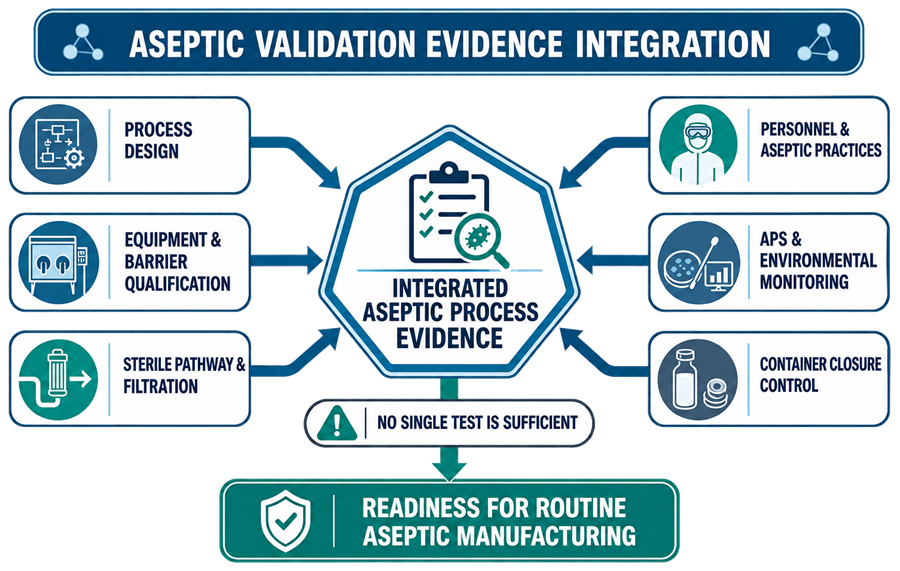
The readiness review should confirm:
- The process and validation boundary are approved
- Requirements are traceable
- Critical risks have defined controls
- Facilities, utilities, and equipment are released
- Sterilization and depyrogenation processes are validated
- Filtration and sterile holds are validated
- Personnel are qualified
- APS has been completed acceptably
- Environmental-monitoring capability is established
- Container and closure controls are qualified
- Procedures and batch records are approved
- Deviations have been resolved or formally assessed
- Remaining limitations are documented
- Quality-unit approval is recorded
No single passing study should override unresolved evidence from another critical control.
Routine batch review
Routine batch review should integrate sterility-assurance evidence rather than review each record in isolation.
The review may include:
- Component and equipment status
- Cleaning and sterilization records
- Product-filter identification
- Filter-integrity results
- Product and equipment hold times
- Critical processing parameters
- Environmental-monitoring results
- Personnel-monitoring results
- Interventions
- Line stops and restarts
- Barrier alarms
- Utility excursions
- Reject counts
- Fill-volume data
- Closure and seal inspection
- Container-integrity results
- Laboratory results
- Deviations and investigations
- Batch reconciliation
The absence of a sterility-test failure does not resolve an unexplained loss of process control.
Continued process verification
Continued process verification should determine whether the aseptic process remains in a state of control during routine manufacturing. Data may include:
- Presterilization and prefiltration bioburden
- Filter-integrity results
- Sterile hold times
- Environmental-monitoring results
- Personnel-monitoring results
- Intervention frequency
- Line-stop duration
- Barrier alarms
- Filling and closure defects
- Reject rates
- Container-integrity failures
- Sterility and endotoxin results
- Particulate results
- Deviations and CAPA
- Maintenance and calibration
- APS results
- Changes and requalification outcomes
Data should be stratified where relevant by line, room, barrier, product, container, shift, operator group, intervention, monitoring location, organism, filter, mold, cavity, or closure configuration.
Acceptable individual batches do not preclude the existence of an adverse trend.
Periodic aseptic process simulation
Periodic APS provides renewed microbiological evidence that the integrated process remains capable under current operating conditions.
The program should account for:
- Each aseptic processing line
- Each applicable shift
- Qualified personnel groups
- Relevant container and closure families
- Barrier configuration
- Process duration
- Campaign conditions
- Representative interventions
- Significant process changes
- Extended shutdown or inactivity
- Adverse trends or investigation findings
Periodic APS is one component of continued verification. It should not replace routine monitoring, batch review, personnel oversight, or technical requalification.
Deviations and investigations
Aseptic-process deviations require timely evaluation because contamination may not be uniformly distributed or detectable through finished-product sampling.
Investigations should reconstruct:
- Process timing
- Affected units
- Product exposure
- Sterile-boundary status
- Personnel actions
- Interventions
- Airflow and barrier conditions
- Environmental data
- Equipment alarms
- Filter status
- Sterilization records
- Container and closure status
- Related batches and historical events
The investigation should determine whether affected product can be scientifically bounded. Arbitrary rejection of a small number of nearby units is inadequate unless the process design and evidence support that boundary.
Change control
Changes should be assessed before implementation where planned and promptly controlled where emergent. Potentially significant changes include:
- Product formulation
- Filtration process
- Sterile hold time
- Container or closure
- Filling speed
- Batch or campaign duration
- Filling machine
- Barrier system
- HVAC or critical-zone airflow
- Product pathway
- Single-use assembly
- Sterilization cycle
- Component supplier
- Intervention method
- Environmental-monitoring program
- Software or recipe
- Inspection or reject system
- Maintenance affecting the sterile boundary
- Facility shutdown or relocation
The assessment should identify affected requirements, risk controls, qualification evidence, process validation, APS, procedures, regulatory commitments, and product impact.
Periodic review and requalification
Periodic review evaluates whether the overall aseptic control strategy remains adequate. It is broader than periodic APS or scheduled cleanroom testing.
Review inputs should include:
- Current process and system configuration
- Qualification and validation status
- APS history
- Environmental and personnel trends
- Sterility and endotoxin results
- Filter-integrity history
- Intervention and alarm trends
- Container and closure defects
- Deviations and investigations
- CAPA effectiveness
- Maintenance and calibration
- Supplier changes
- Regulatory commitments
- Changes in standards or guidance
- Previous review actions
- Obsolescence and technical risk
Requalification should be targeted to the affected capabilities and dependencies. A significant barrier modification may require enclosure integrity testing, airflow studies, environmental qualification, APS, and procedural reassessment. A minor sensor replacement may require calibration and functional verification without repetition of unrelated studies.
Lifecycle model
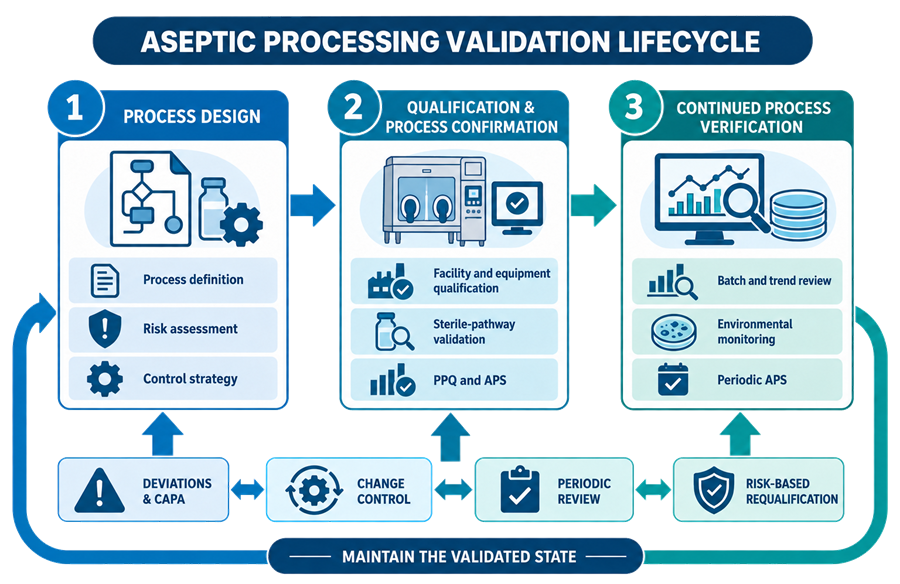
The lifecycle stages are connected:
- Process design defines the process, risks, control strategy, operating ranges, sterile boundaries, and validation requirements.
- Qualification and process confirmation establish facility and equipment capability, validate the sterile pathway, and execute PPQ and APS.
- Continued process verification uses routine batch evidence, monitoring, trending, and periodic APS to confirm continuing control.
- Lifecycle controls assess deviations, changes, review findings, deterioration, and new knowledge and return them to the affected validation stage.
Validation is therefore not complete after initial release. The validated state exists only while current evidence continues to support the approved process and control strategy.
Common strategy deficiencies
Common deficiencies include:
- Treating successful media fills as complete aseptic-process validation
- Executing APS before facility or equipment readiness
- Failing to define the aseptic boundary
- Omitting formulation, filtration, and sterile-hold operations
- Treating equipment qualification as microbiological process validation
- Using nominal operating conditions without justified worst cases
- Omitting interventions, stops, and restarts
- Inadequate connection between airflow studies and interventions
- Relying on environmental monitoring to prove sterility
- Treating sterility testing as proof of process control
- Poor linkage among deviations, environmental data, and batch disposition
- Inadequate personnel qualification
- Uncontrolled expansion of campaign duration
- Changes implemented without APS or requalification assessment
- Periodic review limited to completion dates
- Requalification performed without reviewing adverse trends
- Duplicate studies with no clear evidence purpose
- Acceptance of unresolved prerequisite deviations
- Inability to trace validation evidence to current configuration
Conclusion
Aseptic processing validation is an integrated lifecycle program, not an isolated media-fill exercise. Its purpose is to establish and maintain scientific evidence that the complete process prevents contamination while consistently producing acceptable sterile drug products.
A defensible strategy defines the process and sterile boundary, evaluates contamination risks, qualifies the supporting systems, validates sterilization and filtration processes, confirms commercial performance, challenges aseptic operations through APS, evaluates routine evidence, and responds to changes and deterioration through periodic review and risk-based requalification.