

Filtration Skid Qualification and Lifecycle Control
Introduction
Filtration-skid qualification provides documented evidence that the installed equipment, instrumentation, automation, utilities, and supporting functions are suitable for their intended use and operate reliably within approved limits.
Qualification does not begin with protocol execution. It begins with a defined intended use, controlled system boundary, measurable requirements, appropriate design review, and a risk-based strategy identifying which functions require verification and challenge testing.
This article addresses:
- User requirements
- System boundaries and direct-impact functions
- Supplier documentation
- Factory and site acceptance testing
- Design qualification
- Installation qualification
- Operational qualification
- Equipment-level performance qualification
- Automation and electronic-record controls
- Calibration and maintenance integration
- Change control
- Periodic review
- Requalification
- Retirement
Physical configuration is addressed in filtration and ultrafiltration system architecture. Detailed membrane, housing, pump, valve, piping, and instrument design is addressed in filtration system design and critical components.
Qualification Scope and Lifecycle Position
A filtration skid may support normal-flow filtration, depth filtration, tangential-flow filtration, ultrafiltration, diafiltration, virus filtration, or another defined separation operation. The qualification strategy should reflect the actual application and system complexity.
A small manually operated filtration assembly does not require the same qualification scope as an automated TFF skid connected to a manufacturing execution system and plant historian. Qualification should be proportionate to:
- Product-quality impact
- Process complexity
- Degree of automation
- Number and criticality of instruments
- Electronic-record functions
- Cleaning or sterilization requirements
- Reusable or single-use configuration
- Consequences of equipment failure
- Supplier documentation quality
- Previous equipment and platform experience
Qualification demonstrates equipment fitness for intended use. Process-specific studies establish whether the filtration operation consistently achieves the required separation, retention, yield, capacity, clearance, or microbial-control objective. Filtration-skid qualification begins with intended use and requirements, progresses through design and functional verification, and continues through controlled operation, periodic review, and retirement.
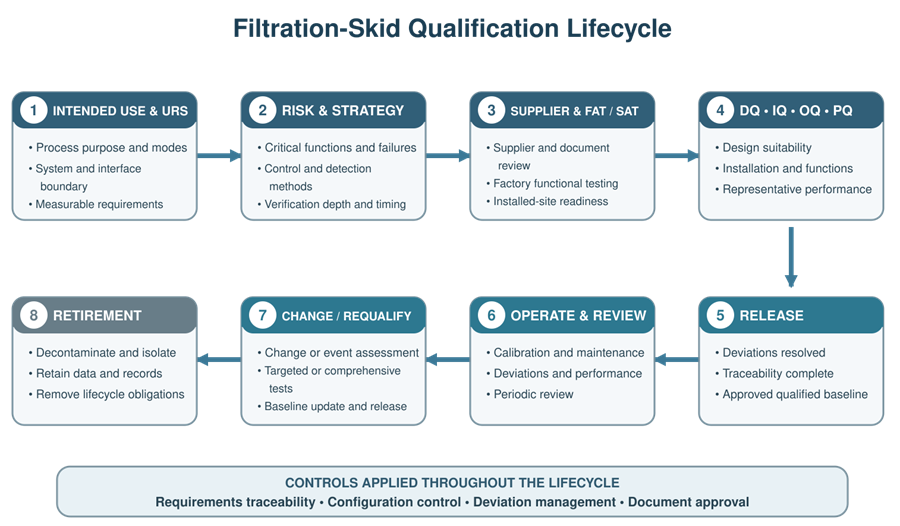
Intended Use and System Boundary
The intended-use statement should explain what the skid does, where it is used, which process it supports, and how its output affects the manufacturing operation. The statement should identify:
- Filtration application
- Process materials
- Batch-size or volume range
- Operating modes
- Normal-flow or tangential-flow operation
- Single-use, reusable, or hybrid configuration
- Manual and automated functions
- Cleaning, sanitization, or sterilization strategy
- Required electronic records
- Interfaces with other equipment or systems
- Applicable environmental conditions
The qualified boundary should distinguish components included in the skid from external systems that supply, receive, control, or store information associated with it.
The boundary may include:
- Feed and recirculation pumps
- Filter housings or membrane holders
- Product-contact tubing and piping
- Valves and manifolds
- Pressure, flow, temperature, conductivity, pH, level, weight, UV, or turbidity instruments
- Control panel
- Programmable logic controller
- Human-machine interface
- Local data storage
- Skid-mounted utilities
- Safety devices
- Supporting frames and mechanical assemblies
External interfaces may include:
- Feed or product vessels
- Buffer systems
- Clean-in-place systems
- Clean steam or sanitization utilities
- Plant air or process-gas supplies
- Electrical distribution
- Building automation
- Supervisory control systems
- Historians
- Manufacturing execution systems
- Network and time-synchronization services
Boundary definition prevents qualification gaps and unnecessary duplication. Each interface should have an assigned owner and an identified verification method.
Direct-Impact and Supporting Functions
Not every skid component has the same GMP impact. Classification should be based on intended use and failure consequences.
Functions commonly requiring direct verification include those that:
- Contact or contain product
- Establish the filtration flow path
- Control pressure, flow, temperature, concentration, or diafiltration addition
- Prevent filter bypass
- Prevent incorrect routing
- Protect the membrane or product from excessive pressure
- Provide measurements used for acceptance decisions
- Generate or maintain GMP records
- Control cleaning, sanitization, sterilization, or integrity-testing sequences
- Maintain segregation between product, cleaning solution, waste, and utilities
Supporting components may still require verification when their failure could affect a direct-impact function. Examples include instrument air, electrical supply, network communication, time synchronization, equipment supports, or environmental services.
Classification should determine the depth of documentation and testing. It should not be used to exclude a component from all verification without evaluating its functional relationship to the system.
User Requirements Specification
The user requirements specification defines what the skid must accomplish. Requirements should be clear, measurable, testable, and traceable.
Process and Performance Requirements
Requirements may include:
- Intended filtration modes
- Batch-volume range
- Required flow range
- Required pressure range
- Permitted transmembrane-pressure range
- Pump capacity and turndown
- Required membrane area or holder capacity
- Maximum allowable differential pressure
- Temperature range
- Concentration or diafiltration functions
- Product-recovery expectations
- Allowable system hold-up
- Required operating sequences
The URS should not contain unsupported universal values. Operating ranges and acceptance criteria should be based on process needs, equipment limitations, supplier information, and development knowledge.
Mechanical Requirements
Mechanical requirements may address:
- Product-contact materials
- Gasket and elastomer materials
- Pressure and temperature ratings
- Surface condition
- Connection types
- Filter seating and bypass prevention
- Cassette compression or holder requirements
- Drainability
- Venting
- Sample connections
- Integrity-test connections
- Equipment mobility or fixed installation
- Single-use assembly support
- Cleanability and accessibility
Instrumentation and Control Requirements
The URS should define:
- Required measurements
- Instrument ranges
- Accuracy or performance expectations
- Display and recording requirements
- Control loops
- Alarm functions
- Interlocks
- Protective shutdowns
- Valve-position verification
- Manual and automatic modes
- Recipe functions
- User access
- Data storage
- Backup and recovery
- External interfaces
The URS should describe required outcomes rather than prescribing unnecessary implementation details unless a specific design is required.
Lifecycle Requirements
Lifecycle requirements may include:
- Calibration access
- Preventive-maintenance access
- Spare-part availability
- Software and configuration backup
- Supplier support
- Obsolescence management
- Cleaning and storage
- Documentation retention
- Change-control expectations
- Periodic-review capability
- Decommissioning and data-retention requirements
Risk Assessment and Qualification Strategy
A documented risk assessment should connect intended use and system functions to the qualification scope.
The assessment should consider:
- Product-contact risk
- Contamination or carryover
- Filter bypass
- Loss of retention function
- Incorrect membrane installation
- Excessive pressure
- Loss of flow
- Incorrect routing
- Instrument failure or drift
- Pump failure
- Alarm or interlock failure
- Loss of electrical power or instrument air
- Software or configuration error
- Data loss or inaccurate records
- Cleaning or sterilization failure
- Single-use assembly damage
- Operator error
For each significant failure mode, the assessment should identify the prevention, detection, or response control and determine where that control will be verified.
Controls may be demonstrated through:
- Design review
- Supplier documentation
- Material certification
- Inspection
- Calibration
- Factory testing
- Site acceptance testing
- IQ
- OQ
- Equipment-level PQ
- Procedure verification
- Training
- Preventive maintenance
- Routine monitoring
The qualification strategy should avoid repeating the same test solely because different lifecycle documents use different names. Existing evidence may be leveraged when it is technically adequate, traceable, approved, and generated under appropriate controls.
Supplier Assessment and Documentation
The supplier’s capabilities and documentation quality can significantly affect qualification efficiency. Supplier assessment may consider:
- Experience with comparable GMP equipment
- Design and manufacturing controls
- Software-development practices
- Configuration management
- Testing methods
- Calibration controls
- Material traceability
- Welding documentation
- Nonconformance management
- Change-notification practices
- Service capability
- Cybersecurity and remote-support practices
- Long-term component availability
Expected documentation should be defined before purchase. Depending on the system, the documentation package may include:
- Approved drawings
- Piping and instrumentation diagrams
- Process-flow diagrams
- General-arrangement drawings
- Electrical schematics
- Instrument lists
- Valve lists
- Equipment and component data sheets
- Product-contact material certificates
- Weld documentation
- Surface-finish information
- Pressure-test records
- Calibration certificates
- Software and firmware versions
- Functional specifications
- Control narratives
- I/O lists
- Alarm and interlock lists
- Recipe or sequence descriptions
- Software backup
- Operating manuals
- Maintenance manuals
- Recommended spare-parts lists
- Factory test records
Receiving a supplier document does not establish its acceptability. Documents should be reviewed for accuracy, applicability, completeness, and consistency with the delivered configuration.
Factory Acceptance Testing
Factory acceptance testing verifies defined functions before the skid is shipped. FAT can identify design or configuration deficiencies while the supplier still has direct access to the equipment and development personnel. FAT scope may include:
- Visual and dimensional inspection
- Component and tag verification
- P&ID comparison
- Product-contact material review
- Pump operation
- Valve actuation
- Instrument signal simulation
- I/O verification
- HMI screen review
- Recipe or sequence execution
- Alarm and interlock challenges
- Emergency-stop testing
- Power-loss response
- Communication testing
- Software-version recording
- Backup creation
- Documentation review
Not every qualification test must be executed during FAT. Some tests require installed utilities, site networks, calibrated site standards, production interfaces, or final operating conditions.
FAT results can support later qualification when:
- Requirements and acceptance criteria were approved
- Test methods were suitable
- Instruments used for testing were controlled
- Results are attributable and reviewable
- Deviations were documented and resolved
- The tested configuration is traceable to the delivered system
- Shipment or installation did not invalidate the evidence
Site Acceptance Testing and Commissioning
Site acceptance testing confirms that the delivered skid was not damaged or altered during shipment and that it functions correctly after installation. SAT and commissioning may include:
- Shipping-damage inspection
- Equipment and accessory inventory
- Utility connection checks
- Rotation or directional checks
- Pump startup
- Valve actuation
- Instrument communication
- Network connection
- Control-panel energization
- Safety-device checks
- Leak testing
- Basic sequence execution
- Software backup
- Verification of installed software and firmware versions
Commissioning should establish readiness for formal qualification. Deficiencies identified during commissioning should be documented and resolved before they can compromise qualification results.
Commissioning data may be used as qualification evidence when the activity was planned, appropriately controlled, traceable to requirements, and subjected to the required review and approval.
Design Qualification
Design qualification confirms that the proposed design satisfies the approved requirements and is suitable for its intended use. DQ should evaluate the complete integrated design rather than isolated vendor data sheets.
Mechanical Design Review
Mechanical DQ may verify:
- Membrane and housing compatibility
- Filter-seating and sealing arrangements
- Product-contact materials
- Pressure and temperature ratings
- Pump selection
- Piping and tubing dimensions
- Connector and gasket specifications
- Vent and drain locations
- Hold-up and recovery considerations
- Cleaning and sanitization provisions
- Integrity-test connections
- Single-use assembly support
- Maintenance accessibility
Instrumentation Design Review
Instrumentation DQ may verify:
- Measurement locations
- Instrument technologies
- Measurement ranges
- Accuracy requirements
- Calibration capability
- Pressure-sensor arrangement
- Flowmeter suitability
- Alarm and shutdown setpoints
- Protection against temperature or pressure damage
- Data-recording requirements
Automation Design Review
Automation DQ may verify:
- Functional specification
- Control philosophy
- Operating modes
- Recipe structure
- Sequence logic
- I/O allocation
- Control loops
- Alarm strategy
- Interlocks
- Fail states
- User roles
- Electronic-record functions
- Data interfaces
- Backup and recovery architecture
- Network and cybersecurity requirements
The DQ report should identify unresolved design issues, required corrective actions, and the documents establishing the approved design baseline. Requirements should remain traceable through design decisions, risk controls, verification activities, deviations, and final qualification release.
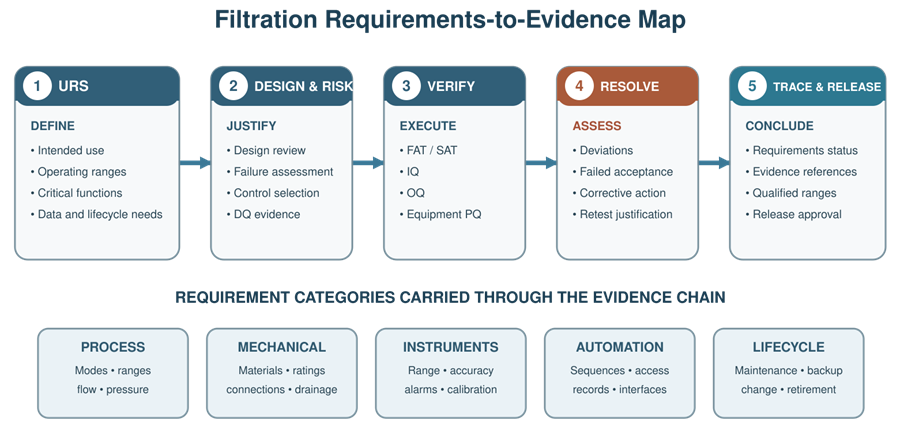
Installation Qualification
Installation qualification verifies that the skid and its supporting systems are installed in accordance with approved drawings, specifications, and supplier requirements.
Equipment and Mechanical Verification
IQ may include:
- Manufacturer, model, and serial-number verification
- Equipment-tag verification
- Component inventory
- P&ID walkdown
- Piping and tubing verification
- Filter-housing or cassette-holder verification
- Pump identification
- Valve identification
- Product-contact material verification
- Gasket and seal verification
- Utility connection verification
- Vent, drain, sample, and integrity-test connection verification
- Pressure-rating verification
- Equipment-support and accessibility inspection
Instrumentation Verification
IQ may confirm:
- Instrument manufacturer and model
- Tag number
- Measurement range
- Installation location
- Orientation
- Wiring or communication connection
- Calibration status
- Calibration certificate
- Applicable calibration procedure
- Alarm or interlock association
Calibration confirms instrument performance against a standard. IQ confirms that the correct instrument is installed and appropriately documented. These activities support each other but are not interchangeable.
Electrical and Automation Verification
Automation IQ may include:
- Control-panel identification
- PLC hardware
- I/O modules
- HMI hardware
- Network components
- Electrical drawings
- Wiring
- Software and firmware versions
- Installed applications
- Configuration files
- User-account configuration
- Time-source configuration
- Data-storage locations
- Interface configuration
- Backup availability
- Restore instructions
Documentation Verification
IQ should confirm the availability and status of required drawings, specifications, manuals, certificates, and supplier records. As-built documents should reflect the installed system or have controlled discrepancies scheduled for correction.
Operational Qualification
Operational qualification demonstrates that the skid functions as intended across defined operating ranges and responds appropriately to abnormal and failure conditions. OQ should challenge critical functions. Merely observing that a pump starts or a valve moves does not demonstrate adequate control.
Mechanical and Hydraulic Testing
Testing may include:
- Pump operation across the qualified range
- Minimum and maximum flow
- Pressure stability
- Module pressure drop
- Transmembrane-pressure calculation
- Flow-direction verification
- Valve routing
- Leak or pressure-hold testing
- Venting and priming
- Drainage
- Product-recovery sequence
- Recirculation
- Permeate collection
- Diafiltration addition
- Cleaning or flushing sequences
Water or another justified test medium may be used when it adequately challenges the equipment function being evaluated.
Instrument Testing
Instrument OQ may include:
- Display verification
- Signal accuracy
- Scaling
- Engineering units
- Low- and high-range response
- Calculation verification
- Alarm generation
- Alarm delay
- Sensor-failure response
- Data recording
- Communication-loss response
Instrument calibration alone does not demonstrate that the signal is correctly scaled, displayed, recorded, alarmed, and used by the control logic.
Alarm, Interlock, and Failure Testing
Challenge testing should verify both the initiating condition and the required protective response.
| Challenge condition | Expected system response |
|---|---|
| High feed pressure | Alarm and defined pump or valve response |
| High module differential pressure | Alarm and protective action before equipment limits are exceeded |
| High transmembrane pressure | Alarm, control response, or shutdown as defined |
| Low feed flow | Alarm and defined sequence response |
| Closed downstream path | Prevention or termination of dead-head pumping |
| Incorrect valve route | Sequence inhibition or alarm |
| Loss of instrument signal | Defined bad-signal indication and safe response |
| Loss of instrument air | Defined valve positions and equipment response |
| Loss of power | Controlled shutdown and defined restart condition |
| Communication failure | Alarm and defined local or safe operating state |
| Emergency stop | Immediate defined equipment response |
| Unauthorized setpoint entry | Access denied or change prevented |
The response should be evaluated against the complete control strategy. A fail-closed valve position is not universally correct; the safe state depends on the valve function and failure consequences.
OQ challenge testing should verify the complete relationship between an abnormal condition, its detection, the control-system decision, and the required protective response.
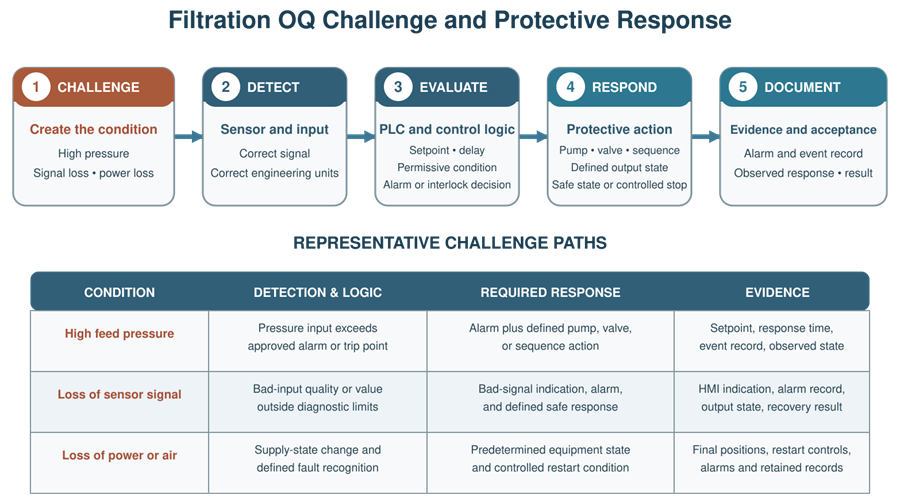
Control Loop and Sequence Testing
Control-loop testing should evaluate:
- Setpoint entry
- Process-variable response
- Output response
- Stability
- Operating-range performance
- High and low limits
- Manual-to-automatic transfer
- Output limitation
- Alarm interaction
- Sensor-failure behavior
Sequence testing should verify:
- Permissives
- Step order
- Transition conditions
- Hold conditions
- Abort behavior
- Recovery behavior
- Operator prompts
- Valve routing
- Pump coordination
- Data capture
Testing should cover applicable normal, abnormal, interrupted, and restart conditions.
Equipment-Level Performance Qualification
Equipment-level PQ demonstrates that the qualified skid can repeatedly execute its intended equipment functions under representative operating conditions.
Depending on the skid, equipment PQ may include:
- Repeated execution of representative operating sequences
- Stable flow and pressure control
- Repeatable transmembrane-pressure control
- Consistent diafiltration addition
- Repeatable volume or weight control
- Product-recovery sequence verification
- Consistent data recording
- Repeatable alarm-free operation under normal conditions
- Operator execution using approved procedures
Equipment PQ should be based on defined loads, configurations, and operating conditions. It may use water, buffer, a justified surrogate, or process material depending on the objective.
Equipment-level PQ is not manufacturing-process performance qualification. It does not by itself establish:
- Filter capacity for a specific process stream
- Product yield
- Product retention
- Impurity clearance
- Virus clearance
- Microbial retention
- Maximum validated processing time
- Acceptable filter reuse
- Commercial-process consistency
Those conclusions require process-specific studies described in bioprocess filtration validation: clarification, TFF, and virus filtration.
Automation and Computerized-System Boundary
The filtration skid may include a PLC, HMI, recipe functions, local data storage, interfaces, or supervisory systems. The required validation scope depends on the functions performed and the records generated.
The assessment should determine:
- Which functions are automated
- Which parameters are controlled
- Which records are generated
- Whether electronic records replace required paper records
- Whether electronic signatures are used
- Where data are stored
- Which system is the authoritative record source
- Which interfaces transmit GMP-relevant data
- Which functions can be changed by users
- Which configuration changes require authorization
- How system recovery is performed
Controls may include:
- Unique user accounts
- Role-based access
- Setpoint restrictions
- Recipe approval
- Audit trails
- Time synchronization
- Data retention
- Accurate and complete record copies
- Backup and recovery
- Interface verification
- Configuration management
These controls should be applied according to intended use and regulatory applicability. A skid that only displays transient values without creating required electronic records does not automatically require the same controls as a skid that creates, modifies, stores, or approves the official batch record.
Where applicable, the assessment should consider 21 CFR Part 11, 21 CFR 211.68, and the FDA guidance on Data Integrity and Compliance With Drug CGMP.
Cleaning, Sanitization, Sterilization, and Integrity-Test Interfaces
Qualification should verify equipment functions supporting cleaning, sanitization, sterilization, and integrity testing without claiming to replace the corresponding process validations.
Applicable verification may include:
- Correct cleaning-route configuration
- Utility connections
- Valve sequencing
- Flow and temperature control
- Cleaning-agent addition
- Contact-time control
- Drainage
- Rinse sequencing
- Storage configuration
- Steam-path configuration
- Condensate removal
- Alarm and interlock functions
- Integrity-tester connections
- Upstream and downstream isolation
- Data transfer from an integrity tester
Qualification establishes that the equipment can execute the required sequence and control its parameters. Cleaning validation, sterilization validation, and filter-retention validation provide separate process evidence.
Sterilizing-grade filtration controls are addressed in sterilizing filtration validation and sterile hold-time control.
Single-Use and Reusable Configurations
Single-Use Systems
Qualification of a single-use filtration skid should distinguish the reusable equipment platform from replaceable product-contact assemblies.
Reusable platform qualification may cover:
- Pumps
- Load cells
- Instruments
- Control panel
- Automation
- Supports
- Clamps
- Connection devices
- Protective functions
Batch-specific verification may cover:
- Correct disposable assembly
- Supplier and part number
- Lot number
- Expiration status
- Packaging condition
- Sterilization status
- Installation
- Connection integrity
- Flow direction
- Pressure rating
- Assembly leak test
- Filter identity
- Integrity-test status
A new disposable assembly should not require complete skid requalification for every batch. It requires controlled verification under the approved manufacturing procedure.
Reusable Systems
Reusable systems require lifecycle controls for:
- Cleaning
- Sanitization or sterilization
- Inspection
- Seal replacement
- Membrane reuse
- Surface condition
- Pressure-boundary integrity
- Storage
- Maintenance
- Cumulative exposure
- Component replacement
Qualification should establish the equipment capability supporting these activities. Process-specific reuse limits require separate supporting evidence.
Deviations and Qualification Discrepancies
Unexpected results, failed acceptance criteria, configuration differences, and missing documentation should be formally assessed.
The assessment should determine:
- What occurred
- Which requirement or test was affected
- Whether the discrepancy is isolated or systemic
- Whether previously executed testing remains valid
- Whether corrective action is required
- Whether retesting is required
- Whether the intended use or acceptance criterion must change
- Whether the discrepancy affects release
Repeating a failed test without evaluating the original result does not resolve the discrepancy.
Qualification deviations should be closed or formally justified before final release. Open items permitted after release should have documented risk assessments, responsibilities, due dates, and interim controls.
Traceability and Qualification Release
Requirements traceability demonstrates that approved requirements have been addressed by design documents, supplier evidence, qualification tests, procedures, or other controlled records.
The traceability matrix should identify:
- Requirement identifier
- Requirement description
- Design reference
- Risk reference
- Verification method
- Test or document reference
- Result
- Deviation reference
- Final status
The qualification summary report should:
- Identify the qualified system and version
- State the intended use
- Define the tested configuration
- Summarize executed protocols
- Summarize deviations
- Identify unresolved items
- Confirm traceability completion
- Define qualified operating ranges
- Identify required procedures
- Confirm calibration and maintenance status
- State restrictions or conditions of use
- Provide the release recommendation
Release should be based on the complete evidence package rather than protocol execution alone.
Calibration and Maintenance Integration
Qualification should establish the initial calibration and maintenance status of critical instruments and components.
The lifecycle program should define:
- Calibration intervals
- Calibration ranges and points
- Instrument tolerances
- Preventive-maintenance tasks
- Inspection requirements
- Pump-tubing replacement
- Seal and gasket replacement
- Filter-holder inspection
- Pressure-device inspection
- Software and configuration backup
- Spare-parts requirements
- Post-maintenance testing
Calibration and maintenance requirements are addressed further in calibration and maintenance control and preventive maintenance and equipment reliability.
Post-maintenance testing should be based on the work performed and the functions potentially affected. Complete requalification is not required after every maintenance activity.
Change Control
Changes should be evaluated before implementation to determine their effect on the qualified state, process validation, cleaning validation, electronic records, procedures, and training. Changes may include:
- Pump replacement
- Instrument replacement
- New filter housing or holder
- Membrane-format change
- Tubing or piping modification
- Valve replacement
- Product-contact material change
- Control-loop modification
- Alarm or interlock change
- Recipe change
- PLC or HMI software revision
- Firmware update
- Network modification
- Historian or MES interface change
- Utility modification
- Cleaning or sterilization change
- Supplier or disposable-assembly change
The assessment should identify required documentation updates and verification. Change-control principles are addressed in change-control impact assessment.
Periodic Review
Periodic review determines whether the skid remains suitable for its intended use and under adequate lifecycle control.
Review inputs may include:
- Current intended use
- Equipment and software configuration
- Change history
- Calibration performance
- Maintenance history
- Instrument drift
- Alarm history
- Interlock activations
- Deviations
- Equipment failures
- Leaks or pressure excursions
- Filter or membrane failures
- Cleaning or sanitization issues
- Data-integrity events
- User-access review
- Backup and recovery status
- Supplier notifications
- Obsolescence
- Process-performance trends
- Previous requalification activities
The review should conclude whether:
- The skid remains in a qualified state
- Additional maintenance or corrective action is required
- Procedures require revision
- Calibration or maintenance intervals require adjustment
- Targeted testing is required
- Requalification is required
- Replacement or retirement planning is necessary
Periodic review is an evidence-based assessment. It should not be limited to confirming that qualification documents exist.
Requalification
Requalification may be scheduled, event-driven, or based on periodic-review conclusions.
Potential triggers include:
- Significant mechanical modification
- Relocation
- Major repair
- Control-system change
- Software or firmware revision
- Critical instrument replacement
- Change in operating range
- New filtration application
- Change in cleaning or sterilization strategy
- Repeated equipment failure
- Adverse calibration trend
- Unexplained pressure or flow instability
- Extended shutdown
- Loss of configuration
- Qualification deviation affecting system capability
Requalification scope should be based on the affected functions and risks.
| Change or event | Possible verification scope |
|---|---|
| Like-for-like instrument replacement | Installation, calibration, signal, display, alarm, and affected-loop verification |
| Pump replacement with equivalent model | Installation, rotation, operating range, pressure protection, flow, and affected sequence testing |
| Piping or valve modification | Drawing update, installation verification, routing, drainage, leak testing, and affected cleaning tests |
| PLC or HMI software change | Version verification, regression testing, affected functions, access, records, backup, and interface testing |
| Relocation | Installation, utilities, leveling or support, network, calibration status, leak testing, and functional testing |
| New process range | Risk assessment and testing of affected equipment functions across the expanded range |
| Repeated unexplained failures | Investigation followed by targeted or broader requalification based on cause |
The rationale for included and excluded tests should be documented. Requalification scope should be selected from the functions and risks affected by the change, failure, or adverse trend.
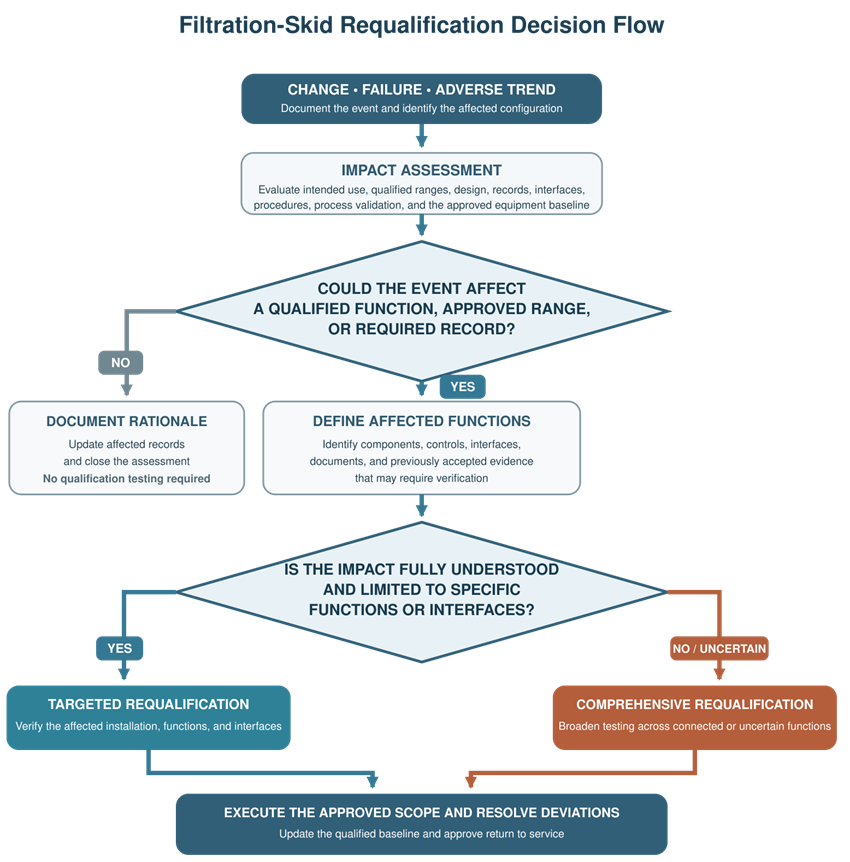
Retirement and Decommissioning
Retirement should be planned and documented. The process should address:
- Removal from service
- Equipment-status identification
- Cleaning or decontamination
- Utility isolation
- Product and material removal
- Software and configuration backup
- Electronic-record retention
- User-account removal
- Network disconnection
- Removal from calibration and maintenance programs
- Spare-part disposition
- Document archival
- Physical disposal or controlled reuse
Reusable components transferred to another system should be evaluated before installation. Previous qualification does not automatically establish suitability for a different intended use or configuration.
Regulatory Context
Filtration-skid qualification supports the equipment expectations in 21 CFR Part 211, Subpart D, including appropriate equipment design, construction, cleaning, maintenance, calibration, inspection, and controls over automated equipment.
The FDA guidance Process Validation: General Principles and Practices describes a lifecycle approach connecting process design, qualification, and continued verification. Equipment qualification supplies essential evidence within that lifecycle but should not be presented as equivalent to process validation.
Conclusion
Filtration-skid qualification should demonstrate that the installed mechanical system, instrumentation, automation, utilities, safety functions, and supporting documentation are suitable for the approved intended use.
An effective program begins with defined requirements and system boundaries, uses supplier and commissioning evidence appropriately, challenges critical functions during OQ, distinguishes equipment-level PQ from process validation, and maintains the qualified state through calibration, maintenance, change control, periodic review, and risk-based requalification.
The result is not merely a completed protocol package. It is a traceable body of evidence defining what the skid can do, the conditions under which it may be operated, and the controls required to keep it suitable throughout its lifecycle.