

Bioreactor Qualification and Lifecycle Control
Purpose and scope
Bioreactor qualification establishes documented evidence that an installed system is suitable for its intended GMP use and capable of operating within approved mechanical, process-control, contamination-control, automation, and safety requirements.
This article addresses qualification and lifecycle control of:
- Stainless-steel bioreactors and fermenters
- Single-use bioreactor hardware and disposable assemblies
- Seed, inoculum, pilot-scale, and production systems
- Associated agitation, gas, feed, sampling, harvest, CIP, SIP, instrumentation, and control functions
The article covers requirements, system boundaries, supplier documentation, design review, FAT, SAT, IQ, OQ, equipment performance verification, release, change control, periodic review, and requalification.
Detailed equipment functionality is addressed in Bioreactor and Fermenter Design, Functionality, and Process Control. Sensor and automation design are addressed in Bioreactor Instrumentation, Sensors, and Automation.
Equipment qualification does not independently establish:
- Product-specific biological process performance
- Process Performance Qualification
- Cleaning validation
- Aseptic-process simulation
- Complete computerized-system validation
- Suitability of every future product, batch size, recipe, or operating mode
Lifecycle position
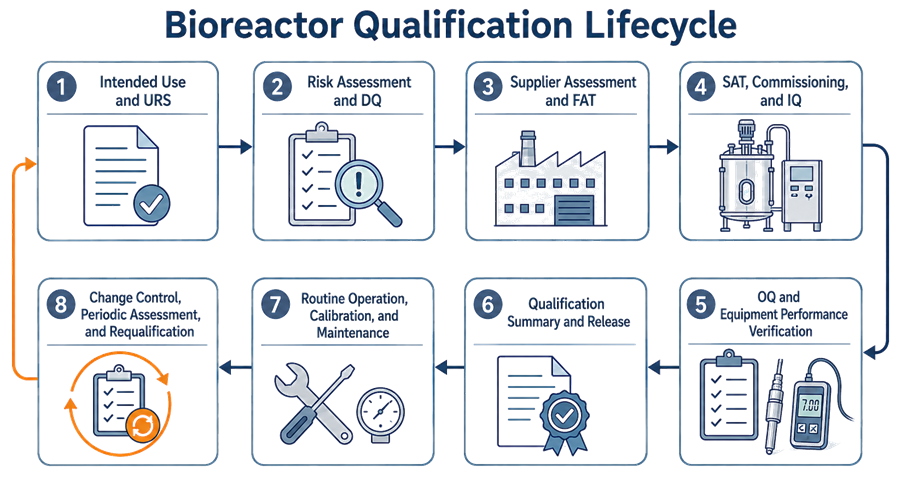
Bioreactor qualification begins before equipment installation. The lifecycle normally includes:
- Intended-use definition
- System boundary and GMP-impact assessment
- User requirements
- Design review and Design Qualification
- Supplier assessment and documentation planning
- Factory Acceptance Testing
- Site Acceptance Testing and commissioning
- Installation Qualification
- Operational Qualification
- Equipment performance verification or equipment-level PQ
- Formal release
- Routine operation and monitoring
- Maintenance, calibration, and change control
- Periodic assessment
- Risk-based requalification
- Controlled retirement
FDA’s process-validation lifecycle separates qualification of facilities, utilities, and equipment from Process Performance Qualification of the integrated commercial process. Both are elements of Stage 2, but they have different objectives and evidence. FDA Process Validation: General Principles and Practices.
The following illustration provides a simplified view of the qualification progression and its connection to requalification.
Regulatory and GMP basis
Applicable requirements depend on whether the bioreactor manufactures a finished drug product, biological drug substance, intermediate, or another regulated material.
For finished pharmaceuticals:
- 21 CFR 211.63 requires equipment to be appropriately designed, adequately sized, and suitably located for intended operation, cleaning, and maintenance.
- 21 CFR 211.65 addresses construction and product-contact surfaces.
- 21 CFR 211.67 establishes cleaning and maintenance requirements.
- 21 CFR 211.68 addresses automatic, mechanical, electronic, and computerized equipment and associated calibration, inspection, and checking.
These regulations establish required outcomes. They do not prescribe one universal bioreactor protocol structure or require identical test packages for every system.
Qualification strategy and system boundary
The qualification plan should define:
- Intended use
- Included equipment and functions
- External dependencies
- GMP-impact classification
- Applicable lifecycle documents
- Supplier-documentation use
- FAT, SAT, commissioning, and qualification allocation
- Testing responsibilities
- Acceptance-criteria basis
- Deviation management
- Release requirements
- Lifecycle controls
Bioreactor system boundary
The qualified boundary may include:
- Vessel or reusable support hardware
- Disposable bioprocess container
- Agitator, shaft, impellers, and drive
- Baffles and spargers
- Temperature-control surfaces and control unit
- Gas panel, regulators, mass-flow controllers, and sterile filters
- Exhaust path and backpressure control
- Feed and addition pumps
- Load cells, scales, or level measurement
- Sampling and harvest assemblies
- CIP spray devices and flow paths
- SIP steam, vent, trap, and condensate interfaces
- Process sensors and transmitters
- Valves and actuators
- PLC or distributed control functions
- HMI, recipes, alarms, data collection, and interfaces
External dependencies can include:
- Clean steam
- Process gases
- Purified Water or Water for Injection
- Cooling water or glycol
- Instrument air
- Electrical power
- Facility drains
- Building automation
- Network and time services
- Central CIP systems
- Historians, recipe servers, or manufacturing systems
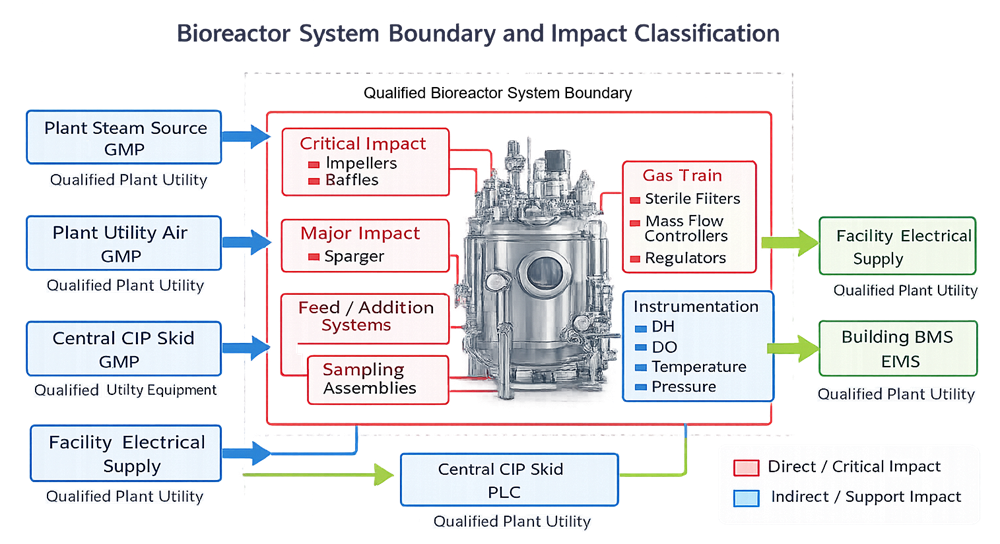
External systems should not be absorbed into the bioreactor qualification package merely because the bioreactor depends on them. Their qualification status and interface requirements should be identified and verified.
The system-boundary illustration distinguishes included bioreactor functions from qualified plant utilities and supporting systems.
GMP-impact assessment
Classification should follow the credible effect of a function or failure. The assessment should consider whether a component can affect:
- Product identity, strength, quality, purity, or potency
- Biological process conditions
- Sterility or containment
- Cross-contamination control
- Critical process measurements
- Automated control
- Electronic records
- Cleaning or sterilization effectiveness
- Safe and controlled equipment operation
Not every component inside the physical boundary requires identical qualification depth. A process sensor, impeller, sterile gas filter, HMI display, frame member, and decorative enclosure do not have equivalent GMP significance.
User requirements
The User Requirements Specification should define what the bioreactor must do without prescribing unnecessary design details. Requirements may include:
- Intended organism or cell-culture application
- Batch, fed-batch, perfusion, or continuous operating mode
- Minimum and maximum working volume
- Vessel geometry
- Stainless-steel or single-use configuration
- Product-contact materials
- Surface-finish and weld requirements
- Pressure and temperature limits
- Agitation range
- Impeller configuration
- Mixing-time requirements
- Gas identity and flow ranges
- Oxygen-transfer capability
- Temperature-control capability
- pH and dissolved-oxygen measurement
- Feed and addition ranges
- Sampling and harvest requirements
- CIP and SIP capability
- Sterile-boundary and containment requirements
- Alarm, interlock, and failure responses
- Recipe and phase control
- Data collection and retention
- User access and configuration protection
- Calibration and maintenance requirements
- Utility requirements
- Documentation and turnover requirements
Requirements should distinguish:
- Normal operating range
- Proven or qualified operating range
- Design range
- Alarm limits
- Mechanical or safety limits
These values are not automatically interchangeable.
Design review and Design Qualification
Design Qualification or an equivalent documented design-review process should confirm that the proposed system satisfies approved requirements and appropriately addresses identified risks. Review should include:
- Vessel and process-flow configuration
- Piping and instrumentation diagrams
- Materials and surface conditions
- Weld and passivation requirements
- Drainability and low points
- Dead-leg and retained-volume risks
- Agitator and seal design
- Gas-delivery and exhaust capacity
- Temperature-control capacity
- Pump sizing and feed accuracy
- Sensor technology and location
- Control-loop design
- Alarm and interlock strategy
- CIP spray coverage and return path
- SIP air removal, steam access, and condensate drainage
- Sterile-filter location and integrity-testing provisions
- Sampling and connection strategy
- Single-use assembly fit and pressure limits
- Automation architecture and data flows
- Access for calibration and maintenance
- Utility capacity and quality
- Pressure, vacuum, and personnel-safety protection
Design review should identify unresolved items before fabrication or configuration makes correction difficult.
Supplier assessment and documentation
Supplier documentation can reduce duplicate work, but it does not transfer GMP responsibility to the supplier. The turnover plan should identify required records such as:
- Equipment specifications
- Approved drawings
- Piping and instrumentation diagrams
- Instrument and valve lists
- Materials certificates
- Surface-finish records
- Weld documentation
- Passivation records
- Pressure-vessel documentation
- Purchased-component records
- Calibration certificates
- Software and firmware versions
- Input/output lists
- Control narratives
- Alarm and interlock schedules
- Recipe specifications
- Source-code or configuration-management arrangements, where applicable
- Operation and maintenance manuals
- Recommended spare parts
- Single-use assembly specifications
- Extractables and leachables support
- Irradiation and shelf-life information
- FAT and commissioning records
Supplier documents should be assessed for:
- Relevance to the delivered configuration
- Completeness
- Accuracy
- Traceability
- Approval status
- Test-method adequacy
- Data integrity
- Deviation resolution
A vendor checklist or unsigned test sheet should not be accepted solely because it was generated before delivery.
FAT, SAT, and commissioning leverage
Factory Acceptance Testing
FAT can verify functions that are most efficiently challenged before shipment, including:
- Equipment configuration
- Vessel and component identification
- Agitation operation
- Valve sequencing
- Instrument input simulation
- Recipe execution
- Alarm and interlock logic
- HMI navigation
- Data collection
- Communication interfaces
- Control-panel construction
- Single-use hardware fit
- Documentation completeness
FAT should emphasize configuration-dependent and software-intensive functions that may be difficult to correct after installation.
Site Acceptance Testing
SAT confirms that the delivered system remains complete and functional following shipment, installation, utility connection, and site integration.
SAT may include:
- Shipping-damage inspection
- Equipment and component reconciliation
- Utility connection checks
- Basic mechanical operation
- Instrument communication
- Network and interface verification
- HMI and recipe availability
- Safety and emergency functions
- Site-specific valve and transfer routing
- Confirmation that FAT conclusions remain applicable
Use of FAT and SAT evidence
FAT, SAT, and commissioning results may support qualification when:
- Tests were planned and approved appropriately
- Acceptance criteria were defined
- Instruments were suitable for the test
- Actual delivered configuration was tested
- Deviations were documented and resolved
- Records are complete and traceable
- No shipment, installation, or configuration change invalidated the result
Leveraging evidence does not mean copying FAT results into an IQ or OQ report without assessment. The qualification package should identify which requirement was tested, where it was tested, and why the evidence remains applicable.
Risk assessment and requirements traceability
Risk assessment should identify functions requiring challenge, failure testing, redundancy, monitoring, or lifecycle control.
Potential failure modes include:
- Loss of agitation
- Inadequate mixing
- Insufficient oxygen-transfer capacity
- Gas-routing error
- Exhaust-filter blockage
- Pressure-control failure
- Inadequate heat removal
- pH or DO sensor drift
- Incorrect feed delivery
- Valve-position failure
- CIP coverage deficiency
- SIP cold location
- Incomplete air removal
- Condensate retention
- Loss of sterile boundary
- Recipe or setpoint error
- Data loss
- Incorrect interface transfer
- Single-use bag damage or incorrect installation
The risk assessment should influence actual test scope. It should not exist only as a completed form separate from protocol design. General principles are addressed in Risk-Based Validation Approach for GMP Systems and Risk Assessment and FMEA-Based Analysis.
Requirements traceability
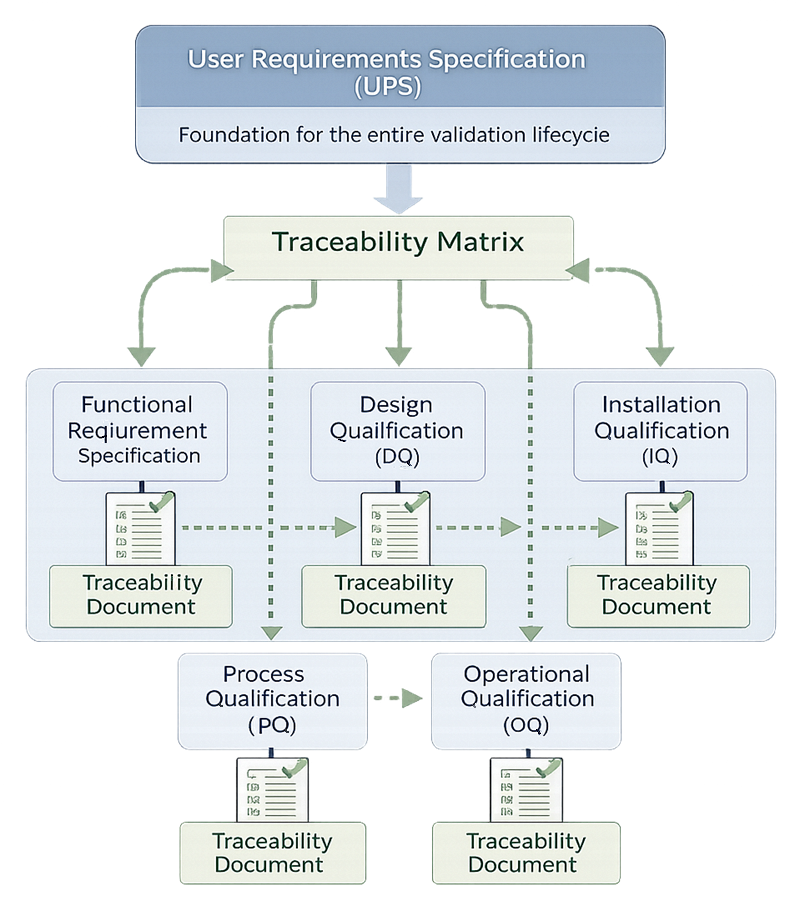
Traceability should connect:
- Requirement
- Design feature
- Risk or criticality
- Verification document
- Test result
- Deviation, where applicable
- Final acceptance status
The traceability matrix can allocate requirements among design review, FAT, SAT, commissioning, IQ, OQ, equipment performance verification, computerized-system validation, utility qualification, or another controlled activity.
The following illustration shows the relationship between requirements and qualification evidence.
Installation Qualification
IQ verifies that the installed bioreactor and its documented configuration conform to approved design and supplier requirements.
Equipment identification and installation
IQ should verify, as applicable:
- Manufacturer
- Model
- Serial number
- Equipment tag
- Installation location
- Vessel capacity
- Agitator and motor
- Impellers and baffles
- Sparger type
- Pumps
- Valves
- Filters
- Sensors
- Control panel
- Reusable single-use-system hardware
- Ancillary equipment
The installed configuration should be reconciled against approved drawings, specifications, and bills of material.
Mechanical installation
Verification may include:
- Equipment support and anchoring
- Vessel leveling
- Agitator alignment
- Shaft and impeller installation
- Mechanical-seal installation
- Valve orientation
- Piping slope
- Drainability
- Gasket installation
- Pressure and vacuum protection
- Maintenance access
- Correct flow direction
- Equipment and line labeling
Materials and sanitary construction
Records should confirm:
- Product-contact material identity
- Surface-finish requirements
- Weld documentation
- Passivation status
- Gasket and elastomer materials
- Lubricant suitability
- Single-use product-contact materials
- Component compatibility with cleaning, sterilization, and process conditions
IQ confirms documented material and construction status. It does not independently demonstrate product compatibility, cleaning effectiveness, or absence of extractables and leachables.
Utilities
Installed utilities should be verified against design requirements:
- Electrical power
- Instrument air
- Process gases
- Clean steam
- CIP supply and return
- Cooling or heating utility
- Water supply
- Drainage
- Network connection
- Time synchronization
Utility quality and capacity should be established through the applicable utility program. Bioreactor testing should confirm the interface and available operating condition at the equipment.
Instrumentation and configuration baseline
IQ should establish:
- Installed instrument identity
- Manufacturer, model, and serial number
- Measurement range
- Engineering units
- Transmitter configuration
- PLC input assignment
- Calibration status
- Calibration interval
- Alarm baseline
- Software and firmware versions
- Recipe and configuration versions
Detailed instrumentation controls are addressed in Bioreactor Instrumentation, Sensors, and Automation.
Documentation verification
The IQ package should identify the approved baseline for:
- Drawings
- Specifications
- Manuals
- Instrument list
- Valve list
- Input/output list
- Control narrative
- Alarm and interlock schedule
- Software and configuration records
- Spare-parts list
- Preventive-maintenance requirements
- Calibration requirements
- Supplier documentation
- FAT and SAT records
Operational Qualification
OQ demonstrates that the installed system functions as intended throughout defined operating, challenge, failure, and recovery conditions. Testing should be traceable to requirements and risks rather than organized only around component lists.
OQ prerequisites
Before OQ execution, confirm:
- IQ acceptance
- Applicable utility availability
- Calibration status
- Approved test procedures
- Required software and recipe baseline
- Training of test personnel
- Availability of test equipment
- Defined deviation process
- Appropriate safety controls
Conditional execution should be formally justified and should not obscure unresolved prerequisites.
Agitation and mechanical operation
Testing may include:
- Minimum and maximum agitation speed
- Speed indication and feedback
- Direction of rotation
- Ramp and acceleration behavior
- Variable-frequency-drive operation
- Abnormal vibration
- Motor overload
- Seal performance
- Agitator trip
- Restart and recovery behavior
- Operation at minimum and maximum working volume
Mixing-time studies may be appropriate when mixing capability is an equipment requirement. The study should define the fluid, working volume, agitation condition, tracer, addition location, measurement locations, endpoint, and acceptance criterion.
Temperature control
OQ should evaluate:
- Heating capability
- Cooling capability
- Setpoint stability
- Control-loop response
- Overshoot
- Recovery after additions or disturbances
- Performance at representative minimum and maximum volume
- High and low alarms
- Heating or cooling utility failure
- Agreement among applicable sensors
- Temperature-control-unit interface
Worst-case cooling demand may require a justified thermal load or simulation. An empty or low-load test may not represent maximum metabolic heat-removal demand.
Gas delivery and pressure control
Testing may address:
- Gas identity and routing
- Mass-flow-controller ranges
- Minimum and maximum flow
- Gas-switching logic
- Oxygen-enrichment sequence
- Carbon dioxide addition
- Overlay gas
- Backpressure control
- Pressure alarms
- Pressure-relief interface
- Gas-supply interruption
- Exhaust restriction
- Filter-housing integrity
- Recovery following disturbance
Facility gas-system controls are addressed in Process Gas Systems for GMP Manufacturing.
pH and dissolved-oxygen control
Functional testing can use water, buffer, a suitable surrogate, instrument simulation, or another justified method. Testing should verify:
- Measurement range and scaling
- Setpoint management
- Acid and base pump response
- Gas-based pH control
- Dissolved-oxygen cascade sequence
- Output transition points
- Output limits
- Response to controlled disturbances
- Overshoot and oscillation
- Sensor-failure response
- Alarm behavior
- Manual-mode restrictions
Equipment OQ does not need to reproduce a complete biological culture when equivalent functional challenges demonstrate the requirement.
Feed and addition systems
Testing may include:
- Pump direction
- Minimum and maximum delivery
- Accuracy and repeatability
- Weight or flow verification
- Load-cell response
- Loss-of-prime detection
- Occlusion or blockage response
- Maximum delivery limit
- Addition sequencing
- Material reconciliation
- Recovery following interruption
Control-loop challenges
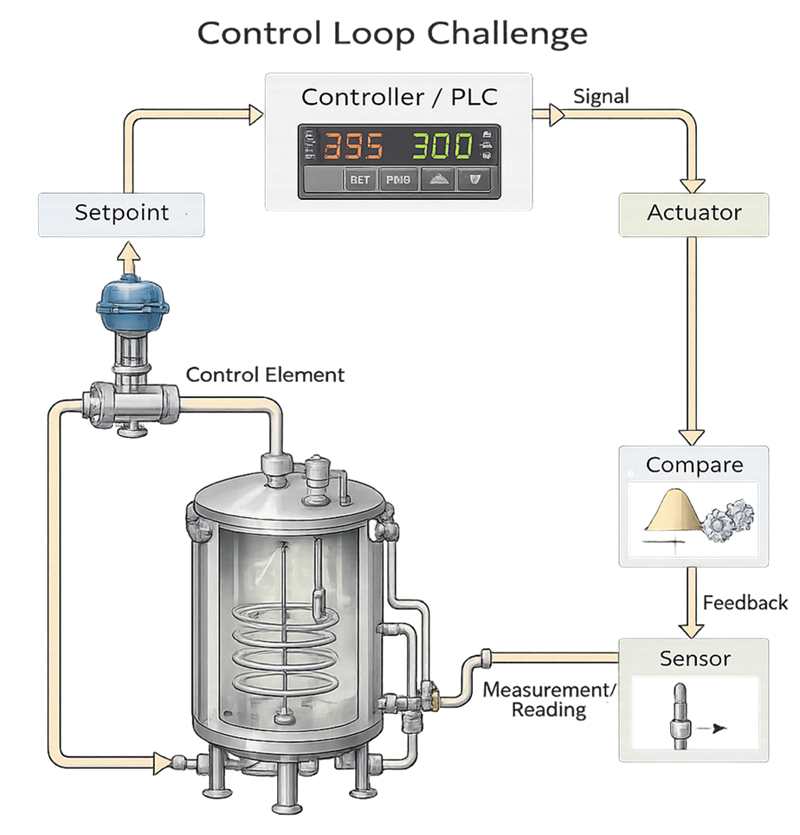
A control-loop challenge evaluates the complete path:
- Setpoint or control instruction
- Controller logic
- Actuator response
- Physical process response
- Sensor measurement
- Feedback comparison
- Alarm or limit response
The test should evaluate stability, overshoot, recovery, output limits, and behavior following a credible disturbance.
Recipes, sequences, and operating modes
OQ should verify applicable phases such as:
- Preparation
- Leak testing
- CIP
- SIP
- Media charge
- Temperature conditioning
- Inoculation
- Cultivation
- Feeding
- Perfusion
- Harvest
- Shutdown
Testing should confirm:
- Phase entry conditions
- Valve and equipment states
- Setpoint loading
- Permissives
- Transition criteria
- Hold conditions
- Operator prompts
- Abort behavior
- Restart and recovery
- Protection against incompatible routing
Alarm, interlock, and failure testing
Testing should challenge the cause of the condition where practical, not merely force an alarm bit on the HMI.
| Failure condition | Expected verification |
|---|---|
| Agitator trip | Alarm, output response, equipment state, restart controls |
| Loss of gas supply | Alarm, cascade response, alternate supply or defined recovery |
| High vessel pressure | Alarm, control response, protective action and relief coordination |
| Exhaust restriction | Pressure response and prevention of uncontrolled overpressure |
| Loss of cooling | Temperature alarm, valve response and recovery strategy |
| Sensor signal failure | Bad-signal detection, control response and operator notification |
| Feed-pump failure | Delivery discrepancy, alarm and phase response |
| Valve-position failure | Command-versus-feedback detection and sequence inhibition |
| Power interruption | Defined equipment state and controlled restart |
| PLC or communication failure | Alarm, fail-safe behavior and recovery |
| Data-storage failure | Notification, buffering or controlled operating restriction |
| Single-use leak indication | Alarm, shutdown or defined containment response |
A “safe state” should be defined according to actual consequences. Immediate shutdown of every function may protect the equipment while unnecessarily compromising the batch, containment, or sterile boundary.
CIP functional qualification
CIP qualification should demonstrate that the installed bioreactor and cleaning circuit can execute the approved cleaning sequence and deliver the required operating conditions.
Testing may include:
- Correct routing
- Spray-device operation
- Coverage
- Flow
- Pressure
- Temperature
- Conductivity or concentration measurement
- Cycle timing
- Valve sequencing
- Return conditions
- Drainability
- Low-point clearance
- Alarm and abort behavior
- Recipe control
The following illustration shows a representative bioreactor CIP flow path.
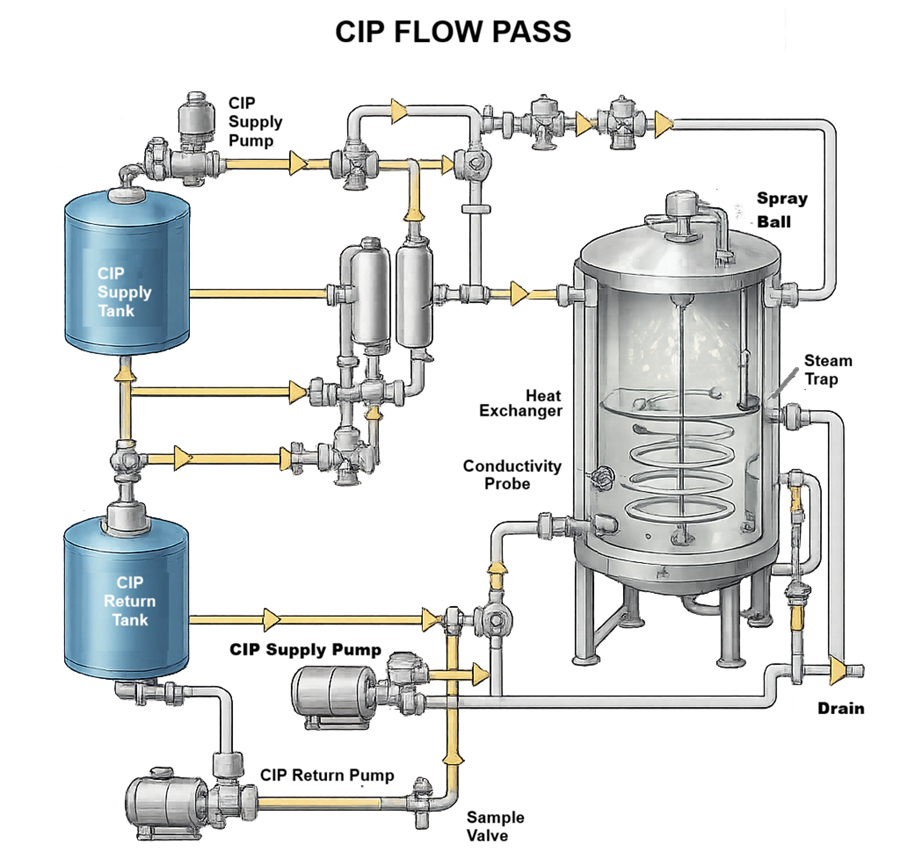
CIP functional qualification demonstrates equipment and cycle capability. It does not establish acceptable removal of every product residue. Product-specific residue limits, worst-case products, sampling, analytical methods, and cleaning efficacy are addressed through the Cleaning Validation Approach.
Detailed utility-system architecture and functional qualification are addressed in Clean-in-Place Utility Systems.
SIP functional qualification
SIP must be evaluated as an integrated sterilization process involving the vessel, connected flow paths, steam supply, vents, valves, traps, filters, sensors, and automation.
Qualification should address:
- Defined sterile boundary
- Pre-SIP equipment state
- Air removal
- Steam admission
- Saturated-steam conditions
- Condensate removal
- Temperature distribution
- Identified cold or difficult locations
- Exposure time
- Lethality, where applicable
- Connected additions and sample paths
- Inlet and exhaust filters
- Valve sequencing
- Pressure control
- Drying or post-SIP conditioning
- Post-SIP boundary integrity
- Cycle failure and recovery
The following illustration identifies representative temperature-measurement locations around an integrated vessel and connected boundary.
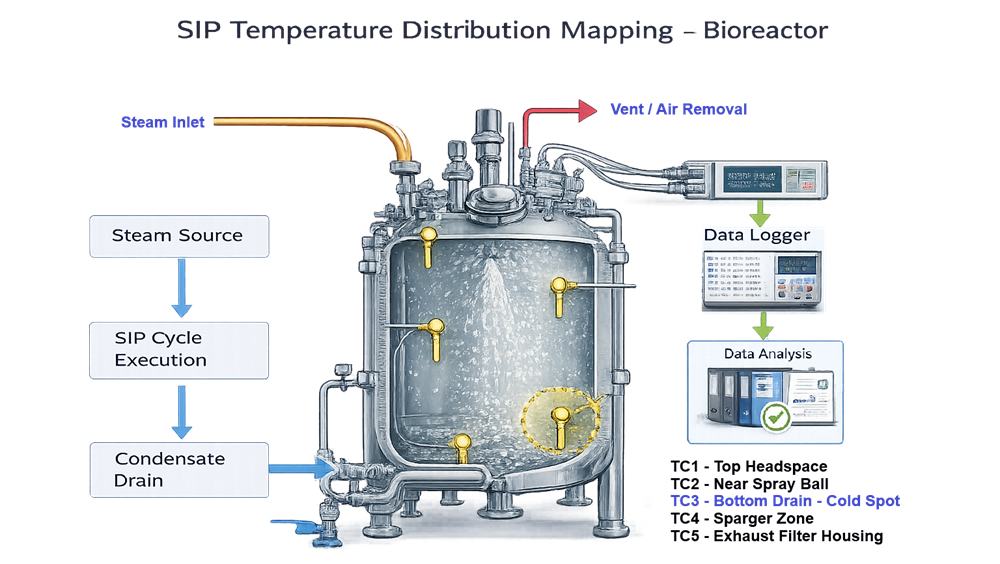
The bottom drain is often a location requiring attention, but it should not automatically be declared the cold spot without evidence. Worst-case locations must be determined from design, development studies, and mapping results.
Detailed cycle-development and qualification principles are addressed in Steam-in-Place Utility Systems.
Single-use bioreactor qualification
A single-use bioreactor consists of reusable hardware and disposable product-contact components. The qualification strategy should address both without treating every disposable assembly as a permanent installed component.
Reusable hardware
Qualification may include:
- Support structure
- Mixing drive
- Bag-retention system
- Load cells
- Temperature-control hardware
- Gas panel
- Pumps
- Sensor readers
- Control system
- Alarms and protective functions
- Maximum pressure and load controls
Disposable assembly
Controls may address:
- Approved assembly specification
- Supplier and manufacturing site
- Product-contact materials
- Irradiation status
- Shelf life
- Shipping and storage
- Correct assembly selection
- Bag fit and installation
- Connector compatibility
- Tubing and filter configuration
- Sensor-patch compatibility
- Leak or pressure testing, where applicable
- Maximum volume and pressure
- Mixing at minimum and maximum volume
- Installation inspection
- Lot traceability
Routine receipt and pre-use checks confirm that the approved disposable assembly is correct and undamaged. They do not require repeating full IQ and OQ for every lot.
Changes in film, port configuration, tubing, filters, sensor patches, irradiation, supplier, manufacturing site, or assembly method require documented impact assessment.
Equipment performance verification
After functional qualification, representative operating studies may be used to demonstrate sustained performance under intended-use conditions.
Depending on the system and site terminology, this phase may be called:
- Performance Qualification
- Equipment PQ
- System PQ
- Equipment performance verification
- Representative-use verification
The study may use:
- Water
- Buffer
- Growth medium without cells
- A qualified surrogate
- Engineering material
- Representative production material, where justified
Study conditions should represent the intended equipment use and relevant risks, including:
- Minimum and maximum working volume
- Representative agitation
- Gas flow and pressure
- Temperature-control load
- Addition sequences
- Sampling and harvest
- Operating duration
- Approved recipe
- Trained operators
- Routine procedures
- Applicable CIP and SIP states
Acceptance criteria should remain equipment-focused, such as:
- Mixing performance
- Temperature stability
- Pressure control
- Gas-flow control
- Pump delivery
- Measurement reliability
- Recipe execution
- Alarm performance
- Drainability
- Sterile-boundary functions
The number of runs should be justified from system risk, test purpose, variability, existing evidence, and site procedures. Three runs are not a universal regulatory requirement for equipment performance verification.
Equipment qualification versus process validation
Equipment qualification and Process Performance Qualification are connected but not interchangeable.
| Aspect | Equipment qualification | Process Performance Qualification |
|---|---|---|
| Primary objective | Demonstrate equipment suitability and operating capability | Demonstrate reproducible commercial-process performance |
| Focus | Mechanical, functional, control, cleaning, sterilization, and data functions | Integrated process and product outcomes |
| Acceptance basis | URS, design requirements, operating ranges, functional criteria | Process parameters, CQAs, specifications, and control strategy |
| Materials | Water, buffers, surrogates, or representative materials may be used | Defined commercial materials and process conditions |
| Product testing | Not necessarily required for every equipment test | Central to PPQ evaluation |
| Number of runs | Risk- and purpose-based | Defined by the PPQ strategy and process knowledge |
| Outcome | Equipment released as suitable for intended use | Commercial process demonstrated as reproducible |
| Lifecycle continuation | Maintenance, calibration, periodic assessment, requalification | Continued Process Verification |
General equipment-PQ principles are addressed in Performance Qualification for GMP Equipment and Systems. The integrated relationship between equipment qualification and PPQ is addressed in Process Qualification: Equipment Qualification and PPQ.
Equipment qualification provides the controlled platform required for PPQ. It does not demonstrate cell growth, product yield, potency, impurity clearance, glycosylation, or other product-specific outcomes unless those attributes are deliberately included in a separate process-validation study.
Aseptic-process boundary
Closed bioreactor operations may include sterile additions, sampling, inoculation, harvest, filter connections, and transfers. Equipment qualification can verify:
- Correct connection design
- Valve sequencing
- Pressure integrity
- Closed-transfer function
- Filter-housing provisions
- Sampling-device operation
- Addition-path configuration
- SIP or disposable-boundary preparation
Equipment qualification does not replace microbiological evaluation of the integrated aseptic process. Where applicable, this is addressed through Media Fill and Aseptic Process Simulation or another product- and process-appropriate aseptic-validation strategy.
Computerized-system boundary
Bioreactor qualification should verify control functions required for equipment operation, including:
- Inputs and outputs
- Scaling
- Control loops
- Recipes
- Sequences
- Alarms
- Interlocks
- Equipment states
- Data display
- Applicable reports
- Interfaces
- Failure and recovery behavior
The broader computerized-system lifecycle may additionally address:
- Supplier assessment
- Software and configuration requirements
- Requirements traceability
- User and role management
- Audit trails
- Electronic signatures
- Data retention
- Backup and recovery
- Cybersecurity
- Infrastructure
- Periodic access review
- Software change control
Equipment qualification should not claim complete computerized-system validation merely because control loops and HMI screens were tested. The strategy should be coordinated with Computerized Systems Validation Planning and, where applicable, 21 CFR Part 11 Compliance and Checklist.
Deviations and qualification acceptance
Qualification deviations should document:
- Requirement or test affected
- Expected result
- Actual result
- Immediate correction
- Root cause or technical explanation
- Potential impact on other tests
- Potential impact on product or process readiness
- Retesting
- Corrective action
- Final disposition
Retesting should not erase the original result. The qualification report should explain why the final evidence is sufficient.
Open items may be classified according to risk and release impact, but conditional release requires:
- Defined restriction
- Interim control
- Assigned owner
- Due date
- Escalation criteria
- Quality approval
- Documented closure requirement
Critical unresolved deficiencies affecting process control, sterility, containment, electronic records, or safe operation should not be hidden behind administrative punch-list status.
Qualification summary and release
The final qualification report should:
- Identify the approved system and boundary
- Summarize executed documents
- Confirm requirements coverage
- Evaluate deviations
- Identify qualified operating ranges
- Identify approved recipes and configurations
- State CIP and SIP status
- State computerized-system dependencies
- Identify unresolved limitations
- Define calibration and maintenance requirements
- State the release decision
- Identify required lifecycle controls
Release should apply to a defined configuration and intended use. It should not be written so broadly that it appears to approve untested volumes, recipes, disposable assemblies, products, or process modes.
Lifecycle monitoring and periodic assessment
After release, continued control should be supported by review of:
- Calibration status and drift
- Preventive and corrective maintenance
- Seal, bearing, impeller, and valve condition
- Sensor replacement
- Alarm frequency
- Control-loop performance
- Recipe and configuration changes
- CIP and SIP performance
- Filter failures
- Utility interruptions
- Batch deviations related to equipment
- Single-use assembly failures
- Supplier notifications
- Backup and recovery results
- Obsolescence and spare-parts availability
Calibration controls are addressed in GMP Calibration Program and Metrology Control. Mechanical reliability is addressed in Preventive Maintenance and Equipment Reliability.
Periodic assessment should determine whether:
- Intended use remains unchanged
- Approved operating ranges remain suitable
- Qualification documentation remains current
- Changes were properly assessed
- Deviations indicate loss of capability
- Maintenance remains effective
- Calibration intervals remain justified
- Repeated alarms indicate emerging problems
- Existing requalification scope remains adequate
- Continued GMP use remains supported
General periodic-review principles are addressed in Periodic Equipment Assessment.
Change control and requalification
Changes requiring qualification impact assessment can include:
- New product or organism
- Changed working volume
- Changed process mode
- New impeller or sparger
- Agitator-drive replacement
- Seal replacement
- Gas-panel modification
- Mass-flow-controller replacement
- Sensor technology or location change
- Temperature-control modification
- New feed pump or tubing
- Valve or piping modification
- CIP recipe or spray-device change
- SIP sequence or parameter change
- New sterile filter
- Disposable assembly change
- PLC logic or recipe change
- HMI, historian, or interface modification
- Network or infrastructure change
- Extended shutdown
- Major repair
- Recurring performance failure
The assessment should determine which requirements, functions, risks, records, and previous test conclusions may be affected.
Possible outcomes include:
- Documentation update only
- Inspection or calibration
- Targeted functional verification
- Targeted OQ
- Targeted equipment performance verification
- Targeted CIP or SIP requalification
- Broader partial requalification
- Comprehensive requalification
- Process-validation or comparability assessment
- Restricted use pending resolution
The following decision map illustrates a risk-based requalification approach.
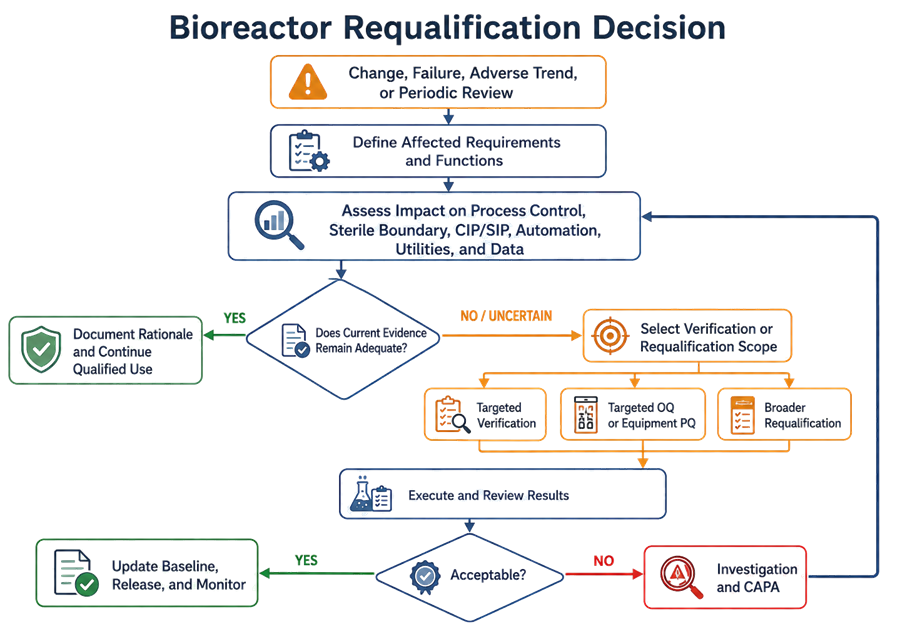
General decision principles are addressed in Risk-Based Requalification of GMP Equipment, Systems, and Utilities.
Documentation package
The controlled qualification package should include or reference:
- Intended-use statement
- System-boundary assessment
- GMP-impact assessment
- User Requirements Specification
- Design Qualification or design-review records
- Risk assessments
- Supplier assessment
- Turnover-documentation index
- FAT and SAT records
- Commissioning records used as qualification evidence
- IQ, OQ, and equipment-performance protocols and reports
- Traceability matrix
- Calibration records
- Software and configuration baseline
- Deviations and corrective actions
- Qualification summary report
- Release authorization
- Operating and maintenance procedures
- Change-control records
- Periodic assessments
- Requalification records
- Retirement records
Documentation should distinguish factual test evidence from engineering judgment. Conclusions should identify why the available evidence supports fitness for the approved intended use.
Conclusion
Bioreactor qualification demonstrates that the defined system is correctly designed, installed, configured, operated, and controlled for its approved GMP use. The strategy should integrate requirements, risk assessment, supplier evidence, FAT, SAT, commissioning, IQ, OQ, representative performance verification, and formal release.
Qualification must challenge normal operation, operating limits, failures, recovery, CIP, SIP, automation, and connected utilities according to actual risk. It must also preserve clear boundaries with cleaning validation, computerized-system validation, aseptic-process validation, and product-specific PPQ.
The qualified state is maintained through calibration, maintenance, monitoring, change control, periodic assessment, and risk-based requalification. Qualification is therefore a lifecycle control system, not a one-time collection of protocols.