

Dispensing and Material Handling Systems Qualification
Dispensing and material handling systems control the movement of pharmaceutical ingredients from released warehouse inventory into manufacturing. The systems must ensure that the correct material is identified, accurately weighed, properly labeled, protected from contamination, and transferred to the intended receiving equipment without unacceptable loss, segregation, or operator exposure.
The equipment boundary may include dispensing booths, balances, scales, drum and bag handling devices, intermediate bulk containers, bin lifters, docking stations, vacuum or pneumatic transfer systems, contained transfer valves, sieves, local dust extraction, barcode readers, printers, and electronic dispensing applications.
Equipment qualification demonstrates that these systems are suitable for their intended use. It does not replace process validation, cleaning validation, occupational-exposure assessment, or verification of the complete manufacturing batch.
Scope and System Boundaries
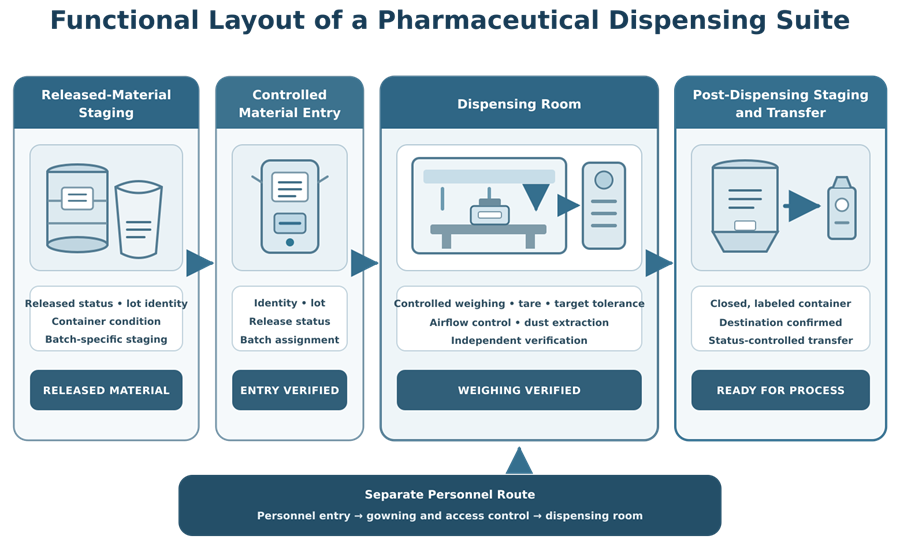
A dispensing and material handling system may extend from the point where a released material is staged for dispensing through delivery of the measured quantity to the next manufacturing operation.
The boundary should identify:
- Material staging and status-control areas
- Dispensing room or booth
- Balances, floor scales, and load cells
- Original and secondary containers
- Scoops, funnels, liners, and transfer utensils
- Drum, bag, and container lifting devices
- Intermediate bulk containers and mobile bins
- Bin lifters and docking stations
- Vacuum or pneumatic transfer equipment
- Flexible hoses and rigid transfer lines
- Split butterfly valves or other contained connections
- Sieves used during or immediately after dispensing
- Dust-extraction connections
- Barcode scanners and label printers
- Electronic batch-record or dispensing software
- Interfaces with warehouse and manufacturing systems
- Transfer to milling, blending, or granulation equipment
The boundary should also distinguish product-contact equipment from non-product-contact handling devices. A pallet truck may influence material flow and operator safety without becoming part of the product-contact boundary. A reusable IBC, transfer hose, valve, or charging funnel normally becomes part of the product-contact and cleaning boundary.
Dispensing and Material Flow
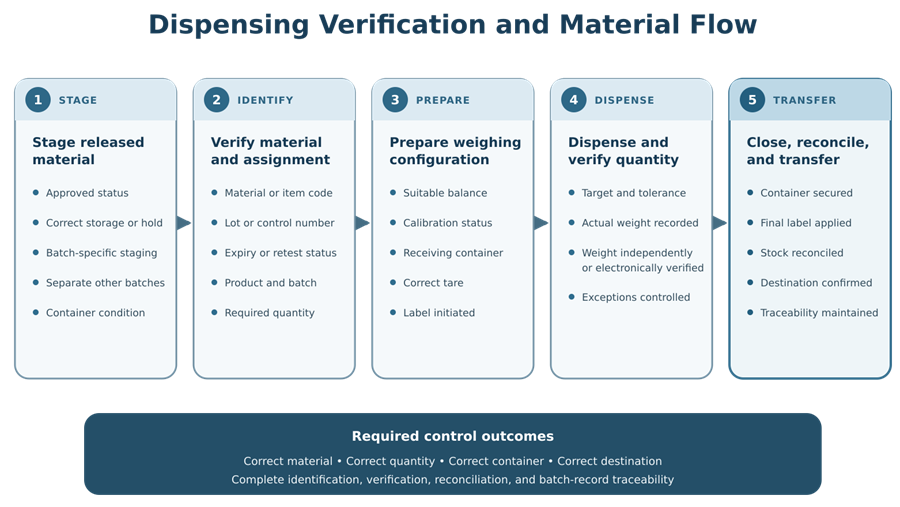
A controlled dispensing process normally follows a defined sequence:
- Released materials are selected and staged.
- Material identity and status are verified.
- The approved batch requirement is retrieved.
- The correct balance or scale is selected.
- The receiving container is identified and tared.
- The required quantity is dispensed.
- The weight or measure is verified.
- The dispensed container is closed and labeled.
- Remaining material is reconciled and returned or otherwise dispositioned.
- Dispensed material is transferred to the designated manufacturing operation.
- Equipment and areas are cleared and cleaned.
Under 21 CFR 211.101, component dispensing must include controls for material release status, weight or measure, container identification, supervision, and verification. Automated equipment may support the verification pathway when it is controlled under 21 CFR 211.68.
Material flow should prevent:
- Use of unreleased or expired material
- Selection of an incorrect lot
- Mixing of staged materials from different batches
- Loss of label identity
- Use of the wrong receiving container
- Cross-contamination
- Uncontrolled return of partial containers
- Transfer to the wrong downstream equipment
- Unexplained yield or reconciliation differences
Equipment and containers should remain identified with their contents and processing status. Equipment identification and traceability requirements are addressed in 21 CFR 211.105.
Equipment Architecture
Dispensing Booths and Weighing Stations
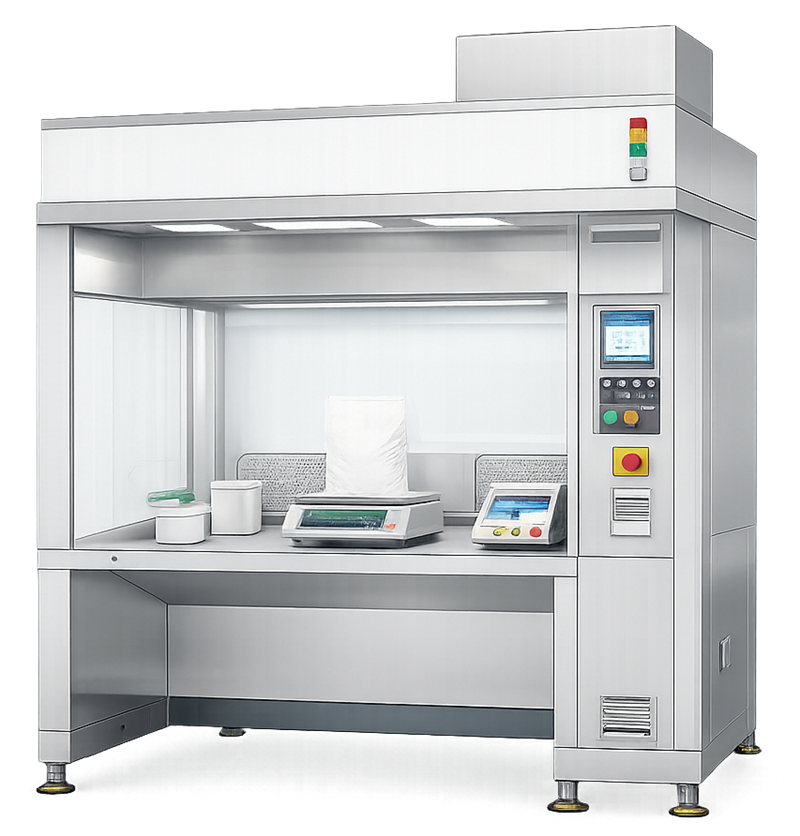
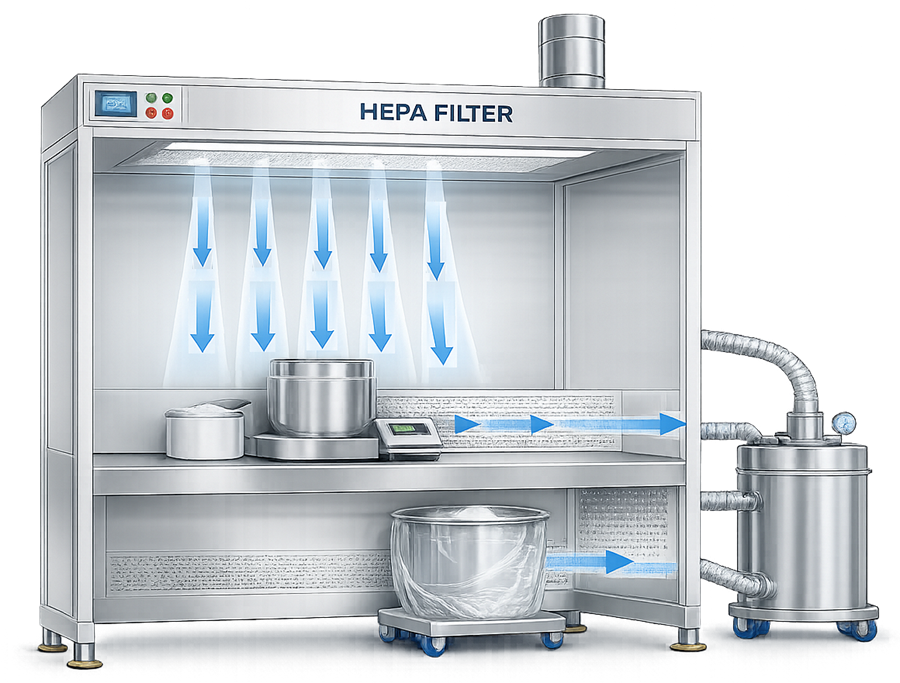
Dispensing booths provide a controlled location for opening containers, sampling or subdividing materials, and performing weighing operations.
Depending on the intended use, booth design may include:
- Directional or unidirectional airflow
- Local exhaust or recirculating airflow
- Supply and exhaust filtration
- Rear or low-level dust capture
- Differential-pressure monitoring
- Airflow alarms
- Integrated work surfaces
- Balance isolation platforms
- Electrical and data connections
- Washable internal surfaces
- Safe-change filtration arrangements
The airflow arrangement must reflect the required combination of product protection, operator protection, and environmental containment. A downflow booth should not automatically be described as providing both product and personnel protection without an assessment of the actual airflow, filtration, material hazard, work practices, and room-pressure strategy.
Airflow turbulence around a balance may delay stabilization or influence the measured value. Balance placement and booth airflow therefore require coordinated design.
Balances, Scales, and Load Cells
The weighing device must be suitable for the quantities and tolerances used in the dispensing process.
Selection should consider:
- Maximum capacity
- Intended operating range
- Smallest routinely dispensed quantity
- Readability and resolution
- Required measurement uncertainty
- Repeatability
- Linearity
- Eccentric-load sensitivity
- Stabilization time
- Environmental influences
- Tare requirements
- Cleaning and material compatibility
- Printer, scanner, or software interfaces
Calibration alone does not establish suitability. A calibrated balance may still be inappropriate when the smallest dispensed quantity is too close to its lower practical operating capability or when its resolution does not support the required tolerance.
Environmental influences may include:
- Airflow
- Floor or equipment vibration
- Electrostatic charge
- Temperature change
- Humidity
- Unstable support surfaces
- Nearby doors or traffic
- Electrical interference
Critical weighing devices should be controlled under the applicable calibration program and metrology control.
Containers and Intermediate Bulk Containers
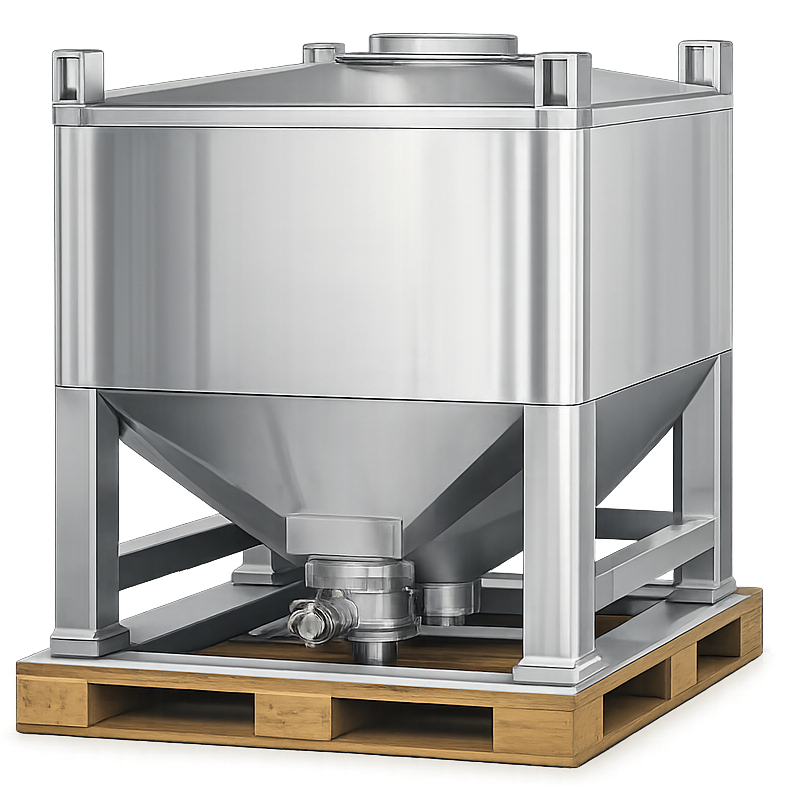
Materials may be dispensed into bags, bottles, drums, mobile bins, or intermediate bulk containers.
Container design should address:
- Material compatibility
- Product-contact surface condition
- Closure integrity
- Label attachment
- Cleanability
- Drainability or discharge
- Powder retention
- Handling and lifting points
- Grounding provisions
- Connection to downstream equipment
- Protection during staging and transport
Reusable IBCs should minimize ledges, inaccessible corners, valve cavities, gasket gaps, and other locations where powder can remain after discharge or cleaning.
Single-use liners may reduce cleaning requirements, but they introduce additional controls for material compatibility, integrity, installation, lot traceability, disposal, and prevention of liner collapse or blockage during discharge.
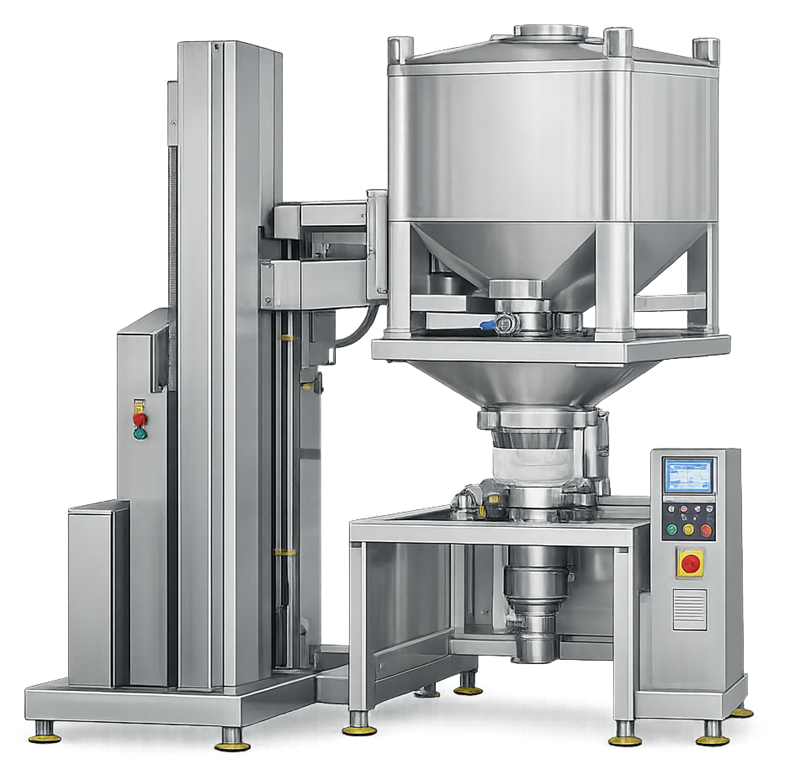
Bin Lifters and Docking Systems
Bin lifters position containers above receiving equipment and permit controlled gravity discharge.
Important design features include:
- Rated lifting capacity
- Container-retention mechanism
- Positive docking and alignment
- Upper and lower travel limits
- Position feedback
- Mechanical guarding
- Emergency stop
- Prevention of movement during discharge
- Controlled valve opening
- Safe response to power loss
- Access for inspection and maintenance
The container, lifting frame, docking station, discharge valve, and receiving equipment function as an integrated mechanical system. Qualification should test the assembled configuration rather than evaluating each component independently.
Vacuum and Pneumatic Transfer
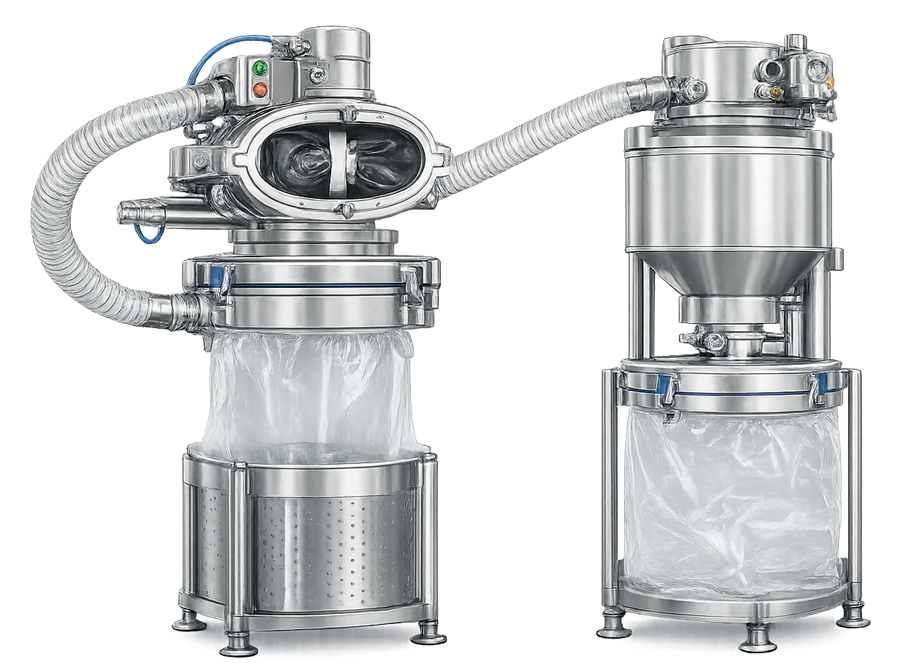
Vacuum and pneumatic systems move powders through enclosed hoses or piping. These systems can reduce manual handling and open exposure, but their suitability depends on the material and transfer conditions.
Design variables may include:
- Transfer pressure or vacuum
- Air or gas flow
- Conveying velocity
- Feed rate
- Transfer distance
- Vertical lift
- Line diameter
- Number and radius of bends
- Receiver-filter design
- Filter-cleaning sequence
- Material discharge sequence
- Transfer-gas quality
- Grounding and bonding
- Line-clearance and cleaning provisions
Transfer conditions can influence particle attrition, electrostatic charging, segregation, filter blinding, line blockage, material recovery, and residual hold-up.
Compressed air or process gas that contacts the material must be suitable for its intended use. Utility quality should be defined from the product and process risk rather than by a generic requirement such as “oil-free” without supporting specifications.
Contained Transfer Connections
Contained docking devices, split butterfly valves, continuous liners, and other closed-transfer connections reduce powder release at the interface between containers and process equipment.
Critical characteristics may include:
- Correct active and passive valve pairing
- Mechanical alignment
- Seal and gasket integrity
- Surface condition
- Locking sequence
- Prevention of premature opening
- Residual powder at exposed interfaces
- Cleaning or safe-change method
- Verification of correct container connection
A contained valve should not be assumed to meet an occupational-exposure objective solely because it is described as a high-containment device. Performance depends on the complete connection, operating technique, maintenance condition, material properties, and exposure-assessment method.
Sieving and Pre-Processing Interfaces
A sieve may be positioned after dispensing to break soft agglomerates or remove unintended foreign matter before the material enters milling equipment, blending and mixing equipment, or granulation equipment.
When included within the dispensing system, the sieve boundary should address:
- Screen identity and opening size
- Screen integrity
- Installation and orientation
- Vibration or operating speed
- Foreign-material control
- Product retention
- Contained charging and discharge
- Cleaning and inspection
- Screen-change control
Particle-size reduction that intentionally changes a material attribute belongs within the milling-process boundary rather than being treated as simple dispensing support.
Containment and Dust Control
Powder containment should be based on material hazard, dust generation, batch scale, operating duration, task frequency, room design, and the required exposure or contamination-control objective.
Potential controls include:
- Closed containers
- Local exhaust ventilation
- Downflow dispensing booths
- Glovebag or glovebox systems
- Contained docking devices
- Split butterfly valves
- Vacuum transfer
- Disposable liners
- Dedicated dust extraction
- Room-pressure control
- Cleaning and decontamination procedures
- Personal protective equipment as a supplementary control
The associated containment and dust collection systems article addresses centralized and local dust-extraction architecture, filtration, airflow balancing, filter monitoring, and lifecycle verification.
Containment Performance
Containment verification may include:
- Airflow measurement
- Directional-airflow visualization
- Differential-pressure testing
- Alarm challenges
- Dust-capture observation
- Surrogate powder testing
- Personal or area exposure monitoring
- Surface-deposition assessment
- Evaluation of docking and disconnection
- Assessment of filter or liner changes
- Evaluation of cleaning and waste removal
The test method and acceptance criteria should reflect the containment objective. Occupational exposure limits, short-term exposure limits, internal control targets, or other industrial-hygiene criteria should be established through the applicable safety and exposure-control program.
A smoke study can demonstrate airflow direction but does not quantify containment of an actual powder. Surrogate testing can provide stronger evidence but must represent the material properties, task, duration, quantity, and operating conditions relevant to the intended use.
Material Transfer Performance
Successful material transfer requires more than visible movement of powder from one container to another.
Performance evaluation should consider:
- Transfer completion
- Material recovery
- Residual hold-up
- Line or hose blockage
- Filter loading
- Discharge consistency
- Transfer duration
- Material loss
- Dust release
- Segregation
- Particle attrition
- Electrostatic accumulation
- Reproducibility across loads
Material Recovery
Transfer recovery may be calculated as:
Recovery (%) = (Mass delivered to the receiving container ÷ Mass introduced into the transfer system) × 100
The calculation should define how the weights are reconciled, which containers and retained residues are included, and how measurement uncertainty is handled.
A high recovery result does not demonstrate absence of segregation. A system may transfer nearly all the material while changing the distribution of particle sizes or components within the delivered material.
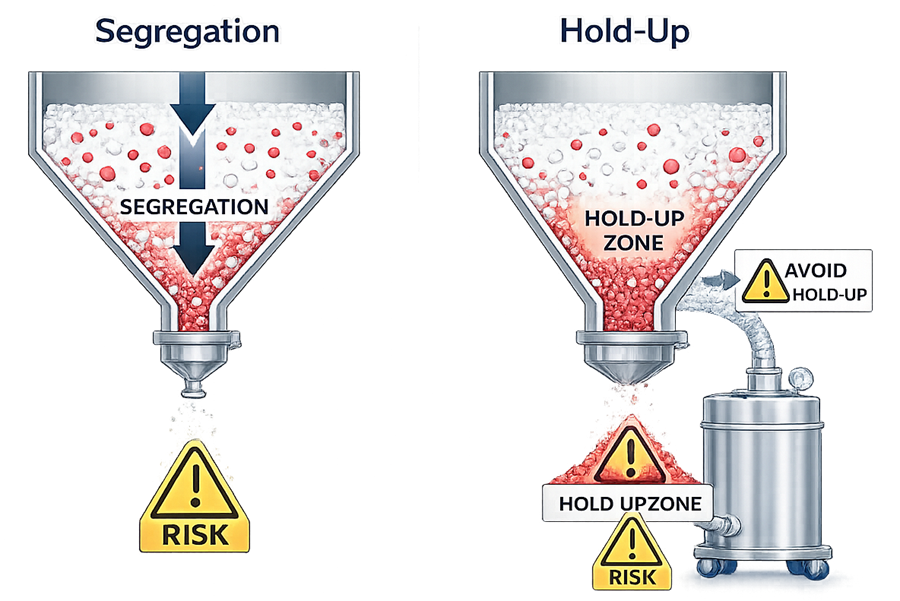
Hold-Up and Segregation
Powder may remain in:
- Hopper corners
- Valve cavities
- Flexible-hose corrugations
- Horizontal line sections
- Elbows
- Receiver filters
- Gaskets and seals
- Docking interfaces
- Poorly drained container geometry
Material-property differences may promote segregation during gravity discharge, vibration, free fall, or pneumatic conveying. Risk increases when components differ substantially in particle size, density, shape, surface properties, or concentration.
Equipment qualification should demonstrate mechanical transfer capability. Product-specific process validation should determine whether transfer affects blend composition, uniformity, yield, or another product-quality attribute.
Hygienic Design and Cleaning Interfaces
Reusable product-contact equipment should be designed for effective cleaning and inspection.
Design considerations include:
- Compatible product-contact materials
- Smooth surface transitions
- Accessible internal surfaces
- Minimal ledges and crevices
- Removable hoses and gaskets
- Defined disassembly requirements
- Drainability where wet cleaning is used
- Drying capability
- Prevention of cleaning-agent retention
- Protection after cleaning
- Clean-status identification
- Defined clean and dirty equipment flows
Equipment qualification may confirm:
- Access for cleaning
- Correct assembly and disassembly
- Operation of cleaning features
- Drainage or drying capability
- Absence of inaccessible mechanical areas
- Compatibility with approved cleaning methods
These activities establish equipment cleanability. They do not replace the product-specific evidence required by the site’s cleaning validation approach.
The cleaning validation program should determine residue limits, worst-case materials, sampling locations, analytical methods, recovery, hold times, and revalidation requirements.
Ergonomics, Safety, and Combustible-Dust Risk
Material handling frequently involves bags, drums, mobile bins, scoops, hoses, and repeated operator movements. Poor ergonomic design can increase both injury risk and dispensing error.
Design measures may include:
- Drum lifters
- Vacuum-assisted bag lifters
- Adjustable work surfaces
- Tilting or rotating devices
- Hoists
- Reduced lift height
- Controlled bag-emptying stations
- Safe access platforms
- Guarding of moving equipment
- Defined container weight limits
Many pharmaceutical powders are not highly potent, but they may still present respiratory, sensitization, combustible-dust, or static-discharge hazards.
A documented hazard assessment should determine whether controls are required for:
- Bonding and grounding
- Static-dissipative hoses and liners
- Ignition-source control
- Classified electrical equipment
- Explosion venting or suppression
- Explosion isolation
- Dust accumulation and housekeeping
- Safe dust-collector location
- Material hazard communication
Not every powder requires explosion-protected equipment. The decision should be based on material data, processing conditions, dust explosibility characteristics, and the applicable facility-safety assessment.
Automation and Electronic Records
Automated dispensing systems may integrate:
- Material-management systems
- Warehouse-management systems
- Manufacturing execution systems
- Electronic batch records
- Balance controllers
- Barcode readers
- Label printers
- Recipe or formulation databases
- User-access controls
- Electronic signatures
- Audit trails
- Interfaces to production equipment
The computerized-system boundary should identify which application performs each function and which system holds the authoritative GMP record.
Control requirements may include:
- Verification of material and lot identity
- Enforcement of released status
- Retrieval of the approved formulation
- Selection of the correct balance
- Tare control
- Target-weight and tolerance logic
- Prevention of dispensing outside approved limits
- Label generation
- Reconciliation calculations
- Independent verification workflow
- Handling of partial containers
- Prevention of unauthorized formula changes
- Audit trail for GMP-relevant changes
- Interface-failure detection
- Backup and recovery
- Record retention
If an electronic record is used to satisfy a GMP record requirement, applicability of 21 CFR Part 11 compliance should be assessed.
Qualification of the physical equipment and validation of the computerized application should remain coordinated. A validated application does not compensate for an unsuitable balance, and a calibrated balance does not validate the software workflow, calculations, interfaces, or electronic record.
Qualification Strategy
Qualification should be based on the intended use, system complexity, material risk, automation, containment requirements, and effect on product quality.
The lifecycle normally includes:
- User requirements
- Risk assessment
- Design review or DQ
- Supplier-documentation assessment
- FAT and SAT, where useful
- Installation Qualification
- Operational Qualification
- Equipment-level Performance Qualification
- Release for intended use
- Calibration and maintenance
- Change control
- Periodic review
- Risk-based requalification
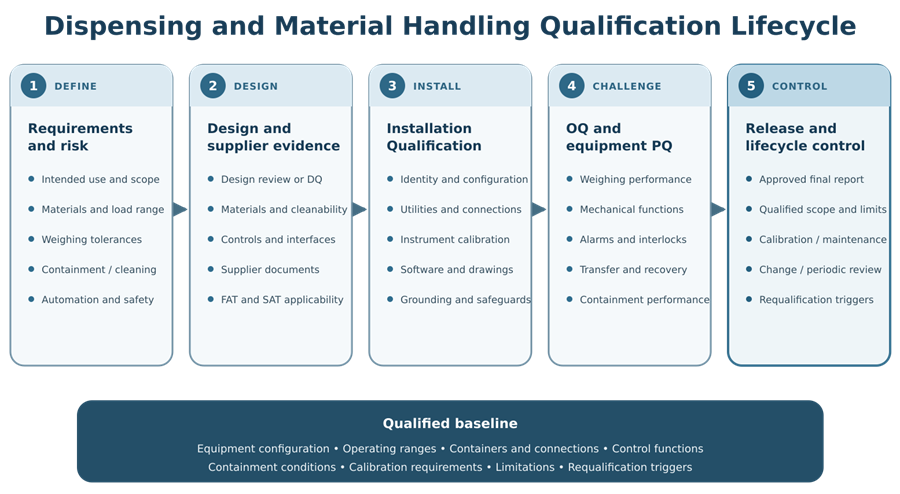
[Insert Dispensing-Material-Handling-Qualification-Lifecycle.png here.]
User Requirements and Design Qualification
Requirements should define:
- Materials and quantities to be handled
- Minimum and maximum weighing loads
- Required weighing tolerances
- Container types
- Transfer distances and rates
- Material-contact surfaces
- Containment objective
- Cleaning method
- Environmental conditions
- Utilities
- Automation functions
- Electronic records
- Safety and ergonomic requirements
- Required alarms and interlocks
- Maintenance access
- Documentation and supplier support
Design review should confirm that the proposed equipment, room, airflow, controls, utilities, and downstream interfaces can meet these requirements.
Installation Qualification
IQ should verify, as applicable:
- Equipment identity and location
- Model, serial number, and asset identification
- Materials of construction
- Surface-finish documentation
- Balance and load-cell installation
- Booth and exhaust configuration
- Filter type and orientation
- Bin-lifter and docking arrangement
- Hoses, transfer lines, and valves
- Electrical and utility connections
- Grounding and bonding
- Safety guarding
- Instrument identification
- Calibration status
- Software and firmware versions
- Network and printer connections
- Drawings and manuals
- Spare parts and maintenance documentation
The installed configuration should be documented sufficiently to support later change assessment.
Operational Qualification
OQ should challenge applicable functions throughout the defined operating range. Testing may include:
Weighing Functions
- Zero and tare
- Repeatability
- Linearity
- Eccentric loading
- Performance at intended load points
- Stabilization
- Printer and label operation
- Barcode input
- Tolerance logic
- Out-of-tolerance response
- Communication failure
- Power-loss and restart behavior
Mechanical Handling
- Minimum and maximum rated loads
- Lifting and lowering
- Travel limits
- Container retention
- Docking alignment
- Position feedback
- Controlled valve operation
- Guards and emergency stops
- Safe response to utility or power loss
Transfer Functions
- Vacuum or pressure range
- Transfer sequence
- Receiver-filter operation
- Filter-cleaning sequence
- Blockage or loss-of-flow alarms
- Valve-state confirmation
- Prevention of incompatible sequences
- Discharge completion
- Line-clearance capability
Containment Functions
- Airflow and pressure
- Airflow alarms
- Directional-airflow visualization
- Dust-extraction response
- Door or sash position
- Safe response to extraction failure
- Docking and disconnection controls
- Filter-change or liner-change functions
Equipment-Level Performance Qualification
Equipment PQ should demonstrate performance under representative conditions using actual materials or justified surrogates. The study may evaluate:
- Weighing under routine booth conditions
- Minimum and maximum representative loads
- Representative containers
- Transfer recovery
- Transfer duration
- Residual hold-up
- Repeated docking and discharge
- Dust generation
- Containment performance
- Cleaning access
- Operator interaction
- Performance across different shifts or trained users
- Integration with downstream equipment
Acceptance criteria should be predefined and tied to intended use.
Equipment PQ demonstrates that the material handling system performs reliably. It does not demonstrate that the complete manufacturing process consistently produces acceptable finished product.
Equipment Qualification Versus Process Validation
The distinction between equipment qualification and process validation should remain explicit.
| Equipment qualification | Manufacturing-process validation |
|---|---|
| Balance accuracy and functional suitability | Correct formulation and batch composition |
| Bin-lifter capacity and docking repeatability | Consistent material charging during production |
| Vacuum-transfer sequence and alarms | Effect of transfer on product and material attributes |
| Transfer recovery using representative material | Batch yield and reconciliation |
| Mechanical hold-up assessment | Product-specific carryover or uniformity impact |
| Containment-system performance | Overall process reproducibility |
| Equipment cleanability | Product-specific cleaning validation |
| Controls, interlocks, and data capture | Process Performance Qualification |
The broader relationship between equipment readiness and PPQ is addressed in process qualification: equipment qualification and PPQ.
Calibration and Maintenance Integration
Balances, floor scales, load cells, airflow instruments, pressure sensors, and other instruments used for GMP decisions should be included in the applicable calibration program.
Controls should address:
- Calibration range
- Calibration points
- Accuracy and uncertainty
- As-found and as-left results
- Routine checks
- Calibration frequency
- Out-of-tolerance assessment
- Protection of adjustment functions
- Reference-standard traceability
- Status labeling
- Return to service
Preventive maintenance may include:
- Inspection of lifting mechanisms
- Lubrication outside product-contact areas
- Cable and chain inspection
- Valve and seal inspection
- Hose inspection and replacement
- Filter replacement
- Receiver-filter cleaning
- Grounding-continuity checks
- Balance-platform inspection
- Printer and scanner maintenance
- Dust-extraction inspection
- Safety-device testing
The sitewide reliability framework is addressed in preventive maintenance and system reliability strategy.
Post-maintenance testing should reflect the function affected. Replacement of a load cell may require calibration and functional verification. Work on a bin-lifter drive may require load, travel-limit, docking, and interlock testing. Replacement of a containment seal may require leak or containment verification.
Change Control and Requalification
Changes should be assessed before implementation to determine the required testing and documentation. Potential triggers include:
- New material or higher material hazard
- Smaller dispensing quantity
- Tighter weighing tolerance
- New balance or load cell
- Relocation of weighing equipment
- Booth airflow modification
- Filter or fan change
- New container or IBC design
- Valve, gasket, or liner change
- Transfer-hose or line-routing change
- Transfer-distance increase
- New downstream interface
- Bin-lifter or docking modification
- Software or recipe change
- Barcode or label-format change
- Interface modification
- Major maintenance
- Repeated transfer or containment failures
- Adverse calibration trend
- Cleaning-validation concern
Requalification may be targeted to the affected function. A new balance may require weighing-system qualification without repeating bin-lifter tests. A booth airflow modification may require airflow balance, visualization, alarms, and containment testing without repeating unrelated automation tests.
A significant system redesign or change affecting multiple boundaries may justify broader requalification.
Periodic Review and Continued Verification
Lifecycle review should determine whether the system remains fit for its intended use.
Review inputs may include:
- Calibration results and drift
- Routine balance checks
- Maintenance history
- Equipment failures
- Transfer interruptions
- Material-recovery trends
- Reconciliation discrepancies
- Containment-test results
- Airflow and pressure trends
- Filter alarms and changes
- Cleaning failures
- Deviations and investigations
- Operator observations
- Safety events
- Software changes
- Access and audit-trail reviews
- Open CAPA
- Supplier support and obsolescence
Adverse trends should be investigated before they become repeated batch events. The review should conclude whether existing controls remain adequate, procedures require revision, maintenance should change, or targeted requalification is necessary.
Documentation and Traceability
The lifecycle record should provide traceability among:
- User requirements
- Material and process risk assessments
- Containment and safety assessments
- Design documents
- Supplier specifications
- FAT and SAT records
- IQ, OQ, and PQ protocols
- Calibration records
- Software configuration
- Test instruments
- Deviations
- Final qualification report
- Operating and cleaning procedures
- Training records
- Maintenance records
- Change controls
- Periodic reviews
- Requalification decisions
The final qualification report should define:
- Qualified equipment and configuration
- Approved materials or surrogate classes
- Weighing and transfer ranges
- Container configurations
- Containment conditions
- Software and interface versions
- Operating limitations
- Calibration and maintenance requirements
- Required routine checks
- Conditions that require reassessment
Common Failure Modes
Common dispensing and material handling failures include:
- Incorrect material selection
- Use of unreleased material
- Wrong lot or batch assignment
- Inaccurate tare
- Unsuitable balance range
- Calibration drift
- Airflow-induced unstable weighing
- Barcode or interface failure
- Incorrect label generation
- Incomplete transfer
- Excessive material hold-up
- Powder segregation
- Blocked transfer line
- Receiver-filter blinding
- Incorrect valve connection
- Loss of containment during docking
- Dust-extraction failure
- Static accumulation
- Inadequate grounding
- Damaged liner or hose
- Incomplete cleaning
- Incorrect equipment assembly
- Unassessed software or configuration change
Failure controls should be incorporated into design, procedures, qualification testing, alarms, maintenance, and lifecycle review rather than relying solely on operator attention.
Summary
Dispensing and material handling systems form the controlled connection between released raw materials and pharmaceutical manufacturing. A defensible system requires:
- Controlled material identity and status
- Suitable weighing equipment
- Accurate and verified dispensing
- Proper container identification
- Controlled material and personnel flow
- Effective dust containment
- Reliable lifting and docking
- Consistent material transfer
- Management of hold-up and segregation
- Hygienic and cleanable design
- Appropriate automation and electronic-record controls
- Risk-based qualification
- Calibration and maintenance integration
- Change control, periodic review, and requalification
Equipment qualification demonstrates that balances, booths, containers, transfer systems, docking devices, controls, and interfaces perform as intended. Manufacturing-process validation determines whether their use within the complete production process consistently results in acceptable product quality.