

Parts-Washer Cycle Development and Cleaning Process Principles
Automated parts washers can provide repeatable cleaning only when the cycle is developed for the actual residues, components, load arrangement, cleaning chemistry, and equipment capability. A programmed sequence is not inherently effective merely because the washer reaches its temperature setpoint or completes without an alarm. Cleaning performance depends on whether mechanical action, chemistry, temperature, exposure time, rinsing, and load configuration act together at the surfaces that are most difficult to clean.
This article addresses the development and control of pharmaceutical parts-washer cleaning cycles. It covers residue characterization, component and load assessment, phase design, operating-parameter selection, development studies, rinse and drying strategy, and definition of the routine recipe.
Pharmaceutical Parts Washers: Types, Design, and System Architecture addresses washer configurations, components, and system design. Parts-Washer Qualification and Lifecycle Control addresses equipment qualification, functional testing, load verification, failure testing, release, change control, and requalification.
Cycle development also supports, but does not replace, cleaning validation. Qualification establishes that the washer can execute and control the intended process. Cleaning validation demonstrates that the approved cleaning process consistently reduces specified residues and contaminants to justified acceptance criteria.
Purpose and Development Objective
The objective of cycle development is to establish a controlled cleaning process capable of removing the defined residue challenge from the approved component and load families without damaging the equipment, leaving unacceptable cleaning-agent residues, or creating an uncontrolled microbial or storage condition.
Development should establish:
- Components and load configurations covered by the cycle
- Residues and process conditions represented
- Required pre-cleaning and disassembly
- Rack selection and loading instructions
- Cleaning-agent type and operating concentration
- Wash and rinse temperatures
- Mechanical-action requirements
- Phase durations and endpoint logic
- Rinse-water quality and rinse endpoint
- Drainage and drying requirements
- Normal operating ranges
- Alarm and abort conditions
- Conditions requiring cycle rejection or investigation
- Evidence supporting transfer to qualification and cleaning validation
The development record should explain why the selected conditions are suitable. Parameters copied from a vendor default recipe or another product family are starting points, not development justification.
Regulatory and Validation Context
21 CFR 211.67 requires equipment and utensils to be cleaned, maintained, and, when appropriate, sanitized or sterilized at suitable intervals to prevent contamination or malfunction. It also requires written procedures that assign responsibility and describe cleaning schedules, methods, equipment, materials, maintenance, inspection, and removal of previous identification.
21 CFR 211.182 requires records of equipment cleaning, maintenance, and use for major equipment when individual equipment logs are applicable. Automated cycle records may support this documentation, but they do not replace required procedural controls, equipment status records, operator actions, or review.
FDA’s Guide to Inspections: Validation of Cleaning Processes emphasizes written procedures, identification of difficult-to-clean locations, scientifically justified acceptance criteria, suitable sampling and analytical methods, control of cleaning delays, and documented evidence that the process is effective and reproducible.
The broader strategy for residue limits, worst-case selection, sampling, analytical methods, recovery, study execution, and revalidation is addressed in Cleaning Validation Approach.
Define the Cleaning Process Boundary
Cycle development should begin by defining what the washer cycle includes and what remains outside the automated sequence.
The cleaning-process boundary may include:
- Post-use product removal
- Gross-soil removal
- Maximum time between equipment use and cleaning
- Manual pre-rinsing or soaking
- Required equipment disassembly
- Transfer of parts to the washer
- Rack selection and loading
- Automated pre-rinse, wash, rinse, and drying phases
- Unloading and visual inspection
- Protection of cleaned components
- Clean hold time before reuse or sterilization
Manual activities outside the washer chamber can determine whether the automated cycle succeeds. If a hose must be connected to an injection port, a valve must be disassembled, a recess must face downward, or a dried film must be soaked before loading, that requirement belongs in the approved cleaning process. It should not remain an undocumented operator technique.
The boundary should also identify components excluded from automated washing because of material incompatibility, inaccessible internal surfaces, damage risk, inability to drain, or lack of a qualified rack or connection.
Characterize the Residue Challenge
Cleaning difficulty is determined by the interaction among the residue, surface, time, temperature history, and cleaning method.
Product potency or toxicity affects the required residue limit, but the most hazardous residue is not necessarily the hardest residue to remove. Development should therefore consider both patient-risk criteria and practical cleanability.
Relevant residue characteristics include:
- Water solubility across the expected temperature and pH range
- Adhesion to stainless steel, polymers, elastomers, glass, or coated surfaces
- Viscosity and film-forming behavior
- Protein, carbohydrate, lipid, polymer, salt, pigment, or particulate content
- Sensitivity to alkaline, acidic, enzymatic, surfactant, or solvent-based agents
- Potential for denaturation, baking, polymerization, precipitation, or degradation
- Effect of drying and dirty hold time
- Maximum expected soil quantity
- Soil distribution across the component
- Interaction with lubricants and processing aids
- Microbial or endotoxin concerns where applicable
Fresh residue may be readily dispersed while the same residue becomes strongly adherent after drying, heating, oxidation, or extended contact with the equipment surface.
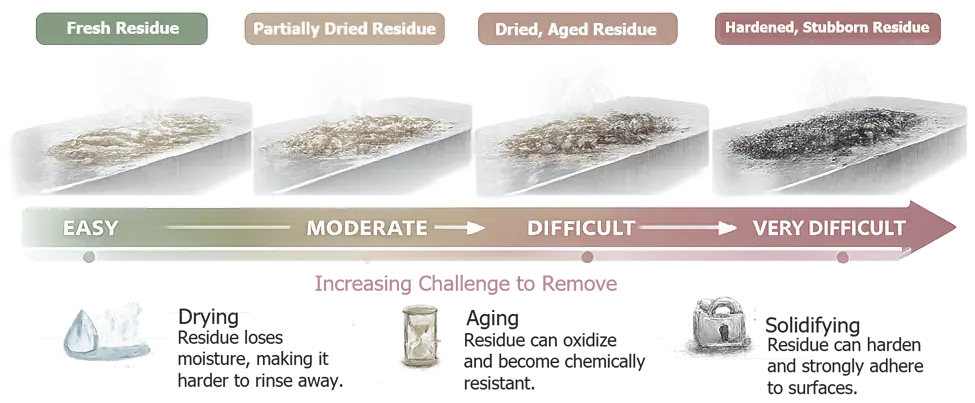
Dirty hold time should have a defined start and endpoint. The effect of immediate gross-product removal, a preliminary water flush, keeping components wet, or delayed disassembly should be understood because these actions may materially change residue condition.
Residue–Surface Interaction
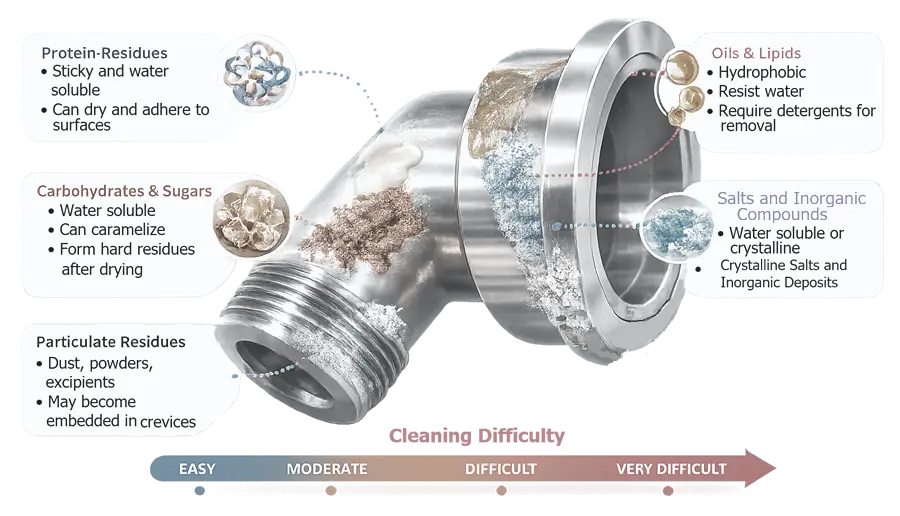
The same cleaning cycle may perform differently on different component materials and geometries. Surface roughness, scratches, welds, gaskets, porous materials, surface treatments, and material compatibility affect residue retention and cleaning-agent access.
Typical interactions include:
- Dried films adhering to broad stainless-steel surfaces
- Oils or hydrophobic materials resisting water-based rinsing
- Particles lodging in threads, screens, crevices, and narrow gaps
- Salts crystallizing in recesses or at evaporation boundaries
- Proteins denaturing when exposed to excessive initial temperature
- Residues absorbing into or adhering to elastomeric components
Representative development coupons may be useful for screening chemistry or hold-time effects. However, coupons do not reproduce the hydraulic limitations, joints, shadowed locations, internal pathways, or drainage behavior of the actual component.
Final development conclusions should therefore include representative parts and load configurations.
Interaction of Cleaning Factors
Parts-washer cleaning performance depends on five interacting factors:
- Mechanical action: Spray impact, flow, turbulence, injection, and impingement
- Chemistry: Cleaning-agent identity, concentration, pH, and residue compatibility
- Temperature: Effect on solubility, viscosity, chemical reaction rate, and residue stability
- Time: Duration of wetting, chemical action, mechanical exposure, and rinsing
- Load configuration: Spacing, orientation, spray exposure, stability, and drainage
Increasing one factor may partly compensate for a reduction in another, but compensation is not unlimited.
Additional exposure time cannot correct a completely blocked spray path. Higher temperature may improve solubility but can also denature proteins, harden some residues, increase corrosion risk, or accelerate detergent degradation. Increasing detergent concentration may not improve cleaning when the limiting factor is insufficient mechanical access.
The development strategy should identify the limiting cleaning mechanism rather than increasing every parameter.
Cleaning Chemistry Selection
Cleaning-agent selection should be based on residue behavior, material compatibility, washer design, water quality, foaming tendency, operator safety, and the ability to rinse the agent from the load and washer.
Cleaning mechanisms may include:
- Solubilization of water-soluble residues
- Emulsification of oils and hydrophobic materials
- Dispersion of particles
- Alkaline hydrolysis or saponification
- Acid dissolution of mineral or inorganic deposits
- Enzymatic breakdown of selected residues
- Improved wetting of difficult-to-penetrate surfaces
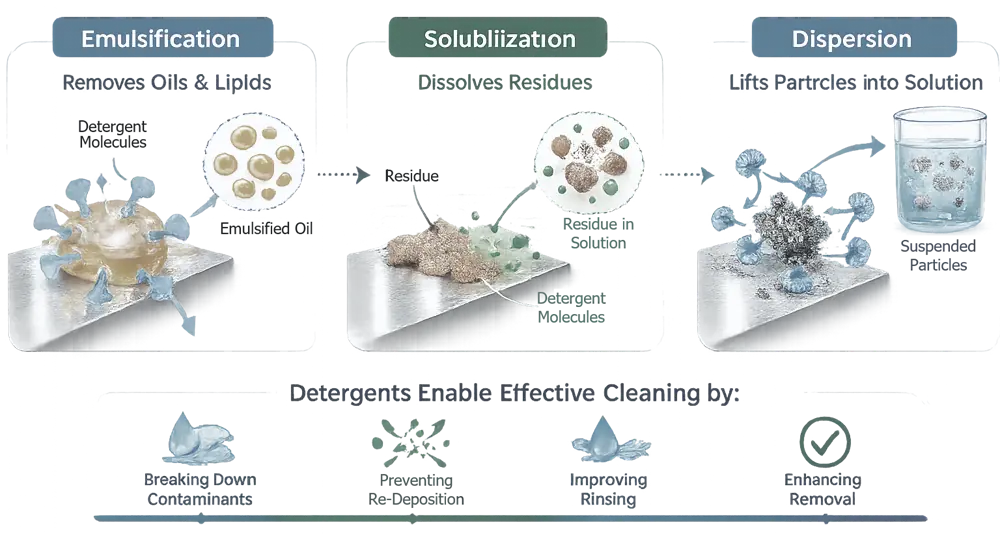
Development should establish the effective cleaning-agent concentration at the point and time of use. A dosing-pump command or delivered volume does not by itself demonstrate concentration in the recirculating solution.
Achieved concentration may be affected by:
- Sump or wash-tank volume
- Retained water from the preceding phase
- Incoming-water variation
- Dosing-pump accuracy
- Cleaning-agent strength
- Chemical temperature
- Mixing and recirculation time
- Chemical degradation or contamination
Where concentration is critical, the control strategy may use delivered mass or volume, conductivity, pH, refractive measurement, titration, or another suitable method.
The selected measurement should be appropriate for its intended decision. Conductivity may indicate ionic concentration but may not distinguish detergent from product residue or changing water quality without suitable characterization.
Material compatibility should address:
- Washer chamber
- Racks and fixtures
- Product-contact components
- Seals and gaskets
- Hoses
- Filters and strainers
- Instrument surfaces
- Drain piping
Development conditions should not cause corrosion, stress cracking, swelling, discoloration, surface degradation, or unacceptable extractables.
Mechanical Action and Spray Access
Mechanical action is generated by the circulation system and delivered through rotating spray arms, fixed nozzles, injection connections, or other distribution devices.
Relevant operating conditions include:
- Circulation-pump performance
- Recirculation flow
- Spray pressure
- Spray-arm rotation
- Nozzle condition and orientation
- Rack connection and engagement
- Injection flow to hollow components
- Filter and strainer condition
- Chamber and load obstruction
- Solution level
- Air entrainment
Pressure measured near the pump does not necessarily establish adequate exposure at every load surface. Mechanical performance depends on the entire hydraulic path and the installed load.
Spray-coverage studies can reveal:
- Spray shadowing
- Blocked or damaged nozzles
- Improper rack positioning
- Inadequate spray-arm rotation
- Disconnected injection ports
- Inaccessible component surfaces
Coverage testing demonstrates wetting or spray exposure under the tested conditions. It does not prove removal of actual product residue, adequate cleaning-agent concentration, or acceptable cleaning-validation results.
Component Geometry and Cleanability
Parts-washer cycles should be developed for actual component families rather than for an undefined basket of parts.
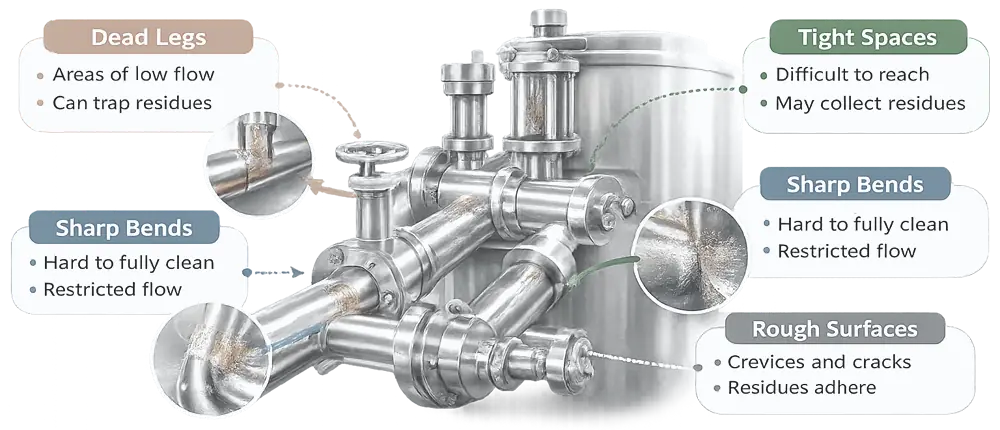
Features that commonly increase cleaning difficulty include:
- Blind holes
- Dead-ended passages
- Narrow lumens
- Long hoses
- Threads
- Close-clearance joints
- Recessed fasteners
- Screens and porous structures
- Hinges and overlapping surfaces
- Gaskets and elastomer interfaces
- Hollow components without direct injection
- Upward-facing cavities that retain liquid
- Heavy components that can move or shield adjacent items
The existing filename contains a spelling error. Retain Cleaning-Challanges.png unless the WordPress media file is deliberately renamed and every existing reference is updated.
When a component cannot be adequately exposed in a general basket, the cleaning process may require:
- Additional disassembly
- Direct injection
- A dedicated fixture
- A controlled orientation
- A separate cleaning cycle
- Manual cleaning of selected surfaces
- An alternative cleaning method
Load Configuration as a Process Variable
The load is part of the cleaning process. An effective empty-chamber cycle does not demonstrate that a densely loaded rack, nested parts, an improperly connected hose, or an inverted component will be cleaned.
Load development should define:
- Approved rack, basket, and fixture configurations
- Part identity and quantity
- Maximum load or justified bracketing condition
- Required separation between items
- Orientation relative to spray and gravity
- Direct-injection connections
- Prohibited stacking or nesting
- Stability during spray action
- Drainage orientation
- Placement of large or shielding components
- Mixed-load restrictions
Dedicated racks, fixtures, or validated loading arrangements may be necessary for complex parts, hoses, vessels, filling-machine components, and product-contact assemblies. Each item should be separated, securely positioned, drainable, and directly exposed to the cleaning spray.
General baskets may be suitable for simple utensils when the validated loading pattern prevents stacking, spray shadowing, liquid retention, and movement during the cycle.
Load families may be bracketed when the rationale considers:
- Component geometry
- Residue type
- Surface material
- Spray exposure
- Internal pathways
- Drainage characteristics
- Load density
- Part orientation
- Soil burden
Part count alone is rarely an adequate worst-case criterion.
Develop the Cleaning Cycle Sequence
A typical parts-washer cycle may include:
- Initial drain
- Pre-rinse
- Detergent wash
- Intermediate rinse
- Final rinse
- Drain
- Drying
- Cooling where required
The selected sequence should reflect the residue-removal mechanism and the equipment’s intended use.
Pre-Rinse
The pre-rinse removes loose soil, reduces the burden on the wash solution, and may prevent product residue from contaminating the detergent stage.
Development variables include:
- Water quality
- Water temperature
- Flow rate
- Spray pressure
- Duration
- Number of fills
- Once-through or recirculated operation
- Drain completion
- Endpoint logic
Initial rinse temperature requires particular attention. A warm rinse may improve removal of oils or viscous materials but may denature proteins or harden heat-sensitive residues.
The selected temperature should be supported by residue-specific evidence.
The pre-rinse endpoint may be:
- Time-based
- Volume-based
- Conductivity-based
- Turbidity-based
- Based on another justified measurement
An endpoint signal should be shown to represent the intended process condition rather than selected only because the instrument is available.
Detergent Wash
The wash phase should establish the required cleaning-agent concentration, temperature, mechanical action, and exposure time.
Development should distinguish among:
- Time required to fill the washer
- Time required to heat the solution
- Time required to dose the cleaning agent
- Time required to reach the target concentration
- Time required to expose all load surfaces
- Effective recirculation or hold time after conditions are achieved
Counting the entire wash-phase duration as effective exposure can overstate the actual cleaning time when the system spends a significant portion of the phase filling, heating, dosing, or stabilizing.
The effective exposure period should begin only after the required process conditions have been achieved, unless development evidence supports a different definition.
Intermediate Rinse
Intermediate rinses progressively remove loosened soil and cleaning agent before the final rinse.
Development should determine whether the process requires:
- Fixed rinse stages
- Repeated fill-and-drain steps
- Once-through rinsing
- Recirculated rinsing
- Endpoint-controlled rinsing
- A combination of these approaches
Recirculation can conserve water but may redistribute dissolved or suspended residue if filtration, dump frequency, and phase-transition controls are inadequate.
Final Rinse
The final rinse should use water of a quality appropriate for the cleaned components and their next use.
Purified Water or Water for Injection may be required by the approved process, but a higher water grade does not correct inadequate spray access or an ineffective wash phase.
Potential final-rinse endpoints include:
- Conductivity
- pH
- Total organic carbon
- Rinse volume
- Rinse duration
- A justified combination of measurements
The endpoint should account for the incoming-water baseline and measurement capability.
Returning conductivity close to the supply-water value can support detergent-removal control when the detergent is ionic and the relationship has been characterized. It does not independently demonstrate removal of every product residue.
Drainage
Drainage should be evaluated after each relevant cycle phase.
Retained solution can:
- Dilute the following phase
- Carry detergent into the final rinse
- Redistribute dissolved residue
- Concentrate residue during drying
- Create spotting
- Support microbial growth
- Affect subsequent analytical samples
Drain time should be sufficient for the installed rack and approved load. Components should be oriented to avoid uncontrolled liquid retention.
Drying
Drying conditions should be appropriate for the load and post-cleaning controls.
Relevant variables include:
- Drying-air temperature
- Airflow
- Filter status where applicable
- Drying duration
- Component orientation
- Residual moisture
- Unloading environment
- Clean hold time
- Protection after unloading
Drying does not compensate for inadequate rinsing. Evaporation of retained rinse solution can concentrate residual detergent or product material on component surfaces.
Establish Operating Ranges and Control Limits
Cycle development should define more than nominal setpoints. The approved process should identify ranges within which cleaning performance remains acceptable.
Routine operating targets should also be distinguished from alarm and abort limits.
| Parameter | Development question | Possible routine evidence |
|---|---|---|
| Cleaning-agent concentration | What range removes the defined soil and remains rinseable? | Dosing record, conductivity, pH, titration, or direct concentration measurement |
| Wash temperature | What minimum supports cleaning, and what maximum risks residue fixation or material damage? | Recorded temperature profile |
| Mechanical action | What hydraulic condition provides coverage and required injection flow? | Flow, pressure, spray-arm monitoring, or qualified equipment state |
| Effective wash time | When does effective exposure begin and end? | Phase record and achieved-condition timing |
| Rinse endpoint | What result demonstrates adequate removal of cleaning agent and loosened soil? | Conductivity, pH, TOC, volume, time, or justified combination |
| Load configuration | Which arrangement represents the approved load family? | Load diagram, recipe selection, and operator verification |
| Drying | What condition prevents unacceptable retained moisture? | Time, temperature, airflow, and post-cycle inspection |
Setpoints should include an appropriate process margin between the routine target and the demonstrated failure boundary.
Operating routinely at the edge of the effective range creates a fragile process even when individual cycles technically meet acceptance criteria.
Development Study Design
Development studies should be planned, documented, and traceable to the intended use.
Study elements may include:
- Representative and difficult-to-clean residues
- Defined soil application or actual post-production residue
- Representative surface materials
- Fresh and aged soil conditions
- Minimum and maximum relevant load conditions
- Difficult component geometries
- Difficult rack locations
- Parameter screening
- Parameter-interaction studies
- Rinse-removal evaluation
- Visual inspection under defined conditions
- Analytical testing where necessary
- Documentation of deviations
- Documentation of unsuccessful trials
Small-scale studies can screen:
- Cleaning-agent type
- Cleaning-agent concentration
- Temperature
- Exposure time
- Residue aging
- Material compatibility
Washer-scale studies are required to evaluate:
- Spray access
- Load effects
- Hydraulic conditions
- Phase transitions
- Drainage
- Rinsing
- Drying
- Repeatability
Development should deliberately examine unfavorable but credible conditions. These may include:
- Reduced cleaning-agent concentration
- Lower wash temperature
- Shorter effective exposure
- Maximum dirty hold time
- High soil burden
- Challenging load density
- Difficult component orientation
- Minimum justified rinse conditions
The objective is to understand process sensitivity and establish a defensible operating window, not to force an arbitrary failure.
Unsuccessful trials are valuable development evidence. They identify limiting conditions and support selection of the final parameters. They should not be omitted merely because the final recipe later succeeded.
Visual Inspection and Analytical Evidence
Visual inspection is an important cleaning control when performed under defined conditions.
The inspection method should define:
- Lighting
- Surface accessibility
- Viewing angle
- Inspection distance
- Use of mirrors, borescopes, or other aids
- Required component disassembly
- Acceptance criteria
- Inspector training or qualification
Visual cleanliness alone does not demonstrate compliance with a quantitative residue limit.
Conversely, a passing rinse sample may not detect localized residue in a crevice, gasket interface, blind hole, or spray-shadow area. Development evidence should combine inspection and analytical methods according to the actual failure risk.
Swab Sampling provides direct evidence from selected accessible surfaces.
Rinse Sampling can evaluate larger or inaccessible pathways but depends on rinse distribution, residue solubility, sample location, rinse volume, and the calculation basis.
Development samples used to understand the cleaning process should be distinguished from formal cleaning-validation samples executed using approved sampling, recovery, and analytical methods.
Transfer from Development to the Approved Recipe
The final cycle should be transferred through controlled documentation.
The development and transfer package should include:
- Cycle-development protocol or plan
- Residue characterization
- Component and surface assessment
- Chemistry-selection rationale
- Material-compatibility evidence
- Load-family and bracketing rationale
- Approved load diagrams
- Setup and connection instructions
- Development results
- Unsuccessful development conditions
- Selected setpoints and operating ranges
- Alarm and abort criteria
- Definition of effective exposure time
- Rinse strategy and endpoint rationale
- Drainage requirements
- Drying requirements
- Required operator actions
- Inspection requirements
- Recipe configuration record
- Traceability to qualification requirements
- Traceability to cleaning-validation requirements
- Change-control requirements
The approved recipe should be protected from unauthorized change.
The following should remain traceable:
- Recipe name
- Recipe version
- Parameter values
- Phase logic
- Alarm settings
- Abort settings
- Approval status
- Effective date
- Change history
Manual overrides, phase advances, repeated phases, and aborted cycles should be recorded and assessed according to an approved procedure.
Relationship to Qualification and Cleaning Validation
Cycle development, washer qualification, and cleaning validation provide different evidence.
| Evidence layer | Primary question |
|---|---|
| Cycle development | Which sequence, parameters, chemistry, and load controls are capable of cleaning the defined challenge? |
| Washer qualification | Can the installed washer, instruments, automation, utilities, racks, and safety functions execute and control the approved process? |
| Cleaning validation | Does the approved process consistently reduce specified residues and contaminants to justified limits under defined routine and worst-case conditions? |
Coverage testing does not replace residue-removal evidence.
A passing residue result does not prove that every critical cycle parameter was controlled.
A qualified washer does not establish that every product, part, load arrangement, or dirty hold time is covered.
Qualification strategy, functional challenges, performance testing, lifecycle control, and requalification are addressed in Parts-Washer Qualification and Lifecycle Control.
Comparable principles for fixed vessels and CIP circuits are addressed in Tank and Process Vessel Cleaning and CIP Integration.
Common Cycle-Development Failures
Weak cycle-development programs commonly show one or more of the following conditions:
- Vendor default cycles adopted without residue-specific evidence
- Cycle targets defined without acceptable operating ranges
- Detergent dose assumed to equal achieved concentration
- Total phase time treated as effective exposure time
- Temperature increased without evaluating residue fixation
- Material compatibility not assessed
- Empty-chamber spray evidence applied to loaded conditions
- Undefined or uncontrolled load arrangements
- General baskets used for parts requiring injection or dedicated orientation
- Dirty hold time omitted from development
- Rinse conductivity treated as universal proof of cleanliness
- Drying used to mask retained rinse water
- Failed development trials omitted from the technical history
- Manual pre-cleaning steps left undocumented
- Development, qualification, and cleaning validation treated as interchangeable
These weaknesses disconnect the approved recipe from the actual cleaning mechanism and routine operating controls.
Lifecycle Considerations
Cycle development should be reassessed when changes affect the residue, component, load, chemistry, equipment, or operating range.
Potential triggers include:
- New product or formulation
- Changed residue composition
- Increased product concentration
- Longer dirty hold time
- New component geometry
- Modified component geometry
- New rack, basket, or fixture
- Changed injection connection
- Cleaning-agent supplier change
- Cleaning-agent formulation change
- Cleaning-agent concentration change
- Water-quality change
- Pump replacement or modification
- Nozzle or spray-arm change
- Heater modification
- Instrument change
- Recipe or software change
- Repeated cleaning failures
- Adverse rinse trends
- New material-compatibility findings
The impact assessment should determine whether the change requires:
- Documentation revision
- Targeted development
- Recipe revision
- Qualification testing
- Cleaning-validation assessment
- Targeted revalidation
- Comprehensive revalidation
Lifecycle execution should be controlled through the site change-control and validated-state management process.
Conclusion
An effective parts-washer cycle is a developed cleaning process, not simply an automated sequence. Its capability depends on matching the cleaning mechanism to the residue, component geometry, load configuration, equipment hydraulics, and required endpoint.
A defensible development program establishes the cleaning boundary, characterizes residues and surfaces, selects compatible chemistry, defines mechanical and thermal conditions, controls exposure and rinsing, verifies drainage and drying, and transfers the resulting operating window into a protected recipe.
Qualification then demonstrates that the washer can execute that process. Cleaning validation demonstrates that the process consistently achieves the required residue-control outcome.