

Pharmaceutical Tank and Process Vessel Types, Functions, and Materials
Pharmaceutical tanks and process vessels provide controlled environments for storing, preparing, mixing, reacting, holding, and transferring materials throughout drug and biologics manufacturing. Although the terms tank and vessel are often used interchangeably, vessel selection should be based on intended process function, product-contact requirements, operating conditions, contamination-control needs, and integration with the surrounding manufacturing system.
A vessel is not suitable for pharmaceutical service merely because it is constructed from stainless steel. Suitability depends on the complete product-contact boundary, including the vessel shell, internal components, seals, valves, instruments, transfer connections, vent system, and any disposable assemblies. The selected configuration must support the process without introducing contamination, unacceptable material interaction, uncontrolled variability, or cleaning difficulties.
This article classifies the principal vessel types used in pharmaceutical manufacturing and explains how function, operating mode, and material of construction affect selection. Detailed requirements for hygienic design, fabrication, instrumentation, qualification, and cleaning are addressed separately in Design Requirements for Tanks and Process Vessels, Tank Qualification and Lifecycle Control, and Tank and Process Vessel Cleaning Integration.
Regulatory and Lifecycle Context
Under 21 CFR 211.63, manufacturing equipment must be appropriately designed, adequately sized, and suitably located for its intended use, cleaning, and maintenance. 21 CFR 211.65 further requires product-contact surfaces to be nonreactive, nonadditive, and nonabsorptive to the extent necessary to protect product safety, identity, strength, quality, and purity.
These requirements establish performance expectations rather than prescribing one universal vessel type or material. A suitable vessel for a nonsterile aqueous buffer may be unsuitable for a potent solvent-based product, an oxygen-sensitive intermediate, a sterile bulk solution, or a cell-culture process.
The vessel-selection basis should therefore define:
- Intended process function
- Materials entering and leaving the vessel
- Product-contact duration
- Required working and total volume
- Mixing, dissolution, reaction, or suspension requirements
- Operating temperature, pressure, vacuum, and gas conditions
- Required level of microbial or particulate control
- Cleaning, sanitization, or sterilization method
- Transfer and sampling strategy
- Material compatibility
- Applicable containment requirements
- Required instrumentation and automation
- Expected product and process lifecycle
The ASME Bioprocessing Equipment standard provides widely used engineering guidance for hygienic equipment, materials, fabrication, surface requirements, and inspection. Its applicability and specific requirements should be established by the project rather than assumed for every vessel.
Classification by Process Function
Pharmaceutical vessels are most usefully classified by what they must accomplish within the manufacturing process. One physical vessel may perform more than one function—for example, preparation, mixing, sterile holding, and transfer—but each function introduces separate requirements and risks.
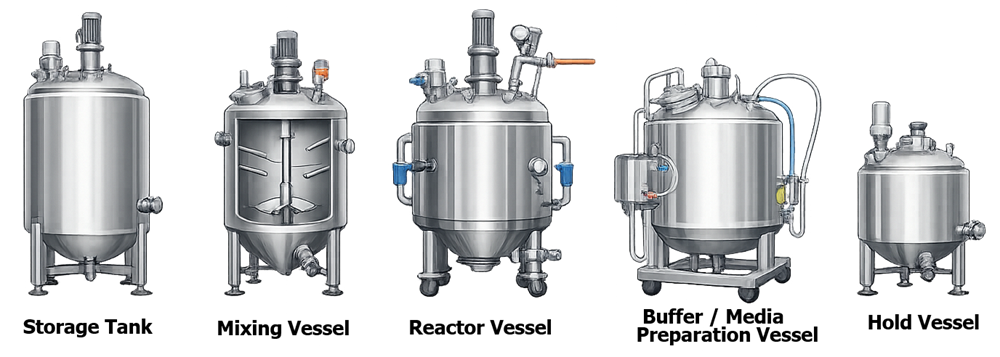
Storage Tanks
Storage tanks retain raw materials, utilities, intermediates, or finished solutions until they are required by another process. Typical applications include:
- Purified water or Water for Injection storage
- Bulk solvent storage
- Liquid excipient storage
- Buffer or media storage
- Concentrate or intermediate storage
- Bulk formulated-product storage
A storage tank may appear operationally simple, but the required controls depend on the stored material. A water-storage tank may require continuous recirculation, sanitary vent filtration, temperature control, and protection against microbial proliferation. A solvent tank may require nitrogen blanketing, grounding, explosion protection, vapor management, and pressure or vacuum protection. A sterile-solution tank may require a defined sterile boundary and qualified sterile venting.
Storage duration is part of the intended use. The tank must preserve the required material attributes for the established storage period rather than merely provide sufficient volume.
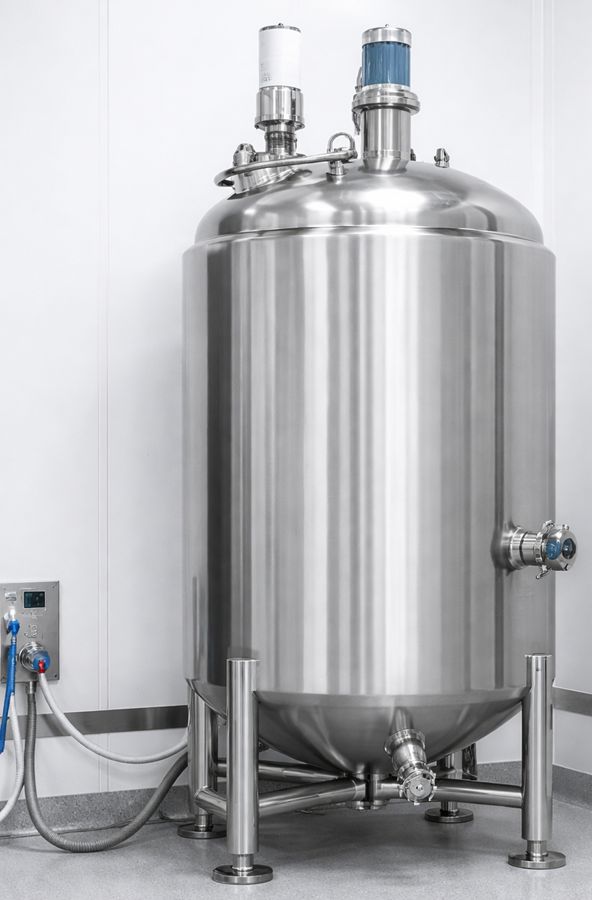
Preparation and Formulation Vessels
Preparation vessels are used to combine raw materials and convert them into a process-ready solution, suspension, emulsion, or slurry. They may support:
- Powder wetting and dissolution
- Buffer and media preparation
- Excipient addition
- pH or conductivity adjustment
- Product formulation
- Solution standardization
- Temperature conditioning
- Controlled ingredient addition
The appropriate vessel configuration depends on material behavior. Rapidly soluble salts may require only moderate circulation, while poorly wetting powders, high-viscosity materials, suspensions, or emulsions may require specialized impellers, high-shear devices, recirculation loops, or controlled addition sequences.
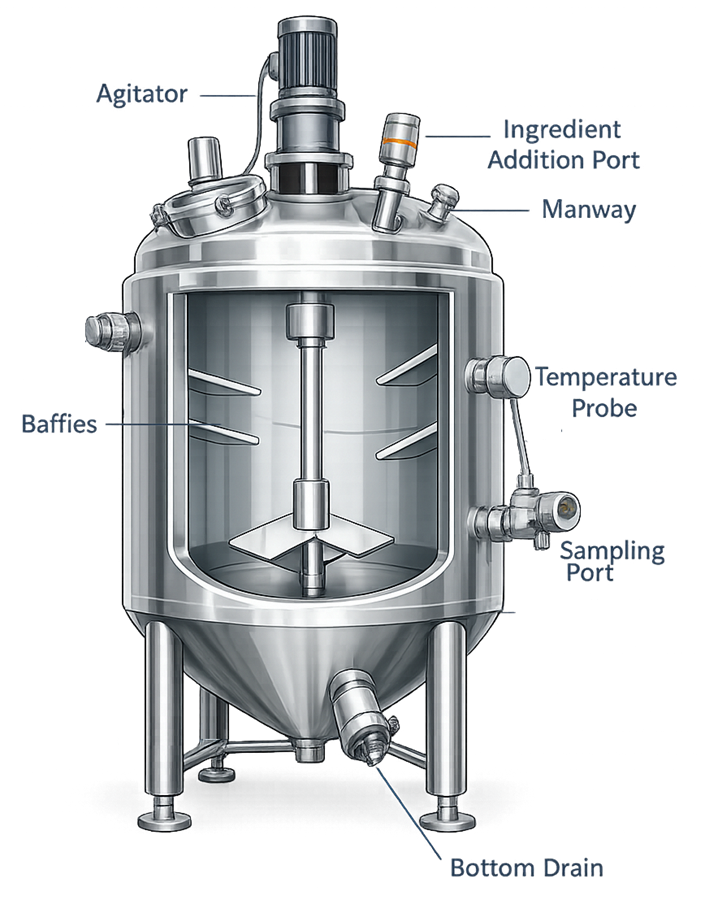
Working volume is especially important. The agitator, baffles, instrument locations, and addition points must remain functional across the qualified operating range. A vessel that mixes effectively at maximum volume may perform poorly at minimum volume.
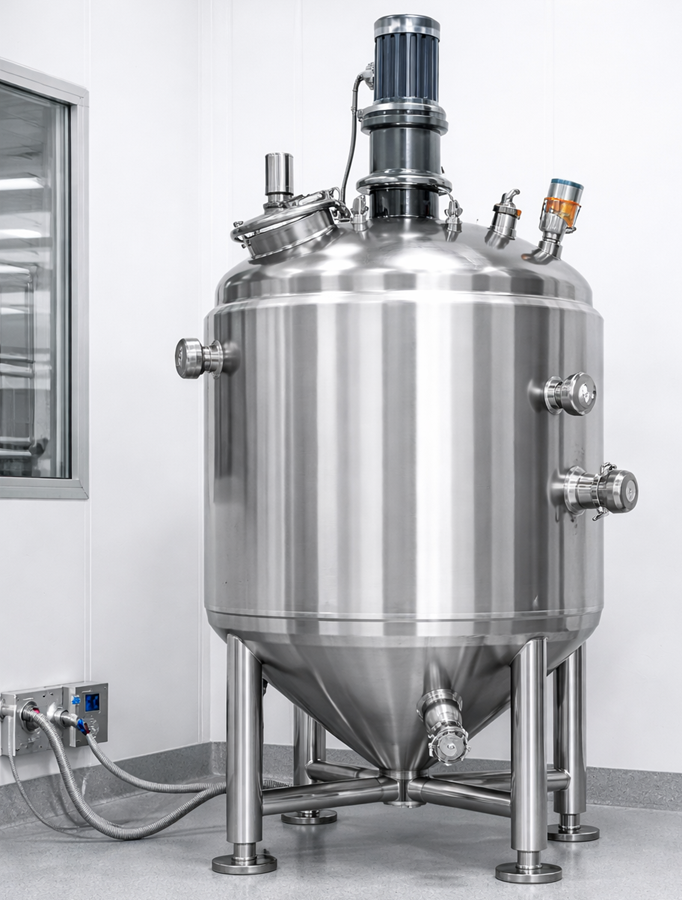
Mixing Vessels
Mixing vessels maintain or develop material uniformity through controlled fluid motion. Depending on the application, the mixing objective may be:
- Homogeneous concentration
- Temperature uniformity
- Solids suspension
- Gas dispersion
- Liquid–liquid blending
- Prevention of settling
- Heat-transfer enhancement
- Maintenance of an emulsion or suspension
Mixing performance cannot be determined solely from vessel volume or agitator speed. Vessel geometry, liquid depth, impeller type and diameter, impeller location, baffles, fluid viscosity, density differences, solids loading, and operating volume all affect performance.
The required evidence should be based on the actual process objective. A buffer-preparation vessel may require dissolution and conductivity uniformity, while a suspension vessel may require demonstration that particles remain acceptably distributed during processing and discharge. Solid-dosage powder blending is a different unit operation and is addressed in Pharmaceutical Blending Equipment: Design, Uniformity, and Qualification.
Reactor Vessels
Reactor vessels provide controlled conditions for chemical, biochemical, or physical transformation. They may be used for:
- API synthesis
- Hydrolysis or neutralization
- Crystallization
- Precipitation
- Enzymatic processing
- Controlled pH reactions
- Temperature-dependent reactions
- Pressure or vacuum processing
Reactor selection must account for more than chemical compatibility. Reaction kinetics, heat generation, heat-transfer capacity, agitation, gas evolution, addition rate, pressure development, foaming, sampling, and emergency response may determine the required configuration.
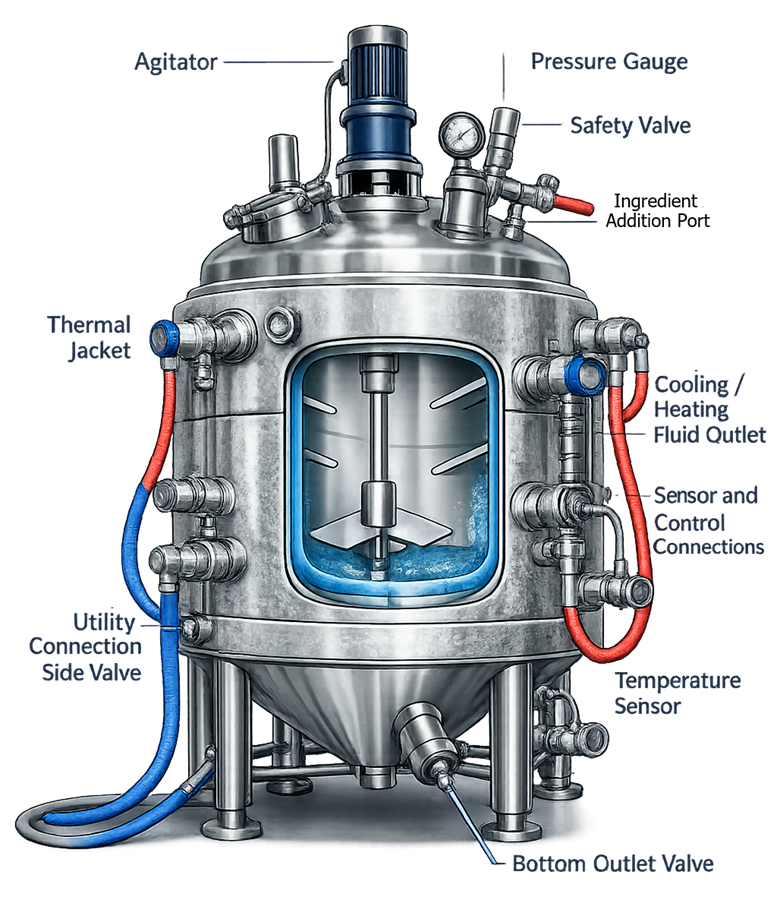
Jacketed vessels commonly use an external thermal jacket to heat or cool the contents. Internal coils may provide additional heat-transfer area but introduce product-contact surfaces and potential cleaning restrictions. Pressure or vacuum service requires an appropriate mechanical design basis, protective devices, and defined operating limits.
Bioreactors and fermenters are specialized reactor systems with additional requirements for gas delivery, dissolved oxygen, pH control, foam control, aseptic additions, biological containment, and process automation. These systems are addressed in Bioreactor and Fermenter Design, Functionality, and Process Control.
Buffer and Media Preparation Vessels
Buffer and media vessels support preparation of solutions used in upstream and downstream bioprocessing. Their functions may include:
- Controlled water charging
- Powder addition and dissolution
- pH and conductivity adjustment
- Temperature conditioning
- Bioburden-controlled holding
- Filtration and transfer to downstream equipment
These vessels frequently interface with load cells, level instruments, transfer pumps, filters, and automated recipe controls. The required hygienic state depends on where the solution is used. A buffer used upstream of a validated sterilizing filter may have different microbial-control requirements from sterile media transferred directly into an aseptic process.
For single-use preparation systems, the disposable bag, mixer, tubing, connectors, sensors, and transfer assemblies collectively form the process boundary.
Hold Vessels
Hold vessels retain intermediates or products between process steps. Examples include:
- Pre-filtration hold vessels
- Post-filtration sterile hold vessels
- Bulk product hold vessels
- Harvest or clarified-intermediate vessels
- Chromatography-pool vessels
- Coating-solution hold vessels
- Filling-line feed vessels
A hold vessel must maintain the material within established conditions throughout the approved hold period. Relevant controls may include temperature, agitation, pressure, nitrogen overlay, light protection, microbial control, and prevention of settling or stratification.
Defined hold time is a process requirement. Vessel qualification establishes that the equipment can provide the required operating conditions; process validation establishes that the material remains acceptable during the defined hold period. The two activities are related but are not interchangeable.
Feed and Surge Vessels
Feed vessels provide controlled delivery to downstream equipment, while surge vessels absorb short-term differences between upstream and downstream flow. Applications include feeding:
- Filling equipment
- Tablet coaters
- Filtration skids
- Chromatography systems
- Spray dryers
- Granulators
- Continuous manufacturing equipment
Their functional requirements may include stable outlet pressure, minimum usable volume, agitation at low level, level-based pump control, protection against air entrainment, and controlled replenishment. The vessel and downstream equipment should be evaluated as an integrated operating system.
Collection and Receiver Vessels
Receiver vessels collect material discharged from another operation. They may receive:
- Filtrate or permeate
- Chromatography fractions
- Condensate
- Process intermediates
- Wash solutions
- Recovered solvents
- Discharged powders or granules
The receiving function can introduce risks not present during static storage, including foaming, splashing, aerosol generation, electrostatic accumulation, pressure imbalance, and contamination through the vent path. Receiver design should therefore reflect the incoming flow, material state, transfer method, and required containment.
Fixed, Portable, and Mobile Vessels
Vessel mobility changes how equipment is connected, identified, cleaned, stored, and controlled.
Fixed Vessels
Fixed vessels are permanently installed and integrated with process piping, utilities, automation, and cleaning systems. Their advantages include repeatable connections, permanent instrumentation, automated transfer, and integration with clean-in-place or steam-in-place systems.
Their limitations include reduced flexibility and the need to manage the complete installed system as a defined equipment boundary.
Portable Tanks and Mobile Vessels
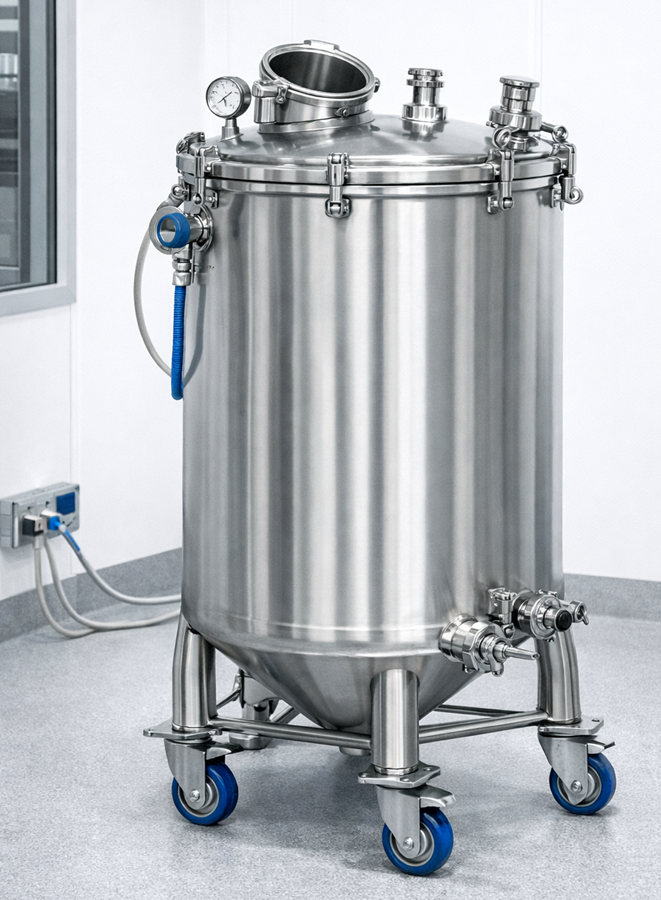
Portable vessels are commonly used for material staging, intermediate holding, small-volume preparation, and transfer between process areas. They may be manually moved, mounted on wheeled frames, or transported with material-handling equipment.
Portable-vessel controls should address:
- Unique equipment identification
- Approved use and product assignment
- Cleaning and status labeling
- Closure and vent protection during transport
- Controlled connection to process equipment
- Prevention of hose and connector mix-ups
- Storage conditions when not in use
- Inspection following movement or impact
- Wheel, brake, frame, and lifting-point condition
- Applicable containment and spill controls
A portable vessel does not become low risk merely because it has no automation. Product-contact condition, mobility, repeated manual connections, and use across multiple areas may increase contamination and operational risks.
Open, Closed, and Functionally Closed Operation
Vessel type should also be classified by how the process boundary is maintained during use.
Open Vessels
Open vessels expose the contents to the surrounding environment during one or more operations. Examples may include open charging, manual sampling, inspection, or discharge. Suitability depends on room classification, product sensitivity, operator protection, exposure time, and procedural controls.
An open vessel may be acceptable for some non-sterile operations but inappropriate for materials requiring tight microbial, particulate, moisture, oxygen, or containment control.
Closed Vessels
Closed vessels maintain a physical boundary during normal processing. Materials enter and leave through defined connections, and the headspace communicates with the environment through a controlled vent, filter, pressure-control device, or gas system.
Closed operation can reduce contamination and exposure risks, but closure alone does not establish sterility or containment. Connections, seals, vents, sampling devices, transfer assemblies, and maintenance interventions remain part of the boundary.
Functionally Closed Systems
A functionally closed system may be opened for setup, cleaning, or component installation but is subsequently closed and controlled during processing. The claimed state must be supported by the actual operating sequence and the controls applied to each opening or connection.
For sterile or highly contained processing, the boundary definition should identify every routine and nonroutine intervention that can affect system integrity.
Atmospheric, Pressure, Vacuum, and Inerted Vessels
Operating mode affects both vessel construction and the required protective controls.
Atmospheric Vessels
Atmospheric vessels normally operate near ambient pressure, with the headspace connected to an appropriate vent system. They may still experience pressure or vacuum during filling, draining, cleaning, steam exposure, or blocked-vent conditions. The design basis should therefore address credible transient conditions rather than relying only on the nominal operating state.
Pressure Vessels
Pressure-rated vessels are designed for internal pressure above the applicable code threshold and require a defined design pressure, design temperature, allowable working conditions, and overpressure protection. Pressure rating is a mechanical designation; it does not establish hygienic suitability.
Vacuum-Rated Vessels
Vacuum can arise intentionally during processing or unintentionally during cooling, draining, pump-out, or steam condensation. A vessel that can withstand positive pressure may not necessarily withstand external pressure created by vacuum. Vacuum rating and protection must be explicitly established.
Inerted or Blanketed Vessels
Nitrogen or another inert gas may be used to reduce oxygen exposure, control moisture, suppress flammable vapor hazards, or support material transfer. The system may require:
- Controlled gas pressure and flow
- Gas-quality specifications
- Pressure and vacuum protection
- Oxygen monitoring
- Vent or vapor management
- Controls against excessive gas consumption
- Assessment of personnel asphyxiation hazards
The inert-gas supply, regulator, filters, piping, valves, and vent path are part of the operating system and should be included in the equipment boundary where they affect product quality or safe operation.
Jacketed and Temperature-Controlled Vessels
Temperature-controlled vessels may use:
- Conventional external jackets
- Half-pipe or dimple jackets
- Internal coils
- External recirculation heat exchangers
- Electrical heating
- Insulation or heat tracing
- Refrigerated or controlled-temperature rooms
Selection depends on required heat-transfer rate, product sensitivity, viscosity, batch volume, temperature range, utility availability, and required control response.
Jackets and coils introduce potential failure interfaces between the utility and process sides. The selected arrangement should address leakage detection, pressure relationships, utility quality, corrosion, thermal stress, and maintenance access. Product-contact internal coils also affect cleanability and inspection.
Stainless-Steel Vessel Materials
Austenitic Stainless Steel
Austenitic stainless steel is widely used for pharmaceutical tanks because it combines mechanical strength, fabricability, cleanability, and corrosion resistance. Common grades include 304/304L and 316/316L.
316L is frequently selected for product-contact surfaces because its molybdenum content generally provides improved resistance to localized corrosion compared with 304L. However, 316L is not universally resistant to all pharmaceutical chemicals or cleaning conditions. Chlorides, strong acids, elevated temperature, stagnant conditions, fabrication defects, and improper chemical use can still produce pitting, crevice corrosion, or stress-corrosion damage.
304L may be suitable for external surfaces, non-product-contact components, structural frames, or selected process applications when supported by the compatibility assessment. The material grade should be specified according to actual service rather than by convention alone.
Required documentation may include:
- Material certificates or mill test reports
- Heat-number traceability
- Positive material identification where justified
- Weld-filler identification
- Elastomer and polymer certificates
- Surface-treatment records
- Passivation or electropolishing records
- Fabrication and inspection documentation
The documentation level should be defined by risk, project specifications, and the applicable code or standard.
Glass-Lined Steel Vessels
Glass-lined steel combines the mechanical strength of a steel shell with a chemically resistant glass product-contact surface. It is commonly used for corrosive chemical reactions and API-processing applications where stainless steel may not provide adequate compatibility.
Important limitations include:
- Susceptibility to impact damage
- Potential chipping, cracking, or delamination
- Restricted inspection of hidden defects
- Sensitivity to thermal shock
- Specialized repair requirements
- Limitations on internal attachments and geometry
- Need for spark or integrity testing where applicable
Glass-lined equipment requires defined inspection and acceptance practices. A mechanically intact steel shell does not demonstrate that the product-contact lining remains acceptable.
High-Alloy and Specialty-Metal Vessels
Highly corrosive processes may require alloys with greater resistance than standard stainless steel. Depending on service conditions, materials may include nickel-based alloys, titanium, or other specialty metals. Selection should be supported by process-specific corrosion data covering:
- Actual chemical composition
- Concentration
- Temperature
- Pressure
- Exposure duration
- Aeration or oxygen condition
- Cleaning chemicals
- Sanitization or sterilization cycles
- Expected impurities
- Welded and heat-affected conditions
Material performance data for a pure chemical at ambient temperature may not represent performance in the actual process mixture and lifecycle conditions.
Polymer and Composite Vessels
Rigid polymer vessels may be used for corrosive chemicals, selected process solutions, waste collection, or lower-pressure applications. Materials can include:
- High-density polyethylene
- Polypropylene
- Polyvinylidene fluoride
- Fluoropolymers
- Fiberglass-reinforced plastic
- Other engineered polymers or composites
Evaluation should address:
- Chemical compatibility
- Temperature limitations
- Pressure or vacuum capability
- Permeation
- Moisture or gas transmission
- Extractables and leachables
- Particle generation
- Cleaning-agent compatibility
- Surface damage and inspection
- Ultraviolet or environmental degradation
- Static-charge accumulation
- Expected service life
A polymer identified by its generic name is not a complete material specification. Resin grade, additives, colorants, processing method, and supplier controls may affect suitability.
Single-Use Vessel Systems
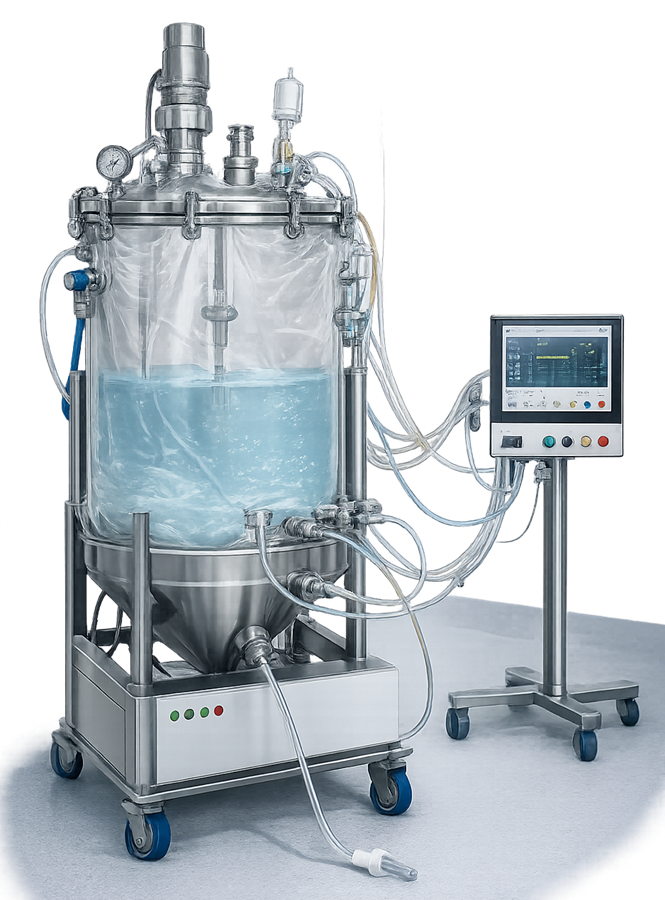
Single-use vessels typically use a disposable polymer bag supported by a reusable rigid container or frame. They are widely used for media and buffer preparation, intermediate holding, mixing, cell culture, product transfer, and collection.
Potential advantages include:
- Reduced cleaning requirements
- Reduced cleaning-validation scope
- Faster product changeover
- Reduced cross-contamination risk
- Lower demand for cleaning chemicals and high-purity water
- Flexible manufacturing configuration
These advantages transfer rather than eliminate lifecycle controls. The single-use assembly must be evaluated as an integrated product-contact system, including:
- Film construction
- Seams and welds
- Ports and tubing
- Connectors and clamps
- Filters
- Sampling devices
- Sensors
- Mixing components
- Irradiation or other sterilization method
- Packaging and shipping protection
- Installation and handling
- Supplier change control
- Extractables and leachables
- Integrity throughout processing
The reusable support frame, mixer drive, load cells, instruments, and control system remain equipment requiring appropriate qualification, calibration, maintenance, and change control.
Product-Contact Surface Condition
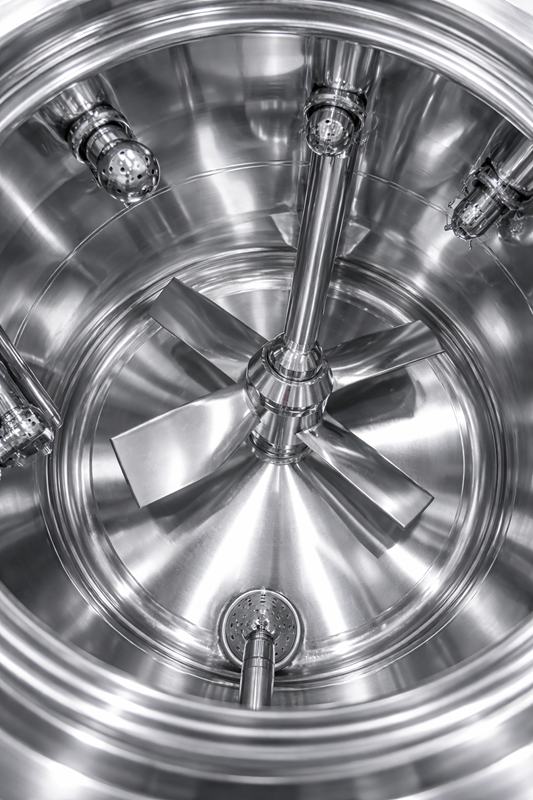
Material grade and surface condition are separate attributes. A vessel fabricated from the correct alloy can still be unsuitable if its product-contact surfaces contain rough welds, pits, crevices, inclusions, embedded contamination, or inaccessible areas.
Surface requirements may include:
- Defined mechanical polish
- Maximum surface-roughness specification
- Electropolishing where justified
- Weld finishing requirements
- Freedom from pits, cracks, and embedded contamination
- Passivation or other specified chemical treatment
- Inspection under defined lighting and cleanliness conditions
- Surface-roughness measurement at representative locations
A single universal roughness limit should not be applied to every vessel. The required finish should be based on product characteristics, microbial-control needs, cleaning method, fabrication standard, and intended service. The specification should also define whether the roughness requirement applies to base material, welds, or both.
Hygienic Components Affecting Vessel Selection
Detailed hygienic design is addressed in the companion design article, but several components materially affect the selection of vessel type.
Cleaning Devices
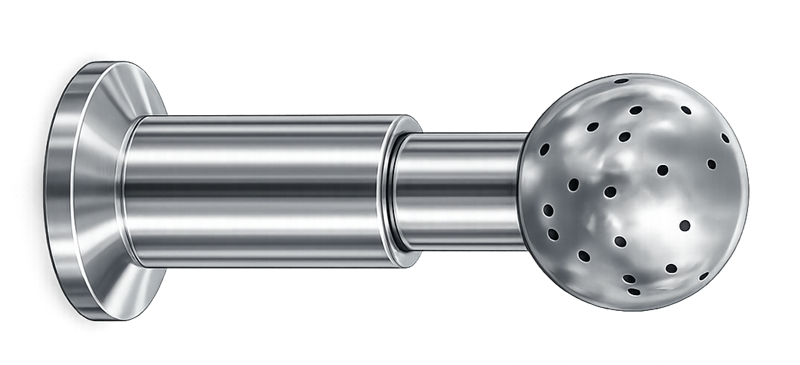
Fixed spray balls, rotary spray devices, and other cleaning components distribute cleaning solution across internal surfaces. The device type, required flow and pressure, vessel geometry, obstructions, and soil characteristics affect the achievable coverage and cleaning action.
Sanitary Connections
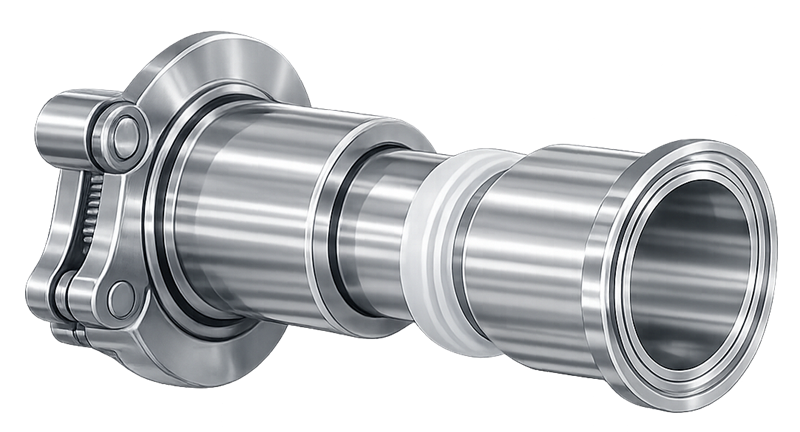
Sanitary clamp connections can provide cleanable, removable interfaces when the ferrules, gasket, alignment, assembly, and operating conditions are appropriate. The connection should not be described as inherently crevice-free; gasket intrusion, recession, misalignment, damage, and incorrect clamp installation can create unacceptable conditions.
Ingredient-Addition Ports
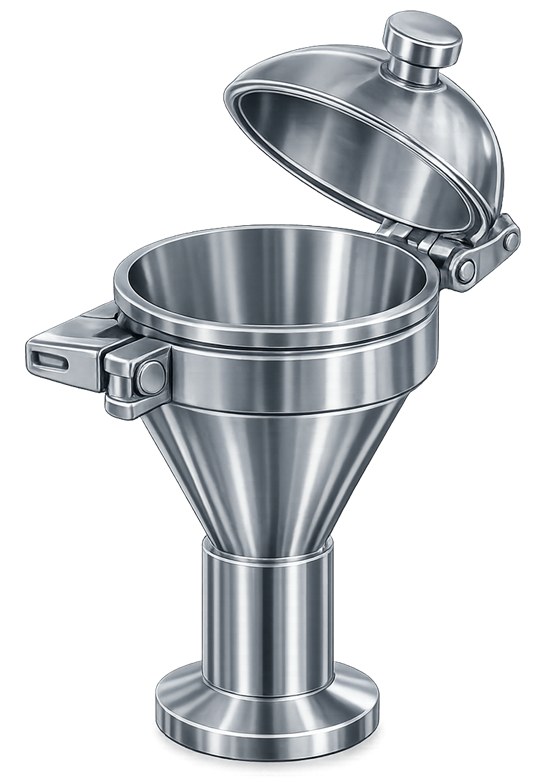
Manual addition ports, funnels, hoppers, and charge chutes must support the material-addition method while controlling contamination, dust release, operator exposure, and material retention. A simple open funnel may be suitable for one process but unacceptable for potent, sterile, moisture-sensitive, or oxidation-sensitive materials.
Vessel Bottom Geometry and Drainage
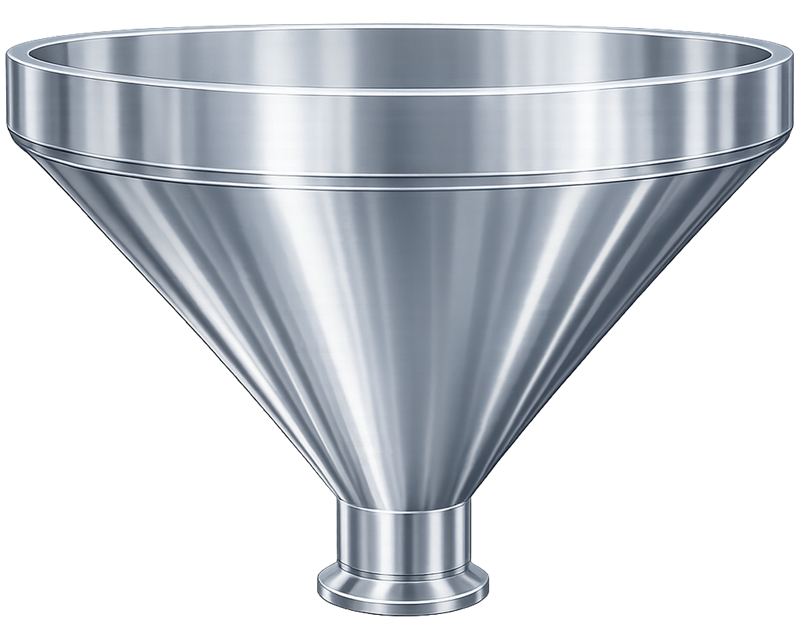
Dished, sloped, or conical bottoms direct liquid toward the outlet and may support drainage, solids handling, or product recovery. Geometry should be selected for the material and process objective. A steep cone that benefits powder or slurry discharge may be unnecessary for a low-viscosity liquid.
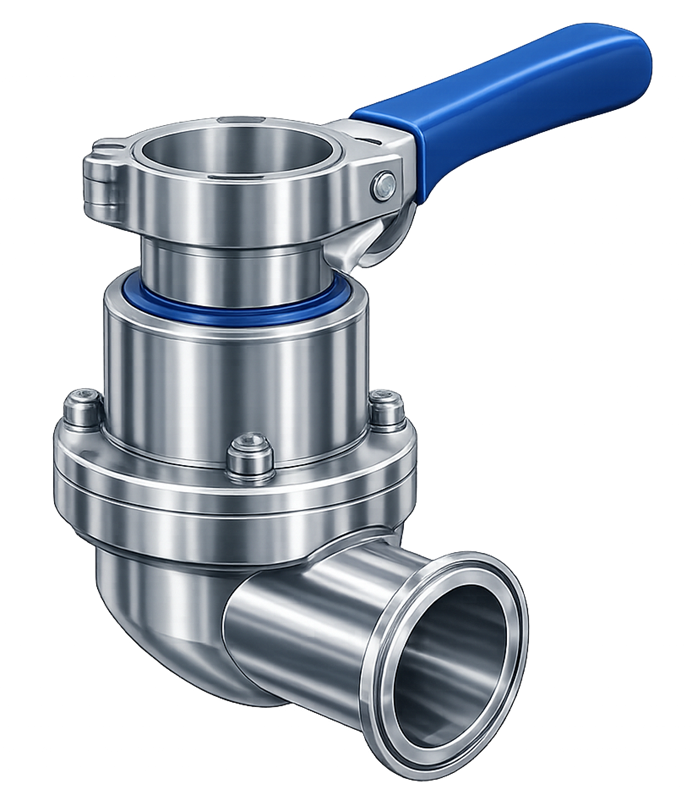
Bottom Outlet Valves
Bottom outlet valves can reduce retained volume and support drainage, transfer, and cleaning. Suitability depends on internal geometry, seal materials, actuation, orientation, drainability, cleanability, and maintenance requirements.
Gaskets, Seals, and Other Nonmetallic Materials
The product-contact material boundary usually includes nonmetallic components even when the vessel shell is stainless steel. These may include:
- Manway gaskets
- Mechanical-seal faces and elastomers
- Valve diaphragms
- O-rings
- Sight-glass seals
- Instrument seals
- Hose liners
- Filter materials
- Disposable sampling components
Material selection should consider product compatibility, cleaning chemicals, steam exposure, temperature, pressure, compression set, abrasion, swelling, embrittlement, and expected replacement frequency.
Material suitability should not be inferred only from a generic designation such as EPDM, silicone, or PTFE. Compound formulation, fillers, curing agents, manufacturing process, and supplier controls can affect performance and extractables.
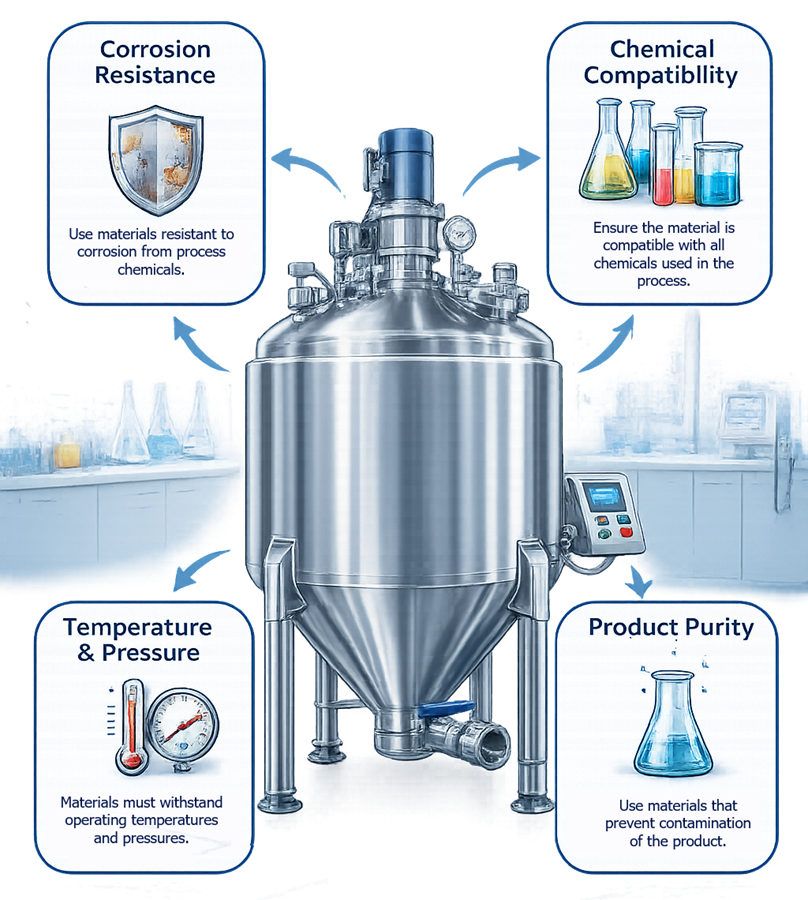
Material Compatibility Assessment
Compatibility assessment should cover the complete service environment rather than only the formulated product. The evaluation should include:
- Raw materials and intermediates
- Expected concentrations and pH ranges
- Process temperature and exposure duration
- Cleaning detergents and concentrations
- Acids, bases, and oxidizing agents
- Sanitization chemicals
- Steam or hot-water exposure
- Process and utility gases
- Lubricants or thermal fluids at credible failure interfaces
- Repeated lifecycle exposure
- Expected degradation products
- Extractables, leachables, particles, or corrosion products
The assessment should consider both acute failure and gradual deterioration. A material may tolerate one exposure but degrade after repeated cleaning, sanitization, sterilization, flexing, or thermal cycling.
Vessel Selection by Process Risk
Vessel selection should begin with intended use and risk rather than with an available equipment model. The following sequence provides a practical basis:
- Define the material and process function.
- Establish working volume and operating range.
- Identify required mixing, heat transfer, reaction, or holding performance.
- Define the required open, closed, sterile, or contained state.
- Establish pressure, vacuum, temperature, and gas conditions.
- Identify product-contact materials and compatibility requirements.
- Define cleaning, sanitization, or sterilization strategy.
- Identify sampling, transfer, addition, and discharge methods.
- Establish instrumentation, automation, alarm, and data requirements.
- Define mobility, installation, and facility-interface requirements.
- Identify applicable mechanical and hygienic standards.
- Establish qualification, maintenance, inspection, and lifecycle needs.
This selection basis should become an input to the user requirements specification and design review. The resulting vessel must then be evaluated as part of the full process system rather than as an isolated container.
Relationship to Qualification and Process Validation
Equipment qualification should demonstrate that the selected vessel is installed correctly and can operate reproducibly across its approved range. Depending on intended use, testing may address:
- Capacity and usable-volume range
- Agitation and speed control
- Heating and cooling performance
- Pressure and vacuum operation
- Instrument and alarm functions
- Transfer and discharge
- Drainability
- Cleaning-system operation
- Automation sequences
- Interlocks and failure response
Detailed execution is addressed in Tank Qualification and Lifecycle Control.
Qualification does not replace process validation. Mixing time, dissolution, suspension uniformity, reaction control, sterile hold time, or product stability may require product- or process-specific studies. FDA’s Process Validation: General Principles and Practices places equipment qualification within a broader lifecycle in which process knowledge, qualification, and continued verification collectively support a state of control.
Lifecycle Control
The continued suitability of a vessel depends on more than its original material certificate and qualification package. Lifecycle controls should detect deterioration or changes affecting the process boundary, including:
- Corrosion, pitting, or rouging
- Surface damage
- Glass-lining defects
- Polymer aging or discoloration
- Gasket and diaphragm degradation
- Seal leakage
- Agitator or shaft damage
- Jacket leakage
- Insulation damage
- Instrument replacement or relocation
- Valve replacement
- Changes to cleaning chemistry
- Changes to process materials or operating ranges
- Supplier changes affecting disposable assemblies
- Repeated handling damage to portable equipment
Inspection, preventive maintenance, calibration, change control, deviation review, and periodic assessment should remain aligned with the vessel’s intended use and risk. A change in product, cleaning method, operating temperature, pressure, hold time, or required hygienic state may require reassessment even when the vessel itself has not been physically modified.
Conclusion
Pharmaceutical tank and process-vessel selection requires alignment among process function, material characteristics, operating mode, hygienic requirements, and lifecycle controls. Storage tanks, formulation vessels, reactors, hold vessels, receivers, portable tanks, and single-use systems present different risks even when their external appearance is similar.
The selected vessel and its complete product-contact boundary must remain compatible with the process, cleaning agents, sanitization or sterilization conditions, and expected operating lifecycle. Correct classification at the requirements stage provides the basis for detailed hygienic design, defensible qualification, effective cleaning integration, and reliable process performance.