

Lyophilization Process Qualification and CPV
Lyophilization process qualification demonstrates that a defined freeze-drying cycle can reproducibly manufacture a specific product meeting its predetermined quality requirements at commercial scale.
The process includes formulation preparation, filling, loading, freezing, primary drying, secondary drying, chamber backfill, stoppering, unloading, and the associated controls and testing. Qualification must evaluate the integrated process rather than treating the lyophilizer recipe as an isolated equipment program.
The lyophilizer itself must already be qualified. Equipment capability—including shelf-temperature control, pressure control, condenser performance, vacuum integrity, alarm operation, stoppering, and data recording—is addressed in lyophilization system qualification and lifecycle control.
Process qualification uses that qualified equipment to demonstrate reproducible product performance.
Position Within the Validation Lifecycle
Lyophilization process qualification belongs within Stage 2 of the process-validation lifecycle. It follows process development and equipment qualification and precedes routine continued process verification.
The lifecycle consists of:
- Process Design — Development studies establish the formulation, critical product temperatures, process parameters, operating ranges, endpoint strategy, and control strategy.
- Process Qualification — Process Performance Qualification confirms that the commercial process performs reproducibly using qualified facilities, utilities, equipment, approved materials, trained personnel, and controlled procedures.
- Continued Process Verification — Routine manufacturing data are evaluated to confirm that the process remains in a state of control.
The broader lifecycle framework is explained in process validation lifecycle: FDA general principles.
Scope and Process Boundaries
The validation boundary should define every operation that can affect the quality of the lyophilized product.
The boundary commonly includes:
- Formulation and bulk-solution hold conditions
- Product concentration and formulation attributes
- Sterile filtration, when applicable
- Filling volume and fill accuracy
- Vial and stopper configuration
- Partial-stopper position before loading
- Loading pattern and loading duration
- Freezing conditions
- Primary-drying conditions
- Primary-drying endpoint determination
- Secondary-drying conditions
- Chamber backfill
- Stoppering under vacuum or controlled gas
- Unloading and transfer to capping
- Product sampling and release testing
- Cycle data acquisition and review
The validation boundary must also identify connected programs. A lyophilization PPQ study does not, by itself, validate aseptic technique, sterilizing filtration, media-fill performance, cleaning, sterilization, or container-closure integrity.
These interfaces should be addressed through the applicable aseptic processing validation strategy, media fill and aseptic process simulation, and stoppering and vial capping system qualification programs.
Prerequisites for Process Qualification
PPQ should not begin until sufficient process knowledge and operational readiness have been documented.
Product and Formulation Knowledge
Development data should define, as applicable:
- Formulation composition
- Solids concentration
- Buffer system and pH
- Product concentration
- Thermal behavior
- Glass-transition temperature
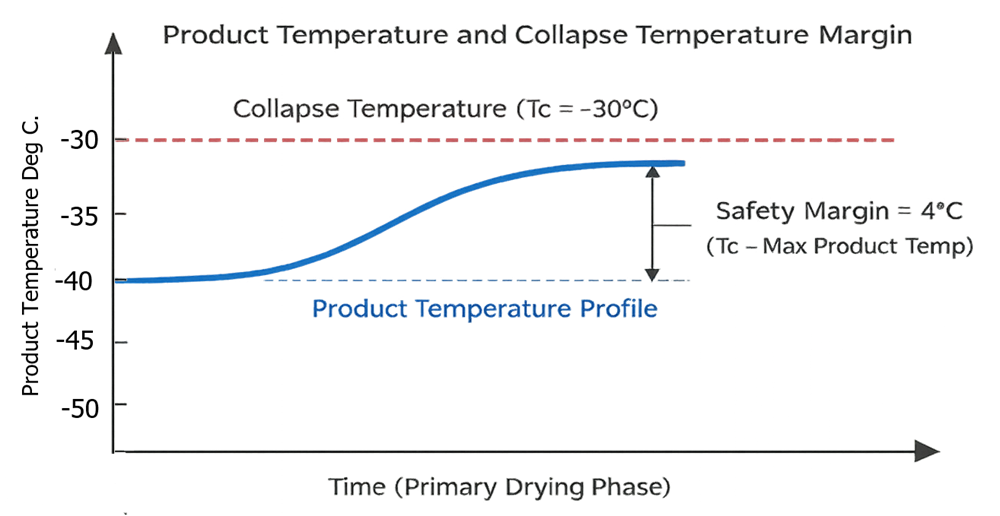
- Collapse temperature
- Eutectic or melting limits
- Product stability during freezing and drying
- Sensitivity to oxygen, light, temperature, or shear
- Target residual-moisture range
- Reconstitution requirements
The relevant critical product temperature depends on the formulation. Collapse temperature may be important for amorphous formulations, while eutectic or melting limits may be more relevant for crystalline systems.
Container-Closure Definition
The qualified configuration should define:
- Vial material, size, and geometry
- Fill volume
- Headspace
- Stopper formulation and dimensions
- Partial-stopper position
- Stoppering conditions
- Backfill gas and target pressure, where applicable
- Capping configuration
Changes to vial dimensions, fill depth, stopper design, or vial-to-shelf contact can affect heat transfer, mass transfer, drying behavior, and closure performance.
Equipment and Facility Readiness
Before PPQ execution, the following should be complete or appropriately controlled:
- Lyophilizer qualification
- Required cleaning and sterilization validation
- Calibration of critical instruments
- Preventive-maintenance status
- Computerized-system and recipe verification
- Utility qualification
- Approved operating and sampling procedures
- Operator training
- Approved analytical methods
- Material and component release
- Deviation and change-control readiness
Equipment design and operating principles are discussed in pharmaceutical lyophilizer design and critical components.
Process Understanding and Cycle Definition
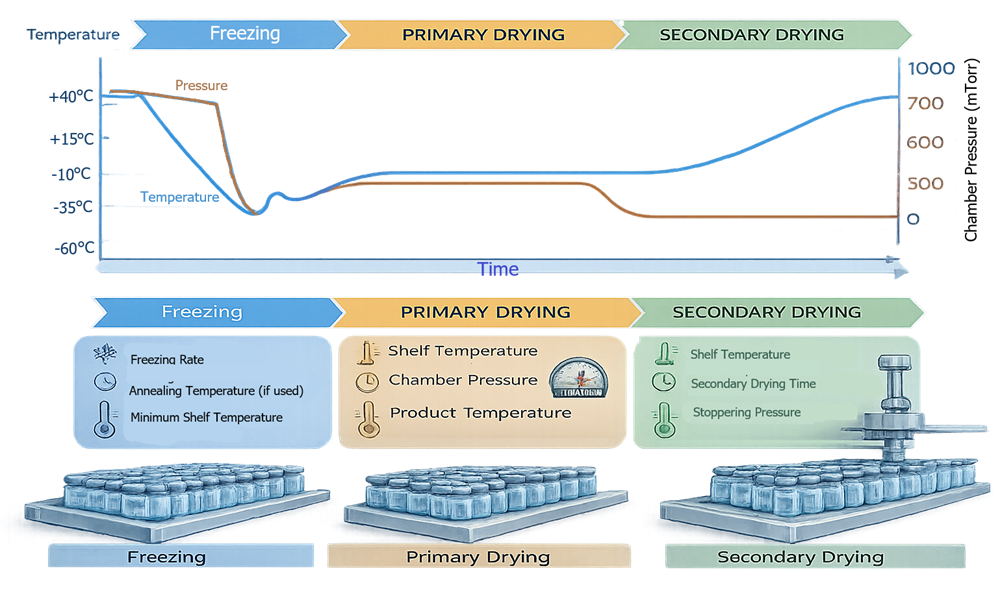
A lyophilization cycle normally contains freezing, primary drying, secondary drying, and backfill or stoppering phases. Each phase has a different purpose and different potential effects on product quality.
Freezing
Freezing converts the product solution into a frozen matrix containing ice and concentrated solutes. Important variables may include:
- Shelf cooling rate
- Minimum shelf temperature
- Freezing hold time
- Degree of supercooling
- Ice nucleation behavior
- Controlled nucleation settings, if used
- Annealing temperature and time, if used
- Load size and arrangement
- Vial and fill configuration
Ice-crystal structure influences resistance to vapor flow during primary drying. However, freezing rate alone does not predict crystal size or subsequent drying behavior. Nucleation temperature, formulation composition, vial geometry, fill depth, and thermal history may also be important.
Annealing may be used when supported by formulation and process-development data. Its purpose and operating conditions should be defined for the particular product rather than assumed to be universally beneficial.
Primary Drying
During primary drying, ice is removed by sublimation under reduced pressure while controlled heat is supplied through the shelves. Important variables may include:
- Shelf-temperature setpoint
- Shelf-temperature ramp
- Chamber-pressure setpoint
- Pressure-control stability
- Product temperature
- Primary-drying duration
- Load configuration
- Vapor-flow resistance
- Condenser and refrigeration performance
Product temperature should remain within the justified thermal limit for the formulation. The appropriate limit may relate to collapse, eutectic melting, product degradation, or another scientifically established failure mechanism.
Product-temperature probes provide useful process information, but their results require careful interpretation. Probe placement may not represent the entire batch, and invasive probes can influence local nucleation or drying behavior. Their role should therefore be defined within the overall monitoring and endpoint strategy.
Primary-Drying Endpoint
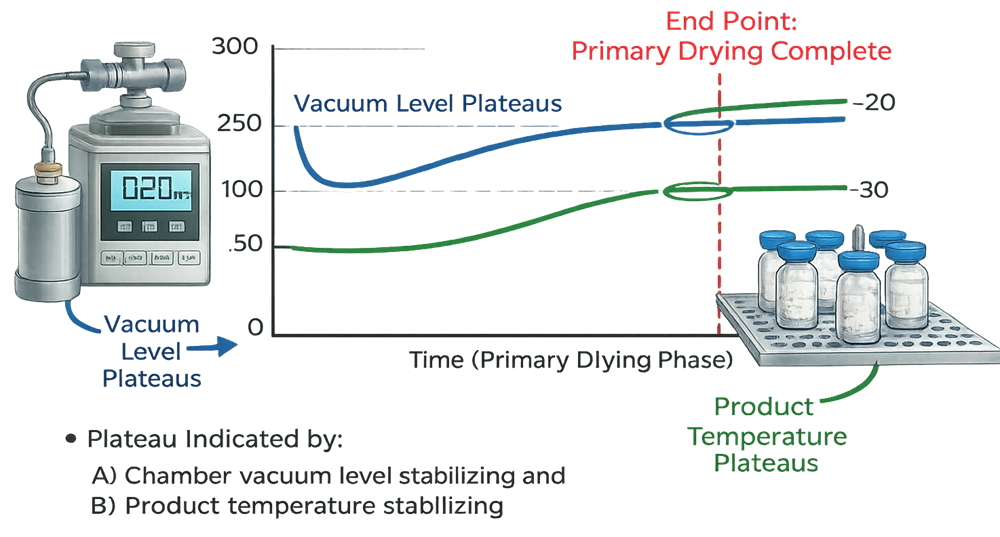
The primary-drying endpoint is the point at which removal of the intended quantity of ice is complete and the process can transition to secondary drying.
Potential endpoint indicators include:
- Product-temperature response
- Comparison of gas-dependent and gas-independent pressure measurements
- Pressure-rise testing
- Manometric temperature measurement
- Tunable diode laser absorption spectroscopy, where installed
- Development-established minimum drying time
- Other validated process analytical technology
No single endpoint method is universally required or suitable for every lyophilizer and product.
Convergence between Pirani and capacitance-manometer readings can provide supportive evidence in appropriately configured systems, but it should not automatically be treated as the sole endpoint criterion. Pressure-rise testing also requires suitable chamber isolation, validated interpretation, and equipment capability.
The qualification protocol should define:
- Endpoint method
- Instruments and calculations
- Sampling frequency
- Decision criteria
- Required confirmation
- Response to inconsistent indicators
- Minimum safety margin before transition
Secondary Drying
Secondary drying removes a portion of the unfrozen or adsorbed moisture remaining after primary drying.
Important variables may include:
- Shelf-temperature ramp
- Maximum shelf temperature
- Product temperature
- Chamber pressure
- Secondary-drying duration
- Final residual-moisture target
The cycle must balance moisture removal with product stability. Excessive drying temperature or exposure may increase degradation, while insufficient drying may compromise stability, appearance, or reconstitution performance.
The acceptable residual-moisture range should be product-specific and supported by development and stability data. The lowest achievable moisture result is not automatically the optimum result.
Backfill and Stoppering
At the end of drying, the chamber may be returned to a defined pressure using sterile filtered air or an inert gas before the vials are fully stoppered.
Controls may include:
- Backfill-gas identity and quality
- Sterilizing-filter status
- Backfill pressure
- Oxygen or headspace target, when applicable
- Stoppering pressure or vacuum condition
- Shelf-travel position
- Stopper seating
- Hold time before unloading
These controls may affect residual oxygen, stopper position, container-closure integrity, and long-term product stability.
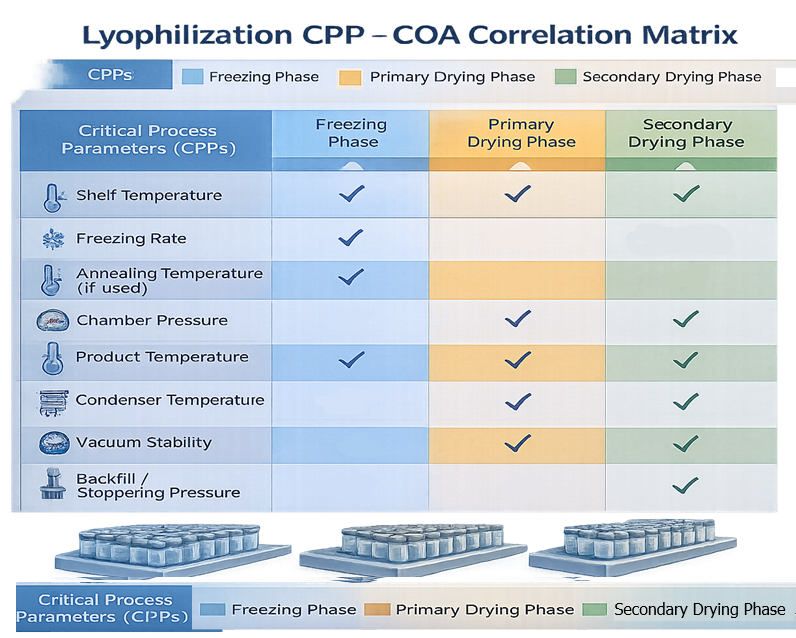
Critical Quality Attributes and Process Variables
The PPQ protocol should clearly distinguish product attributes, process parameters, monitored variables, material attributes, and equipment-performance indicators.
Not every recorded value is a critical process parameter.
| Category | Lyophilization examples | Qualification role |
|---|---|---|
| Critical quality attributes | Residual moisture, cake appearance, potency, degradants, reconstitution time, sterility, container-closure integrity | Confirm that the finished product meets predefined quality requirements |
| Potential critical process parameters | Shelf temperature, chamber pressure, phase duration, freezing conditions, backfill pressure | Controlled when variability can affect a CQA |
| Monitored process variables | Product temperature, endpoint response, pressure-gauge relationship | Provide process understanding and support decisions |
| Critical material attributes | Formulation concentration, vial dimensions, stopper properties, fill volume | Control material-related variability |
| Equipment-performance indicators | Condenser temperature, valve position, refrigeration output, vacuum-pump behavior | Confirm that qualified equipment continues to support the process |
Criticality should be based on scientific knowledge and documented risk assessment. A parameter should not be designated critical merely because it is available in the batch record or historian.
The relationship between process parameters and product quality should be supported by development studies, prior knowledge, risk assessment, scale-up data, and PPQ evidence. General methodology is addressed in risk assessment for CPP and CQA identification.
Scale-Up and Commercial-Process Readiness
Laboratory or pilot-scale cycle performance does not automatically establish commercial-scale performance.
Scale-up assessment should consider:
- Differences in shelf area and shelf mass
- Chamber geometry
- Condenser location and capacity
- Vapor-path resistance
- Refrigeration capacity
- Pressure-control behavior
- Heat-transfer differences
- Vial heat-transfer coefficient
- Edge-vial effects
- Loading and unloading duration
- Differences in nucleation behavior
- Maximum expected sublimation load
- Differences between lyophilizer units
The commercial cycle should remain within equipment capability while protecting the product from its critical thermal and stability limits.
Where multiple lyophilizers are proposed, equivalence or bracketing should be justified using equipment design, qualification data, control-system configuration, thermal mapping, pressure performance, condenser capacity, and product-specific risk.
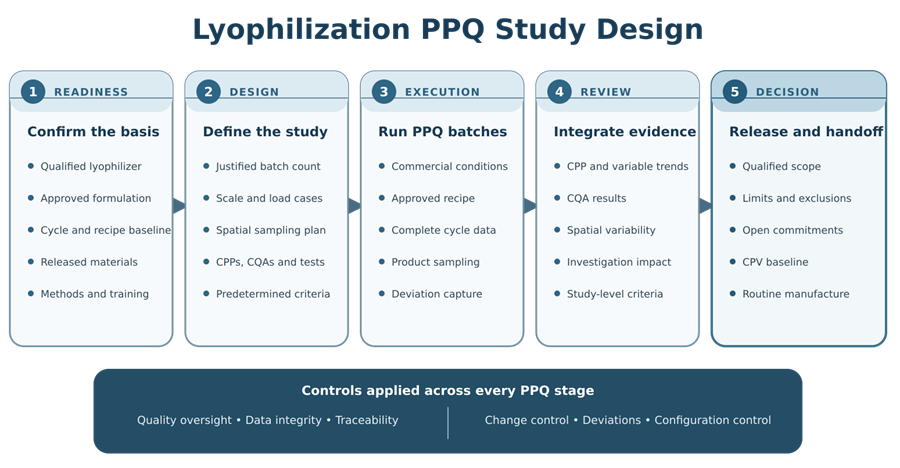
PPQ Protocol and Study Design
The PPQ protocol should define how reproducible commercial performance will be demonstrated.
The protocol should include:
- Objective and scope
- Product and process description
- Batch size and scale
- Lyophilizer identification
- Approved recipe and version
- Formulation and component requirements
- Loading configuration
- Process parameters and operating ranges
- Critical quality attributes
- Sampling plan
- Analytical methods
- Acceptance criteria
- Statistical methods, where appropriate
- Deviation-handling requirements
- Responsibilities and approvals
- Requirements for final report and batch disposition
Number of PPQ Batches
There is no universal number of PPQ batches suitable for every lyophilization process.
The number should be scientifically justified using factors such as:
- Process complexity
- Product risk
- Development knowledge
- Expected variability
- Scale-up uncertainty
- Equipment differences
- Prior manufacturing experience
- Sampling intensity
- Statistical confidence
- Regulatory commitments
Three batches may be used in some programs, but it should not be presented as an automatic regulatory requirement.
Manufacturing Conditions
PPQ batches should represent the intended commercial process. They should use:
- Qualified equipment and utilities
- Approved materials and components
- Trained operators
- Approved manufacturing procedures
- Intended commercial batch size or a justified representative scale
- Routine process controls
- Qualified analytical methods
PPQ should not intentionally introduce uncontrolled variation. Planned challenges or operating-range evaluations should be scientifically justified, predefined, and consistent with product safety and regulatory commitments.
Load Patterns and Bracketing
The study should address load-related risk, including:
- Minimum and maximum load
- Partial versus full shelves
- Vial spacing
- Use of trays
- Shelf position
- Edge exposure
- Loading time
- Maximum allowable door-open time
Bracketing or matrixing may be appropriate when product strengths, fill volumes, vial sizes, formulations, loads, or equipment configurations are sufficiently comparable. The scientific rationale and limitations must be documented.
Sampling and Testing Strategy
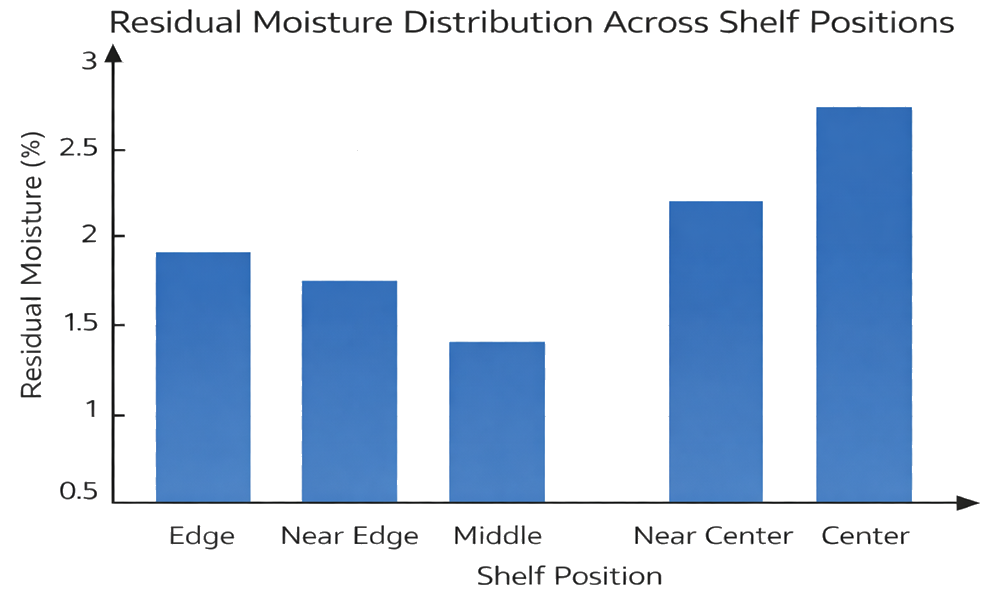
Sampling should evaluate both batch-wide quality and potential spatial variability within the lyophilizer.
Locations may include:
- Upper, middle, and lower shelves
- Edge and corner positions
- Center positions
- Locations near the chamber door
- Locations near the vapor outlet
- Areas identified during mapping or development as potentially different
- Representative locations containing product-temperature probes
A fixed “edge versus center” plan should not be copied from another product without justification. Sampling locations should be based on equipment mapping, development results, heat- and mass-transfer knowledge, and the specific loading configuration.
Testing may include:
- Residual moisture
- Cake appearance
- Reconstitution time
- Assay or potency
- Degradation products
- pH after reconstitution
- Particulate matter
- Sterility
- Endotoxin
- Container-closure integrity
- Headspace oxygen or pressure, when applicable
- Other product-specific CQAs
Destructive sampling should be distributed across the load and PPQ batches. Sample quantities must support meaningful evaluation while remaining consistent with approved analytical and batch-disposition requirements.
Acceptance Criteria and Qualification Decisions
Acceptance criteria should be predefined, measurable, scientifically justified, and linked to product requirements and process understanding.
The protocol should distinguish among:
Batch-Level Criteria
These determine whether an individual batch meets requirements, such as:
- Approved process parameters were maintained
- Required endpoint criteria were satisfied
- Product specifications were met
- Spatial results were acceptable
- No unresolved critical deviation affected the batch
Study-Level Criteria
These determine whether the complete PPQ study supports process qualification, such as:
- Reproducible performance across the planned PPQ batches
- Consistent CQA results
- Acceptable process variability
- No unexplained location-dependent failures
- Control strategy effectiveness
- Adequate evidence supporting routine operation
Lifecycle Conclusions
The final report should state:
- Whether the process is qualified
- Which product, strength, vial, fill volume, load, recipe, equipment, and site are covered
- Any limitations or exclusions
- Required enhanced monitoring
- CPV requirements
- Outstanding commitments
- Conditions requiring additional qualification
Acceptance criteria should not be revised retrospectively merely to accommodate unexpected results. Any proposed change requires documented scientific justification, impact assessment, and quality-unit approval.
Deviations and Investigations
A process deviation does not automatically invalidate an entire PPQ program, but it must be evaluated before qualification conclusions are made.
The investigation should determine:
- What occurred
- When it occurred
- Which units and process phases were affected
- Whether the deviation affected a CPP, CQA, or control
- Whether the batch remains representative of the approved process
- Whether product quality was affected
- Whether the event reveals inadequate process understanding
- Whether corrective or preventive action is required
- Whether an additional PPQ batch or study is necessary
Relevant events may include:
- Shelf-temperature excursions
- Chamber-pressure excursions
- Unexpected endpoint behavior
- Condenser or refrigeration limitations
- Vacuum leaks
- Probe failures
- Recipe or software discrepancies
- Power interruption
- Extended loading time
- Stoppering abnormalities
- Unexpected residual-moisture distribution
- Atypical cake appearance
- Analytical or sampling errors
The effect on the overall validation conclusion should be documented separately from the disposition of the affected production batch.
PPQ Report and Process Release
The PPQ report should integrate process data, laboratory results, deviations, investigations, and statistical evaluation where appropriate.
The report should include:
- Identification of executed batches
- Equipment and recipe configuration
- Actual process conditions
- Process trend graphs
- Sampling locations and results
- CQA summaries
- Comparison among batches
- Spatial-variability assessment
- Deviations and investigations
- Protocol exceptions
- Assessment of acceptance criteria
- Conclusions regarding reproducibility
- Approved process and control strategy
- CPV plan or reference
- Quality-unit approval
Release of the process for routine commercial manufacture should be based on the entire body of process-design and process-qualification evidence, not only on whether individual finished-product tests passed.
Continued Process Verification
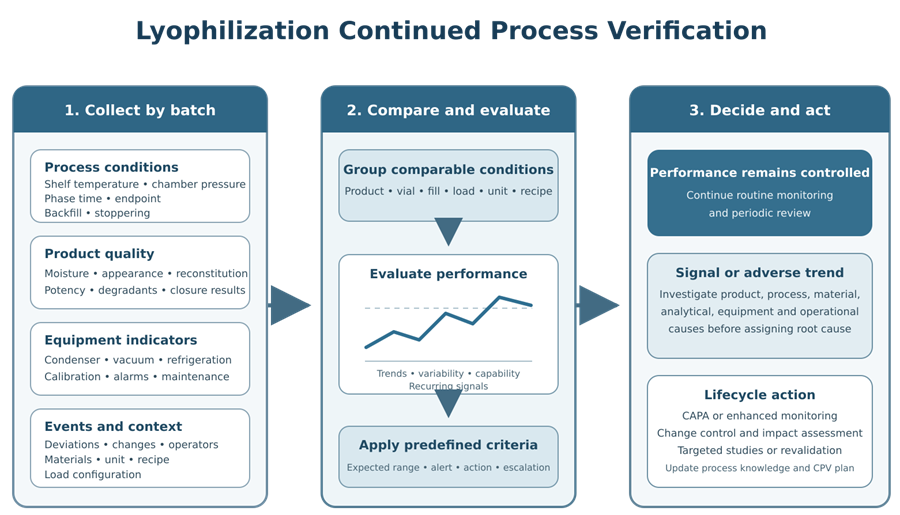
Continued Process Verification provides ongoing assurance that the lyophilization process remains in a state of control during routine manufacturing.
The CPV plan should define:
- Data to be collected
- Review frequency
- Methods for grouping comparable batches
- Statistical or graphical methods
- Alert and action criteria
- Roles and responsibilities
- Investigation requirements
- Escalation pathways
- Reporting and management-review requirements
Data may include:
Process Parameters and Monitored Variables
- Freezing temperature and duration
- Shelf-temperature ramps and holds
- Chamber-pressure control
- Product-temperature behavior, where monitored
- Primary-drying duration
- Endpoint indicators
- Secondary-drying conditions
- Backfill and stoppering conditions
Product-Quality Results
- Residual moisture
- Cake appearance
- Reconstitution time
- Assay or potency
- Degradants
- Container-closure results
- Headspace oxygen or pressure
- Stability trends
Supporting Equipment Indicators
- Condenser temperature
- Vacuum-control behavior
- Refrigeration demand
- Pressure-gauge relationship
- Alarm frequency
- Sensor calibration history
- Maintenance events
- Chamber leak-rate results
Data should be compared under meaningful conditions. Different products, vial sizes, fill volumes, load patterns, lyophilizer units, or recipe versions should not be combined without justification.
A trend is a signal requiring evaluation; it is not automatically proof of a root cause. Investigation should consider process, material, analytical, equipment, maintenance, and operational factors.
Change Control and Revalidation
Changes should undergo documented assessment to determine whether additional development, engineering studies, equipment requalification, process revalidation, or enhanced monitoring is required.
Potential triggers include:
- Formulation or concentration change
- Fill-volume change
- Vial or stopper change
- Container-closure supplier change
- Batch-size or load-pattern change
- Cycle setpoint or phase-duration change
- Endpoint-method change
- Transfer to another lyophilizer
- Scale change
- Chamber, shelf, condenser, or refrigeration modification
- Pressure-instrument or control-strategy change
- Recipe-software modification
- Major maintenance
- Repeated excursions or adverse trends
- New stability information
- Unexpected CQA variability
- Site transfer
Equipment requalification and process revalidation are related but different decisions.
A component replacement may require equipment testing without repeating product PPQ. Conversely, a formulation, container, load, or cycle change may require product-specific process studies even when the equipment remains qualified.
The extent of revalidation should be proportionate to the potential effect on process performance and product quality.
Documentation and Traceability
The validation package should provide traceability among:
- Product-development studies
- Critical product temperatures
- Risk assessments
- CPP and CQA rationale
- Equipment qualification
- Approved master recipe
- Batch records
- Sampling plan
- Analytical methods
- PPQ protocol
- Raw process data
- Laboratory results
- Deviations and investigations
- PPQ report
- Change controls
- CPV reports
- Revalidation decisions
Recipe versions, control-system configurations, analytical methods, equipment identification, and component specifications should be clearly documented. Traceability must allow reviewers to determine exactly which commercial process was evaluated and what remains within the qualified scope.
Summary
Lyophilization process qualification demonstrates that a product-specific commercial freeze-drying process can operate reproducibly and deliver acceptable product quality.
A defensible program requires:
- Qualified equipment and utilities
- Adequate product and process knowledge
- Defined formulation and container-closure configuration
- Scientifically justified process parameters
- Product-specific acceptance criteria
- Representative commercial PPQ batches
- Risk-based spatial sampling
- Integrated evaluation of process and product data
- Documented investigation of deviations
- Continued Process Verification
- Risk-based change assessment and revalidation
Equipment qualification establishes what the lyophilizer can do. Process qualification demonstrates that the defined product and cycle perform reproducibly within that capability. Continued verification confirms that this performance is maintained throughout routine manufacture.