

Tablet Coating Equipment: Design, Controls, and Qualification
Tablet coating equipment applies protective, cosmetic, taste-masking, identification, enteric, or modified-release layers to tablets and other suitable solid dosage forms. The equipment must coordinate product movement, spray delivery, conditioned airflow, solvent removal, temperature control, exhaust, containment, and data recording.
Coating quality depends on a balance between liquid deposition and drying. Applying coating faster than the equipment can remove solvent may cause overwetting, sticking, picking, twinning, or tablet damage. Excessive drying may cause spray drying, rough surfaces, poor film formation, or low coating efficiency.
Equipment qualification demonstrates that the coating system is properly designed, installed, and capable of operating throughout its approved ranges. Product-specific coating formulation, parameter ranges, weight gain, appearance, dissolution, and release performance must be established through process development, PPQ, and continued process verification.
Purpose and scope
This article addresses:
- Perforated coating pans
- Conventional solid coating pans
- Fluid-bed coating systems
- Coating-solution preparation and delivery
- Spray guns, nozzles, pumps, tubing, and gun positioning
- Air handling, exhaust, and solvent removal
- Product-bed movement and mixing
- Temperature, humidity, airflow, pressure, and spray controls
- Equipment distribution and mapping studies
- Containment, cleaning, and changeover
- Automation and electronic records
- URS, DQ, supplier documentation, FAT, SAT, IQ, OQ, and equipment-level PQ
- Product-specific PPQ and continued verification
- Calibration, maintenance, change control, periodic review, and requalification
The article focuses primarily on film coating of tablets and multiparticulates. Specialized processes such as compression coating, dip coating, and softgel encapsulation require separate equipment and control strategies.
Position within solid dosage manufacturing
Tablet coating normally follows tablet compression. Some hard capsules, pellets, granules, beads, or mini-tablets may also be coated using equipment suited to their size, shape, mechanical strength, and required product movement.
After coating, products may proceed to:
- Cooling
- Holding
- In-process inspection and reject systems
- Metal detection
- Printing
- Bottling
- Blister packaging
- Other packaging operations
Core properties established during pharmaceutical granulation, pharmaceutical drying, blending, and compression can affect coating performance. Weak tablets, excessive friability, variable porosity, residual moisture, or inconsistent dimensions may cause coating defects even when the coating equipment operates correctly.
Functions of pharmaceutical coatings
Coating may be used to:
- Protect the product from moisture, oxygen, or light
- Mask taste or odor
- Improve appearance
- Improve swallowability
- Provide product identification
- Reduce dusting
- Increase mechanical protection
- Separate incompatible ingredients
- Delay release
- Control release rate
- Provide site-specific release
- Improve handling during packaging
The required coating composition, thickness, weight gain, uniformity, and performance are product-specific. Equipment capability must support these requirements without being confused with the evidence needed to validate the product-specific coating process.
Coating equipment types
Perforated pan coaters
A perforated pan coater uses a rotating drum with perforated areas that permit conditioned process air to pass through the moving product bed.
The illustration below shows a representative perforated pan coating system with drum, spray guns, process air, exhaust, and controls.
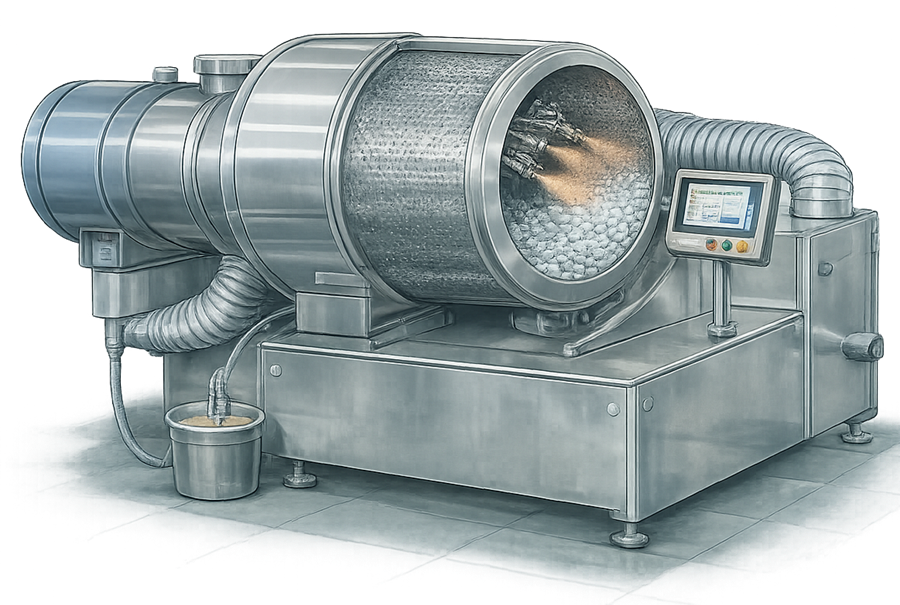
A perforated pan system may include:
- Product-loading connection
- Rotating perforated drum
- Mixing baffles
- Spray-gun bar
- Inlet-air plenum
- Exhaust plenum or exhaust shoe
- Air-handling unit
- Solution-delivery system
- Dust and overspray control
- Product-discharge system
- Cleaning system
- Instrumentation and automation
Perforated pans generally provide efficient contact between the product bed and drying air. Performance still depends on drum loading, baffle design, tablet movement, spray coverage, air distribution, and exhaust arrangement.
Fluid-bed coaters
Fluid-bed coaters suspend and circulate particles in conditioned air while coating liquid is sprayed onto them. They are commonly used for pellets, beads, granules, multiparticulates, and other relatively small dosage forms.
The illustration below shows a bottom-spray fluid-bed coater using a Wurster partition.
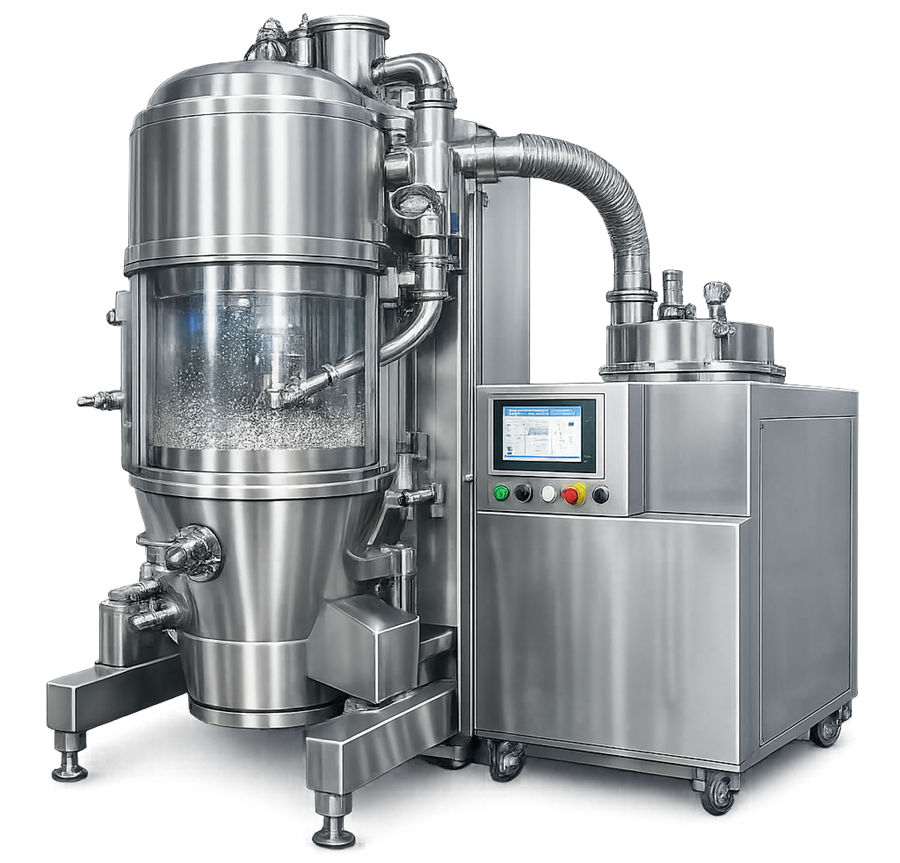
Common configurations include:
- Top spray
- Bottom spray or Wurster coating
- Tangential spray or rotor coating
A Wurster system uses a partition to establish controlled particle circulation through a central spray and drying zone.
Potentially important equipment variables include:
- Distribution-plate design
- Wurster-column dimensions and position
- Partition gap
- Nozzle position
- Airflow distribution
- Product load
- Expansion-chamber geometry
- Product filters
- Filter cleaning
- Spray-zone stability
Loss of circulation, particle agglomeration, filter loading, or nonuniform spray exposure can produce variable coating.
Conventional coating pans
A conventional coater uses a rotating solid pan. Drying air is directed onto or into the product bed rather than passing through a perforated drum.
The illustration below shows a conventional solid coating pan with external spray and drying-air arrangements.
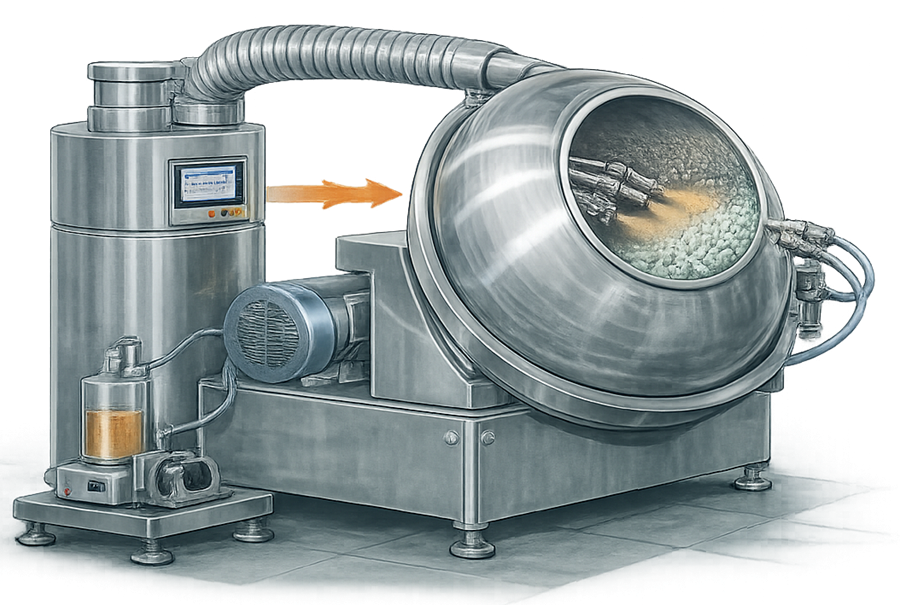
Conventional pans may provide suitable performance for specific products but generally offer less direct air passage through the bed than perforated systems.
Qualification should evaluate:
- Product-bed movement
- Air-distribution method
- Exhaust location
- Spray coverage
- Pan loading
- Baffle configuration
- Drying capacity
- Product discharge
- Cleaning access
Coating process sequence
A representative coating cycle may include:
- Equipment preparation and line clearance
- Product loading
- Drum or product-bed movement
- Preheating
- Spray-gun and airflow stabilization
- Coating-liquid application
- Concurrent solvent removal and film formation
- Final drying or curing where required
- Cooling
- Product discharge
- Yield reconciliation
- Equipment cleaning
The illustration below presents the sequence from product loading through spray coating, drying, cooling, and discharge.
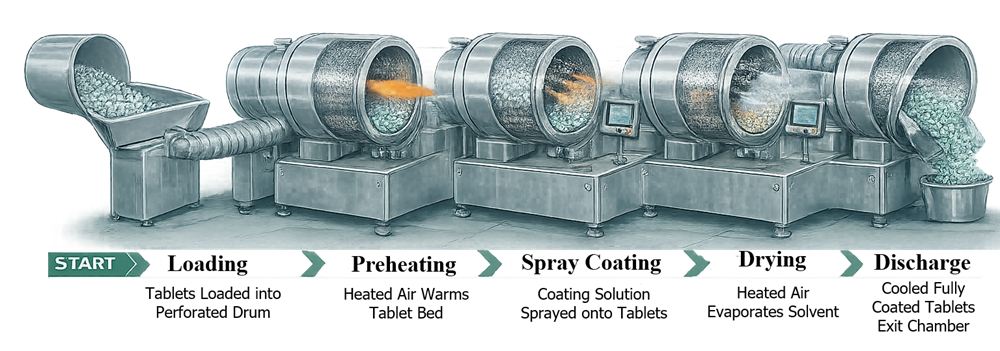
The approved recipe should define the sequence, permitted transitions, alarm response, interruption handling, and criteria for moving from one phase to another.
System boundaries and interfaces
The coating-equipment boundary may include:
- Product-loading system
- Coating pan or fluid-bed chamber
- Baffles, distribution plates, or Wurster partition
- Drive system
- Spray-gun bar
- Spray guns and nozzles
- Coating-liquid preparation tank
- Agitator
- Transfer pump
- Tubing and manifold
- Atomization and pattern-air supply
- Inlet-air handling
- Heating and cooling coils
- Humidity-control components
- Supply and exhaust fans
- Filters
- Dampers
- Exhaust treatment
- Solvent condenser or recovery equipment
- Dust collection
- Product-discharge system
- Cleaning system
- Instruments and controls
- Facility and computerized-system interfaces
The coating-liquid preparation system may be qualified as part of the coater or as a connected process system. The boundary should be explicit.
Pan and product-bed design
Pan geometry and working load
Pan diameter, length, perforated area, internal geometry, baffles, and rotation determine tablet movement and exposure to spray and drying air.
The qualified working range should define:
- Minimum load
- Maximum load
- Permitted product-bed depth
- Approved baffle arrangement
- Approved drum direction
- Drum-speed range
- Product size and mechanical limitations
Gross pan volume does not define the qualified working capacity.
Baffles and product movement
Baffles lift, divide, and redistribute tablets as the pan rotates. Their design influences:
- Axial mixing
- Radial mixing
- Tablet-bed turnover
- Spray exposure
- Drying exposure
- Tablet attrition
- Twinning risk
- Discharge
Baffle changes should be assessed because apparently small geometric differences may alter product movement and coating uniformity.
Pan speed
Pan speed affects tablet-bed movement, mixing, mechanical stress, and spray exposure.
Insufficient speed may produce poor bed turnover and uneven coating. Excessive speed may cause tablet damage, high attrition, or unstable bed movement.
The suitable speed range depends on pan geometry, product load, tablet shape, core strength, baffles, and spray conditions.
Coating-liquid preparation and delivery
Coating liquids may be solutions, suspensions, dispersions, or emulsions. Preparation equipment may include:
- Mixing vessel
- Agitator
- High-shear mixer where required
- Temperature control
- Load cells
- Filtration or screening
- Recirculation
- Transfer pump
- Tubing
- Manifold
- Spray guns
- Return line
Controls may address:
- Ingredient identity and quantity
- Mixing sequence
- Mixing speed and time
- Temperature
- Solids content
- Viscosity
- Homogeneity
- Filtration
- Hold time
- Agitation during use
- Prevention of settling
- Microbial controls where applicable
A stable spray rate does not prove that the coating liquid remains homogeneous. Suspensions may settle or change concentration if agitation, circulation, temperature, or hold time is not controlled.
Spray system design
The spray system must distribute coating liquid across the moving product bed without excessive overlap, shadowing, overspray, dripping, or gun-to-gun imbalance.
Important design variables include:
- Number of spray guns
- Nozzle type
- Orifice size
- Gun spacing
- Gun-to-bed distance
- Spray angle
- Gun orientation
- Pattern overlap
- Atomization-air pressure
- Pattern-air pressure
- Liquid pressure
- Tubing length
- Manifold design
- Pump type
- Pulsation
- Gun triggering
- Needle position
The illustration below shows the functional arrangement of an atomizing coating nozzle.
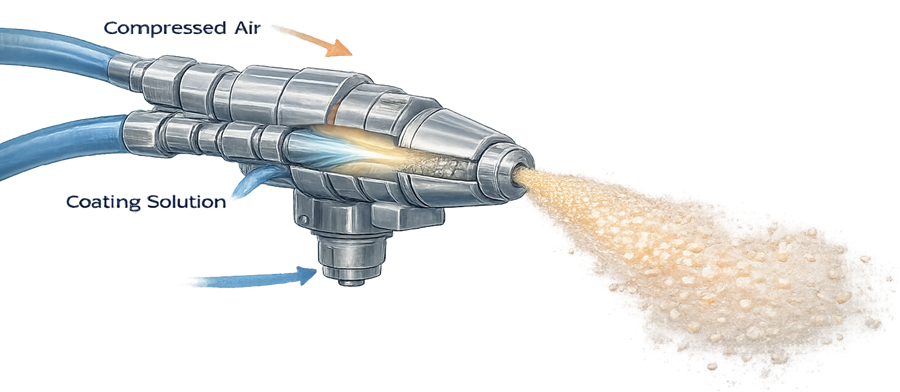
Spray-pattern testing may evaluate:
- Pattern shape
- Pattern width
- Droplet distribution
- Gun alignment
- Gun-to-gun consistency
- Nozzle blockage
- Dripping
- Start and stop response
A visually acceptable water pattern does not independently demonstrate suitable behavior with the actual coating liquid. Viscosity, surface tension, solids content, temperature, and atomization conditions can change spray performance.
Spray rate and distribution
Spray rate may be controlled as:
- Total system flow
- Flow per gun
- Pump speed
- Mass-flow rate
- Volumetric-flow rate
- Weight loss from the solution tank
- Batch-average application rate
Total flow can remain within limits while individual guns deliver unevenly. Qualification should verify distribution across the spray manifold where gun-to-gun balance is important.
Potential causes of flow imbalance include:
- Different tubing lengths
- Partial nozzle blockage
- Pump pulsation
- Manifold pressure differences
- Worn gun needles
- Air trapped in tubing
- Incorrect assembly
- Coating-liquid settling
Atomization and droplet formation
Atomization converts the coating liquid into droplets suitable for deposition on the product surface.
Droplet behavior depends on:
- Nozzle design
- Liquid flow
- Atomization pressure
- Pattern-air pressure
- Liquid viscosity
- Surface tension
- Solids content
- Temperature
- Gun-to-bed distance
Large droplets may cause localized overwetting, sticking, or rough distribution. Extremely fine droplets may dry before reaching the product bed, reducing transfer efficiency and producing rough or powdery surfaces.
The objective is not the smallest possible droplet. The spray system must produce droplets appropriate for deposition, spreading, drying, and film formation.
Air-handling and exhaust systems
The air-handling system supplies conditioned air and removes moisture or solvent vapor from the coating chamber.
The system may include:
- Prefilters and final filters
- Heating coil
- Cooling coil
- Humidity or dehumidification control
- Supply fan
- Dampers
- Ductwork
- Inlet-air temperature sensor
- Humidity or dew-point sensor
- Airflow measurement
- Exhaust fan
- Exhaust filter
- Pressure-control devices
- Solvent recovery
- Emission-control equipment
Air quality and filtration should be defined according to intended product contact and contamination risk.
Airflow through a perforated pan
In a perforated system, conditioned air enters the pan, passes through the moving product bed, and exits through the exhaust arrangement.
The illustration below shows heated inlet air passing through the tablet bed and leaving as moisture- or solvent-laden exhaust air.
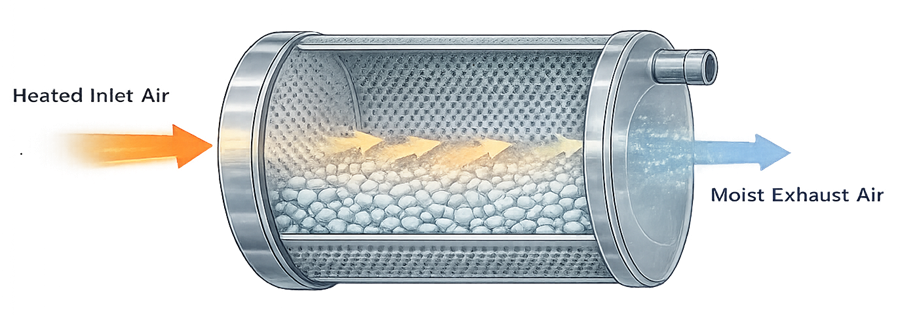
Air distribution can be affected by:
- Pan load
- Tablet-bed depth
- Perforation condition
- Baffle arrangement
- Inlet plenum
- Exhaust-shoe location
- Filter loading
- Damper position
- Fan performance
- Door and seal leakage
A stable total airflow value does not prove uniform airflow through all regions of the product bed.
Temperature and humidity
Relevant measurements may include:
- Inlet-air temperature
- Exhaust-air temperature
- Product-bed temperature
- Inlet-air humidity
- Exhaust humidity
- Dew point
Product-bed temperature generally provides a more direct indication of the thermal condition experienced by the dosage forms than inlet temperature alone. Its interpretation still depends on sensor location, bed movement, sampling method, and process phase.
Relative humidity depends on temperature. Dew point or absolute humidity may provide a more direct indication of air moisture content when seasonal or process variation is important.
Balance between spraying and drying
Successful coating requires coordination among:
- Spray rate
- Atomization
- Airflow
- Inlet-air temperature
- Inlet-air humidity
- Exhaust conditions
- Product-bed temperature
- Pan speed
- Product-bed movement
- Gun position
If deposition exceeds drying capacity, the product bed may become overwet. If drying greatly exceeds deposition, droplets may dry before proper spreading and coalescence.
The operating range should be established from product and process development rather than from equipment capability alone.
Critical process parameters and responses
| Parameter or condition | Equipment function | Potential process or product response |
|---|---|---|
| Pan speed | Controls product movement and mixing | Coating uniformity, attrition, twinning |
| Product load | Establishes bed depth and movement | Spray exposure and drying |
| Spray rate | Controls coating-liquid application | Weight gain, overwetting, coating time |
| Atomization pressure | Influences droplet formation | Droplet size, surface texture, transfer efficiency |
| Pattern-air pressure | Shapes spray pattern | Coverage and overlap |
| Gun-to-bed distance | Influences droplet travel | Premature drying, overwetting, coverage |
| Inlet-air temperature | Provides drying energy | Evaporation rate and bed temperature |
| Airflow | Removes moisture or solvent | Drying capacity and process pressure |
| Inlet-air humidity | Influences drying potential | Drying rate and film formation |
| Product-bed temperature | Indicates product thermal condition | Drying balance and film formation |
| Coating-liquid solids | Influences delivered coating mass | Weight gain and viscosity |
| Coating-liquid agitation | Maintains suspension uniformity | Coating composition and color uniformity |
Equipment qualification verifies that the system can achieve, control, and record approved ranges. Product-specific studies establish which ranges produce the intended coating quality.
Coating weight gain
Coating weight gain may be expressed as:
Weight gain (%) = ((coated weight − initial core weight) ÷ initial core weight) × 100
The calculation should define:
- Whether individual tablets or a composite sample are used
- How initial core weight is established
- Whether tablets are conditioned before weighing
- Balance suitability
- Sample quantity
- Moisture or volatile loss
- Sampling time
- Treatment of removed samples
- Calculation precision
Apparent weight gain can be affected by moisture loss from the tablet core during preheating or coating. Weight gain therefore may not equal the total mass of coating solids deposited without appropriate correction or supporting study.
Weight gain is not a direct measurement of coating thickness or functional performance.
Equipment distribution and mapping
Qualification may evaluate distribution of:
- Inlet-air temperature
- Airflow
- Product-bed temperature
- Spray-gun flow
- Spray pattern
- Atomization pressure
- Pan speed
- Solution-delivery rate
- Exhaust conditions
Airflow and temperature studies
Testing may use:
- Empty-pan conditions
- Defined surrogate loads
- Representative minimum and maximum loads
- Multiple sensor locations
- Smoke or airflow visualization where suitable
- Product-bed temperature measurements
- Exhaust-location measurements
- Repeat runs
Fixed sensors can interfere with the moving tablet bed. Probe placement and restraint should be designed to prevent equipment damage and misleading measurements.
Temperature uniformity does not independently prove coating uniformity. Coating also depends on tablet movement, spray coverage, droplet behavior, solution properties, and film formation.
Spray-distribution studies
Spray-system evaluation may include:
- Total flow accuracy
- Individual gun flow
- Gun-to-gun variability
- Spray-pattern width
- Pattern overlap
- Nozzle alignment
- Drip prevention
- Response after start, stop, or interruption
- Blocked-gun detection where provided
The test liquid should be selected with consideration of the intended coating-liquid properties and study objective.
Endpoint determination
Coating endpoint may be based on:
- Applied solution quantity
- Calculated coating solids
- Weight gain
- Spray time
- Product appearance
- Color measurement
- Product-bed temperature
- Residual moisture or solvent
- PAT measurement
- Functional testing performed during development
The equipment may calculate applied coating quantity from pump flow, solution-tank weight, or recipe totals. The calculation and measurement chain should be verified.
Equipment qualification verifies the measurement and control functions. Product-specific development establishes the endpoint and its relationship to coating performance.
Process analytical technology
PAT applications may use:
- Near-infrared spectroscopy
- Raman spectroscopy
- Color measurement
- Image analysis
- Terahertz measurement
- Other suitable technologies
PAT may support monitoring of:
- Coating thickness
- Coating composition
- Moisture
- Color
- Endpoint progression
- Uniformity
The PAT lifecycle should address model development, reference methods, sampling, calibration range, preprocessing, software, data integrity, maintenance, and model changes.
Coating defects
Common defects may include:
- Sticking
- Picking
- Twinning
- Peeling
- Chipping
- Cracking
- Bridging of scores or embossing
- Roughness or orange peel
- Spray drying
- Mottling or color variation
- Erosion
- Blistering
- Uneven coating
- Tablet breakage
The illustration below shows representative visible coating defects.
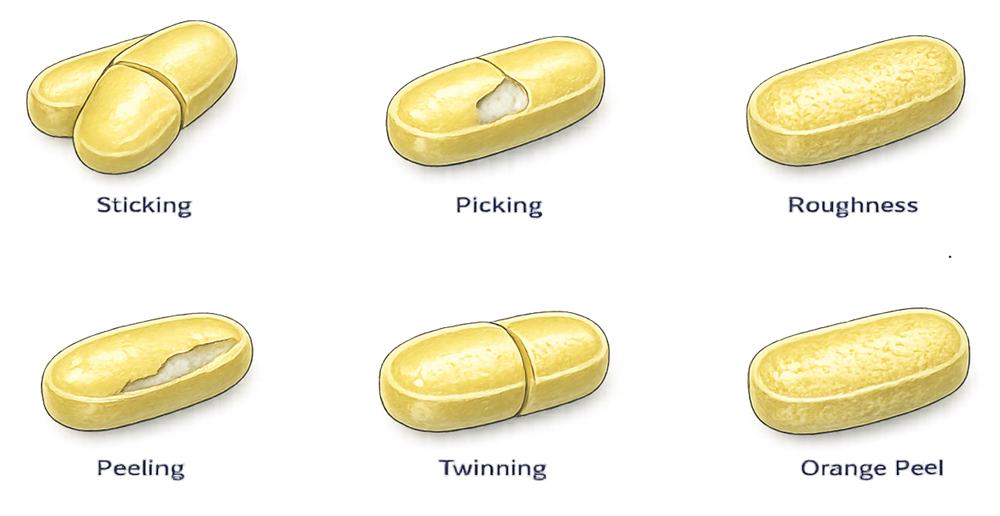
A visible defect should not automatically be assigned to one parameter.
| Defect | Possible contributors |
|---|---|
| Sticking or picking | Overwetting, low bed temperature, low airflow, weak cores |
| Twinning | Tablet shape, overwetting, low pan speed, inadequate mixing |
| Roughness or orange peel | Large droplets, high viscosity, poor spreading, rapid drying |
| Spray drying | Fine droplets, excessive drying, long gun distance |
| Peeling or cracking | Poor adhesion, inadequate plasticization, mechanical stress |
| Bridging | High application rate, coating properties, poor atomization |
| Mottling | Coating-liquid variation, migration, uneven drying, poor mixing |
| Chipping or erosion | Weak cores, excessive pan speed, aggressive baffles |
| Uneven coating | Poor bed movement, gun misalignment, flow imbalance |
| Blistering | Excessive product temperature or vapor formation |
Investigation should consider equipment, coating liquid, tablet core, method, environment, measurement, and operator factors.
Containment and solvent controls
Coating may generate:
- Coating mist
- Powder
- Water vapor
- Organic-solvent vapor
- Cleaning-agent vapor
- Contaminated exhaust
Controls may include:
- Negative-pressure operation
- Closed solution transfer
- Enclosed spray system
- Exhaust filtration
- Solvent condenser
- Emission-control equipment
- Vapor monitoring
- Inerting
- Explosion protection
- Grounding and bonding
- Closed product transfer
- Safe-change filters
For flammable solvents, the equipment and facility should be designed from the applicable solvent properties, vapor concentration, ignition risk, ventilation, environmental requirements, and safety assessment.
The associated pharmaceutical powder containment and dust collection systems article addresses powder extraction, filtration, airflow, and lifecycle control.
Hygienic design and cleaning
Product-contact and residue-retaining locations may include:
- Coating pan
- Baffles
- Perforations
- Spray guns
- Nozzles
- Gun bar
- Solution tank
- Agitator
- Pump
- Tubing
- Manifold
- Product-loading and discharge connections
- Inlet and exhaust plenums
- Filters
- Fluid-bed distribution plate
- Wurster partition
- Product container
Cleaning design should support:
- Safe access
- Defined disassembly
- Spray-device coverage
- Drainage
- Drying
- Inspection
- Correct nozzle and gun reassembly
- Prevention of cleaning-agent retention
- Protection of cleaned equipment
- Line clearance
Equipment qualification may verify cleaning recipes, spray devices, flow, pressure, temperature, drainage, and drying. It does not replace the residue limits, sampling recovery, analytical capability, worst-case selection, and reproducibility required by the site’s cleaning validation approach.
Instrumentation and automation
Coating-system instrumentation may include:
- Pan-speed measurement
- Airflow instruments
- Temperature sensors
- Humidity or dew-point sensors
- Pressure and differential-pressure transmitters
- Solution-tank load cells
- Flowmeters
- Pump-speed monitoring
- Atomization- and pattern-air pressure instruments
- Product-bed temperature probes
- Solvent-vapor detectors
- PAT instruments
Automated functions may include:
- Recipe management
- Preheating
- Pan-speed control
- Airflow control
- Temperature and humidity control
- Spray-gun triggering
- Pump control
- Spray interruption
- Coating-quantity calculation
- Cooling
- Discharge
- Cleaning
- Alarm management
- Batch reporting
Computerized-system controls should address:
- Authorized access
- Approved recipes
- Parameter limits
- Manual-mode restrictions
- Audit trails where applicable
- Data accuracy
- Time synchronization
- Backup and recovery
- Configuration management
- Software changes
- Interface verification
User requirements and design qualification
The URS should define measurable requirements for:
- Intended products and coating types
- Batch-size range
- Pan or fluid-bed configuration
- Product dimensions and mechanical limitations
- Spray-system capacity
- Number of guns
- Coating-liquid properties
- Airflow, temperature, and humidity ranges
- Solvent handling
- Containment
- Cleaning
- Product-contact materials
- Instrumentation
- Automation and electronic records
- Product loading and discharge
- Facility and utility interfaces
- Maintenance access
- Supplier documentation
Design qualification should confirm that the selected coating system satisfies intended use and adequately controls identified risks.
Supplier documentation, FAT, and SAT
Supplier documentation may include:
- General arrangement drawings
- Process and instrumentation diagrams
- Airflow diagrams
- Product-contact drawings
- Spray-system specifications
- Pump and nozzle data
- Fan and heater data
- Filter specifications
- Solvent-control documentation
- Instrument lists
- Electrical drawings
- Functional specifications
- Software and configuration documentation
- Alarm and interlock lists
- Cleaning instructions
- Maintenance recommendations
- Operating manuals
Factory acceptance testing may verify:
- Pan or product-container operation
- Pan-speed control
- Airflow and temperature controls
- Spray-system operation
- Pump control
- Recipe execution
- Alarms and interlocks
- Cleaning sequences
- Data recording
- Safety functions
Site acceptance testing should confirm equipment condition after delivery and operation with installed air handling, exhaust, utilities, controls, and facility interfaces.
Approved FAT results may support qualification when they remain applicable and traceable. Functions affected by shipment, installation, utilities, configuration, or site integration require site verification.
Installation qualification
Installation qualification should verify, as applicable:
- Equipment identity and location
- Pan, chamber, product container, and baffles
- Distribution plate or Wurster partition
- Spray guns, nozzles, pump, tubing, and manifold
- Solution tank and agitator
- Air-handling and exhaust components
- Filters
- Heating and cooling systems
- Solvent-control equipment
- Product-contact materials
- Utilities
- Instruments and calibration status
- Control hardware
- Software and firmware versions
- Cleaning connections
- Drawings and manuals
Installation discrepancies should be documented and assessed before release.
Operational qualification
Operational qualification should challenge the coating system throughout its approved equipment ranges.
Testing may include:
- Minimum and maximum pan speed
- Airflow range
- Temperature-control range
- Humidity measurement or control
- Pressure and differential-pressure functions
- Pump and flow range
- Atomization- and pattern-air pressure
- Spray-gun triggering
- Individual gun-flow distribution
- Spray-pattern evaluation
- Solution-tank agitation
- Loaded or simulated-load operation
- Recipe limits
- Alarm and interlock challenges
- Manual and automatic modes
- Power-loss and restart behavior
- Data recording
- Cleaning sequences
Product-specific coating weight gain, appearance, dissolution, or release criteria should not be assigned as generic equipment OQ acceptance criteria.
Equipment-level performance qualification
Equipment-level PQ demonstrates that the installed coater can perform its intended equipment functions reproducibly under representative operating conditions. Testing may evaluate:
- Representative minimum and maximum loads
- Product-bed movement
- Pan or fluid-bed operation
- Airflow and temperature distribution
- Spray-system repeatability
- Gun-to-gun flow
- Solution delivery
- Charging and discharge
- Containment
- Solvent-removal capability
- Cleaning functionality
- Repeated recipe execution
- Extended operation
Suitable placebo cores, surrogate particles, water, or another justified challenge material may be used when they adequately represent the equipment function being tested.
Equipment-level PQ does not demonstrate that a commercial coating formulation consistently produces dosage forms meeting product specifications. That conclusion requires product-specific PPQ.
Product-specific PPQ and sampling
Product-specific PPQ evaluates the integrated commercial coating process using the approved dosage form, coating formulation, equipment configuration, operating strategy, analytical methods, and sampling plan.
PPQ may evaluate:
- Coating weight gain
- Weight-gain distribution
- Coating thickness
- Appearance
- Color
- Defects
- Residual moisture or solvent
- Tablet dimensions
- Friability
- Disintegration
- Dissolution
- Modified-release performance
- Yield and reconciliation
- Performance after interruption or restart
The illustration below shows a conceptual coating-sampling timeline. The displayed intervals and sample quantities are examples only and must not be copied as universal requirements.
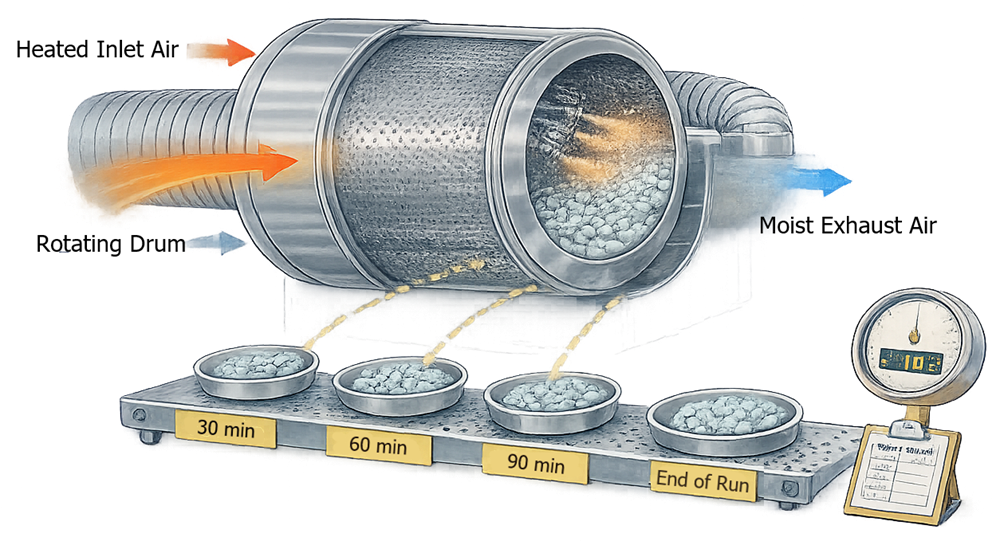
A justified PPQ sampling plan may include:
- Uncoated core reference
- End of preheating
- Stable spray operation
- Defined coating intervals
- Solution-tank replenishment
- Spray-gun interruption
- Process restart
- End of spraying
- Final drying or curing
- Cooling
- Early, middle, and late discharge
Sampling principles are addressed further in sampling plan and data collection strategy.
Equipment qualification versus process validation
| Equipment qualification | Product-specific process validation |
|---|---|
| Confirms equipment installation and configuration | Confirms the commercial product and coating process |
| Verifies pan, spray, airflow, temperature, pressure, alarms, and controls | Establishes product-specific parameter ranges |
| Challenges approved equipment ranges | Challenges coating-liquid, core, load, and process variability |
| Demonstrates mechanical and control repeatability | Demonstrates coating quality and product performance |
| May use suitable placebo or surrogate materials | Uses justified commercial-process conditions |
| Does not establish dissolution or release performance | Evaluates applicable finished-product attributes |
| Does not determine PPQ batch requirements | Establishes PPQ and continued-verification evidence |
The broader lifecycle is addressed in PPQ strategy and batch definition and general principles of process validation.
Calibration and maintenance
Instruments used to control, record, test, or make GMP decisions should be included in the applicable calibration program and metrology control.
Relevant devices may include:
- Temperature sensors
- Humidity and dew-point sensors
- Airflow instruments
- Pressure and differential-pressure transmitters
- Flowmeters
- Solution-tank load cells
- Pump-speed indicators
- Pan-speed indicators
- Atomization- and pattern-air pressure instruments
- Solvent-vapor detectors
- PAT instruments
Preventive maintenance should address:
- Pan drive
- Bearings
- Baffles
- Perforated drum
- Spray guns
- Nozzles
- Gun needles
- Pump
- Tubing and manifold
- Solution-tank agitator
- Fans
- Heaters and coils
- Dampers
- Filters
- Seals
- Exhaust system
- Cleaning devices
Broader principles are addressed in preventive maintenance and equipment reliability.
Common equipment failure modes
| Failure mode | Potential effect | Typical detection or control |
|---|---|---|
| Nozzle blockage | Uneven spray distribution | Gun inspection, flow verification, pressure trend |
| Gun dripping | Local overwetting or defects | Needle inspection and start-stop testing |
| Pump-flow drift | Incorrect application rate | Flow or weight verification |
| Gun-to-gun imbalance | Uneven coating | Individual gun-flow testing |
| Low airflow | Overwetting or poor solvent removal | Airflow and pressure monitoring |
| Excessive airflow | Spray drying or product attrition | Airflow limits and product assessment |
| Temperature-sensor drift | Incorrect drying control | Calibration and trend review |
| Product-bed probe displacement | Misleading temperature indication | Setup verification and inspection |
| Baffle damage or incorrect installation | Poor mixing or tablet damage | Inspection and configuration control |
| Filter blockage | Reduced airflow and pressure instability | Differential-pressure monitoring |
| Incorrect recipe | Operation outside approved conditions | Access control and recipe approval |
| Spray-gun misalignment | Poor coverage or overspray | Setup fixture and pattern verification |
| Loss of coating-liquid agitation | Settling or composition variation | Agitator monitoring and alarm |
| Exhaust or solvent-control failure | Vapor accumulation or shutdown | Interlock and safety-system testing |
Change control and requalification
Changes should be evaluated for effects on equipment qualification and the validated coating process.
Examples include:
- New pan or product-container size
- Baffle modification
- Spray-gun or nozzle change
- Number or position of guns
- Pump or tubing change
- Air-handling modification
- Filter change
- Sensor replacement or relocation
- New solvent system
- Exhaust or solvent-recovery modification
- Control-software change
- Recipe modification
- Cleaning-process change
- Major repair
- Equipment relocation
- New coating formulation with substantially different spray properties
The impact assessment should determine whether the change requires:
- Document revision
- Calibration or functional testing
- Targeted IQ or OQ
- Airflow or temperature remapping
- Spray-distribution testing
- Equipment-level PQ
- Cleaning assessment
- Product-development work
- Additional PPQ or process validation
Requalification should focus on affected functions and risks rather than automatically repeating every original test.
Periodic review and continued verification
Periodic equipment review should evaluate:
- Qualification status
- Changes
- Deviations
- Alarms
- Calibration
- Maintenance
- Spray-gun and nozzle history
- Air-handling performance
- Filter history
- Software and recipe status
- Cleaning performance
- Recurring failures
- Supplier support
- Obsolescence
- Requalification decisions
Product continued verification should separately evaluate applicable coating weight, appearance, defect, dissolution, release, residual-solvent, yield, and process-parameter trends.
Documentation and traceability
Lifecycle documentation should connect:
- Intended use
- User requirements
- Design specifications
- Risk assessments
- Supplier documentation
- FAT and SAT
- IQ, OQ, and equipment-level PQ
- Airflow, temperature, and spray-distribution studies
- Instruments and calibration
- Automation configuration
- Recipes
- Cleaning procedures
- Maintenance
- Training
- Deviations
- Change controls
- Requalification decisions
- Product-development studies
- PPQ
- Continued process verification
The documentation should distinguish evidence of coating-equipment capability from evidence validating the product-specific coating process.
Regulatory basis
21 CFR 211.63 requires equipment to be appropriately designed, adequately sized, and suitably located for intended use, cleaning, and maintenance.
21 CFR 211.67 establishes requirements for equipment cleaning, maintenance, written procedures, and records.
21 CFR 211.68 addresses automatic, mechanical, electronic, and computerized equipment, including calibration, inspection, checks, and system controls.
21 CFR 211.110 requires appropriate in-process controls and tests to monitor process output and manufacturing sources of variability.
FDA’s Process Validation: General Principles and Practices separates equipment qualification from process performance qualification and continued process verification.
Conclusion
Tablet coating equipment must coordinate product-bed movement, spray delivery, conditioned airflow, temperature, humidity, solvent removal, containment, cleaning, and data capture.
Qualification demonstrates that the installed coating system can operate reproducibly throughout its approved equipment ranges. It does not establish the commercial coating formulation, product-specific operating ranges, coating endpoint, dissolution, or release performance.
Product development, PPQ, and continued verification must demonstrate control of the integrated coating process and continued suitability of the coated dosage form.