

Chromatography System Qualification and Lifecycle Control
Chromatography system qualification demonstrates that the equipment, instruments, automation, column interfaces, utilities, and supporting functions are suitable for their intended GMP use. Qualification should challenge the system across its approved operating range and confirm that failures, alarms, interlocks, recipes, records, and recovery functions behave as intended.
This article addresses equipment-level qualification and lifecycle control. It does not replace column-packing verification, cleaning validation, computerized-system validation, or purification-process validation.
Purpose and Lifecycle Position
The purpose of chromatography system qualification is to establish documented evidence that the installed system:
- Conforms to approved requirements and design documentation
- Is correctly installed and identified
- Operates throughout its intended ranges
- Controls flow, pressure, gradients, valve routing, and process sequencing
- Measures and records critical operating conditions accurately
- Responds appropriately to alarms, interlocks, and failures
- Supports approved cleaning, sanitization, and storage procedures
- Protects electronic records and controlled recipes
- Remains suitable through maintenance, change control, periodic review, and requalification
The extent of qualification should reflect intended use, system complexity, automation, product-contact risk, operating range, available supplier evidence, and potential effect on product quality.
Qualification Scope and System Boundary
The qualification boundary should be defined before protocol development. A chromatography system may include:
- Process pumps
- Flow-control devices
- Valve manifolds
- Product-contact tubing and piping
- Pressure instruments
- Flow instruments
- UV detectors
- Conductivity and pH instruments
- Temperature instruments
- Air or bubble detectors
- Gradient or buffer-mixing functions
- Column inlet and outlet connections
- Sample, divert, waste, and fraction-collection paths
- Cleaning and sanitization flow paths
- PLC, HMI, recipes, alarms, and electronic records
- Utility and communication interfaces
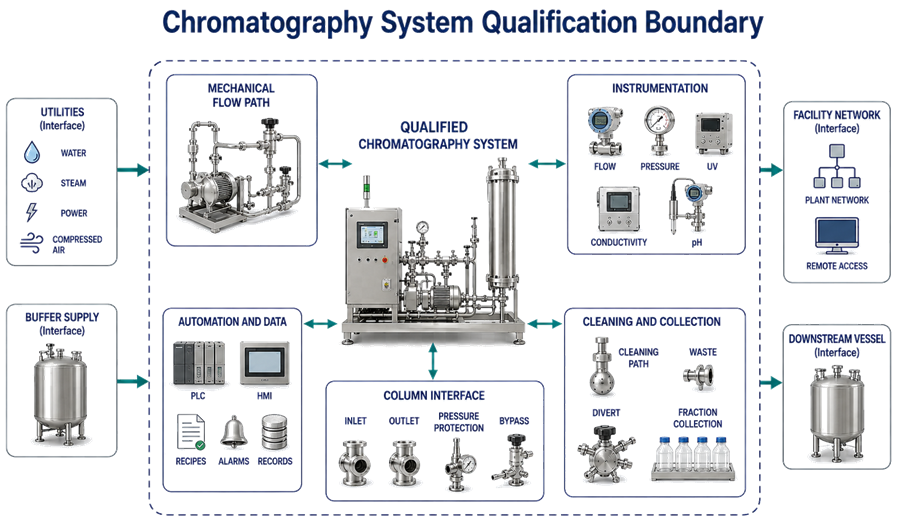
The boundary should identify which components are part of the qualified system and which are separately controlled systems. Buffer-preparation equipment, utility-generation systems, external data historians, laboratory instruments, and downstream collection vessels may interact with the chromatography system without being included in the same qualification package.
The equipment architecture and operating logic are described in chromatography skid design, architecture, and process control. Column hardware, packing, packing verification, and resin-reuse controls are addressed separately in chromatography columns, packing, and resin lifecycle control.
Intended Use and User Requirements
Qualification begins with a defined intended use and approved user requirements specification. The URS should identify what the system must do without prescribing unnecessary design details.
Requirements may address:
- Applicable chromatography modes
- Product and buffer characteristics
- Required flow range
- Normal and maximum operating pressure
- Column sizes and connection arrangements
- Gradient or buffer-mixing capability
- Required detector types and ranges
- Fraction-collection and divert functions
- Product-contact materials
- Cleaning and sanitization requirements
- Drainability and hold-up volume
- Single-use or reusable flow paths
- Recipe-management requirements
- Alarm and interlock expectations
- Electronic records and audit trails
- User-access levels
- Data interfaces
- Backup and recovery
- Maintenance and calibration access
- Environmental and utility conditions
Each requirement should be testable or otherwise verifiable. General requirements for equipment URS development are addressed in URS for GMP facilities, utilities, and equipment.
Risk-Based Qualification Strategy
A documented risk assessment should identify the equipment functions, instruments, automation features, and failure modes requiring qualification.
Risk evaluation should consider:
- Direct and indirect product contact
- Potential effect on product quality
- Potential for cross-contamination or carryover
- Loss of flow, pressure, or gradient control
- Incorrect valve routing
- Inaccurate detection or fraction collection
- Recipe or configuration errors
- Failure of alarms or interlocks
- Loss or alteration of electronic records
- Utility interruptions
- Incomplete cleaning or sanitization
- Single-use assembly failures
- Failure recovery and restart behavior
Risk results should determine test depth, challenge conditions, acceptance criteria, required traceability, and the extent to which supplier testing may be leveraged. Risk assessment should not be used to eliminate testing without documented technical justification.
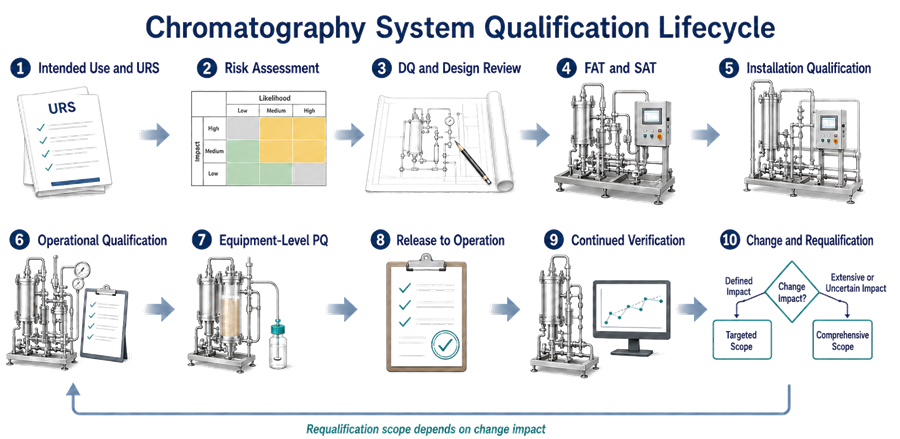
ICH Q9(R1) supports applying risk-management formality and documentation in proportion to risk. See FDA’s Q9(R1) Quality Risk Management guidance.
Design Qualification and Design Review
Design qualification demonstrates that the proposed design is suitable for the approved requirements and intended use. DQ may be documented through a dedicated protocol, controlled design review, requirements traceability, or a combination of these activities.
Design review should evaluate:
- Process-flow and instrumentation diagrams
- Product-contact materials and surface requirements
- Pressure ratings and system protection
- Pump operating range and turndown
- Valve arrangement and flow-direction control
- Dead legs, hold-up volume, and drainability
- Gradient and buffer-mixing design
- Instrument type, location, range, and accuracy
- Column connection and pressure-monitoring arrangements
- Fraction-collection and divert logic
- Cleaning, sanitization, flushing, and storage paths
- Sampling and venting provisions
- Single-use assembly connections
- Utility capacity and quality
- Control-system architecture
- Recipe and data-management functions
- Alarm and interlock strategy
- Maintenance and calibration accessibility
- Supplier documentation and support
The review should document unresolved design risks, required modifications, and verification activities. Equipment used in drug manufacturing should be appropriately designed, sized, and located to facilitate intended operation, cleaning, and maintenance, consistent with 21 CFR 211.63.
Supplier Documentation, FAT, and SAT
Supplier documentation can provide valuable qualification evidence when its scope, methods, results, and data integrity are reviewed and accepted. Relevant documentation may include:
- Approved drawings
- Piping and instrumentation diagrams
- Materials certificates
- Component specifications
- Instrument data sheets
- Pressure-test records
- Weld and surface-finish documentation
- Software and configuration documents
- Alarm and interlock lists
- Valve matrices
- Recipe descriptions
- Calibration certificates
- Factory test protocols and reports
- Operating and maintenance manuals
- Recommended spare-parts lists
Factory acceptance testing may verify fabrication, control logic, alarms, recipes, valve operation, interfaces, and basic functional performance before shipment. Site acceptance testing may confirm the system after delivery, assembly, and connection to site utilities.
FAT and SAT evidence may be leveraged in qualification when the tests were approved, controlled, traceable, technically adequate, and unaffected by shipment or installation. Supplier testing should not be accepted solely because a signed report exists.
Further controls are addressed in vendor protocols in equipment qualification and supplier assessment and vendor qualification.
Installation Qualification
Installation qualification confirms that the chromatography system is installed according to approved design documents, specifications, and supplier requirements.
IQ commonly verifies:
- Equipment identity and location
- Manufacturer, model, and serial numbers
- Installed components
- Product-contact materials
- Tubing, piping, valves, and connection orientation
- Column connections
- Instruments and measurement ranges
- Utility connections
- Electrical installation and grounding
- Network and communication connections
- PLC, HMI, and software versions
- Controlled configuration baseline
- Drawings and piping diagrams
- Safety devices
- Pressure ratings
- Calibration status
- Required spare parts
- Operating and maintenance manuals
- Preventive-maintenance requirements
Discrepancies between the installed condition and approved documentation should be resolved or formally assessed before functional testing proceeds.
Operational Qualification
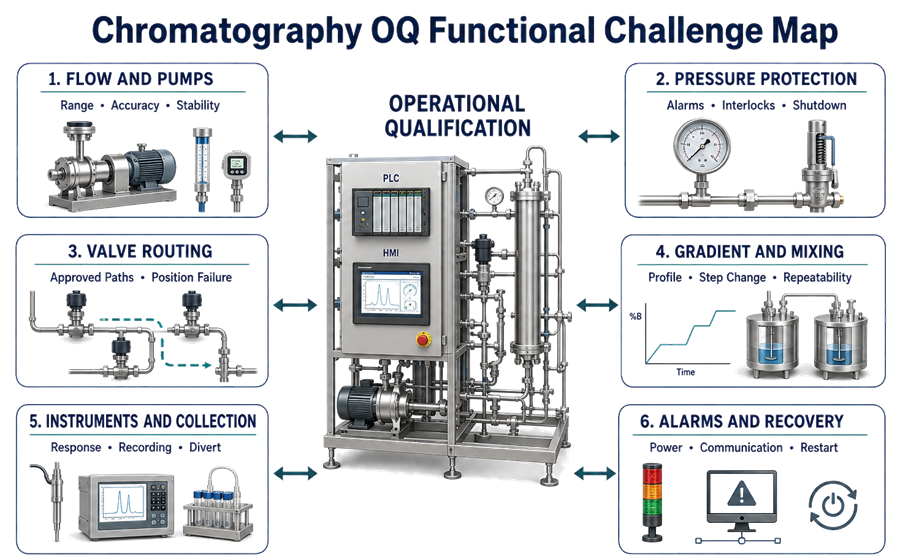
Operational qualification demonstrates that the installed system functions as intended throughout its approved operating range. Testing should challenge normal operation, operating limits, alarms, interlocks, incorrect conditions, and recovery functions.
Flow and Pump Control
Testing should verify, as applicable:
- Minimum and maximum intended flow
- Flow-control accuracy and stability
- Pump start, stop, and speed control
- Low-flow and no-flow detection
- Flow response after valve changes
- Operation against representative backpressure
- Pump pressure protection
- Flow-direction control
Pressure Control and Protection
Testing should verify:
- Pressure indication
- High-pressure alarms
- High-high-pressure shutdown or protective action
- Differential-pressure calculations where used
- Response to a restricted flow path
- Response to a closed or incorrectly positioned valve
- Protection of the column and flow-path components
- Alarm acknowledgement and reset
Challenge pressures should remain within the safe limits of the installed equipment and test arrangement.
Valve Routing and Flow Paths
Valve testing should confirm:
- Correct valve identification
- Commanded valve position
- Open and closed feedback where provided
- Approved flow paths
- Prevention of prohibited routing
- Product, buffer, waste, clean-in-place, and collection paths
- Response to valve-position failure
- Recipe-controlled valve sequencing
- Safe state following interruption or failure
The approved P&ID, valve matrix, recipe definition, and software configuration should establish the expected routing.
Gradient and Buffer Mixing
Where the system produces gradients or mixes buffers, testing should evaluate:
- Pump proportioning
- Programmed gradient profiles
- Step changes
- Mixing performance
- Composition repeatability
- Conductivity or other suitable response
- Operation at intended flow ranges
- Alarm or response to unavailable buffer
The test method should be capable of distinguishing equipment performance from variability introduced by test-solution preparation.
Instrument and Detector Functions
Testing should verify the operation of applicable:
- Flow instruments
- Pressure instruments
- UV detectors
- Conductivity instruments
- pH instruments
- Temperature instruments
- Air or bubble detectors
- Level or weight interfaces
- Fraction-collection sensors
Qualification should confirm range, response, display, recording, alarms, and applicable calculation or control functions. Calibration establishes measurement accuracy; OQ demonstrates that the instrument performs correctly as part of the integrated system.
Fraction Collection and Divert Functions
Testing should verify:
- Collection based on time, volume, UV, conductivity, or recipe conditions
- Correct destination selection
- Divert-to-waste functions
- Collection start and stop
- Container or position sequencing
- Response to missing or full collection containers where detected
- Alarm and recovery behavior
- Traceability between fractions and recorded process data
Alarms, Interlocks, and Failure Testing
Relevant abnormal conditions should be simulated safely. Examples include:
- High pressure
- Low or no flow
- Incorrect valve position
- Air detection
- Detector failure
- Utility interruption
- Communication failure
- Power interruption
- Emergency stop
- Unavailable buffer
- Full waste or collection condition
- Invalid recipe parameters
Testing should confirm detection, alarm priority, message clarity, protective response, event recording, acknowledgement, reset, and restart requirements.
Automation and Computerized-System Boundary
Chromatography automation may include the PLC, HMI, recipe database, local data storage, historian, network interfaces, reporting software, and external manufacturing systems.
Qualification should address the equipment-control functions. Computerized-system lifecycle controls should address:
- Approved requirements
- Software and firmware versions
- Configuration management
- User roles and access
- Recipe creation, approval, and modification
- Parameter limits
- Audit trails
- Electronic records
- Electronic signatures where applicable
- Time synchronization
- Data transfer
- Report generation
- Backup and restoration
- System security
- Failure recovery
- Data retention
Equipment qualification and computerized-system validation may share tests and documents, but their scopes should remain clear. Automated equipment requirements are addressed in 21 CFR 211.68.
Broader electronic-record controls are discussed in data governance and risk-based control strategy.
Calibration and Maintenance Integration
Instruments used for control, alarms, calculations, acceptance decisions, or recorded process evidence should be included in the applicable calibration program.
The qualification package should confirm:
- Instrument identification
- Required range and accuracy
- Calibration status
- Calibration points
- Traceability to recognized standards
- Installation-specific adjustments
- Access for routine calibration
- Response to calibration failure
Maintenance requirements should address pumps, valves, seals, tubing, detectors, lamps, flow cells, communication hardware, and other components that may affect performance.
Calibration verifies measurement performance. Maintenance preserves equipment reliability. Qualification demonstrates that the assembled system functions as intended. These activities support one another but are not interchangeable.
Applicable controls are described in calibration program and metrology control.
Equipment-Level Performance Qualification
Equipment-level PQ demonstrates that the complete system can perform its intended integrated functions under representative operating conditions.
Depending on intended use, PQ may include:
- Representative flow paths
- Representative column configuration
- Approved test solutions or process-representative fluids
- Expected flow and pressure conditions
- Gradient or step-change programs
- Detector response
- Fraction collection
- Recipe execution
- Cleaning or flushing sequences
- Repeated operation
- Data and report generation
- Operator interaction
The number of runs and challenge conditions should be justified from risk, system complexity, previous testing, and intended use. A universal requirement for a fixed number of equipment-PQ runs should not be imposed without justification.
Equipment-level PQ confirms integrated system performance. It does not establish that the purification process consistently achieves product recovery, impurity clearance, or product-quality requirements.
Column and Packing Interface
Qualification should verify the equipment functions needed to operate and protect the intended column configurations.
Testing may address:
- Column connection compatibility
- Flow direction
- Column bypass
- Pressure indication
- Differential-pressure calculation
- Pressure alarm and shutdown
- Column isolation
- Drain and vent functions
- Air removal
- Maximum allowable pressure protection
- Column-volume calculations where automated
The qualification package should identify the column sizes and operating ranges represented by the tests.
Column assembly, resin packing, tracer testing, HETP, peak asymmetry, resin cleaning, reuse limits, and retirement are addressed in chromatography columns, packing, and resin lifecycle control.
Cleaning and Sanitization Interface
Chromatography-system qualification should verify that cleaning and sanitization sequences execute as designed. Testing may include:
- Correct flow-path selection
- Pump and valve sequencing
- Flow and pressure control
- Chemical-addition or buffer-selection logic
- Contact or recirculation time
- Temperature where controlled
- Rinse sequencing
- Conductivity or pH endpoints
- Drainability
- Alarm and interruption handling
- Recipe security
- Cycle records
These tests demonstrate equipment functionality. They do not independently demonstrate removal of product residues, cleaning agents, microorganisms, or carryover.
Cleaning effectiveness and acceptance limits should be established through the applicable cleaning validation approach. Equipment cleaning and maintenance procedures are addressed in 21 CFR 211.67.
Stainless-Steel, Single-Use, and Hybrid Systems
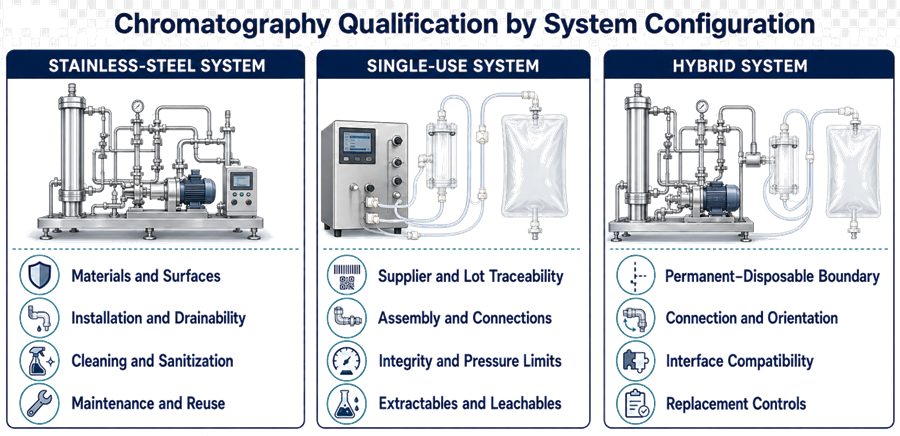
Qualification requirements differ according to the system configuration.
Reusable stainless-steel systems generally require greater emphasis on:
- Materials and surface documentation
- Welds and permanent piping
- Drainability
- Cleaning and sanitization sequences
- Reuse and maintenance
- Valve and seal integrity
- Cleaning-validation interfaces
Single-use systems generally require greater emphasis on:
- Supplier qualification
- Assembly specifications
- Component and lot traceability
- Installation and connection
- Orientation and support
- Pre-use inspection
- Integrity verification where applicable
- Pressure and flow limits
- Extractables and leachables assessment
- Sterility or microbial status where applicable
- Disposal and reconciliation
Hybrid systems require a clearly defined boundary between permanent and disposable components. Qualification should verify the interface, connection method, pressure compatibility, flow direction, sensor arrangement, and replacement controls.
Single-use designation does not remove the need for qualification. It changes the evidence and controls required.
Deviations and Qualification Acceptance
Qualification deviations should be documented and evaluated before system release.
The assessment should determine:
- What requirement or acceptance criterion was not met
- Whether the failure reflects equipment, software, test method, or execution
- Whether previously completed tests remain valid
- Whether product-quality or data-integrity risks exist
- Whether corrective action is required
- Whether testing must be repeated
- Whether additional testing is needed
- Whether the deviation affects release
Repeating a failed test without investigating the cause is not an adequate resolution.
Conditional release should be exceptional, formally justified, risk assessed, time limited where appropriate, and supported by defined controls and closure responsibilities.
Qualification Documentation and Traceability
The qualification package should provide traceability from intended use through testing and release.
Typical documentation includes:
- Intended-use statement
- URS
- Risk assessment
- Design-review or DQ records
- Supplier-document assessment
- FAT and SAT records
- IQ, OQ, and PQ protocols and reports
- Requirements traceability matrix
- Approved drawings
- Instrument and calibration records
- Software and configuration records
- Alarm and interlock testing
- Deviations and investigations
- Change records
- Training records
- Release authorization
Test records should identify the approved procedure, actual results, supporting data, equipment configuration, personnel, date, deviations, and approval status.
Release to GMP Operation
Release should occur after:
- Required qualification activities are complete
- Acceptance criteria are met
- Deviations are resolved or appropriately controlled
- Calibration and maintenance programs are active
- Operating and cleaning procedures are approved
- Required recipes are approved
- User access is established
- Training is complete
- Backup and recovery arrangements are implemented
- Drawings and configuration records reflect the released system
- Quality approval is documented
Equipment release allows the system to enter controlled GMP operation. It does not constitute process validation or authorization for every possible product, resin, column, or operating condition.
Continued Verification and Periodic Review
Routine operation should generate evidence that the system remains in a controlled state.
Review inputs may include:
- Flow and pressure performance
- Alarm and interlock history
- Deviations and investigations
- Calibration results
- Maintenance history
- Component failures
- Valve and pump performance
- Detector performance
- Recipe and configuration changes
- User-access reviews
- Audit-trail reviews
- Backup and restoration testing
- Cleaning-cycle performance
- Adverse process trends
- Supplier notifications
- Obsolescence risks
Review frequency and depth should reflect risk, use, complexity, failure history, and procedural requirements. Relevant principles are addressed in periodic review and continued verification.
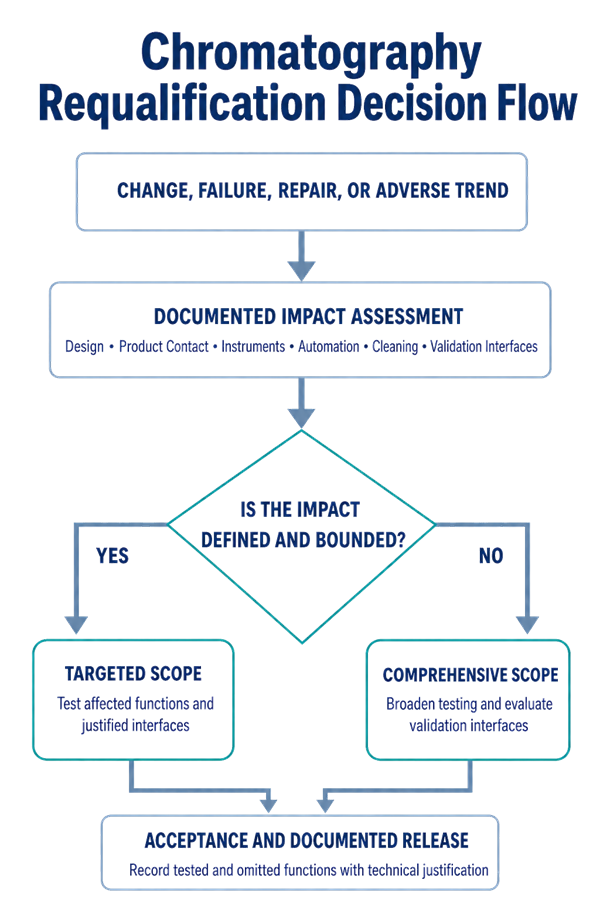
Change Control and Requalification
Changes should be assessed before implementation to determine the required verification or requalification.
Potential triggers include:
- Pump replacement or modification
- Valve-manifold changes
- New column size or pressure range
- Detector replacement
- Instrument-range changes
- Tubing or product-contact material changes
- New single-use assembly
- Utility changes
- Software or firmware updates
- Recipe-logic changes
- Alarm or interlock changes
- Data-interface changes
- Network or security changes
- Cleaning-sequence changes
- Major repair
- Extended shutdown
- Adverse performance trend
- Repeated unexplained failures
Requalification may be targeted to the affected functions when the impact is understood and justified. Comprehensive requalification may be appropriate when changes are extensive, system knowledge is inadequate, multiple critical functions are affected, or the validated state cannot otherwise be demonstrated.
The decision, scope, omitted tests, acceptance criteria, results, and release should be documented.
Qualification Versus Related Validation Activities
| Activity | Principal question |
|---|---|
| Chromatography-system qualification | Does the equipment and its automation operate as intended throughout the approved range? |
| Column-packing verification | Is the specific packed resin bed intact and hydraulically acceptable? |
| Computerized-system validation | Are computerized functions and electronic records reliable and fit for intended use? |
| Cleaning validation | Does the cleaning process reproducibly meet established residue and carryover limits? |
| Purification-process validation | Can the complete chromatography process consistently produce material meeting predefined quality requirements? |
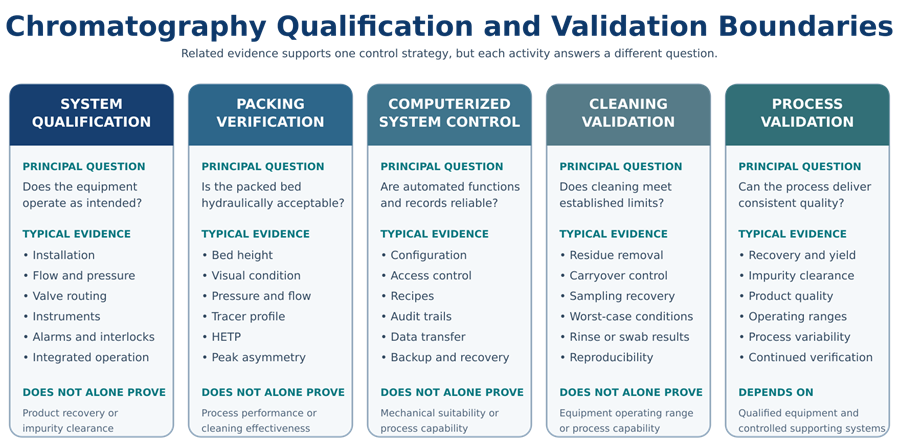
These activities may share requirements, data, and tests, but one should not be treated as a substitute for another.
The broader distinction between equipment qualification and manufacturing-process validation is explained in general principles of process validation. FDA defines process validation as lifecycle-based collection and evaluation of data establishing scientific evidence that a process can consistently deliver quality product.
Common Deficiencies
Common deficiencies include:
- Undefined qualification boundaries
- Generic requirements that cannot be tested
- Failure to establish requirements traceability
- Accepting supplier testing without documented assessment
- Testing only normal operation
- Failing to challenge alarms and interlocks
- Testing only one flow rate or pressure condition
- Incomplete valve-path verification
- Failure to verify recovery after power or communication loss
- Uncontrolled recipes or configuration changes
- Missing audit-trail or access-control testing
- Treating calibration as instrument qualification
- Treating equipment PQ as process validation
- Treating a passing packing test as system qualification
- Using cleaning-cycle execution as evidence of cleaning effectiveness
- Repeating failed tests without investigation
- Releasing the system with unresolved documentation or configuration discrepancies
- Failing to assess changes for requalification
Conclusion
Chromatography-system qualification should demonstrate that the equipment, instruments, automation, column interfaces, utilities, and supporting records function together as intended. Effective qualification begins with defined requirements and boundaries, uses risk to determine test depth, leverages supplier evidence only after documented assessment, and challenges both normal and abnormal operation.
The qualified state is maintained through calibration, maintenance, controlled recipes, deviation management, data governance, periodic review, change control, and risk-based requalification. Equipment qualification provides the operating foundation for chromatography manufacturing, while packing verification, cleaning validation, computerized-system validation, and purification-process validation provide separate evidence for their respective lifecycle controls.