

Facility Installation Qualification for GMP Facilities
Purpose and Scope
Facility Installation Qualification provides documented evidence that the as-built GMP facility conforms to approved requirements, drawings, specifications, design decisions, and applicable installation standards.
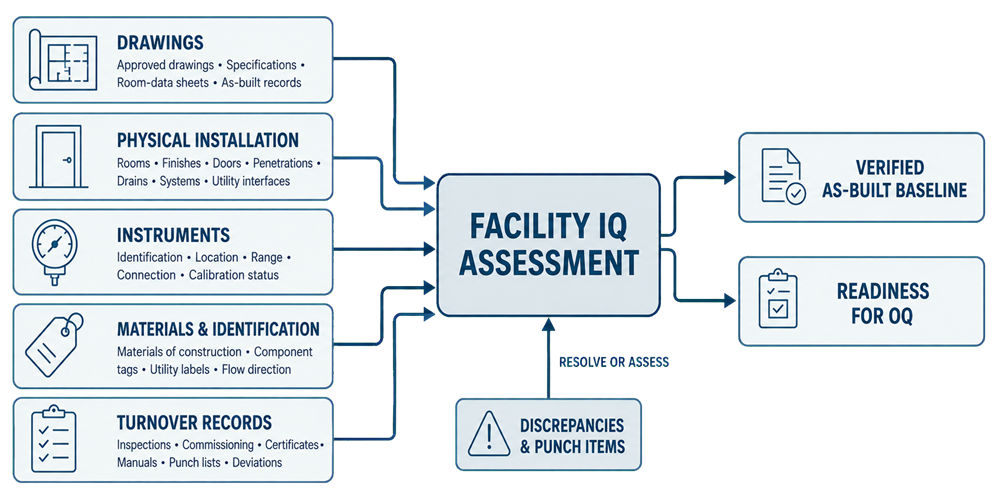
Facility IQ verifies the installed condition. It determines whether rooms, architectural features, facility systems, components, instruments, utility interfaces, and supporting documentation are complete, correctly identified, and suitable to proceed to operational testing.
Facility IQ does not demonstrate that systems operate throughout their intended ranges or that rooms maintain required environmental conditions during use. Those conclusions require Facility Operational Qualification, system-specific testing, and any required performance verification.
Facility IQ may include verification of:
- Room identities, dimensions, and layouts
- Walls, floors, ceilings, and finishes
- Doors, windows, airlocks, and pass-throughs
- Penetrations, seals, coving, and joints
- Sinks, drains, and plumbing features
- Installed equipment and components
- HVAC and utility interfaces
- Instruments and monitoring devices
- Electrical and automation interfaces
- Materials of construction
- Component and service identification
- As-built drawings
- Turnover and commissioning records
- Calibration and maintenance status
- Deviations, discrepancies, and punch-list items
- Readiness for OQ
The scope should be based on intended use, GMP impact, design risk, facility complexity, and the verification already provided by acceptable construction and commissioning records.
Regulatory and Lifecycle Basis
21 CFR Part 211, Subpart C establishes requirements for pharmaceutical buildings and facilities.
21 CFR 211.42 requires suitable construction, adequate space, orderly placement, controlled flow, and defined areas or other controls necessary to prevent contamination and mix-ups.
21 CFR 211.46 addresses ventilation, filtration, air pressure, microorganisms, dust, humidity, temperature, exhaust, and air recirculation.
21 CFR 211.48 establishes requirements for plumbing and drains, while §§ 211.56 and 211.58 address sanitation and maintaining buildings in a good state of repair.
These regulations primarily establish required outcomes. Facility IQ provides controlled evidence that the physical attributes and systems intended to support those outcomes were installed as approved.
FDA’s Process Validation: General Principles and Practices guidance places facility and utility qualification before process performance qualification. For sterile operations, FDA’s Aseptic Processing CGMP Guidance provides additional recommendations concerning clean-area construction, surfaces, filtration, airflow, pressure relationships, sanitation, and environmental control.
The regulations and guidance do not prescribe a universal facility IQ protocol format. The qualification approach must nevertheless be planned, controlled, technically adequate, traceable, and approved.
Position of IQ in the Facility Lifecycle
Facility IQ follows approved design development and sufficient completion of construction, commissioning, and system turnover. The general progression is:
- Define facility requirements and intended use.
- Complete design review and Facility Design Qualification.
- Construct and commission the facility.
- Review turnover packages and confirm qualification readiness.
- Execute IQ walkdowns, document reviews, and installation verifications.
- Resolve or formally assess discrepancies and punch-list items.
- Establish the approved as-built baseline.
- Confirm readiness for OQ.
- Perform operational and performance testing.
- Release the facility for its approved use.
IQ should verify the implemented design—not become the primary process for discovering routine construction defects.
Construction inspection and commissioning should identify and correct installation problems as work progresses. IQ independently confirms that the resulting installed baseline is adequately supported by controlled evidence.
The complete facility qualification lifecycle should define how engineering, commissioning, qualification, and release activities interact.
Defining the Facility IQ Boundary
Facility IQ boundaries should be established before protocol preparation. The scope may be organized by:
- Building
- Floor
- Operational area
- Room group
- HVAC zone
- Architectural system
- Utility system
- Automation system
- Construction package
- Turnover package
- Qualification package
The boundary should identify:
- Rooms and spaces included
- Facility attributes included
- Systems and components included
- Utilities and interfaces included
- Instruments included
- Drawings and specifications applicable
- Commissioning evidence intended for use
- Items verified in separate system protocols
- Exclusions and their justification
- Interfaces with adjacent or supporting systems
Facility IQ should not duplicate every system-specific IQ. For example, detailed HVAC-component verification may be performed in an HVAC Installation Qualification protocol. The facility IQ may then verify the HVAC interface, room relationship, applicable turnover status, and traceable reference to the approved HVAC evidence.
The strategy should prevent both gaps and unnecessary duplication.
Prerequisite Turnover Review
Qualification should not begin merely because construction personnel state that installation is complete. A documented turnover review should determine whether the facility or defined portion is sufficiently complete and controlled for IQ execution.
Turnover Package Contents
The turnover package may include:
- Approved design drawings and specifications
- Current construction drawings
- Redlined drawings
- Available as-built drawings
- Room-data sheets
- Equipment and component schedules
- Instrument lists
- Valve, damper, panel, and filter lists
- Material certificates
- Welding, joining, or inspection records
- Factory and site test records
- Pressure or leak-test records
- Duct-cleanliness records
- Flushing and cleaning records
- Electrical test records
- Grounding or bonding records
- Startup and commissioning records
- Testing, adjusting, and balancing records
- Manufacturer manuals
- Installation instructions
- Certificates and permits where applicable
- Calibration records
- Construction inspection records
- Approved field changes
- Requests for information and technical resolutions
- Nonconformance records
- Punch lists
- Spare-parts information
- Recommended maintenance requirements
- Warranties
- Training documentation where applicable
Not every record applies to every facility. The required turnover contents should be defined according to scope and risk.
Turnover Readiness Review
Before IQ execution, the review should confirm that:
- The physical boundary is defined.
- Construction is sufficiently complete.
- Required design documents are approved and available.
- Field changes have been documented.
- Systems are in a safe and controlled condition.
- Areas are accessible for inspection.
- Construction activities will not invalidate completed verification.
- Critical turnover records are available.
- Instruments used to generate qualification evidence are calibrated.
- Open items have been identified.
- Remaining work will not prevent meaningful IQ execution.
- Responsibilities for discrepancies and document updates are defined.
A turnover package does not need to be perfect before every IQ activity begins. However, missing information that prevents objective verification should be resolved before the affected test is executed or accepted.
IQ Planning and Protocol Development
The facility IQ protocol or controlled verification package should define:
- Purpose and scope
- Facility and system boundaries
- Responsibilities
- Applicable requirements
- Reference drawings and specifications
- Prerequisites
- Verification methods
- Sampling rationale, if sampling is used
- Acceptance criteria
- Data-recording requirements
- Required test instruments
- Deviation handling
- Punch-list handling
- Traceability expectations
- Documentation requirements
- Approval requirements
- Criteria for OQ readiness
Acceptance criteria should be derived from approved design documents, requirements, material specifications, installation standards, risk assessments, and intended use.
The protocol should identify the specific document revisions used as the verification baseline. Referring only to “approved drawings” is insufficient when several revisions exist.
Prepopulated equipment, component, instrument, or drawing information should be independently confirmed during execution. Copying information from a design schedule into the IQ record does not verify the physical installation.
Facility Walkdowns
Facility walkdowns provide direct comparison between approved documentation and the installed condition. The walkdown should be systematic and documented. It may be organized by room, drawing, system, component, or verification category.
Walkdown records should identify:
- Area or room inspected
- Drawing or specification used
- Attribute or component examined
- Actual installed condition
- Acceptance status
- Discrepancy reference
- Inspector
- Date
- Supporting photograph or record when useful
A walkdown should confirm more than the physical presence of an item. Depending on the attribute, it may also verify:
- Location
- Orientation
- Accessibility
- Identification
- Material
- Size or capacity
- Connection
- Seal or closure
- Installation condition
- Consistency with intended use
- Consistency with the as-built record
Walkdowns should be performed by personnel capable of recognizing both documentation discrepancies and technically unacceptable installation conditions.
Verification of Rooms and As-Built Layouts
Facility IQ should verify that rooms and operational spaces correspond to the approved design. Verification may include:
- Room number
- Room name
- Intended use
- Location
- Dimensions
- Ceiling height
- Installed equipment layout
- Access points
- Airlocks
- Pass-throughs
- Windows
- Utility locations
- Drains and sinks
- Monitoring locations
- Maintenance access
- Emergency features
- Adjacent-room relationships
Room dimensions should be verified where they affect:
- Equipment placement
- Required clearances
- Personnel or material movement
- Cleaning access
- Maintenance access
- Room volume
- HVAC calculations
- Classification or monitoring strategy
- Qualification testing
A room does not need to be re-surveyed in full when acceptable controlled construction evidence already confirms its dimensions. The IQ strategy may verify critical dimensions and review the supporting survey records.
Actual equipment locations should be compared with approved layouts. Relocation may affect airflow, cleaning access, utility connections, maintenance access, material movement, heat load, or environmental-monitoring locations even when the equipment itself is unchanged.
Architectural Finishes and Cleanability
Room finishes are functional GMP controls and should be verified against approved room-data sheets, finish schedules, drawings, and specifications.
Floors
Floor verification may address:
- Approved material or coating
- Surface integrity
- Smoothness
- Cleanability
- Chemical compatibility
- Slip characteristics where relevant
- Coving
- Joints and seams
- Cracks, chips, bubbles, or delamination
- Transitions
- Drain interfaces
- Slope where specified
- Sealing around supports and penetrations
Walls and Partitions
Wall verification may address:
- Approved construction and finish
- Surface integrity
- Smoothness and cleanability
- Sealed panel joints
- Wall-to-floor transitions
- Wall-to-ceiling transitions
- Impact damage
- Open seams
- Unsealed fasteners
- Ledges
- Utility penetrations
- Embedded fixtures
- Compatibility with cleaning and disinfection agents
Ceilings
Ceiling verification may address:
- Approved material
- Panel or monolithic construction
- Joint integrity
- Sealed penetrations
- Light-fixture installation
- Filter-housing interfaces
- Access-panel control
- Signs of water intrusion
- Surface damage
- Cleanability
- Pressure-boundary integrity where applicable
The IQ walkdown should identify damaged, unfinished, porous, inaccessible, or inadequately sealed surfaces that could compromise cleaning, environmental control, containment, or maintenance.
The relevant design principles are discussed in Cleanroom Design Principles.
Doors, Windows, Airlocks, and Pass-Throughs
Facility IQ should verify installed doors and controlled-transfer features against approved schedules and drawings. Verification may include:
- Door identifier and location
- Door type and material
- Swing direction
- Frame installation
- Surface finish
- Vision panels
- Gaskets and seals
- Thresholds
- Door closers
- Latches and hardware
- Automatic operators
- Interlock devices
- Access-control hardware
- Emergency-release provisions
- Pass-through configuration
- Cleanability
- Damage or visible gaps
IQ confirms installation and configuration. Functional challenge of door interlocks, access control, alarms, or failure responses belongs in OQ or the applicable automation protocol.
Airlocks should also be checked for consistency with the approved facility zoning and segregation strategy. An installed airlock that differs from the approved flow concept requires evaluation even if its individual components were installed correctly.
Penetrations, Seals, Joints, and Transitions
Penetrations through walls, ceilings, floors, and controlled boundaries should be included in the facility walkdown. Examples include:
- Utility piping
- Electrical conduit
- Cable trays
- Data cables
- Ductwork
- Sprinkler piping
- Process piping
- Instrument tubing
- Equipment supports
- Drains
- Temporary services
Verification should determine whether penetrations are:
- Located as approved
- Properly supported
- Completely sealed
- Finished with compatible materials
- Cleanable
- Free from visible gaps or damage
- Suitable for the applicable pressure, fire, containment, or cleanliness boundary
- Identified where required
Temporary penetrations and construction openings should not remain unassessed at IQ completion.
Fire stopping, environmental sealing, cleanroom sealing, and containment sealing serve different purposes. Evidence for one should not automatically be treated as evidence for all of them.
Drains, Sinks, and Plumbing Features
Facility IQ should verify plumbing features that affect sanitation, contamination control, or intended operation. Verification may include:
- Drain and sink locations
- Drain type and size
- Materials of construction
- Trap or air-break configuration
- Grates and covers
- Sealing at floor interfaces
- Drain accessibility
- Cleanability
- Slope where specified
- Backflow-prevention devices
- Identification
- Utility connection
- Consistency with room classification and use
Directly connected drains should be evaluated against the back-siphonage controls required by 21 CFR 211.48.
IQ confirms installation. Flow, drainage, leak, alarm, or failure testing should be assigned to commissioning or OQ as appropriate.
Unplanned drains, capped connections, unused sinks, or undocumented plumbing modifications should be evaluated because they may affect cleanability, pest control, pressure control, or contamination risk.
Installed Facility Systems and Components
Facility IQ should verify applicable building and support-system installations at the level defined by the qualification strategy. Systems may include:
- HVAC
- Exhaust
- Building automation
- Environmental monitoring
- Electrical distribution
- Emergency power
- Lighting
- Plumbing
- Fire-protection interfaces
- Security and access control
- Communications
- Process and clean utilities
- Waste systems
- Gas distribution
- Temperature-control systems
Verification may address:
- Equipment manufacturer and model
- Equipment identification
- Capacity or rating
- Location
- Orientation
- Mounting
- Connections
- Service clearances
- Required guards
- Insulation
- Direction-of-flow markings
- Valve and damper identification
- Filters
- Panels and enclosures
- Utility interfaces
- Instrumentation
- Interface with controls and monitoring systems
- Consistency with drawings and schedules
Facility IQ should reference system-specific qualification evidence when detailed verification is performed elsewhere.
Utility Interfaces
Facility IQ should confirm that required utility connections are installed at the correct locations and correspond to approved requirements. Interfaces may include:
- Electrical power
- Emergency power
- Grounding
- Potable water
- Purified water
- Water for injection
- Clean steam
- Plant steam
- Compressed air
- Process gases
- Vacuum
- Chilled water
- Heating water
- Drainage
- Exhaust
- Data and communication connections
Verification may include:
- Utility type
- Point-of-use location
- Connection size
- Material
- Identification
- Flow direction
- Isolation
- Pressure or temperature rating
- Connection to the correct source
- Drainability or slope where required
- Protection against cross-connection
- Accessibility
- Applicable sampling or monitoring points
IQ verifies the physical interface. Capacity, quality, pressure, flow, alarms, and operating performance require commissioning, OQ, or utility qualification.
Instruments and Monitoring Devices
Facility IQ should verify instruments that monitor, control, record, alarm, or provide qualification evidence. Examples include:
- Temperature sensors
- Humidity sensors
- Pressure transmitters
- Differential-pressure indicators
- Airflow or flow devices
- Control thermostats
- Particle-monitoring interfaces
- Environmental-monitoring devices
- Utility instruments
- Alarm devices
- Data loggers
- Building-management-system sensors
- Qualification test instruments
Verification may include:
- Unique instrument identifier
- Manufacturer
- Model
- Serial number
- Measurement range
- Engineering units
- Location
- Orientation
- Process or room association
- Accessibility
- Connection
- Calibration requirement
- Calibration status
- Calibration range
- Status labeling
- Inclusion in the controlled instrument inventory
- Consistency with instrument lists and drawings
The installed range should be suitable for the intended operating and alarm ranges. An instrument can be correctly calibrated but unsuitable if its range, accuracy, resolution, or location does not support the intended measurement.
The sitewide control framework is addressed in Calibration Program and Metrology Control.
Calibration Status
Before an instrument is used to generate qualification data, its calibration status must be acceptable for the intended measurement. Facility IQ should distinguish between:
- Instruments installed as part of the facility
- Portable instruments used to execute IQ
- Instruments required for later OQ
- Indicators not used for GMP decisions
- Devices awaiting calibration
- Devices intentionally excluded from calibration with justification
IQ may verify enrollment and status rather than repeat calibration. The calibration certificate should be reviewed when calibration results, range, acceptance limits, or traceability affect qualification acceptance.
Materials of Construction
Materials should be verified where they affect:
- Cleanability
- Chemical compatibility
- Corrosion resistance
- Product protection
- Contamination control
- Containment
- Pressure-boundary integrity
- Utility quality
- Durability
- Regulatory suitability
Evidence may include:
- Material certificates
- Manufacturer data
- Purchase records
- Approved submittals
- Finish schedules
- Component markings
- Construction inspection records
- Direct field verification
Facility materials may include:
- Flooring and coatings
- Wall and ceiling systems
- Sealants
- Gaskets
- Door and pass-through surfaces
- Ductwork
- Piping
- Drain components
- Insulation
- Filter housings
- Utility components
- Equipment supports
Material verification should focus on attributes with a defined requirement or credible GMP impact. Recording certificates for every ordinary construction material without a technical purpose produces documentation volume rather than useful assurance.
Material substitutions must be traceable to approved technical assessment.
Equipment, Component, and Service Identification
Identification supports operation, maintenance, calibration, drawing accuracy, and configuration control. Facility IQ should verify applicable:
- Room numbers
- Equipment tags
- Instrument tags
- Panel identifiers
- Valve numbers
- Damper numbers
- Filter identifiers
- Duct or pipe service labels
- Flow-direction arrows
- Utility labels
- Emergency-system identification
- Access-control device identifiers
- Status labels
Identification should be:
- Unique where required
- Legible
- Durable
- Consistent with drawings and controlled inventories
- Suitable for the environment
- Located where personnel can use it
- Free from conflicting legacy labels
A component that cannot be reliably connected to its drawing, maintenance record, or calibration record does not provide an adequately controlled installed baseline.
As-Built Drawings and Document Verification
Facility IQ should confirm that controlled drawings accurately represent the installed condition. Applicable documents may include:
- Architectural plans
- Room layouts
- Finish schedules
- Reflected ceiling plans
- Door schedules
- HVAC schematics
- Ductwork drawings
- Pressure-cascade diagrams
- Utility flow diagrams
- Piping and instrumentation diagrams
- Plumbing drawings
- Drain drawings
- Electrical single-line diagrams
- Panel schedules
- Instrument lists
- Equipment schedules
- Control-system architecture
- Network diagrams
- Cause-and-effect documents
- Room-data sheets
As-built verification should confirm:
- Correct document number and revision
- Correspondence with the defined IQ boundary
- Accurate room and equipment locations
- Accurate system routing where required
- Accurate component and instrument identifiers
- Incorporated field changes
- Removal of superseded or abandoned features
- Resolution of redlines
- Approval and controlled status
IQ should not close drawing verification by stating only that drawings were “reviewed.” The record should establish what was compared and whether discrepancies were found.
Not every concealed installation can be directly inspected after construction. In those cases, controlled construction records, photographs, inspection reports, test records, or approved commissioning evidence may provide the necessary verification.
Use of Commissioning and Construction Evidence
Existing engineering evidence may be used to support IQ when it is suitable for its intended qualification purpose. Before using such evidence, assess:
- Scope
- Test or inspection method
- Acceptance criteria
- Instrument calibration
- Personnel qualifications
- Data completeness
- Traceability
- Documentation controls
- Deviations
- Review and approval
- Correspondence with the final installed configuration
Acceptable evidence can be referenced or incorporated into the IQ package. It does not need to be repeated solely because it was originally generated during commissioning.
Evidence should be supplemented or repeated when:
- Acceptance criteria do not support GMP requirements.
- The method was not adequately documented.
- Required raw data are missing.
- Instruments were not appropriately calibrated.
- Results cannot be connected to the installed component.
- The installation changed after the test.
- Deviations were not resolved.
- The records are unreliable or uncontrolled.
- The verification does not cover the approved IQ requirement.
Leveraging should be a documented technical decision, not an assumption that every contractor record is acceptable.
Punch-List Management
Punch lists identify incomplete work, defects, corrections, document deficiencies, or follow-up activities. Not every punch-list item has the same qualification impact. Items may include:
- Cosmetic defects
- Missing labels
- Minor finish repairs
- Incomplete documentation
- Unsealed penetrations
- Damaged surfaces
- Missing instruments
- Incorrect components
- Unapproved substitutions
- Incomplete utilities
- Drawing discrepancies
- Outstanding calibration
- Unresolved construction nonconformances
Each open item should be assessed for its effect on:
- Product quality
- Contamination or cross-contamination
- Containment
- Cleanability
- Personnel or material flow
- Environmental control
- Safety
- Data integrity
- Calibration
- Maintenance
- IQ acceptance
- OQ execution
- Facility release
Punch-list items should have:
- Unique identifier
- Clear description
- Location
- Impact classification or assessment
- Responsible owner
- Required action
- Due date
- Restrictions imposed
- Verification of completion
- Final approval
A genuinely cosmetic item may remain open without preventing OQ if its lack of impact is documented. An open penetration, missing critical instrument, uncontrolled field change, damaged cleanroom surface, or inaccurate critical drawing may prevent affected testing or approval.
Punch lists should not be used to hide protocol deviations or failed acceptance criteria.
Deviations and Discrepancies
A discrepancy exists when the observed condition differs from the approved requirement, drawing, specification, protocol expectation, or controlled record. Examples include:
- Incorrect material
- Incorrect component
- Missing component
- Incorrect location
- Drawing mismatch
- Damaged finish
- Unsealed penetration
- Missing identification
- Expired calibration
- Incomplete documentation
- Unapproved field modification
- Failed installation inspection
The discrepancy record should identify:
- Expected condition
- Observed condition
- Location and affected system
- Applicable requirement or document
- Immediate action
- Technical and GMP impact
- Root cause when required
- Correction or accepted disposition
- Retesting or reverification
- Drawing and document updates
- Effect on completed testing
- Approval
Not every typographical or administrative correction requires a formal deviation. The governing procedure should distinguish controlled field corrections from conditions requiring investigation and approval.
A failed acceptance criterion should not be converted into a passing result by changing the expected value after execution unless the original criterion is demonstrably incorrect and the revision is scientifically justified and formally approved.
Traceability and IQ Evidence
Facility IQ should demonstrate traceability among:
- User requirements
- Design criteria
- Approved drawings and specifications
- Design risks and controls
- Installed facility attributes
- Commissioning or construction evidence
- IQ verification
- Deviations and punch-list dispositions
- Planned OQ or performance tests
- Final acceptance status
Each applicable requirement should have a clear disposition, such as:
- Verified by direct IQ inspection
- Verified through accepted commissioning evidence
- Verified in a system-specific IQ
- Assigned to OQ
- Not applicable with justification
- Open and preventing progression
- Open under an approved conditional plan
Traceability should identify the actual evidence. A general reference to an entire turnover package does not show how a specific requirement was satisfied.
IQ Acceptance Criteria
IQ acceptance criteria should be approved before execution. Typical acceptance criteria include:
- The IQ scope and boundaries are defined.
- Required turnover documentation has been reviewed.
- The facility installation corresponds to approved requirements and design documents.
- Room identities, layouts, and critical dimensions are acceptable.
- Required architectural finishes are installed and free from unacceptable defects.
- Doors, airlocks, windows, and pass-throughs correspond to approved schedules.
- Penetrations and controlled-boundary interfaces are properly sealed.
- Drains, sinks, and plumbing features are correctly installed.
- Facility systems and utility interfaces are installed as approved.
- Required equipment and components are present and identified.
- Applicable materials of construction are verified.
- Critical instruments are installed, identified, and included in the calibration program.
- Instruments used for qualification have acceptable calibration status.
- Component and service identification is consistent with controlled records.
- As-built drawings accurately represent the installed condition.
- Construction and commissioning evidence used for IQ has been assessed and accepted.
- Deviations have approved dispositions.
- Open punch-list items do not prevent the next qualification stage.
- Required maintenance and calibration activities have been established.
- The installed baseline is adequately documented.
- Readiness for OQ has been formally determined.
Approval should be based on the complete evidence package, not merely on completion of protocol signature fields.
Readiness for Operational Qualification
IQ completion should support a documented decision that the affected facility or system is ready for operational testing. OQ readiness may require confirmation that:
- The tested configuration is identified and controlled.
- Installation affecting the planned OQ tests is complete.
- Critical deviations are resolved.
- Remaining punch-list items have acceptable impact assessments.
- Required instruments are calibrated.
- Required utilities are available.
- Systems have been started and commissioned sufficiently.
- Required procedures or temporary test instructions are available.
- Safety controls are functional.
- Drawings needed for testing are current.
- Construction activity will not invalidate results.
- Applicable commissioning evidence has been accepted.
- OQ prerequisites are satisfied.
Controlled overlap between IQ and OQ may be acceptable for large projects when:
- Separate systems or areas have clear boundaries.
- The applicable IQ prerequisites are complete.
- Open work cannot affect the OQ configuration or results.
- Configuration is controlled.
- Dependencies are documented.
- The qualification plan permits phased execution.
- Required approvals are obtained.
OQ should not proceed on an affected system when unresolved installation conditions could invalidate functional testing.
IQ Report and Approved As-Built Baseline
The IQ report should summarize:
- Scope and boundaries
- Protocols and supporting records used
- Walkdowns and verifications performed
- Commissioning evidence accepted
- Requirements and drawings verified
- Deviations and discrepancies
- Punch-list status
- Open actions
- Acceptance-criteria status
- Restrictions or conditions
- OQ readiness
- Final conclusion
- Approval
The report should identify the controlled documents that establish the approved as-built baseline, including applicable:
- Drawings
- Specifications
- Equipment schedules
- Instrument lists
- Component lists
- Room-data sheets
- Material records
- Calibration records
- Commissioning records
- Traceability records
- Deviation dispositions
IQ approval establishes the verified baseline. It does not prevent later change, but subsequent modifications must be evaluated and documented through change control.
Relationship Between Commissioning, IQ, and OQ
| Activity | Principal question |
|---|---|
| Construction inspection | Was the work performed according to applicable construction requirements while installation was accessible? |
| Commissioning | Was the installed facility started, adjusted, tested, and made functional according to its design? |
| IQ | Does controlled evidence confirm that the as-built facility conforms to approved requirements, drawings, specifications, and installation criteria? |
| OQ | Do installed systems operate as intended through defined operating, alarm, failure, and recovery conditions? |
| Performance verification | Does the integrated facility support its intended use under representative conditions? |
Commissioning evidence may support IQ, but engineering turnover alone does not constitute qualification acceptance. IQ does not replace commissioning, and OQ does not correct an unsuitable or inadequately documented installation.
Common Facility IQ Weaknesses
Common weaknesses include:
- Starting IQ before the facility is sufficiently complete
- Treating contractor turnover as automatic IQ acceptance
- Using IQ to discover routine construction defects
- Undefined facility or system boundaries
- Inadequate prerequisite review
- Referencing superseded drawings
- Copying design information without field verification
- Walkdowns limited to confirming component presence
- Failure to verify room finishes and cleanability
- Incomplete inspection of penetrations and seals
- Failure to verify doors, airlocks, and pass-throughs
- Drains or plumbing modifications omitted from IQ
- Missing utility-interface verification
- Instruments installed without unique identification
- Calibration status not established before OQ
- Qualification test instruments used outside calibration
- Unverified material substitutions
- Inconsistent component labels and drawings
- As-built drawings that remain inaccurate
- Concealed installations accepted without supporting records
- Repeating acceptable commissioning tests without justification
- Leveraging inadequate commissioning records
- Punch-list items accepted without impact assessment
- Failed criteria reclassified as cosmetic items
- Deviations closed without correcting drawings or records
- Missing traceability between requirements and evidence
- Assuming all IQ must be complete before any phased OQ can begin
- Beginning OQ where unresolved installation work can invalidate results
- Approving IQ without identifying the controlled as-built baseline
These weaknesses create uncertainty about what was installed, weaken OQ evidence, and make future maintenance, change assessment, and requalification more difficult.
Summary
Facility Installation Qualification verifies that the as-built GMP facility conforms to approved requirements, drawings, specifications, design decisions, and applicable installation standards.
Effective facility IQ begins with controlled turnover review and clearly defined boundaries. It uses document review, field walkdowns, construction evidence, commissioning records, and direct verification to establish the installed baseline.
The scope should address rooms, layouts, finishes, doors, airlocks, penetrations, drains, systems, components, utility interfaces, instruments, calibration status, materials, identification, and as-built documentation according to intended use and risk.
Punch-list items and discrepancies require documented assessment. Minor items may remain open when they cannot affect qualification or intended use, but critical installation defects, uncontrolled changes, missing evidence, or inaccurate records must not be hidden through conditional acceptance.
IQ establishes what was installed. OQ demonstrates how the installed systems operate. Performance verification determines whether the integrated facility supports its intended use.