

Computerized System Interfaces and Data-Transfer Controls
Computerized-system interfaces move regulated data between instruments, applications, databases, middleware, cloud services, and external organizations. Interfaces can eliminate manual transcription and improve process efficiency, but they also create risks of data loss, duplication, truncation, incorrect transformation, unauthorized access, and inconsistent records.
An interface should not be treated as a technical connection alone. It is a controlled process that begins with an authoritative source, applies defined mapping and transformation rules, delivers data through an approved channel, and confirms that the receiving system accepted and used the information correctly.
Validation should demonstrate the complete data path rather than separately confirming that the sending system can transmit and the receiving system can receive.
Interface Types
Computerized-system interfaces can be implemented through several technologies. The technology affects the risks, controls, monitoring, and testing strategy, but it does not determine GxP significance by itself.
Common interface types include:
- direct database connections;
- application programming interfaces;
- middleware or integration platforms;
- message queues;
- shared files;
- secure file transfer;
- scheduled imports and exports;
- web services;
- instrument connections;
- and manual file uploads.
The interface inventory should identify the technology, direction, transferred data, authoritative source, business owner, technical owner, frequency, security method, monitoring, and validation status.
Direct Interfaces
A direct interface connects two systems without an independent integration layer. Examples include an instrument sending results directly to a laboratory information management system or an application writing data to another application through a defined connector.
Direct interfaces can reduce architectural complexity, but they may create tight dependencies between:
- software versions;
- database structures;
- network addresses;
- authentication methods;
- field definitions;
- and supplier-specific protocols.
Changes to either connected system may affect the interface. Version upgrades, configuration changes, database changes, certificate changes, and network changes should therefore include interface-impact assessment.
Direct database writes should be used cautiously. Bypassing the receiving application’s approved business rules can create records without required validation, audit trails, status controls, or workflow processing.
Middleware-Based Interfaces
Middleware receives data from one system, processes or transforms it, and delivers it to another. It may provide:
- message routing;
- field mapping;
- format conversion;
- unit conversion;
- filtering;
- enrichment;
- transaction control;
- queue management;
- retries;
- technical logging;
- and monitoring.
Middleware should be included within the validated system boundary when its configuration or operation can affect regulated records or decisions.
The validated configuration should identify:
- source and destination connections;
- message definitions;
- transformation rules;
- routing conditions;
- error-handling rules;
- retry settings;
- service accounts;
- certificates;
- logging;
- and deployed version.
Middleware logs can provide important technical evidence, but they do not necessarily replace audit trails maintained in the source or receiving application.
Application Programming Interfaces (API)
An application programming interface, or API, allows applications to exchange data through defined requests and responses.
An API specification should define:
- endpoints;
- permitted operations;
- request and response structures;
- required fields;
- field definitions;
- authentication;
- authorization;
- status codes;
- error responses;
- rate limits;
- timeouts;
- versioning;
- and retry behavior.
API controls should prevent unauthorized users or services from retrieving, creating, changing, or deleting records. Authorization should be evaluated at both the endpoint and record or object level.
The NIST Guidelines for API Protection for Cloud-Native Systems provide a current security framework for identifying API risks and applying protection throughout the API lifecycle. The OWASP API Security Project provides additional technical information on common API security weaknesses.
File-Based Transfers
File-based interfaces may use:
- comma-separated value files;
- extensible markup language files;
- JavaScript Object Notation files;
- spreadsheets;
- fixed-width text files;
- portable document format files;
- proprietary instrument files;
- or encrypted archive packages.
Controls should define:
- file naming;
- file structure;
- delimiters;
- encoding;
- headers and trailers;
- date and time formats;
- decimal notation;
- units;
- required fields;
- record counts;
- control totals;
- checksums;
- encryption;
- transfer location;
- file permissions;
- processing status;
- and archival or deletion rules.
Partial files should not be processed as complete transfers. Temporary naming, completion markers, atomic file movement, or equivalent controls may be used to prevent premature processing.
Processed, rejected, and unprocessed files should remain distinguishable. The system should prevent the same file from being processed repeatedly without detection.
Message Queues
Message queues separate sending and receiving processes by temporarily holding messages until they can be processed. Queue controls should address:
- unique message identifiers;
- message order;
- delivery guarantees;
- acknowledgment;
- persistence;
- expiration;
- retry limits;
- dead-letter queues;
- duplicate detection;
- consumer availability;
- queue capacity;
- and monitoring.
“Delivered” may mean only that a message reached the queue, not that the receiving application accepted or processed it. The required confirmation point should be defined from the business process.
Messages routed to a dead-letter queue should generate an alert and remain traceable to investigation and final disposition.
One-Way Interfaces
A one-way interface transfers data from a source to a destination without returning business data to the source.
Even when the data path is one-way, a control response may still be required. This may include:
- technical acknowledgment;
- acceptance confirmation;
- rejection notification;
- processing status;
- record identifier;
- or reconciliation report.
Without a return control, the sending system may be unable to distinguish successful processing from network delivery, partial processing, or rejection.
Bidirectional Interfaces
Bidirectional interfaces exchange information in both directions. For example, an enterprise system may send sample information to a laboratory system, while the laboratory system returns approved results and status.
Bidirectional arrangements should define:
- which system owns each field;
- which direction each field may travel;
- permitted update conditions;
- conflict-resolution rules;
- synchronization timing;
- status dependencies;
- and prevention of circular updates.
A field should not be independently editable in both systems unless controlled synchronization and conflict resolution are defined.
Interface Architecture and Ownership
Each interface should have a documented architecture showing:
- source system;
- destination system;
- middleware;
- transfer direction;
- transport method;
- security boundary;
- data objects;
- monitoring;
- technical logs;
- and responsible owners.
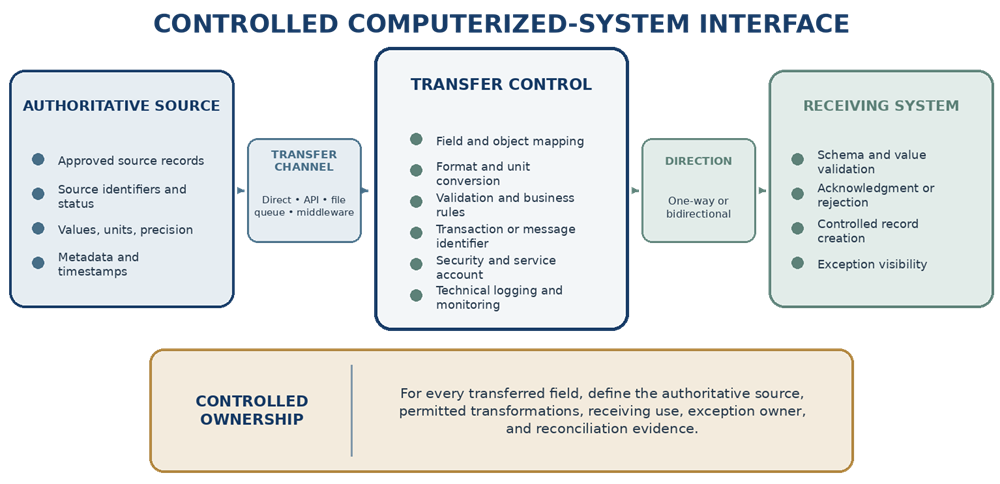
The architecture should distinguish three control areas:
- the authoritative source and approved source data;
- the transfer mechanism, mappings, transformations, and delivery controls;
- the receiving system’s validation, acceptance, and record-creation controls.
Authoritative Data Sources
The authoritative data source is the controlled system relied upon to provide the official value or record. For every transferred field or object, the interface specification should identify:
- authoritative system;
- source field;
- source object;
- owner;
- allowed source status;
- destination field;
- destination use;
- permitted transformation;
- and update rules.
Examples include:
- the enterprise system as the authority for material and batch identifiers;
- the laboratory system as the authority for approved test results;
- the training system as the authority for training status;
- or the quality-management system as the authority for deviation status.
The receiving system should not silently become a competing authoritative source. If users can edit transferred values, the reason, authority, synchronization, and downstream consequences should be controlled.
Field and Object Mapping
Interface mapping connects source data elements to destination data elements.
The mapping specification should include:
- source and destination field names;
- business definitions;
- data type;
- maximum length;
- required or optional status;
- allowed values;
- units;
- precision;
- default values;
- transformation rules;
- null-value handling;
- and rejection criteria.
Mapping should also preserve relationships between objects. A result must remain associated with the correct sample, test, method, specification, batch, material, and product.
Mapping by field position without adequate structural validation creates risk when a supplier changes a file layout or adds a new field.
Data Formats
Source and destination systems may represent the same information differently. Format controls should address:
- text encoding;
- uppercase and lowercase;
- leading and trailing spaces;
- special characters;
- prohibited characters;
- date formats;
- time formats;
- time zones;
- decimal separators;
- thousands separators;
- scientific notation;
- Boolean values;
- and coded values.
A date such as 03/04/2026 is ambiguous unless the format is defined. Standardized and unambiguous formats should be used where practical.
Format conversion should not change the meaning of the record or prevent reconstruction of the original value.
Units and Precision
Interfaces should preserve or deliberately convert measurement units and numerical precision. The specification should define:
- source unit;
- destination unit;
- conversion formula;
- conversion factor;
- significant figures;
- decimal places;
- rounding rule;
- truncation rule;
- acceptable tolerance;
- and handling of values outside the destination range.
A value should not be rounded merely because the receiving field supports fewer decimal places. The potential effect on specifications, calculations, trends, and release decisions should be evaluated.
Unit symbols should be standardized. Similar labels do not guarantee equivalent units.
Status and Workflow Context
Transferred data should include sufficient status information to prevent unapproved, obsolete, invalidated, or incomplete records from being used incorrectly. Relevant statuses may include:
- draft;
- pending;
- reviewed;
- approved;
- released;
- rejected;
- superseded;
- canceled;
- invalidated;
- and archived.
The interface should define which statuses are eligible for transfer and how the destination interprets them.
Status changes should be evaluated separately from data-value changes. A result may remain numerically unchanged while its approved, invalidated, or superseded status changes.
Timestamps and Time Zones
Interfaces should preserve meaningful timestamps and their context. The specification should distinguish:
- event time;
- record-creation time;
- transmission time;
- receipt time;
- processing time;
- approval time;
- and retry time.
Timestamps should include the applicable time zone or use a controlled common-time standard. Daylight-saving changes, clock drift, and differences between server locations should be addressed.
The interface should not replace the original event timestamp with the time the destination processed the message.
Time synchronization dependencies should be included in infrastructure qualification and system risk assessment.
Transformations
Transformations modify data structure, format, or content during transfer. Examples include:
- unit conversion;
- date conversion;
- code translation;
- concatenation;
- splitting fields;
- calculations;
- aggregation;
- filtering;
- status conversion;
- and enrichment using reference data.
Each transformation should be specified, justified, tested, and traceable.
The specification should identify whether the transformation is:
- reversible;
- lossy;
- dependent on reference data;
- dependent on version;
- or capable of changing a regulated decision.
Custom transformation code, scripts, and low-code workflows should be controlled under the applicable software-development and change-control process.
Validation Rules
Validation rules determine whether transferred data are acceptable for processing. Rules may verify:
- required fields;
- allowed values;
- data type;
- format;
- field length;
- numerical range;
- unit;
- referential integrity;
- record status;
- source authorization;
- uniqueness;
- sequence;
- and logical consistency.
Invalid data should not be silently corrected or discarded unless an approved rule explicitly permits the action and preserves appropriate evidence.
The rejection response should identify the affected transaction, failed rule, date and time, and information necessary for resolution without exposing unnecessary sensitive data.
Acknowledgments
An acknowledgment confirms a defined stage in the transfer process. The specification should state exactly what the acknowledgment means. Possible acknowledgment levels include:
- connection established;
- file received;
- message entered into a queue;
- schema validation passed;
- business validation passed;
- record created;
- record approved for downstream use;
- or transaction fully completed.
A technical acknowledgment should not be interpreted as business acceptance. Where several stages matter, separate technical and business acknowledgments may be required.
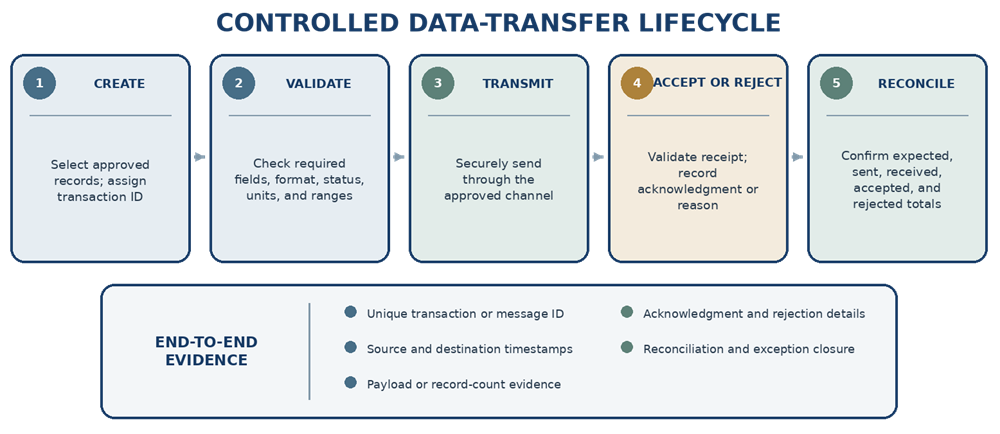
Controlled Data-Transfer Lifecycle
A complete transfer normally includes:
- selecting the correct approved source data;
- validating the source payload;
- securely transmitting it;
- accepting or rejecting it in the receiving system;
- and reconciling the complete transaction population.
Each stage should produce evidence appropriate to the interface’s risk and complexity.
Rejected Messages
Rejected messages should remain visible and controlled. The system should record:
- transaction or message identifier;
- source and destination;
- date and time;
- rejected content or protected reference to it;
- rejection reason;
- failed validation rule;
- retry status;
- responsible owner;
- investigation;
- and final disposition.
Rejected records should not disappear from routine monitoring merely because they were moved to another folder, queue, or technical table.
The process owner should determine the business impact of the rejection. Technical support should not make product-quality or record-disposition decisions without appropriate process and Quality involvement.
Duplicate Transactions
Duplicate processing can cause repeated records, repeated status changes, incorrect inventory, duplicate results, or repeated downstream actions. Duplicate controls may use:
- unique transaction identifiers;
- message identifiers;
- file identifiers;
- sequence numbers;
- source record identifiers;
- checksums;
- idempotency keys;
- and destination-side uniqueness rules.
Idempotent processing means that repeating the same transaction produces the same final state without performing the business action twice. It is useful for retryable interfaces but should be explicitly designed and tested.
A duplicate should not be deleted without evidence showing whether either occurrence was processed and which one represents the valid transaction.
Retries and Retransmission
A retry repeats an unsuccessful technical action, while retransmission may resend the complete payload or transaction. The strategy should define:
- conditions permitting automatic retry;
- retry interval;
- maximum attempts;
- transaction-identity handling;
- duplicate prevention;
- escalation threshold;
- manual authorization;
- and final disposition.
Retries should not create a new unrelated transaction identifier if that would prevent correlation with the original failure.
Before manual retransmission, personnel should confirm whether the destination processed the original transaction. A missing acknowledgment does not necessarily mean the destination received nothing.
Reconciliation
Reconciliation compares what should have transferred with what was actually transmitted, received, accepted, rejected, and posted. Reconciliation may use:
- record counts;
- control totals;
- sequence checks;
- message identifiers;
- batch identifiers;
- file counts;
- checksums;
- status reports;
- exception reports;
- and source-to-destination comparison.
A useful reconciliation distinguishes:
- expected;
- sent;
- received;
- accepted;
- rejected;
- pending;
- duplicated;
- and manually resolved transactions.
The reconciliation frequency should reflect data criticality, transfer frequency, detectability, transaction volume, and the time available to correct an error before the information is relied upon.
Exception Handling
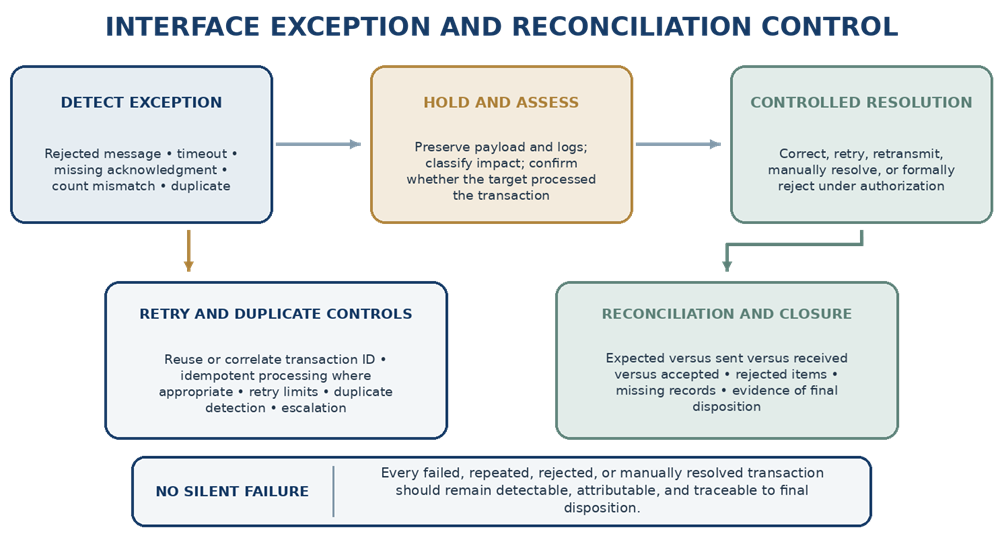
Exception handling should prevent silent data loss and uncontrolled manual correction. The procedure should define:
- detection;
- notification;
- initial containment;
- technical assessment;
- business-impact assessment;
- record preservation;
- investigation;
- correction;
- retry or retransmission;
- verification;
- reconciliation;
- Quality involvement;
- and closure.
Temporary workarounds should be authorized and documented. Manual data entry used to resolve an interface failure should remain attributable and independently verified when required by risk.
Interface Security
Interface security should protect data confidentiality, integrity, authenticity, and availability. Controls may include:
- authenticated connections;
- transport encryption;
- payload encryption;
- digital signatures;
- certificates;
- network segmentation;
- firewalls;
- allowlists;
- restricted endpoints;
- schema validation;
- input sanitization;
- rate limiting;
- and monitoring for abnormal activity.
Security should be applied at the appropriate layers. An encrypted network connection does not establish that the sending service is authorized to access every object or operation exposed by an API.
Interface-security changes should be assessed through Computerized System Change Control, Patching, and Revalidation.
Service Accounts
Interfaces commonly use nonhuman service accounts for authentication. Service-account controls should address:
- unique account assignment;
- documented owner;
- approved purpose;
- least privilege;
- prohibited interactive login;
- credential storage;
- password or secret rotation;
- certificate management;
- expiration monitoring;
- access review;
- activity logging;
- and prompt removal when no longer required.
Service accounts should not use shared personal credentials. Administrative privileges should not be assigned merely to simplify integration.
Where one service account supports several interfaces, the reduced accountability and broader impact of credential compromise should be assessed.
Technical Logs
Technical logs should support monitoring, investigation, and reconstruction of interface events. Logs may include:
- connection attempts;
- authentication results;
- transaction identifiers;
- source and destination;
- message status;
- timestamps;
- processing duration;
- acknowledgments;
- validation failures;
- retries;
- exceptions;
- and administrative changes.
Logs should avoid unnecessary exposure of passwords, tokens, personal information, or complete sensitive payloads.
Technical logs should be protected from unauthorized modification and retained for a period appropriate to the interface risk, investigation needs, and reconciliation frequency.
Technical logs do not replace regulated application audit trails when audit trails are required to document changes to records.
Monitoring
Interface monitoring should detect:
- unavailable connections;
- failed transfers;
- rejected messages;
- queue backlog;
- excessive processing time;
- missing acknowledgments;
- duplicate transactions;
- unexpected record counts;
- replication or transfer lag;
- certificate expiry;
- service-account failure;
- and abnormal data volumes.
Alerts should be actionable and assigned to defined owners. Repeated alerts should be trended rather than closed individually without investigating the recurring cause.
The process owner should receive information about exceptions that can affect regulated operations, not only technical availability statistics.
Recovery
Interface recovery should address transactions that were:
- created but not sent;
- sent but not acknowledged;
- received but not processed;
- processed without response;
- queued during an outage;
- partially transferred;
- duplicated during restart;
- or manually entered during downtime.
Recovery procedures should define the safe restart sequence and how pending transactions will be identified and reconciled.
The interface should not automatically process a large backlog after recovery without considering sequence, status changes, expired data, duplicate risk, capacity, and downstream business impact.
Interface recovery should be coordinated with Backup, Restoration, Disaster Recovery, and Business Continuity.
Interface Requirements
Interface requirements should define the business outcome and required controls before technical design begins.
Requirements should address:
- source and destination;
- transferred records;
- authoritative source;
- direction;
- frequency;
- timing;
- volume;
- availability;
- mapping;
- transformations;
- units and precision;
- status;
- metadata;
- security;
- acknowledgment;
- rejection;
- retry;
- duplicate prevention;
- reconciliation;
- monitoring;
- recovery;
- retention;
- and performance.
Requirements should be uniquely identified, approved, testable, and traceable to risk controls and verification evidence.
See User Requirements Specification for Computerized Systems and Functional, Design, and Configuration Specifications for Computerized Systems.
Interface Risk Assessment
Interface risk assessment should evaluate credible failures and their consequences. Failure scenarios may include:
- wrong source record;
- wrong destination;
- incorrect mapping;
- truncated value;
- changed precision;
- incorrect unit conversion;
- incorrect status;
- lost metadata;
- shifted timestamp;
- unauthorized transaction;
- missing record;
- duplicate record;
- out-of-sequence processing;
- rejected message not investigated;
- uncontrolled retry;
- or monitoring failure.
The assessment should consider:
- product-quality impact;
- patient impact;
- data-integrity impact;
- regulatory impact;
- detectability;
- transfer frequency;
- transaction volume;
- software complexity;
- supplier controls;
- manual controls;
- and time before the data are relied upon.
Risk should determine the required control and test depth rather than serving as a numerical justification for excluding important verification.
See Computerized System Risk Assessment and Test Strategy.
End-to-End Testing
End-to-end testing should begin with controlled source data and continue through the actual interface path to the receiving system and downstream use.
Testing should include:
- representative records;
- maximum field lengths;
- boundary values;
- decimal precision;
- unit conversion;
- date and time formats;
- time zones;
- special characters;
- required and optional fields;
- allowed statuses;
- invalid statuses;
- missing fields;
- invalid formats;
- rejected records;
- duplicate messages;
- retries;
- timeouts;
- lost acknowledgments;
- queue interruption;
- interface restart;
- security restrictions;
- and reconciliation.
Testing should confirm both successful processing and controlled failure behavior.
Evidence should demonstrate:
- source value;
- transmitted value;
- transformation;
- received value;
- destination record;
- acknowledgment;
- technical logs;
- audit trail where applicable;
- and reconciliation result.
Supplier component testing may be leveraged when assessed as suitable, but it does not replace testing of the site-specific mappings, configuration, security, connected systems, data, and operating procedures.
Release and Lifecycle Control
Before release, the organization should confirm that:
- requirements are approved;
- mappings and transformations are verified;
- service accounts are authorized;
- certificates and secrets are controlled;
- monitoring is active;
- exception procedures are approved;
- reconciliation is defined;
- recovery is tested;
- deviations are resolved;
- users and support personnel are trained;
- and traceability is complete.
Changes to either connected system should include interface-impact assessment. Relevant changes include:
- application upgrades;
- database changes;
- field changes;
- new statuses;
- new code values;
- report changes;
- API versions;
- middleware configuration;
- security controls;
- certificates;
- service accounts;
- network routes;
- and supplier releases.
Periodic review should evaluate failures, rejected messages, duplicates, retries, reconciliation discrepancies, security events, supplier notices, unresolved defects, and interface performance.
Maintaining Controlled Data Transfer
A controlled interface should establish:
- which system is authoritative;
- what information is transferred;
- how every field is mapped;
- which transformations are permitted;
- how delivery and acceptance are confirmed;
- how duplicates and retries are controlled;
- how rejected messages are resolved;
- how complete transfer is reconciled;
- how security and service accounts are maintained;
- how failures are detected;
- and how recovery is verified.
The objective is not merely successful transmission. It is demonstrable preservation of complete, accurate, attributable, secure, and usable data from the authoritative source through the receiving business process.