

IT Infrastructure Qualification for GMP Computerized Systems
GMP computerized systems depend on technical infrastructure that may not perform the regulated business process directly but can still affect product quality, patient safety, data integrity, record availability, and regulatory compliance.
This infrastructure may include physical servers, virtual machines, operating systems, databases, networks, storage, directory services, cloud resources, middleware, backup agents, monitoring platforms, certificates, and time-synchronization services. Failure or uncontrolled change within any of these components can disrupt validated applications, alter processing conditions, weaken security, compromise timestamps, interrupt interfaces, or prevent recovery of regulated records.
IT infrastructure qualification establishes documented evidence that the technical platform has been properly specified, installed or provisioned, configured, verified, released, operated, changed, and maintained.
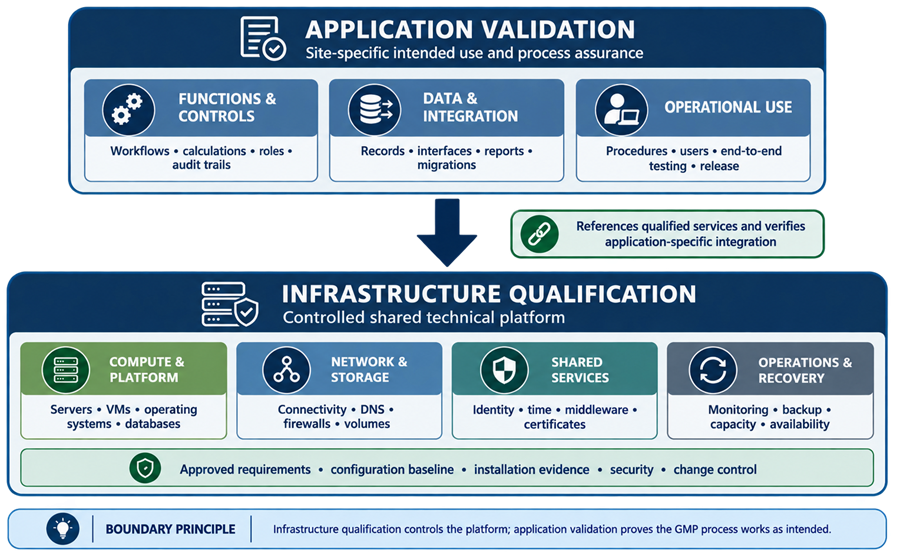
Infrastructure qualification does not replace application validation. It establishes a controlled foundation upon which application validation can rely.
What Is IT Infrastructure Qualification?
IT infrastructure qualification is the documented process used to demonstrate that infrastructure components and shared technical services are:
- suitable for their intended technical use;
- installed or provisioned according to approved requirements;
- configured according to controlled standards;
- accurately identified and inventoried;
- appropriately secured;
- separated according to environment and access requirements;
- monitored for failures and adverse conditions;
- protected through backup or recovery arrangements;
- maintained under change control;
- supported throughout their operational life; and
- retired without compromising dependent systems or retained records.
The qualification approach should be proportionate to the infrastructure service’s intended use, complexity, novelty, configuration, supplier involvement, and potential effect on supported GMP systems.
Qualification may be performed for:
- an individual server;
- a virtual-machine template;
- a database platform;
- a network segment;
- a storage service;
- a shared authentication service;
- a backup platform;
- a cloud landing zone;
- a standardized infrastructure stack; or
- a controlled combination of infrastructure services.
A qualified infrastructure service may support several validated applications. Its qualification evidence can be referenced by those applications when the service boundary, configuration, responsibilities, and dependencies are clearly defined.
Infrastructure Qualification Versus Application Validation
Infrastructure qualification and application validation address related but different objectives.
Infrastructure qualification demonstrates that the shared technical platform is correctly established and controlled. Application validation demonstrates that a configured application performs its intended GMP functions correctly within that platform.
| Infrastructure qualification | Application validation |
|---|---|
| Establishes the controlled technical platform | Establishes fitness for the application’s intended GMP use |
| Verifies infrastructure versions and configurations | Verifies configured workflows and business rules |
| Verifies servers, virtual machines, operating systems, databases, networks, and storage | Verifies application functions, calculations, records, reports, and interfaces |
| Verifies shared identity, time, monitoring, backup, and certificate services | Verifies application roles, permissions, audit trails, signatures, and record controls |
| Establishes technical configuration baselines | Establishes the application’s as-built configuration baseline |
| Confirms infrastructure monitoring and operational support | Confirms business procedures, training, and process readiness |
| Controls shared technical changes | Evaluates each change’s application-specific validation impact |
| May be leveraged by multiple applications | Must address each application’s specific intended use |
Infrastructure qualification does not demonstrate that:
- an application calculation is correct;
- a configured workflow follows the approved business process;
- application permissions implement the required segregation of duties;
- an audit trail captures the required application events;
- an electronic signature has the required meaning;
- a report contains complete and accurate GMP information;
- an interface maps application data correctly;
- a business user can execute an end-to-end process; or
- a system is suitable for product release or another regulated decision.
These matters remain within application validation.
Similarly, application validation should not assume that infrastructure is controlled merely because the application functions during a test. The supporting infrastructure should have defined ownership, approved configuration, operational controls, qualification evidence, and lifecycle governance.
Infrastructure Inventory and Ownership
A controlled infrastructure inventory provides the foundation for qualification, change control, vulnerability management, capacity planning, periodic review, and retirement.
The inventory should identify, as applicable:
- infrastructure component or service name;
- unique asset or configuration-item identifier;
- component type;
- manufacturer or service provider;
- product name;
- hardware model;
- software or firmware version;
- operating-system version and build;
- database type and version;
- virtual or physical status;
- cloud account, subscription, project, or tenant;
- network location;
- host name and internet protocol address;
- operating environment;
- data center or cloud region;
- owner;
- technical administrator;
- supplier;
- support status;
- qualification status;
- configuration-baseline reference;
- supported applications;
- backup classification;
- monitoring status;
- critical certificates;
- patch status;
- retirement status; and
- relevant lifecycle records.
Inventory detail may be maintained across a configuration-management database, cloud asset inventory, virtualization platform, security inventory, and qualification records. These sources should be governed so that they collectively provide an accurate and retrievable representation of the infrastructure.
Ownership should be assigned for both individual components and shared services.
Infrastructure Service Owner
The infrastructure service owner should be responsible for:
- defining the service;
- maintaining requirements;
- approving the service architecture;
- coordinating qualification;
- maintaining the controlled baseline;
- managing support;
- reviewing capacity and availability;
- evaluating changes;
- coordinating periodic review; and
- approving retirement.
Technical Administrator
Technical administrators should:
- provision and configure components;
- maintain technical records;
- manage privileged access;
- apply approved patches;
- investigate alerts;
- support backup and restoration;
- maintain certificates;
- monitor performance;
- implement approved changes; and
- preserve objective evidence.
Application Owner
Application owners should:
- identify infrastructure dependencies;
- define application-specific technical requirements;
- assess infrastructure changes for application impact;
- verify integration with shared services;
- confirm backup and restoration scope;
- participate in incident assessment; and
- ensure that infrastructure evidence is appropriately referenced by application validation.
Quality Oversight
Quality oversight should be proportionate to infrastructure criticality and the organization’s governance model. It may include:
- approval of infrastructure-qualification procedures;
- review of qualification strategy;
- oversight of significant discrepancies;
- approval of risk acceptance;
- review of major changes;
- assessment of departures from standards; and
- review of continued-use decisions for unsupported or materially vulnerable components.
Architecture and Dependency Mapping
Infrastructure qualification should be based on an understood architecture rather than an isolated list of installed components.
Architecture documentation should identify:
- physical and virtual servers;
- hypervisors and management platforms;
- cloud services;
- operating systems;
- databases;
- networks and security zones;
- firewalls and load balancers;
- storage;
- directory and identity services;
- name-resolution services;
- time sources;
- middleware;
- message brokers;
- backup services;
- monitoring services;
- certificate services;
- interfaces;
- administrative access paths;
- external dependencies; and
- dependent GMP applications.
The documentation should show which services are shared and which are dedicated to a particular application.
Dependencies should be traceable in both directions. An application record should identify the infrastructure services upon which the application depends, while the infrastructure service should identify the applications that could be affected by its failure or change.
This relationship is especially important when assessing:
- operating-system upgrades;
- database patches;
- certificate replacement;
- firewall changes;
- identity-service changes;
- storage migration;
- virtualization-platform changes;
- cloud-region changes;
- backup-agent upgrades;
- middleware changes;
- network-segmentation changes; and
- infrastructure retirement.
Without dependency mapping, a technically successful infrastructure change can unintentionally affect validated applications that were omitted from impact assessment or regression testing.
Infrastructure Requirements
Infrastructure requirements should define the technical and operational capabilities needed to support regulated applications.
Requirements may address:
- supported hardware and virtualization platforms;
- operating-system versions;
- database versions;
- processor and memory capacity;
- storage capacity;
- storage performance;
- network connectivity;
- availability;
- environmental separation;
- identity integration;
- privileged-access controls;
- time synchronization;
- encryption;
- certificate management;
- event logging;
- monitoring;
- backup;
- restoration;
- disaster recovery;
- recovery-point objectives;
- recovery-time objectives;
- security configuration;
- patching;
- vulnerability management;
- supportability;
- data location;
- retention of infrastructure records; and
- retirement.
Requirements should be testable where practical. For example, “the server shall be secure” is not sufficiently specific. More useful requirements would identify the approved configuration standard, permitted network services, authentication controls, administrative-access route, logging requirements, and vulnerability-management process.
Infrastructure requirements may originate from:
- application requirements;
- corporate architecture standards;
- security standards;
- supplier specifications;
- cloud-service requirements;
- business-continuity requirements;
- data-integrity controls;
- regulatory requirements; and
- service-level agreements.
Conflicts among these requirements should be resolved before release.
Servers and Physical Hosts
Physical servers and host systems should be identified and controlled according to their role and criticality.
Qualification considerations may include:
- manufacturer and model;
- processor type;
- memory;
- storage controllers;
- network interfaces;
- firmware;
- management-controller configuration;
- redundant components;
- power arrangements;
- physical location;
- rack identification;
- environmental monitoring;
- hardware support;
- warranty;
- secure boot;
- approved ports and services; and
- hardware-health monitoring.
Where redundant components are required, their presence and monitoring should be verified. Redundancy should not be assumed to provide protection unless failover, alerting, and recovery arrangements are understood and periodically exercised where appropriate.
Physical access to data centers, server rooms, and infrastructure-management consoles should be restricted to authorized personnel.
For supplier-hosted or cloud infrastructure, equivalent information may be represented through supplier documentation, contractual controls, independent assurance reports, service descriptions, and customer-controlled configuration evidence.
Virtual Machines and Hypervisors
Virtualization allows several systems to share physical resources and introduces dependencies that may not be visible within an individual application.
Qualification should consider:
- hypervisor product and version;
- host-cluster design;
- virtual-machine templates;
- processor and memory allocation;
- storage allocation;
- virtual-network configuration;
- virtual-device configuration;
- high-availability settings;
- migration capabilities;
- management interfaces;
- administrative roles;
- snapshot controls;
- time synchronization;
- monitoring;
- image and template control; and
- separation of production and nonproduction workloads.
Virtual-machine templates can improve consistency when they are controlled, approved, uniquely versioned, and verified. The resulting virtual machine should still be checked against its approved build record.
Snapshots should not automatically be treated as backups. Their intended use, retention, consistency, security, and restoration limitations should be defined.
NIST’s Guide to Security for Full Virtualization Technologies provides technical guidance for securing virtualization hosts, hypervisors, guest operating systems, and associated management infrastructure.
Operating Systems
The operating system provides core services upon which the application, database, middleware, monitoring, and security controls depend.
The controlled baseline should identify:
- operating-system name;
- edition;
- version;
- build;
- patch level;
- enabled roles and features;
- installed packages;
- active services;
- service accounts;
- local accounts;
- authentication configuration;
- file-system permissions;
- audit and event-logging settings;
- firewall configuration;
- antivirus or endpoint-protection status;
- time settings;
- remote-administration configuration;
- hardening-standard reference; and
- exceptions from the approved standard.
Unnecessary services, accounts, packages, protocols, and administrative interfaces should be disabled or removed where appropriate.
If an application supplier requires settings that differ from the organization’s security baseline, the difference should be assessed. The rationale, risks, compensating controls, approval, and required verification should be documented.
Unsupported operating systems present risks beyond the absence of vendor support. They may no longer receive security updates, may be incompatible with current backup or monitoring tools, and may create recovery or migration difficulties. Continued use should require documented justification and a time-bound remediation or replacement plan.
Database Platforms
Database qualification should address the platform and shared technical controls rather than the correctness of application-specific data structures or business rules.
Infrastructure-level database controls may include:
- database product and edition;
- version and patch level;
- server or managed-service configuration;
- instance identification;
- character set;
- collation;
- storage allocation;
- transaction logging;
- encryption;
- authentication method;
- administrative roles;
- service accounts;
- network listeners;
- allowed connections;
- backup configuration;
- high-availability configuration;
- monitoring;
- maintenance tasks;
- capacity thresholds; and
- recovery arrangements.
Application validation remains responsible for application-specific matters such as:
- data-model suitability;
- field definitions;
- data relationships;
- business constraints;
- application calculations;
- application audit trails;
- record status;
- retention logic;
- data migration; and
- application-level reconciliation.
Direct database access should be restricted. Where administrative or support access can alter regulated data outside the application, the risk should be assessed and controlled through authorization, logging, oversight, and review.
Networks and Connectivity
Network infrastructure can affect system availability, interface completeness, remote access, tenant separation, and protection against unauthorized activity.
Qualification considerations may include:
- network diagrams;
- security zones;
- virtual local-area networks;
- subnets;
- routing;
- firewall rules;
- proxy services;
- load balancers;
- domain-name services;
- wireless networks;
- remote-access services;
- network-management services;
- allowed protocols;
- bandwidth;
- latency;
- redundancy;
- monitoring;
- logging;
- interface endpoints; and
- external connections.
Network verification should focus on the intended service and controlled configuration. It may confirm that:
- required endpoints can communicate;
- prohibited pathways are blocked;
- firewall rules correspond to approved requirements;
- administrative access follows the approved route;
- name resolution works correctly;
- network time is available;
- redundancy functions as designed;
- monitoring detects defined failures; and
- logs are retained and reviewable.
Application validation should verify the application-specific data exchanges that operate across the network, including mapping, completeness, acknowledgments, retries, error handling, and reconciliation.
Storage Services
Storage qualification should address the infrastructure’s ability to provide controlled capacity, availability, protection, and performance.
Relevant controls may include:
- storage platform and version;
- allocated volumes;
- mount points;
- file shares;
- object-storage locations;
- access-control lists;
- encryption;
- replication;
- redundancy;
- capacity thresholds;
- performance monitoring;
- snapshots;
- backup inclusion;
- retention;
- alerting;
- restoration;
- secure disposal; and
- migration.
Storage replication can improve availability, but it does not necessarily protect against accidental deletion, corruption, ransomware, or an application writing incorrect data. Backup, retention, recovery, and archival objectives should therefore be defined separately.
When storage is migrated, the organization should verify completeness, integrity, permissions, metadata, timestamps where relevant, application connectivity, and the controlled disposition of the former storage location.
Domain and Identity Services
Directory and identity services may support user authentication, group membership, service accounts, privileged access, and application authorization.
Qualification should address, as applicable:
- directory or identity-service name;
- domain or tenant;
- authentication method;
- integration method;
- group-management process;
- privileged roles;
- administrative separation;
- service-account controls;
- multifactor authentication;
- password policy;
- session controls;
- account lockout;
- account provisioning;
- account suspension and removal;
- federation;
- recovery procedures;
- monitoring; and
- audit logging.
Qualification of a shared directory establishes confidence in the identity service. It does not prove that an application’s roles and permissions are appropriate. Application validation should verify the mapping between directory identities or groups and application privileges.
Service accounts should have:
- an identified owner;
- a defined purpose;
- the minimum required privileges;
- controlled credentials;
- protected secrets;
- a review process;
- monitoring where appropriate; and
- a controlled retirement process.
Time Synchronization
Reliable time is essential for event sequencing, audit trails, electronic records, security logs, interfaces, investigations, and reconstruction of regulated activities.
The infrastructure design should define:
- authoritative time source;
- synchronization hierarchy;
- permitted time servers;
- time zone;
- daylight-saving treatment;
- synchronization interval;
- allowable drift;
- failure detection;
- alerting;
- logging;
- virtual-machine time configuration;
- disconnected-system arrangements; and
- responsibilities for investigation.
Qualification should verify that relevant servers, databases, middleware, network devices, and monitoring systems obtain time from approved sources and represent time consistently.
The NIST Internet Time Service provides official US time through publicly accessible services. NIST also documents an authenticated Network Time Protocol service.
The FDA’s Part 11—Scope and Application guidance recommends that systems using time stamps be implemented with a clear understanding of the time-zone reference used.
Middleware and Shared Technical Services
Middleware may connect applications, translate messages, manage queues, schedule jobs, provide application programming interfaces, or support authentication and reporting.
Examples include:
- message brokers;
- integration engines;
- application servers;
- web servers;
- API gateways;
- job schedulers;
- file-transfer services;
- enterprise service buses;
- reporting platforms; and
- container platforms.
Infrastructure qualification should address the middleware platform, version, technical configuration, security, availability, monitoring, backup, and operational support.
Application validation should address:
- application-specific mappings;
- transformations;
- message rules;
- field precision;
- units;
- status handling;
- error handling;
- duplicate prevention;
- retry logic;
- acknowledgments;
- reconciliation; and
- end-to-end data transfer.
Cloud Infrastructure
Cloud infrastructure may be delivered through infrastructure as a service, platform as a service, or shared services incorporated into a software-as-a-service solution.
The qualification strategy should define which controls belong to:
- the cloud provider;
- a managed-service provider;
- the application supplier;
- corporate IT;
- the system owner;
- cybersecurity personnel; and
- the Quality unit.
Cloud-infrastructure controls may include:
- account, subscription, or project structure;
- regions and availability zones;
- virtual networks;
- routing;
- security groups;
- firewalls;
- virtual machines;
- managed databases;
- storage;
- identity and access management;
- encryption;
- key-management services;
- logging;
- monitoring;
- backup;
- recovery;
- automated provisioning;
- infrastructure templates;
- tagging;
- configuration policies; and
- administrative access.
Provider qualification evidence may support the assessment of provider-controlled physical facilities, foundational infrastructure, and service operations. Customer-controlled cloud configuration should still be specified, reviewed, verified, and maintained.
The organization should understand whether provider changes can alter:
- supported versions;
- interfaces;
- security behavior;
- backup capabilities;
- availability;
- logging;
- data location;
- administrative access;
- or recovery procedures.
Cloud responsibilities are addressed in greater detail in Cloud and SaaS Systems in GMP Environments.
Backup Agents and Recovery Services
Backup agents and shared backup platforms should be included within the infrastructure boundary when regulated systems depend on them.
Qualification should address:
- backup-agent version;
- supported operating systems;
- connectivity to the backup service;
- service accounts;
- encryption;
- backup schedules;
- included volumes and databases;
- exclusions;
- retention;
- protected copies;
- monitoring;
- failed-job alerts;
- retry procedures;
- restoration permissions;
- recovery documentation; and
- evidence retention.
Successful job status does not by itself demonstrate recoverability. Restoration should be tested at a frequency and depth appropriate to the system’s risk, architecture, and recovery objectives.
Application owners should confirm that the backup scope includes all information required to restore the application, such as:
- application data;
- databases;
- configuration;
- audit trails;
- attachments;
- encryption keys where applicable;
- certificates;
- middleware configuration;
- scheduled tasks; and
- supporting metadata.
Backup, restoration, disaster recovery, and business continuity are addressed further in Backup, Restoration, Disaster Recovery, and Business Continuity.
Monitoring and Alerting
Monitoring helps maintain the qualified state by detecting failures, degradation, unauthorized conditions, and capacity constraints.
Monitoring may cover:
- server health;
- processor utilization;
- memory utilization;
- storage capacity;
- storage performance;
- database status;
- network connectivity;
- service availability;
- backup status;
- certificate expiry;
- time synchronization;
- security events;
- failed authentication;
- malware protection;
- scheduled jobs;
- interface services;
- high-availability status; and
- cloud-service health.
Qualification should verify that:
- required monitoring agents are installed;
- monitored objects are correctly identified;
- thresholds are approved;
- alerts reach the responsible function;
- alert severity is appropriate;
- escalation is defined;
- monitoring failures are detected;
- logs are retained;
- time is synchronized; and
- response procedures are available.
Monitoring should be meaningful. Excessive alerts that are routinely ignored can weaken control as effectively as missing alerts.
The absence of an alert does not automatically prove correct operation. Monitoring should complement, not replace, preventive controls, periodic review, restoration testing, and application-level checks.
Certificates, Encryption Keys, and Secrets
Certificates and cryptographic materials may support:
- secure web communication;
- system authentication;
- digital signatures;
- database encryption;
- file-transfer encryption;
- interface authentication;
- cloud-service access; and
- remote administration.
Controls should address:
- certificate owner;
- intended use;
- issuing authority;
- subject and endpoint;
- validity period;
- private-key protection;
- renewal;
- expiry monitoring;
- replacement testing;
- revocation;
- trust-store management;
- backup where appropriate;
- emergency replacement; and
- retirement.
Certificate renewal should be managed as a controlled change when failure or replacement could affect validated applications or interfaces.
Secrets such as passwords, API keys, tokens, and private keys should not be embedded in uncontrolled scripts or qualification records. Approved vaults or secret-management services should be used where appropriate.
Development, Test, Validation, and Production Environments
Environment separation protects production operations and prevents uncontrolled code, configuration, or test activity from affecting regulated use.
The organization should define the intended purpose of each environment.
| Environment | Typical purpose |
|---|---|
| Development | Configuration development, coding, unit testing, and technical experimentation |
| Test | Controlled functional, integration, and regression testing |
| Validation | Formal verification or representative preproduction testing where maintained separately |
| Production | Authorized operational use and regulated record processing |
| Disaster recovery | Recovery or continuity processing following defined activation |
| Training | User training without affecting production records |
Separation controls may include:
- separate servers or cloud resources;
- separate network segments;
- separate databases;
- separate storage;
- distinct service accounts;
- separate credentials;
- environment-specific certificates;
- restricted administrative access;
- controlled data movement;
- naming conventions;
- monitoring; and
- deployment controls.
Production data should not be copied into nonproduction environments without authorization and controls for confidentiality, data integrity, retention, and disposition. Data should be masked or otherwise protected when appropriate.
Where environments share infrastructure, the risk of cross-environment access, resource contention, configuration error, and unintended deployment should be assessed.
Configuration Baselines
A configuration baseline is the approved representation of how an infrastructure component or service is established at a defined point in time.
The baseline may include:
- hardware or cloud-resource specification;
- software and firmware versions;
- operating-system build;
- installed packages;
- enabled services;
- database configuration;
- network configuration;
- firewall rules;
- storage allocation;
- access groups;
- privileged accounts;
- service accounts;
- security settings;
- monitoring configuration;
- backup configuration;
- certificates;
- time source;
- scheduled tasks;
- high-availability settings;
- deviations from standards; and
- approved references.
Baselines may be documented through:
- build specifications;
- automated infrastructure templates;
- configuration-management records;
- approved hardening standards;
- cloud-policy definitions;
- exported configuration reports;
- screenshots where necessary;
- scripts;
- supplier documentation; and
- qualification test records.
Automated provisioning can strengthen repeatability when templates, scripts, modules, variables, repositories, approvals, and execution records are controlled.
A baseline should be detailed enough to:
- verify the deployed state;
- support change assessment;
- detect unauthorized configuration drift;
- rebuild or recover the service;
- support investigation;
- and establish what was approved at release.
Installation and Provisioning Verification
Installation verification confirms that the approved infrastructure has been correctly installed or provisioned and accurately documented.
Verification should be based on risk and may include confirmation of:
- component identity;
- approved hardware or cloud-resource type;
- version and build;
- operating environment;
- network identity;
- assigned processor and memory;
- storage allocation;
- installed packages;
- enabled services;
- domain membership;
- identity integration;
- service accounts;
- time synchronization;
- security settings;
- monitoring;
- backup-agent installation;
- certificate installation;
- logging;
- administrative access;
- environment designation;
- high-availability configuration;
- supplier documentation; and
- configuration-baseline reference.
Evidence may include:
- system-generated reports;
- configuration exports;
- command output;
- cloud-resource inventories;
- deployment logs;
- automated compliance reports;
- controlled screenshots;
- monitoring records;
- backup-console records; and
- approved checklists.
Evidence should show what was verified, when it was verified, who performed the verification, what acceptance criteria applied, and whether discrepancies were resolved.
Screenshots should not be used where more reliable, complete, or reproducible system-generated evidence is available.
Supplier Evidence
Infrastructure suppliers may provide useful lifecycle evidence for hardware, operating systems, databases, virtualization platforms, cloud services, backup products, and monitoring tools.
Supplier evidence may include:
- product specifications;
- installation instructions;
- compatibility matrices;
- architecture documentation;
- development-process information;
- supplier test summaries;
- security documentation;
- hardening guides;
- release notes;
- known-defect information;
- support policies;
- service reports;
- independent assurance reports;
- vulnerability notifications;
- backup and recovery documentation; and
- end-of-support notices.
Supplier evidence should be assessed before acceptance. The assessment should consider:
- supplier capability;
- evidence relevance;
- document authority;
- document version;
- test environment;
- test scope;
- acceptance criteria;
- result completeness;
- unresolved defects;
- applicability to the deployed configuration; and
- the organization’s ability to retain and retrieve the evidence.
Accepted supplier evidence can reduce unnecessary duplication. It does not replace verification of:
- the organization’s deployed configuration;
- local infrastructure integration;
- local access controls;
- environment separation;
- application dependencies;
- backup scope;
- monitoring;
- operating procedures; and
- site-specific acceptance criteria.
Supplier assessment and evidence leverage are addressed in Computerized System Supplier Assessment and Evidence Leverage.
Security and Privileged Access
Infrastructure qualification should verify that security controls supporting the intended service are established.
These controls may include:
- unique administrative identities;
- role-based privileged access;
- least privilege;
- separation of administrative duties;
- multifactor authentication;
- secure remote access;
- controlled emergency access;
- service-account restrictions;
- account-lockout controls;
- session timeouts;
- administrative logging;
- malware protection;
- host firewalls;
- network segmentation;
- encryption;
- secure protocols;
- vulnerability scanning;
- security monitoring; and
- periodic privileged-access review.
Qualification does not require proving that the infrastructure is immune to every threat. It should demonstrate that defined security requirements and risk controls have been implemented and can be maintained.
Cybersecurity controls should be integrated with change control, incident management, backup, restoration, business continuity, and periodic review. Further detail is provided in Cybersecurity Controls for GMP Computerized Systems.
Patching
Patches may correct defects, close vulnerabilities, maintain supplier support, or introduce functional and technical changes.
The patch-management process should address:
- supplier notification;
- patch identification;
- applicability;
- urgency;
- vulnerability severity;
- affected assets;
- affected applications;
- compatibility;
- testing;
- backup or rollback;
- implementation timing;
- downtime;
- approval;
- installation evidence;
- post-installation checks;
- application regression needs;
- exceptions;
- deferral;
- compensating controls; and
- baseline updates.
Patches should not be classified as harmless solely because they are supplier-issued or described as security updates. They can affect drivers, libraries, authentication, encryption, database behavior, network communication, reporting, and application compatibility.
Conversely, a lengthy validation process should not unnecessarily delay an urgent security patch. A risk-based process should support expedited assessment, defined emergency changes, focused verification, documented approval, and retrospective review.
NIST SP 800-40 Revision 4 describes enterprise patch management as preventive maintenance that supports risk reduction, business objectives, and operational continuity.
Vulnerability Management
Vulnerability management should cover infrastructure components throughout their supported life.
The process may include:
- asset identification;
- vulnerability-information sources;
- supplier notifications;
- scanning;
- applicability assessment;
- exploitability;
- exposure;
- business and GMP impact;
- available patches;
- compensating controls;
- remediation priority;
- risk acceptance;
- verification;
- exception expiry;
- and management reporting.
A scanner finding should not be accepted or rejected solely from its automated score. Assessment should consider the component’s configuration, exposure, data, privileges, network location, dependent applications, available mitigations, and possible effect of remediation.
Where remediation cannot be completed promptly, compensating controls may include:
- network isolation;
- firewall restrictions;
- disabling services;
- restricting administrative access;
- enhanced monitoring;
- application controls;
- temporary procedural restrictions;
- or accelerated replacement.
Risk acceptance should be documented, approved, periodically reviewed, and time-limited where appropriate.
Capacity, Performance, and Availability
Infrastructure should provide sufficient capacity and availability to support its intended services.
Capacity management may consider:
- processor use;
- memory use;
- storage use;
- storage growth;
- database growth;
- network bandwidth;
- transaction volumes;
- backup duration;
- restoration duration;
- concurrent applications;
- concurrent users;
- log growth;
- monitoring-data growth; and
- cloud-service limits.
Thresholds should provide sufficient time for corrective action before service failure or data loss.
Availability controls may include:
- redundant hardware;
- host clustering;
- database clustering;
- load balancing;
- multiple availability zones;
- replicated storage;
- redundant networks;
- automatic failover;
- spare capacity;
- alternate service providers;
- monitoring; and
- documented recovery procedures.
High availability and disaster recovery are not interchangeable. High availability reduces certain service interruptions, while disaster recovery restores service following more extensive disruption.
Performance qualification at the infrastructure level may confirm that the platform meets defined technical criteria. Application validation should confirm that actual workflows, transaction volumes, interfaces, and user activities remain acceptable under representative conditions.
Infrastructure Change Control
Infrastructure changes should be assessed before implementation unless an approved emergency process applies.
Changes may include:
- hardware replacement;
- resource resizing;
- firmware updates;
- hypervisor updates;
- operating-system patches;
- database upgrades;
- network changes;
- firewall changes;
- storage changes;
- domain-policy changes;
- identity-provider changes;
- certificate replacement;
- time-service changes;
- backup-agent changes;
- monitoring changes;
- cloud-service changes;
- relocation;
- configuration-standard changes; and
- retirement.
The impact assessment should identify:
- affected configuration items;
- affected applications;
- regulated records at risk;
- downtime;
- security consequences;
- backup and recovery consequences;
- supplier support;
- compatibility;
- documentation changes;
- qualification evidence;
- application regression testing;
- procedure changes;
- training;
- rollback;
- communication; and
- required approvals.
A change to a shared service may affect many applications. Dependency records should be used to determine which application owners must participate in the assessment.
Post-implementation verification should confirm that:
- the approved change was implemented;
- the baseline was updated;
- monitoring resumed;
- backup remained effective;
- interfaces remained available;
- security controls remained active;
- affected applications passed required checks;
- and deviations were resolved.
Infrastructure and application changes are addressed further in Computerized System Change Control, Patching, and Revalidation.
Maintaining the Qualified State
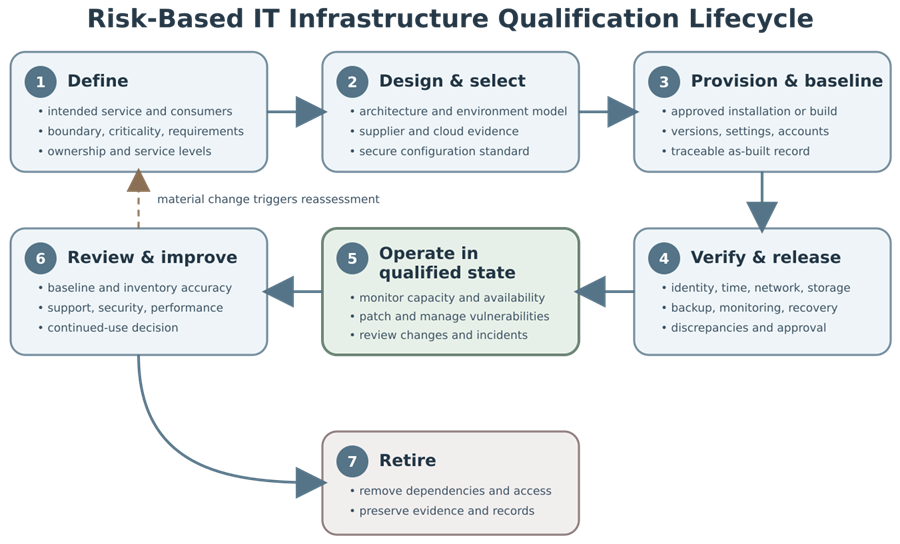
Infrastructure qualification is not complete at initial release. The qualified state depends on continued control of the service.
Lifecycle controls should include:
- accurate inventory;
- approved baselines;
- access management;
- privileged-access review;
- monitoring;
- incident management;
- patching;
- vulnerability management;
- capacity management;
- backup monitoring;
- restoration testing;
- certificate management;
- supplier-notice review;
- change control;
- deviation management;
- periodic review;
- obsolescence management; and
- retirement planning.
Configuration drift should be detected through periodic comparison, automated compliance tools, or controlled review. Differences should be evaluated to determine whether they are approved changes, inaccurate documentation, benign operational states, or unauthorized configuration changes.
Periodic Review
Periodic review should determine whether the infrastructure service remains suitable, controlled, secure, supported, and accurately documented.
Review inputs may include:
- current inventory;
- configuration baseline;
- qualification status;
- supported applications;
- changes;
- incidents;
- problems;
- deviations;
- security events;
- vulnerabilities;
- patch status;
- unsupported components;
- capacity trends;
- availability;
- backup failures;
- restoration tests;
- disaster-recovery exercises;
- access reviews;
- certificate status;
- monitoring coverage;
- supplier notices;
- service-level performance;
- documentation status; and
- planned retirement.
Review frequency should reflect criticality, change rate, vulnerability exposure, supplier support, complexity, and previous performance.
The review should conclude whether the service:
- remains acceptable without action;
- requires documentation correction;
- requires remediation;
- requires additional qualification;
- requires application-impact assessment;
- requires risk acceptance;
- requires replacement; or
- should be retired.
Periodic review and retirement are addressed further in Computerized System Periodic Review and Retirement.
Infrastructure Retirement
Infrastructure retirement should be planned before a component or service is removed.
The retirement assessment should identify:
- dependent applications;
- retained GMP records;
- active interfaces;
- service accounts;
- certificates;
- network routes;
- backup sets;
- recovery dependencies;
- monitoring dependencies;
- security dependencies;
- migration requirements;
- replacement services;
- documentation to retain;
- supplier obligations; and
- disposal requirements.
Before retirement, the organization should confirm that:
- dependent applications have been migrated or retired;
- required records remain accessible;
- required configuration and qualification evidence is retained;
- interfaces have been redirected or disabled;
- accounts and credentials have been removed;
- certificates and keys have been revoked or securely disposed of;
- monitoring has been updated;
- backup and recovery documentation has been updated;
- asset records have been updated;
- storage media has been securely sanitized;
- cloud resources have been removed;
- ongoing charges have been terminated; and
- retirement has been approved.
Backup copies should not be deleted merely because the active infrastructure has been retired. Retention requirements, legal holds, recovery needs, security, and the ability to restore or read the retained information should be considered.
Risk-Based Qualification Deliverables
A proportionate infrastructure-qualification package may include:
- infrastructure service description;
- intended-use statement;
- criticality or GxP impact assessment;
- architecture diagram;
- dependency record;
- requirements;
- supplier assessment;
- qualification plan;
- configuration or build specification;
- security standard;
- installation or provisioning record;
- verification evidence;
- discrepancies and resolutions;
- configuration baseline;
- traceability record;
- backup and recovery evidence;
- monitoring evidence;
- release approval;
- operating procedures;
- change records;
- periodic reviews; and
- retirement records.
Not every infrastructure component requires an identical document set. Documentation may be combined, standardized, or automated when the result remains clear, approved, traceable, and retrievable.
A standardized virtual-machine template may have extensive central qualification evidence and a shorter instance-specific verification record. A novel cloud service supporting a critical data platform may require a more detailed supplier assessment, architecture review, security assessment, recovery evaluation, and technical verification.
The strategy should follow intended use and risk rather than a predetermined document count.
Practical Qualification Outcome
A useful infrastructure-qualification process establishes:
- what technical service is being provided;
- which components are within its boundary;
- which applications depend on it;
- who owns and administers it;
- which requirements apply;
- how the service is configured;
- which supplier evidence is accepted;
- which local verification is required;
- how security and access are controlled;
- how configuration changes are assessed;
- how patches and vulnerabilities are managed;
- how capacity and availability are monitored;
- how backup and restoration are supported;
- how the qualified state is reviewed;
- and how the service will be retired.
The central principle is that infrastructure qualification and application validation should complement one another without being confused.
Infrastructure qualification establishes confidence that the technical platform is correctly provisioned, controlled, secure, monitored, recoverable, and maintained. Application validation establishes confidence that the configured application, its data, interfaces, controls, procedures, and users support the intended GMP process. Together, they provide an efficient and defensible basis for operating computerized systems in a validated state.