

Analytical Instrument Categories and Risk Classification
Analytical instruments range from simple apparatus with no software or electronic data to configurable systems that automate sample handling, measurement, processing, calculation, and reporting. A structured classification framework helps laboratories distinguish these technical differences and apply appropriate qualification and lifecycle controls.
Instrument category alone, however, does not determine qualification scope. The same instrument model may support commercial product release, development work, equipment troubleshooting, or training. Its regulatory significance depends on intended use, the criticality of the generated data, method dependence, credible failure consequences, and the likelihood that an erroneous result would be detected before a GMP decision is made.
Analytical instrument governance must therefore evaluate two related but distinct characteristics:
- Instrument category, which describes technical and data-system complexity
- Risk classification, which evaluates how instrument failure could affect analytical data, product-quality decisions, patient safety, and regulatory compliance
These characteristics are evaluated together when establishing the risk-based analytical instrument qualification strategy.
Purpose and Scope
This article establishes a practical framework for categorizing analytical instruments and assessing their GMP impact and risk. It applies to laboratory apparatus, measuring instruments, configurable analytical instruments, and computerized analytical systems used in:
- Raw-material and component testing
- In-process testing
- Product release testing
- Stability programs
- Environmental and utility testing
- Process and cleaning validation
- Microbiological testing
- Analytical development
- Investigations and troubleshooting
- Training and non-GMP research
The framework supports decisions concerning:
- User requirements
- Supplier and design assessment
- Qualification scope
- Calibration and routine verification
- Preventive maintenance
- Software validation
- Data-integrity controls
- Change control
- Periodic review
- Requalification
- Retirement or replacement
The objective is not to force every instrument into a rigid universal category. It is to create a consistent, documented basis for determining which controls are necessary for the instrument’s actual use.
Regulatory and Compendial Context
US drug CGMP regulations do not prescribe a single mandatory instrument-classification model. They require scientifically sound laboratory controls and suitable programs for calibration, checking, and maintenance of laboratory instruments.
21 CFR 211.160, General Requirements requires scientifically sound laboratory controls and calibration of instruments, apparatus, gauges, and recording devices at suitable intervals according to an established written program.
21 CFR 211.194, Laboratory Records requires complete laboratory data and records of periodic calibration of laboratory instruments and apparatus.
21 CFR 211.68, Automatic, Mechanical, and Electronic Equipment addresses written programs for routine calibration, inspection, or checking of automatic, mechanical, electronic, and computer-related equipment.
USP General Chapter <1058>, Analytical Instrument Qualification, provides a recognized framework for establishing fitness for intended use of laboratory apparatus, instruments, and analytical systems. Organizations should consult the currently official chapter when defining their classification model because compendial terminology and lifecycle guidance may be revised.
The site framework below uses descriptive categories rather than relying only on letter or group designations. This allows the classification record to explain the instrument’s actual technical characteristics, software, data handling, and intended use.
Instrument Category and Risk Are Not the Same
Instrument category describes what the instrument is and how it functions. Risk classification describes what could happen if the instrument, software, data process, or associated control failed in its intended application.
For example:
- An HPLC system is technically complex whether it is used for research or commercial release testing.
- Its GMP impact is substantially different when results determine batch disposition.
- A simple balance may have limited technical complexity but significant GMP impact when used to prepare release-testing standards.
- A computerized instrument may have strong automated controls but still present data-integrity risk if access, audit trails, storage, or review are inadequate.
- A simple instrument may require strong calibration control when a measurement error would not be detected by later testing.
Classification should therefore avoid assumptions such as:
- Simple equipment is always low risk.
- Complex equipment is always high risk.
- Non-networked instruments do not create electronic-record risks.
- Passing system suitability eliminates qualification risk.
- Calibration alone is sufficient for measuring instruments.
- Vendor category assignments determine the user’s qualification obligations.
The final qualification strategy must reflect both technical complexity and intended-use risk.
Analytical Instrument Categories
A four-category model provides sufficient distinction for most regulated laboratories. The categories represent increasing hardware, software, configuration, and data complexity, but not automatically increasing GMP risk.
Analytical instruments can be organized into four descriptive categories representing increasing hardware, software, configuration, and data complexity.
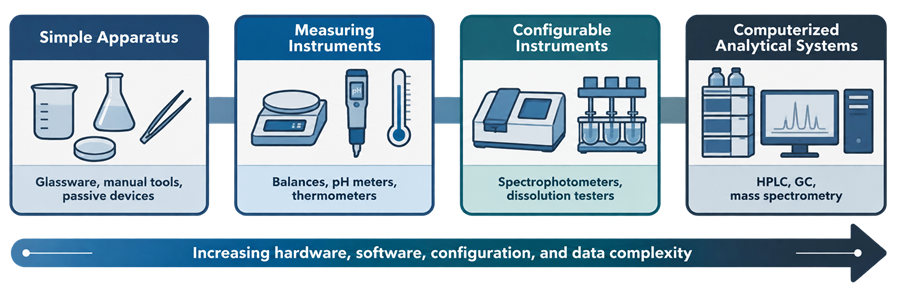
Simple Apparatus
Simple apparatus performs a basic physical or procedural function without embedded software, configurable logic, electronic data processing, or automated calculations.
Examples may include:
- Volumetric glassware
- Manual sample-preparation tools
- Mechanical sieves
- Manual pipettes
- Passive temperature indicators
- Basic timing devices
- Sample holders
- Manual comparators
- Non-instrumented laboratory fixtures
Control of simple apparatus may include:
- Identification and inventory control
- Inspection before use
- Cleaning and storage
- Material or dimensional verification
- Calibration or standardization where applicable
- Defined replacement criteria
- Procedural controls
- Training
Not every item of laboratory apparatus requires an IQ/OQ/PQ package. The required evidence depends on whether the item has characteristics that materially affect the analytical procedure and whether those characteristics are otherwise verified or controlled.
For example, calibrated volumetric glassware can directly affect preparation accuracy even though it contains no software or electronics.
Measuring Instruments
Measuring instruments provide direct physical or chemical measurements and generally have limited configuration or data-processing capability.
Examples may include:
- Analytical and top-loading balances
- pH meters
- Thermometers
- Conductivity meters
- Pressure gauges
- Tachometers
- Timers
- Refractometers
- Simple moisture analyzers
- Handheld meters
Typical controls may include:
- Intended-use definition
- Identification and installation checks
- Measurement-range verification
- Calibration
- Routine checks
- Environmental controls
- Reference standards
- Preventive maintenance
- Out-of-tolerance assessment
- Training and operating procedures
The presence of a digital display does not automatically make an instrument a complex computerized system. The assessment should determine whether the instrument merely displays a measurement or also stores records, performs configurable calculations, manages users, maintains methods, or transfers data.
Configurable Analytical Instruments
Configurable instruments perform defined analytical functions and contain settings, methods, firmware, calculations, or software that affect measurement and reported results. They may operate as stand-alone instruments or use a dedicated local controller.
Examples may include:
- UV-Visible spectrophotometers
- FTIR spectrometers
- Dissolution apparatus
- Automated titrators
- Particle counters
- Total organic carbon analyzers
- Osmometers
- Polarimeters
- Configurable gas analyzers
- Automated microbial readers
Typical controls may include:
- Approved user requirements
- Design and supplier assessment
- Installation verification
- Functional and operational testing
- Performance qualification
- Calibration of critical parameters
- Method and configuration control
- Access control
- Electronic-record assessment
- Data review
- Backup or controlled record export
- Change control
- Periodic review and requalification
The qualification boundary must include the configurations and accessories required for the intended procedure. A spectrophotometer used only for fixed-wavelength measurements may have a different qualification scope from the same platform used with spectral libraries, configurable calculations, electronic signatures, or networked data storage.
Computerized Analytical Systems
Computerized analytical systems combine multiple hardware modules, control software, automated data acquisition, processing functions, electronic records, and supporting infrastructure.
Examples may include:
- HPLC and UHPLC systems
- Gas chromatography systems
- Headspace systems
- Liquid or gas chromatography–mass spectrometry systems
- Inductively coupled plasma systems
- Networked spectroscopy systems
- Automated dissolution systems
- Laboratory automation platforms
- Integrated microbial identification systems
- Analytical systems connected to LIMS or centralized data platforms
The system boundary may include:
- Instrument modules
- Detectors and sensors
- Autosamplers
- Embedded firmware
- Acquisition and control software
- Workstations
- Operating systems
- Databases
- Processing methods
- Calculation functions
- User accounts
- Audit trails
- Network services
- Interfaces
- Backup and archival systems
These systems normally require coordinated instrument qualification and analytical instrument software validation. Qualification of the hardware does not establish that software functions, calculations, security, audit trails, interfaces, and electronic records are adequately controlled.
Classification by Intended Use
Intended use is the primary link between technical category and GMP impact. It should define:
- What the instrument measures or analyzes
- Which materials and sample types are tested
- Which analytical procedures are supported
- Whether results support product release, stability, validation, development, or other activities
- Required measurement ranges and performance
- Whether the instrument generates original electronic records
- How results are processed, reviewed, transferred, and retained
- Whether an independent control could detect erroneous results
- Which decisions rely on the generated data
Intended use must be specific enough to support the analytical instrument user requirements and qualification strategy.
Statements such as “used by the Quality Control laboratory” or “used for GMP testing” are too broad. More useful intended-use statements identify the instrument, analytical application, data use, and decision supported.
Examples include:
- HPLC system used for assay and impurity testing of commercial drug-product release and stability samples
- Analytical balance used to prepare reference standards and samples for release testing
- UV-Visible spectrophotometer used for identity and concentration testing under approved analytical procedures
- pH meter used for in-process measurements that determine continuation of a manufacturing step
- GC system used exclusively for exploratory development studies that do not support batch disposition or a regulatory submission
When intended use changes, the classification and qualification strategy must be reassessed.
Data Criticality and GMP Impact
Data criticality reflects the significance of the generated result within the regulated process.
Greater control is generally appropriate when data are used to:
- Determine product or material release
- Evaluate stability
- Confirm identity, strength, purity, potency, or quality
- Support sterility, endotoxin, or microbiological decisions
- Establish validation acceptance
- Support a deviation or product-impact investigation
- Demonstrate compliance with an approved application
- Support a regulatory submission
- Control a critical manufacturing decision
Lower GMP impact may apply when an instrument is used exclusively for:
- Preliminary feasibility work
- Non-GMP research
- Demonstration or training
- Equipment troubleshooting that does not generate reportable GMP results
- General laboratory support unrelated to quality decisions
“Lower impact” does not mean uncontrolled. The laboratory must still define appropriate operating, safety, maintenance, and data-management practices. It means the formal qualification and quality-oversight model may be reduced when justified.
Failure Consequences and Detectability
Risk classification should evaluate credible failures rather than rely only on the equipment name or category. Potential failures include:
- Measurement bias
- Loss of precision
- Drift
- Incorrect temperature or timing
- Inaccurate sample delivery
- Carryover
- Detector instability
- Incorrect calculations
- Use of an unauthorized method
- Uncontrolled configuration change
- Data loss
- Incorrect data transfer
- Missing metadata
- Undetected reprocessing
- Inadequate audit trails
- Unauthorized record modification
The assessment should consider:
- Effect on the reported analytical result
- Effect on product-quality or patient-safety decisions
- Whether the failure affects one result or an extended period
- Whether system suitability would detect the failure
- Whether calibration or routine verification would detect it
- Whether another analytical control provides independent detection
- Whether the failure would be apparent to the analyst or reviewer
- Whether previously generated data could be affected
A severe failure with reliable independent detection may require a different control strategy from a less severe failure that can remain hidden for an extended period.
Detectability should not be credited without evidence. A laboratory should not assume that an analyst, reviewer, system-suitability test, or later manufacturing control will detect the failure unless the detection mechanism is defined and technically capable.
Method Dependence
Instrument risk depends partly on how strongly the analytical procedure relies on specific instrument functions. Examples include:
- Chromatographic impurity methods may depend on flow accuracy, gradient composition, injector performance, detector response, integration, and data processing.
- Dissolution methods may depend on rotational speed, temperature, vessel geometry, alignment, vibration, and sampling position.
- Spectroscopic identification may depend on wavelength accuracy, resolution, reference libraries, spectral processing, and comparison algorithms.
- Gravimetric preparations may depend on balance accuracy, repeatability, minimum weight, environmental conditions, and correct tare operation.
- Microbiological readers may depend on incubation temperature, optical detection, calculation logic, and result interpretation.
Qualification should focus on instrument characteristics required by the analytical procedure. It should not consist of a generic set of vendor tests disconnected from actual laboratory use.
Analytical procedure validation or verification remains separate from instrument qualification. Method validation demonstrates that the procedure is fit for its analytical purpose; instrument qualification demonstrates that the instrument or system can support its defined use.
Computerized Functions and Data Risk
Software and data functions can increase risk even when the physical measurement technology is well understood. The classification assessment should determine whether the system:
- Controls critical instrument functions
- Uses configurable analytical methods
- Performs calculations
- Applies processing parameters
- Supports manual integration or reprocessing
- Stores original electronic data
- Creates audit trails
- Maintains user roles
- Transfers data to another system
- Uses a shared database
- Relies on network or cloud infrastructure
- Requires backup and recovery
- Uses spectral libraries or analytical models
- Supports electronic review or approval
FDA’s Data Integrity and Compliance With Drug CGMP guidance explains expectations for complete data, metadata, audit trails, authorized access, record retention, review, and investigation of data-integrity deficiencies.
Computerized functionality should be evaluated at the function level. A complex system may contain high-impact acquisition and processing functions, lower-impact administrative features, and functions that are not used. Qualification and testing should concentrate on the configured functions required for intended use.
Structured Instrument Risk Assessment
The risk assessment should document how category, intended use, data criticality, failure consequences, detectability, method dependence, and computerized functions were evaluated. A practical assessment sequence is:
- Define the intended use.
- Establish the system boundary.
- Assign the technical instrument category.
- Identify data and decisions supported by the system.
- Identify critical instrument, software, and interface functions.
- Identify credible failures.
- Evaluate consequences and available detection controls.
- Determine required qualification and lifecycle controls.
- Document assumptions and justification.
- Approve the classification and qualification strategy.
Intended use, data criticality, failure detectability, method dependence, and system complexity are evaluated together to define proportionate qualification and lifecycle controls.
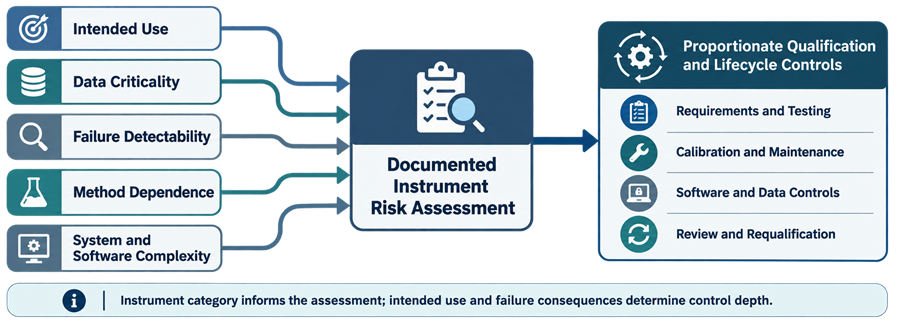
A numerical risk-priority score is not mandatory. Scoring can support consistency, but it must not replace technical reasoning. Different combinations of severity, occurrence, and detectability can produce the same numerical score while requiring different controls.
The assessment should clearly state what will be controlled and why.
Translating Classification into Qualification Controls
Classification informs qualification, but the final scope must remain tied to intended use and risk.
| Control area | Simple apparatus | Measuring instrument | Configurable instrument | Computerized analytical system |
|---|---|---|---|---|
| Intended-use record | As applicable | Required for GMP use | Required | Required |
| User requirements | Limited or incorporated into a specification | Focused requirements | Formal requirements | Formal hardware, software, data, interface, and infrastructure requirements |
| Installation verification | Basic identification and condition check | Normally required | Required | Required |
| Functional testing | Limited | Measurement functions | Critical configured functions | Hardware, software, security, data, and interface functions |
| Performance qualification | When needed to demonstrate intended use | Based on measurement application | Normally required for GMP use | Normally required for GMP use |
| Calibration | Where measurable characteristics affect results | Central control | Critical parameters | Critical hardware and measurement parameters |
| Software validation | Not applicable | Limited assessment if electronic functions exist | Based on configured functions and records | Integrated into system qualification |
| Data-integrity controls | Procedural records | Based on record type | Electronic-record assessment | Comprehensive controls based on system use |
| Maintenance | Inspection or replacement criteria | Defined where needed | Defined program | Coordinated hardware and software lifecycle program |
| Periodic review | Usually inventory or condition based | Calibration and performance history | Qualification, maintenance, change, and performance review | Integrated system, software, data, access, interface, and infrastructure review |
| Requalification | Following significant change where applicable | Based on change or failure impact | Targeted or comprehensive based on impact | Function- and risk-based following changes, failures, or review findings |
This table provides a starting framework. It is not a substitute for the approved risk assessment.
Examples of Category and Intended-Use Interaction
| Instrument and use | Technical category | Principal risk considerations | Likely control emphasis |
|---|---|---|---|
| Analytical balance used to prepare commercial release standards | Measuring instrument | Preparation error directly affects reported results and may not be independently detected | Intended-use qualification, minimum-weight assessment, calibration, routine verification, environmental control, failure impact assessment |
| Same balance used only for analyst training | Measuring instrument | Data do not support GMP decisions | Basic operational control and maintenance; formal GMP qualification may not be necessary |
| HPLC used for commercial release and stability testing | Computerized analytical system | Separation, detection, calculations, processing, security, records, and interfaces affect product decisions | Comprehensive hardware and software qualification, calibration, system suitability, data-integrity controls, maintenance, periodic review |
| HPLC used only for exploratory non-GMP research | Computerized analytical system | High technical complexity but no direct GMP disposition decision | Documented use boundary and proportionate technical control; reduced GMP qualification may be justified |
| pH meter used to determine continuation of a critical processing step | Measuring or configurable instrument | Incorrect measurement may affect process control and product quality | Calibration, functional verification, buffer control, routine checks, maintenance, and data traceability |
| Networked spectrometer using an identification library | Configurable or computerized analytical system | Instrument performance, library content, algorithm, user access, and electronic records affect identification | Instrument qualification, library and software control, security, audit trails, backup, and periodic review |
These examples demonstrate why instrument type cannot be used as the sole basis for risk classification.
Qualification and Lifecycle-Control Outcomes
The documented classification and risk assessment should establish requirements for:
Qualification
- Required DQ, IQ, OQ, and PQ activities
- Critical functions and parameters
- Required operating ranges
- Challenge conditions
- Acceptance criteria
- Use of supplier documentation
- Traceability
- Deviations and release
Calibration and Routine Verification
- Parameters requiring calibration
- Standards and traceability
- Calibration ranges and tolerances
- Routine checks
- Calibration intervals
- Out-of-tolerance handling
- Assessment of previously generated data
Detailed controls are addressed in Calibration Control for Analytical Instruments.
Maintenance
- Preventive-maintenance activities
- Consumables and replacement parts
- Service-provider controls
- Post-maintenance testing
- Repair documentation
- Configuration restoration
- Return-to-service requirements
Software and Data Integrity
- Software-validation scope
- Configuration control
- User-access controls
- Audit trails
- Processing and calculations
- Electronic-record review
- Backup and recovery
- Interfaces
- Data retention
- Change control
Continued Qualification
- Performance monitoring
- System-suitability trends
- Calibration and maintenance review
- Deviation and failure history
- Change assessment
- Periodic review
- Requalification triggers and scope
- Obsolescence and retirement planning
Detailed requalification decisions are addressed in Analytical Instrument Requalification.
Classification Governance and Records
The laboratory should maintain a controlled instrument inventory containing sufficient information to support governance.
Records may include:
- Equipment identifier
- Instrument name and type
- Manufacturer and model
- Serial number
- Location
- Owner
- Intended use
- GMP status
- Technical category
- System boundary
- Software and firmware versions
- Data-storage location
- Interfaces
- Critical functions
- Risk-assessment reference
- Qualification status
- Calibration and maintenance requirements
- Periodic-review requirements
- Retirement status
Classification should be approved by appropriate laboratory, validation, quality, metrology, and IT representatives according to the system’s scope.
The basis for classification must remain traceable. A category selected from a dropdown without supporting intended-use and risk information provides little value during qualification planning or inspection.
Review and Reclassification Triggers
Instrument classification is not necessarily permanent. Reassessment is required when changes alter intended use, technical complexity, data handling, or failure consequences. Potential triggers include:
- Use for a new product or analytical procedure
- Transition from development to GMP release testing
- Addition of software-controlled functions
- Addition of an autosampler, detector, or other module
- Network connection
- LIMS integration
- Migration from paper to electronic records
- Addition of calculations or processing methods
- Software or firmware upgrade
- Database or infrastructure migration
- Instrument relocation
- Significant repair
- Recurring calibration failure
- Data-integrity finding
- Change in the ability to detect failure
- Supplier support or obsolescence concern
The assessment should determine whether the existing category remains appropriate and whether qualification, calibration, maintenance, software, data, or review controls require revision.
Common Classification Deficiencies
Common deficiencies include:
- Assigning category solely by instrument name
- Treating instrument category as the final risk decision
- Assuming simple instruments cannot affect critical results
- Assigning all computerized systems the same qualification scope
- Failing to define intended use
- Failing to establish the system boundary
- Ignoring embedded firmware or local electronic records
- Failing to consider calculations and processing methods
- Treating development use as automatically non-GMP
- Assuming system suitability detects every instrument failure
- Crediting detection controls without technical evidence
- Using numerical risk scores without explaining the control decision
- Failing to reassess classification after changes
- Applying vendor categories without site-specific evaluation
- Omitting calibration, maintenance, and data controls from the assessment
A useful classification process leads directly to justified controls. If the classification record does not affect requirements, testing, calibration, software validation, or lifecycle management, it is functioning only as an administrative label.
Conclusion
Analytical instrument categorization describes technical complexity. Risk classification evaluates the significance of the instrument’s actual use and the consequences of failure. A defensible qualification strategy requires both.
Simple apparatus, measuring instruments, configurable instruments, and computerized analytical systems require different forms of control, but no category automatically determines GMP risk. Intended use, data criticality, method dependence, failure detectability, software functions, and data handling must be evaluated together.
The resulting classification should provide a traceable basis for proportionate requirements, qualification testing, calibration, maintenance, data-integrity controls, change management, periodic review, and requalification throughout the instrument lifecycle.