

Risk-Based Analytical Instrument Qualification Strategy
A risk-based analytical instrument qualification strategy converts intended use, instrument complexity, GMP impact, data criticality, failure risk, and supplier evidence into a documented plan for establishing and maintaining fitness for intended use.
The strategy defines the analytical-system boundary, applicable qualification activities, testing depth, acceptance criteria, supplier-document use, software and data controls, traceability, release requirements, periodic review, and requalification approach. It should explain not only what qualification work will be performed, but why the selected scope is appropriate for the specific instrument and its intended application.
Risk-based qualification does not mean reducing documentation or testing without technical justification. It means concentrating evidence and verification on functions, parameters, records, interfaces, and failure modes that could affect analytical results or regulated decisions. For the governing analytical instrument qualification lifecycle and regulatory framework, see Analytical Instrument Qualification: Strategy, Lifecycle, and Regulatory Framework.
Purpose and Lifecycle Position
The qualification strategy connects the approved analytical instrument user requirements and system boundary with design assessment, qualification execution, release, and continued lifecycle control.
The strategy should establish:
- Intended use and GMP status
- Instrument category and complexity
- System boundary and dependencies
- Critical functions and parameters
- Data and decisions supported
- Applicable DQ, IQ, OQ, and PQ activities
- Testing methods and depth
- Acceptance criteria
- Supplier assessment
- Use of supplier evidence
- Software-validation scope
- Electronic-record and data-integrity controls
- Interface-verification requirements
- Calibration and maintenance prerequisites
- Requirements traceability
- Deviation and acceptance rules
- Release requirements
- Periodic-review inputs
- Requalification triggers and potential scope
- Retirement and data-retention considerations
The strategy may be documented in a stand-alone plan, qualification plan, validation plan, protocol strategy section, or another approved lifecycle document. The format should be proportionate to system complexity and risk, but the technical basis must remain clear and reviewable.
Regulatory and Quality-Risk Basis
US regulations do not prescribe a universal analytical instrument qualification sequence. They require scientifically sound laboratory controls, suitable instrument performance, complete records, calibration, and appropriate controls over computer-related systems.
21 CFR 211.160, General Requirements requires scientifically sound laboratory controls and calibration programs containing specific directions, schedules, accuracy and precision limits, and provisions for remedial action.
21 CFR 211.68, Automatic, Mechanical, and Electronic Equipment requires routine calibration, inspection, or checking of automated equipment and appropriate controls over computer-related systems, data input and output, authorized changes, and backup data.
21 CFR 211.194, Laboratory Records requires complete laboratory data and records of periodic calibration of laboratory instruments and apparatus.
FDA’s Q9(R1) Quality Risk Management guidance provides principles for systematic, science-based risk decisions. The level of formality, documentation, and effort should be commensurate with the level of risk, uncertainty, importance, and complexity.
USP General Chapter <1058>, Analytical Instrument Qualification, provides a recognized framework for demonstrating that analytical apparatus, instruments, and systems are fit for intended use. The strategy should be aligned with the currently official compendial chapter without treating a general framework as a substitute for site-specific technical assessment.
Inputs to the Qualification Strategy
A defensible strategy should be based on documented inputs rather than a predefined package assigned solely by instrument type. Principal inputs include:
- Intended analytical use
- Instrument category
- Hardware and system complexity
- GMP impact
- Data criticality
- Method dependence
- Critical functions and parameters
- Failure consequences
- Failure detectability
- Software and configuration complexity
- Electronic-record lifecycle
- Interfaces
- Infrastructure dependencies
- Supplier capability
- Supplier documentation and test evidence
- Site experience with similar platforms
- Applicable regulations, compendial chapters, procedures, and commitments
Intended use, complexity, GMP and data impact, failure risk, and supplier evidence are converted into a documented qualification and lifecycle strategy.
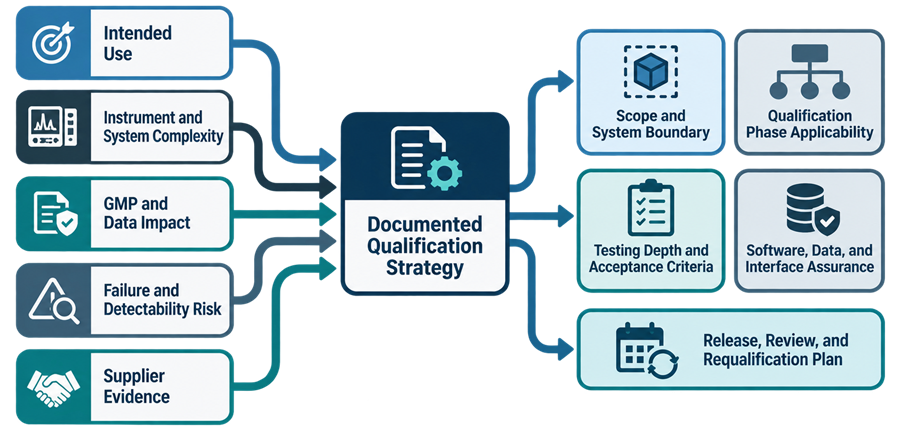
Incomplete inputs produce arbitrary qualification scope. For example, a strategy cannot determine appropriate PQ testing if the intended analytical procedures and performance needs are undefined.
Intended Use and GMP Impact
Intended use establishes why the instrument is needed, how it will be used, and which decisions rely on its output.
The strategy should identify:
- Materials and sample types
- Analytical procedures or technique families
- Measurement ranges
- Required performance
- Release, stability, in-process, validation, development, or research use
- Data and records generated
- Required electronic processing
- Reporting and review workflow
- Interfaces
- Operating locations
- Expected throughput
- Record-retention requirements
The same instrument model may require different qualification strategies when used for different purposes.
An HPLC system used for commercial release and stability testing requires strong control of hardware performance, acquisition, processing, user access, audit trails, records, and interfaces. The same model used exclusively for preliminary non-GMP development may justify a different quality-system framework, even though its technical complexity remains unchanged.
A measuring instrument can also have significant GMP impact. An analytical balance used to prepare release-testing standards may require rigorous intended-use qualification, calibration, routine verification, environmental control, and failure assessment despite limited software complexity.
Instrument and System Complexity
Technical complexity affects the number of functions, dependencies, configurations, and potential failure modes that must be considered.
The analytical instrument categories and risk-classification framework distinguishes among:
- Simple apparatus
- Measuring instruments
- Configurable instruments
- Computerized analytical systems
Complexity considerations include:
- Number of modules
- Sensors and detectors
- Automated sample handling
- Embedded firmware
- Configurable methods
- Calculations
- Data processing
- User roles
- Audit trails
- Databases
- Network services
- Interfaces
- Backup and archival dependencies
Complexity alone does not establish GMP risk. It influences the effort needed to understand, configure, test, and control the system.
Data Criticality and Decision Impact
The strategy should identify the data created by the system and the decisions supported by those data.
Greater qualification rigor is generally appropriate when results support:
- Batch or material release
- Stability evaluation
- Identity, assay, potency, purity, or impurity testing
- Sterility, endotoxin, or microbiological decisions
- Validation acceptance
- Specification compliance
- Product-impact investigations
- Regulatory submissions
- Approved-application commitments
- Critical in-process decisions
The assessment should follow the data from acquisition through processing, calculation, review, transfer, reporting, retention, and archival.
A critical result can be compromised by failure of:
- Instrument hardware
- Sample delivery
- Detector response
- Temperature or timing
- Processing methods
- Calculations
- User access
- Audit trails
- Data storage
- Interfaces
- Review workflow
The qualification strategy must address the complete path needed to produce and preserve the reported result.
Failure Risk and Detectability
The risk assessment should identify credible failures and determine how they could affect analytical data or GMP decisions. Potential failures include:
- Measurement bias
- Loss of precision
- Drift
- Incorrect sample delivery
- Carryover
- Detector instability
- Incorrect temperature
- Incorrect timing
- Unauthorized method change
- Incorrect calculation
- Uncontrolled data processing
- Missing metadata
- Data loss
- Duplicate or incomplete transfer
- Disabled audit trail
- Unauthorized record modification
The strategy should consider:
- Severity of the possible consequence
- Duration of the failure
- Number of potentially affected records
- Probability or technical plausibility
- Ability to detect the failure
- Reliability of existing detection controls
- Effect on previously generated data
- Need for independent verification
Detectability should be credited only when a defined control is technically capable of detecting the failure before the result is used.
System suitability, calibration, routine verification, review, and automated diagnostics may provide detection, but none should be assumed to detect every failure mode.
Defining the System Boundary
The qualification strategy should define which components and dependencies are included within the analytical system. The boundary may include:
- Instrument modules
- Sensors and detectors
- Autosamplers
- Accessories
- Firmware
- Control and acquisition software
- Processing and calculation functions
- Workstations
- Operating systems
- Databases
- User and security configuration
- Audit trails
- Network connections
- Interfaces
- Backup and archival arrangements
- Time-synchronization services
The strategy should also identify external dependencies such as:
- Reference standards
- Approved analytical procedures
- Utilities
- Environmental conditions
- Network infrastructure
- LIMS
- Enterprise storage
- Identity management
- Backup services
- Trained users
- Controlled procedures
The qualification boundary should be broad enough to cover functions that affect analytical results, but it should not duplicate qualification of controlled supporting systems. Responsibilities and interface conditions must be defined.
Qualification-Phase Applicability
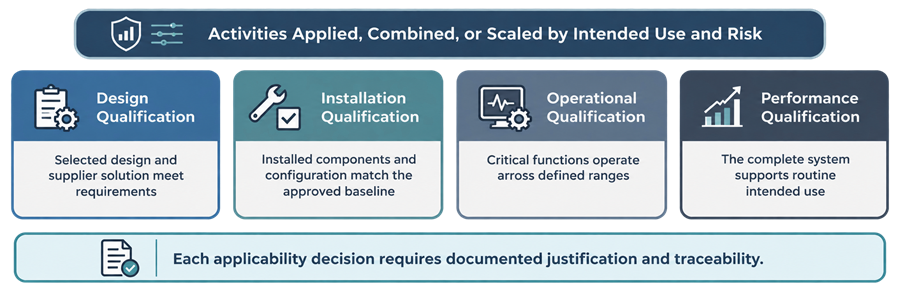
The strategy should determine how Design Qualification, Installation Qualification, Operational Qualification, and Performance Qualification will be applied. These activities represent different qualification objectives. They may be documented separately, combined, or scaled when justified by intended use, system complexity, risk, and available evidence.
The decision should not be reduced to “full qualification” versus “no qualification.” The strategy must identify which objectives require evidence and the most suitable way to obtain it.
DQ, IQ, OQ, and PQ address different objectives and may be applied, combined, or scaled when the strategy provides documented justification and traceability.
Design Qualification Applicability
Analytical Instrument Design Qualification confirms that the selected design, configuration, supplier solution, software, infrastructure, and support model can satisfy the approved requirements.
DQ should address, as applicable:
- Analytical technology
- Measurement capability
- Required modules
- Sample compatibility
- Materials of construction
- Software functions
- Data architecture
- Security capability
- Audit trails
- Interfaces
- Utilities
- Environment
- Calibration provisions
- Maintenance
- Supplier documentation
- Support and obsolescence
For a simple commercial instrument, design assessment may be concise and incorporated into a selection record or qualification plan. For a configurable or computerized analytical system, a formal DQ is normally appropriate.
The design-suitability objective should not be omitted merely because the supplier offers a standard product.
Installation Qualification Applicability
Analytical Instrument Installation Qualification establishes the installed and configured baseline.
IQ typically verifies:
- Manufacturer, model, and serial number
- Delivered components
- Modules and accessories
- Physical installation
- Utilities
- Environmental suitability
- Workstation and software installation
- Firmware and software versions
- Licenses
- Enabled options
- Configuration
- Network connections
- Interfaces
- Documentation
- Calibration certificates
- Equipment identification
Installation verification is relevant to most GMP analytical instruments, but its formality and depth may differ. A concise inspection may be suitable for a simple instrument, while a complex system requires detailed hardware, software, data, and infrastructure verification.
Operational Qualification Applicability
Analytical Instrument Operational Qualification demonstrates that critical functions operate correctly across defined conditions and ranges.
OQ may address:
- Instrument functions
- Measurement parameters
- Alarms
- Interlocks
- Error handling
- Module communication
- Calculations
- Processing
- Security roles
- Audit trails
- Electronic signatures
- Interfaces
- Backup and recovery
- Boundary conditions
- Interrupted operation
- Power or communication failures
Testing should focus on functions whose failure could affect intended use, analytical results, or data integrity. A complex system does not require exhaustive testing of every available feature when only a defined subset is configured and used.
Unused functions should be disabled, restricted, or explicitly excluded from the qualified configuration.
Performance Qualification Applicability
Analytical Instrument Performance Qualification demonstrates that the complete system supports routine intended use under representative laboratory conditions.
PQ may use:
- Approved analytical procedures
- Representative samples
- Certified or characterized standards
- Routine configurations
- Site analysts
- Normal operating conditions
- Defined performance checks
- Expected workflow
- Actual accessories and interfaces
PQ should not simply repeat supplier OQ tests. It should demonstrate integration of the instrument, configuration, procedure, environment, users, and operating controls.
For simple or limited-use instruments, OQ and PQ objectives may be combined when the protocol clearly distinguishes functional verification from intended-use performance. Combining activities should not obscure acceptance criteria or traceability.
Qualification-Phase Decision Table
| System and intended use | DQ approach | IQ approach | OQ approach | PQ approach |
|---|---|---|---|---|
| Simple apparatus affecting GMP testing | Concise suitability assessment | Identification and condition verification | Limited or not separately applicable | Intended-use verification where necessary |
| Measuring instrument used for critical GMP measurements | Focused capability assessment | Installation and environmental verification | Critical measurement functions and controls | Representative intended-use performance |
| Configurable instrument used for GMP testing | Formal design and configuration assessment | Hardware, software, utility, and configuration baseline | Critical functions, ranges, calculations, security, and data controls | Representative analytical use |
| Computerized analytical system supporting release or stability | Comprehensive design, supplier, software, data, infrastructure, and interface assessment | Detailed installed and configured baseline | Risk-based hardware, software, security, data, interface, and failure testing | Integrated routine-use performance |
| Complex system used exclusively for non-GMP research | Documented suitability and use boundary | Technical installation verification | Technical functional testing based on operational need | Formal GMP PQ may not apply; intended-use confirmation remains appropriate |
This table provides a starting framework. The approved strategy must be based on the specific system and use.
Determining Testing Depth
Testing depth should reflect the importance, complexity, uncertainty, and failure risk of the function being verified.
The strategy should determine:
- Which functions require direct testing
- Which requirements can be verified by inspection
- Which requirements can be supported by supplier evidence
- Which parameters require calibration
- Which functions require boundary testing
- Which failures require challenge testing
- Which configurations require independent verification
- Which interfaces require end-to-end testing
- Which controls require negative testing
- Which requirements will be verified during PQ
- Which functions are excluded from use
Greater testing depth may be appropriate when:
- Failure could affect a critical GMP decision
- Failure would be difficult to detect
- Configuration is complex
- Custom calculations are used
- Data are transformed or transferred
- Software controls original records
- Supplier evidence is incomplete
- Technology is new to the site
- The supplier solution is highly configurable
- Historical performance is limited
- Requirements involve security or data integrity
Reduced testing may be justified where a function is noncritical, simple, well understood, independently controlled, or adequately verified through assessed supplier evidence.
Positive, Negative, and Boundary Testing
A strategy limited to successful operating steps may fail to challenge important controls.
Testing should include, where appropriate:
- Positive testing — confirms correct operation with valid inputs and conditions
- Negative testing — confirms that unauthorized or invalid actions are prevented or detected
- Boundary testing — confirms operation at defined limits or transitions
- Failure testing — confirms controlled behavior following power loss, communication interruption, invalid input, or component failure
- Recovery testing — confirms preservation and restoration of data and configuration
- Interface testing — confirms accurate, complete, and traceable transfer, including errors and reconciliation
The selected test types should correspond to identified risks and requirements.
Acceptance Criteria
Acceptance criteria should be predefined, objective, scientifically justified, and traceable to requirements. They may be based on:
- Intended analytical use
- Approved analytical procedures
- Compendial expectations
- Supplier specifications
- Site standards
- Calibration tolerances
- Measurement uncertainty
- Historical platform capability
- Data-integrity requirements
- Risk assessment
Supplier specifications should not be copied automatically. They may describe maximum design capability rather than the performance required for the laboratory’s intended use.
Acceptance criteria should also define how deviations, incomplete tests, and residual risks affect release.
Supplier Assessment
Supplier assessment determines whether the supplier and its evidence can be relied upon within the qualification strategy. The assessment should be proportional to:
- System complexity
- GMP impact
- Software dependency
- Degree of configuration or customization
- Criticality of supplier services
- Availability of alternative controls
- Extent of supplier evidence to be leveraged
Assessment areas may include:
Supplier Capability
- Experience with the instrument technology
- Experience in regulated industries
- Quality-system maturity
- Technical expertise
- Manufacturing and testing controls
- Software-development practices
- Document control
- Training capability
- Service organization
- Parts availability
- Change-notification practices
- Complaint and defect handling
- Cybersecurity support
- Product-lifecycle and obsolescence management
Product and Configuration Control
- Hardware configuration
- Firmware and software versions
- Release control
- Configuration management
- Known issues
- Defect management
- Supported operating systems and databases
- Interface specifications
- Upgrade paths
- Backward compatibility
Documentation and Evidence
- Technical specifications
- Architecture descriptions
- Data-flow diagrams
- Installation records
- Calibration certificates
- IQ/OQ protocols
- Executed test evidence
- Software-development evidence
- Traceability
- Release notes
- Maintenance procedures
- Backup and recovery instructions
- Security documentation
- Training materials
- Service reports
A questionnaire alone does not constitute supplier qualification. The assessment should evaluate evidence relevant to the purchased product, configuration, services, and intended use.
Leveraging Supplier Documentation
Supplier evidence may be leveraged when it is relevant, technically sound, complete, and available for review. The user assessment should confirm:
- The tested configuration matches the purchased system
- Relevant user requirements are covered
- Test methods are suitable
- Standards and test equipment are identified
- Calibration status is acceptable
- Acceptance criteria are defined
- Actual results are recorded
- Deviations are documented
- Software and firmware versions are identified
- Records are attributable
- Traceability is available
- Evidence can be retained or accessed as required
Supplier evidence should be leveraged only after the user confirms configuration match, requirement relevance, suitable methods, complete results, deviations, traceability, and record availability.
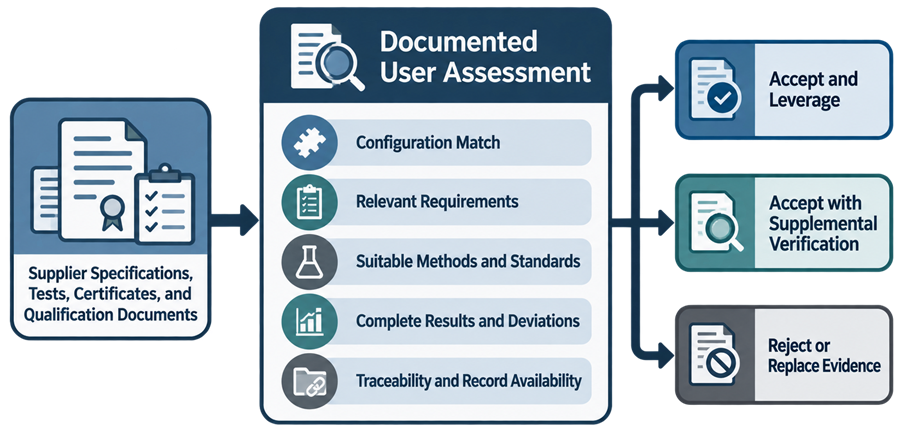
Possible outcomes include:
Accept and Leverage
Supplier evidence may be accepted directly when it adequately verifies the relevant requirement for the installed configuration and intended use.
Accept with Supplemental Verification
Supplier evidence may support part of the requirement while site testing addresses:
- Site-specific configuration
- Local infrastructure
- User roles
- Interfaces
- Data storage
- Backup and recovery
- Intended-use performance
- Gaps in supplier testing
- Critical functions not adequately challenged
Reject or Replace the Evidence
Supplier evidence should not be relied upon when:
- Configuration cannot be confirmed
- Only blank protocol templates are available
- Results are absent
- Methods are unsuitable
- Test equipment is not traceable
- Deviations are unresolved
- Software versions do not match
- Documentation is incomplete
- Evidence cannot be reviewed
- Records are inconsistent or unreliable
Supplier performance of a test does not transfer responsibility for the qualification conclusion from the regulated company.
Factory and Site Testing
Factory Acceptance Testing may provide useful evidence for hardware functions, configuration, interfaces, or software behavior before delivery.
The strategy should define:
- FAT scope
- Witnessing requirements
- Documentation expectations
- Acceptance criteria
- Deviation handling
- Evidence retained
- Tests that will not be repeated
- Tests requiring site confirmation
Site testing remains necessary for conditions that cannot be established at the factory, including:
- Actual utilities
- Environmental conditions
- Final network configuration
- Site user roles
- Local interfaces
- Site backup
- Installed software environment
- Final configuration
- Routine analytical use
Repeat testing should be based on risk, not convention. Tests may be repeated when shipping, installation, configuration, environment, or site integration could invalidate earlier evidence.
Software Assurance Strategy
For computerized analytical systems, qualification strategy must integrate hardware qualification with software and data assurance. The strategy should address:
- Software intended use
- Software and firmware versions
- System architecture
- Configured functions
- Calculations
- Processing methods
- User roles
- Audit trails
- Electronic signatures
- Original records and metadata
- Interfaces
- Backup and recovery
- Retention and archival
- Time synchronization
- Infrastructure
- Supplier software evidence
- Change and patch control
Detailed controls are addressed in Analytical Instrument Software Validation.
Software testing should focus on functions used in the approved configuration and their potential impact on analytical results and data integrity. Unused functions should not remain uncontrolled merely because they were excluded from testing.
Data-Integrity and Electronic-Record Strategy
The qualification strategy should define how electronic records remain complete, consistent, accurate, attributable, protected, and available. It should identify:
- Original data
- Metadata
- Data ownership
- Record location
- Data-processing steps
- Reprocessing controls
- Audit trails
- Review responsibilities
- User and administrator access
- Backup
- Restore
- Archival
- Retrieval
- Migration
- Retention
- Interface reconciliation
FDA’s Data Integrity and Compliance With Drug CGMP guidance explains expectations for complete data, metadata, authorized access, audit trails, review, retention of original records, and investigation of data-integrity deficiencies.
Data-integrity testing should not be postponed until after instrument qualification. Security, records, audit trails, calculations, interfaces, and storage are part of the system’s fitness for intended use.
Calibration and Maintenance Strategy
Qualification should be coordinated with calibration control for analytical instruments.
The strategy should identify:
- Critical parameters requiring calibration
- Calibration ranges
- Tolerances
- Reference standards
- Calibration prerequisites
- Routine verification
- Maintenance prerequisites
- Post-maintenance testing
- Out-of-tolerance handling
- Impact assessment
- Return-to-service controls
Calibration verifies defined measurement characteristics. It does not replace qualification of integrated functions, software, data controls, or intended-use performance.
Maintenance may affect calibration, configuration, qualification, or previously generated data. The strategy should establish how these impacts will be assessed.
Requirements Traceability
Traceability demonstrates that approved requirements and identified risks are addressed by design features, supplier evidence, qualification tests, procedures, or lifecycle controls. The traceability record should identify:
- Requirement identifier
- Requirement priority
- Risk or critical function
- Design or supplier response
- Verification method
- Protocol or evidence reference
- Result
- Deviation
- Final disposition
- Approval status
Not every requirement must be tested directly. Some may be verified through:
- Design review
- Supplier assessment
- Inspection
- Calibration
- Configuration verification
- Functional testing
- Performance qualification
- Procedure review
- Training
- Infrastructure qualification
The strategy should define the appropriate evidence and maintain traceability through final acceptance.
Deviations and Residual Risk
The qualification strategy should define how deviations will be documented, assessed, corrected, retested, and closed. Deviation assessment should consider:
- Affected requirement
- Test objective
- Data integrity
- Instrument performance
- Intended use
- Previously executed tests
- Previously generated data
- Need for corrective action
- Need for retesting
- Residual risk
- Effect on release
A deviation should not be accepted solely because the observed result is close to the criterion or because routine operation is expected to differ.
Residual risk may be acceptable when it is understood, controlled, documented, and consistent with intended use. Required controls may include restricted functionality, procedural controls, increased monitoring, supplier correction, or planned replacement.
Qualification Acceptance and Release
The strategy should define the evidence required before release. Release prerequisites may include:
- Approved requirements
- Approved system boundary
- Completed supplier assessment
- Completed required qualification activities
- Acceptance criteria met
- Deviations resolved or acceptably justified
- Critical requirements verified
- Calibration complete
- Maintenance program established
- Software and data controls operational
- Backup and recovery available
- Interfaces verified
- Procedures approved
- Users trained
- Configuration baseline documented
- Traceability complete
- Quality approval obtained
A successful supplier OQ visit or passing PQ result does not independently establish release. The complete evidence set must support the conclusion that the system is fit for intended use.
Periodic-Review Strategy
The initial qualification strategy should define how continued suitability will be reviewed. Periodic-review inputs may include:
- Current intended use
- Configuration
- Qualification status
- Calibration history
- Maintenance and repair history
- Deviations
- OOS and OOT investigations
- Performance trends
- System-suitability trends
- Software and firmware changes
- User and administrator access
- Audit-trail findings
- Backup and recovery evidence
- Interface failures
- Supplier notifications
- Recurring defects
- Open corrective actions
- Obsolescence and support status
The strategy should not assign a review interval solely from instrument category. Review frequency and depth should reflect risk, performance history, change rate, data criticality, and procedural or compendial requirements.
Requalification Strategy
The qualification plan should establish how changes, failures, repairs, and review findings will be evaluated for requalification. Potential triggers include:
- New intended use
- Instrument relocation
- Module replacement
- Major repair
- Repeated calibration failure
- Adverse performance trend
- Software or firmware update
- Operating-system change
- Database migration
- Interface modification
- Security change
- Data-integrity finding
- Environmental or utility change
- Supplier recommendation
- Periodic-review conclusion
Possible decisions include:
- No additional qualification testing
- Documentation or configuration update
- Calibration or routine verification
- Targeted functional testing
- Partial OQ
- Partial PQ
- Expanded OQ/PQ
- Comprehensive requalification
- Restricted use
- Retirement or replacement
Each decision should follow affected requirements, functions, risks, and dependencies. Detailed decisions are addressed in Analytical Instrument Requalification.
Qualification-Strategy Deliverables
A complete strategy may generate or reference:
- Intended-use statement
- Instrument-category assessment
- GMP-impact assessment
- System-boundary description
- Data-flow diagram
- User Requirements Specification
- Risk assessment
- Supplier assessment
- Supplier-document leverage assessment
- Qualification plan
- DQ, IQ, OQ, and PQ applicability assessment
- Software-validation strategy
- Data-integrity assessment
- Interface strategy
- Calibration and maintenance strategy
- Requirements traceability matrix
- Acceptance and release criteria
- Periodic-review strategy
- Requalification decision framework
The documentation can be consolidated when appropriate. Separate documents should be created only when they improve control, ownership, execution, or traceability.
Common Strategy Deficiencies
Common deficiencies include:
- Assigning qualification scope solely by instrument category
- Using the same protocol package for every instrument
- Intended use defined too broadly
- System boundary limited to physical hardware
- Supplier IQ/OQ accepted without assessment
- Blank supplier protocols treated as evidence
- Testing every available function without risk focus
- Failing to test critical failure conditions
- Supplier specifications copied as site acceptance criteria
- Software and data controls separated from instrument qualification
- Interfaces tested only for successful transfers
- Calibration treated as a substitute for qualification
- PQ used as a repetition of OQ
- No traceability to requirements
- Deviations closed without impact assessment
- Release based on document completion rather than evidence
- Periodic review and requalification omitted from the initial strategy
- Risk scores used without technical explanation
- Reduced testing justified only by schedule or cost
A risk-based strategy should make qualification more technically focused and defensible. It should not make the evidence incomplete.
Conclusion
A risk-based analytical instrument qualification strategy translates intended use, system complexity, GMP impact, data criticality, failure detectability, and supplier evidence into a controlled qualification and lifecycle plan.
The strategy defines the system boundary, qualification-phase applicability, testing depth, acceptance criteria, supplier-document leverage, software and data assurance, traceability, release, periodic review, and requalification approach.
The objective is neither maximum testing nor minimum documentation. It is sufficient, scientifically justified evidence that the complete analytical system is fit for its intended use and can remain under control throughout its lifecycle.