

Analytical Instrument Performance Qualification and Continued Verification
Analytical instrument Performance Qualification (PQ) provides documented evidence that the complete instrument system can support its intended analytical use under representative operating conditions.
PQ evaluates the integrated performance of the qualified instrument, software, analytical procedure, reference materials, samples, trained users, data workflow, and routine laboratory controls. It bridges controlled functional testing performed during Operational Qualification with release for routine analytical use.
Continued performance verification begins after initial qualification. It uses routine checks, system-suitability results, calibration history, deviations, failures, maintenance records, and performance trends to confirm that the instrument remains fit for use throughout its operational life.
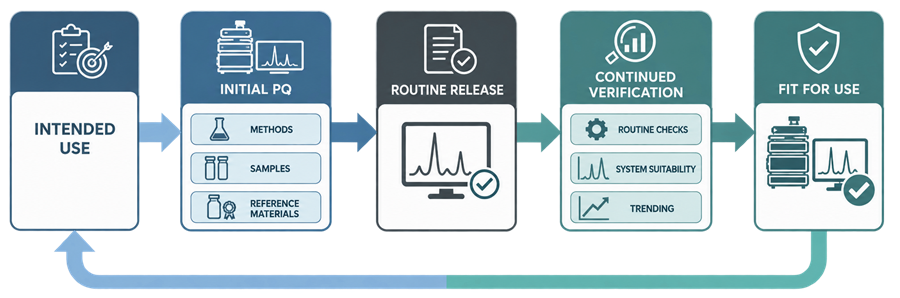
Initial PQ and continued performance verification serve different purposes:
- Initial PQ establishes an acceptable performance baseline before routine release.
- Continued verification evaluates whether that performance baseline remains effective after release.
The lifecycle should not rely on a successful initial PQ as permanent evidence of suitability.
Purpose of Performance Qualification
Initial PQ should demonstrate, where applicable, that:
- the complete analytical system supports its approved intended use
- representative analytical procedures can be executed successfully
- relevant sample and reference materials can be handled and measured
- critical performance criteria are met
- accuracy and precision are appropriate for the intended application
- method-specific system-suitability requirements can be achieved
- routine data acquisition, processing, review, and reporting operate correctly
- trained users can execute the defined workflow
- the system is suitable for release to routine operation
Continued performance verification should subsequently demonstrate that:
- critical performance attributes remain within approved criteria
- system-suitability results remain acceptable
- routine checks remain stable
- calibration results do not show adverse drift
- failures, deviations, and repeat events are evaluated collectively
- maintenance and repair history do not indicate declining reliability
- the instrument remains capable of supporting its approved methods
- emerging adverse trends are identified before loss of control
- changes or failures trigger appropriate assessment, correction, or requalification
The following illustration separates initial PQ from the continued verification activities used after routine release.
PQ Applicability and Qualification Strategy
A separate PQ protocol is not universally required for every analytical instrument.
The need for a distinct PQ phase should be determined through the approved risk-based analytical instrument qualification strategy. Factors include:
- intended use
- analytical technique
- instrument complexity
- dependence on software
- method dependence
- data criticality
- effect on product-quality decisions
- ability to detect instrument failure through system suitability
- availability of representative methods
- calibration and routine-check strategy
- supplier qualification evidence
- laboratory experience with the technology
For a simple instrument, intended-use performance may be established through calibration, reference-standard testing, and routine verification without a separately titled PQ protocol.
For a complex instrument used for release, stability, validation, or other critical testing, a distinct PQ may be appropriate to demonstrate integrated performance with representative analytical procedures, samples, users, and data workflows.
Qualification phases may be combined when their individual objectives, acceptance criteria, evidence, and conclusions remain clear.
Relationship Among IQ, OQ, PQ, and Continued Verification
The qualification lifecycle should preserve the purpose of each stage:
- Installation Qualification establishes the installed hardware, software, firmware, utilities, interfaces, and configuration baseline.
- Operational Qualification challenges functions, controls, operating ranges, alarms, calculations, security, and data handling.
- Initial PQ confirms that the integrated system supports representative intended-use applications.
- Continued performance verification evaluates performance after release using routine lifecycle evidence.
- Requalification provides additional documented testing after significant changes, failures, repairs, adverse trends, or other defined triggers.
PQ should not repeat all IQ and OQ tests. It should use the approved installed and functional baselines as prerequisites and focus on integrated performance under conditions representative of actual use.
Prerequisites for Initial PQ
PQ should begin after the conditions required for meaningful intended-use testing have been established. Typical prerequisites include:
- approved intended use
- approved system boundary
- completed or appropriately released OQ
- resolved or accepted critical qualification deviations
- controlled hardware and software configuration
- current calibration status
- approved analytical procedures or suitably controlled representative procedures
- defined reference materials and samples
- qualified or trained analysts
- approved operating procedures
- defined system-suitability requirements
- predefined PQ acceptance criteria
- established data review and approval workflow
- approved PQ protocol or controlled study plan
- available deviation and investigation procedures
A validated analytical procedure is not always necessary before instrument PQ. For newly implemented technology, a controlled representative procedure may be used when it adequately challenges the intended instrument capabilities. The basis for method selection and the limitations of the resulting PQ should be documented.
Intended-Use-Based PQ Design
PQ should be derived from the approved intended use rather than from the instrument’s entire technical capability. The intended-use statement should define, as applicable:
- analytical technique
- types of tests
- product or material categories
- sample characteristics
- concentration or measurement ranges
- required sensitivity
- required accuracy and precision
- throughput expectations
- critical instrument modules
- data-acquisition and processing functions
- required calculations
- reportable results
- electronic-record requirements
- interfaces
- laboratory environment
- regulatory role of the generated data
An HPLC system used only for assay testing may require a different PQ challenge than the same model used for trace-level impurities, dissolution samples, stability-indicating procedures, and gradient separations.
PQ should demonstrate suitability for the approved use. It should not be presented as qualification for every application the instrument might technically support.
Selection of Representative Analytical Procedures
Representative procedures should exercise the instrument functions that are important to intended use. Selection factors may include:
- instrument modules used
- measurement principle
- operating range
- detector type
- sample introduction mode
- temperature or flow requirements
- sensitivity
- run duration
- sequence length
- processing functions
- calculations
- report requirements
- data-transfer requirements
- method criticality
- known performance challenges
One procedure may cover several intended uses when it adequately challenges their critical functions. Multiple procedures may be required when the system supports materially different techniques, modules, detectors, sample types, or performance demands.
A representative procedure should not be selected merely because it is convenient or consistently produces favorable results. The selection should be risk-based and traceable to the system’s intended-use requirements.
FDA’s Q2(R2) Validation of Analytical Procedures and Q14 Analytical Procedure Development provide relevant principles for analytical procedure performance and lifecycle understanding. They do not prescribe a universal analytical instrument PQ design.
Representative Samples and Reference Materials
PQ materials should be suitable for assessing the performance characteristics selected for verification. Applicable materials may include:
- certified reference materials
- compendial reference standards
- characterized secondary standards
- calibration standards
- system-suitability standards
- control samples
- spiked samples
- placebo
- matrix-matched samples
- representative product samples
- stable internal standards
- physical reference artifacts
- traceable measurement standards
Material selection should consider:
- identity
- purity or assigned value
- traceability
- stability
- expiration or retest date
- storage
- preparation
- concentration
- matrix
- homogeneity
- suitability for the intended measurement
Reference materials should have adequate quality and documentation for the conclusion they support. A material used to assess accuracy should have an appropriate assigned or independently established value.
PQ should distinguish variability introduced by the instrument from variability caused by unstable standards, heterogeneous samples, or uncontrolled sample preparation.
Complete-System Performance Evidence
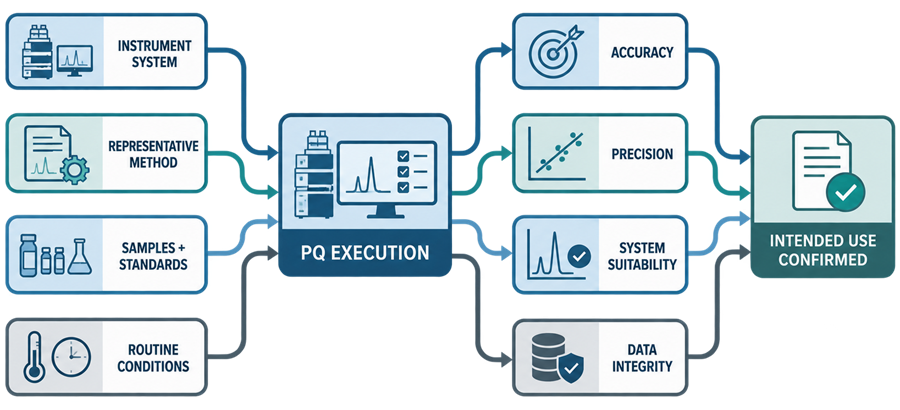
PQ evaluates more than the isolated measurement device. It confirms the performance of the complete analytical system under representative conditions. The evaluated system may include:
- physical instrument
- instrument modules
- controlling software
- acquisition software
- processing methods
- calculations
- database
- workstation or server
- configured user roles
- reports
- interfaces
- sample and standard preparation
- laboratory environment
- trained users
- applicable procedures
The following illustration shows how the instrument, analytical procedure, materials, and routine conditions combine to produce PQ evidence supporting intended use.
PQ Test Design and Replication
PQ test design should provide sufficient evidence to support the intended-use conclusion without relying on arbitrary run counts. The number of runs, preparations, measurements, injections, analysts, or days should be determined from:
- intended use
- analytical procedure
- expected variability
- measurement criticality
- system complexity
- prior development knowledge
- OQ results
- supplier information
- method validation data
- statistical rationale
- ability of routine controls to detect failure
There is no universal requirement that every instrument PQ include three runs, three analysts, multiple days, or a fixed number of replicates.
Replication should be sufficient to evaluate the selected performance characteristic. For example:
- repeat measurements may support measurement repeatability
- independent sample preparations may include preparation variability
- multiple sequence positions may evaluate autosampler or sequence effects
- different days may assess short-term stability
- different analysts may evaluate routine procedural variability
- different modules or channels may verify equivalent system components
The protocol should state what each source of replication is intended to demonstrate.
Accuracy
Accuracy expresses agreement between a measured result and an accepted reference value. Accuracy may be evaluated through:
- certified reference materials
- samples with known assigned values
- spike recovery
- comparison with an established reference procedure
- comparison with a qualified reference instrument
- physical standards
- gravimetric or volumetric reference measurements
- other scientifically justified approaches
Acceptance criteria should come from the analytical procedure, compendial requirements, intended-use needs, product specification strategy, or another approved scientific basis.
Generic accuracy limits should not be imposed across unrelated instruments and methods. A 98–102% recovery criterion may be appropriate for a particular application but is not a universal analytical instrument PQ requirement.
The test should distinguish instrument response from sample-preparation recovery when the purpose is to evaluate the instrument itself.
Precision
Precision expresses agreement among repeated measurements under specified conditions. Depending on the intended conclusion, PQ may evaluate:
- instrument repeatability
- injection repeatability
- measurement repeatability
- preparation repeatability
- within-run precision
- between-run precision
- short-term intermediate precision
- module or channel comparability
Precision may be expressed using:
- standard deviation
- relative standard deviation
- range
- difference between results
- another method-appropriate statistical measure
The source of variability included in the test should be clear. Repeated injections from one vial principally evaluate injection and measurement repeatability; they do not demonstrate independent sample-preparation precision.
Intermediate precision belongs primarily to analytical procedure validation when it evaluates the procedure across analysts, days, equipment, or other routine factors. PQ may incorporate selected variability where it is needed to demonstrate the instrument’s intended-use performance, but it should not duplicate method validation without justification.
Other Performance Characteristics
Depending on instrument type and intended use, PQ may evaluate:
- response stability
- linearity
- range
- sensitivity
- signal-to-noise performance
- baseline stability
- carryover
- resolution
- retention-time consistency
- wavelength performance
- photometric performance
- temperature stability
- flow stability
- injection-volume repeatability
- weighing repeatability
- measurement bias
- recovery
- throughput
- sequence stability
- sample-position effects
- channel comparability
Performance characteristics should be selected because they affect the intended analytical result. PQ should not become a generic collection of every test the instrument can perform.
System Suitability
System suitability verifies that the analytical system is capable of acceptable performance for a specific analytical procedure at the time of use. Depending on the technique, system-suitability parameters may include:
- repeatability
- resolution
- retention time
- tailing or asymmetry
- theoretical plates
- response
- sensitivity
- signal-to-noise ratio
- calibration response
- correlation
- blank response
- carryover
- control-sample result
- reference-standard response
- instrument check result
System suitability performs three roles within the lifecycle:
- During PQ, it provides method-relevant evidence that the complete system can perform acceptably.
- During routine use, it verifies suitability for the current analytical run or sequence.
- During continued verification, aggregated results can reveal drift or declining performance.
Passing system suitability does not replace calibration, qualification, or method validation. It provides time-of-use evidence for a particular procedure and analytical run.
System-suitability failure should be investigated according to approved laboratory procedures. Repeated injections or reintegration should not be used to test into compliance without scientific justification and complete data review.
Relationship to Analytical Procedure Validation
Instrument PQ and analytical procedure validation answer different questions.
Instrument PQ asks:
Can the qualified analytical system support its intended use under representative conditions?
Analytical procedure validation asks:
Does the analytical procedure provide results suitable for its intended analytical purpose?
Method validation may evaluate accuracy, precision, specificity, range, robustness, and other characteristics that also appear in PQ. The overlap does not make the activities interchangeable.
Existing method-validation evidence may support PQ when:
- the same or equivalent instrument configuration was used
- the data remain applicable
- the instrument identity is known
- the method sufficiently challenges intended use
- the required performance characteristics were evaluated
- the records are complete and approved
The decision to leverage method-validation data should be documented. PQ should not automatically repeat scientifically adequate evidence, but it should address any gaps between the validation configuration and the instrument being released.
Relationship to Calibration
Calibration and PQ provide different types of assurance.
Calibration control for analytical instruments establishes the relationship between instrument indications and traceable reference values for selected measurement functions. PQ evaluates whether the complete system performs acceptably for its intended analytical application.
For example:
- flow calibration may demonstrate pump flow accuracy
- PQ may demonstrate acceptable chromatographic performance using the complete HPLC system and representative method
- wavelength calibration may demonstrate detector wavelength accuracy
- PQ may demonstrate adequate identity, resolution, or quantitative performance for the intended procedure
Calibration is normally a PQ prerequisite for critical measurement functions. A successful PQ does not eliminate the need for periodic calibration, and successful calibration does not establish complete intended-use performance.
Calibration results become an important input to continued performance verification because changes in bias, drift, adjustment frequency, or out-of-tolerance events may indicate declining instrument control.
Routine Performance Checks
Routine performance checks provide focused confirmation that selected instrument functions remain acceptable between formal calibration or qualification activities. Examples include:
- balance daily or before-use checks
- pH meter slope and buffer checks
- spectrophotometer reference checks
- detector response checks
- wavelength checks
- temperature checks
- flow checks
- leakage checks
- baseline or noise checks
- autosampler precision checks
- reference-standard measurements
- control-sample testing
- diagnostic checks
Routine checks should have:
- defined purpose
- approved procedure
- suitable standard or reference
- predefined acceptance criteria
- required frequency
- documented result
- failure response
- data review requirements
- trend-review expectations where appropriate
The frequency should reflect risk, stability, use frequency, failure detectability, manufacturer information, historical performance, and the strength of other controls.
Routine checks do not automatically require a formal qualification protocol. They should be controlled as part of the instrument’s operational program.
Continued Performance Verification
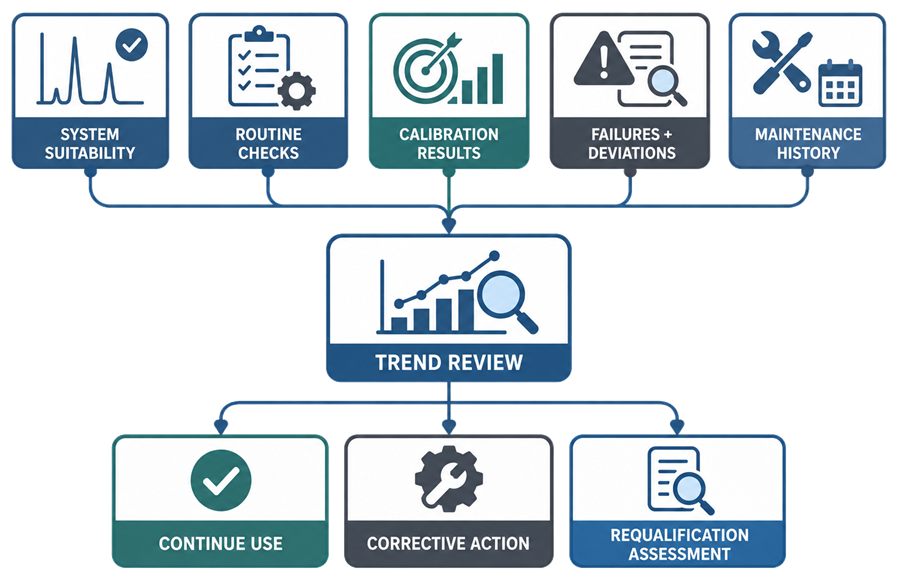
Continued performance verification is the ongoing evaluation of evidence that the complete instrument system remains fit for its approved use. It should integrate information that may otherwise be reviewed separately, including:
- system-suitability results
- routine performance checks
- calibration results
- calibration adjustments
- out-of-tolerance events
- failed runs
- invalidated results
- laboratory investigations
- instrument alarms
- error logs
- service calls
- recurring repairs
- preventive maintenance
- replaced components
- software or firmware changes
- configuration changes
- user complaints
- audit-trail observations
- interface failures
- backup or recovery events
- instrument downtime
- requalification results
The purpose is not to create a second calibration program or repeat PQ continuously. It is to determine whether separate lifecycle records collectively demonstrate stable and acceptable performance.
Performance Trending
Trending can identify deterioration that remains hidden when individual results are reviewed only against pass/fail limits. Useful trends may include:
- system-suitability precision
- detector response
- reference-standard response
- baseline noise
- sensitivity
- retention-time shift
- pressure
- flow adjustment
- temperature deviation
- balance check results
- calibration bias
- calibration adjustment magnitude
- frequency of calibration failure
- failed injections or runs
- carryover
- service frequency
- repeat repairs
- instrument downtime
- recurring alarms
- repeat deviations
A result may meet its acceptance criterion while still contributing to an adverse trend. Trend assessment should therefore consider:
- movement toward a limit
- gradual drift
- step changes
- increasing variability
- recurring excursions
- seasonal or environmental patterns
- changes following maintenance
- differences among modules or channels
- differences among users or procedures
- recurring system-suitability failure
Statistical control limits may be useful when sufficient comparable data exist, but they are not mandatory for every parameter. Visual trend review, descriptive statistics, and event-frequency analysis may provide adequate control for lower-volume instruments.
Trend-Review Decisions
Trend review should lead to documented decisions rather than simply generating charts. Possible outcomes include:
- continued use without action
- increased observation
- adjustment of a routine-check interval
- calibration-interval reassessment
- maintenance
- repair
- supplier investigation
- procedural correction
- retraining
- reference-material investigation
- method investigation
- impact assessment of previous results
- change control
- partial requalification
- expanded requalification
- temporary restriction
- instrument removal from service
The following illustration shows how routine performance evidence should be integrated into trend review and translated into a lifecycle decision.
Adverse trends should not automatically result in full requalification. The response should be proportionate to the affected function, failure mechanism, potential impact, and ability of existing controls to detect invalid results.
Review Frequency
Continued verification may occur at several frequencies:
- before use
- during each analytical sequence
- after each run
- daily
- at defined routine-check intervals
- during calibration
- following maintenance or repair
- after significant deviation or investigation
- during periodic instrument review
- during quality-system management review
Not all evidence should be reviewed at the same frequency.
Immediate review is appropriate for information affecting current result validity, including:
- failed system suitability
- critical alarm
- out-of-tolerance calibration
- unsuccessful routine check
- interrupted acquisition
- data-storage failure
- potentially invalid analytical result
Longer-term aggregated review is appropriate for:
- gradual drift
- recurring service events
- increasing variability
- repeated minor failures
- calibration-interval adequacy
- maintenance effectiveness
- instrument reliability
- lifecycle obsolescence
The review schedule should be defined by procedure and justified from instrument risk and use.
Performance Failures and Investigations
A performance failure should be evaluated in the context of the affected instrument function and analytical records. The assessment should consider:
- nature of the failure
- time of occurrence
- affected instrument or module
- affected analytical procedures
- samples or batches potentially affected
- last known acceptable performance
- ability of system suitability to detect the condition
- relevant calibration history
- routine-check results
- maintenance and repair history
- software or configuration changes
- environmental conditions
- recurrence
- impact on electronic records
- need for retrospective data review
The investigation should distinguish among potential causes such as:
- instrument malfunction
- calibration drift
- sample-preparation error
- reference-standard problem
- analytical procedure issue
- consumable failure
- environmental influence
- software or data-processing error
- interface failure
- user error
- inadequate maintenance
Passing a subsequent check does not by itself resolve the original failure. The initial result and its potential impact should remain part of the investigation.
Maintenance, Repair, and Component Replacement
Maintenance and repair records are continued-verification inputs because repeated intervention may indicate declining instrument reliability. After maintenance or repair, the required verification should be determined from:
- component replaced
- function affected
- effect on measurement
- effect on software or configuration
- calibration requirements
- potential effect on existing data
- supplier recommendations
- available post-service tests
- failure history
- intended-use risk
A low-impact maintenance activity may require only an operational check. Replacement of a critical detector, pump, measurement sensor, controller, data system, or other major component may require calibration, focused OQ, intended-use performance verification, or broader requalification.
The analytical instrument requalification assessment should define the appropriate scope rather than automatically repeating the entire original qualification package.
Change Control and Intended-Use Expansion
Changes to the instrument or its approved use should be assessed against the established PQ baseline. Examples include:
- new analytical technique
- more demanding method
- lower quantitation range
- new detector
- new sample-introduction system
- new software or firmware
- revised processing algorithm
- new report
- new interface
- relocation
- major repair
- workstation or server replacement
- altered environmental conditions
- new sample matrix
- increased sequence length
- new product category
A method that operates within the previously verified performance envelope may not require a new instrument PQ. A use that introduces materially different sensitivity, range, configuration, or performance demands may require supplemental PQ or requalification.
The assessment should define:
- affected requirement
- affected instrument function
- applicability of existing evidence
- required calibration
- required functional testing
- required intended-use testing
- required continued-verification updates
PQ Acceptance Criteria
PQ acceptance criteria should be predefined and scientifically justified. Criteria may come from:
- approved analytical procedure
- compendial requirement
- reference-material assignment
- system-suitability requirement
- user requirement
- development data
- method-validation data
- instrument capability
- product specification strategy
- statistical rationale
- historical performance
- risk assessment
Criteria should identify:
- characteristic evaluated
- calculation or statistical measure
- number and type of results
- allowable limit
- handling of excluded or invalid results
- required sequence of testing
- failure response
Generic acceptance limits should not be applied without confirming their relevance to the intended application.
PQ is acceptable when the executed evidence supports the intended-use conclusion, required criteria have been met, and deviations have been resolved or acceptably justified.
PQ Deviations
PQ deviations should be evaluated for their effect on:
- instrument performance
- analytical procedure performance
- sample or standard validity
- result reliability
- data integrity
- intended use
- previously executed PQ tests
- routine-release decision
Each deviation should document:
- expected condition
- observed condition
- affected test
- affected data
- investigation
- impact assessment
- correction
- retesting rationale
- final disposition
- approval
Repeating a failed measurement until an acceptable result is obtained is not an adequate deviation strategy. Original data should be retained and the reason for failure investigated.
PQ Deliverables
The initial PQ package may include:
- approved protocol or study plan
- intended-use statement
- representative procedure rationale
- sample and reference-material records
- executed test records
- raw data
- calculations
- statistical evaluation
- system-suitability results
- electronic-record review
- traceability to requirements
- deviations and investigations
- summary report
- approved performance baseline
- routine-release decision
- defined continued-verification controls
Continued verification records may include:
- routine-check results
- system-suitability trends
- calibration trends
- failure and deviation summaries
- maintenance history
- service history
- periodic review
- trend-review conclusions
- documented lifecycle decisions
- corrective actions
- requalification assessments
PQ Approval and Routine Release
Initial PQ may be approved when:
- representative intended uses have been adequately evaluated
- critical performance criteria have been met
- selected procedures and materials are justified
- accuracy and precision are appropriate for intended use
- system-suitability requirements can be achieved
- routine data workflows operate correctly
- deviations have been acceptably resolved
- the qualified configuration is controlled
- continued-verification requirements are defined
- no unresolved condition compromises intended use or data reliability
Approval should identify:
- instrument and configuration
- intended uses covered
- representative procedures used
- performance range established
- limitations
- required routine checks
- required calibration
- required system suitability
- continued-verification expectations
- authorized release status
PQ approval should not be written as unrestricted qualification for unassessed methods, configurations, sample types, or measurement ranges.
Common Weaknesses
Common weaknesses include:
- treating PQ as another OQ
- requiring a separate PQ for every instrument without risk assessment
- using arbitrary run and replicate counts
- applying generic 98–102% accuracy limits
- selecting an easy method that does not challenge intended use
- failing to justify representative procedures
- using unsuitable or poorly characterized reference materials
- confusing injection precision with preparation precision
- duplicating analytical procedure validation
- treating system suitability as a replacement for qualification
- treating calibration as proof of complete system performance
- releasing the instrument without defined continued-verification controls
- reviewing routine results only as isolated pass/fail events
- failing to trend calibration adjustments or system-suitability performance
- ignoring recurring minor failures
- repeating failed tests without investigation
- automatically requiring full requalification after every maintenance event
- extending intended use without assessing existing PQ coverage
Conclusion
Analytical instrument Performance Qualification demonstrates that the complete qualified system can support its intended analytical use under representative conditions.
Initial PQ should use justified procedures, samples, reference materials, performance characteristics, and acceptance criteria. It should establish a controlled performance baseline without duplicating IQ, OQ, calibration, or analytical procedure validation.
Continued performance verification maintains that conclusion after release. By integrating routine checks, system suitability, calibration, failures, deviations, maintenance, and trend data, the laboratory can identify deteriorating performance and take proportionate action before the instrument becomes unsuitable for use.